
World War Two
Published 3 Feb 2022“Who dares, wins”. Nowadays the British SAS — Special Air Service — is considered one of the best special forces in the world. Yet its wartime origins are shrouded in mysteries and legends. From the first ideas of top-secret “special raiding squadrons”, to the first raids in North Africa accompanying the Long Range Desert Group, the SAS’s beginnings resemble one big experiment. An experiment from which a truly legendary special service would emerge.
(more…)
February 4, 2022
The Origins of the SAS – WW2 Special Episode
Comments Off on The Origins of the SAS – WW2 Special Episode
Proposed Advanced Variants of the Avro Canada CF-100 Canuck
Polyus Studios
Published 20 Nov 2018Don’t forget to like the video and subscribe to my channel!
Support me on Patreon – https://www.patreon.com/polyusstudiosThis video covers some of the advanced variants that were proposed for to enhance the capabilities of the CF-100 Canuck. It covers both weapon systems and a few airframe redesigns.
0:00 Introduction
0:55 Velvet Glove and Sparrow 2 missiles
1:36 Falcon and Sidewinder missiles
2:22 Eagle missile
2:53 Genie nuclear rocket
3:18 Engine testing
3:50 Canuck Mk10
4:40 VTOL Canuck
6:03 ConclusionMusic:
Denmark – Portland Cello Project#CF100 #CanadianAerospace #PolyusStudios

Comments Off on Proposed Advanced Variants of the Avro Canada CF-100 Canuck
February 3, 2022
Colonies Lead the Way: Charger-Loading Lee Enfield MkI India Pattern
Forgotten Weapons
Published 27 Sep 2021http://www.patreon.com/ForgottenWeapons
https://www.floatplane.com/channel/Fo…
Cool Forgotten Weapons merch! http://shop.forgottenweapons.com
While the Indian Army was looked down upon by much of the British military, it saw much more combat service than its European counterpart. The Indian Army was actually faster than the British to recognize and adopt a number of small arms improvements, and the CLLE MkI India Pattern is a good example.
When the mobile charger guide was first adopted by the British military, no effort was made to retrofit earlier rifles with it. The Indians, however, saw the advantage and began to convert Long Lees to the Charger-Loading configuration as early as 1905. Between then and 1909, some 22,000 of these MkI I.P. rifles were assembled at the Ishapore Arsenal. Following the adoption of the fixed charger bridge, a MkII I.P. became the new standard, with the fixed guide instead of the mobile one.
Contact:
Forgotten Weapons
6281 N. Oracle 36270
Tucson, AZ 85740

Comments Off on Colonies Lead the Way: Charger-Loading Lee Enfield MkI India Pattern
February 2, 2022
The Congress of Vienna (Part 1) (1814)
Historia Civilis
Published 29 Jan 2022Patreon | http://historiacivilis.com/patreon
Donate | http://historiacivilis.com/donate
Merch | historiacivilis.com/merch
Mailing List | http://historiacivilis.com/mailinglist
Twitter | http://historiacivilis.com/twitter
Website | http://historiacivilis.comSources:
Wolfram Siemann, Metternich: Strategist and Visionary | https://amzn.to/3Glc5c8
Eric Hobsbawm, The Age of Revolution, 1789-1848 | https://amzn.to/3zOQWV4
Adam Zamoyski, Rites of Peace: The Fall of Napoleon and the Congress of Vienna | https://amzn.to/3zSpcir
Richard J. Evans, The Pursuit of Power: Europe 1815-1914 | https://amzn.to/3qhFE8G
A. Wess Mitchell, The Grand Strategy of the Habsburg Empire | https://amzn.to/332Sorj
Robert K. Massie, Dreadnought: Britain, Germany, and the Coming of the Great War | https://amzn.to/3r6jllP
—
N. Gash, “After Waterloo: British Society and the Legacy of the Napoleonic Wars”, from Transactions of the Royal Historical Society, vol. 28, 1978, pp. 145-157. | https://www.jstor.org/stable/3679205
The Annual Register, 1815, Preface | https://hdl.handle.net/2027/mdp.39015…
Voltaire, “An Essay on Universal History, the Manners, and Spirit of Nations” | https://amzn.to/34BGbtL
The History of Parliament: The 5th Parliament of the United Kingdom | https://www.historyofparliamentonline…Music:
“Like,” by Nctrnm
“But Enough About Me Bill Paxton,” by Chris Zabriskie
“I Don’t See the Branches, I See the Leaves,” by Chris Zabriskie
“Orion,” by Josh Stewart
“CGI Snake,” by Chris Zabriskie
“Gown,” by Nctrnm
“Hallon,” by Christian BjoerklundWe are a participant in the Amazon Services LLC Associates Program, an affiliate advertising program designed to provide a means for us to earn fees by linking to Amazon.com and affiliated sites.

Comments Off on The Congress of Vienna (Part 1) (1814)
Places – Lost in Time: The Vesuvius Volcanic Railways
Ruairidh MacVeigh
Published 23 Oct 2021Hello, and welcome back to Places – Lost in Time, a series that looks back on the tale of places and locations that existed within living memory or photographic record, but are now lost to the pages of history.
In perhaps one of the most unlikely of places, among the world’s most popular funicular railways once existed on the slopes of Mount Vesuvius, arguably the most dangerous volcano in the world. However, despite the inherent risk of putting a major tourist attraction on its slopes, the Vesuvius funicular railway, and the corresponding mountain railway, were among the biggest visitor magnets in Italy during the late 1800s and early 1900s, but sadly the forces of nature wouldn’t allow this unusual feature to stay in situ for long.
All video content and images in this production have been provided with permission wherever possible. While I endeavour to ensure that all accreditations properly name the original creator, some of my sources do not list them as they are usually provided by other, unrelated YouTubers. Therefore, if I have mistakenly put the accreditation of “Unknown”, and you are aware of the original creator, please send me a personal message at my Gmail (this is more effective than comments as I am often unable to read all of them): rorymacveigh@gmail.com
The views and opinions expressed in this video are my personal appraisal and are not the views and opinions of any of these individuals or bodies who have kindly supplied me with footage and images.
If you enjoyed this video, why not leave a like, and consider subscribing for more great content coming soon.
Thanks again, everyone, and enjoy! 😀
References:
– Thomas Cook Archive (and their respective references)
– Wikipedia (and its respective references)

Comments Off on Places – Lost in Time: The Vesuvius Volcanic Railways
QotD: Breaking the trench stalemate with Stormtroopers (Stoßtruppen)
One way to respond to a novel tactical problem is with novel tactics. And the impetus for this kind of thinking is fairly clear: if your own artillery is the problem digging you into a hole, then find a way to use less of it.
The mature form of this tactical framework is often called “Hutier” tactics, after German general Oskar Emil von Hitier, though he was hardly the sole or even chief inventor of the method. In its mature form, the technique went thusly: instead of attacking with large waves of infantry which cleared each objective in sequential order, attacks ought to be proceeded by smaller units, carefully trained with the layout of the enemy positions. Those units, rather than having a very rigid plan of attack, would be given those general objectives and left to figure for themselves how to accomplish them (“mission tactics” or Auftragstaktik), giving them more freedom to make decisions based on local conditions and the ground.
These elite spearhead units, called Stoßtruppen or “Stormtroopers” were well equipped (in particular with a higher amount of automatic firearms and hand grenades, along with flamethrowers). Importantly, they were directed to bypass enemy strong-points and keep moving forward to meet their objectives. The idea here was that the follow-up waves of normal infantry could do the slow work of clearing out points where enemy resistance was strong, but the stormtroopers should aim to push as deeply as possible as rapidly as possible to disorient the defenders and rapidly envelop what defenses remained.
These sets of infantry tactics were in turn combined with the hurricane barrage, a style of artillery use which focused on much shorter but more intense artillery barrages, particularly associated with Colonel Georg “Breakthrough” Bruchmüller. Rather than attempting to pulverize defenses out of existence, the hurricane barrage was designed merely to force enemies into their dugouts and disorient the defenders; much of the fire was directed at longer ranges to disrupt roads and artillery in the enemy rear. The short barrage left the ground relatively more intact. Meanwhile, those elite infiltration units could be trained to follow the creeping barrage very closely (being instructed, for instance, to run into the shell explosions, since as the barrage advantages, no gun should ever strike the same spot twice; a fresh shell-hole was, in theory, safe). Attentive readers will recognize the basic foundations of the “move fast, disorient the enemy” methods of the “modern system” here.
So did infiltration tactics break the trench stalemate? No.
First, it is necessary to note that while infiltration tactics were perhaps most fully developed by the Germans, they were not unique to them. The French were experimenting with many of the same ideas at the same time. For instance, basic principles of infiltration were being published by the French General Headquarters as early as April, 1915. André Laffargue, a French infantry captain, actually published a pamphlet, which was fairly widely distributed in both the French and British armies by the end of 1915 and in the American army in 1916, on exactly this sort of method. In many cases, like at the Second Battle of Artois, these French tactics bore significant fruit with big advances, but ran into the problem that the gains were almost invariably lost in the face of German counter-attacks. The Russians, particularly under Aleksei Brusilov, also started using some of these techniques, although Brusilov was as much making a virtue of necessity as the Russians just didn’t have that much artillery or shells and had to make due with less and Russian commanders (including Brusilov!) seem to have only unevenly taken the lessons of his successes.
The problem here is speed: infiltration tactics could absolutely more efficiently overrun the front enemy lines and even potentially defeat multiple layers of a defense-in-depth. But after that was done and the shock of the initial push wore off, you were still facing the same calculus: the attacker’s reinforcements, shells, artillery and supplies had to cross broken ground to reach the new front lines, while the defender’s counter-attack could ride railways, move over undamaged roads and then through prepared communications trenches. In the race between leg infantry and trains, the trains always won. On the Eastern Front or against the Italians fighting under the Worst General In History at Caporetto (1917), the already badly weakened enemy might simply collapse, producing massive gains (but even at Caporetto, no breakthrough – shoving the enemy is not a breakthrough, to qualify as a breakthrough, you need to get to the “green fields beyond” that is open ground undefended by the enemy), but against a determined foe, as with the 1918 Spring Offensives, these tactics, absent any other factor, simply knocked big salients in the line. Salients which were, in the event, harder to defend and brought the Germans no closer to victory. Eventually – often quite rapidly – the front stabilized again and the deadlock reasserted itself. Restoring maneuver, the actual end-goal of these tactics, remained out of reach.
Bret Devereaux, “Collections: No Man’s Land, Part II: Breaking the Stalemate”, A Collection of Unmitigated Pedantry, 2021-09-24.
Comments Off on QotD: Breaking the trench stalemate with Stormtroopers (Stoßtruppen)
February 1, 2022
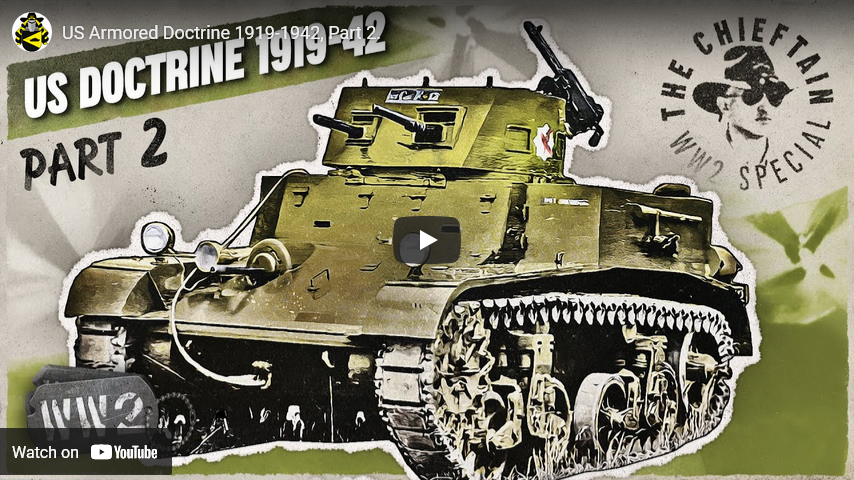
US Armored Doctrine 1919-1942, Part 2
The Chieftain
Published 29 Jan 2022Continuing on this series of videos supporting the WW2 Channel, this is part one of a two-part look at how the US Army ended up with the armored force with which it entered combat in North Africa. https://www.youtube.com/c/WorldWarTwo
If you missed part 1… https://www.youtube.com/watch?v=hLkJP…
Sources include:
Forging the Thunderbolt (Gillie)
Men on Iron Ponies (Morton)
Greasy Automatons and the Horsey Set (Tedesco)
A number of Center of Military History documents to include GHQ Maneuvers 1941 https://history.army.mil/catalog/pubs…
A few other things I’ve forgotten about, but the above will get you 90% of the way there.Improved-Computer-And-Scout Car Fund:
Patreon: https://www.patreon.com/The_Chieftain
Direct Paypal https://paypal.me/thechieftainshat1939 Cavalry Journal with Polish cavalry article.
https://mcoepublic.blob.core.usgovclo…
Comments Off on US Armored Doctrine 1919-1942, Part 2
Ancient Nian Gao | Lunar New Year Cake
Tasting History with Max Miller
Published 9 Feb 2021Help Support the Channel with Patreon: https://www.patreon.com/tastinghistory
Tasting History Merchandise: crowdmade.com/collections/tastinghistoryFollow Tasting History here:
Instagram: https://www.instagram.com/tastinghist…
Twitter: https://twitter.com/TastingHistory1
Tiktok: TastingHistory
Reddit: r/TastingHistory
Discord: https://discord.gg/d7nbEpyTasting History’s Amazon Wish List: https://amzn.to/3i0mwGt
LINKS TO INGREDIENTS & EQUIPMENT**
Sony Alpha 7C Camera: https://amzn.to/2MQbNTK
Sigma 24-70mm f/2.8 Lens: https://amzn.to/35tjyoW
Glutinous Rice Flour: https://amzn.to/3cxbdFd
Dried Bamboo Leaves: https://amzn.to/3ama0xT
Roast Chestnuts: https://amzn.to/3tc3emZ
Dried Jujubes: https://amzn.to/3aqBrqkLINKS TO SOURCES**
The Annals of Lü Buwei: https://amzn.to/3rfbjFM
Chinese Fairy Tales and Legends by Frederick Martens: https://amzn.to/39BqwLe
Chinese Mythology by Matt Clayton: https://amzn.to/3j6pxpv**Amazon offers a small commission on products sold through their affiliate links, so each purchase made from this link, whether this product or another, will help to support this channel with no additional cost to you.
Subtitles & Ketchup with Max host: Jose Mendoza
PHOTO CREDITS
Pig: By Made by Fanghong – Own work, CC BY 2.5, https://commons.wikimedia.org/w/index…
Rat and Ox: D.h.Isais, CC BY-SA 4.0 https://creativecommons.org/licenses/…, via Wikimedia Commons
Chinese Zodiac Carving: By Jakub Hałun – Own work, CC BY-SA 4.0, https://commons.wikimedia.org/w/index…
Guangdong Niangao: avlxyz from (optional), CC BY-SA 2.0 https://creativecommons.org/licenses/…, via Wikimedia Commons
Hong Kong niangao: Mk2010, CC BY-SA 3.0 https://creativecommons.org/licenses/…, via Wikimedia Commons
Niangao from local Hong Kong: Geoffreyrabbit, CC BY-SA 4.0 https://creativecommons.org/licenses/…, via Wikimedia Commons
Nian gao 2: ProjectManhattan, CC BY-SA 3.0 https://creativecommons.org/licenses/…, via Wikimedia Commons
Chinese New Year Sticky Rice Cakes: ProjectManhattan, CC BY-SA 3.0 https://creativecommons.org/licenses/…, via Wikimedia Commons
Spring and Autumn Period Map: By Yug – Own work, *Background data: ETOPO1 + QGIS > then vectorized using Inkscape *Semantic data: some from Le Monde Chinois, Gernet, p58.or (en:) Gernet (1996) A History of Chinese Civilisation, Cambridge university press, p. 59, CC BY-SA 3.0, https://commons.wikimedia.org/w/index…
Statue of Wu Zixu: By Peter Potrowl – Own work, CC BY 3.0, https://commons.wikimedia.org/w/index…
Bronze DIng: drs2biz, CC BY-SA 2.0 https://creativecommons.org/licenses/…, via Wikimedia Commons
Great Wall at Mutianyu: By J. Samuel Burner – https://www.flickr.com/photos/lobster…, CC BY 2.0, https://commons.wikimedia.org/w/index…MUSIC CREDITS
Music promoted by 1HMNC – No Copyright Music
PeriTune – Folk Chinese https://youtu.be/_FKFunLPksg Folk Chinese by PeriTune (https://soundcloud.com/sei_peridot) is licensed under a Creative Commons License.(CC BY 3.0)#tastinghistory #niangao #chinesenewyear #chinesefood

Comments Off on Ancient Nian Gao | Lunar New Year Cake
January 31, 2022
Stalingrad: Endgame – WW2 – 179b – January 31, 1943
World War Two
Published 30 Jan 2022The Battle of Stalingrad is nearing its end. Strong contingents of the 21st and 62nd Soviet Armies broke through the German defensive lines west of Stalingrad and were now pushing deep into the city. Despite the “Kessel” being split into several parts, the Axis soldiers are still resisting fiercely, fighting street by street, house by house. Yet it is a desperate last stand. Overwhelmed and undersupplied, many Generals push for surrender. But only their commander, the freshly promoted “Field-Marshal” Paulus, has the authority to do so.
(more…)
Comments Off on Stalingrad: Endgame – WW2 – 179b – January 31, 1943
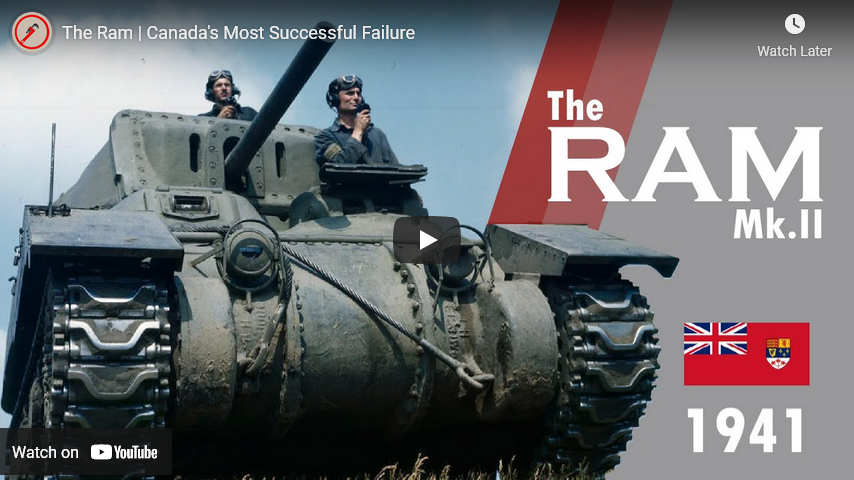
The Ram | Canada’s Most Successful Failure
Red Wrench Films
Published 4 Dec 2020A Canadian Franken-tank that pre-dated the M4 Sherman, the Ram would be an icon of Canada’s industry in the early war years. Ultimately a failure as a battle tank, variants of the vehicle would see combat in Normandy and beyond, as the Kangaroo APC which revolutionised mechanised warfare in 1944 and 1945.
Any feedback is greatly appreciated, I’m always trying to improve.
Any suggestions for the next video? Leave it down in the comments or message me. 🙂
((Like and subscribe))
Please note that the footage I can find on these vehicles is scarce and sometimes the video will not match properly or will perhaps be slightly inaccurate.
Sources:
https://tanks-encyclopedia.com/ww2/ca…
https://www.dday-overlord.com/en/mate…
https://www.friends-amis.org/index.ph…
http://panzerserra.blogspot.com/2015/…Intuit256 by Kevin MacLeod is licensed under a Creative Commons Attribution 4.0 licence. https://creativecommons.org/licenses/…
Source: http://incompetech.com/music/royalty-…
Artist: http://incompetech.com/
Comments Off on The Ram | Canada’s Most Successful Failure
January 30, 2022
Time to Fire Rommel? – WW2 – 179 – January 29, 1943
World War Two
Published 29 Jan 2022The Allies are unable to win in Tunisia, though further east Bernard Montgomery has achieved his goal of driving the enemy out of Libya. To the west, the Casablanca Conference comes to its end and the Allies write a list of their war priorities. The Soviets, however, are on the move everywhere, closing in on Stalingrad, and launching new operations up and down the eastern front, to the dismay and detriment of the Axis forces.
(more…)
Comments Off on Time to Fire Rommel? – WW2 – 179 – January 29, 1943
Engineer’s Delight: Stemple 76/45 Becomes the Stemple Takedown Gun
Forgotten Weapons
Published 17 Sep 2021http://www.patreon.com/ForgottenWeapons
https://www.floatplane.com/channel/Fo…
Cool Forgotten Weapons merch! http://shop.forgottenweapons.com
The saga of how the original Stemple 76/45 became the Stemple Takedown Gun is a fantastic story of engineering design choices.
Essentially, John Stemple began by building a rather crude copy of the Swedish K in .45 ACP in the mid 1980s, called the Stemple 76/45. He produced and registered 2,000 transferrable receivers for the gun (pre-1986), but only built them slowly, a few at a time. In the late 1980s he faced criminal charges from ATF, and transferred the receivers to a friend while he (successfully) fought the charges. When he went to get the receivers back, his friend refused, and the two entered into a nearly decade-long legal battle over them.
By the time Stemple eventually won the case, he recovered about 900 transferrable tubes. By this time (circa 2000) these tube receivers were much more valuable than when he first made them, as the machine gun registry was closed in 1986 and new ones can no longer be made. At this point, Stemple reached out to Brian Poling (BRP Corp) to act as a subcontractor to make the parts for the Stemple 76/45. But Poling had a better idea …
Poling’s thought was to instead design a new gun that would be much more desirable as a recreational gun than the 76/45. He envisioned something controllable, low recoil, and using large drum magazines. Such a gun would be a lot more fun at the range than the MACs and Uzis that tended to dominate the submachine gun market at the time. In addition, Poling’s gun would be designed specifically to protect the irreplaceable registered receiver tubes from wear or damage. The result was the STG-76 — the Stemple Takedown Gun.
In order to remain legal, the STG-76 had to leave the original 76/45 receiver tube cutouts unmodified, so as not to change the configuration of the receiver itself. Poling designed a replaceable internal trunnion and slip-over magazine well, allowing multiple different calibers and magazine configurations. The internals were closely based on the Finnish kp31 Suomi, for which parts kits became readily available in the early 2000s. This also facilitated the use of Suomi 71-round drum magazines. The original STF-76 design also included a bipod for easy shooting, and a grip and stock from an HK91 or CETME Model C for comfortable handling (instead of the terrible metal strut stocks common to most budget SMGs).
Several other interesting configurations would follow (stay tuned for those videos), and the guns remain available brand new to this day. The original supply of receivers is sufficient for production until about 2023 …
Contact:
Forgotten Weapons
6281 N. Oracle 36270
Tucson, AZ 85740

Comments Off on Engineer’s Delight: Stemple 76/45 Becomes the Stemple Takedown Gun
QotD: Montgomery on the advance after El Alamein
Suddenly I saw a lorry coming up from behind, and on it a large boat; a naval Petty Officer sat with the driver and some sailors were inside.
I stopped the lorry and said to the Petty Officer: “What are you doing here? Do you realise that you are right up with the most forward elements of the Eighth Army, and you and your boat are leading the advance? This is a very dangerous area just at present, and you are unarmed. You must turn round and go back at once.”
He was dreadfully upset. He had been ordered to open up a “petrol point” at a small cove well to the north of Mersa Brega; small naval craft were to land petrol at this point in order that the leading armoured car regiments could refill their tanks; this was the easiest way of getting petrol and oil to them. He explained this to me, looking at me with pleading eyes rather like a spaniel asking to be taken for a walk to hunt rabbits.
He then said: “Don’t send me back, sir. If the armoured cars don’t get their petrol, they will have to halt and you will lose touch with the Germans. Couldn’t I go on with you? I would then be quite safe.”
That Petty Officer was clearly a student of psychology! In point of fact I did not know about these small petrol points for the armoured cars; it was a staff plan and a very good one. I took the naval party forward with me and saw them safely to their cove, where I was their first customer for petrol. I have often thought of that Petty Officer; he was from the Merchant Navy and in the R.N.V.R.; his sense of duty was of the highest order, and Britain will never lose her wars so long as the Royal Navy can count on men like him.
Bernard L. Montgomery, The Memoirs of Field-Marshal Montgomery, 1958.
Comments Off on QotD: Montgomery on the advance after El Alamein
January 29, 2022
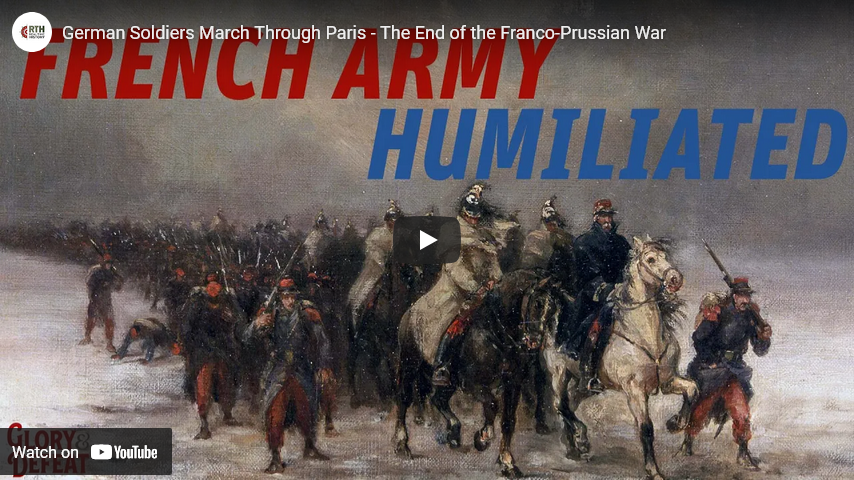
German Soldiers March Through Paris – The End of the Franco-Prussian War
Real Time History
Published 27 Jan 2022https://patreon.com/realtimehistory – support future Real Time History series on Patreon
The end of the Franco-Prussian War is marked by humiliation for France. German soldiers march into Paris and the French Army of the East under Bourbaki flees to neutral Switzerland to surrender there.
» THANK YOU TO OUR CO-PRODUCERS
John Ozment, James Darcangelo, Jacob Carter Landt, Thomas Brendan, Kurt Gillies, Scott Deederly, John Belland, Adam Smith, Taylor Allen, Rustem Sharipov, Christoph Wolf, Simen Røste, Marcus Bondura, Ramon Rijkhoek, Theodore Patrick Shannon, Philip Schoffman, Avi Woolf,» OUR PODCAST
https://realtimehistory.net/podcast – interviews with historians and background info for the show.» LITERATURE
Arand, Tobias: 1870/71. Der Deutsch-Französische Krieg erzählt in Einzelschicksalen. Hamburg 2018Bauer, Gerhard u.a. (Hrsg.): Ausst.-Kat. MHM Dresden‚ Krieg – Macht – Nation. Wie das deutsche Kaiserreich entstand. Dresden 2020
Bolek, Nina: “Die Regelungen des Frankfurter Friedensvertrages zur Kriegerbestattung”, in: Das Schlachtfeld von Woerth – Geschichtsort, Erinnerungsort, Lernort, hrsg. v. T. Arand und Ch. Bunnenberg. Münster. 2012: 109-130
Buk-Swienty, Tom: Feuer und Blut. Hauptmann Dinesen. Hamburg 2014
Gouttman, Alain: La grande défaite. 1870-1871. Paris 2015
Joland, Gérard: “La variole et la guerre de 1870”, in Les Tribunes de la santé 33/4 (2011): 25-30
Tomasetti, Philippe: “L’œvre des tombes et des prières et l’érection des premiers monuments commémoratifs français de la guerre de 1870-1871”, in: L’Outre-Fôret 155 (2011): 3-17
» SOURCES
Deuerlein, Ernst: Die Gründung des Deutschen Reichs 1870/71 in Augenzeugenberichten. Gerlingen 2011 (Neuauflage)Engels, Friedrich: Der Deutsch-Französische Krieg. Sechzig Artikel aus der “Pall Mall Gazette”. Berlin (Ost) 1957
Gerstäcker, Friedrich: “Um Paris herum. IV. Die Brücke von Sèvres”, in: Die Gartenlaube, Heft 11 (1871). SW. 183-186
Goncourt, Edmond de: Journal des Goncourts. II.1. 1870-1871. Paris 1890
Pietsch, Ludwig: Von Berlin bis Paris. Kriegsbilder 1870-1871. Berlin 1871
Reich-Gesetzblatt Nr 26. 1871. Berlin 1872
Russell, William Howard: My diary during the last great war. London 1874
Schellendorf, Paul Bronsart von: Geheimes Kriegstagebuch 1870-71, hrsg. v. Peter Rassow. Bonn 1954
Zeitz, Karl: Kriegserinnerungen eines Feldzugsfreiwilligen aus den Jahren 1870 und 1871. Altenburg 1905
» OUR STORE
Website: https://realtimehistory.net»CREDITS
Presented by: Jesse Alexander
Written by: Cathérine Pfauth, Prof. Dr. Tobias Arand, Jesse Alexander
Director: Toni Steller & Florian Wittig
Director of Photography: Toni Steller
Sound: Above Zero
Editing: Toni Steller
Motion Design: Philipp Appelt
Mixing, Mastering & Sound Design: http://above-zero.com
Maps: Battlefield Design
Research by: Cathérine Pfauth, Prof. Dr. Tobias Arand
Fact checking: Cathérine Pfauth, Prof. Dr. Tobias ArandChannel Design: Battlefield Design
Contains licensed material by getty images
All rights reserved – Real Time History GmbH 2022
Comments Off on German Soldiers March Through Paris – The End of the Franco-Prussian War
Miscellaneous Myths: King Midas
Overly Sarcastic Productions
Published 22 Oct 2021Ahh, Midas. Shockingly one of the least Problematic ancient greek kings, and certainly one of the funniest to read about. Bizarrely good at surviving direct confrontations with temperamental gods!
PARTIAL TRACKLIST: Starfall, Flight of the Silverbird, Sky Becomes Water, Starfall
“Sneaky Snitch” Kevin MacLeod (incompetech.com)
Licensed under Creative Commons: By Attribution 3.0
http://creativecommons.org/licenses/b…Our content is intended for teenage audiences and up.
PATREON: https://www.Patreon.com/OSP
PODCAST: https://overlysarcasticpodcast.transi…
DISCORD: https://discord.gg/osp
MERCH LINKS: http://rdbl.co/osp
OUR WEBSITE: https://www.OverlySarcasticProductions.com
Find us on Twitter https://www.Twitter.com/OSPYouTube
Find us on Reddit https://www.Reddit.com/r/OSP/

Comments Off on Miscellaneous Myths: King Midas


