
It was more profound than that. France was now too small as well, and that is the reason why de Gaulle’s story is in the end a tragedy. Postwar America simply could not permit France to continue as she had. Washington would not risk another 1939. The former powers of Europe had to be cut down to size and compelled to get on with one another.
De Gaulle’s struggles with Churchill were, by comparison, lovers’ tiffs. Churchill, like most civilized Englishmen, loved France, “that sweet enemy”, as Philip Sidney called her. While de Gaulle was cold to veterans of the Resistance, Churchill — when he went to Paris to meet them — was so moved by their bravery that he was in tears for most of the day.
De Gaulle’s quarrel with Roosevelt was based on real loathing. Washington’s vision for postwar Europe, in which the old nations would be diminished and homogenized, was directly opposed to de Gaulle’s idea of a French resurrection in glory and might. Washington loved and promoted the idea of a Europe dominated by supranational bodies, and would later use Marshall aid and the CIA to spread the idea of a European union. Jean Monnet, one of the founders of the eventual European superstate, was much more welcome in the U.S.A. than de Gaulle, whom FDR once airily dismissed as “the head of some French committee.” No doubt, this was what Roosevelt wished he was. Nancy Mitford, in her satirical 1951 novel, The Blessing, neatly caricatured this American unifying vision of the new Europe in the figure of the appalling American world-reforming bore, Hector Dexter, who dreamed of seeing a bottle of Coca-Cola on every European table:
When I say a bottle of Coca-Cola I mean it metaphorically speaking, I mean it as an outward and visible sign of something inward and spiritual. I mean it as if each Coca-Cola bottle contained a djinn, and as if that djinn was our great American civilization ready to spring out of each bottle and cover the whole global universe with its great wide wings.
In May 1962, de Gaulle would oppose to this his assertion that Europe could not be real “without France and her Frenchmen, Germany and her Germans, Italy and her Italians.” He said (a recording of the performance still exists) that Dante, Goethe, and Chateaubriand “belong to Europe,” precisely because they spoke and wrote as Italians, Germans, or Frenchmen. They would not, he jeered, have served Europe much if they had been stateless and had written in some form of Esperanto or Volapük.
Peter Hitchens, “A Certain Idea of France”, First Things, 2019-04.
May 12, 2022
QotD: De Gaulle and FDR
May 11, 2022
Operation Mincemeat – The True Story – WW2 – Spies & Ties 16
World War Two
Published 10 May 2022We’ve encountered plenty of different secret agents. Men, women, Allied, Axis, Partisans. They all fight for different reasons: patriotism, vengeance, or cold hard cash. But they’ve all had one thing in common. They’ve been alive. We’ve never had a dead secret agent. Yet …
(more…)
M1944E1/M1945 Johnson Light Machine Gun
Forgotten Weapons
Published 27 Aug 2016http://www.patreon.com/ForgottenWeapons
After getting his Model 1941 machine gun purchased in small numbers by the US military, Melvin Johnson continued to press for more sales and a general adoption. Following testing results and recommendations from soldiers in the field, he made a number of modifications to the gun and developed the M1944, which was quickly tweaked to become the M1944E1, also called the M1945. This new version included several improvements including:
* Replacing the bipod with a monopod less prone to interfering with barrel removal
* Improved stronger bolt anti-bounce latch
* Metal dual-tube buttstock in place of wood
* and most significantly, a gas-boosted hybrid recoil operating systemThis new model of the Johnson was in testing at the end of WWII, and weapons development budget cuts at the conclusion of the war prevented it from replacing the BAR as Johnson and many in the Marine Corps had hoped.
This particular M1945 Johnson is fully transferrable, as came out of the Winchester Museum Collection (now the Cody Firearms Museum) back many years ago when curators would occasionally sell items from the collection to raise money.

May 10, 2022
How did Jim Jones persuade hundreds of people to commit suicide at his command?
Chris Bray has more disturbing details drawn from Tim Reiterman’s history/biography of Reverend Jim Jones and the Peoples Temple, Raven:
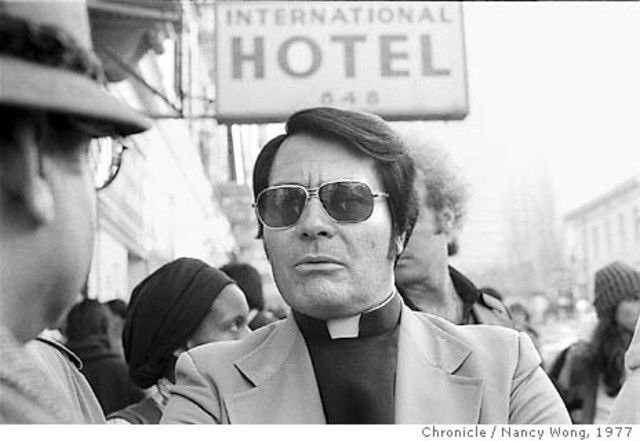
Reverend Jim Jones in front of the International Hotel in San Francisco’s Chinatown on Kearny & Jackson Streets during a rally to save the hotel.
San Francisco Chronicle photo by Nancy Wong, 1977 via Wikimedia Commons.
He broke families, he taught fear, he isolated people, he shamed and demeaned people to break their spirit, he made people dependent, he ran obedience tests with deliberate sadism to see who would take it. That’s it. Those are the tools. Again, all of this comes from Tim Reiterman’s book Raven, which I encourage you to read.
When Jonestown shows up in news stories, Peoples Temple is usually described as a 1970s-era Bay Area cult that moved to Guyana. But that’s not where Jim Jones started the church — he began in Indianapolis in the 1950s. In a moment when there were mostly black churches and white churches, Jones insisted on building a racially integrated congregation. Then he warned them, with increasing urgency, that the church would be attacked by white supremacists who were outraged by their social progress; a flood of menacing phone calls and threatening letters backed up the point. One night, as members of the church visited Jones at home, he stepped into his bedroom alone — just as a brick crashed through the window. The visitors rushed into the bedroom, where Jones told them that the white supremacists had just attacked his house. (Miraculously, the brick and the broken glass had landed outside the window.)
Over the years, the threats built to a crescendo — look, another terrifying letter! — and Jones warned his congregation that the white supremacist threat was moving toward its culmination. At the same time, he began to receive visions about the other great threat hanging over the world: nuclear war. It’s coming, he told them, over and over again, sometimes even naming likely dates for the attack.
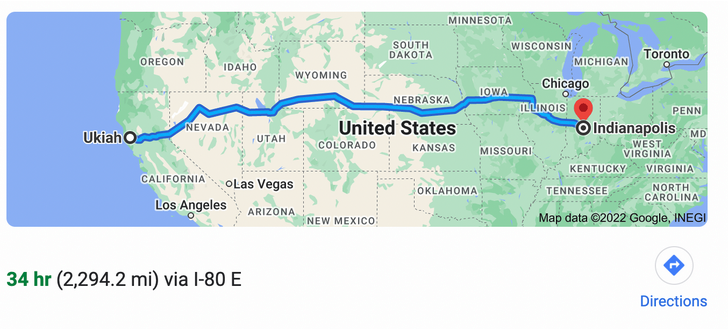
Finally, under the increasingly terrifying dual threat of death from local attack or death from Soviet missiles, either of which could happen at any moment, Jones sent an advance party across the country to find a place where his people could survive — and then, with a secure haven located, he led his congregation to safety in a remote area of Northern California. Good thing they made it out, right?
For a congregation of Midwesterners, the journey to California meant a departure from parents, siblings, and adult children; for many, it meant a departure from their birthplace and every social connection they had made outside the church. It put them in the woods a couple thousand miles from their families, in isolation together in a new place.
Then, with church members living in church-built homes on a church-owned property, Jones helped them to see that selfishness was cruel and atavistic. People who loved, who were spiritual, shared together. So what kind of self-involved monster kept a husband or a wife trapped in a limiting one-on-one relationship? Liberating the members of his church, he helped them to start having sex with other church members outside of their marriages. In some instances, particularly close couples with especially stable relationships — like the church attorney Tim Stoen and his wife, Grace — forced Jones to issue direct orders telling them who else they would be having sex with. And yes, it did liberate them from the confinement of their close marriage, quickly and decisively.
Jones also helped by having sex with everybody, teaching them how to become free. One night, Jones had a heart attack — another maneuver he used all the time — in the presence of a church member named Larry Layton; as Layton rushed to help, Jones explained that he needed to fuck Layton’s wife, and had already started, and had brought her to orgasm “no fewer than sixteen or seventeen times” during their first encounter. But no worries, because Jones also assigned another church member, Karen Tow, to have sex with Layton to assuage his pain. After the divorce, Layton and Tow got married — but Tow let Layton know that she still preferred to have sex with Jones. See how liberating this is?
The Crusades: Part 4 — Life in Outremer
seangabb
Published 11 Feb 2021The Crusades are the defining event of the Middle Ages. They brought the very different civilisations of Western Europe, Byzantium and Islam into an extended period of both conflict and peaceful co-existence. Between January and March 2021, Sean Gabb explored this long encounter with his students. Here is one of his lectures. All student contributions have been removed.
(more…)
History of Rome in 15 Buildings 08. The Baths of Caracalla
toldinstone
Published 27 Sep 2018Every day, ten thousand bathers and over a million gallons of water were funneled through the Baths of Caracalla, the subject of this eighth episode in our History of Rome. The astonishing scale of the Baths indicates the power of two Roman obsessions: imperial propaganda and public bathing.
If you enjoyed this video, you might be interested in my book Naked Statues, Fat Gladiators, and War Elephants: Frequently Asked Questions about the Ancient Greeks and Romans. You can find a preview of the book here:
https://toldinstone.com/naked-statues…
If you’re so inclined, you can follow me elsewhere on the web:
https://www.reddit.com/r/AskHistorian…
https://www.instagram.com/toldinstone/To see the story and photo essay associated with this video, go to:
https://toldinstone.com/the-baths-of-…Thanks for watching!

May 9, 2022
Barbie and the Trail of Blood – WAH 059 – May 8, 1943
World War Two
Published 8 May 2022Europe is burning and it seems there is little that will end the suffering except victory over Naziism.
(more…)
Reverend Jim Jones and the Peoples Temple
Chris Bray is reading a book by Tim Reiterman which goes into great detail about the life and career of cult leader and mass murderer Jim Jones:
Reverend Jim Jones in front of the International Hotel in San Francisco’s Chinatown on Kearny & Jackson Streets during a rally to save the hotel.
San Francisco Chronicle photo by Nancy Wong, 1977 via Wikimedia Commons.
In 1971, Jim Jones loaded up some buses in California and took members of his Peoples Temple across the country to Pennsylvania — to Woodmont, the estate of the late spiritual leader Father Divine, who had a much bigger church (and a lot more money) than Jones did.
Reaching Woodmont, Jones tried Plan A, announcing the glorious news that he was the reincarnation of Father Divine and had come to lead his church again, and we might as well just go ahead and put my name on all the bank accounts; the dead leader’s wife suggested, in fairly clear language, that Jones get back on his bus while he could still walk. The delegation from Peoples Temple took the hint. But Jones also executed Plan B, with modest success: He poached some congregants, and drove them across the country to his own church in Ukiah.
Back home, Jones worried that people who had followed Father Divine would struggle to make the transition, feeling more loyalty to their old leader than to their new one. So he showed them that he couldn’t be crossed. One day, as the refugees from Philadelphia sat eating a meal with everyone else in the communal dining room, Jones walked in and caught several of the earlier members of his church being disloyal to him — and so, pointing a finger, he ordered them to die.
They did, immediately. Bodies littered the floor. Jones let the silence linger, standing over the lifeless bodies of the people who had betrayed his trust, the power of death shooting through his fingertips. And then he showed his merciful side: He resurrected them, a choice that allowed the dead to share the horrible feeling of being struck down by the indescribably vast and awesome power of Jim Jones. Terrified, the new members of the church fell into line.
He did this shit all the time. During recruiting trips to rented churches in other cities, visitors had mid-sermon strokes and heart attacks; nurses in the congregation frantically tried to resuscitate them, but announced that it was too late. But no, the Reverend Jones wouldn’t allow death to strike in his own holy church! Rushing forward and shoving the nurses aside, he commanded the dead to ARISE, ARIIIIISSSSEEE yadda yadda whatever. In 1972, a church bulletin proudly announced that Jones had personally resurrected forty dead people so far in just that one year. And here you are feeling proud that you remembered to make the bed this morning.
I take these stories from Raven, a doorstop-thick history of Jones and Peoples Temple written by the journalist Tim Reiterman (with research assistance from a colleague, John Jacobs). Reiterman decided to write about Jones after he was shot at Jonestown, visiting the final Peoples Temple location with the congressional delegation led by Leo Ryan. The research task was made easier by the self-regard the Reverend Jones had felt, because he left behind a giant catalogue of taped sermons and lectures, and a long paper trail of church bulletins and memoranda. The resulting book is an extraordinarily detailed look at every step Jones took along the path to mass murder, starting with the sadistic hucksterism of his strange childhood.
Military Civics: The Many Armies of the United States
The Chieftain
Published 19 Dec 2020There are just shy of a hundred official land component military organizations in the United States of America, each with their own unique legal structure and chain of command. In this video, I try to break down the details for you. It also seems to have taken several days for someone to observe I have the branches in the wrong sequence, Marines go before Navy.
Improved-Computer-And-Scout Car Fund:
Patreon: https://www.patreon.com/The_Chieftain
Direct Paypal https://paypal.me/thechieftainshat
Subscribestar: https://www.subscribestar.com/the_chi…

May 8, 2022
Kilroy was Here! The fall of Tunis – WW2 – 193 – May 7, 1943
World War Two
Published 7 May 2022Tunis falls to the Allies, but the Axis are still fighting back from their little corner of Tunisia. There is more of the seemingly endless fighting in the Kuban in the Caucasus, and the Chinese Theater comes to life with a new Japanese offensive.
(more…)
Tank Chat #146 Carro Veloce | The Tank Museum
The Tank Museum
Published 28 Jan 2022► JOIN OUR PATREON: Our Patreons have already enjoyed Early Access and AD free viewing of our weekly YouTube video! Consider becoming a Patreon Supporter today: https://www.patreon.com/tankmuseum
► TIMESTAMP:
00:00 – INTRO
00:33 – FEATURES
(more…)
May 7, 2022
The Crusades: Part 3 — The Crusader States
seangabb
Published 6 Feb 2021The Crusades are the defining event of the Middle Ages. They brought the very different civilisations of Western Europe, Byzantium and Islam into an extended period of both conflict and peaceful co-existence. Between January and March 2021, Sean Gabb explored this long encounter with his students. Here is one of his lectures. All student contributions have been removed.
(more…)
“Urban conservative” has become a modern oxymoron
Ed West on the increasingly rare creature known as the city or urban conservative (he’s primarily talking about the UK, but it applies equally well in Canada and the United States):
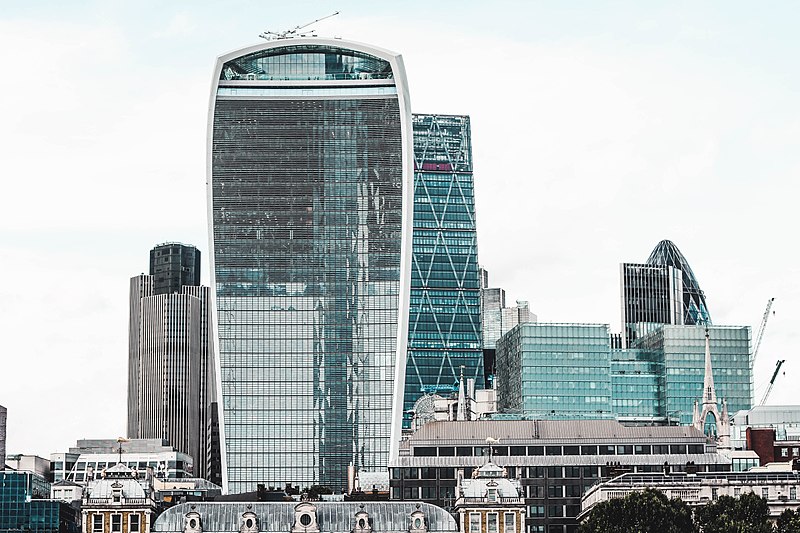
20 Fenchurch Street in London has been nicknamed the “Walkie-Talkie” due to its distinctive design.
Image by Toa Heftiba via Wikimedia Commons.
It’s largely forgotten now, but political polarisation is written into the very fabric of London. In the 18th century, when rivalries between Whigs and Tories were at their most intense, different West End squares were built so that the two groups could live among their own kind.
Hanover Square in Mayfair was built for Whigs to live cosily while, further south, St James’s Square was a home for Tories. This was close to the Cocoa Tree coffee house in Pall Mall, their unofficial meeting place, where in the 20th century workmen found a bolt hole so that they could make a quick escape if the authorities turned up.
At the time the Whigs were the party of London merchants, and the Tories that of the country, where they enjoyed widespread support from the rural population. They had once been seen as dangerously close to the old Jacobite dynasty, hence their fear of being arrested, but as that issue receded their popularity in the country at large become stronger. The Whigs were an out-of-touch metropolitan elite, sipping on their fancy “coffee”, but this didn’t stop them ruling the country for decades, nor shaping its political and historical narrative.
Two or three political realignments later, we have arrived to where we started again. As of today the City of Westminster, home of those fashionable West End squares as well as the seat of government itself, is no longer controlled by the Conservatives, as seismic an event in the great realignment as the loss of Kensington was in the 2017 election.
In fact the whole of London is emptying of Conservatives, the party losing Wandsworth and holding onto just three boroughs. It’s not just London: the Tories have no councillors in most large cities now.
As with many social patterns, in this we are following the United States, where Bill Bishop coined the phrase “The Big Sort” to describe how Americans were becoming more polarised by geography, and which Will Wilkinson described as the formation of “communities of psychologically/ideologically similar people”.
This has resulted in cities becoming one-party enclaves, as progressive values become the norm, and conservative-minded people leave. My own parliamentary constituency, in north London, was from its formation in 1983 a suburban Tory seat but shifted between three different parties during the 80s and 90s; at the last election Labour had a 20,000 majority. Labour has now run my borough, Haringey, for 51 years, and the last time the Tories won it, back in 1968, they also took Hackney, Lambeth, Lewisham and in total 28 of London’s 32 boroughs. Truly a different world. Today they do not even fully-field candidates in some wards.
Modele 1890 Berthier Cavalry Carbine
Forgotten Weapons
Published 14 Jul 2017Get the shirt here: https://shop.bbtv.com/collections/for…
http://www.patreon.com/ForgottenWeapons
The Berthier was adopted in 1890 as a new repeating rifle for the French cavalry, who were at that time still using single shot Gras carbines. The Lebel rifle had been adopted in 1886 for the infantry, but because of its tube magazine it was not conducive to being shortened into carbine form. Andre Berthier devised a way to combine the basic action of the Lebel with the Mannlicher clip system, resulting in a light and handy repeating carbine.
The majority of these carbines were made in 1890 and 1891, and have full length stocks without any provision for bayonets (since the cavalry already had their sabers). A few more were made between 1900 and 1904, and a final order for 40,000 was placed in 1905, but it is unknown if they were actually built. Total production was either 160,000 or 200,000, depending on that last order.
It was not long into World War One when it became clear that cavalry were not suited to trench warfare, and the French cavalry units were repurposed as infantry. As a result, these cavalry carbines were rebuilt in the 1892 infantry pattern when damaged, and after the war all the surviving examples in original configuration were rebuilt as well. This makes them quite rare today in original form.
If you enjoy Forgotten Weapons, check out its sister channel, InRangeTV! http://www.youtube.com/InRangeTVShow

QotD: De Gaulle’s France
Peter Hitchens, “A Certain Idea of France”, First Things, 2019-04.


