
Socialism can be good or bad, depending on how it is run. Our national parks are an example of a socialist enterprise which is beautifully run… Here in the USA, where we have much more socialism than most people appear to believe, we are good at it in some spots, fair in others, lousy in some. In general I have come to believe that we here are usually better off with private ownership government policed than we are when the government actually owns the deal and a bored clerk looks at you and sneers when you complain. But I don’t hold it as an article of faith, either way — people ought to be able to organize their affairs to suit their convenience, either individually or collectively. They ought to be free to do either one. They ought to be free.
Robert A. Heinlein, letter to Robert A.W. Lowndes, 1956-03-13 (quoted in William H. Patterson Jr’s Robert A. Heinlein, In Dialogue with His Century Volume 2: The Man Who Learned Better, 2014).
June 10, 2014
June 9, 2014
Happy Tax Freedom Day!
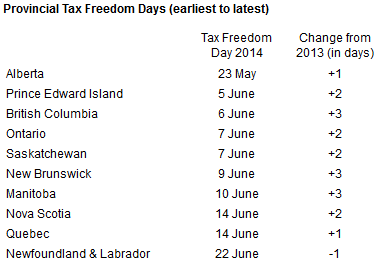
The Fraser Institute says today is Tax Freedom Day for Canadian taxpayers:
Tax Freedom Day for the average Canadian family falls on June 9, one day later than in 2013, according to the Fraser Institute’s annual calculations.
Tax Freedom Day measures the total tax burden imposed on Canadian families by the federal, provincial and local governments. If you had to pay all your taxes up front, you’d give government each and every dollar you earned before Tax Freedom Day. The later the Tax Freedom Day, the heavier the tax burden.
“Without our Tax Freedom Day calculations, it’s nearly impossible for Canadian families to know all the taxes they pay because governments levy such a wide range of taxes including income taxes, payroll taxes, health taxes, sales taxes, property taxes, fuel taxes, vehicle taxes, profit taxes, import taxes, ‘sin’ taxes on liquor and tobacco, and more,” said Charles Lammam, resident scholar in economic policy at the Fraser Institute and co-author of Canadians Celebrate Tax Freedom Day on June 9, 2014.
After accounting for all taxes, the average Canadian family (with two or more people) in 2014 will pay $43,435 in total taxes, or 43.5 per cent of their annual income. On the calendar, this percentage translates into a June 9 Tax Freedom Day, when Canadians start working for themselves and their families instead of government.
June 8, 2014
Regulating cosmetics
Jeffrey Tucker discusses the coming crash in the world of make-up:
The organization Campaign for Safe Cosmetics doesn’t just want you to be able to have new choices about the makeup or other products you buy. It wants the FDA to be able to ban and recall products. It will decide for you what is and isn’t safe.
And it is prevailing against the industry itself, which has no interest whatsoever in selling unsafe products, but precisely the opposite. The industry is already ridiculously overregulated.
What’s the excuse? The usual nonsense about safety and security and health, along with predictable headlines about how your shampoo is giving you cancer. There is a crowd of lobbyists backed by regulators who seem to believe that all of modernity is corrupting and horrible and must be reversed until we are living in the most-primitive state of being, sans makeup, of course.
In other words, cosmetics are going the way of everything else. The quality of the product will be depleted by regulations, just as with indoor plumbing, electricity, cars, light bulbs, soaps and gas-powered tools. Entrepreneurship will be hindered and truncated. Innovation will stop. In a few years, you will wonder: Whatever happened to makeup and deodorant and hair spray that actually works? Prepare: The end is near!
Already, I’ve heard many women complain that cosmetics today are far worse than they were 10 years ago. The colors don’t behave they way they should, and color is mainly what the FDA currently controls. I don’t doubt that whatever problems exist are due to government regulations. Whenever you see consumer products that decline in quality to the point that you have to pay vastly more for something of good quality, or that high quality suddenly becomes completely unavailable, you will find the hand of government if you look hard enough.
June 5, 2014
Living in a post-Snowden world, under the gaze of the Five Eyes
It’s been a year since the name Edward Snowden became known to the world, and it’s been a bumpy ride since then, as we found out that the tinfoil-hat-wearing anti-government conspiracy theorists were, if anything, under-estimating the actual level of organized, secret government surveillance. At The Register, Duncan Campbell takes us inside the “FIVE-EYED VAMPIRE SQUID of the internet”, the five-way intelligence-sharing partnership of US/UK/Canada/Australia/New Zealand:
One year after The Guardian opened up the trove of top secret American and British documents leaked by former National Security Agency (NSA) sysadmin Edward J Snowden, the world of data security and personal information safety has been turned on its head.
Everything about the safety of the internet as a common communication medium has been shown to be broken. As with the banking disasters of 2008, the crisis and damage created — not by Snowden and his helpers, but by the unregulated and unrestrained conduct the leaked documents have exposed — will last for years if not decades.
Compounding the problem is the covert network of subornment and control that agencies and collaborators working with the NSA are now revealed to have created in communications and computer security organisations and companies around the globe.
The NSA’s explicit objective is to weaken the security of the entire physical fabric of the net. One of its declared goals is to “shape the worldwide commercial cryptography market to make it more tractable to advanced cryptanalytic capabilities being developed by the NSA”, according to top secret documents provided by Snowden.
Profiling the global machinations of merchant bank Goldman Sachs in Rolling Stone in 2009, journalist Matt Taibbi famously characterized them as operating “everywhere … a great vampire squid wrapped around the face of humanity, relentlessly jamming its blood funnel into anything that smells like money”.
The NSA, with its English-speaking “Five Eyes” partners (the relevant agencies of the UK, USA, Australia, New Zealand and Canada) and a hitherto unknown secret network of corporate and government partners, has been revealed to be a similar creature. The Snowden documents chart communications funnels, taps, probes, “collection systems” and malware “implants” everywhere, jammed into data networks and tapped into cables or onto satellites.
June 2, 2014
Still no answers in the Miriam Carey case
Scott Greenfield at the Simple Justice blog wonders why there are still no answers to the questions about what happened at the south gate to the White House that day in 2013. The lawyer for Miriam Carey’s family is exasperated with the delay:
“It’s just bizarre. What’s so complex about this incident? It’s a police shooting. You know who the parties are. You know who discharged their weapons. I mean, c’mon, it’s not complex. We should have known within in a week or two. I don’t understand what’s taking so long,”
DC Metro police say the incident is still under investigation, and won’t answer any questions about it. Why is the story being withheld from the public?
That’s an excellent question, as the answer appears to be that Carey, with her daughter in the back seat, made a wrong turn into the south gate of the White House, panicked, u-turned and drove away. And so the police started firing.
When Mike Paar sent me a link to this story, it was because this otherwise “insignificant” story was curious, as it was now eight months old and there were no answers. But for the World Net Daily article, which billed the killing as “fascinating,” it would have easily fallen into obscurity, a one-day wonder story.
When it was included in a post here, it didn’t warrant any particular scrutiny. The ramming of a barricade was still the explanation du jour, and its interest was found in the need to shoot the fleeing car. Because they need to shoot at fleeing cars, which the Supreme Court says is fine.
Once the story is stripped of its ramming the barricade myth, however, there is no justification under Tennessee v. Garner as there was no fleeing felon. There was only an embarrassed dental hygienist. With her one-year-old in the back seat.
Now knowing that there was no barricade ramming, no drugs, no mental illness, the story of Miriam Carey’s death becomes even less interesting, and yet more a story of importance. If, as believed, this was an overreaction by police to a woman who made a wrong turn, who then shot her to death and is now burying their mistake by invoking excuse number 4, and no one cares, we’ve got another problem.
June 1, 2014
In the Progressive Era, “big business led the struggle for the federal regulation of the economy”
Timothy Carney says we should know much more about socialist historian Gabriel Kolko and his careful debunking of the “Teddy Roosevelt as trust-buster” myth:
Every American knows the fable of the Progressive Era and that “trust buster” Teddy Roosevelt wielding the big stick of federal power to battle the greedy corporations. We would be better off if more people knew the work of the man who dismantled this myth: historian Gabriel Kolko, who died this month at age 81.
Kolko was a self-described socialist and a Harvard-educated historian, but he had little use for the liberal political establishment’s pious regard for the Progressive Era of 1900 to 1916. And he was never credulous enough to believe that government intervention in the economy was generally in the public interest.
For today’s politics, Kolko’s most important book was The Triumph of Conservatism, published in 1967. His thesis: “The dominant fact of American political life” in the Progressive Period “was that big business led the struggle for the federal regulation of the economy.”
The standard history of the Progressive Period — which painted Teddy and the Feds as the scourge of Big Business — relied too much on the public rhetoric of TR and his cohorts. Kolko dug deeper to show how Big Business truly felt about Big Government, and how the Progressives truly felt about Big Business.
Many corporate titans in the early 20th Century, buying into the pervasive hubris of the day, believed that a state-managed economy was the inevitable end of a rational society — the conclusion of what Standard Oil’s top lobbyist Samuel Dodd called the “march of civilization.” Competition, in their eyes, was destructive redundancy.
[…]
Liberal scholar William Galston at the Brookings Institution explains the economics at play. “Corporations have sizeable cash flows and access to credit markets, which gives them a cushion against adversity and added costs,” he wrote in 2013, explaining why the big guys often welcome regulation. “[S]mall businesses often operate much closer to the margin and are acutely sensitive to policies that threaten to drive up costs.” Also, “CEOs can hire experts to help them cope with added regulatory burdens and can spread the costs over a large workforce.”
Kolko’s research smashed the favorite tales of the Progressive myth. When Upton Sinclair wrote The Jungle, which included descriptions of rancid meat-packing plants, Roosevelt saw Sinclair as personally despicable, but a useful asset in his quest to impose federal meat inspection. Sinclair opposed Roosevelt’s regulation, and Kolko relates that “the big packers were warm friends of regulation, especially when it primarily affected their innumerable small competitors.”
By “conservatism,” Kolko meant “stability,” and preservation of the status quo. This is often the aim of corporate giants. It is consistently the consequence of federal action. And it is reliably the enemy of entrepreneurship, economic growth and free choice.
Healthy eating … the Woody Allen moment approaches
The “prophecy”:
And in The Economist this week:
Ms Teicholz describes the early academics who demonised fat and those who have kept up the crusade. Top among them was Ancel Keys, a professor at the University of Minnesota, whose work landed him on the cover of Time magazine in 1961. He provided an answer to why middle-aged men were dropping dead from heart attacks, as well as a solution: eat less fat. Work by Keys and others propelled the American government’s first set of dietary guidelines, in 1980. Cut back on red meat, whole milk and other sources of saturated fat. The few sceptics of this theory were, for decades, marginalised.
But the vilification of fat, argues Ms Teicholz, does not stand up to closer examination. She pokes holes in famous pieces of research — the Framingham heart study, the Seven Countries study, the Los Angeles Veterans Trial, to name a few — describing methodological problems or overlooked results, until the foundations of this nutritional advice look increasingly shaky.
The opinions of academics and governments, as presented, led to real change. Food companies were happy to replace animal fats with less expensive vegetable oils. They have now begun abolishing trans fats from their food products and replacing them with polyunsaturated vegetable oils that, when heated, may be as harmful. Advice for keeping to a low-fat diet also played directly into food companies’ sweet spot of biscuits, cereals and confectionery; when people eat less fat, they are hungry for something else. Indeed, as recently as 1995 the AHA itself recommended snacks of “low-fat cookies, low-fat crackers…hard candy, gum drops, sugar, syrup, honey” and other carbohydrate-laden foods. Americans consumed nearly 25% more carbohydrates in 2000 than they had in 1971.
It would be ironic indeed if the modern obesity crisis was actually caused by government dietary recommendations intended to improve public health (and fatten the bottom lines of big agribusiness campaign donors).
Getting on the ballot is a major struggle, if you’re not a Democrat or Republican
Doug Mataconis gives a few examples of how the two major US political parties have conspired to make it much harder for anyone to get on the ballot without being a nominee of the Democratic or Republican parties:
In theory, the purpose of nominating petitions is supposed to be to ensure some level of ballot integrity by requiring people who want to appear on the ballot for local, state, or national office to demonstrate some minimal level of support for their candidacy. In reality, what ballot access laws in many parts of the country have become are a means by which the two major parties in general, and incumbents specifically, restrict third parties and challengers from getting on the ballot, or at least making it more difficult for them to do so. The Michigan law at issue in this case, which requires Congressional candidates to get just 1,000 signatures to get on the ballot. Given the fact that the population of Conyers’ district is some 700,000 people, and that he got more than 200,000 votes in 2012, one imagines that it wouldn’t be too difficult for Conyers to meet that target. The situation is quite different, though, for independent and minor party candidates. According to Ballotpedia, an independent candidate for Congress must submit at least 3,000, and no more than 6,000, valid signatures of registered voters in order to get on the ballot, three times as many as a candidate from ether of the two major political parties. In other states, the ballot access requirements are even more restrictive. In Virginia for example, a candidate for statewide office must submit at least 10,000 valid signatures, including at least 400 from each of the state’s 11 Congressional Districts. Other states are even more stringent, although there are some standouts. New Jersey, for example seems to be one of the few states where petition requirements for independent and third party candidates are actually lower than those for major parties candidates, at least when it comes to Federal offices. In general, though, even a short perusal of the nominating petition laws of the states leaves when with the inescapable conclusion that they are generally designed to make it harder for candidates to get on the ballot than aimed toward any legitimate goal of “ballot integrity.”
Other restrictions in various states include all sorts of timewasting — and volunteer effort-wasting — requirements for third-party efforts that often don’t apply to incumbents or to the two major parties. Every political party depends on volunteers, and those volunteer hours are used up quickly (and not renewed) when they have to be spent on busywork, rather than activity that helps elect their candidate.
For example, in Ontario, where there’s currently an election underway, it takes only 25 signatures from voters in the constituency to get a nominee’s name on the ballot. If you’re running as a member of a recognized political party, you also need the party leader’s signature on your nomination form (example here [PDF]). That’s an easy enough hurdle that anyone should be able to clear it (yet every election, a few would-be candidates fail to achieve ballot status … and sometimes it’s a major party candidate).
To run as a candidate in a Canadian federal election requires 100 signatures from voters in the riding (but only 50 in lower-population ridings in remote areas of the country). The nomination paper includes several pages for the signatures [PDF]. For more detail on how the signatures are validated, there was an interesting case in the last federal election.
May 31, 2014
“The smoke from this plant causes a brief state of euphoria, immediately followed by permanent insanity”
Paula Bolyard says that this collection of TV public service announcements from the 1970s may go a long way to explain why as parents they obsessively over-protect their kids (the Millenial generation). I loved this one:
In an effort to communicate a hip-sounding anti-drug message that teens could relate to, this PSA probably achieved the opposite of its intended effect. It made drugs seem fun and cool and glamorized drug use more than demonizing it.
Here are some gems from this hilarious PSA:
I know what you’re thinking. What is marijuana? What makes it so dangerous? Where can I get some marijuana? Well, brother, I’m not going to nickle and dime you. I’m not like ‘the man’ all you kids are rebelling against. I’m hip. I know what young people are dealing with these days.
Yes, he actually said “nickle and dime you.”
Rolled in Zig Zags or puffed from 7th period wood shop projects, the smoke from this plant causes a brief state of euphoria, immediately followed by permanent insanity. Users are prone to unpredictable behavior including junk food binges, joy rides, and a sudden urge to wear sunglasses at night.
At long last I now know why my brother was so interested in wood shop in junior high.
Long term use of marijuana can lead to a psychological dependency. Soon you’ll be taking all sorts of measures to get your fix. People will start calling you names like ‘pothead’ or ‘Smokie McBongwater.’ Losing all motivation, it’s likely that you will drop out of school take a sudden liking to sitar music and maybe even get felt up by a cop or two.
This explains basically everything about the 70s.
Is marijuana really where it’s at? Is it really as righteous as you think? There is more to life than grass. There are fulfilling careers and grrrr000vy beach parties. The closer you look the more seeds you find in your stash. Follow your hopes and dreams. Be someone. Do yourself and your country a favor. Don’t let this happen to you.
Raise your hand if you’re convinced.
May 30, 2014
“French spies [are] number two in the world of industrial cyber-espionage”
High praise indeed for French espionage operatives from … former US Secretary of Defence Robert Gates:
Former spy and defense department secretary Robert Gates has identified France as a major cyber-spying threat against the US.
In statements that are bound to raise eyebrows on both sides of the Atlantic, Gates (not Bill) nominated French spies as being number two in the world of industrial cyber-espionage.
“In terms of the most capable, next to the Chinese, are the French – and they’ve been doing it a long time” he says in this interview at the Council on Foreign Relations.
Rather than a precis, The Register will give you some of Gates’s (not Bill) words verbatim, starting just after 21 minutes in the video, when he answers a question about America’s recent indictment of five Chinese military hackers.
“What we have accused the Chinese of doing – stealing American companies’ secrets and technology – is not new, nor is it something that’s done only by the Chinese,” Gates tells the interviewer. “There are probably a dozen or fifteen countries that steal our technology in this way.
“In terms of the most capable, next to the Chinese, are probably the French, and they’ve been doing it a long time.
May 29, 2014
A state legislative session devoted to “unlegislating”
Our elected officials at all levels of government spend much of their time passing new laws … to the extent that it is no longer possible for an average citizen of a state or province to know what their legal status is on any given issue — it’s been estimated that you’ll commit three felonies a day without ever knowing it. Given that, this session of the Minnesota state legislature has a huge natural attraction:
It’s no longer a crime in Minnesota to carry fruit in an illegally sized container. The state’s telegraph regulations are gone. And it’s now legal to drive a car in neutral — if you can figure out how to do it.
Those were among the 1,175 obsolete, unnecessary and incomprehensible laws that Gov. Mark Dayton and the Legislature repealed this year as part of the governor’s “unsession” initiative. His goal was to make state government work better, faster and smarter.
“I think we’re off to a very good start,” Dayton said Tuesday at a Capitol news conference.
In addition to getting rid of outdated laws, the project made taxes simpler, cut bureaucratic red tape, speeded up business permits and required state agencies to communicate in plain language.
“We got rid of all the silly laws,” said Tony Sertich, the Iron Range Resources and Rehabilitation Board commissioner who headed Dayton’s effort.
Well, not quite all of them. They kept a law on the books that requires state Agriculture Commissioner Dave Frederickson to personally capture or destroy any wild boar that gets loose in Minneapolis or St. Paul. Sertich said it’s conceivable that such a critter could wander into the cities.
It would be a good use of any legislature’s time to trim old laws from the books, but that’s not how most politicians view their job, unfortunately.
H/T to Doug Mataconis for the link.
Harper’s “starve the beast” policy continues
In Maclean’s, Paul Wells updates us on the multi-year diet Stephen Harper has been running on the government’s “revenue generating” tools:
If I were the Conservative Party, I’d be using the latest report [PDF] from the office of Parliamentary Budget Officer Jean-Denis Fréchette to fundraise too. By the standards that motivate Conservative donors, this report is highly motivating.
The report, by PBO analyst Trevor Shaw, examines the reduction in federal revenues resulting from all the major changes to personal income tax and the GST since 2005. It’s an odd choice of starting point — 2005 was the second of Paul Martin’s two calendar years as prime minister — but only a small part of the reduction Shaw measures is attributable to that second Martin budget. Most has happened since.
And the net effect is striking:
“In total, cumulative changes have reduced federal tax revenue by $30 billion, or 12 per cent. These changes have been progressive, overall. Low and middle income earners have benefited more, in relative terms, than higher income earners.”
Shaw attributes $17.1 billion of the reduction to changes to personal income tax level and structure, and $13.3 billion to changes in GST/HST rates. He doesn’t count revenue reductions from changes to corporate income tax. We’ll get back to that. But on the personal income-tax and GST side, the final number is probably actually a little bigger than $30 billion: Shaw writes that he couldn’t get enough data to make his own estimate of revenue reductions due to Tax Free Savings Accounts, but passes along a Finance Canada estimate that it’s good for $410 million in revenue reductions. So, figure $30 billion and change in the current tax year that Ottawa would have raised if it hadn’t been for the past decade’s worth of tax changes.
NDP leader Thomas Mulcair is apparently hoping to make up the “shortfall” (from the point of view where any reduction in government spending is bad) by jacking up corporate taxes. This may not work as well as he hopes:
First, Mulcair is fooling himself if he thinks corporate taxes can be increased to make up for the shortfall in personal-tax income Harper has engineered. As the PBO points out, “Personal income tax and the federal portion of the GST/HST account for 75 per cent of federal tax revenues.” There’s way less room to make money off rich fat cats than Mulcair pretends. I mean, he’s welcome to keep pretending, but if he keeps his word an NDP government will remain short of cash. And a Liberal government, more so.
Second, this is why Stephen Harper is in politics. I wrote a book about that. He may one day stop being prime minister, at which point the real fun begins, because his opponents are promising to run a Pierre Trudeau government or a Jack Layton government at John Diefenbaker prices. It can’t be done. Their inability to do it will be Harper’s legacy.
May 28, 2014
QotD: The voters
There is, so to say, good news and bad news for democratic European Unionists. The good news is that, for the first time, voter turnout actually increased from the previous election to the European Parliament. Just over 43 percent of the eligible bothered to vote, up 1/10th of 1 percent. The bad news is that so many of these voters selected parties devoted to the destruction of as much of the European Union as possible.
We are laughing, up here in the High Doganate. Or rather, no, we are not laughing, it is all a pose. Still, there is a glint of recognition, gleeful in its own way. The voters, especially in England and France — the pioneer “Nation States” from the later Middle Ages — appear to have been motivated by something akin to the feist that came over the municipal electorate in the Greater Parkdale Area, the last time we voted. That was when we chose the notorious drunkard and drug addict, Rob Ford, to be our mayor. As polls since have repeatedly confirmed, we knew what we were doing. We had a task for him. It was to destroy as much of the vast municipal bureaucracy as possible. Our instruction was: “Keep smashing everything you see until they take you away.” Finesse would not be required, and the licker and crack might be an advantage.
One may love “the people,” without being especially impressed by them. They are stupid, but as the stopped clock, there are moments when they are stupidly correct. These are very brief moments, but let us enjoy them while we can.
David Warren, “Hapless Voters”, Essays in Idleness, 2014-05-26.
May 27, 2014
WSJ – “…the Canadian government is paying almost 80% of his developers’ salaries”
Stephen Gordon linked to this rather boggling Wall Street Journal article that outlines how the Canadian and provincial governments are attempting to lure start-up technology businesses to locate in Canada with vast bribes of taxpayer money:
Imagine you are launching or running a startup and there’s a place where all of your developers — the biggest expense for most tech companies — cost one quarter what they do in Silicon Valley. Sure, it’s cold there, but talent is plentiful and the locals are friendly. Would you trade your hash browns for poutine?
Adam Adelman, co-founder of Mighty Cast, a startup working on a new kind of wearable technology, recently told me the Canadian government is paying almost 80% of his developers’ salaries. And that’s not a tax credit. It’s a rebate, a check he gets from the government whether or not his startup makes money.
Even at Mighty Cast, a two-year-old hardware startup, salaries have been 80% of expenses. Combine that with the lower salaries demanded by engineers in Montreal, where Mighty Cast moved its headquarters after its genesis in Silicon Valley, and Mr. Adelman says he’s able to stretch his angel round of investment four times as far.
So the federal government is literally giving away money to start-up tech companies to compete at a huge advantage against actual Canadian companies? Nearly 80% of the payroll is funded from taxes, partly collected from the domestic competition? Does this seem like a good idea to anyone who isn’t already drawing 100% of their income from Ottawa?
The government is particularly badly suited to picking technology winners, and this program sounds like a vast give-away for the well-connected few, literally at the expense of everyone else. Maple-flavoured crony capitalism, with the official stamp of approval of Stephen Harper’s “conservative” government.


