On October 26, 2013, protesters from across the political spectrum gathered in Washington, D.C. to take part in the Stop Watching Us rally, a demonstration against the National Security Agency’s domestic and international surveillance programs.
Reason TV spoke with protesters — including 2012 Libertarian Party presidential candidate Gary Johnson and former Congressman Dennis Kucinich — to discuss the rally, why people should worry about the erosion of privacy, and President Barack Obama’s role in the growth of the surveillance state.
Correction: Laura Murphy, Director of the ACLU Washington Legislative Office, was incorrectly identified as Susan N. Herman, ACLU President.
Produced by Joshua Swain, interviews by Todd Krainin.
October 28, 2013
Reason.tv – What We Saw At The Anti-NSA “Stop Watching Us” Rally
Mark Steyn on the Obamacare software
Mark Steyn’s weekend column touched on some items of interest to aficionados of past government software fiascos:
The witness who coughed up the intriguing tidbit about Obamacare’s exemption from privacy protections was one Cheryl Campbell of something called CGI. This rang a vague bell with me. CGI is not a creative free spirit from Jersey City with an impressive mastery of Twitter, but a Canadian corporate behemoth. Indeed, CGI is so Canadian their name is French: Conseillers en Gestion et Informatique. Their most famous government project was for the Canadian Firearms Registry. The registry was estimated to cost in total $119 million, which would be offset by $117 million in fees. That’s a net cost of $2 million. Instead, by 2004 the CBC (Canada’s PBS) was reporting costs of some $2 billion — or a thousand times more expensive.
Yeah, yeah, I know, we’ve all had bathroom remodelers like that. But in this case the database had to register some 7 million long guns belonging to some two-and-a-half to three million Canadians. That works out to almost $300 per gun — or somewhat higher than the original estimate for processing a firearm registration of $4.60. Of those $300 gun registrations, Canada’s auditor general reported to parliament that much of the information was either duplicated or wrong in respect to basic information such as names and addresses.
Sound familiar?
Also, there was a 1-800 number, but it wasn’t any use.
Sound familiar?
So it was decided that the sclerotic database needed to be improved.
Sound familiar?
But it proved impossible to “improve” CFIS (the Canadian Firearms Information System). So CGI was hired to create an entirely new CFIS II, which would operate alongside CFIS I until the old system could be scrapped. CFIS II was supposed to go operational on January 9, 2003, but the January date got postponed to June, and 2003 to 2004, and $81 million was thrown at it before a new Conservative government scrapped the fiasco in 2007. Last year, the government of Ontario canceled another CGI registry that never saw the light of day — just for one disease, diabetes, and costing a mere $46 million.
But there’s always America! “We continue to view U.S. federal government as a significant growth opportunity,” declared CGI’s chief exec, in what would also make a fine epitaph for the republic. Pizza and Mountain Dew isn’t very Montreal, and on the evidence of three years of missed deadlines in Ontario and the four-year overrun on the firearms database CGI don’t sound like they’re pulling that many all-nighters. Was the government of the United States aware that CGI had been fired by the government of Canada and the government of Ontario (and the government of New Brunswick)? Nobody’s saying. But I doubt it would make much difference.
October 25, 2013
The glamour of big IT projects
Virginia Postrel on the hubris of the Obamacare project team:
The HealthCare.gov website is a disaster — symbolic to Obamacare opponents, disheartening to supporters, and incredibly frustrating to people who just need to buy insurance. Some computer experts are saying the only way to save the system is to scrap the current bloated code and start over.
Looking back, it seems crazy that neither the Barack Obama administration nor the public was prepared for the startup difficulties. There’s no shortage of database experts willing to opine on the complexities of the problem. Plenty of companies have nightmarish stories to tell about much simpler software projects. And reporting by the New York Times finds that the people involved with the system knew months ago that it was in serious trouble. “We foresee a train wreck,” one said back in February.
So why didn’t the administration realize that integrating a bunch of incompatible government databases into a seamless system with an interface just about anyone could understand was a really, really hard problem? Why was even the president seemingly taken by surprise when the system didn’t work like it might in the movies?
We have become seduced by computer glamour.
Whether it’s a television detective instantly checking a database of fingerprints or the ease of Amazon.com’s “1-Click” button, we imagine that software is a kind of magic — all the more so if it’s software we’ve never actually experienced. We expect it to be effortless. We don’t think about how it got there or what its limitations might be. Instead of imagining future technologies as works in progress, improving over time, we picture them as perfect from day one.
October 23, 2013
Perhaps the “starve the beast” plan is working
In Maclean’s, Stephen Gordon provides an updated look at the Harper government’s ongoing “starve the beast” policy:

Canadian federal government revenues and expenditure, 1960-2013
As I’ve written before, the Conservatives have applied the “starve the beast strategy“: First, cut taxes; second, cut spending in order to match lower revenues; third, obtain a balanced-budget for a smaller government. As the red line in the chart shows, the Harper government was temporarily thrown off this past by the financial crisis, which required emergency stimulus spending. They are, however, back on track.
Once again though, we need to be careful to see that the government’s revenues are back above expenditures (so the yearly deficit has been reduced over time), but the government’s outstanding debts are still quite substantial: $892 billion for 2012-13. As long as interest rates stay low, the debt should start to decline, but if-and-when interest rates rise, so will that big pile of accumulated debt.
October 21, 2013
The US debt iceberg
Jon Gabriel has put together a clear, understandable way to show the relationship between the US government’s revenue, deficit and debt numbers:
When Washington raised the debt ceiling this week, the Beltway media breathlessly reported that the fiscal crisis had ended. Lawyers danced in hallways, bureaucrats twerked on the Metro, congressional aides kissed strangers in the streets — the Tea Party has been defeated! It was like VJ day for wonks.
As our political class exchanged high fives and reporters praised a return to “sanity,” I wondered how these odd creatures defined insanity.
America’s fiscal crisis is not that our debt ceiling was too low, the fiscal crisis is that our debt is too high. When I mentioned this to left-leaning folks, they seemed indifferent. “Obama lowered the deficit.” “I think Bush spent more.“ “It’s Reagan’s fault!”
So I made this infographic:
Since most graphs look like this, I focused on just three big numbers: Deficit, revenue and debt.
The analogy is imperfect, but imagine the green is your salary, the yellow is the amount you’re spending over your salary, and the red is your Visa statement. Then imagine your spouse runs into the room and shouts, “great news honey, our fiscal crisis is over. We just got approved for a new MasterCard!” Your first call would be to a marriage counselor or a shrink.
H/T to Nick Gillespie:
What is it that Hemingway always used to say? That thing’s not loaded? Or something about how the “dignity of movement of an ice-berg is due to only one-eighth of it being above water.” Yeah, well, the horrors of federal finances is pretty undignified just looking at the amount of spending versus revenue we do and then it gets really sloppy when you look at the huge amount of debt below the waterline.
The nudge notion rebranded as a “human-centred” approach
In sp!ked, James Heartfield discusses a new book by David Chandler:
In his new book, Freedom vs Necessity in International Relations, David Chandler, professor of international relations at the University of Westminster, offers a masterful summation of the latest trends in policy internationally and domestically. The book lays bare the claims of governments to put people and their decision-making at the centre of policy. What Chandler shows to great effect is that the latest claims of policymakers and theorists to a human-centred approach result in something like its opposite. In a wide range of cases — from the United Nations’ Human Development Report to the Cabinet Office’s prioritisation of the ‘choice environment’ — Chandler explains how ‘human-centred’ policy is, in fact, very far from human-centred. The real aim is for people to align their behaviour and choices to the outcomes chosen by those in power, rather than deciding such outcomes for themselves. ‘Human-centred’ policy turns out to have as much to do with people deciding for themselves as the Ministry of Peace had to do with Peace, or the Ministry of Plenty to do with Plenty in Orwell’s novel.
Chandler draws attention to the irony of a worldview that imagines a much greater role for human action ending up making the case for greater restraints on freedom. As he explains, one of the marked prejudices of our times is that people have a far greater impact on the external world — for example, with the question of pollution — where mankind’s industrial output is held to threaten the very existence of life on the planet. Similarly, he observes, we have an exaggerated view of the way that our own health is shaped by the choices that we make. Political loyalties, too, are now widely seen as a great destructive force, limiting more positive outcomes.
[…]
But as Chandler explains, Sen’s own approach, enshrined in the UN Development Report, is less respectful of people’s own choices than you might expect. According to Sen ‘the outcome one wants is a reasoned assessment’ but ‘the underlying question’ is ‘whether the person has had an adequate opportunity to reason about what she really wants’. Building capacity turns out to mean building capacity to make the right choices — in other words, the choices that development economists think are the right choices. ‘Reducing risk-taking among youth requires that they have the information and the capacity to make and act on decisions’, explains the World Bank’s Development Report.
You’ll be free to make choices, as long as you’re careful to only make the approved choices. A very restrictive kind of “freedom” indeed.
Update: Also in sp!ked, Sean Collins talks about the introduction of so-called “libertarian paternalism” aka the nudge:
When Nudge: Improving Decisions About Health, Wealth and Happiness was published in 2008, it seemed like it might be a fad bestseller, like Freakonomics or one of those Malcolm Gladwell books.
Nudge authors Richard Thaler and Cass Sunstein, both American academics, proposed that government and employers should more consciously direct people to make ‘better’ choices in health, personal finance and other areas, in order to improve their lives. They gave the example of a cafeteria that lays out food in a way that encourages people to select carrot sticks over French fries or dessert. The authors label their approach ‘libertarian paternalism’: ‘paternalism’ because they want to steer people in a certain direction, and ‘libertarian’ because they would still offer people an array of choices (if you really want the chocolate mousse, you can reach under the counter at the back).
Although a new idea at the time, nudge was hardly a Big Idea. And yet governments around the world picked it up and ran with it, giving the concept more substance and longevity than might have been expected. As Sunstein has noted, the findings from his and others’ behavioural research have informed US regulations concerning ‘retirement savings, fuel economy, energy efficiency, environmental protection, healthcare, and obesity’. Sunstein himself implemented many of these measures in his role of Regulatory Czar in the Obama administration (described in his recently published book, Simpler: The Future of Government). In the UK, prime minister David Cameron set up a Behavioural Insights Team, also known as the ‘nudge unit’, in 2010. This has led to a variety of new policies and schemes directed at anything from obesity and teenage pregnancy to organ donations and the environment.
October 18, 2013
October 17, 2013
Yesterday’s throne speech
The big news from yesterday’s throne speech appears to be that there was no big news. In Maclean’s, John Geddes sounds underwhelmed:
To my ear, the pro-consumer rhetoric is flat. The job-creation talk is slightly better, but still pretty prosaic. I think these Conservatives know what they want to say, and how they want to say it, much better when it comes to Canadian history and the Canadian military.
So the opposition parties should be worried when they hear the revving of the 2017 Anniversary of Confederation engines. That’s a huge political marketing opportunity. Next year’s centennial of the start of World War I isn’t bad either. I was surprised, however, that the Tories risked tarnishing the history-commemoration theme by linking it closely to, of all things, the Senate. “The road to 2017 is a fitting time to strengthen our institutions and democratic processes,” the throne speech said, segueing awkwardly from great moments in Canadian history to the depressing present reality of Parliament’s upper chamber.
On the military, the throne speech hit some effectively brassy notes. For instance, touting their purchase of transport aircraft for the air force, it said: “No longer does Canada have to hitch a ride with out allies. Our serving men and women can now carry out their vital missions.” That’s good, straightforward material. The challenge will be sustaining that tone as the Department of National Defence moves from expanding to cutting.
Paul Wells considers this the government’s moment to “seize Canada’s moment, and suffocate it”:
In an excellent season for Canadian literature, the Prime Minister will pay personal tribute to Stephen Leacock by riding madly off in all directions.
He will introduce balanced-budget legislation as reliable and airtight as his fixed-election legislation. He will sell off federal assets, if he feels like it. He will encourage foreign investment, if he likes it. He will, by state fiat, find the Franklin Expedition. He’ll release a new science strategy. He’ll “crack down on predatory payday lenders,” something he already did once this year when he fired Nigel Wright. He’ll implement the Leslie Report on moving military resources from National Defence Headquarters to someplace more useful — not because the report’s ideas were self-evidently useful, but because Andrew Leslie is now in the business of giving ideas to Justin Trudeau. He’ll make Malala a Canadian citizen. He will celebrate the hell out of Canada’s 150th birthday.
Somewhere in there, at about the point where Tom Hanks would be starting to feel mighty thirsty if this had been a screening of Captain Phillips, there are a few paragraphs about consumer rights. Far less than there is about the 150th birthday celebrations. And far, far less than there is about continuing to crack down on criminals, people who look like criminals, people who might be criminals, and people who might know where there are some criminals. But the PMO assiduously leaked these table scraps about consumer protections for days before the big read, and everyone played the consumer stuff up big in the pre-throne-speech stories, and the CBC spent two hours talking nonstop about the “consumer agenda” after the speech as though there had actually been one in it. The great thing about leaking news is that you can create news where there is none, durably, long after your ruse should have been noticed. No wonder it’s so addictive.
October 9, 2013
Reasons not to be fearful of “China’s economic threat”
If you’ve been following the blog for a while, you’ll probably have picked up some of my disdain for the “OMG! China’s going to eat our (economic) lunch!” meme that is pretty much a copy-paste of the same worry over Japan in the 1980s. In Maclean’s, Colby Cosh explains why you shouldn’t put too much effort into worrying about the Chinese economic Colossus crushing us any time real soon:
What I always wonder when I encounter a China bull or a Chinaphobe — for they are two sides of the same coin — is this: Even if they think “socialism with Chinese characteristics” is economically superior to ordinary capitalism, where in China are the parallel cultural institutions to support prolonged capitalist-style growth? Maybe China doesn’t need reciprocal free trade to blow our doors off in the race to utopia. Maybe it doesn’t need untidy democratic quarrelling. One presumes it won’t need a high level of achievement in basic science, either, judging by the Nobels: It is well-documented that the Chinese civilian research establishment is awash in fraud and plagiarism, to say nothing of the destructive favouritism inherent to a one-party state.
Rowan Callick’s new book The Party Forever: Inside China’s Modern Communist Party makes a simple, compact judgment on the general state of Chinese higher education: Just look where the Party leadership sends its own children to university: the U.S. Another important leading indicator of cultural progress is press freedom, which, if history has anything to say on the matter at all, appears to be utterly integral to sustained prosperity. But Mainland China has no newspapers as we understand them; it is not even clear that the regimented, spoon-fed “reporters” there could assemble one, even if the Party would allow it.
The Diane Francises of the world would have us reject the relevance of the Soviet experience to China’s future, to the point of ignoring familiar Soviet themes that are increasingly apparent in China: the vast infrastructure projects standing unused in the middle of nowhere, the blind environmental despoliation, the dodgy economic statistics. Beyond mastery of trading, interior China has simply never possessed much of the cultural technique upon which the advanced stages of economic development would seem to depend. Hong Kong is the exception, but having taken it over, China shows little appetite so far for imitating its social openness and individuality — or for those of Taiwan or Japan or South Korea. It still requires a strange leap of faith to believe it possible for China to economically surpass these neighbours, and ourselves, without becoming a great deal more like us.
Regular visitors to the blog know that I’ve been rather skeptical about the official statistics reported by Chinese government and media sources.
Mismeasuring American poverty
It’s always headline-worthy to say that some absurdly high number of Americans are living in poverty — that the richest country in history still has desperately poor people in vast numbers. It’s shocking to see … and it’s mostly bogus:
We get told they do often enough I know, the latest example being this:
About 15% of Americans live in poverty, so why is no one talking about it?
It isn’t true.
In a nation where, according to the US Census Bureau’s poverty statistics released last month, 46.5 million people (roughly 15%) of the nation’s population lives in poverty,
Sorry, but their repeating it does not make it true.
The correct formulation is that 15% of Americans would be living in poverty if it were not for the things that are done to alleviate poverty.
There are two things that make this correction really rather important. The first being that everyone else measures poverty after all the things that are done to alleviate it. Thus any comparison across countries is going to leave the US looking very bad indeed: for others are talking about the residual poverty left after trying to do something about it and the US is talking about the poverty before alleviation. Very different things I hope you’ll agree.
There are reasons why this meme won’t go away (aside from it being a handy eye-catching headline to attract readers for newspapers and websites), including the fact that many civil servants are employed in federal, state, and local organizations to work on programs intended to alleviate poverty. If they are too successful, their caseload goes down and so will their budget and headcount. Any bureaucracy has a prime directive quite separate from their original reason for existing — organizations have primal motivations for surviving and growing. Their incentive is thus merely to ease the problem, not to solve it, or else they’re working to put themselves out of business.
October 8, 2013
In defence of savings
Keynes notoriously thought savings were bad … that a penny saved was a penny “prevented” from working its “magic” in the economy. Gregory Bresiger explains why Keynes’ notion has become the unspoken understanding of most Americans:
Our grandparents believed in the value of thrift, but many of their grandchildren don’t.
That’s because cultural and economic values have changed dramatically over the last generations as political and media elites have convinced many Americans that saving is passé. So today, under the influence of Keynesian economists who champion government spending and high levels of consumption, thrift has been devalued.
“The growth in wealth, so far from being dependent on the abstinence [savings] of the rich, as is commonly supposed, is more likely to be impeded by it,” according to John Maynard Keynes’s The General Theory of Employment, Interest and Money.
“The more virtuous we are, the more determinedly thrifty, the more obstinately orthodox in our national and personal finance, the more incomes will have to fall,” he writes. “Saving,” Keynes wrote in his Treatise on Money, “is the act of the individual consumer and consists in the negative act of refraining from spending the whole of his current income on consumption.”
But saving, pace Keynes, isn’t “negative.” It is deferred consumption. “The great producing countries are the great consuming countries,” writes Benjamin Anderson in Economics and the Public Welfare. More importantly, high rates of savings will lead to higher productivity, which would benefit our children and grandchildren, classical and Austrian economists have explained.
“We are the lucky heirs of our fathers and forefathers whose saving has accumulated the capital goods with the aid of which we are working today,” wrote Ludwig von Mises in Human Action. Saving, ultimately, is consumption, writes Detley S. Schlichter in Paper Money Collapse. “By setting aside some resources for meeting financial consumption needs, we invest them.”
Nevertheless, Keynesian ideas dominate the Obama administration and mass media. Most politicians, including Republicans who often pretend to be friends of thrift and self-improvement, are tacit or overt Keynesians. That’s because politicians, whether they have studied Keynes or not, generally love the idea of cheap money. Most delight in spending taxpayer dollars. They believe this is the way elections are won.
October 7, 2013
QotD: Progressives and power
Charlie Cooke had a very good column and follow up post this week on progressive disdain for our system of separated powers. What liberals want, according to Charlie, is an “elected king” who can do whatever he wants. I agree with him almost entirely. For instance, he doesn’t say it, but this is exactly what Thomas Friedman wants. It’s what all the pseudo-eggheady-jagoff technocrats always want. The desire to simply impose “optimal policies” heedless of democratic or legal impediments lies behind virtually every technocratic fad of the last couple of centuries. We know what to do, and the problem with democracy is that the rubes won’t let us do it! Stuart Chase, one of the architects of the New Deal (who some say coined the term), openly pleaded for an “economic dictatorship.” After all, he asked, “why should the Russians have all the fun remaking the world?”
But here’s where I disagree a bit with Charlie. The key issue for progressives has never been the form power takes, but power itself. You want my five-second lesson in progressive history? No? Sucks for you, because I’m going to tell you anyway: They always go where the field is open.
That’s it.
When the public was on their side the progressives relied on the public. That’s why we have the direct election of senators. That’s why women got the franchise. Etc. In his early years as an academic Woodrow Wilson wanted Congress to run the country — the way parliament runs England — and relegate the president to a glorified clerk. When the public became unreliable and Congress was no longer a viable vehicle, progressives suddenly fell in love with a Caesarian presidency. Indeed, Wilson himself, the former champion of Congress, became an unapologetic voluptuary of presidential power the moment it suited him — and nary a progressive complained (save poor Randolph Bourne, of course). The progressives rode the presidency like it was a horse they never expected to return to a stable. And when that started to hit the point of diminishing returns, they moved on to the courts (even as they bleated and caterwauled about Nixon’s “abuses” of powers that were created and exploited by Wilson, FDR, and Johnson). After the courts, they relied on the bureaucracy. Like water seeking the shortest path, progressives have always championed the shortest route to social-justice victories.
My point is that I think Charlie is entirely right that progressives want to maximize their power. But the elected king scenario is just one of many they’d be perfectly happy with. If they could have a politburo instead of a unitary executive, they’d probably prefer that. But the point is that the instruments are, uh, instrumental. The core imperative is power. We see this in miniature when liberals don’t control the presidency but do control Congress. Suddenly, it’s vital that the “people’s house” exert its constitutional prerogatives! When the president is a Democrat he needs to rule unimpaired. When he’s a Republican, his dictatorial tendencies must be held in check. When liberals want to reinterpret the Constitution by judicial whim or fiat, it’s proof that the Constitution is living up to its nature as a “living, breathing, document.” When conservatives actually want to amend the Constitution — the only legitimate and constitutional means to change the meaning of the Constitution, I might add — it is a horrible affront to the vision of the Founders!
Once you realize this it helps explain so many of the Left’s hypocrisies and alleged double standards. I say alleged, because they aren’t really double standards. You can only have a double standard when you actually believe something should be a standard. Ultimately, for progressives these procedural debates about how power is used in America are just that: procedural debates. The alleged standards at stake are evanescent and petty — for liberals. The only true standard is whatever advances the progressives’ ball downfield. That is the very heart of “social justice” — doing whatever “good” you can, when you can, however you can. As they say, behind every confessed double standard there is an unconfessed single standard. And for progressives, the single enduring standard is “whatever works for us.”
Jonah Goldberg, “Progressives and Power”, The Goldberg File email newsletter, 2013-10-04
October 4, 2013
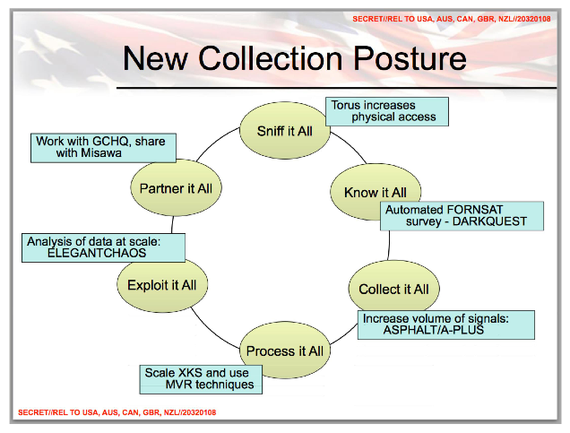
John Lanchester on the Guardian‘s GCHQ files
Novelist John Lanchester was invited to look at the trove of files the Guardian received from Edward Snowden:
In August, the editor of the Guardian rang me up and asked if I would spend a week in New York, reading the GCHQ files whose UK copy the Guardian was forced to destroy. His suggestion was that it might be worthwhile to look at the material not from a perspective of making news but from that of a novelist with an interest in the way we live now.
I took Alan Rusbridger up on his invitation, after an initial reluctance that was based on two main reasons. The first of them was that I don’t share the instinctive sense felt by many on the left that it is always wrong for states to have secrets. I’d put it more strongly than that: democratic states need spies.
And all’s well in the world and we’re worried over nothing?
My week spent reading things that were never meant to be read by outsiders was, from this point of view, largely reassuring. Most of what GCHQ does is exactly the kind of thing we all want it to do. It takes an interest in places such as the Horn of Africa, Iran, and North Korea; it takes an interest in energy security, nuclear proliferation, and in state-sponsored computer hacking.
There doesn’t seem to be much in the documents about serious crime, for which GCHQ has a surveillance mandate, but it seems that much of this activity is covered by warrants that belong to other branches of the security apparatus. Most of this surveillance is individually targeted: it concerns specific individuals and specific acts (or intentions to act), and as such, it is not the threat.
Few people are saying we don’t need intelligence-gathering organizations like GCHQ, but we do have a right to be concerned about what they are doing when they’re not watching actual, known threats. They have capabilities that we generally thought were just from the pages of James Bond novels or Tom Clancy thrillers … and they use them all the time, not just for keeping tabs on the “bad guys”.
In the case of modern signals intelligence, this is no longer true. Life has changed. It has changed because of the centrality of computers and digital activity to every aspect of modern living. Digital life is central to work: many of us, perhaps most of us, spend most of our working day using a computer. Digital life is central to our leisure: a huge portion of our discretionary activity has a digital component, even things which look like they are irreducibly un-digital, from cycling to cooking.
[…]
As for our relationships and family lives, that has, especially for younger people, become a digital-first activity. Take away Facebook and Twitter, instant messaging and Skype and YouTube, and then — it’s hard to imagine, but try — take away the mobile phone, and see the yawning gap where all human interaction used to take place. About the only time we don’t use computers is when we’re asleep — that’s unless we have a gadget that tracks our sleep, or monitors our house temperature, or our burglar alarm, or whatever.
This is the central point about what our spies and security services can now do. They can, for the first time, monitor everything about us, and they can do so with a few clicks of a mouse and — to placate the lawyers — a drop-down menu of justifications.
Looking at the GCHQ papers, it is clear that there is an ambition to get access to everything digital. That’s what engineers do: they seek new capabilities. When it applies to the people who wish us harm, that’s fair enough. Take a hypothetical, but maybe not unthinkable, ability to eavesdrop on any room via an electrical socket. From the GCHQ engineers’ point of view, they would do that if they could. And there are a few people out there on whom it would be useful to be able to eavesdrop via an electrical socket. But the price of doing so would be a society that really did have total surveillance. Would it be worth it? Is the risk worth the intrusion?
That example might sound far-fetched, but trust me, it isn’t quite as far fetched as all that, and the basic intention on the part of the GCHQ engineers — to get everything — is there.