
Sometimes the law defends plunder and participates in it. Thus the beneficiaries are spared the shame and danger that their acts would otherwise involve … But how is this legal plunder to be identified? Quite simply. See if the law takes from some persons what belongs to them and gives it to the other persons to whom it doesn’t belong. See if the law benefits one citizen at the expense of another by doing what the citizen himself cannot do without committing a crime. Then abolish that law without delay — No legal plunder; this is the principle of justice, peace, order, stability, harmony and logic.
Frédéric Bastiat, The Law, 1850.
October 2, 2018
QotD: Legal plunder
Comments Off on QotD: Legal plunder
September 28, 2018
The staunch Progressive dismissal of Warren Harding and Calvin Coolidge
In Richard Epstein’s review of Jill Lepore’s recent book These Truths: A History of the United States, there’s some interesting discussion of the Harding and Coolidge administrations:
Lepore’s narrative of this period begins with President Warren Harding, who, she writes, “in one of the worst inaugural addresses ever delivered,” argued, in his own words, “for lightened tax burdens, for sound commercial practices, for adequate credit facilities, for sympathetic concern for all agricultural problems, for the omission of unnecessary interference of Government with business, for an end to Government’s experiment in business, for more efficient business in Government, and for more efficient business in Government administration.” Harding’s sympathetic reference of farmers is a bit out of keeping with the rest of his remarks. Indeed, farmers had already been a protected class before 1920, and the situation only got worse when Franklin Roosevelt’s administration implemented the Agricultural Adjustment Acts of the 1930s, which cartelized farming. But for all her indignation, Lepore never explains what is wrong with Harding’s agenda. She merely rejects it out of hand, while mocking Harding’s conviction.
Given her doggedly progressive premises, Lepore may have predicted a calamitous meltdown in the American economy under Harding, but exactly the opposite occurred. Harding appointed an exceptionally strong cabinet that included as three of its principal luminaries Charles Evans Hughes as Secretary of State, Andrew Mellon as Secretary of Treasury, and Herbert Hoover as the ubiquitous Secretary of Commerce, with a portfolio far broader than that position manages today. And how did they perform? Lepore does not mention that Harding coped quickly and effectively with the serious recession of 1921 by refusing to follow Hoover’s advice for aggressive intervention. Instead, Harding initiated powerful recovery by slashing the federal budget in half and reducing taxes across the board. Both Roosevelt and Obama did far worse in advancing recovery with their more interventionist efforts.
To her credit, Lepore notes the successes of Harding’s program: the rise of industrial production by 70 percent, an increase in the gross national product by about 40 percent, and growth in per capita income by close to 30 percent between 1922 and 1928. But, she doesn’t seem to understand why that recovery was robust, especially in comparison with the long, drawn-out Roosevelt recession that lingered on for years when he adopted the opposite policy of extensive cartelization and high taxes through the 1930s.
Lepore is on sound ground when she attacks Harding and Coolidge for their 1920s legislation that isolated the American economy from the rest of the world. The Immigration Act of 1924 responded to nativist arguments by seriously curtailing immigration from Italy and Eastern Europe, subjecting millions to the ravages of the Nazis a generation later. Harding and Coolidge also increased tariffs on imports during this period. What Lepore never quite grasps is that any critique of these actions rests most powerfully on the classical liberal worldview that she rejects. Indeed, Harding and Coolidge exhibited the same intellectual confusion that today animates Donald Trump, who gets high marks for supporting deregulation and tax reductions at home, while simultaneously indulging in unduly restrictive immigration policies and mercantilist trade wars abroad. Analytically, however, the same pro-market policies should control both domestically and abroad. Hoover never got that message — as president, he signed the misguided Smoot-Hawley Tariff Act of 1930 that sharply reduced the volume of international trade to the detriment of both the United States and all of its trading partners, which helped turn what had been a short-term stock market downturn in 1929 into the enduring Great Depression of the 1930s.
Comments Off on The staunch Progressive dismissal of Warren Harding and Calvin Coolidge
September 26, 2018
QotD: Offensive and defensive use of the law
As long as it is admitted that the law may be diverted from its true purpose — that it may violate property instead of protecting it — then everyone will want to participate in making the law, either to protect himself against plunder or to use it for plunder.
Frédéric Bastiat, The Law, 1850.
Comments Off on QotD: Offensive and defensive use of the law
September 25, 2018
QotD: The Laffer Curve
Around a certain sort of leftist mention of the Laffer Curve just brings a derisive snort. The sadness of that reaction being that it’s just an obvious mathematical truth. Tax rates of 0 % and 100 % bring in no revenue. Somewhere in between maximises the moolah. Note what isn’t being said, that all tax cuts always pay for themselves, nor even that lower tax rates are necessarily a good thing. Only that there’s some optimal level with regard to revenue collection.
All the arguments about the optimal level of government are over in the Wagner Curve and such others.
The Laffer Curve is also made up of two components, the income and substitution. Some people will work just to make their nut. Observational studies have shown that many taxi drivers do. So, increase their tax rates and they’ll work more. The substitution effect is, well, what’s that net wage worth to me? What’s the value of not working? When going fishing is worth more than working then people will go fishing. The curve as a whole is the interplay of these two effects.
Each tax in each society has its own such curve. A transactions tax of 0.01% can reduce revenue collection, as the EU’s study of a financial transactions tax shows us. Taxes upon income of 20% are below that Laffer Curve peak.
But where, exactly, is that peak for taxes upon income? The best study we’ve got, Saez and Diamond, says between 54% and 80% dependent upon other structures in the tax system. The Tory part of the UK Treasury says around 40 to 45% for income tax, plus national insurance, so at the bottom end of that S&D range. Many lefties want to say it’s higher so we can tax “the rich” more.
Tim Worstall, “How Lovely To Spot The Laffer Curve In The Wild – Doctors’ Pensions Edition”, Continental Telegraph, 2018-09-05.
Comments Off on QotD: The Laffer Curve
September 14, 2018
A sensible post-Brexit farming policy
Tim Worstall linked to his 2016 post at the Adam Smith Institute that nicely summarizes the best post-Brexit farm policy for Britain:

We have an alternative policy framework to suggest. Let’s just not have a policy. No subsidies, no payments, no department, no Minister, nothing, nowt, zippedy dooh dah. The New Zealand option. You’ve had it good for a century or more now there’s yer bike and have a nice ride.
We would not swear that this is true but we have heard that it is so — British farming has long passed Parkinson’s Event Horizon. There are now more bureaucrats “managing” farming than there are farmers farming. Let’s not pay the farmers anything and thus we don’t need the bureaucrats paying it — a double saving. Instead of £2 to £3 billion a year in taxes going to the farmers, plus whatever the amount again to pay it to them, we could just keep that what, £5 billion? And go and buy food from whomever.
Sounds like a plan really and we recommend it to all. Let’s use Brexit to right some of the wrongs of our current system. One of those wrongs being the incessant whining and demands for bribery from the farming sector.
The correct design of the new domestic agriculture policy is that there isn’t one. And nor is there any funding for either it or its absence. In short Meurig, go away.
Comments Off on A sensible post-Brexit farming policy
September 13, 2018
The lasting impact of Haida Nation vs. British Columbia
I was not aware that a single case had such a major influence on relations between the federal and provincial governments on the one hand and First Nations groups on the other. Barbara Kay explains just how we got to the point of overturning decades of settled legal practice in the wake of the Haida Nation decision:
In his newly published book, There is no Difference: An Argument for the Abolition of the Indian Reserve System, lawyer Peter Best devotes a chapter to unpacking the consequences of Haida Nation. It makes for fascinating reading.
Before this decision, Best says, it was understood “that aboriginal claims and rights over the land were more than ‘reconciled.’ In fact, Canadians, Indians and non-Indians alike, thought they were, especially in treaty areas, extinguished, plain and simple,” apart from the right to hunt, fish and trap on unoccupied wilderness Crown land, and even then with Crown sovereignty. Haida Nation – and cases decided since then – reversed the meaning of the treaties.
The SCC read in an intent “merely to ‘reconcile’ Indians’ prior sovereign occupancy of the land with the new sovereignty of the Crown.” That is, they were “instruments of power and land-sharing, not instruments of rights extinguishment.”
So it seems we are now in a never-ending power-sharing arrangement, “requiring the constant, expensive, uncertain fine-tuning and adjustment from time to never-ending time of the granted Crown rights with the retained sovereign Indian rights.” This new jurisprudence, Best says, decrees a devolution of Crown sovereignty to Indians – a handing back of previously surrendered power, effectively turning Indian bands into a third order of government.
The key words, “to consult and where appropriate, accommodate the Aboriginal interests…” give Indian bands across the country power over all kinds of economic development – mines, forestry, wind power installations, roads, and of course pipelines.
Following Haida Nation, any band that asserts a proposed off-reserve project affects an Indian interest, actual or projected, the “consultation and accommodation if necessary” process is automatically launched. No evidence has to be produced, no threshold of importance to be met. (“Sacred ground” is always effective – and what ground is not sacred to aboriginals who live on it?).
In most negotiations with conflicting interests, each party has a motive to see the deal done. But “consultation” is not negotiation, and aboriginals often have no particular reason to settle. Best notes that during consultations, there’s a great deal of travel, expense account living, important meetings and pleasant busywork, with most politicians lacking the courage to utter the words “not appropriate” with regard to further “consultation.”
There is also no incentive for aboriginals to settle for anything less than exactly what they want. The Lax Kw’alaams of B.C. turned down a billion dollars in exchange for their support of an industrial project. There was no downside for them. They had the power and knew it. No matter how long they held out, their transfer payments flowed in as usual, and they took no economic risks if the project failed. If one side has nothing to lose and the other side has everything to lose, Best says, “you don’t have negotiations – you have a shakedown.”
September 11, 2018
How the Media and Literati Class Determines the Politics of a Nation
rubatirabbit
Published on 15 Oct 2016From Yes Prime Minister S02E05 Power To The People
The prime minister intends to introduce a professor’s scheme for enacting bottom-up government. The civil service and reformists reacts to this scheme.
Comments Off on How the Media and Literati Class Determines the Politics of a Nation
September 7, 2018
QotD: Government distortion of the housing market
Behind the veneer of free-market governance is a deep expanse of government involvement in massive areas of the economy, such as the housing market and health care. People don’t make decisions on housing and health-care concerns every day, but when they do, they would benefit from the information that markets provide about whether they can afford a large house or whether a particular drug is worth the price. Government distortion of these key markets has scrambled these signals.
An annual congressional report, “Estimates of Federal Tax Expenditures,” gives insight into how Washington manipulates supply and demand in these sectors. Consider house prices. This year, Washington will pay homeowners $99 billion in forgone taxes to borrow money to purchase or refinance a house or to sell that house and reap the profit. Americans will buy or sell about $600 billion worth of houses this year. Government subsidy, then, represents nearly one-sixth of this market. The federal government also provides a guarantee for most mortgages, thanks to Fannie Mae and Freddie Mac, the two government-supported mortgage companies that benefited for decades from an implicit government guarantee before they got an explicit guarantee during the 2008 financial crisis.
These subsidies have fired the growth of the housing industry. Between 1975 and 1979, the U.S. Treasury paid out $102.6 billion in mortgage-interest breaks in today’s dollars. Between 2015 and 2019, the Treasury will pay out $419.8 billion in such tax favoritism — a more than fourfold rise, nearly ten times the population increase. The hike is particularly extraordinary, considering that in the late 1970s, the annual interest rate on a mortgage was 9 percent, twice what it is today. Taking today’s lower rates into account, Washington has increased the mortgage subsidy more than eightfold.
It’s no surprise that mortgage debt has soared, to $9.5 trillion, from $2.6 trillion in inflation-adjusted dollars in 1981. Back then, mortgage debt constituted 31 percent of our nation’s GDP. Today, it makes up nearly 53 percent. [Dierdre] McCloskey, who thinks that free markets are generally healthy, acknowledges that “there are examples of the price signal not coming through.” The mortgage-interest deduction is “a silly idea,” she says, yet “very hard to change.”
Indeed, government subsidy is a critical factor in whether families can afford to purchase a home, and what kind of home, how large, and in what zip code. The home-mortgage deduction, then, helps determine how people live — yet we barely notice. Few of us consider how the government shapes one of the biggest decisions we’ll ever make, or how the U.S. government’s presence in the housing market maintains the value of our homes.
Nicole Gelinas, “Fake Capitalism: It’s not free markets that have failed us but government distortion of them”, City Journal, 2016-11-06.
Comments Off on QotD: Government distortion of the housing market
September 4, 2018
“So now we know what ‘the resistance’ really is. It’s the establishment”
Brendan O’Neill on the funeral of “maverick” Republican senator John McCain:
So now we know what ‘the resistance’ really is. It’s the establishment. It’s the old political order. It’s that late 20th-century political set, those out-of-touch managerial elites, who still cannot believe the electorate rejected them. That is the take-home message of the bizarre political spectacle that was the burial of John McCain, where this neocon in life has been transformed into a resistance leader in death: that while the anti-Trump movement might doll itself up as rebellious, and even borrow its name from those who resisted fascism in Europe in the mid 20th-century, in truth it is primarily about restoring the apparently cool, expert-driven rule of the old elites over what is viewed as the chaos of the populist Trump / Brexit era.
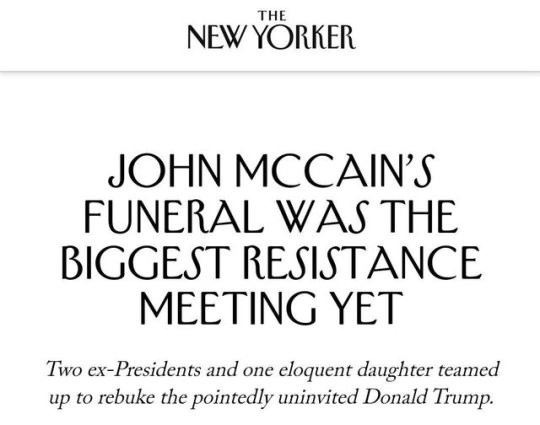
The response to McCain’s death has bordered on the surreal. The strangest aspect has been the self-conscious rebranding of McCain as a searing rebel. In death, this key establishment figure in the Republican Party, this military officer, senator, presidential candidate and enthusiastic backer of the exercise of US military power overseas, has been reimagined as a plucky battler for all that is good against a wicked, overbearing political machine. ‘John McCain’s funeral was the biggest resistance meeting yet’, said a headline in the New Yorker, alongside a photo of George W Bush, Bill Clinton, Hillary Clinton, Al Gore, and soldiers from the US Army, the most powerful military machine on Earth. This is ‘the resistance’ now: the former holders of extraordinary power, the invaders of foreign nations, the Washington establishment.
The New Yorker piece, like so much of the McCain commentary, praises to the heavens the anti-Trump theme of McCain’s funeral. McCain famously said Trump couldn’t attend his funeral. And that in itself was enough to win him the posthumous love of a liberal commentariat that now views everything through the binary moral framework of pro-Trump (evil, ill-informed, occasionally fascistic) and anti-Trump (decent, moral, on a par with the warriors against Nazism). Even better, though, was the fact that orators at the funeral, including McCain’s daughter Meghan and both Bush and Obama, used the church service to slam Trumpism, without explicitly mentioning it, and in the process to big-up what came before Trumpism, which of course was their rule, their politics, their establishment. The Washington political and media set might seem bitterly bipartisan, said the New Yorker writer, but it is also ‘more united’ in one important sense – ‘in its hatred of Donald Trump’.
[…]
The religious allusions, the talk of vengeance against Trump, the misremembering of McCain’s life so that it becomes a moral exemplar against the alleged crimes of Trumpism, exposes the infantile moralism of the so-called resistance. Albert Burneko, assessing some of the madder McCain commentary, says there is now a ‘condition’ that he calls ‘Resistance Brain’, where people display an ‘urge to grab and cling on to anything that seems, even a little bit, like it might be the thing that Finally Defeats Donald Trump’. Even if the thing they’re grabbing on to is actually a bad thing. Like a seemingly endless FBI investigation into the elected presidency. Or George W Bush, whose moral rehabilitation on the back of Anti-Trumpism has been extraordinary. Or neoconservatism: this was the scourge of liberal activists a decade ago, yet now its architects are praised because they subscribe to the religion of Anti-Trumpism. Being against Trump washes away all sins.
Comments Off on “So now we know what ‘the resistance’ really is. It’s the establishment”
September 3, 2018
QotD: “Market failure”
It is not too much of an exaggeration to say that markets are considered to fail if and whenever they fail at achieving some ideal, while governments are considered to succeed if and whenever they succeed at achieving anything other than utter chaos and calamity.
Don Boudreaux, “Quotation of the Day…”, Café Hayek, 2016-11-04.
Comments Off on QotD: “Market failure”
September 2, 2018
QotD: Coyote’s first rule of government authority
Never support any government power you would not want your ideological enemy wielding.
Warren Meyer, “Regulatory Deception”, Coyote Blog, 2014-11-12.
Comments Off on QotD: Coyote’s first rule of government authority
September 1, 2018
The legal tangle around the Trans-Mountain pipeline approval process
Jay Currie suspects the process has been intentionally complicated to the point that there may not be a way out for this government:
What the Court essentially asked was, “Did the Federal Government consult enough?” and then concluded, “No, not enough.”
How much is “enough”? That is a question which this decision really does not answer. And I suspect it does not answer it because there is actually no answer which is even close to true.
In a normal process a reasonable level of public consultation would be reached when the public has been given an opportunity to comment on the matter at hand. Which is a bit vague but there is case law which fleshes out what such an opportunity might look like.
However, once environmentalists and First Nations are engaged it is not at all obvious that merely having the opportunity to comment is sufficient. Unlike a rezoning application, an application to build a pipeline (or, realistically, virtually any other large undertaking) creates the opportunity for First Nations to talk about everything from ancient hunting rights, to sacred grounds, to former village sites, to disruptions to present First Nation culture and so on. Having the environmentalists involved ensures that the relatively easy solution of simply paying the First Nations’ people for their consent, is off the table. That solution will be denounced by the enviros as cultural genocide and worse.
All of which creates, and might arguably have been intended to create, a Gordian knot when it comes to considering major projects. Consultation becomes an endless task and one which has no defined parameters. The decision today indicates that an extensive consultation process is not enough but it does not indicate what might be enough.
Delightfully, the shareholders of Kinder Morgan – which owns TransMountain – voted today to sell the project to Canada’s feckless Federal Government for several billion dollars.
I suspect the CEO danced a little jig relieved that he no longer had to guess at how far consultations have to go. But Canada is stuck with a completely dysfunctional system which is being exploited by environmentalists and First Nations to prevent infrastructure from being built. That will have to be fixed.
Comments Off on The legal tangle around the Trans-Mountain pipeline approval process
August 30, 2018
“This is simply drivel. And it’s the standard Green Party phantasm written out again”
Tim Worstall is not impressed with a new study out of Finland which recommends that the United Nations become much more involved in organizing and directing the lives of everyone on the planet … for our own good, of course:

We’ve another of those pieces of environmental drivel on offer to us. Here it’s the considered opinions of some Finnish knownothings on what is necessary to achieve the UN’s Sustainable Development Goals. The basis of which is that we should all prepare to be rather poorer. No, not because the Earth is running out of stuff to make us richer but because our Finnish knownothings are recommending that the UN take charge of things and forcibly make us poorer.
This is perhaps not the correct manner of running the global economy.
[…]
That’s all entirely drivel, of course. Capitalism doesn’t depend upon cheap fossil fuels nor even cheap energy. It’s just an economic system in which we have private property. Including the value added belonging to the people who own the property which adds the value. That’s really all it is too. Profit belongs to the people providing the capital – this is definitional by the way. For that’s what we define profit as, that part of the returns from an activity which go to those who provide the capital.
There is absolutely nothing at all which requires that energy, or any natural resource, be of any particular price nor level of price. All we are saying when we recommend capitalism is that the system seems to work better when those who make a profit get to keep it. Our economic definition of profit being when value of output is greater than the costs of inputs. Who gets those profits is definitional about capitalism. Any and every economic system is trying to produce profits. Because any and every economic system is trying to add value to inputs, trying to create value.
[…]
There’s a remarkable lack of reasoning as to why international trade needs to be limited or regulated. If we’re facing more expensive energy then we should be doing more of it, not less. But then perhaps those doing bio- and physics don’t know that Adam Smith pointed out we’d do better getting the wine from Bourdeaux rather than growing the grapes in Scotland. Or even that David Ricardo launched an entire subset of economics with his observation that trade uses fewer resources than non-trade. I mean, it is possible that they’re just ignorant of the most basic points here, isn’t it?
They’ve also not grasped that good life and economic growth part at all. No one actually producing economic growth – defined, as always, as an increase in the value being produced – does so in order to produce economic growth. They do it in pursuit of their definition of the good life. Economic growth is simply the aggregate of all those people trying to make their own lives better, their pursuit of that good life. The inverse is also true. If we leave people alone to pursue their own versions of the good life then economic growth is what we get. Our bio-p types seem unaware of the laissez faire argument. That we all get richer faster if left alone to our own visions of life?
Now, if this was just a few blokes in the Far North muttering to themselves among the trees of future toilet roll this wouldn’t matter. But this is serious advice to the United Nations? It’s about to become art of how world governance works? Dear God Above, what have any of us one to deserve this?
Try this for example:
A key problem with carbon pricing has been that states, federations, or unions have not implemented it on a sufficiently high level, fearing industrial leakage to less environmentally-regulated countries. For this reason, many economists and politicians hope for global carbon pricing. But if we return to the four examples above, energy, transport, food, and housing, we can see that it would be highly unlikely that even global carbon pricing would guide economic activity in the right direction – at least with sufficient speed and breadth. As a policy tool, carbon pricing lacks the crucial element of coordinating a diverse set of economic actors toward a common goal. Individual actors would have an incentive to decrease carbon emissions, but they would still compete through their own business logics; there would be nothing to ensure that any one business logic would support the transition to sustainability on a systemic level.
Everyone on the planet economises on their carbon emissions because emissions are now more expensive. This does not work to coordinate everyones’ actions about carbon emissions? These people never have considered the role of the price system in coordinating human activities, have they? Not heard a single beanie about Hayek, the Pretence of Knowledge and all that?
Comments Off on “This is simply drivel. And it’s the standard Green Party phantasm written out again”
August 23, 2018
It’s quite possible to spend too much on infrastructure
Tim Worstall on the recent cancellation of two large Chinese infrastructure projects in Malaysia:
A working mantra of our times is that we should all be building much, much, more infrastructure. And that it should be government telling us where and what should be built, even going and building it. All of which rather runs into that brick wall of what is happening with China’s Belt and Road Initiative.
Yes, it’s entirely true that the old Silk Road was a useful and enriching trade route. It’s equally obvious that other trade routes have had the same effect, enriching. That is not though the same as the statement that building a trade link enriches. A trade route which is used does, one that is built still has to be used to enrich anyone other than the constructors who make off with their pay. The measure of whether the Belt and Road Initiative enriches is whether it is used, not whether it is built.
This being something that the planners in China have forgotten. Just as our own home grown ones fail to note our own past problems. The Humber Bridge never even paid back the cost of building it, let alone the interest upon it. Infrastructure doesn’t, necessarily, pay for itself. It is that upon which grand plans fail.
[…]
That it’s too expensive means that it’s not going to make money, not even meet its construction costs. And therefore it shouldn’t be built anyway, should it? Why spend more to build a railway than the benefit to be gained by having a railway? That’s just a waste of resources.
All of which is useful for our own infrastructure fetishists. It’s only if the new stuff is used that it can be worth building it. So, only build that which will be used, not whatever crosses those pretty little synapses of yours. Why, we might even insist that private economic actors put their own money at risk in order to concentrate minds on that very issue, of whether what is to be built will get used. Leave government planning out of it that is, in order to see what is worth building.
Comments Off on It’s quite possible to spend too much on infrastructure


