
People do not oppose corruption in politics and government. They oppose only the corruption that does not steer loot and social domination to them. After all, the entire process of so-called democratic government is nothing but corruption writ large and backed by the threat of violent force.
Robert Higgs, “Political and Governmental Corruption Is a Feature, Not a Bug”, The Beacon, 2016-11-04.
August 22, 2018
QotD: Corruption
Comments Off on QotD: Corruption
August 15, 2018
QotD: State economic intervention in theory and practice
The economic theory: the state intervenes in the economy in order to prevent free-riding – in order to internalize externalities – in order to better ensure that all private parties pay the full marginal costs of their activities, and that all private parties reap the full marginal benefits of their activities – in order to promote competition – in order to protect the weak from the strong.
The political reality: the state intervenes in the economy in order to promote free-riding – in order to externalize costs and benefits that the market has reasonably internalized – in order to better ensure that politically powerful private parties escape the full marginal costs of their activities, and that politically disfavored groups be stripped of much of the marginal benefits of their activities – in order to promote monopoly – in order to render some people weak who are then pillaged by the strong.
Don Boudreaux, “Economists’ Normative Case for Government Intervention is a Very Poor Positive Theory of that Intervention”, Café Hayek, 2016-09-26.
Comments Off on QotD: State economic intervention in theory and practice
August 14, 2018
Ontario embraces online sales for marijuana, with retail stores to follow in 2019
Chris Selley on the Ontario government’s surprisingly sensible approach to phasing in retail sales of cannabis over the next eight months:

Ontario’s Progressive Conservative government called a brief truce in its multi-front war with the federal Liberals on Monday to give one of Prime Minister Justin Trudeau’s signature policies a major boost: as had been widely rumoured, the Tories will scrap the previous Liberal government’s tentative public marijuana retail scheme and instead hand out licenses to the private sector.
How many licenses and what kinds of stores are just two of many unresolved details. The government says it will consult widely to determine how best to proceed, with a target opening date for licensed brick-and-mortar stores of April 1, 2019 (with publicly run online sales to commence in October). But it seems safe to hope the cap, if any, will be significantly higher than the previous government’s laughably timid 150.
Thanks to Toronto’s reluctantly laissez-faire approach to illegal storefront (nudge-wink) “medical” marijuana “dispensaries,” we know 150 might not even satisfy a free market in the country’s largest city. Trudeau has always said the goal of legalization was to smash the illegal market and plunk down a legal one in its place. The Ontario Liberals’ plan seemed almost tailor-made to fail in that endeavour.
There remains ample room for the new government to screw this up. But if it gets pricing and regulation and enforcement halfway right, the country’s most populous province should now be well placed to give legalization a good shot at achieving what proponents have always said it should — which is, basically, to make it like booze. Of course kids still get their hands on booze, but at least it’s a bit of a chore. And at least when kids get drunk, they’re not drinking moonshine.
The need to claim the retail market from the existing extra-legal networks will hinge on quality, availability and (especially) the prices that the province sets. Price it too high (pun unintentional), and the legal market will not take over distribution and sales from the black market. Provide poor quality and get the same results. Restrict sales too stringently, and watch the profits go back to the current dealers … who are not noted for their sensibilities about selling drugs to the under-aged.
In the meantime, it’s interesting to ponder why they’re going in this direction. Fedeli and Attorney-General Caroline Mulroney were at great pains Monday to stress their primary concern was the children.
“First and foremost, we want to protect our kids,” said Mulroney. “There will be no compromise, no expense spared, to ensure that our kids will be protected following the legalization of the drug.”
“Under no circumstances — none — will we tolerate anybody sharing, selling or otherwise providing cannabis to anybody under the age of 19,” said Mulroney. Fedeli vowed that even a single sale to a minor would void a retailer’s license.
Yet, let’s be honest, kids well under the age of 19 can already get cannabis and other illicit drugs — more so in urban and suburban areas, but it’s hard to imagine that legalizing cannabis for 19-plus customers somehow magically renders the under-19s uninterested in getting access, too.
Comments Off on Ontario embraces online sales for marijuana, with retail stores to follow in 2019
August 7, 2018
Grasping at straws to virtue signal
Richard Morrison points out just how banning plastic straws will not do anything meaningful to save the environment, but will definitely have a negative impact on consumers:
Of all the consumer products one might have expected to become a flashpoint for political controversy, the humble plastic drinking straw is an unlikely contender. Leap into the headlines it has, though, with communities like Seattle and San Francisco recently enacting bans on disposable straws. The city council of Santa Barbara, California, initially voted for a ban that would have punished restaurant workers with up to six months of jail time for giving out a disposable plastic straw, but city officials agreed to revisit the ordinance when it appeared to also ban the sale of straws at supermarkets.
[…] the case against the plastic straw is exceedingly weak. There aren’t as many plastic straws thrown away as claimed, and only a tiny portion of U.S. straws end up anywhere near the oceans — the vast majority of municipal solid waste in this country ends up either buried in landfills, recycled, or burned up in incinerators, far from any congested sea turtles.
The vast majority of plastic waste in oceans actually comes not from advanced countries like the U.S. but from countries like China and Indonesia that consume a large volume of plastic products but lack our modern waste collection infrastructure. Much of their plastic waste ends up washed into major river systems that empty into the oceans. A study published last year in the journal Environment Science & Technology by three German researchers found that 90 percent of the plastic debris found in the world’s oceans is dumped there by just ten of the world’s rivers — none of which are in the Western Hemisphere, much less the United States.
Beside the fact that U.S. consumers are contributing very little to the ostensible problem is the other side of the equation: the benefits of the straws themselves. I suspect many Americans who were initially receptive to the idea of a ban were genuinely surprised to learn that disposable drinking straws are very important to people with certain disabilities. British disability rights activist Penny Pepper recently commented in the Guardian about how she depends on plastic straws — and other single-use, disposable products like baby wipes — writing “I don’t have the luxury of a plastic-free life.” The durability, convenience, cleanliness, low price, and resistance to heat of disposable plastic straws make them irreplaceable to people with many different physical limitations.
Vancouver, as any Canadian would have guessed, was the first Canadian city to pick up on this particular variant of virtue signalling.
Comments Off on Grasping at straws to virtue signal
July 31, 2018
A gruesome experiment in determining the actual need for social housing
Tim Worstall discusses an aspect of the terrible Grenfell Tower fire in London that I hadn’t considered:

The fire at Grenfell Tower in London, 14 June 2017.
Photo by Natalie Oxford via Wikimedia Commons
That the Grenfell Tower fire was a tragedy is obvious. That lessons need to be learned is equally so. At which point, OK, which lessons would we like to learn? One that would be useful is to work out how much of social housing in London – for that’s what the evidence allows us to estimate – is illegally sublet. Or, as we might also put it, how much social housing in London is not actually needed as social housing?
For sublets are, by their nature, at something close to market rents, the difference between those and the social rents being pocketed by those doing the renting out.
No, we don’t know and that might be just because we’ve not been paying the detailed attention required. But it’s also something we tend to think will have been glossed over in investigations into the events. Something that perhaps should not have been glossed over – if indeed it has.
[…] The thought that a place, in the centre of London, where we could house – safely perhaps this time – several hundred people not be used to house several hundred people? We have a housing shortage or not?
However, it’s the insight into that larger question that interests. We know that some amount of social (and or council) housing in London is illegally sublet. The very fact that it is shows that it’s not needed. Those who are paying the landlord a reduced rent clearly don’t need the property as they’re not living in it. Those paying the near market rents don’t need social housing as they’re paying near market rents. Thus subletting shows that the entire structure of – at least in that instance – the social rent isn’t necessary.
So, how prevalent is it? We know that some of it occurred at Grenfell. We’ve all admitted it, clearly, for we’ve not insisted that only those on the tenants’ listing are those who should be granted aid for having had their home burned down. So, we know there’s some. So, how much?
It’s unlikely that we’ve as much information on this concerning any other building in the country. Thus this is an excellent place to actually conduct such research.
Comments Off on A gruesome experiment in determining the actual need for social housing
July 27, 2018
Toronto’s proposed handgun ban is a feelgood/do nothing distraction
Every time there’s a tragedy, there are calls from the local media for politicians to “do something”. Politicians are hard-wired to want to “do something” even without prompting. They want (and need, for electoral purposes) to be seen to be “doing something”, if only to divert any blamecasting away from themselves. The most recent tragedy was a senseless shooting on Toronto’s Danforth in the Greektown district. The shooter, who was either killed by police or committed suicide shortly after the attack, was apparently not a legal gun owner, and under current gun laws would not have been able to obtain a handgun. So, in the wake of the tragic deaths and injuries, Toronto city council jumped into action to be seen “doing something”. Chris Selley explains why the proposed ban of handgun and ammunition sales in the city will not make a difference, except to punish non-criminals:
The whiz-bang solution on everyone’s lips — from Mayor Tory to city councillors to the Toronto Star’s and Globe and Mail’s editorial boards and the usual activists — is to ban handguns. Tory admits there is no “magic wand” that will solve Toronto’s gun problem. But still he asks: “Why does anyone in this city need to have a gun at all?”
The idea has a very superficial appeal. We all wish the Danforth shooter hadn’t managed to get a hold of a gun. Toronto is having a bad year for shootings — not much worse than last year, but at the wrong end of a distinct and steady five-year-trend. (At this point in 2014 there had been 101 shootings and 127 fatalities; so far in 2018 there have been 228 shootings and 308 fatalities.) It is understandable (if not entirely creditable) that the Danforth shooting would have rapidly intensified demands for something to be done: the victim count was high, and it happened in a wealthy part of town where it would have been easy to pretend there wasn’t a problem at all.
Still, the limitations of a “handgun ban” are both many and obvious. When Canadian police forces occasionally report on the sources of crime guns, they often find the vast majority have been smuggled across the border. In Toronto nowadays, the number is reportedly more like 50 per cent; the rest of the supply comes from licensed handgun owners who sell them on illegally — a spectacularly risky thing to do, as any used in crimes would be instantly traced back to the registered owner, but apparently worth it to some.
But we all know how permeable the Canada-U.S. border is. If we made it impossible to own a handgun legally in Canada, is there any reason to suspect the cross-border flow couldn’t regain its market share? Furthermore, CTV reported Wednesday that the Danforth shooter’s handgun was prohibited — i.e., it could never have been licensed in Canada — and that he had obtained it from some gang associates. If true, his carnage illustrates the limitations of handgun bans better than it does their efficacy.
Comments Off on Toronto’s proposed handgun ban is a feelgood/do nothing distraction
July 26, 2018
The Trump tariffs are working exactly as designed
That is, they’re becoming a drag on the economy and will take away a lot of the economic activity that was stimulated by the tax cuts enacted earlier. Warren Meyer says that it’s time that congress reclaimed the tariff powers it has outsourced to the executive branch over the years:
I Know Congress Hates To Challenge A President of Its Own Party, But…
…Congress simply has to pare back the tariff authority it has delegated the President. It is simply insane that Trump can just unilaterally impose 20% tariffs on foreign automobiles, a $200 billion new tax on US consumers.
It is appalling to see Trump following the usual blue model of economic regulation, imposing one intervention after another, each meant to fix the unintended consequences of the last intervention. Steel tariffs increased costs to domestic auto makers, so Trump proposes tariffs on foreign autos. When tariffs result (inevitably) in counter-tariffs on US agricultural exports, Trump proposes more agricultural subsidies. People (not me) lament gridlock in government and want more fluid lawmaking — well here it is. And it sucks. It is mindless and reactive and emotional and totally ignorant of economics.
These tariffs, when combined with earlier actions, will result in tax increases on consumers that swamp the tax cuts Trump and the Republicans were so proud of last year.
Jon Gabriel on the most recent “fix” for one of those unintended consequences:
A few months back, President Trump declared that “trade wars are good, and easy to win.” Now, just as nearly every economist on the left and right predicted, Americans are being hurt.
The White House slapped tariffs on imported steel and aluminum. China retaliated with planned tariffs on soybeans, meats and various agricultural products. Mexico, Canada and the European Union also struck back at farm goods and other U.S. exports.
A smart leader would notice his mistake and end the destructive policy. Instead, Trump declared that “tariffs are the greatest” and created a multibillion-dollar federal program to mitigate a small part of the mess he created.
Since Agriculture Secretary Sonny Perdue estimated $11 billion in damage to the industry, he announced a $12 billion payoff to make up the difference.
The administration used emergency executive powers created during the Great Depression; that way Congress wouldn’t get to weigh in.
“This is obviously a short-term solution that will give President Trump time to work on a long-term trade policy and deal to benefit agriculture as well as all sectors of the American economy,” Perdue told reporters.
It’s certainly short-term, but hardly a solution. Trade deals and networks are disrupted, farmers can’t plan for the future, and non-agricultural industries are still losing money. Not to mention all the American consumers watching prices rise on all sorts of household goods.
But red states have a lot of farmers and the midterms are just three months away. Maybe borrowing a few billion dollars will hide enough economic pain to convince voters to keep Republicans in power for two more years.
Comments Off on The Trump tariffs are working exactly as designed
July 22, 2018
QotD: A touching naivety
… the typical “Progressive” continues to imagine the state to exist in the same way that a four-year old child imagines Santa Claus to exist: as a super-human force for good that possesses a supernatural capacity for pursuing and achieving that good. There is, in practice, no epistemological difference between the belief of many children that dusk on December 24th causes reindeer to fly and the belief of many adults that minimum-wage legislation causes the incomes of all low-skilled workers to rise. Higher-skilled workers, and the labor unions that represent them – as well as some firms that use fewer low-skilled workers than are used by their competitors – are only too happy to promote this juvenile fantasy.
Don Boudreaux, “Bonus Quotation of the Day…”, Café Hayek, 2016-09-04.
Comments Off on QotD: A touching naivety
July 20, 2018
Fiat currency and the impact of cryptocurrencies
At Catallaxy Files, Sinclair Davidson explains some of the advantages and disadvantages of both fiat (government-issued) and private currency:
As George Selgin, Larry White and others have shown, many historical societies had systems of private money — free banking — where the institution of money was provided by the market.
But for the most part, private monies have been displaced by fiat currencies, and live on as a historical curiosity.
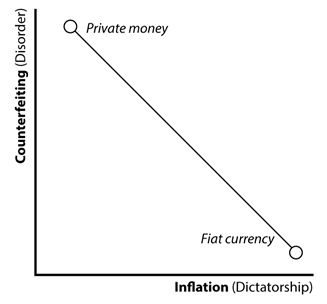
We can explain this with an ‘institutional possibility frontier’; a framework developed first by Harvard economist Andrei Shleifer and his various co-authors. Shleifer and colleagues array social institutions according to how they trade-off the risks of disorder (that is, private fraud and theft) against the risk of dictatorship (that is, government expropriation, oppression, etc.) along the frontier.
As the graph shows, for money these risks are counterfeiting (disorder) and unexpected inflation (dictatorship). The free banking era taught us that private currencies are vulnerable to counterfeiting, but due to competitive market pressure, minimise the risk of inflation.
By contrast, fiat currencies are less susceptible to counterfeiting. Governments are a trusted third party that aggressively prosecutes currency fraud. The tradeoff though is that governments get the power of inflating the currency.
The fact that fiat currencies seem to be widely preferred in the world isn’t only because of fiat currency laws. It’s that citizens seem to be relatively happy with this tradeoff. They would prefer to take the risk of inflation over the risk of counterfeiting.
One reason why this might be the case is because they can both diversify and hedge against the likelihood of inflation by holding assets such as gold, or foreign currency.
The dictatorship costs of fiat currency are apparently not as high as ‘hard money’ theorists imagine.
Introducing cryptocurrencies
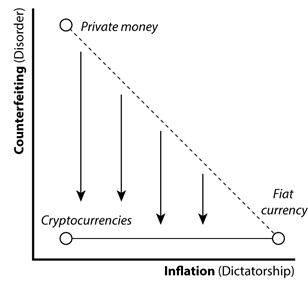
Cryptocurrencies significantly change this dynamic.
Cryptocurrencies are a form of private money that substantially, if not entirely, eliminate the risk of counterfeiting. Blockchains underpin cryptocurrency tokens as a secure, decentralised digital asset.
They’re not just an asset to diversify away from inflationary fiat currency, or a hedge to protect against unwanted dictatorship. Cryptocurrencies are a (near — and increasing) substitute for fiat currency.
This means that the disorder costs of private money drop dramatically.
In fact, the counterfeiting risk for mature cryptocurrencies like Bitcoin is currently less than fiat currency. Fiat currency can still be counterfeited. A stable and secure blockchain eliminates the risk of counterfeiting entirely.
Comments Off on Fiat currency and the impact of cryptocurrencies
July 19, 2018
Crony capitalists of the military-industrial complex
Matthew D. Mitchell comments on some of the problems with government contractors and their all-too-cosy relationship with the government officials who hand out the public’s funds:
… as economist Luigi Zingales explains in his book, A Capitalism for the People, governments contracting with private interests has its own set of risks:
The problem with many public-private partnerships is best captured by a comment that George Bernard Shaw once made to a beautiful ballerina. She had proposed that they have a child together so that the child could possess his brain and her beauty; Shaw replied that he feared the child would have her brain and his beauty. Similarly, public-private partnerships often wind up with the social goals of the private sector and the efficiency of the public one. In these partnerships, Republican and Democratic politicians and businesspeople frequently cooperate toward just one goal: their own profit.
When President Dwight Eisenhower warned against the “unwarranted influence” of the “military-industrial complex,” he was concerned that certain firms selling to the government might obtain untoward privilege, twisting public resources to serve private ends. It is telling that one of those contractors, Lockheed Aircraft, would become the first company to be bailed out by Congress in 1971.
For many observers, the George W. Bush administration’s “no-bid” contracts to Halliburton and Blackwater appeared to exemplify the sort of deals that Eisenhower had warned of. It is true that federal regulations explicitly permit contracts without open bidding in certain circumstances, such as when only one firm is capable of providing a certain service or when there is an unusual or compelling emergency. In any case, a report issued by the bipartisan Commission on Wartime Contracting in 2011 estimated that contractor fraud and abuse during operations in Afghanistan and Iraq cost taxpayers an estimated $31 to $60 billion. This includes, but is not limited to:
requirements that were excessive when established and/or not adjusted in a timely fashion; poor performance by contractors that required costly rework; ill-conceived projects that did not fit the cultural, political, and economic mores of the society they were meant to serve; security and other costs that were not anticipated due to lack of proper planning; questionable and unsupported payments to contractors that take years to reconcile; ineffective government oversight; and losses through lack of competition.
Governments may also award contracts to perform a service that has more to do with serving a parochial interest than with providing a benefit to the paying public. For example, Congress may order the Pentagon to procure more tanks even though the Pentagon itself says the tanks aren’t needed. Paying General Dynamics hundreds of millions of dollars to produce unneeded tanks in order to protect jobs in particular congressional districts may be an abuse even if the underlying process by which the contract was awarded is legitimate.
Comments Off on Crony capitalists of the military-industrial complex
July 18, 2018
QotD: Understanding how company profits can be used
In its fight against company tax cuts, [the Australian] Labor [Party] peddles the myth that company tax cuts are a windfall for big businesses and their shareholders, this week even launching ads suggesting [Australian PM] Malcolm Turnbull supports company tax cuts because he’ll personally benefit as an investor.
It’s a myth easily debunked. Think about it. What exactly can a company do with the extra money retained from paying less tax? It can only spend profits in two ways: paying dividends to shareholders or spending more on its operations.
Dividends are subject to tax, including withholding tax for foreign shareholders. Suggesting Turnbull or any other investor will get a windfall is a blatant lie.
In fact, many shareholders will pay more tax to make up the greater difference between the company tax rate and their own tax rate. That’s how dividend imputation works, as Labor well knows.
Alternatively, the company can spend more on things like technology, plant and equipment, funding research and development, expanding its sales force or opening new shopfronts or branches. In other words, more money paid in wages to workers and buying goods and services from suppliers.
All of that spending is also taxed. Workers pay income tax. GST [Goods and Services Tax] is collected on goods and services. Suppliers pay company tax or income tax themselves.
Lower company tax simply allows a business to use more of its money on something productive before the money is collected by government.
Nyunggai Warren Mundine, “Bill Shorten’s Labor would kill the reforms of Hawke and Keating”, Financial Review, 2018-06-26.
Comments Off on QotD: Understanding how company profits can be used
July 17, 2018
QotD: The incentive problem for universities
Incentives matter. This is a fundamental tenet of economics: People respond to their incentives. If something in a market seems to be going wrong, it’s because the incentives have gotten screwed up.
Looking at the market for education, it’s hard not to think that there’s something wrong with the incentives. Tuition keeps going up and so does debt. The percentage of people who are not paying off that debt — either because they are in default, deferment, or an income-based repayment program — is staggering. Naturally, a lot of folks would like to get the government in there to start tweaking those incentives until the market stops being so crazy.
One issue involves the incentives that schools have to ensure that their graduates get value out of their degrees. At the moment, a school can enroll you in practically any program, and the government will lend you money for tuition and living expenses, whether or not that degree is likely to produce the means to repay the loan. Since schools are often in a better position to know the economic value of their degrees than naive potential students, that twists the incentives. Eventually, the student will pay, either with money or trashed credit. If the loan defaults, taxpayers will pay too. The school has the most information about the transaction and yet it has the least at stake. No wonder we have such high tuition, so many dubious degree programs and such a troubling rate of default.
Megan McArdle, “Don’t Make Colleges Pay for Student-Loan Defaults”, Bloomberg View, 2016-09-07.
Comments Off on QotD: The incentive problem for universities
July 15, 2018
QotD: “Temporary” government programs
Obamacare will not collapse imminently — or maybe not even ever. But that is not because it is “working” as a public policy. Countries around the world have carried the husk of their far more socialized health-care systems for generations. Rent control, the minimum wage, and countless other economically ridiculous policies endure because they satisfy the political needs of politicians, bureaucrats, and a whole phylum of remora-like rent-seekers. That’s why Milton Friedman said, “Nothing is so permanent as a temporary government program.” He should know, given how it was basically his idea to implement tax-withholding from paychecks as a wartime measure.
You might say that these programs also help real people too. And that is true. But wealth distribution efforts always help someone. And those someones become vested interests who demand perpetuation of the status quo. If the federal government implemented a program to give every left-handed person in the country $20,000 a year free and clear (no doubt to compensate for the fact that such people are witches), you can be sure the Left Handed Association of America would work assiduously to protect their entitlement.
Jonah Goldberg, “The Consequences of Overpromising on Obamacare”, National Review, 2016-10-08.
Comments Off on QotD: “Temporary” government programs
July 14, 2018
Trump’s tariffs are working
Tim Worstall explains that the recent US price hikes in washing machines is exactly what the Trump administration wanted:
The part of import tariffs that all too many fail to understand is that it is consumers being “protected” by them who actually pay them. That is, import tariffs on foreign goods entering the United States are paid by those inside the United States. Or, as we can also put it, Trump’s tariffs are making Americans poorer. This isn’t a known to be desired effect of economic policy.
However, it’s important to note that the real burden doesn’t come from the rise in price of the imports. It’s what the domestic producers do to us all in the absence of that foreign competition which is important:
The clear and obvious effect of import tariffs – Credit, BLS, via Mark Perry and AEI, by permission
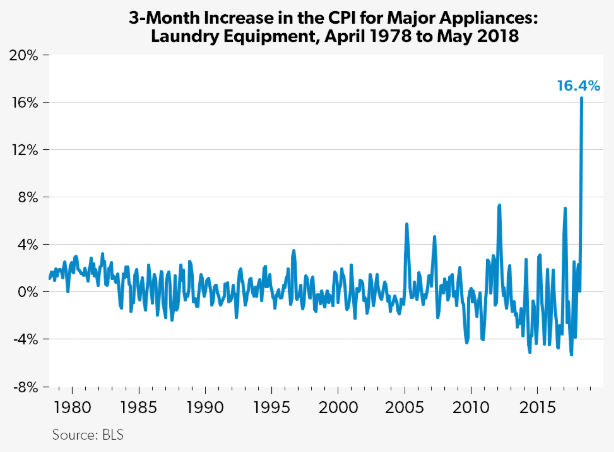
If you’re unfortunate enough to be shopping for a new washing machine, you can thank the Trump tariffs on imported washing machines, washing machine parts, steel and aluminum for the largest three-month price increase — 16.4% from February to May this year — in the 40-year history of the BLS series for Major Appliances: Laundry Equipment that started in January 1978 (see chart above). In the May CPI report (see Table 2), the one-month increase in the CPI for Laundry Equipment of 7.4% in May followed a 9.6% increase in April, and in both months was the largest monthly price increase of any of the 300 individual CPI categories or sub-categories. For the month of May, the 7.4% increase in the washing machine series was twice the increase of the next highest increase of 3.7% for educational books and supplies (mostly college textbooks).
What’s worse than this price rise is that this is planned. This is the desired outcome from the people who imposed these taxes.
Comments Off on Trump’s tariffs are working
July 12, 2018
QotD: Bloomberg Syndrome
It is a human trait to focus on cheap lofty rhetoric rather than costly earthy reality. It is a bureaucratic characteristic to rail against the trifling misdemeanor rather than address the often-dangerous felony. And it is political habit to mask one’s own failures by lecturing others on their supposed shortcomings. Ambitious elected officials often manage to do all three.
The result in these hard times is that our elected sheriffs, mayors and governors are loudly weighing in on national and global challenges that are quite often out of their own jurisdiction, while ignoring or failing to solve the very problems that they were elected to address.
Quite simply, the next time your elected local or state official holds a press conference about global warming, the Middle East or the national political climate, expect to experience poor county law enforcement, bad municipal services or regional insolvency.
Victor Davis Hanson, “The Bloomberg Syndrome”, Private Papers, 2011-01-24.
Comments Off on QotD: Bloomberg Syndrome


