Why is the price of oil so volatile? I thought I knew the answer — scarcity and OPEC — till I read Aguilera and Radetzki. They make the case that depletion has never been much of a factor in driving oil prices, despite the obvious drying up of certain fields (such as the North Sea today). Nor did OPEC’s interventions to fix prices make much difference over the long run. What caused the price of oil to rise much faster than other commodities, though erratically and with crashes, they argue, was the result of one factor in particular.
There was a wave of nationalisation in the oil industry beginning in the 1960s. Today some 90 per cent of oil reserves are held by nationalised companies. ExxonMobil and BP are minnows compared with the whales owned by the governments of Saudi Arabia, Venezuela, Iran, Iraq, Kuwait, the United Arab Emirates, Nigeria and Russia. Post-colonial nationalisation affected many resource-based industries, but whereas many mineral and metal companies were privatised in the 1990s as their grotesque inefficiencies became visible, the same has not happened to state oil companies.
The consequence is that most oil is produced by companies that are milked by politicians, and consequently starved of cash (or incentives) for innovation and productivity. Lamenting “politicians’ extraordinary ability to mess things up”, the two authors note “the severely destructive role that can be played by political fights over the oil rent and its use”.
If politicians don’t get in the way, and we have two decades of relatively cheap oil it will be bad news for petro-dictators, oil-igarchs, ISIS thugs, and the promoters of wind power, solar power, nuclear energy and electric cars. But it is good news for everybody else, especially those on modest incomes.
Matt Ridley, “Low oil prices are a good thing”, The Rational Optimist, 2016-02-14.
September 30, 2019
QotD: Oil price volatility
September 29, 2019
Being a dictator is a stressful vocation
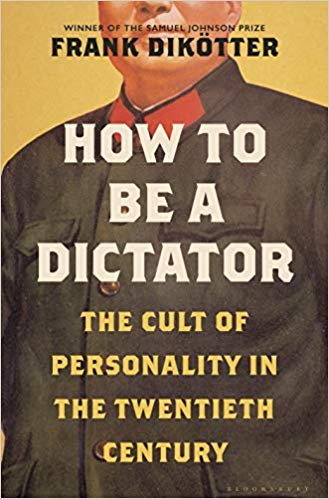
Gustav Jönsson reviews a new book by Professor Frank Dikötter on twentieth-century dictators:
One of the first things to emerge from Professor Frank Dikötter’s eagerly awaited new book How to Be a Dictator is that it is a stressful vocation: there are rivals to assassinate, dissidents to silence, kickbacks to collect, and revolutions to suppress. Quite hard work. Even the most preeminent ones usually meet ignominious ends. Mussolini: summarily shot and strung upside down over a cheering crowd. Hitler: suicide and incineration. Ceausescu: executed outside a toilet block. Or consider the fate of Ethiopia’s Haile Selassie: rumoured to have been murdered on orders of his successor Mengistu Haile Mariam, he was buried underneath the latter’s office desk. Not the most alluring career trajectory, one might say.
Dikötter’s monograph is a study of twentieth century personality cults. He examines eight such cults: those created by Mussolini, Hitler, Stalin, Mao, Kim Il-sung, Duvalier, Ceausescu, and Mengistu. For them, cultism was not mere narcissism, it was what sustained their regimes; foregoing cultism, Dikötter argues, caused swift collapse. Consider Pol Pot and the Khmer Rouge. Cambodians were unsure of Pol Pot’s exact identity for years, even after he had assumed leadership of the country. The Khmer Rouge, meanwhile, was in its initial stages merely called “Angkar” — “The Organisation.” There was no inspiring iconography. There was no ritualised leader worship. There was only dark terror. Dikötter quotes historian Henri Locard: “Failing to induce adulation and submissiveness, the Angkar could only generate hatred.” The Khmer Rouge soon lost its grip on the country. Dikötter makes an obligatory reference: “Even Big Brother, in George Orwell’s 1984, had a face that stared out at people from every street corner.”
Readers of Orwell will remember that INGSOC has no state ideology. There is only what the Party says, which can change from hour to hour. Likewise, Dikötter argues, there was no ideological core to twentieth century dictatorships; there was only the whim of the dictator. Nazism, for example, was not a coherent creed. It contained antisemitism, nationalism, neo-paganism, etc., but its essence was captured in one of its slogans: The Führer is Always Right. That is what the creed amounted to. Indeed, the NSDAP referred to itself simply as “the Hitler movement.” Nazism was synonymous with Hitlerism. Italian Fascism was perhaps even more vacuous. The regime’s slogan was simple: Mussolini is Always Right. Explaining his method of politics, Mussolini said: “We do not believe in dogmatic programmes, in rigid schemes that should contain and defy the changing, uncertain, and complex reality.”
While it is uncontroversial to argue that Nazism and Fascism were without ideology, as Dikötter writes, the “issue is more complicated with communist regimes.” Naturally, Marxism was connected with Stalin, Mao, Ceausescu, Kim, and Mengistu. But Dikötter rightly says that it was Lenin’s revolutionary vanguard, not Marx’s philosophical works, that inspired them. Doctrines can be interpreted in contradictory ways, creating schismatic movements — as shown throughout the history of socialism. In this regard personality cults are far safer because they are substantively empty. Marxist dictators thus subverted Marxism. Engels had said that socialism in one country was impossible, but that is what Stalin’s Soviet Union favoured. Or consider Kim’s North Korea, which in 1972 replaced Marxism with Great Leader Thought. And as Dikötter writes, “Mao read Marx, but turned him on his head by making peasants rather than workers the spearhead of the revolution.” Reading Marx under Marxism, Dikötter says, was highly imprudent: “One was a Stalinist under Stalin, a Maoist under Mao, a Kimist under Kim.” In short, Marxism was whatever the dictator said, and not what Marx had actually written.
September 28, 2019
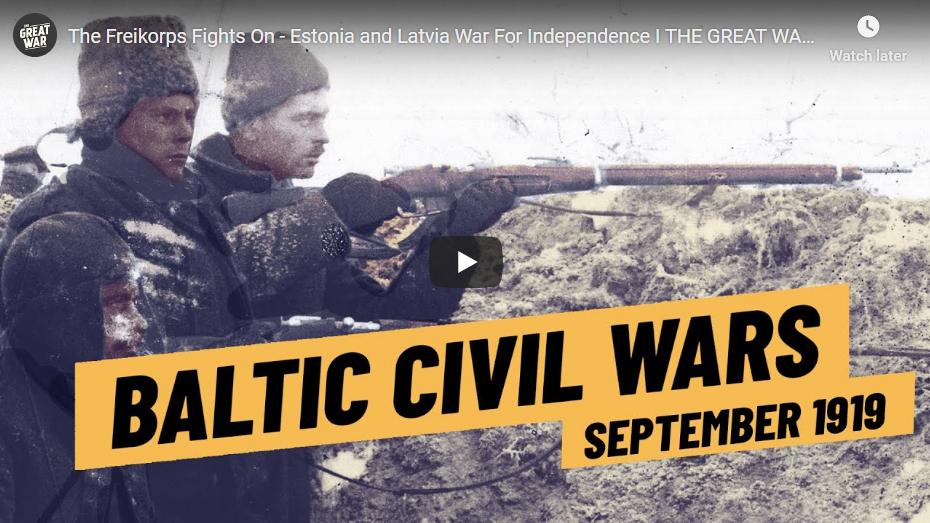
The Freikorps Fights On – Estonia and Latvia War For Independence I THE GREAT WAR 1919
The Great War
Published 27 Sep 2019Support 16 Days in Berlin: https://realtimehistory.net/indiegogo
After the Battle of Cesis it seemed the situation in Latvia and Estonia was about to quieten down. But the German soldiers in the region and the ongoing conflict with Bolshevik Russia meant the 2nd half of 1919 saw even more fighting in the Baltics.
» SUPPORT THE CHANNEL
Patreon: https://www.patreon.com/thegreatwar
Merchandise: https://shop.spreadshirt.de/thegreatwar/»CREDITS
Presented by: Jesse Alexander
Written by: Jesse Alexander
Director: Toni Steller & Florian Wittig
Director of Photography: Toni Steller
Sound: Toni Steller
Editing: Toni Steller
Mixing, Mastering & Sound Design: http://above-zero.com
Maps: Daniel Kogosov (https://www.patreon.com/Zalezsky)
Research by: Jesse Alexander
Fact checking: Florian WittigChannel Design: Alexander Clark
Original Logo: David van StepholdA Mediakraft Networks Original Channel
Contains licensed material by getty images
All rights reserved – Real Time History GmbH 2019
September 27, 2019
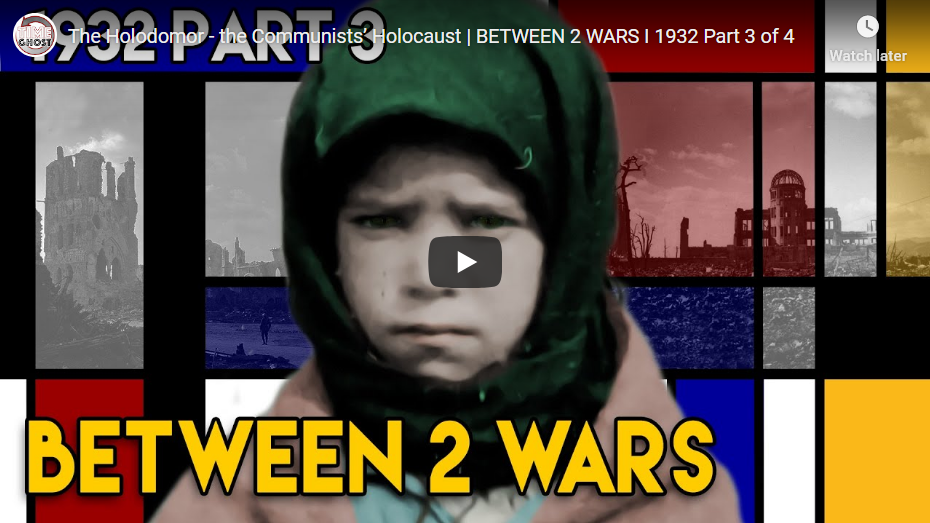
The Holodomor – the Communists’ Holocaust | BETWEEN 2 WARS I 1932 Part 3 of 4
TimeGhost History
Published 26 Sep 2019What do you get when you combine vigorous grain-tax policies, bad harvests with Stalins fear and animosity for the rural population of Ukraine? A man-created murder famine, designed to kill millions of Ukrainian men, women and children.
Join us on Patreon: https://www.patreon.com/TimeGhostHistory
Subscribe to our World War Two series: https://www.youtube.com/c/worldwartwo…
Hosted by: Indy Neidell
Written by: Indy Neidell and Spartacus Olsson
Directed by: Spartacus Olsson and Astrid Deinhard
Executive Producers: Bodo Rittenauer, Astrid Deinhard, Indy Neidell, Spartacus Olsson
Creative Producer: Joram Appel
Post-Production Director: Wieke Kapteijns
Research by: Naman Habtom and Spartacus Olsson
Edited by: Danliel Weiss
Sound design: Marek KaminskiSources:
– Applebaum, Anne, Red Famine: Stalin’s War on Ukraine (2017).
– Davies, R. W. and Stephen G, “Stalin and the Soviet Famine of 1932-33: A Reply to Ellman”, in: Europe-Asia Studies 58-4 (2006), 625-633, https://www.uio.no/studier/emner/hf/i…
– Lewin, M, “The Immediate Background of Soviet Collectivization,” in: Soviet Studies 17-2 (1965) 162–197.
– Kuromiya, Hiraoki, “Ukraine and Russia in the 1930’s”, in Harvard Ukrainian Studies 18-3/4 (1994) 327–341.
– Marples, David R, “Ethnic Issues in the Famine of 1932-1933 in Ukraine,” in: Europe-Asia Studies 61-3 (2009) 505–518.
– Watstein, Joseph, “The Role of Foreign Trade in Financing Soviet Modernization,” in: The American Journal of Economics and Sociology 29-3 (1970) 305–319.
– Wolowyna et al., “Regional Variations of 1932–1934 Famine Losses in Ukraine”.A TimeGhost chronological documentary produced by OnLion Entertainment GmbH.
From the comments:
TimeGhost History
4 hours ago (edited)
This might have been one of the hardest episodes we have written, both historically and emotionally. Nothing could ever do justice to the millions of men, women and children who suffered, starved and died during this episode of history. Let us never forget them. We acknowledge that this topic is surrounded by many opposing agendas, myths so that talking about it can get emotional. This is why, as should be known by now, will UNDER NO CIRCUMSTANCES tolerate any kind of Stalinist apologism, falsification of known facts, or outright denial of the Holodomor. The sources, which are clearly presented in our video, the description and in this comment, are unequivocal about the events covered in this episode. Anywhere were there is an assumption based on deduction from these facts, we mention it. Keep that in mind when discussing this under the episode. We will moderate any comments that can’t abide to these clear and simple rules.
September 14, 2019
Stalin’s 5 Year Plan for Economic Mass Murder | BETWEEN 2 WARS I 1932 Part 1 of 4
TimeGhost History
Stalin has to deal with the consequences of forcibly changing the Soviet Union from an agrarian economy into a modern industrialized society as his first five-years plan reaches its final year.
Join us on Patreon: https://www.patreon.com/TimeGhostHistory
Hosted by: Indy Neidell
Written by: Spartacus Olsson and Naman Habtom
Directed by: Spartacus Olsson and Astrid Deinhard
Executive Producers: Bodo Rittenauer, Astrid Deinhard, Indy Neidell, Spartacus Olsson
Creative Producer: Joram Appel
Post-Production Director: Wieke Kapteijns
Research by: Naman Habtom
Edited by: Daniel Weiss en Wieke Kapteijns
Sound design: Marek KaminskiA TimeGhost chronological documentary produced by OnLion Entertainment GmbH.
From the comments:
TimeGhost History
1 hour ago (edited)
Debating the concepts, definition and framework of Marxism, Communism and Socialism is something that historians don’t seem to get enough of, much like applying these theories to historical and contemporary phenomena. The study of how these theories turned into ideology and what effect that had on nations, cultures, peoples and wars is a very interesting field of history, which can be debated to great lengths, which we ourselves also like to engage and participate in. However, we want to once again emphasise that we will only allow debate within the generally accepted rules of academic debate. Keep it civil, substantiated, name your sources whenever possible and stay away from pseudo-science and contemporary politics. We are fierce believers in the benefits of academic debate and don’t want to resort to turning off the comments, as other channels might do when talking about subjects like the 5-year plan or the Holodomor.Cheers, Joram
September 4, 2019
Viewing WW2 as “the Air-Sea Super Battlefield”
According to Phillips Payson O’Brien, it’s old-fashioned to view large land battles as being “decisive” in modern warfare:
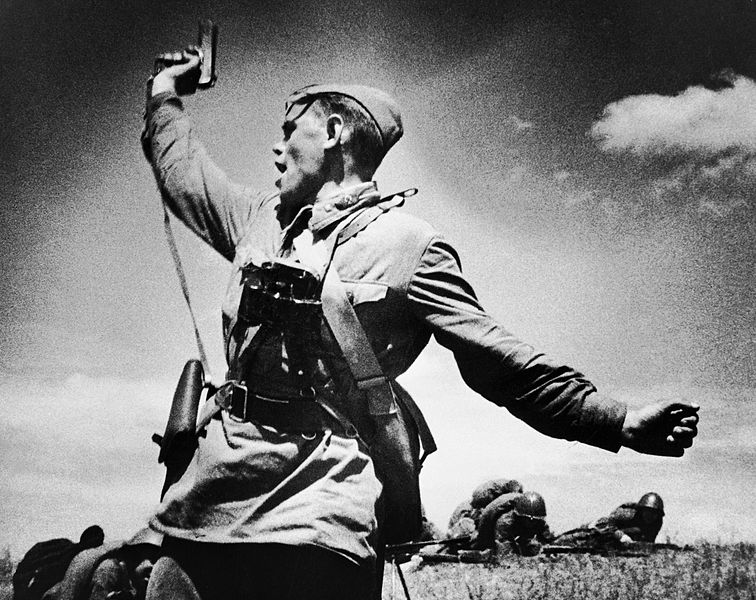
Kombat (Russian: Комбат, lit. “battalion commander”) is a black-and-white photograph by the Soviet photographer Max Alpert. It depicts a Soviet military officer armed with a TT pistol who is raising his unit for an attack during World War II. This work is regarded as one of the most iconic Soviet World War II photographs, yet neither the date nor the subject is known with certainty. According to the most widely accepted version, the photograph depicts junior politruk (political officer) Aleksei Gordeyevich Yeryomenko, minutes before his death on 12 July 1942, in Voroshilovgrad Oblast, Ukraine.
Wikimedia Commons.
Allied victory in WWII is usually viewed through the lens of large land battles, from Stalingrad to Kursk to D-Day. However, battlefield losses of equipment in these “great” land battles were relatively small and easily replaceable. This column demonstrates that the real effort of the major powers was put into the construction of air and sea weapons. The Allies used their air and sea power to destroy the Axis’s in a multi-layered campaign. This was the true battlefield of WWII: a massive air-sea super battlefield that stretched for thousands of miles. Victory in this super-battlefield led to victory in the war.
Every aspect of WWII is discussed in a vast literature. Considering its diversity, explanations of why Germany lost the war are surprisingly predictable. It remains widely argued that the Nazis were beaten mostly by the Soviet Union’s powerful Red Army (Hastings 2005: 508, Kennedy 2013: 183).
From June 1941 to May 1945, German “power” was supposedly engaged and destroyed by the Russians. At some points, more than two-thirds of German infantry were engaged against the Red Army. The famous battles of the Eastern Front, such as Stalingrad and Kursk, supposedly caused the Germans’ crippling losses. The upshot of this lopsided deployment was that most German soldiers died in the East. Fighting against the Americans and British, conversely, is often portrayed as a secondary concern (Roberts 2010: 573).
What’s wrong with a focus on battles?
This battle-centric view, like much history of WWII, is old-fashioned. Historians of strategy have moved away from seeing battles as determinative. Nolan (2017) has argued that attrition losses are more important than battle losses in explaining outcomes.
The battle-centric analysis implies that infantry deployment is the best way to analyse effort. Yet, human-power was rarely the key factor in deciding combat in WWII. Equipment and specialised training mattered more. Possessing and operating the largest stores of modern weapons, not only tanks and artillery but also aircraft and naval vessels, determined the course of battles and the war.
If we reframe the discussion of the war to look not only at what equipment was made but also at how it was destroyed, it emerges that the war was decided far from the land battlefield (O’Brien 2015). The most striking sign of this is how little war production went to the land war and how much went to the combined air-sea war. This was the case for all the powers except the USSR.
September 3, 2019
An alternative end to the Molotov-Ribbentrop Pact?
On the anniversary of the German invasion of Poland, Arthur Chrenkoff wonders if Stalin’s greatest miscalculation wasn’t refraining from attacking the Nazi forces after they’d been fighting the Polish army for three weeks in 1939:
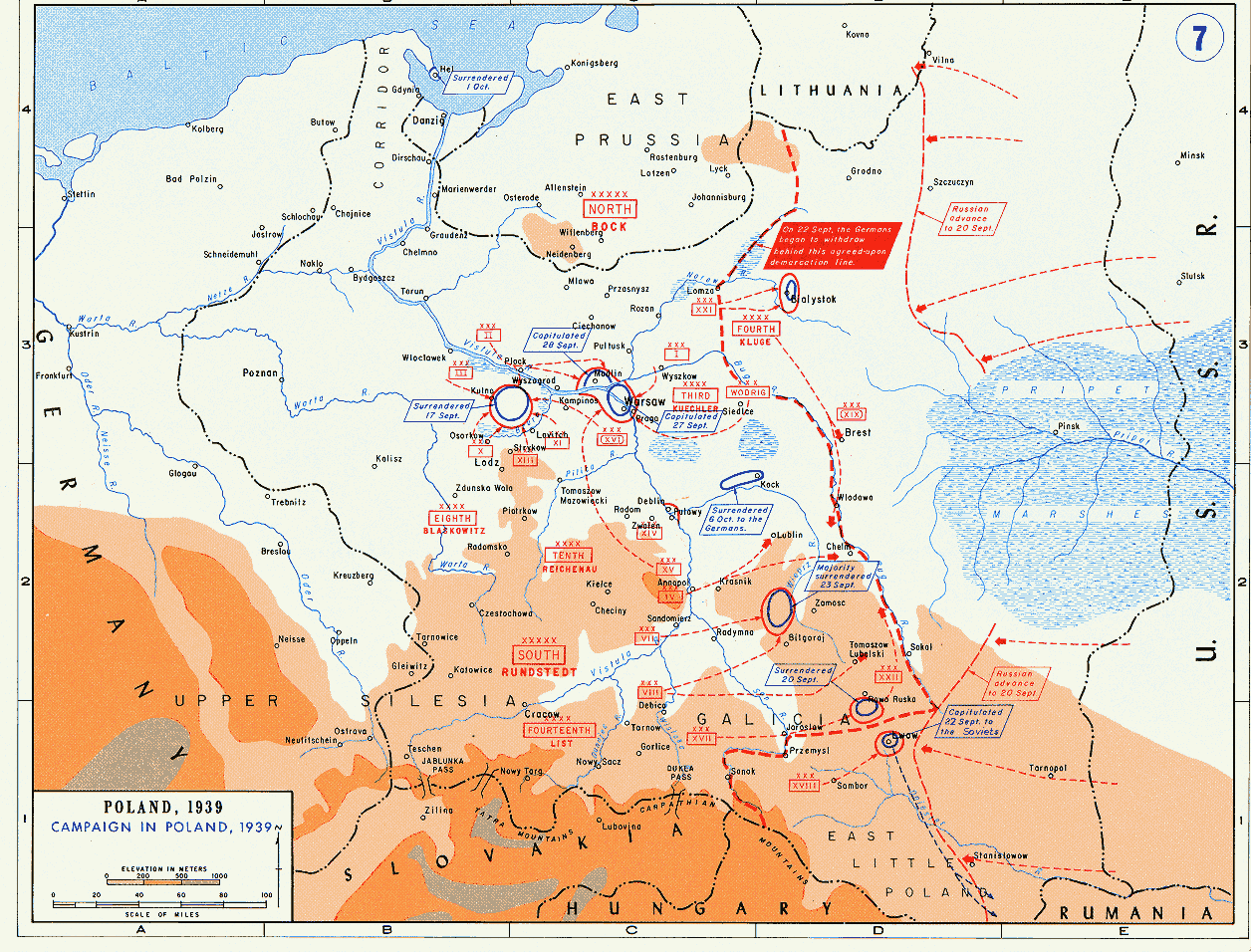
Military situation in Poland, 14 September 1939 (map does not show Slovak Army activity in southern Poland).
United States Military Academy, Department of History via Wikimedia Commons.
In late August, the Soviet Union signed the infamous Ribbentrop-Molotov non-aggression pact with Germany, effectively green-lighting Hitler’s invasion of Poland a few days later. The secret protocols attached to the pact stipulated for the division of Central Europe between the two powers, with the Soviet Union being rewarded for its cooperation with the Nazis with the gift of eastern Poland, the Baltic states and Bessarabia, or the north-eastern Romania (as well as, it transpired later, the German non-interference during the Soviet invasion of Finland).
The Soviets were not naive (even if Stalin discounted all the indications of the coming German attack in 1941) to believe in a long-term friendship with Nazi Germany. There are strong indications that the Soviet Union intended to attack Germany, perhaps sometime in 1942, but Hitler beat it to the punch. The official Russian justification for the Ribbentrop-Molotov pact has certainly always been that the Soviet Union needed to buy itself extra time to prepare for this eventual showdown, since in 1939 it was still nowhere near ready (not least because of Stalin’s decapitation of the Red Army’s top leadership during the Great Terror a few years before).
But what if that was Stalin’s greatest miscalculation ever? By 17 September, when the Red Army crossed the eastern borders of Poland in accordance with the secret partition agreement, it was pretty clear to all that Poland was close to a military defeat (it would have hold on for longer, of course, without the Soviet stab in the back, but this would not have changed much without the Western allies’ military involvement, which never eventuated). While the German armed forces were winning, they were also overcommitted and overstretched. The German high command expected a quicker and easier victory and were taken aback by the ferocity of Polish resistance, despite clear German superiority in armour, air power and logistics. By the second half of September, some ammunition stocks were beginning to run low (particularly bombs) and motorised equipment, from tanks to trucks, has been significantly degraded through a combination of attrition and significant wear and tear in Polish autumn.
So what if the Red Army, instead of eventually coming to a halt along the previously agreed demarcation line, kept going west? There was no significant Polish military force to take into account and German army was tired and weakened after three weeks of hard fighting (losing a third of its tanks and 25 per cent of its air force in the process). While Wehrmacht had numerical advantage on the ground, this was only because the Red Army chose to invade Poland with half a million men, which was certainly enough to subdue the thinly-held eastern marches, but should they have needed it, the Soviets had reserves to draw upon to even out the field against the Germans. Even with their 33 committed divisions, the Red Army had a significant advantage over the German armed forces in the Polish theatre in terms of armour and air power (two to one for the former).
Who would have triumphed in this 1939 clash of the rival totalitarian war machines? We don’t know, of course, except that at the time of the invasion of Poland, Germany was militarily at its weakest point it would be until the final months of World War Two. Should the Red Army have proven victorious in September and October 1939, it would have likely ended up in Berlin in a matter of weeks, instead of years it eventually took. It’s a reasonable guess that Great Britain and France, faced with the Soviet invasion of the Reich and the looming defeat of Hitler, would have overcome their initial inertia and moved into Germany from the west so as to prevent having the communists proverbially water their horses in the Rhine. In this scenario, we would have ended up with a divided Germany and a divided Europe (though without much of the rest of Central and south-Eastern Europe in the Soviet camp) some six years earlier and without the tens of millions of dead, a ruined continent, and the Holocaust that accompanied World War Two as it actually unfolded.
Alas.
August 30, 2019
“Stalingrad” – World War Two – Sabaton History 030 [Official]
Sabaton History
Published on 29 Aug 2019The Sabaton song “Stalingrad” is about the devastating battle of the Russian city of Stalingrad, which lasted for 5 months from August 1942 till February 1943. The battle is infamous for its brutal street fighting and high casualties on both sides.
Support Sabaton History on Patreon: https://www.patreon.com/sabatonhistory
Listen to Primo Victoria (where “Stalingrad” is featured):
CD: http://bit.ly/PrimoVictoriaStore
Spotify: http://bit.ly/PrimoVictoriaSpotify
Apple Music: http://bit.ly/PrimoVictoriaAppleMusic
iTunes: http://bit.ly/PrimoVictoriaiTunes
Amazon: http://bit.ly/PrimoVictoriaAmzn
Google Play: http://bit.ly/PrimoVictoriaGooglePlayHosted by: Indy Neidell
Written by: Markus Linke and Indy Neidell
Directed by: Astrid Deinhard and Wieke Kapteijns
Produced by: Pär Sundström, Astrid Deinhard and Spartacus Olsson
Creative Producer: Joram Appel
Executive Producers: Pär Sundström, Joakim Broden, Tomas Sunmo, Indy Neidell, Astrid Deinhard, and Spartacus Olsson
Maps by: Eastory
Edited by: Iryna Dulka
Sound Editing by: Marek KaminskiEastory YouTube Channel: https://www.youtube.com/channel/UCElybFZ60Hk1NSjgCf7I2sg
Archive by: Reuters/Screenocean https://www.screenocean.com
Music by Sabaton.Sources:
– Photo of Stalingrad field hospital – Natalia Bode
– Photo of the Soviet loudspeaker by Arkady Shaikhet
– Colorization by Klimbim: German soldier in Stalingrad, Soviet machine gunners
– IWM: TR 153An OnLion Entertainment GmbH and Raging Beaver Publishing AB co-Production.
© Raging Beaver Publishing AB, 2019 – all rights reserved.
August 26, 2019
Russia attempts to retroactively “normalize” the Molotov-Ribbentrop Pact
Just before the outbreak of World War II on the Polish-German frontier, the Soviet Union concluded a non-aggression pact with Hitler’s Germany that included a large slice of Polish territory and a free hand in the Baltic for Soviet expansion (only the early Finnish success prevented total Soviet domination of the eastern Baltic region). The current Russian government is conducting a public relations (propaganda) campaign to recast this pact as being unexceptional diplomatic activity by attempting to cast Britain, France, and all the other countries that had active diplomatic arrangements with Germany as being “just the same” as the infamous Molotov-Ribbentrop Pact. Wikipedia sums up the fate of the two chief diplomats:
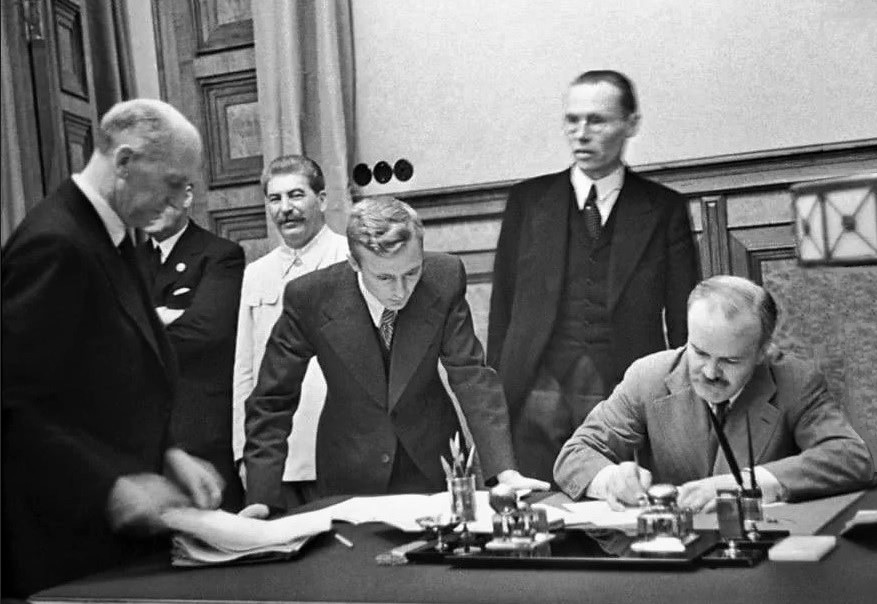
Translation of the Russian caption for this image:
People’s Commissar of Foreign Affairs of the USSR V.M. Molotov signs a friendship and border treaty between the USSR and Germany. Among those present: I.V. Stalin, translator of the Ministry of Foreign Affairs V.N. Pavlov, German diplomat G. Hilger (“truncated” version of the photograph of M. Kalashnikov distributed on the net)
Photograph attributed to Mikhail Mikhaylovich Kalashnikov (1906-1944) via Wikimedia Commons.
The Pact was terminated on 22 June 1941, when Nazi Germany launched Operation Barbarossa and invaded the Soviet Union (thus as well executing the ideological goal of Lebensraum). After the war, von Ribbentrop was convicted of war crimes and executed. Molotov died aged 96 in 1986, five years before the USSR’s dissolution. Soon after World War II, the German copy of the secret protocol was found in Nazi archives and published in the West, but the Soviet government denied its existence until 1989, when it was finally acknowledged and denounced. Vladimir Putin, while condemning the pact as “immoral”, has also defended the pact as a “necessary evil”, a U-turn following his earlier condemnation
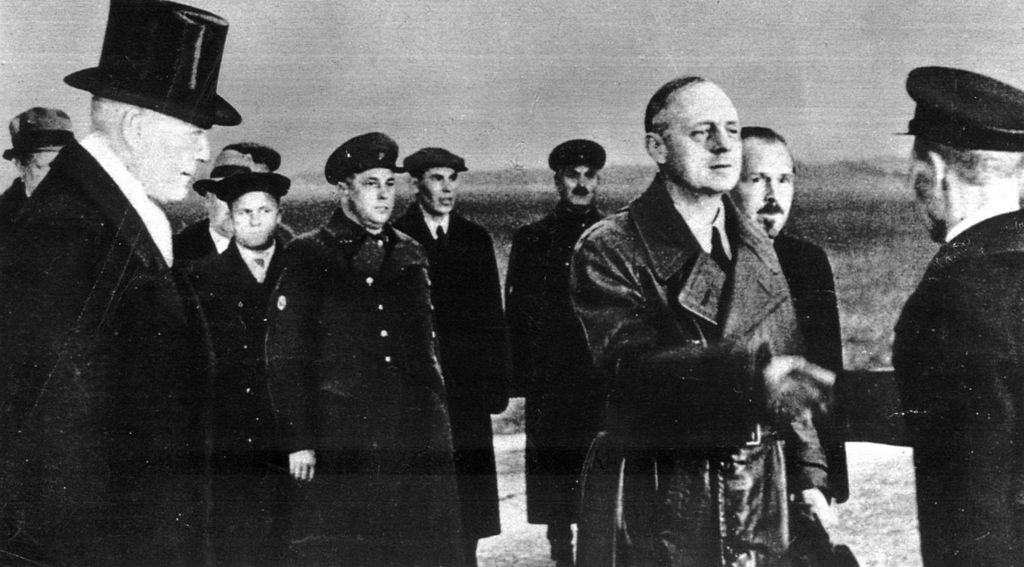
Ribbentrop arrives at Moscow airport, August 1939.
Photograph via Wikimedia Commons.
Arthur Chrenkoff explains why we should vigorously resist this attempt to “normalize” Molotov-Ribbentrop:
1. While the shameful Western appeasement of Hitler, culminating in the infamy of Munich, allowed the Reich to bloodlessly dismember the sovereign and democratic Czechoslovakia, neither Great Britain nor France participated in or benefited from Germany’s cannibalism of this “faraway country of which we know little”. The difference is that while the West remains ashamed of Munich (a name which quickly become synonymous with a craven sell-out), a few years back, Russia’s culture minister Vladimir Medinsky called the Ribbentrop-Molotov pact “a great achievement of Soviet diplomacy”.
2. Unlike all the other agreements signed with Germany during the 1930s, it was the Ribbentrop-Molotov pact that green-lit the armed German aggression and led to the outbreak of the deadliest war in human history. It’s difficult to blame Germany’s neighbours or countries threatened by the Soviet Union (like Poland, Romania and the Baltic states) for trying to stay on Germany’s good side. It was naive and in any case it didn’t work in the end, as they all later found out to their detriment and downfall. Soviet Union, on the other hand, not only climbed into bed with Nazi Germany but it fully and enthusiastically consummated this marriage of convenience.
3. Unlike other agreements cited above, thanks to the “secret protocols” attached to the Ribbentrop-Molotov pact, the Soviet Union was both a co-aggressor in and a co-beneficiary of the start of World War Two. Stalin has relatively bloodlessly acquired the by-then (mid-September) almost defenseless eastern Poland (subsequently incorporated into Belarussian and Ukrainian Soviet Republics; these historically Polish areas remain today parts of Belarus and Ukraine), Bessarabia from Romania (incorporated into the Moldovan Soviet Republic), the Baltic States of Lithuania, Latvia and Estonia, as well as being given a free hand in the invasion of Finland, a country which otherwise might have counted on German friendship and support. All these aggressive territorial gains were the consequence of the Ribbentrop-Molotov division of Eastern Europe between the Reich and the Soviet Union into the respective spheres of interest, soon confirmed as the “facts on the ground” by Wehrmacht and Red Army.
4. While Britain and France, their empires and their allies, fought Germany for almost two years after September 1939, first through the period of the “phony war”, then through the Blitzkrieg in the West and the Battle of Britain, the Soviet Union remained a de facto Nazi ally, continuing to cooperate in security matters and supplying Germany with food and raw materials. Grain trains were still rolling west across the border with the Reich as Wehrmacht was launching Operation Barbarossa in the morning of 22 June 1941. During the period of Nazi-Soviet cooperation, Germany conquered Poland, Norway, Denmark, Belgium, the Netherlands, Luxembourg, France, Yugoslavia and Greece. Soviet exports helped to feed and build up the German war machine before it was unleashed against the West in 1940; German troops surging into the Low Countries walked on their stomachs (to borrow from Napoleon) full of bread baked from Russian wheat or were carried on the tanks and trucks made with Russian coal and ores. Never forget that for Russia, World War Two – or the Great Patriotic War as it is called there – begins only in June 1941, not September 1939, as it does in all Western history books.
5. It’s true that the Ribbentrop-Molotov pact was partly defensive in nature as far as the Soviet Union was concerned, aiming to postpone the inevitable armed clash between the two rival totalitarianisms and in the meantime give Russia some essential breathing space to build up its army and strategic reserves (the top leadership of the Soviet armed forces was decapitated by Stalin during the purges in 1937-8, leaving them even more unprepared to face Germany than would have otherwise been the case). But as I pointed out above, it was also offensive and directly benefited Stalin’s territorial ambitions while it lasted. In some ways, the legacy of the pact lives on in the shape of Poland’s post-war borders, which have nothing to do with its thousand-year history. This is the real #TruthAboutWWII and this is why the Ribbentrop-Molotov pact remains singled out in the infamy of the interwar European democracy.
August 17, 2019
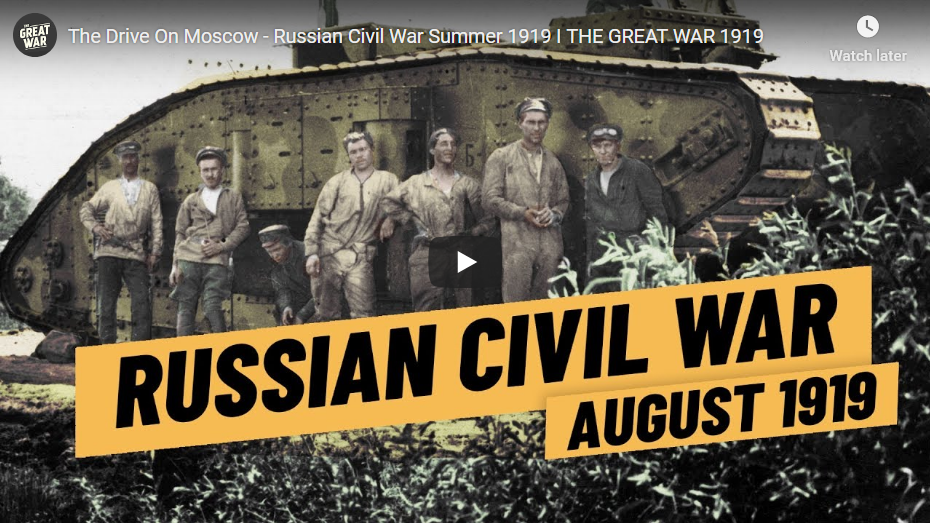
The Drive On Moscow – Russian Civil War Summer 1919 I THE GREAT WAR 1919
The Great War
Published on 16 Aug 2019Register for our free newsletter: https://realtimehistory.net/subscribe
The summer of 1919 was a pivotal moment in the Russian Civil War. Backed with Allied support the White movement went on the offensive in the East under Alexander Kolchak and in the South under Anton Denikin. However, the Bolsheviks were not wasting time either. They consolidated their power and got the Red Army into shape to crush the enemy once and for all.
» SUPPORT THE CHANNEL
Patreon: https://realtimehistory.net/patreon
Merchandise: https://realtimehistory.net/spreadshirt
Become a member: https://realtimehistory.net/join» BUY OUR SOURCES IN OUR AMAZON STORES
https://realtimehistory.net/amazon» SOURCES
Smele, Jonathan. The “Russian” Civil Wars 1916-1926 (London: Hurst, 2015).Makhno, Nestor. The Struggle Against the State and Other Essays. AK Press: Edinburgh & San Francisco, 1996.
Mawdsley, Evan. The Russian Civil War (New York: Pegasus Books, 2005).
Robert Gerwarth, The Vanquished. Why the First World War Failed to End, 1917-1923 (Penguin, 2017)
Sumpf, Alexandre. “Russian Civil War”, in 1914-1918 online. International Encyclopedia of the First World War. https://encyclopedia.1914-1918-online.
Mawdsley, Evan. “International Responses to the Russian Civil War”, in 1914-1918 online. International Encyclopedia of the First World War. https://encyclopedia.1914-1918-online…
Leonhard, Jörn. Der überforderte Frieden. Versailles und die Welt 1918-1923 (CH Beck, 2018).
Figes, Orlando. A People’s Tragedy. The Russian Revolution (London: The Bodley Head, 2017 [1996]).
Gilley, Christopher: “Makhno, Nestor Ivanovich”, in: 1914-1918-online. International Encyclopedia of the First World War, ed. by Ute Daniel, Peter Gatrell, Oliver Janz, Heather Jones, Jennifer Keene, Alan Kramer, and Bill Nasson, issued by Freie Universität Berlin, Berlin 2014-10-08 https://encyclopedia.1914-1918-online…
»CREDITS
Presented by: Jesse Alexander
Written by: Jesse Alexander
Director: Toni Steller & Florian Wittig
Director of Photography: Toni Steller
Sound: Toni Steller
Editing: Toni Steller
Mixing, Mastering & Sound Design: http://above-zero.com
Maps: Daniel Kogosov (https://www.patreon.com/Zalezsky)
Research by: Jesse Alexander
Fact checking: Florian WittigChannel Design: Alexander Clark
Original Logo: David van StepholdA Mediakraft Networks Original Channel
Contains licensed material by getty images
All rights reserved – Real Time History GmbH 2019
From the comments:
The Great War
7 hours ago
Register for our free newsletter and win $250 worth of our recommended history books: https://realtimehistory.net/win **Instead of paying Facebook, Twitter & Co. money for the possibility to reach you with our content, we’d rather get in touch with you directly and spend the money on history books and the production of the show.
August 16, 2019
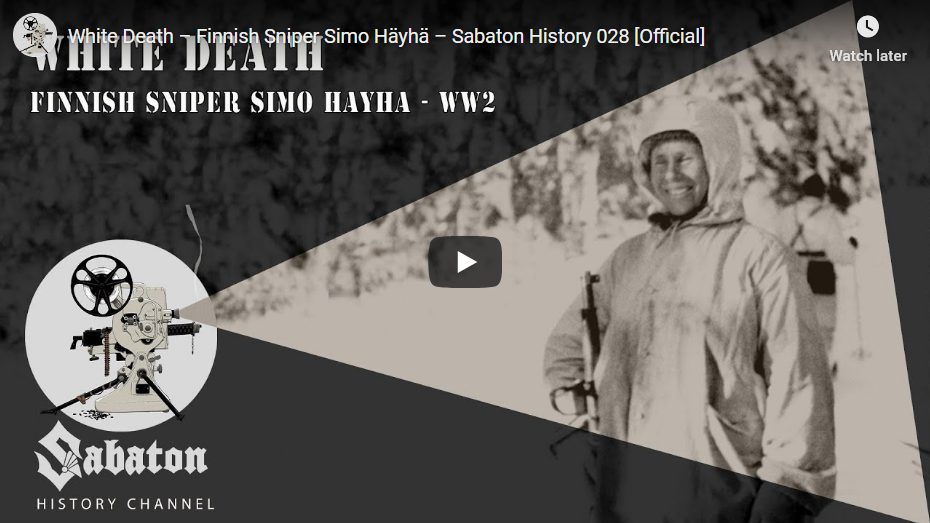
“White Death” – Finnish Sniper Simo Häyhä – Sabaton History 028 [Official]
Sabaton History
Published on 15 Aug 2019One of the deadliest snipers ever to roam the face of the earth was Simo Häyhä, who fought on the Finnish side during the Winter War in 1939 and 1940. He was also known as White Death, as he killed an estimated 500 Russians in the cold snowy winter.
Support Sabaton History on Patreon: https://www.patreon.com/sabatonhistory
Watch our episode on “Talvisota” here: https://youtu.be/6grVeu3EWis
Listen to Coat of Arms (where “White Death” is featured):
CD: http://bit.ly/CoatOfArmsStore
Spotify: http://bit.ly/CoatOfArmsSpotify
Apple Music: http://bit.ly/CoatOfArmsAppleMusic
iTunes: http://bit.ly/CoatOfArmsiTunes
Amazon: http://bit.ly/CoatOfArmsAmzn
Google Play: http://bit.ly/CoatOfArmsGooglePlayHosted by: Indy Neidell
Written by: Markus Linke and Indy Neidell
Directed by: Astrid Deinhard and Wieke Kapteijns
Produced by: Pär Sundström, Astrid Deinhard and Spartacus Olsson
Creative Producer: Joram Appel
Executive Producers: Pär Sundström, Joakim Broden, Tomas Sunmo, Indy Neidell, Astrid Deinhard, and Spartacus Olsson
Maps by: Eastory
Edited by: Iryna Dulka
Sound Editing by: Marek KaminskiEastory YouTube Channel: https://www.youtube.com/channel/UCEly…
Archive by: Reuters/Screenocean https://www.screenocean.com
Music by Sabaton.Sources: SA-Kuva, Finish wartime archive.
An OnLion Entertainment GmbH and Raging Beaver Publishing AB co-Production.
© Raging Beaver Publishing AB, 2019 – all rights reserved.
From the comments:
Sabaton History
2 days ago (edited)
This episode is one of the most frequently requested songs for Sabaton History. And while the story of Simo Häyhä is a compelling story, the Winter War was about much more than the deadliest sniper of World War Two. We have made an earlier episode about the Winter War, based on the Sabaton Song “Talvisota”, which is Finnish for Winter War. You can watch that right here: https://youtu.be/6grVeu3EWis. If after that, you’re keen to dive even deeper into the history of the Winter War, I suggest you check out Indy’s World War Two channel, where he covered the Winter War (and everything before and after that) week by week. You can check that out right here: https://www.youtube.com/c/worldwartwo
August 12, 2019
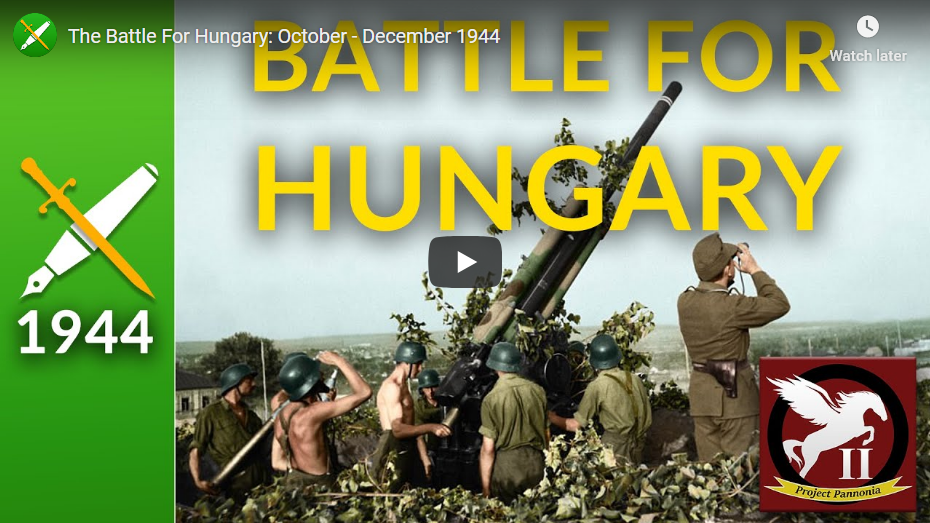
The Battle For Hungary: October – December 1944
Historigraph
Published on 10 Aug 2019Join me in War Thunder! Use my link for a FREE premium aircraft, tank or ship and a three day account boost as a BONUS: https://gjn.link/Historigraph/190810 Also available for free on PlayStation®4 and Xbox One.
If you enjoyed this video and want to see more made, consider supporting my efforts on Patreon: https://www.patreon.com/historigraph
To chat history, join my discord: https://discord.gg/vAFTK2D
I’m indebted to some viewers for helping me out with pronounciation of Hungarian words:
https://www.youtube.com/watch?v=FApWW…
https://www.youtube.com/watch?v=nCG_w…If you are Hungarian, please be charitable as I will still not have the word sounds 100% correct, as I am not a native speaker. I’m not about to put on a bad hungarian accent!
#WarThunder #BattleForHungary #HistorigraphSources:
The Siege of Budapest and the battles that led to it have had precious little written about them (in English!), so the bulk of this video (and the next) comes from one book:
Krisztián Ungváry, Battle for Budapest: 100 Days in World War 2
This is by far the most detailed account of the battle that I could find.
August 11, 2019
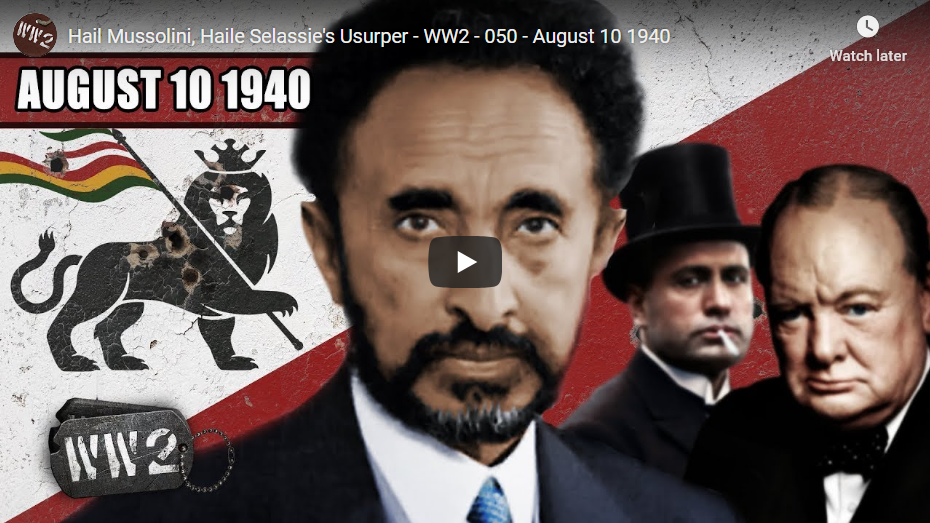
Hail Mussolini, Haile Selassie’s Usurper – WW2 – 050 – August 10 1940
World War Two
Published on 10 Aug 2019This week, the war spreads to Africa, when the Italians invade the British Colony of British Somaliland. While this might seem trivial, it might have tremendous consequences on the remainder of the war.
Join us on Patreon: https://www.patreon.com/TimeGhostHistory
Or join The TimeGhost Army directly at: https://timeghost.tvFollow WW2 day by day on Instagram @World_war_two_realtime https://www.instagram.com/world_war_t…
Join our Discord Server: https://discord.gg/D6D2aYN.
Between 2 Wars: https://www.youtube.com/playlist?list…
Source list: http://bit.ly/WW2sourcesWritten and Hosted by: Indy Neidell
Produced and Directed by: Spartacus Olsson and Astrid Deinhard
Executive Producers: Bodo Rittenauer, Astrid Deinhard, Indy Neidell, Spartacus Olsson
Creative Producer: Joram Appel
Post-Production Director: Wieke Kapteijns
Research by: Indy Neidell
Edited by: Iryna Dulka
Map animations: EastoryColorisations by Norman Stewart and Julius Jääskeläinen https://www.facebook.com/JJcolorization/
Eastory’s channel: https://www.youtube.com/channel/UCEly…
Archive by Screenocean/Reuters https://www.screenocean.com.Sources:
Freepngimg.com
IWM: CH 3484
Sound effect: littlerobotsoundfactoryA TimeGhost chronological documentary produced by OnLion Entertainment GmbH.
From the comments:
World War Two
2 days ago
Last week, we saw how one of our flagship episodes was taken down by YouTube. It turned out that this was a mistake by a YouTube worker who erroneously identified our content as hate speech. While we contacted YouTube immediately to protest, they themselves noticed the mistake before we reached the right people. They have since apologized to us and reinstated the episode. You can watch it here: https://youtu.be/DLN8NHXiMy0. We welcome YouTube’s diligence in fighting against extremist hateful content, especially in light of the current tragic events in the US, and we have accepted their apology. However, this does not change the fact that we still face demonetization of many of our videos, connected to lower recommendation of these videos. This is a problematic situation that we deplore – we continue to believe that the best way to fight ignorance and hatred is by education and that is at the heart of what we do here, unfortunately YouTube’s monetization policies continue to stand in the way of that mission.When the episode went down we saw a surge of support from many of you and we are humbly grateful for our dedicated community. The effort you all have made to share our content and support us on Patreon and timeghost.tv is what makes this show possible, and it’s an honor to have you all here. It is your support, both financially and in spirit that keeps us getting up in the morning to face yet another day of the war. Thank You!
Cheers,
The TimeGhost team
August 3, 2019
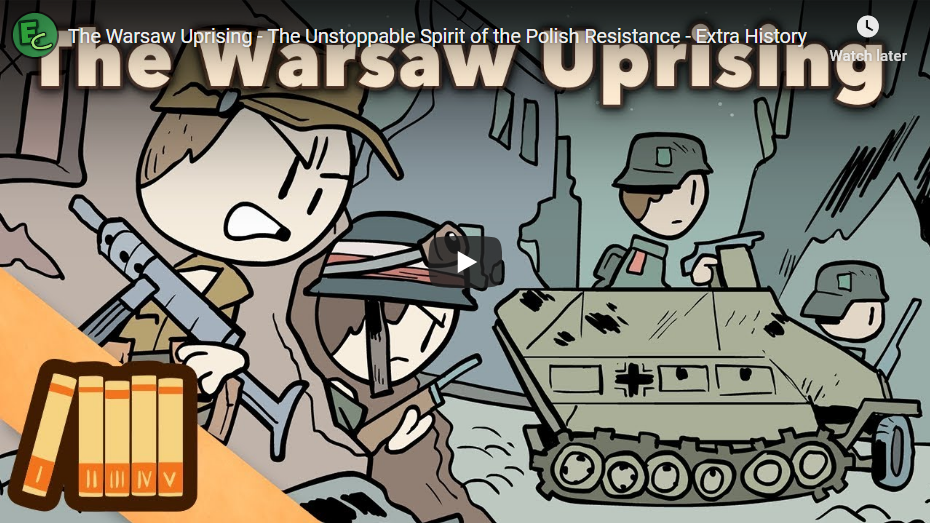
The Warsaw Uprising – The Unstoppable Spirit of the Polish Resistance – Extra History
Extra Credits
Published on 1 Aug 2019Thanks to the Polish National Foundation for sponsoring this video. https://www.pfn.org.pl/
The Polish are determined to make Poland matter on the world stage, and they will not wait for whatever mercies may come from the Russians. So the Home Army stages their own uprising to liberate Warsaw, and for some 60-odd days, their strongest members, the Grey Ranks, tragically held steadfast.
Join us on Patreon! http://bit.ly/EHPatreon
July 26, 2019
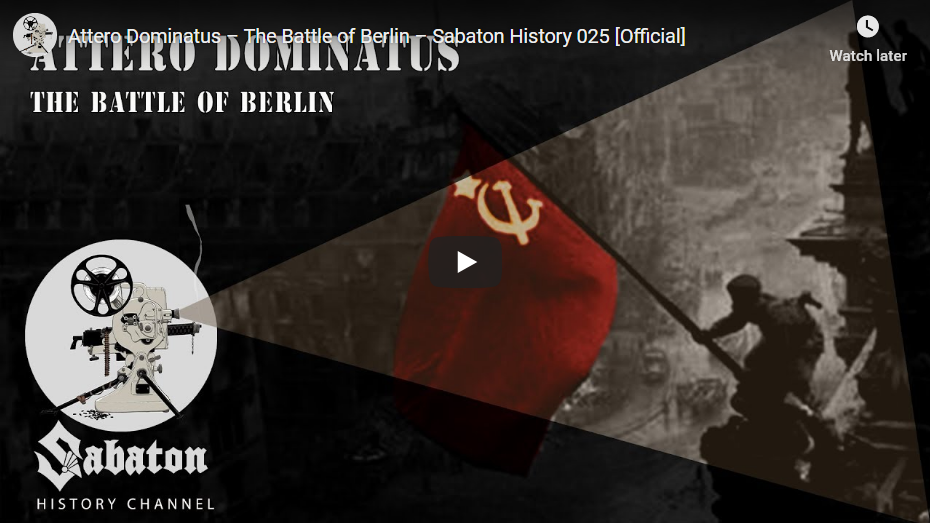
“Attero Dominatus” – The Battle of Berlin – Sabaton History 025 [Official]
Sabaton History
Published on 25 Jul 2019The Sabaton song “Attero Dominatus” is about the Soviet advance on Berlin in the last months of World War Two. As the Soviets approach Berlin, two commanders, General Zhukov and General Konev, try their best to be the one to take the centre of the German capital. Meanwhile, thousands of Germans are raped or murdered by the Soviets in retaliation to the atrocities that the Germans committed in the east.
Support Sabaton History on Patreon: https://www.patreon.com/sabatonhistory
Listen to Attero Dominatus (where “Attero Dominatus” is featured):
CD: http://bit.ly/AtteroDominatusStore
Spotify: http://bit.ly/AtteroDominatusSpotify
Apple Music: http://bit.ly/AtteroDominatusAppleMusic
iTunes: http://bit.ly/AtteroDominatusiTunes
Amazon: http://bit.ly/AtteroDominatusAmzn
Google Play: http://bit.ly/AtteroDominatusGooglePlayCheck out the official videoclip for “Attero Dominatus” here: https://www.youtube.com/watch?v=eNlRq…
Listen to Sabaton on Spotify: http://smarturl.it/SabatonSpotify
Official Sabaton Merchandise Shop: http://bit.ly/SabatonOfficialShopHosted by: Indy Neidell
Written by: Markus Linke and Indy Neidell
Directed by: Astrid Deinhard and Wieke Kapteijns
Produced by: Pär Sundström, Astrid Deinhard and Spartacus Olsson
Creative Producer: Joram Appel
Executive Producers: Pär Sundström, Joakim Broden, Tomas Sunmo, Indy Neidell, Astrid Deinhard, and Spartacus Olsson
Maps by: Eastory
Edited by: Iryna Dulka
Sound Editing by: Marek KaminskiEastory YouTube Channel: https://www.youtube.com/channel/UCEly…
Archive by: Reuters/Screenocean https://www.screenocean.com
Music by Sabaton.An OnLion Entertainment GmbH and Raging Beaver Publishing AB co-Production.
Sources:
Colored portrait of W. Wenck by Ruffneck88
Ministry of Defence of the Russian Federation
Photos of Helmuth Weidling from ww2gallery on Flickr© Raging Beaver Publishing AB, 2019 – all rights reserved.