
The Times managed to get the salient feature of the story entirely wrong. They were not an “anti-government” mob, but a government mob, a mob of “public servants” objecting to austerity measures that would end, for example, the tradition of 14 monthly paychecks per annum. You read that right: the Greek public sector cannot be bound by anything so humdrum as temporal reality. So, when it was mooted that the “workers” might henceforth receive a mere 12 monthly paychecks per annum, they rioted. Their hapless victims — a man and two women — were a trio of clerks trapped in a bank when the mob set it alight and then obstructed emergency crews attempting to rescue them.
You don’t have to go to Athens to find “public servants” happy to take it out on the public. In Madison, politicized doctors provide fake sick notes for politicized teachers to skip class. In New York’s Christmas snowstorm, Sanitation Department plough drivers are unable to clear the streets, with fatal consequences for some residents. On the other hand, they did manage to clear the snow from outside the Staten Island home of Sanitation Dept head honcho John Doherty, while leaving all surrounding streets pristinely clogged. Three hundred Sanitation Department workers have salaries of over $100,000 per year. In retirement, you get a pension of 66 grand per annum plus excellent health benefits, all inflation proofed.
That’s what “collective bargaining” is about: It enables unions rather than citizens to set the price of government. It is, thus, a direct assault on republican democracy, and it needs to be destroyed. Unlovely as they are, the Greek rioters and the snarling thugs of Madison are the logical end point of the advanced social democratic state: not an oppressed underclass, but a spoiled overclass, rioting in defense of its privileges and insisting on more subsidy, more benefits, more featherbedding, more government.
Mark Steyn, “States of the Unions”, SteynOnline, 2011-02-26
February 27, 2011
QotD: Big government and big unions
February 25, 2011
What the large print giveth, the small print taketh away
Ever read the fine print of a contract to discover that the actual term of the contract contradicts the claims? Britain’s Office of Fair Trading is looking into this practice:
Companies whose small print changes the basis of consumer deals will face investigation by consumer regulator the Office of Fair Trading (OFT), it has said. According to the OFT, one in five consumers had experienced a contract problem in the last year.
The OFT has set out the criteria it will use to judge whether or not consumer contracts are unfair and should be investigated by it. The crucial factor determining the fairness of contracts will be the consumer’s understanding of what the contract means.
If the small print of terms and conditions alters the contract from what a consumer would understand it to mean from other claims made by a company, that is likely to be harmful and could be unlawful, the OFT said in a paper on unfair contracts.
“Our approach to identifying the potential for harm from a particular contract, before considering whether there is any breach of law, is to assess whether a contract term changes the deal from what consumers understand it to be,” said the OFT’s paper.
“One way in which a contract term can change the deal is where there are surprises buried in the small print,” it said. “Our research found that for 80 per cent of those who had experienced a problem with a consumer contract, the problem came as a surprise.”
February 24, 2011
UK’s largest off-grid housing development
If you’re really a fan of alternative energy, you might want to keep an eye on this new development in Brighton:
The six apartment buildings, to be built at the mouth of Shoreham port near Brighton, will be linked by wind turbines, and their southern face will be tiled in solar thermal and photovoltaics panels.
Batteries will be charged during the day in order to keep the lights on at night, and the apartments themselves will be heavily insulated in order to keep power use as low as possible.
But resident behaviour will also play a key role, says the developer, Colin Brace of Bohogreen, who has worked on previous low-carbon projects. “We can’t tell people that you only have so much power, and no more. But there are studies showing that if you give people renewable energy they think, oh good, it’s free, and their energy use actually goes up. So an important aspect of the project will be to educate people about their energy use.
“The apartments will be designed to encourage communal living as much as possible,” says Brace, “rather than having everyone in their own rooms using their own sources of power.” There will also be LED lights on the wind turbines which light up red, amber and green to show which block is using power most heavily, in order to foster “a healthy sense of competition between residents to keep their power use low”.
I wouldn’t want to live in a development where the neighbours are pre-selected for their “greener than thou” attitudes, frankly. The LED lights of shame would probably encourage more neighbour nosiness into the lives of the other residents.
Of course, all that healthy greenery comes at a slight premium to ordinary housing:
The apartments in Portzed will be up to 22% more expensive than an “on-grid” development, due to the extra costs of installing high-spec insulation and renewables. At current market rates, that could add £20-24,000 to the final price of a two-bedroom flat. The developers believe however that there is a high demand for this kind of home due to their rarity. The financing for the project is already in place and the project is expected to be financial viable.
The core of the Irish financial crisis
Theodore Dalrymple explains the underlying reason for Ireland’s financial woes:
If you want to study the economic crisis of the last few years, go to Ireland, where you will find it in its purest form. Ireland is a small country, with a population of just 4.4 million, and the connection between clientelistic politics, bankers’ cupidity, and the mass psychology of bubble markets is easiest to comprehend there.
Dotted around the country, outside of almost every town and sometimes in the middle of nowhere, are housing estates — completed, half-completed, and never-to-be-completed — which are unsaleable, will almost certainly never be inhabited, and are destined to fall into graceless ruins. Some 300,000 new dwellings now stand empty in the Irish Republic, a number whose equivalent in the United States would be approximately 21 million.
[. . .]
A house in Shrewsbury Road, Dublin, sold for $80 million in 2005 but, now standing empty, is on the way to dereliction, and no house on the road — a millionaires’ row — has sold for the last two years, despite a fall in prices of at least 66 percent. During the boom, taxi drivers and shop assistants would tell you about the third or fourth house they had bought — on borrowed money, of course — and of their apartments in Europe, from Malaga to Budapest to the Black Sea Coast of Bulgaria. It was not so much a boom as a gold rush, or a modern reenactment of the Tulipomania.
February 23, 2011
Now you can’t have “Cornish Pasties” unless they’re from Cornwall
Apparently the poor bakers of Cornwall have been driven to the edge by unfair competition. They’ve been fighting the tide of so called “Cornish Pasties” that have never been within hundreds of miles of Cornwall. Now, thanks to the intrepid bureaucrats of Brussels, the Cornish Pasty now has the same kind of name protection as Champagne:
Aficionados of the Cornish pasty will in future be assured that their pasty is the real deal, following a European Commission ruling that only pasties prepared in Cornwall in the traditonal way can be labelled “Cornish”.
Cornish maiden bearing platter of genuine Cornish pasties. Photo: Cornish Pasty AssociationThe announcement that the pasty has been granted “protected geographical indication” (PGI) marks a great day for the Cornish Pasty Association, which for nine years has battled to protect its product from pretenders pumping out non-traditional imitations “inferior in both quality and taste”.
I’ve always been a big fan of “Cornish Pasties”, but I now discover that I’ve apparently been cheated all these years: I’ve never actually eaten a “real” Cornish Pasty in my entire life! (And given that I’ve never been to Cornwall, I may never try one . . .)
February 22, 2011
Former UK Home Secretary shocked to discover the internet awash in porn
The amusing thing is that she lead a major effort to suppress “extreme porn” while in office:
Former Home Secretary Jacqui Smith has professed herself “shocked” at the availability of porn on the internet after investigating the issue for a radio documentary.
Which raises the question of what exactly she thought she was cracking down on during her time in charge of law and order.
[. . .]
Smith told the Radio Times that during her research for the documentary, she had been “shocked” to discover how much hard-core material was washing around the net. And so much of it for absolutely no cost at all.
She admitted that after the pay-per-view smut scandal had broken, her son had said: “Dad, haven’t you heard of the internet?” Smith was also shocked by a visit to the Erotica exhibition, where confronted by the likes of the Monkey Spanker and artisan-built bondage furniture, “I felt completely innocent.
That Smith was ignorant of the amount of porn available on the internet seems incredible, given that during her time in government Labour cracked down hard on “extreme porn”. Smith’s Home Office also sought to clamp down on extremism on the internet, and to track all the UK’s browsing habits via a vast uber-database, the Interception Modernisation Programme. Surely some her staff might have noticed there’s lots of smut out there as well?
February 21, 2011
RAF cuts pilot training numbers
I’ve mentioned this before . . . when a big bureaucracy is forced to cut back, the instinct of most bureaucrats is to cut the “frontline”: if they have extensive public contact, cutting back there to cause the greatest disruption to the public is a common (and often effective) way to protest. The public react to the cuts in service and complain to the politicians, and (too often) the politicians soften or even rescind the cutbacks.
Britain’s Royal Air Force is having to cut back from their current numbers, and have chosen a way that will (they hope) cause some public outcry:
Britain is planning massive cuts in its armed forces, and while exact numbers are still being debated, the Royal Air Force (RAF) has gone ahead and dismissed 25 percent of 400 pilot officers currently in training. This means 20 fighter, 30 helicopters and 50 transport student pilots halt their training and become civilians again. Some of the pilot trainees are only weeks away from completing their training. Over a hundred million dollars has already been spent on the training of those dismissed, and the former officers can probably use that training to quickly complete a civilian flying course, so they can get jobs as civilian pilots.
It will also mean that the almost fully trained pilots will displace an equal number of civilian pilot trainees, and the civil aviation scene in Britain is already over-supplied with willing pilots.
February 19, 2011
When “hacker army” is not an exaggeration
Strategy Page counts noses of the various semi-organized hacker armies out in the wild:
Despite spending over a billion dollars a year defending their government networks, Britain recently complained openly of hackers getting into the communications network of the Foreign Office. The government also warned of increasing attacks on British companies. The recent attacks government and corporations were all targeting specific people and data. While China was not mentioned in these official announcements, British officials have often discussed how investigations of recent hacking efforts tended to lead back to China. There is also a strong suspicion, backed up by hacker chatter, that governments are offering large bounties for information from foreign governments. Not information from China, but from everyone else.
China one of many nations taking advantage of the Internet to encourage, or even organize, patriotic Internet users to obtain hacking services. This enables the government to use (often informally) these thousands of hackers to attack targets (foreign or domestic.) These government organizations arrange training and mentoring to improve the skills of group members. Turkey has over 45,000 of hackers organized this way, Saudi Arabia has over 100,000, Iraq has over 40,000, Russia over 100,000 and China, over 400,000. While many of these Cyber Warriors are rank amateurs, even the least skilled can be given simple tasks. And out of their ranks will emerge more skilled hackers, who can do some real damage. These hacker militias have also led to the use of mercenary hacker groups, who will go looking for specific secrets, for a price. Chinese companies are apparently major users of such services, judging from the pattern of recent hacking activity, and the fact that Chinese firms don’t have to fear prosecution for using such methods.
It was China that really pioneered the militia activity. It all began in the late 1990s, when the Chinese Defense Ministry established the “NET Force.” This was initially a research organization, which was to measure China’s vulnerability to attacks via the Internet. Soon this led to examining the vulnerability of other countries, especially the United States, Japan and South Korea (all nations that were heavy Internet users). NET Force has continued to grow. NET Force was soon joined by an irregular civilian militia; the “Red Hackers Union” (RHU). These are nearly half a million patriotic Chinese programmers, Internet engineers and users who wished to assist the motherland, and put the hurt, via the Internet, on those who threaten or insult China. The RHU began spontaneously in 1999 (after the U.S. accidentally bombed the Chinese embassy in Serbia), but the government has assumed some control, without turning the voluntary organization into another bureaucracy. The literal name of the group is “Red Honkers Union,” with Honker meaning “guest” in Chinese. But these were all Internet nerds out to avenge insults to the motherland.
You have to wonder how many script kiddies ever thought they’d end up being government operatives.
February 15, 2011
Defector’s lies may have been the key to convincing White House to invade Iraq
The Guardian has a fascinating story about Rafid Ahmed Alwan al-Janabi, an Iraqi whose made-up tales of bioweapons may have tipped the scales on the decision to attack Saddam Hussein’s regime:
The defector who convinced the White House that Iraq had a secret biological weapons programme has admitted for the first time that he lied about his story, then watched in shock as it was used to justify the war.
Rafid Ahmed Alwan al-Janabi, codenamed Curveball by German and American intelligence officials who dealt with his claims, has told the Guardian that he fabricated tales of mobile bioweapons trucks and clandestine factories in an attempt to bring down the Saddam Hussein regime, from which he had fled in 1995.
“Maybe I was right, maybe I was not right,” he said. “They gave me this chance. I had the chance to fabricate something to topple the regime. I and my sons are proud of that and we are proud that we were the reason to give Iraq the margin of democracy.”
The admission comes just after the eighth anniversary of Colin Powell’s speech to the United Nations in which the then-US secretary of state relied heavily on lies that Janabi had told the German secret service, the BND. It also follows the release of former defence secretary Donald Rumsfeld’s memoirs, in which he admitted Iraq had no weapons of mass destruction programme.
Update: Ace points out that the Guardian is trying to push the idea that “Curveball” was a proven liar long before western intelligence agencies depended on his information:
The Guardian, in reporting this, is of course invested in proving that Curveball had “already” been “proven a liar” when Colin Powell referenced mobile WMD trucks in his United Nations speech. Their evidence? Well, Curveball claimed that the son of an Iraqi official in the Military Industries Commission was abroad for the purposes of procuring WMD. That official said that Curveball was lying. Case closed, the Guardian claims triumphantly.
What? One source says Iraq had mobile weapons lab and the man in the Military Industries Commission accused of facilitating WMD procurement says Oh no we don’t and the Guardian thinks that the case has been proven and this should have been oh so obvious to the world’s intelligence services?
While knocking Western intelligence for being credulous and not understanding that people might have motive to lie they credulously accept the word of a high military/industrial official in Saddam’s regime as the definitive statement on the matter.
Um, doesn’t he have a motive to lie, too?
If the Guardian and the left generally wants to demonstrate it’s more wordly, savvy, and wise than the dummy-dumb-dumbs in the intelligence bureaus, shouldn’t their conclusion be something far more modest like “The evidence was conflicting and scant, and should have given decision-makers pause” rather than “Oh gee, Saddam’s accused of something but one of his Top Henchmen says Nuh-uhhh so obviously the case for war was a lie”?
QotD: Don’t trust your government
Last week’s civil liberties bill was hardly perfect but it’s still a step in the right direction. And, frankly, it’s bonny and startling in equal measure to have a Deputy Prime Minister who says things like this:
“I need to say this — you shouldn’t trust any government, actually including this one. You should not trust government — full stop. The natural inclination of government is to hoard power and information; to accrue power to itself in the name of the public good.”
I’m quite happy to oblige Mr Clegg. I don’t trust this government either. I think it’s intentions are often fine but I doubt whether it has the courage of those convictions. Government necessitates trimming and compromising but the troubling ease with which this crew can be blown off course does not bode well for stormier times ahead. It needs to make a proper — muscular, you might say — defence of its liberalism. Thus far it has been too wimpy by far and, for that matter, too content to try and blame everything on its predecessor. That dog won’t hunt anymore.
Cameron, Clegg, Clarke, Grieve, Gove, Alexander, IDS and so on are, on the whole, decent men with decent ideas. Their government still has a surprising amount of potential and the ability to do some good. But that doesn’t mean they can be trusted.
Alex Massie, “Nick Clegg is Right. Again.”, The Spectator, 2011-02-14
February 14, 2011
The plod may not get around to protecting you, but you’ll be charged if the burglar is hurt while stealing your stuff
Ah, England. Land of green hills, picturesque village pubs, and absolutely daft law enforcement priorities:
A spate of thefts in several towns and villages in Kent and Surrey over the past few months led to many householders taking action to protect their property.
Some have been warned by police that using wire mesh to reinforce shed windows was ”dangerous’’ and could lead to criminals claiming compensation if they ”hurt themselves’’.
Thieves target sheds to steal lawnmowers, power drills, bicycles and a variety of DIY tools.
Thomas Cooper, of Tatsfield, Surrey, used wire mesh to protect three of his garden sheds after two break-ins over the past four years. He decided to take action after reports of a rise in garden raids in the area.
Mr Cooper said: “I reinforced my shed windows with wire mesh, but was told by the police I had to be very careful because thieves can actually sue you if they get hurt.
”It is ridiculous that the law protects them even though they are breaking it.”
It’s getting to the stage that I’m expecting to hear the police in some English town declare that locking your doors and windows will no longer be allowed because of the risks to burglars. That’s only a tiny bit more ridiculous than what they’re already saying.
H/T to Damian Penny for the link.
Update, 2 March: Eugene Volokh does a bit more digging on the original story:
Some readers expressed doubt about the accuracy of the news stories on which I relied, so I e-mailed the Surrey Police Department for more information. Here’s what I learned.
February 10, 2011
The Netherlands go nuke, downplay wind power
Of all the EU states, the last one you’d expect to give up on wind power would be the one that everyone associates with windmills:
In a radical change of policy, the Netherlands is reducing its targets for renewable energy and slashing the subsidies for wind and solar power. It’s also given the green light for the country’s first new nuclear power plants for almost 40 years.
Why the change? Wind and solar subsidies are too expensive, the Financial Times Deutschland, reports.
Holland thus becomes the first country to abandon the EU-wide target of producing 20 per cent of its domestic power from renewables. This is a remarkable turnaround from a state that took the Kyoto Agreement seriously and chivvied other EU members into adopting renewable energy strategies. The FT reports that instead of the €4bn annual subsidy, it will be slashed to €1.5bn.
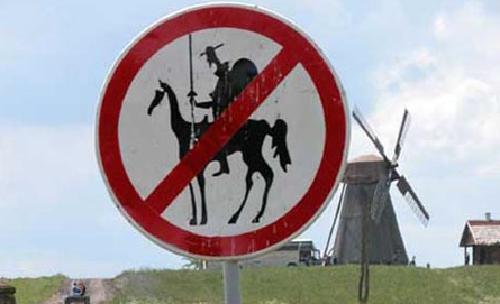
I did a quick Google image search for a typical Dutch windmill image, and decided that this one was too amusing to pass up:
February 9, 2011
LSE to buy TSX
It’s a crafty move, but it’s not clear whether it’s the buyer or the seller being the craftier:
London Stock Exchange Group Plc, the 210-year-old bourse operator, agreed to buy Toronto Stock Exchange owner TMX Group Inc. for about C$3.2 billion ($3.2 billion) in stock as the companies cut costs to counter lost market share. LSE surged to a two-year high.
LSE shareholders will own 55 percent of the company, while TMX investors will hold the rest, the exchanges said today in a statement. TMX shareholders will receive 2.9963 LSE shares for each they own, valuing the Toronto-based company at about C$42.68 a share, 6 percent more than yesterday’s closing price.
Xavier Rolet, LSE’s chief executive officer, will reduce 35 million pounds ($56 million) a year in costs and expand into new businesses such as derivatives as competition from alternative trading platforms increases as do mergers among rivals. His predecessor Clara Furse fought off five takeover offers in two years and bought the operator of the Milan stock exchange. The LSE’s share of U.K. equity trading was 63.8 percent last quarter, compared with 75 percent in 2009, data from the London- based company show.
It could be a way for London to diminish the impact of European rules on their business (by having a non-EU place to land if necessary) or it could be a way for the EU to extend their rule-making to the Canadian market. Or, and this is the least believable scenario, it might just be an ordinary acquisition by a company that happens to run stock markets.
Update: What is presented as a take over in other markets is being positioned (spun?) as a “merger” for domestic consumption:
TMX Group, which operates the Toronto Stock Exchange, and the London Stock Exchange announced Wednesday they are merging to create one of the world’s largest stock exchanges.
The merger, which is subject to regulatory approvals, is unanimously being recommended by the boards of both exchanges.
The merger, if approved, would give the new firm a value of just over $6 billion (Cdn.) and give LSE shareholders just over 50 per cent of the combined company.
TMX Group is valued at $2.99 billion, while the London Stock Exchange Group’s value is slightly higher, around $3.25 billion.
The new company will have the world’s largest number of listing, more than 6,700 companies with an aggregate value of $5.8 trillion, the partners said in a statement early Wednesday.
[. . .]
The company will be co-headquartered in Toronto and London with Xavier Rolet, the CEO of the London Exchange, retaining that position with the new company. The president will be Thomas Kloet, the CEO of TMX. The FO will be Michael Ptasznik, who currently holds the same post with TMX, and the company director will be Raffaele Jerusalmi, the Milan-based CEO of Borsa Italiana.
Expect this deal, even if it eventually gets regulatory approval, to drag on for most of this year.
February 8, 2011
Royal Navy to withdraw patrol from Caribbean
The funding crisis for Britain’s Royal Navy is reported to be the reason for the cancellation of patrols in and around British dependencies in the West Indies:
Britain is to abandon its warship patrols of the Caribbean for the first time since the second world war because of the navy’s funding crisis, the Guardian has learned.
The withdrawal means the navy will no longer provide a warship for anti-narcotic operations in the region, and will have to reduce its role in disaster relief work.
The decision to stop the patrols, which is expected to be confirmed on Tuesday, comes at an embarrassing time for the Ministry of Defence — a documentary series on operations undertaken by the destroyer HMS Manchester in the Caribbean is due to start tonight. The programme on Channel Five follows the ship and crew throughout its seven month deployment last year.
February 4, 2011
As expected, BBC offers apology for Top Gear anti-Mexican remarks
It still won’t change anything:
The BBC has now obliged, with a statement which concedes that while the remarks were “rude” and “mischievous”, there was “no vindictiveness” behind them.
The Corporation continues: “Our own comedians make jokes about the British being terrible cooks and terrible romantics, and we in turn make jokes about the Italians being disorganised and over dramatic, the French being arrogant and the Germans being over-organised.”
It adds that “stereotype-based comedy was allowed within BBC guidelines in programmes where the audience knew they could expect it, as was the case with Top Gear“.
The apology concludes: “Whilst it may appear offensive to those who have not watched the programme or who are unfamiliar with its humour, the executive producer has made it clear to the ambassador that that was absolutely not the show’s intention.”
Indeed, said executive producer apologised personally to señor Medina-Mora Icaza, and we look forward to seeing that meeting on Top Gear in due course, complete with witty commentary from Clarkson, Hammond and May.


