Quotulatiousness

March 16, 2011

Japan’s plight distracts the world from Libya

Filed under: Africa, Europe, Media, Military, USA — Tags: , , , , — Nicholas @ 07:43

As we all feverishly check the media reports for updates on rescue efforts for survivors of the earthquake and tsunami in Japan, or even more urgently try to figure out the actual situation in and around the crippled nuclear reactors at Fukushima, it’s a huge boon to Moammar Gadhafi as he works on crushing the rebellion in Cyrenaica:

The megalomaniacal Gadhafi entertains many fantasies. Not so long ago, taking control of Egypt, via assassination or divine acclamation, was among them. Now, as he and his corrupt clique fight for survival, his loyalist and mercenary forces need only take Benghazi and Tobruk.

Crack Tobruk, and the Libyan rebels have three choices: surrender, seek asylum in Egypt or head for the deep southern desert and wage a longshot guerrilla war. Surrender is defeat, followed by mass executions and mass gravesites. Asylum is defeat — as the rebels hole up in Cairo, Gadhafi will launch bloody reprisals against Cyrenaica’s people. As for a guerrilla war waged from the Sahara? Gadhafi will have an air-power advantage. The coastal cities will also provide him with thousands of hostages (the guerrillas’ relatives) to torture and kill.

Rebel options, post-Tobruk, are dreadful. The mass graves outside the cities will be hideous. The long-term strategic implications of a Gadhafi victory are also hideous.

Why can’t NATO or the UN or the G-8 agree to impose a no-fly zone on Libya’s dictator? The Obama administration, whatever its latest rhetoric, has willingly enmeshed itself in a multilateral spider’s web of narrow interests, fear and greed. At some level, Gadhafi serves Russian and Chinese commercial arrangements. Europe fears the appearance of colonialism. The pertinent phrase here is, “Gadhafi is the devil we know.”

Update: George Jonas thinks the crowding-out of Libyan affairs is a boon to Barack Obama’s administration:

The disaster also gives Barack Obama and colleagues some breathing space. Based on past performance, that’s not necessarily a good thing. Instead of talking softly and carrying a big stick, our leaders bluster and carry nothing. By letting Gaddafi know they’ll be merciless to him in a defeat they aren’t lifting a finger to inflict, they’re only telling the strongman that standing firm is his best bet.

When Gaddafi takes their advice, Obama and his mates first cry foul, then develop a sudden urge to examine their fingernails. Having shown themselves to be large of mouth, short of sight and faint of heart, the earthquake in Japan offers them a reprieve.

Can’t they use a reprieve for something constructive? In fairness, at this juncture there isn’t a whole lot anyone can do. Certain problems are solved only by hugs or bear-hugs, and the Middle East isn’t conducive to either. The West’s enemies are too numerous to maul, and who, in God’s name, is there to embrace?

Nick Clegg: “These laws make a mockery of British justice”

Filed under: Britain, Law, Liberty, Media — Tags: , , , , — Nicholas @ 00:13

Every now and again, you find a politician with the right approach to solving a problem. Right now, that politician appears to be Nick Clegg:

London is the number one destination for libel tourism, where foreign claimants bring cases against foreign defendants to our courts — even when the connection with England is tenuous at best. It is a farce that has prompted Barack Obama to legislate to protect his citizens from rulings in our courts.

These laws make a mockery of British justice. They kill debate and smother scientific inquiry. They undermine our moral authority as we seek to promote the values of an open society in other parts of the world.

And it is ordinary people who really suffer: protecting their interests means ensuring corruption can be unearthed and charlatans exposed. Of course, individual citizens must be able to protect their reputations from false and damaging claims, and we cannot allow companies to be the victims of damaging, untrue and malicious statements.

But from the humble blogger to the consumer watchdog, corporate whistleblower, medical researcher, or roving reporter, public-spirited voices must be heard.

Here’s hoping that the new legislative changes will address the worst of the problems, not just paper over a few of the lesser sins.

March 15, 2011

A new way of looking at wood flooring

Filed under: Europe, Technology, Woodworking — Tags: , , — Nicholas @ 08:39

To state the obvious, trees don’t grow in nice straight lines. As natural creatures, they bend and sway in their environment — if they didn’t, they wouldn’t be able to withstand the extremes of weather. While this is great for the tree, once the tree has been cut down, the amount of useful wood that can be harvested is limited by many factors, including just how far from “straight” the trunk of the tree grew. Much of the wood that can’t be economically used for solid wood products ends up as chips, flakes, or fibres for manufactured “wood” products.

Bolefloors may increase the amount of solid wood that can be used for flooring:

Bolefloor technology combines wood scanning systems, tailor-made CAD/CAM developments and innovative optimization algorithms for placement software developed by a Finnish engineering automation company and three software companies in cooperation with the Institute of Cybernetics at Tallinn University of Technology.

Bolefloor scanners’ natural-edge visual identification technology evaluates “imperfections” such as knots and sapwood near the edges or ends so that floors are both beautiful and durable.

H/T to BoingBoing for the link.

March 11, 2011

Another oddity of British law

Filed under: Britain, Law, Liberty — Tags: , , , , — Nicholas @ 17:19

I was unaware, until today, that it is possible to get a legal injunction that effectively prevents anyone from knowing that the injunction has been issued: a “super injunction“:

The existence of the draconian injunction — so strict it prevents $PERSON being identified as a $OCCUPATION — was disclosed by John Hemming, a back-bench Liberal Democrat MP, in a question during a business debate at the House on Thursday morning. His comments are protected by parliamentary privilege.

He said: “In a secret hearing $PERSON has obtained a super-injunction preventing him being identified as a $OCCUPATION.

“Will the government have a debate or a statement on freedom of speech and whether there’s one rule for the rich like $PERSON and one rule for the poor?”

Leader of the House Sir George Young said a forthcoming Westminster Hall debate would explore freedom of speech, adding: “I will raise with the appropriate minister the issue he has just raised.”

The terms of the injunction are so strict that the Daily Telegraph cannot reveal the nature of the information that $PERSON is attempting to protect.

Because I am not rich, I’ve chosen to avoid including any information which may fall under the strict terms of the injunction . . . others are not being as careful, so you can find out who the rich wanker is and what occupation he wants to prevent the public from discovering by reading the whole thing.

Amazon recommendation fail

Filed under: Books, Economics, Europe, France, History, Media — Tags: — Nicholas @ 08:45

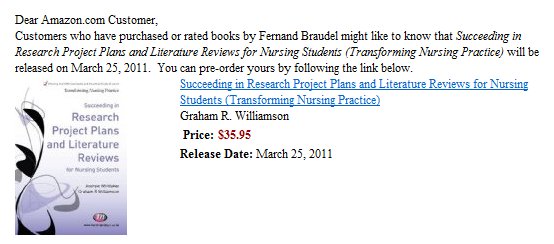
Like many of you, I’ve bought lots of books from Amazon over the years. Knowing a fair bit about my book-buying habits, their recommendations for books I might be interested in are usually pretty good. Today’s email rather missed the mark:

I’m not sure how that book relates in any way to the work of Fernand Braudel:

Fernand Braudel (24 August 1902 – 27 November 1985) was a French historian and a leader of the Annales School. His scholarship focused on three main projects, each representing several decades of intense study: The Mediterranean (1923–49, then 1949–66), Civilization and Capitalism (1955–79), and the unfinished Identity of France (1970–85). His reputation stems in part from his writings, but even more from his success in making the Annales School the most important engine of historical research in France and much of the world after 1950. As the dominant leader of the Annales School of historiography in the 1950s and 1960s, he exerted enormous influence on historical writing in France and other countries.

Braudel has been considered one of the greatest of the modern historians who have emphasized the role of large-scale socioeconomic factors in the making and writing of history.[1] He can also be considered as one of the precursors of World Systems Theory.

If you’ve browsed the history section, you’ll have seen them:

March 10, 2011

“An opportunity to stop English libel law chilling free speech around the world”

Filed under: Britain, Law, Liberty, Science — Tags: , , — Nicholas @ 12:43

Simon Singh at the Guardian‘s “Comment is Free” site explains just how much the chilling effect of English libel law can obstruct free speech:

. . . it is important to remember that for every case of a scientist or journal who dares to face the ordeal of a libel trial, there are dozens of (or probably hundreds of) others who immediately apologise and retract after a libel threat, or who self-censor in order avoid any risk of libel, which is the so-called chilling effect of libel.

For example, I gave an interview to an Australian medical correspondent at the Melbourne Age about the lack of evidence surrounding homeopathy, but he was unable to quote me in detail because his in-house lawyer was frightened of being sued for libel in London. The only reason this came to light was because the journalist in question wrote a blog describing how tough it was to be a health journalist in Australia when the vulture of English libel law was always circling above.

More worryingly, I recently received an email from an American researcher (whose name I cannot mention) who had worked with a librarian (whose name I cannot mention) to write a paper on the subject of impact factors, the scoring system often used by librarians and others to assess the quality of a research journal. The anonymous researchers cited one journal (whose name I cannot mention) which may be using certain techniques to boost its own impact factor. Impact factors are an important issue, so the paper was sent to a respected British journal (which I shall not name in order to avoid embarrassment) with an international readership. The journal replied: “We regret that we are unable to publish after all because unfortunately it has potential legal implications under UK libel law.”

The anonymous researchers then sent the paper to an American journal (which I shall not name), which also had an international readership and which did agree to publish the paper. Initially, there seemed to be no problem, because the in-house lawyer agreed that the paper did not breach US libel law. However, the lawyer went on to demand that edits were necessary or there would be a serious risk of being sued in London according to English libel law.

The British government is to introduce a new bill to (one hopes) address some of these concerns soon. Let’s hope that they’re paying attention.

March 7, 2011

Your energy consuming future

Filed under: Britain, Economics, Government, Technology — Tags: , — Nicholas @ 11:00

Britain is facing a very different future, from the point of energy consumption, according to Steve Holliday, CEO of National Grid:

Because of a six-fold increase in wind generation, which won’t be available when the wind doesn’t blow, “The grid is going to be a very different system in 2020, 2030,” he told BBC’s Radio 4. “We keep thinking that we want it to be there and provide power when we need it. It’s going to be much smarter than that.

“We are going to change our own behaviour and consume it when it is available and available cheaply.”

The more of your electricity that is produced from wind power, the more there will be very noticeable peaks and valleys in available electricity. Not only do you need more sources, you need over-capacity in some areas to generate sufficient power to supply to areas which are becalmed.

Under the so-called “smart grid” that the UK is developing, the government-regulated utility will be able to decide when and where power should be delivered, to ensure that it meets the highest social purpose. Governments may, for example, decide that the needs of key industries take precedence over others, or that the needs of industry trump that of residential consumers. Governments would also be able to price power prohibitively if it is used for non-essential purposes.

Perhaps it’s just the libertarian in me that finds the term “highest social purpose” to be very disturbing: just who the hell is going to be making that determination? And on what basis will the new high priests of the lightnings be making that call?

Smart grids are being developed by utilities worldwide to allow the government to control electricity use in the home, down to the individual appliance. Smart grids would monitor the consumption of each appliance and be capable of turning them off if the power is needed elsewhere.

Like the idea that someone at your local electrical board can decide that you don’t really need to run that TV set or that toaster right now? If the control freaks at the utilities manage to foist this off on us, we’ll be techno-peasants who are only allowed to run electrical devices that meet “social purpose” guidelines.

March 3, 2011

Eurofighter Typhoon sets new standard for “bloated expense” and “limited usefulness”

Filed under: Britain, Europe, Military, Technology — Tags: , — Nicholas @ 12:41

Lewis Page is on record as thinking the Eurofighter Typhoon was a bad bargain, but even he is shocked at just how bad a bargain the plane is:

Probably the most dismal figure we are given is that the RAF will actually put into service just 107 Typhoons. At the moment it has received 70: the last of the 160 planes ordered by the UK will be delivered in 2015. But, we are told, “by 2019” all the Tranche 1 jets (which were still being delivered to the RAF at the start of 2008) will be “retired” — that is, thrown away. We’ll pay for 160 jets (actually we’ll pay for 232), but we’ll only ever get a fleet of 107.

This shows the acquisition cost of the Eurofighter/Typhoon in an even worse light than it had previously appeared, when an RAF fleet of 160 had been expected. It is now acknowledged that the development and production cost to the UK of Eurofighter will be £23bn with planned upgrades.

This means that we UK taxpayers will have shelled out no less than £215m for each of our 107 jets — that’s $350m at today’s rates, rather more than the US taxpayers have been made to pay for each of their 185 Raptor superfighters, almost all of which will be used operationally. And the Raptor has third-generation Stealth: the Eurofighter has no stealth features at all. The Raptor has thrust vectoring for unbeatable manoeuvrability in a dogfight: the Eurofighter doesn’t.

But, for all the expense, at least the RAF has a fine, modern, fully in-service fleet? Well, almost:

The lack of planes actually fit to fly is serious — the NAO reports that of the 70 Eurofighters the RAF currently possesses, just 42 are actually available to flying squadrons. And the lack of flight hours has meant that some flyboys haven’t been able to get into the cockpit at all [. . .]

The RAF currently has eight pilots who are capable of undertaking ground attack missions on Typhoon … The Department plans to have sufficient numbers of trained pilots to conduct a small scale ground attack mission by 2014 and aims to deliver sufficient flying hours to train enough pilots to undertake the full range of planned tasks by 2016.

What a joy it is to think that we paid £119m to upgrade the Tranche 1 planes back in 2008 so that they could do ground attack. In 2016 the RAF will finally have the pilots it needs to use this capability: but by then the Tranche 1s will already be being thrown away – all of them will be gone by 2019, remember.

We paid all that money upgrading the Tranche 1s and now we’ll dispose of them without ever having pilots trained to use the upgrade! The Eurofighter story really just gets better and better.

Happy 25th anniversary to independent Australia

Filed under: Australia, Britain, History, Law, Pacific — Tags: , — Nicholas @ 09:30

I had been labouring under the impression that Australia had been freed from the colonial yoke in 1931, but I was mistaken:

TWENTY-FIVE years ago today, Australia became independent.

You might think this statement absurd. Surely Australia has been independent for a lot longer than that? Let me provide a lawyer’s answer: yes and no. Yes, Australia as a nation became independent at some unknown date after 1931. By 1931 it had the power to exercise independence but chose not to do so for some time. Arguably, having the capacity to exercise independence is enough to be classified as independent, although the parents of 20-something children who show no inclination to leave home may beg to differ.

The Australian states, however, did not gain their independence from Britain at that time. Bizarrely, they remained colonial dependencies of the British crown, despite being constituent parts of an independent nation. This meant state governors were appointed by the Queen on the advice of British ministers and that it was the Queen of the United Kingdom (not the Queen of Australia) who gave royal assent to state bills. When an Australian governor-general once complained to the British government about this anomaly, the response of British diplomats was that it was better to “let sleeping anomalies lie”.

H/T to Roger Henry for the link.

March 2, 2011

QotD: Humour

Filed under: Britain, Europe, Germany, History, Humour, Quotations, WW2 — Nicholas @ 12:02

A German I know will on occasion tell you his father died in the concentration camps. He waits for the concerned and properly sympathetic faces and then adds that he got drunk and fell out of a watchtower. Europeans find that boorish, faintly crass and rather tasteless; the English love it. It’s a proper joke, and a German doing it is double bubble. The surprise is that neither the Europeans or the English realize that it’s not a joke at all, his father really did fall out of a watch tower and it’s poignant and sad because his son never knew him, never met his dad.

A.A. Gill, The Angry Island: Hunting the English, p. 112.

Love it or hate it: Marmite and social media

Filed under: Britain, Food, Randomness — Tags: , , — Nicholas @ 00:06

Oddly enough, I just picked up a jar of Marmite recently, not having tasted the stuff for literally decades. I love the stuff, but I can understand why others might hate it:

When it comes to evoking passionate debate British brand Marmite has proven controversy can help build buzz and sales. This brown savory spread made from yeast extract has an incredibly distinctive flavor. 15 years ago Marmite’s own “Love It or Hate It” campaign evolved out of a difference of tastes among the creative team at DDB London. One loved the brown, savory spread and one hated it. The campaign’s longevity and fame reflects the fact that even in its country of origin, the brand’s strong taste is “challenging.” (Few Americans can even stand the idea of Marmite and it is questionable whether many Brits would if they had not been introduced to the taste as children.)

[. . .]

The “Love it or Hate It” campaign brought to an end five years of stagnating sales and a weakening brand and led to sustained, penetration-led growth of around 5% each year for the next five years.

When sales once again started to slow in 2002 the campaign idea proved flexible enough to help revive the brand’s fortunes once again. The campaign was enlisted to introduce a new, “squeezy” container and extend usage to sandwiches. Messing with a much loved brand is never easy, but astute brand management involved ardent fans with the relaunch and enlisted another British icon, Paddington Bear, to bring the brand back to growth. In 2010, the brand spoofed the British elections. Love and Hate parties battled it out to either build a shrine to the brand or rename it “Tarmite.”

The fact that people are so passionate about the brand (for or against) means that Marmite’s “Love It or Hate It” campaign is a natural fit with social media. According to Contagious Magazine, some 200,000 fans were already on Facebook as self-declared Marmite lovers long before the official page was launched in 2008.Today the brand has a fully fledged social media presence with over 500,000 people liking the brand and 182,000 liking The Marmite Hate Party (Dedicated to Stop the Spread of Marmite by reducing, and ultimately terminating, its production and consumption).

Damn. Now I’ve gone and made myself hungry . . .

March 1, 2011

Iran already threatening 2012 Olympic boycott

Filed under: Britain, Middle East, Sports — Tags: , , — Nicholas @ 12:23

They’ve suddenly realized that the truth was staring them right in the face the whole time:

The 2012 London Olympics are more than a year away, but Iran already is threatening to boycott them. According to Bahram Afsharzadeh, secretary general of Iran’s National Olympic Committee, the 2012 Olympic logo secretly spells out the word “Zion,” which makes it “racist.” The Iranians also claim that use of the logo “is a disgracing action and against the Olympics’ valuable mottos.”



This may provide the boost 3D TV has been waiting for

Filed under: Europe, Media, Technology — Tags: , , — Nicholas @ 07:36

Lester Haines reports that Penthouse will be launching a European 3D TV service:

Marc Bell, big swinging dick of Penthouse owner FriendFinder Networks, enthused: “We are very excited about the launch of the Penthouse 3D channel. Our goal is always to deliver the latest technology on the world’s best platform.”

Jacky Wauters, head of Penthouse distributor NOA Productions, joined the love-in, saying: “Thanks to the increasing consumer acceptance of 3D, I am delighted to work with Penthouse to be able to satisfy the needs of the consumers and broadcasters alike who demand high quality, cutting edge entertainment backed by a solid and well established brand like Penthouse.”

Penthouse originally announced it’d be launching 3D porn in the US in the second quarter of this year, but has obviously decided to come early over European viewers.

Pornographic content has traditionally been one of the first major uses of new technology.

The shifting tide of extreme wealth

Filed under: Economics, Europe, France, Politics — Tags: , , , — Nicholas @ 07:07

Ever wonder how the children of wealthy foreign potentates fit in with “ordinary” wealthy westerners? Anne Applebaum says the relationship has shifted from bare toleration all the way out to sycophancy, but its most noticeable change is the way they can buy influence and apologists:

Money, even foreign money (and particularly that Saudi money), has always been able to buy access to Western statesmen. But in the last decade or so, the proportions have subtly shifted. The democratic West has become relatively poorer, while a clutch of undemocratic “emerging” markets have become richer. To put it more bluntly, Western politicians, ex-politicians, and even aristocrats have become much, much poorer than the very, very rich businessmen emerging from the oil-and-gas states of Central Asia, Eastern Europe, and the Middle East. Twenty years ago, no retired British or German statesman would have looked outside his country for employment. Nowadays, Blair advises the governments of Kuwait and the United Arab Emirates, among others; Gerhard Schröder, the former German chancellor, collects a paycheck from Gazprom, the Russian energy behemoth.

True, there is a legitimate argument for maintaining contacts with dictators: Blair helped persuade Col. Qaddafi to give up his nuclear weapons program in 2003, and in the last 10 days he has twice called the dictator and asked him to stop shooting his people. It hasn’t helped, of course, but it can’t hurt to try.

But there is no justification for taking dictators’ money or befriending their offspring, especially not while simultaneously playing politics with their parents. This is not just a British problem, either. Frank Wisner, the U.S. envoy sent by President Barack Obama to negotiate with Hosni Mubarak in the early days of the Egyptian revolution, also works for Patton Boggs, a law firm that has worked for the Egyptian government. The administration was reportedly angry when he unexpectedly opined that Mubarak “must stay” just a few days before Mubarak fled Cairo. But should anyone have been surprised? Meanwhile, Michelle Alliot-Marie, the French foreign minister, has just lost her job because she went on holiday in Tunisia during the revolution, hitched a few rides on a private plane belonging to a friend of the Tunisian president, and helped her father do a business deal there. When she got back, she tactfully suggested that the French help their friends in the Tunisian police put down the riots.

February 28, 2011

London’s “congestion charge” didn’t keep pace with traffic after all

Filed under: Britain, Bureaucracy, Economics, Technology — Tags: , — Nicholas @ 08:51

Remember the great fanfare (usually from “urban advocates” and local government bureaucrats) over the stunning success of London’s road pricing scheme? It immediately reduced traffic volumes in the downtown core of London, which also reduced the travel times for those drivers who were willing to pay the usage charges. It looked like a solid win for pay-for-use roads (which do, incidentally, make a great deal of economic sense . . . if they’re not being used as a cash cow to fund other transportation options instead).

Fast forward to today, and we discover that all the gains from introducing the congestion charge have been wasted:

According to Yass’ analysis, based on figures obtained from the Department of Transport and local bodies such as councils and Transport for London, the increase in traffic lights — and perhaps even more so, the increasing trend to prioritise pedestrian movement through junctions by changing lights’ programming — is seriously increasing congestion for wheeled road traffic (buses excepted in some cases, as they too are favoured by the lights).

The report indicates that a large fall in congestion was seen in London following introduction of the capital’s congestion charging scheme introduced by the previous mayor Ken Livingstone. A noticeable proportion of motorists ceased to drive in the charging zone, and vehicle numbers in the zone remain well down on previous levels. Nonetheless, congestion is now back up to its old state:

Monitoring reports of the congestion charging zone show that, after an initial improvement, congestion has been increasing again and is back to pre-charge levels, even though the number of vehicles entering the zone has not increased.

How could this have happened?

According to Yass, the gains achieved by the congestion charge have been wiped out by Mayor Ken’s parallel policy drive to cut down the time it takes to cross the road in London, and in particular to make the streets safer for the disabled. A large number of London’s new traffic lights would seem to have been put in at new pedestrian crossings — “most junctions were already controlled by lights”, writes Yass — and those at junctions now usually have “full pedestrian stages” where all traffic is held stopped in both directions.

« Newer PostsOlder Posts »

Powered by WordPress