
H/T to Roger Henry for the link.
March 26, 2011
550th anniversary of the bloodiest battle in English history
Unless you were paying close attention in your history classes, you probably wouldn’t recognize the name:
It was one of the biggest and probably the bloodiest battle ever fought on British soil. Such was its ferocity almost 1 per cent of the English population was wiped out in a single day. Yet mention the Battle of Towton to most people and you would probably get a blank stare.
Next week marks the 550th anniversary of the engagement that changed the course of the Wars of the Roses. It is estimated that between 50,000 and 80,000 soldiers took part in the battle in 1461 between the Houses of York and Lancaster for control of the English throne. An estimated 28,000 men are said to have lost their lives.
But this bloody conflict is unlikely to remain forgotten for much longer. Archaeologists believe they will unearth what is likely to be Britain’s largest mass grave this summer.
Work is to begin in June, at a site 12 miles south of York between the villages of Saxton and Towton where the battle took place in snowy March weather. The locations of the graves were discovered by archaeologists using geophysical imagery and now, with funding in place, they are able to begin excavating.
And why is such a major battle so little-known? Perhaps because the “wrong” side won:
Very few records of the battle survive, which is one reason that so little is known about it. Historians believe this could be due to an early propaganda campaign by the Tudors.
Author and historian George Goodwin, who this month publishes a new book: Fatal Colours: Towton, 1461 — England’s Most Brutal Battle, said: “The Tudors did a tremendously good propaganda job in making Bosworth the key battle because that was the battle which ended the Wars of the Roses. They were the winners and they got to write the history books. Because Towton was a Yorkist victory that wasn’t really very useful to them.”
Comments Off on 550th anniversary of the bloodiest battle in English history
March 25, 2011
Libya operations do not support UK’s recent defence decisions
Lewis Page is doing an analysis of the current British involvement in Libya. He points out that many of the recent decisions by the British government are not being proven by the actual pattern of combat:
Recent combat operations by British and allied forces in Libya are beginning to tell us a lot: not so much about the future of Libya, which remains up for grabs, but about the tools one actually needs for fighting real-world wars against real-world enemy armed forces.
The vast bulk of our own armed forces are set up, equipped and focused on this type of mission — rather than the hugely more common one of battling guerillas and insurgents, as seen in Afghanistan — so the Libyan operations of the last week are very important to us at a time of shrinking budgets and worldwide turbulence. Libya is telling us how well the Coalition government did in its recent Strategic Defence and Security Review — and bluntly, it is showing that the Review was a fiasco.
Mr. Page has not been a fan of the Eurofighter, and sees the initial stages of the Libyan campaign as proving the investment is so much wasted money:
. . . highly advanced specialist air-to-air combat capability has not been necessary here. The RAF has rushed Eurofighter Typhoons to Italy — they were the first British aircraft to arrive there, in fact — but they are pure air-to-air planes at the moment (the RAF doesn’t expect to have them properly ready for use as bombers until 2018). The odds are that they will not fire a shot — and if they do it will be to swat down some rusty old MiG flown by a suicidal pilot. For this job, much cheaper fighters would have been more than adequate: say American F-18s or F-16s, or even our previous embarrassing Tornado F3, now retired.
So, point one: buying the Eurofighter remains a stupid idea on our part.
Canada’s F-18 aircraft have seen more combat in Libyan airspace than the RAF’s Eurofighters, because the F-18 has a ground-attack capability.
On the other hand, Mr. Page rejoiced at the overdue decision to scrap the Nimrod, but the ancient-but-terribly-expensive aircraft appear to have a valid role to play in Libya:
Point two: electronic warfare and AWACS planes are useful, even against the minor regimes who we might genuinely fight in the real world. The decision to keep both in the recent UK Defence Review was sensible (the Nimrod R1 Elint planes were marked for the bin — and have been temporarily been reprieved for duty in the Libyan situation — but replacement “Rivet Joint” aircraft are on order).
The use of the Tornado aircraft for very long range attacks seems like a waste of time and resources:
We are told in official announcements that some 112 Tomahawk cruise missiles were used in the initial strike at the weekend, launched from US and British warships and submarines off the Libyan coast. We are also told that “a number” of Storm Shadow shorter-ranged cruise missiles were launched from Tornado bombers. The Tornadoes had flown 3,000 miles from
KentNorfolk to do so, requiring the aid of repeated air-to-air refuelling assistance both on the way out and on the way back.We can be pretty sure what the unspecified number of Storm Shadows was, as the Tornado can carry only one Storm Shadow into combat and we are told that a total of four Tornadoes have been assigned to Operation ELLAMY, the British contribution to the Libyan fighting. Some accounts suggest that in fact only three Storm Shadows were fired in the initial long-range Tornado raid.
[. . .]
Our lesson from a shooting war against a national air force — the first we have fought since 1982 — is that you don’t suppress enemy air defences of the sort you actually meet in the real world with deep penetration bombers and clever air-launched weapons (far less with stealth planes). You do it with AWACS and Elint planes and Tomahawks launched from the sea.
And speaking of the sea . . . what about the Royal Navy contribution to the Libya campaign?
Don’t we just wish we had a carrier off Libya now? Shame we scrapped ours just months ago. Nice work, Mr Cameron
There can be little doubt that the Harrier would also have been better for Libya. The Harrier fleet actually had more aircraft modernised to drop the latest smart weaponry — it was a superior battlefield strike plane — and it was cheaper to run. Best of all, it could operate from our also-recently-axed pocket aircraft carriers right off the coast and thus reach the theatre of action in minutes rather than hours. France and the USA both have carriers operating off the Libyan coast right now, but our foolish decisions in the recent review have left us on the sidelines.
Mr. Page still thinks the Royal Navy got royally shafted by the RAF:
Point four: The decisions taken over many years to whittle down the Harrier force to the point where it was barely viable – and then finally axe it in the Review — were totally wrong. Instead the Tornado should have been scrapped. Our present-day fleet of more than 130 of these cripplingly expensive-to-run, slow, lumbering low-altitude jets, assisted by similarly costly tanker planes, has offered us an utterly pathetic capability to deliver three or four dodgy missiles into Libya and a minimalist air support capability thereafter.
Even by the time of the Review, when the Harrier fleet was down to an almost unviable 44 jets, it would have made more sense to keep them, scrap the Tornado and buy or lease some nice cheap F-18s from America to bulk up our strike forces somewhat. The RAF should be ashamed of itself for manipulating the Prime Minister into keeping Tornado; heads should roll.
Is it too late to save the Ark Royal and Invincible? Yes:
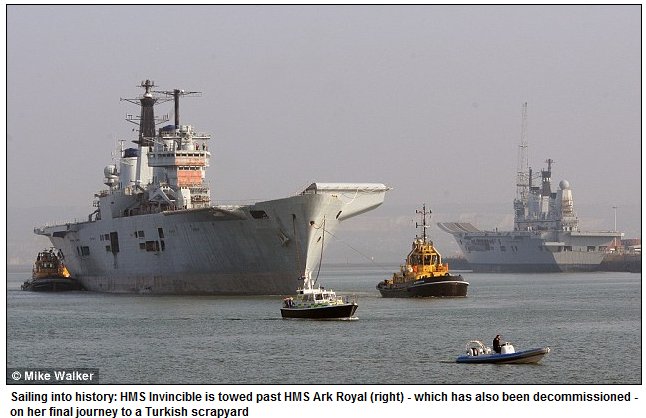
To make the situation even more pathetic:
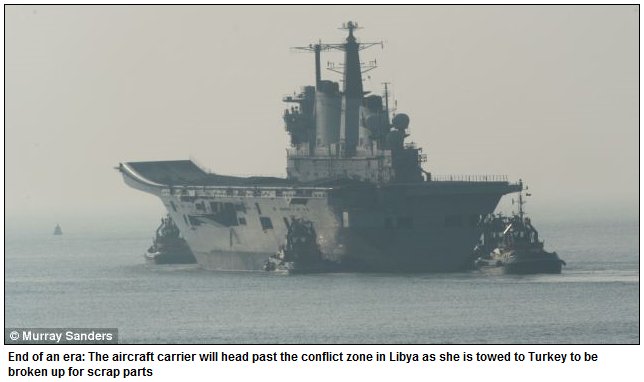
Once, this would have been a sight to strike fear into the hearts of any enemy fleet, a vivid portrait of the naval clout of this island nation.
But, today, these are two ghost ships. This depressing photograph taken yesterday is merely a reminder of the current state of the Royal Navy. Until recently, Britain had three aircraft carriers. The latest round of defence cuts means we have just one carrier — HMS Illustrious — and no planes on board. It only does choppers these days.
Invincible is bound for the Middle East. But Colonel Gaddafi need have no fears about this gallant old warhorse. In a few days’ time she will be off the coast of Libya but she won’t be stopping. She’ll be pressing straight on for Turkey where she is due to be cut up — or ‘recycled’ as an MoD spokesman insisted yesterday.
Back to Mr. Page’s conclusions (not that there should be any surprises based on the examples I’ve included):
Summing up, the lesson of Libya is that the recent Defence Review was, indeed, a dismal failure. RAF empire-preservation saddled us with the useless Tornado at the cost of our carrier capability. The army insisted on preserving pointless tanks and big guns and as a result we are not pulling our weight in Helmand — a war we more or less unilaterally started in 2005 — and we have no option to intervene on the ground in Libya seriously.
The navy made no real effort to help matters. It might have managed to preserve a carrier capability by making concessions on its pointless frigate flotilla, but this it refused to do.
[. . .]
But the chance to change things is not gone yet. So badly fudged were the Strategic Defence and Security Review’s figures that more reorganisation remains on the cards; in effect, a review of the Review is now very likely. The chance is still there to scrap the cripplingly expensive Tornado and Eurofighter altogether and replace them with cheap, excellent F-18s — so getting our carrier capability back in just a few years, as well. When the F-35C actually becomes affordable at last around 2025 we can buy some — by that point its Stealth and other new technologies might actually be becoming relevant for wars that might really happen, along the lines of Libya.
French stereotypes
Even if we have to stop calling them “Cheese-eating surrender monkeys”1, we still have all the other stereotypes to fall back on:
The myth of the great Gallic unwashed seems to have travelled back to the US after the second world war with GIs shocked to discover that a still largely rural population with scant access to hot and cold running water should, after four years of German occupation, not always consider irreproachable personal hygiene an overriding priority.
It is, unfortunately, sustained by the odd wayward statistic. According to one 1998 survey only 47% of French people take a daily bath or shower, against 80% of Dutch and Danes. Worse, France’s own health education council calculated that if those 47% were being honest, the country’s annual soap consumption should be 2.2lb a head, whereas it happened to be 1.3lb.
Another 1998 report found that only 60% of French men and 75% of French women pulled on clean underwear every morning.
March 23, 2011
Re-inventing pastis for a modern audience
From the description, what is called pastis in France is marketed in Ontario as Pernod, one of my favourite beverages:
It is as French as berets and pétanque but now drinks groups are trying to boost flagging sales of pastis by shaking off the national drink’s fusty image and recasting it as a trendy long summer drink.
The French use the phrase “je suis dans le pastis” to mean in trouble and the foggy liqueur is indeed in trouble — eclipsed by whisky as the country’s favourite tipple.
Although 120m litres of pastis are still knocked back in France annually, sales are declining at a rate of about 1% a year and, like brands such as Baileys in the UK, it is heavily discounted in supermarkets.
Now market leader Pernod Ricard says it is trying to “redefine the pastis drinking experience” by marketing a new drink “piscine” — French for swimming pool — a heavily diluted pour of its Pastis 51 brand.
One of the things I find most appealing about Pernod is that it can be diluted quite a bit without becoming “watery”. It fills a number of different “roles” in the alcoholic beverage category, unless you’re one of those weird folks that don’t appreciate the anise flavour.
Comments Off on Re-inventing pastis for a modern audience
Latest outlet for excess Chinese investment money: Bordeaux wineries
Running out of interesting investment opportunities? Some Chinese investors are moving into French wineries:
Walking among the ancient vines at Château de Malle, De Bournazel said many families struggled to make ends meet. “Nobody sells for pleasure, but you would struggle to find a chateau that wouldn’t sell for the right price. It’s sad, but I’d rather see families sell to the Chinese than tear themselves apart trying to keep a property.”
Rather than being viewed as conquerors, Chinese wine buyers are seen as saviours of the region — last year China overtook both Germany and the UK to become Bordeaux’s biggest customer, with exports growing by 67%. Bernard Farges, president of the Conseil Interprofessionnel du Vin de Bordeaux (CIVB), the body representing its wine growers and buyers, said Chinese investors buying vineyards would boost exports further.
“These are businessmen who believe in their investment, who are opening doors to a new market and ploughing money into properties to make great wine,” he said.
Others argue that the Chinese are simply the latest in a long line of foreign investors — including the Dutch, the English and the Danes — in Bordeaux.
That last part is certainly true: although you may not realize it, many of the wineries in the Bordeaux region have been foreign-owned for generations. The nationality of the foreign owners may change, but the principal is the same.
Of course, regardless of ownership, if the investors don’t maintain the property, they risk ruining their chances of benefitting from the purchase:
Not everyone is supportive of this new breed of Bordelais. Patrick Etineau recently sold Château de la Salle to a Chinese investor amid a storm of acrimony. “I found them very condescending,” he said. “They have the money and they think we are in penury.”
He says since the chateau was sold in January the vines have been left largely untended. “I was happy to sell, because I couldn’t maintain the property, but now I have the impression that they don’t care at all. We used to make beautiful wine, but this year I fear it will only be fit for the pigs.”
Comments Off on Latest outlet for excess Chinese investment money: Bordeaux wineries
Middlesbrough hopes for low tax designation
My old home town has been struggling pretty much my entire life, as its original prosperity was built on industries which have been declining for decades. The Guardian says there’s a chance that Middlesbrough will be one of the new designated “low-tax enterprise zones”:
George Osborne does not know it, but Wednesday’s “budget for growth” could change much more than the lives of ponies now grazing quietly on a grassed-over industrial site in the heart of Middlesbrough. It seems all but certain that the chancellor will designate the Tees valley one of 10 new low-tax enterprise zones. If so, one of the local options will be to set up a precision-engineering cluster on the old ironmasters site — relic of the days when “Made in Middlesbrough” was stamped on countless bridges, including Sydney harbour’s.
In September 1987, Margaret Thatcher famously took her “walk in the wilderness” across a similar derelict site five miles upstream in Stockton, where as local MP in the 30s Harold Macmillan once preached the economic “middle way” she rejected. Stockton’s enterprise zone eventually became a business park, supporting 4,500 jobs at its peak. But this is a region that has long struggled to diversify its coal-and-ships, chemicals-and-steel economy, its hard-won gains always at risk — from global conditions as well as government policy and the region’s own mistakes.
[. . .]
So an enterprise zone will generate good headlines in the Middlesbrough Gazette and Northern Echo. But in deciding exactly how to proceed, disrupting ponies will be the least of it. The five unitary authorities that make up the sub-region of Tees Valley – Hartlepool, Redcar, Stockton, Darlington and Middlesbrough – must agree which of their local plans will make most long-term impact for all of them in terms of inward investment, skills upgrades and job creation along the supply chain. Spread the opportunity too thinly and it may be wasted. It has happened here before.
As Teesside University’s professor Tony Chapman puts it, the north-east has endured so many changes in Whitehall’s regional policies that someone could make a career in “the archaeology of regeneration”. Likewise, countless local government reorganisations have seen Anglo-Saxon “Mydilsburgh” change from a hamlet to an industrialised borough, become part of unloved Cleveland (1974-96), return as a borough, and now boast an elected mayor in ex-superintendent Ray “Robocop” Mallon.
Everyone agrees Middlesbrough has had its problems, some worse than its neighbours. Steel and chemicals have shrunk, as has the population of the town (bidding to become a Jubilee city) by 20,000 since the 60s to 140,000. “We have 200 teenage pregnancies a year,” says Mallon, who thinks a hardcore of families let the town down. But 16 wards out of 23 have high indices of deprivation, which cuts seem likely to intensify.
Comments Off on Middlesbrough hopes for low tax designation
March 22, 2011
March 20, 2011
Stilton cheese
In the comments to a post at BoingBoing about something called a shooter’s sandwich (which itself sounds remarkably edible) was a link to Huntsman cheese. I’ve actually had Huntsman cheese, although I didn’t know it had a formal name: it’s Stilton and Double Gloucester cheeses in alternating layers (very tasty).
Having already made myself hungry — I got up late this morning and still haven’t had breakfast — I followed the link for Stilton cheese to discover the following little bit of EU nomenclature inanity:
Stilton is a type of English cheese, known for its characteristic strong smell and taste. It is produced in two varieties: the well-known blue and the lesser-known white. Both have been granted the status of a protected designation of origin by the European Commission, together one of only seventeen British products to have such a designation. Only cheese produced in the three English counties of Derbyshire, Leicestershire, and Nottinghamshire — and made according to a strict code — may be called “Stilton”. This means that cheese produced in Stilton, the village in Cambridgeshire for which the cheese is named, would not legally be allowed to be called Stilton Cheese.
Absurd, right? Well, for a change, there is actually a good reason for the restriction:
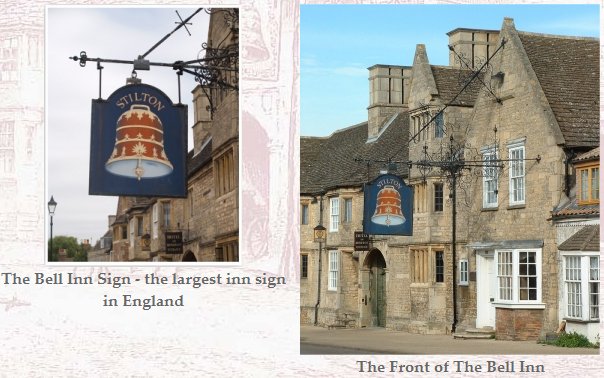
It is commonly believed that the pioneer of blue Stilton was Cooper Thornhill, owner of the Bell Inn on the Great North Road, in the village of Stilton, Huntingdonshire. Traditional legend has it that in 1730, Thornhill discovered a distinctive blue cheese while visiting a small farm near Melton Mowbray in rural Leicestershire — possibly in Wymondham. He fell in love with the cheese and made a business arrangement that granted the Bell Inn exclusive marketing rights to blue Stilton. Soon thereafter, wagon loads of cheese were being delivered to the inn. Since the main stagecoach routes from London to Northern England passed through the village of Stilton he was able to promote the sale of this cheese and the fame of Stilton rapidly spread. However, the first known written reference to Stilton cheese was in William Stukeley’s Itinerarium Curiosum, letter V, dated October 1722, and in his 1724 work A tour thro’ the Whole Island of Great Britain Daniel Defoe describes Stilton cheese as “famous”.
So the cheese called “Stilton” isn’t actually made in Stilton. However, the Bell Inn is still there, and you can indeed get a meal with Stilton cheese in the building that helped to make it famous. I’d dig out my photos of the building, but I was there in the pre-digital photography age, so I’m not at all certain where they are . . .
Comments Off on Stilton cheese
Hacking a secure WiFi connection not illegal, says Dutch court
An interesting legal precedent may not be as far-reaching as the headline might imply:
Breaking in to an encrypted router and using the WiFi connection is not an criminal offence, a Dutch court ruled. WiFi hackers can not be prosecuted for breaching router security.
A court in The Hague ruled earlier this month that it is legal to break WiFi security to use the internet connection. The court also decided that piggybacking on open WiFi networks in bars and hotels can not be prosecuted. In many countries both actions are illegal and often can be fined.
[. . .]
The Judge reasoned that the student didn’t gain access to the computer connected to the router, but only used the routers internet connection. Under Dutch law breaking in to a computer is forbidden.
A computer in The Netherlands is defined as a machine that is used for three things: the storage, processing and transmission of data. A router can therefore not be described as a computer because it is only used to transfer or process data and not for storing bits and bytes. Hacking a device that is no computer by law is not illegal, and can not be prosecuted, the court concluded.
The key here is the definition of a computer under the law: I expect the Dutch to update this definition in response to the outcome of this case.
March 18, 2011
March 17, 2011
Steam narrowboat
H/T to Eric Kirkland, who noted:
Please note the compulsory requisites for ‘proper’ canal cruising:
1) The flat cap
2) The grey beard
3) The mucky overalls
4) Bloomin’ great boots
Prior to the current ‘Elf and Safety regime there would also be
5) Roll ups permanently attached to the lower lip or a blazing briar full of Ogdens’ Flake
Comments Off on Steam narrowboat
AWACS in Libyan airspace
Strategy Page reports on the use of AWACS resources over the north African country:
A week after NATO began sending its AWACS aircraft to monitor aircraft activity over northern Libya, it’s been decided to have these radar aircraft monitor that airspace 24/7. The AWACS can fly over international waters and still monitor air activity several hundred kilometers into Libya. This may become crucial if a no-fly zone is established over the Libyan coastal area (where most of the population lives). AWACS can spot Libyan aircraft taking off, and call in fighters to deal with that problem before the Libyan warplanes can get very far.
The Libyan rebels resisted calling for a no-fly zone, but recent defeats have changed their minds. The Arab League has also called on the UN to authorize a no-fly zone, and the U.S. has agreed to participate. American and French carriers, plus, possibly, Egyptian fighters, would provide the combat aircraft needed for enforcement. While Libya doesn’t have many flyable warplanes, the few they do get into the air have proved to be powerful weapons against the rebels. In at least three cases, Libyan pilots refused to bomb the rebels. The pilots of two aircraft defected and flew to Malta. The two crew in another fighter-bomber ejected and let their aircraft crash. It’s believed that Libyan dictator is now using mercenary pilots (perhaps from Syria).
Comments Off on AWACS in Libyan airspace


