Quotulatiousness

February 3, 2011

How bad is Ireland’s banking situation? Try “spectacularly bad” and you’re close

Filed under: Economics, Europe — Tags: , , — Nicholas @ 17:28

Michael Lewis tries to provide some idea of the scale of the problem to American readers:

It had been two years since a handful of Irish politicians and bankers decided to guarantee all the debts of the country’s biggest banks, but the people were only now getting their minds around what that meant for them. The numbers were breathtaking. A single bank, Anglo Irish, which, two years before, the Irish government had claimed was merely suffering from a “liquidity problem,” faced losses of up to 34 billion euros. To get some sense of how “34 billion euros” sounds to Irish ears, an American thinking in dollars needs to multiply it by roughly one hundred: $3.4 trillion. And that was for a single bank. As the sum total of loans made by Anglo Irish, most of it to Irish property developers, was only 72 billion euros, the bank had lost nearly half of every dollar it invested.

That’s one of the three big banks the Irish government had to help. The other two may be in worse shape. You could say Ireland’s banks are awful:

Even in an era when capitalists went out of their way to destroy capitalism, the Irish bankers set some kind of record for destruction. Theo Phanos, a London hedge-fund manager with interests in Ireland, says that “Anglo Irish was probably the world’s worst bank. Even worse than the Icelandic banks.”

Ireland’s financial disaster shared some things with Iceland’s. It was created by the sort of men who ignore their wives’ suggestions that maybe they should stop and ask for directions, for instance. But while Icelandic males used foreign money to conquer foreign places — trophy companies in Britain, chunks of Scandinavia — the Irish male used foreign money to conquer Ireland. Left alone in a dark room with a pile of money, the Irish decided what they really wanted to do with it was to buy Ireland. From one another. An Irish economist named Morgan Kelly, whose estimates of Irish bank losses have been the most prescient, made a back-of-the-envelope calculation that puts the losses of all Irish banks at roughly 106 billion euros. (Think $10 trillion.) At the rate money currently flows into the Irish treasury, Irish bank losses alone would absorb every penny of Irish taxes for at least the next three years.

As mentioned in this post yesterday, the Irish who can do so are starting to head to greener pastures. A thousand a week in net emigration over the last year and a half.

H/T to Tyler Cowen for the link.

February 2, 2011

Thousands are sailing flying

Filed under: Europe, History, Media — Tags: , , — Nicholas @ 12:31

Patricia Treble reports on the new wave of Irish emigration:

With their economy in a tailspin and bad financial news piling up, the Irish people are voting with their feet—they’re leaving the Emerald Isle at the rate of 1,000 a week. Last Thursday, the Economic and Social Research Institute (ESRI) published a grim forecast: net outward migration will reach 100,000 in the two years ending in April 2012.

Packing up and leaving in dire times is nothing new for Ireland. In the 1800s, millions fled the island’s famines and disease for the chance of a better life in countries such as Canada, the United States and Australia. Even recently, there have been waves of emigration. The last time the emigration numbers were as high as they are now was in 1989, when 44,000 fled the economically depressed nation. Soon after, Ireland cut taxes, attracted massive foreign investment and transformed itself into a Celtic Tiger. Property prices soared along with personal wealth.

It’s always a good time for some Pogues music:

BBC’s Top Gear team spark hostile response from Mexico

Filed under: Americas, Britain, Media — Tags: , , , , , , , — Nicholas @ 09:25

I guess that diplomats must do things like this, but anyone who’s watched more than five minutes of Top Gear would not take them seriously as political commentators. Hilariously funny, yes, but not particularly representative of British or British government views. Mexico, however, has chosen to take offense and has sent a demand to the BBC for a formal apology:

The irreverent British motoring show “Top Gear” has driven into diplomatic hot water after a host branded a Mexican car “lazy, feckless and flatulent” and said it mirrored Mexico’s national characteristics.

Mexico’s ambassador to Britain fired off a letter to the state broadcaster protesting the show’s “outrageous, vulgar and inexcusable insults” and demanding an apology.

In the episode, host Richard Hammond likened a Mexican sports car to “a lazy, feckless and flatulent oaf with a mustache, leaning against a fence asleep, looking at a cactus with a blanket with a hole in the middle on as a coat.”

Co-host James May went on to describe Mexican food as “like sick with cheese on it,” or “refried sick,” while Jeremy Clarkson predicted they would not get any complaints about the show because “the ambassador is going to be sitting there with a remote control, snoring.”

I’m sure the BBC will provide the requested apology, but I doubt that it will change anything. Top Gear without the over-the-top commentary would be just another bloody car show.

UK government trying to further economize on helicopters for Afghan service

Filed under: Asia, Britain, Military — Tags: , , — Nicholas @ 08:25

Lewis Page is concerned that, on top of the wrong-headed approach to cutting military costs, the coalition government may further reduce the Chinook helicopter plans:

In its last months in office, the previous Labour government announced plans to order 22 new Chinook helicopters (in addition to two which would replace recent combat losses in Afghanistan). The money was to be found by cutting squadrons of fast jets — in particular, Tornado low-level deep strike bombers. The first 10 helicopters were to come into service in 2012-13.

On arrival in office the Coalition carried out a Strategic Defence Review, personally supervised by Prime Minister Cameron, in which it was decided that the Tornado bomber fleet would be preserved intact, the Chinook order would be cut to just 12 — and, controversially, that the Harrier jumpjet fleet would be scrapped entirely.

Even the much reduced Chinook order has so far failed to actually be signed, and there have since been suggestions that the Ministry of Defence financial assumptions which underlay the Review were too optimistic – thus, that more cuts might be required.

February 1, 2011

A nasty bureaucratic trick

Filed under: Asia, Britain, Bureaucracy, Liberty — Tags: , , , — Nicholas @ 09:47

Jon, my former virtual landlord, sent along this link describing it as a “creative solution”:

An immigration officer tried to rid himself of his wife by adding her name to a list of terrorist suspects.

He used his access to security databases to include his wife on a watch list of people banned from boarding flights into Britain because their presence in the country is ‘not conducive to the public good’.

As a result the woman was unable for three years to return from Pakistan after travelling to the county to visit family.

The tampering went undetected until the immigration officer was selected for promotion and his wife name was found on the suspects’ list during a vetting inquiry.

The Home Office confirmed today that the officer has been sacked for gross misconduct.

Because these lists are easy to get added to, but nearly impossible to get removed from (and there’s little chance you get told why you’re on the list — or even if you’re on it), this little trick could have continued indefinitely until the perpetrator had to go through security screening for a higher position.

January 29, 2011

A bit of history, from a Yeoman Warder at the Tower of London

Filed under: Britain, History, Humour — Tags: — Nicholas @ 10:39

H/T to Craig Zeni for the link.

January 28, 2011

Finns unhappy with icy iPhones

Filed under: Europe, Law, Technology — Tags: , , , — Nicholas @ 09:23

Bill Ray reports on the source of Finnish unhappiness with Apple iPhone performance:

Finnish iPhone users unhappy at the inability of the handset to operate below zero are entitled to their money back, even if the limitation appears in the small print.

The clarification comes from the Finland’s Consumer Agency, as reported by Finnish news agency YLE.fi, in response to numerous questions from concerned Finns who are unhappy that their shiny Apple toys won’t promise to work again until the spring, at best. So unless the shop specifically stated the zero-degree operational limit, then the regulator reckons iPhone-purchasing Finns are entitled to their money back.

Finland, like the UK, requires all items sold new to operate in the way they might reasonably be expected to do. Small print can’t negate those rights, and it’s reasonable for Finns to expect to be able to make phone calls outside, so refunds would seem to be in order. Meanwhile the regulator is preparing a list of questions for Apple about how it trains its staff, and how badly the iPhone breaks down when it gets cold.

January 27, 2011

UK government officials implicated in ADE-651 bomb detector scam

Filed under: Britain, Law, Middle East, Military, Technology — Tags: , , , — Nicholas @ 13:03

Remember the ADE-651? The bomb detector that could “detect elephants, humans and 100 dollar bills”? It now appears that British army personnel and civil servants were involved in the effort to sell the bogus device:

The government has admitted that the Army and UK civil servants helped market so-called “bomb detectors”, which did not work, around the world.

Export of the “magic wand” detectors to Iraq and Afghanistan was banned on 27 January 2010 because of the threat they posed to British and allied troops.

The move followed a BBC Newsnight investigation showing they could not detect explosives — or anything else.

Now Newsnight has learned that they are still being sold around the globe.

You can understand the attraction to potential scammers, as the things cost £11 to make (at most) and can be sold for £15,000 to unsuspecting dupes (or willing accomplices, splitting the profits) representing foreign governments.

New entrant into the “Security Theatre Kabuki Hall of Fame”

Filed under: Britain, Bureaucracy — Tags: , , , — Nicholas @ 12:54

Step forward, our first inductee for 2011, Gatwick Airport security staff:

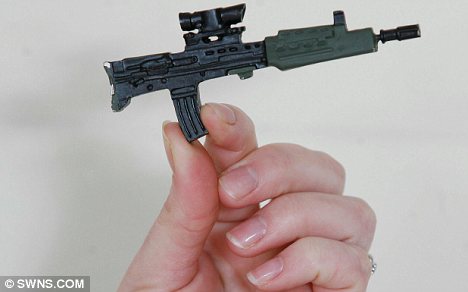
Airport officials ordered a holidaymaker carrying a toy soldier onto a plane to remove its three-inch gun — because it was a safety threat.

Ken Lloyd was stunned when he was told he could not go on the plane with the nine-inch model soldier because it was carrying a ‘firearm’.

The Canadian tourist and his wife had bought the toy, which holds a replica SA80 rifle, during a visit to the Royal Signals Museum at Blandford Camp in Dorset.

Well caught, security super-heroes! Here’s the vicious piece of deadly weaponry they bravely prevented from being smuggled aboard the plane:

They’ll be around to collect his “man card” any moment

Filed under: Europe, Germany, Randomness — Tags: , , — Nicholas @ 12:50

Poor guy can’t get enough sleep because of his sex-mad spouse:

An exhausted Turkish man living in Germany has asked cops to protect him from his sex-mad missus, Bild reports.

The bleary-eyed victim of his wife’s “voracious embraces” walked into a police station in the southwestern city of Waiblingen on Tuesday to explain he’d spent four years kipping on the sofa in a vain attempt to get some shut-eye.

Grounding the Nimrod

Filed under: Britain, Military — Tags: , , — Nicholas @ 07:22

It’s as predictable as night following day: for every defence cut, you can find retired senior officers getting up on their hind legs and protesting:

Scrapping the RAF’s Nimrod surveillance aircraft will leave a “massive gap” in British security, former defence chiefs warned today.

The controversial decision to get rid of the £4bn fleet was taken on cost grounds as part of the government’s strategic defence and security review last year.

With the process of breaking up the equipment set to begin, a number of service chiefs signed an open letter to the Daily Telegraph warning of the dangers of the move.

“Machine tools have been destroyed; several millions of pounds have been saved but a massive gap in British security has opened,” the letter said.

“Vulnerability of sea lanes, unpredictable overseas crises and traditional surface and submarine opposition will continue to demand versatile responsive aircraft.

There was a number in there that helps to explain the cuts: £4bn. That’s a lot of money. What did the RAF get for their money? In a column from 2009, here’s Lewis Page on the manifold wonders of the Nimrod:

Quite apart from all that, the Nimrod MR2 — being a flying antique — is horribly expensive to run, both in money and in lives. The MR2’s extensive use above Afghanistan in recent times as a flying spyeye and to relay radio messages between ground units in no way justified its continued, very expensive existence; far less could such unimportant work possibly have justified the known risks of refuelling these aged birds in mid-air.

So getting rid of the MR2s loses us nothing important, and will make our service people noticeably safer — the Nimrod has actually killed one of our people for every 15 killed by the Taliban. Better still, this will permit another pricey airbase here in the UK to largely close, saving money to be spent at the front line. As a fringe benefit, the base in question — RAF Kinloss — is in a Scottish National Party constituency, giving people there a taste of the independence from the UK that they have voted for. (Strangely the local SNP member of parliament still isn’t happy.)

So the Nimrod was expensive to buy, eye-wateringly expensive to upgrade, but it must be cheap to operate, right? No:

[. . .] our new fleet of refurbished De Havilland Comet subhunters (sorry, “Nimrod MRA4s”) will cost at least £700m a year to operate. If we put the whole Nimrod force on the scrapheap for which they are so long overdue right now, by the year 2019 we will have saved [. . .] £7bn

That’s from an earlier column in 2009.

Update: Lewis Page says that scrapping the four Nimrods is great news:

The UK press is bursting with indignation today as the process of scrapping the Nimrod MRA4 submarine-hunting aircraft begins. But in fact the four planes now being broken up were a financial and engineering disaster. Had they gone into service they would have become a terrible, cripplingly expensive millstone around the neck of the Ministry of Defence. We are much, much better off without them.

[. . .]

What the ex-brasshats are bemoaning is the UK’s loss of long-range maritime patrol aircraft in general, not the Nimrod MRA4 in particular. They’re wise to draw this distinction, as the MRA4 project has now achieved the unwelcome distinction of producing the most expensive aircraft ever made: with a reported £4.1bn spent, just one is airworthy.

By comparison, a new Space Shuttle would cost about £1.75bn at current rates if it were built today. Even the staggeringly expensive B-2 nuclear Stealth bombers only cost £1.3bn apiece.

Our sole flying Nimrod MRA4 (pictured above) has wound up costing us no less than £4.1bn — and it is not even a new aircraft. All the MRA4s are refurbished and re-equipped Nimrod MR2s, which had already been purchased by the RAF long ago at inflated prices.

But wait . . . it gets even worse:

And make no mistake, scrapping the Nimrods will save money — a lot of money. Support and maintenance of a normal military aircraft can be expected to cost two to three times the acquisition price over its service life — and the Nimrod was far from normal.

In fact, the MRA4s would have been the last nine De Havilland Comet airliner airframes left flying in the world. The Comet, designed in the 1940s, failed commercially and went out of airline service many decades ago — and since then large aircraft have no longer been made in the UK.

The Nimrod/Comet is so old that it belongs to a lost era of manufacturing: this is the main reason why the MRA4 project was so horrifically late and over budget. The planes supplied for upgrading by the RAF had significant differences in size and shape — they had been essentially coach-built, bodged together with the blueprints used more as a guide than followed with any accuracy in the modern sense. Trying to rebuild, re-equip and re-engine them, with no real idea what the physical dimensions and internal layout of any given plane actually were, was a technical nightmare.

January 26, 2011

Be careful with your old, tired URLs

Filed under: Britain, Technology — Tags: , , , — Nicholas @ 09:22

The very first domain name I registered ended up getting hijacked: the ISP I was using got taken over by someone else, and they arbitrarily changed all the contact info for my domain to point to them instead. The domain expired (no notice to me), the grace period for renewal expired (again, no word to me), and suddenly the historical society’s domain name is now a porn site (slightly longer original story here).

That’s why I have some sympathy for this British MP who linked to a site promoting a local concern, which then became a German porn site:

Red-faced Tory MP Francis Maude last night denied all responsibility for the content of a German SmutSite — and then quietly removed a link to it from his own personal front page.

The embarrassment seems to have arisen after Francis Maude, the member for Horsham, and Henry Smith, MP for neighbouring Crawley, got together to sponsor a campaign for an acute hospital to be built in the Pease Pottage area of Sussex. The campaign registered and made use of a domain — c4pph.org (NSFW) — which certainly appears at one time to have been a perfectly respectable site campaigning on this issue.

However, as an official spokeswoman for Francis Maude told us last night: “The campaign … no longer owns or operates the c4pph.org web address and hasn’t done so since last year. We understand the domain name is now under new ownership with no connection to the campaign.”

Nostalgia for the Dreadnought era?

Filed under: China, Economics, Germany, History, WW1 — Tags: — Nicholas @ 09:03

Ambrose Evans-Pritchard finds the parallels between the rise of Imperial Germany in the years leading up to the first world war and attitudes toward China today:

And we all learned how the Kaiser overplayed his hand. That much was obvious.

Yet it is difficult to pin-point exactly when the normal pattern of great power jostling began to metamorphose into something more dangerous, leading to two rival, entrenched, and heavily armed alliance structures unable or unwilling to avert the drift towards conflict. The Long Peace died by a thousand cuts, a snub here, a Dreadnought there, the race for oil.

[. . .]

Is China now where Germany was in 1900? Possibly. There are certainly hints of menace from some quarters in Beijing. Defence minister Liang Guanglie said over New Year that China’s armed forces are “pushing forward preparations for military conflict in every strategic direction”.

Professor Huang Jing from Singapore’s Lee Kwan Yew School and a former adviser to China’s Army, said Beijing is losing its grip on the colonels.

“The young officers are taking control of strategy and it is like young officers in Japan in the 1930s. This is very dangerous. They are on a collision course with a US-dominated system,” he said.

The problem with drawing parallels from history is that it’s never as neat and clean-cut as you’d expect. First, China is supposed to be like Kaiser Wilhelm’s Germany, then more like Japan after WW1. I have to say I’m not totally following this line of thought. But, getting back to today’s situation:

There is a new edge to Chinese naval policy in the South China Sea, causing Japan, Vietnam, Indonesia, and the Philippines to cleave closer to the US alliance. Has Beijing studied how German naval ambitions upset the careful diplomatic legacy of Bismarck and pushed an ambivalent Britain towards the Entente, even to the point of accepting alliance with Tsarist autocracy?

Factions in Beijing appear to think that China will win a trade war if Washington ever imposes sanctions to counter Chinese mercantilism. That is a fatal misjudgement. The lesson of Smoot-Hawley and the 1930s is that surplus states suffer crippling depressions when the guillotine comes down on free trade; while deficit states can muddle through, reviving their industries behind barriers. Demand is the most precious commodity of all in a world of excess supply.

H/T to Jon, my former virtual landlord, for the link.

January 25, 2011

Russian army still suffering from Soviet hangover

Filed under: History, Military, Russia — Tags: , , , — Nicholas @ 07:47

Strategy Page reports on the troubles the Russian army is still experiencing twenty years after the fall of the Soviet Union:

Russian efforts to reform and upgrade its armed forces have, so far, failed. The basic problem is that few Russian men are willing to join, even at good pay rates. Efforts to recruit women and foreigners have not made up for this. The Russian military has an image problem that just won’t go away. This resulted in the period of service for conscripts being lowered to one year (from two) in 2008. That was partly to placate the growing number of parents who were encouraging, and assisting, their kids in avoiding military service.

But there are other problems. The latest crop of draftees are those born after the Soviet Union dissolved. That was when the birth rate went south. Not so much because the Soviet Union was gone, but more because of the economic collapse (caused by decades of communist misrule) that precipitated the collapse of the communist government. The number of available draftees went from 1.5 million a year in the early 1990s, to 800,000 today. Less than half those potential conscripts are showing up, and many have criminal records (or tendencies) that help sustain the abuse of new recruits that has made military service so unsavory. With conscripts in for only a year, rather than two, the military is forced to take a lot of marginal (sickly, overweight, bad attitudes, drug users) recruits in order to keep the military and Ministry of Interior units up to strength. But this means that even elite airborne and commando units are using a lot of conscripts. Most of these young guys take a year to master the skills needed to be useful, and then they are discharged. Few choose to remain in uniform and become a career soldiers. That’s primarily because the Russian armed forces is seen as a crippled institution, and one not likely to get better any time soon. With so many of the troops now one year conscripts, an increasing number of the best officers and NCOs get tired of coping with all the alcoholics, drug users and petty criminals that are taken in just to make quotas. With the exodus of the best leaders, and growing number of ill-trained and unreliable conscripts, the Russian military is more of a mirage than an effective combat (or even police) organization.

January 22, 2011

Russian drama: Defense Minister disses AK-47

Filed under: Europe, Military, Russia, Technology — Tags: — Nicholas @ 11:06

The Russian Defense Minister just stirred up a controversy that could only be equalled here if the Prime Minister called hockey a pansy frou-frou game:

Apparently, Russia’s Defense Minister, Anatoly Serdyukov, opined publically that the Kalashnikov and Dragunov SVDs sniper rifles, are “morally outdated.” To add insult to injury, he intimated that he’s considering replacing the weapons with something else. Let’s just say this didn’t play well in the Russian equivalent of the Borscht Belt. In fact, “firestorm of controversy” would be a pretty accurate depiction of the ensuing fireworks.

Evidently, Russians are a prideful people. And they take a lot of pride in Kalishnikov’s Greatest Hit of 1947. The AK-47 has withstood the test of time, doing exactly what it’s designer set out for it to do — function as a rugged, all-purpose weapon that was cheap to build, easy to use, and would run even if you filled it full of mud. Accuracy was not really high on the list of objectives, but I understand from people that know far more about the AKs than I, that they are far more accurate than most people believe.

[. . .]

So for Mother Russia, their very own Defense Minister dissin’ the AK would be like Jeff Cooper bitch-slappin’ the 1911, and throwin’ in a little trash talk against John Moses Browning, to boot. But the times they are a-changin,’ and I’m not so sure Anatolovich doesn’t have a valid pointsky.

The venerable 1911 and AK-47 bear more than a passing comparison. They are both well-established, respected designs. They are both manufactured by multiple armories. And they both have several features that are seen in a modern context as design flaws at worst, and in desperate need of an update, at best.

I’ve posted on the reputation of the AK-47 before.

« Newer PostsOlder Posts »

Powered by WordPress


