Quotulatiousness

January 31, 2020

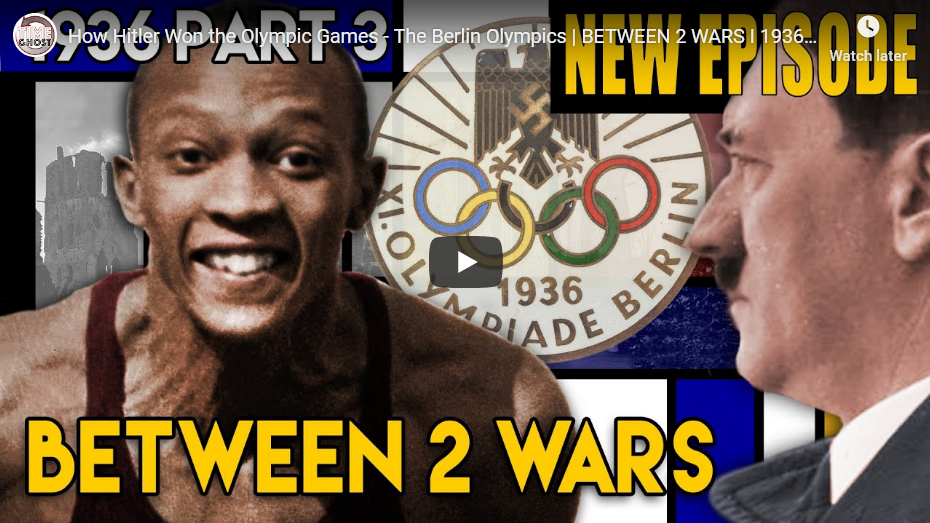
How Hitler Won the Olympic Games – The Berlin Olympics | BETWEEN 2 WARS I 1936 Part 3 of 3

Filed under: Germany, History, Sports — Tags: , , , , — Nicholas @ 06:00

TimeGhost History
Published 30 Jan 2020

The Berlin Olympics in 1936 were a masterfully played piece of Nazi propaganda, where they framed their race as physically superior and their ideology as modern, organised and cultured while also ostensibly downplaying their anti-internationalism racism and anti-semitism. But the Germans didn’t embrace sports for friendly competition. They did so for something very different.

Join us on Patreon: https://www.patreon.com/TimeGhostHistory

Hosted by: Indy Neidell
Written by: Joram Appel
Directed by: Spartacus Olsson and Astrid Deinhard
Executive Producers: Bodo Rittenauer, Astrid Deinhard, Indy Neidell, Spartacus Olsson
Creative Producer: Joram Appel
Post-Production Director: Wieke Kapteijns
Research by: Joram Appel
Edited by: Daniel Weiss
Sound design: Marek Kaminski

Sources:
Bundesarchiv_Bild:
183-G00372, 102-08105, 145_Bild-P017100, 183-R96374, 146-
1998-020-00A, 146-1976-033, 183-G00978, 183-1992-0421-500,
146-2005-0017, 183-G00352, 146-1976-116-08A, 146-1988-106-
29, 146II-728, 8076_Bild-0008
Modern Olympic Photos:
Photo from illang https://www.flickr.com/photos/ilan_sr…,
Photo by Agência Brasil http://agenciabrasil.ebc.com.br/rio-2…

Colorizations by:
Daniel Weiss
Norman Stewart
Joram Appel

Soundtracks from Epidemic Sound:
– “First Responders” – Skrya
– “The Inspector 4” – Johannes Bornlöf
– “Heroes On Horses” – Gunnar Johnsén
– “Split Decision” – Rannar Sillard
– “Not Safe Yet” – Gunnar Johnsen
– “Thunder Storm 01” – Fredrik Ekstrom
– “Dawn Of Civilization” – Jo Wandrini (1)
– “March Of The Brave 4” – Rannar Sillard
– “Magnificent March 3” – Johannes Bornlöf
– “Imperious” – Bonnie Grace
– “The Charleston 3” – Håkan Eriksson

A TimeGhost chronological documentary produced by OnLion Entertainment GmbH.

From the comments:

TimeGhost History
2 days ago (edited)
The 1936 Berlin Summer Olympics and Garmisch-Partenkirchen Winter Olympics were the first true modern Olympic games. Many of the now staples of the Olympic games were introduced for the first time by the Nazis. But magnificent as they might have been, the intent of the Germans was not really to advance the vision of the internationalist and pacifist goals of the Olympic games. And while we do realise that many of the characteristics of the 1936 Olympics – how it was used to push a certain national image or to strengthen nationalism, could be said of more recent editions of the Olympics as well. And while sports and international institutions are still today being used to push alternate agendas, we’d rather not discuss them in the comment section here as this is a history channel – not a current affairs channel.
Cheers, Joram

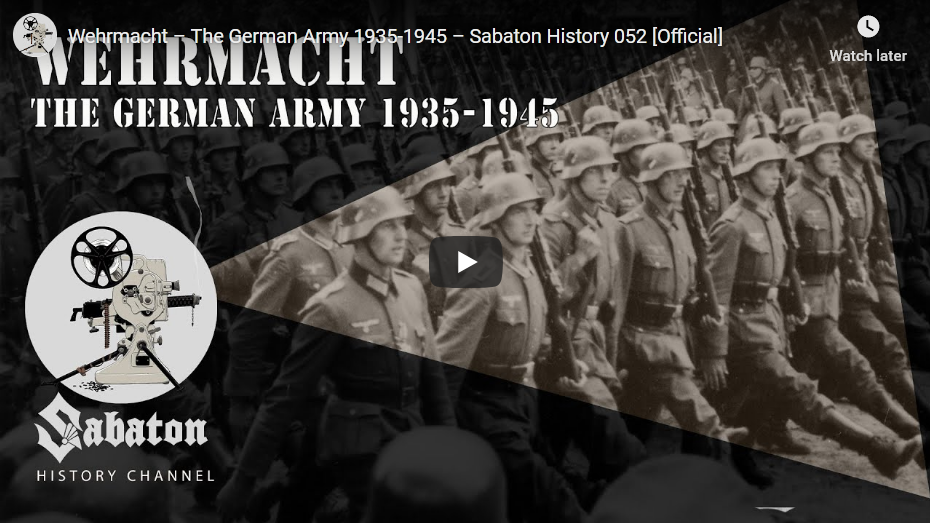
Wehrmacht” – The German Army 1935-1945 – Sabaton History 052 [Official]

Filed under: Germany, History, Media, Military, WW2 — Tags: , , , , , — Nicholas @ 04:00

Sabaton History
Published 30 Jan 2020

From 1935 onwards, the German Wehrmacht was expanding rapidly. Millions of men joined the army, the Luftwaffe and the Kriegsmarine to fulfill Adolf Hitler’s visions for the 3rd Reich.

Highly motorized Panzergrenadiers, elite parachute- and resilient mountain-infantry troops were trained and and led with the utmost combat-efficiency in mind, supported by state of the art Panzers and aircraft. If it came to war, they would break the enemy and break them fast, achieving fast victories in a series of devastating hits. However, succumbing to the ideological influence of National-Socialism, the Wehrmacht found itself soon to be both culprit and accomplice to a self-reinforcing cycle of violence and atrocities.

Support Sabaton History on Patreon: https://www.patreon.com/sabatonhistory

Listen to “Wehrmacht” here:
CD: http://bit.ly/CoatOfArmsStore
Spotify: http://bit.ly/CoatOfArmsSpotify
Apple Music: http://bit.ly/CoatOfArmsAppleMusic
iTunes: http://bit.ly/CoatOfArmsiTunes
Amazon: http://bit.ly/CoatOfArmsAmzn
Google Play: http://bit.ly/CoatOfArmsGooglePlay

Check out the trailer for Sabaton’s new album The Great War right here: https://www.youtube.com/watch?v=HCZP1…

Listen to Sabaton on Spotify: http://smarturl.it/SabatonSpotify
Official Sabaton Merchandise Shop: http://bit.ly/SabatonOfficialShop

Hosted by: Indy Neidell
Written by: Markus Linke and Indy Neidell
Directed by: Astrid Deinhard and Wieke Kapteijns
Produced by: Pär Sundström, Astrid Deinhard and Spartacus Olsson
Creative Producer: Joram Appel
Executive Producers: Pär Sundström, Joakim Broden, Tomas Sunmo, Indy Neidell, Astrid Deinhard, and Spartacus Olsson
Post-Production Director: Wieke Kapteijns
Edited by: Iryna Dulka
Sound Editing by: Marek Kaminski
Maps by: Eastory – https://www.youtube.com/c/eastory

Archive by: Reuters/Screenocean https://www.screenocean.com
Music by Sabaton.

Sources:
– Bundesarchiv
– IWM: H 21907- Bundesarchiv
– IWM: H 21907

An OnLion Entertainment GmbH and Raging Beaver Publishing AB co-Production.

© Raging Beaver Publishing AB, 2019 – all rights reserved.

January 24, 2020

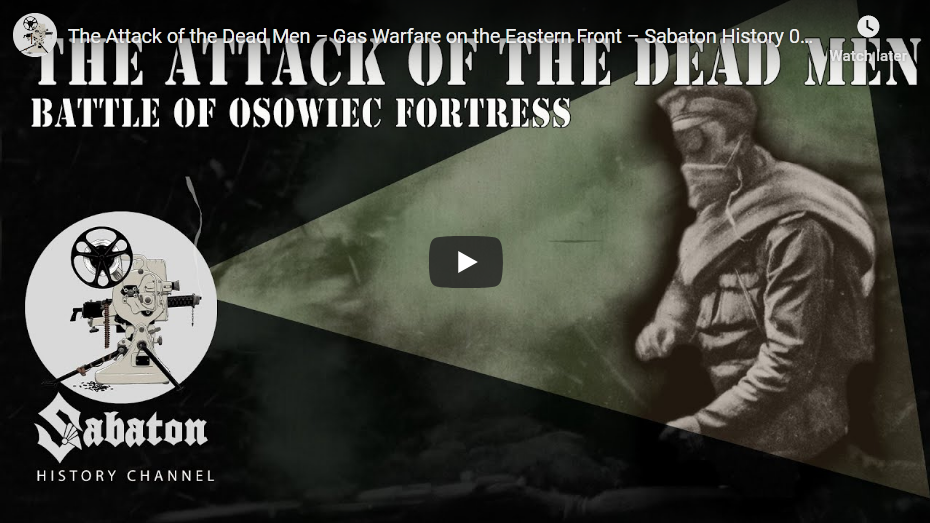
“The Attack of the Dead Men” – Gas Warfare on the Eastern Front – Sabaton History 051 [Official]

Filed under: Germany, History, Media, Military, Russia, WW1 — Tags: , , , — Nicholas @ 04:00

Sabaton History
Published 23 Jan 2020

This episode is about the “Attack of the Dead Men”. During the third battle for Osowiec Fortress in July 1915 during the Great War, German artillery was bombarding the defending Russian soldiers with a new deadly weapon: Poison Gas. The fatal mixture of chlorine and bromine descended like a green fog over the Russian trenches. Without adequate gas-masks to protect themselves, the defenders were believed to all have died in agony. However, as the German infantry advanced, they did not only march right into a Russian counterattack but also encountered the dead, seemingly rising from their graves.

Support Sabaton History on Patreon: https://www.patreon.com/sabatonhistory

Listen to The Great War (where “The Attack of the Dead Men” is featured):
CD: http://nblast.de/SabatonTheGreatWar
Spotify: https://sabat.one/TheGreatWarSpotify
Apple Music: https://sabat.one/TheGreatWarAppleMusic
iTunes: https://sabat.one/TheGreatWarItunes
Amazon: https://sabat.one/TheGreatWarAmazon
Google Play: https://sabat.one/TheGreatWarGooglePlay

Check out the trailer for Sabaton’s new album The Great War right here: https://www.youtube.com/watch?v=HCZP1…

Listen to Sabaton on Spotify: http://smarturl.it/SabatonSpotify
Official Sabaton Merchandise Shop: http://bit.ly/SabatonOfficialShop

Hosted by: Indy Neidell
Written by: Markus Linke and Indy Neidell
Directed by: Astrid Deinhard and Wieke Kapteijns
Produced by: Pär Sundström, Astrid Deinhard and Spartacus Olsson
Creative Producer: Joram Appel
Executive Producers: Pär Sundström, Joakim Broden, Tomas Sunmo, Indy Neidell, Astrid Deinhard, and Spartacus Olsson
Post-Production Director: Wieke Kapteijns
Edited by: Iryna Dulka
Sound Editing by: Marek Kaminski
Maps by: Eastory – https://www.youtube.com/c/eastory

Archive by: Reuters/Screenocean https://www.screenocean.com
Music by Sabaton.

Sources:
– IWM: Q 78100, Q 86635
– The New York Public Library
– Narodowe Archiwum Cyfrowe

An OnLion Entertainment GmbH and Raging Beaver Publishing AB co-Production.

© Raging Beaver Publishing AB, 2019 – all rights reserved.

January 23, 2020

QotD: The “great” modern architects

The widely accepted narrative of modernism à la Gropius is that it was some kind of logical or ineluctable development from the Arts and Crafts movement. This seems to me utterly fantastic: it is like saying that Mickey Spillane is a logical or ineluctable outgrowth of Montesquieu. It is true that in the work of certain artists, for example Mondrian, one can see a gradual change which might be considered logical, starting from figurative landscapes and ending, via ever greater abstraction, to purely geometric shapes. But even where there is such a development, it is ultimately beside the point: it does not prove that what came later was better. Each artistic product has to be assessed aesthetically on its own merits (which in architecture includes its harmony with an existing townscape), and only someone who sees with an ideology rather than with eyes could conclude anything other than that modernism has been overwhelmingly a disaster.

Moreover, claiming respectable ancestors is somewhat at variance with equal claims to be starting from zero (as Gropius put it), but such a contradiction is hardly noticed by the grand narrative history of modernism that Professor Curl attacks and destroys.

He is not unable or unwilling to praise where it is due, though it is due rarely enough; and he is particularly effective in tracing the opportunistic ideological divagations of the modernists, whose one constant predilection was for absolute power over others. Mies, for example, was attracted to socialist totalitarianism, and his only objection to Nazism was that the Nazis eventually rejected his desire to have everything built according to his prescriptions. He left Nazi Germany because he feared his previous pro-leftism made him permanently suspect in its eyes, not because he was appalled by its brutality. If only they’d let him build! But contrary to apologists for Mies, and to a legend constantly repeated, it was not the Nazis who closed the Bauhaus but Mies himself, and he left Germany only four years after their assumption of power.

Finding refuge in America, Mies quickly perceived that the power of patronage of megalomaniac building lay with giant corporations rather than with fascists or communists and persuaded many of them to build his preternaturally inhuman and uninspired monstrosities. By a strange quirk of history, and because of mankind’s perpetual propensity to make logical errors, Mies was able to pose dishonestly as anti-totalitarian and even as a friend of freedom precisely because he had fled Nazi Germany where they hadn’t patronised him. He was fortunate that soon afterwards the United States had another totalitarian enemy, the Soviet Union. Mies and his allies were thus able to claim that his totalitarian modernism was actually a manifestation of western freedom. There are many such ironies pointed up in this book that would be delicious had they not had such appalling consequences.

Corbusier was a fascist in the most literal sense of the word, and early during the Occupation advocated the removal by force of the majority of Paris’ population because it had no business to be living there. Can one wonder that a man with thoughts like that built monstrosities?

Theodore Dalrymple, “Architectural Dystopia: A Book Review”, New English Review, 2018-10-04.

January 17, 2020

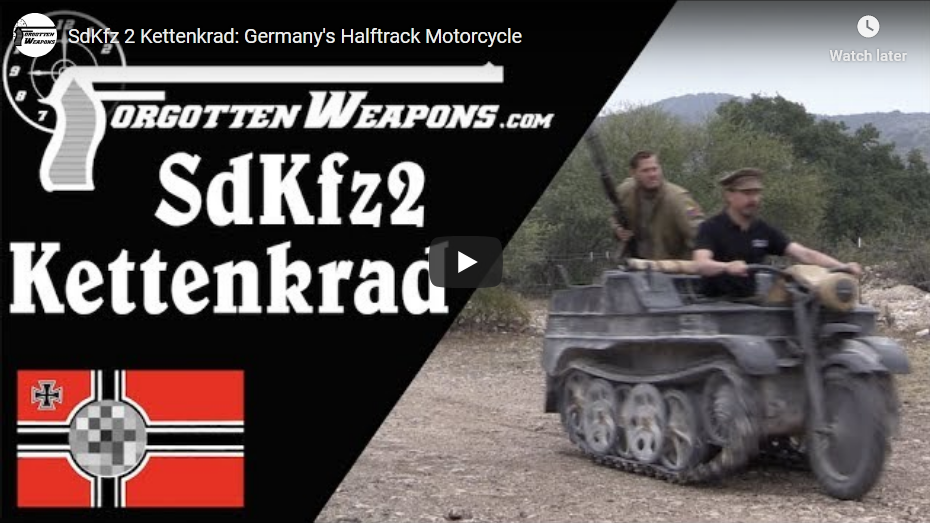
SdKfz 2 Kettenkrad: Germany’s Halftrack Motorcycle

Filed under: Germany, History, Military, Technology, WW2 — Tags: , , , — Nicholas @ 04:00

Forgotten Weapons
Published 16 Jan 2020

http://www.patreon.com/ForgottenWeapons

https://www.floatplane.com/channel/Fo…

Cool Forgotten Weapons merch! http://shop.bbtv.com/collections/forg…

The Sd.Kfz. 2 Kettenkraftrad (aka Kettenrad) is a deliciously German sort of vehicle, a small utility tractor made with a pair of treads and motorcycle front wheel. It was powered by a 4 cylinder Opel automotive engine generating 36 horsepower, and had a 3-speed gearbox with high and low range transfer case. Top speed was 44 mph, and it could tow about 1,000 pounds of ammunition or other supplies in a small 2-wheeled trailer, or directly tow light artillery pieces.

The vehicle was developed in 1939, and in mass production in time to see substantial use in Operation Barbarossa; the German invasion of Russia. Although complex to maintain and expensive to produce, the Kettenkrad was quite well suited to the terrain and distances of the Eastern Front. As the war progressed and supplies became scarcer and artillery became heavier it was less universally useful, but remained in service until the very end of the war, tasked with jobs as mundane as towing aircraft at airfields. After the war, they were put into civilian agricultural service (much like the Jeep in the US).

This example is in the rental fleet at DriveTanks.com, available for instruction and driving to anyone. It is one of my very favorite vehicles from World War Two, and I really appreciate DriveTanks giving me the opportunity to do some driving on it and show it to you! See all their available rentals here:

https://www.drivetanks.com

Contact:
Forgotten Weapons
6281 N. Oracle #36270
Tucson, AZ 85740

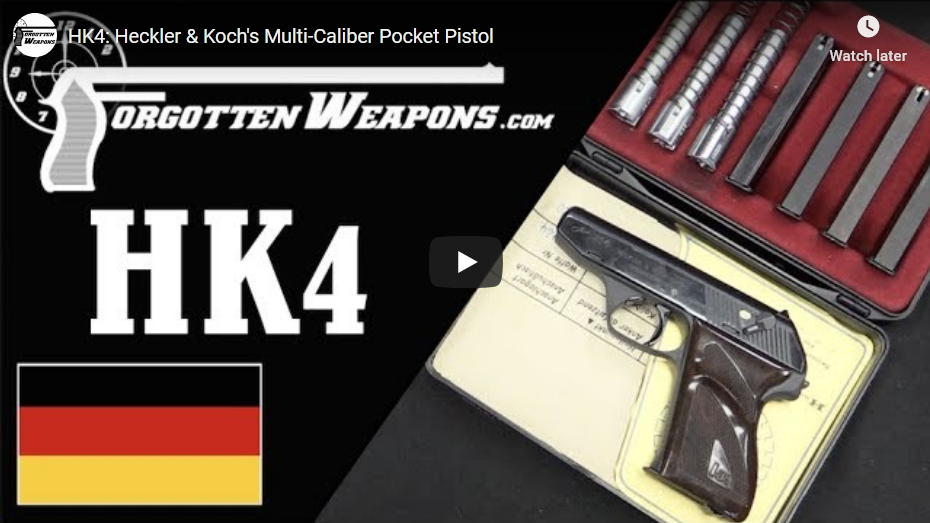
HK4: Heckler & Koch’s Multi-Caliber Pocket Pistol

Filed under: Germany, History, Weapons — Tags: , , — Nicholas @ 02:00

Forgotten Weapons
Published on 28 Aug 2019

RIA on YouTube: https://www.youtube.com/user/RockIsla…
RIA on Instagram: https://www.instagram.com/rockislanda…

The H&K Model 4 was named for the fact that it was offered in four different calibers – .22LR, .25 ACP, .32 ACP, and .380 ACP. The gun came with a complete set of spare barrels and magazines to allow conversion between all of them, and interesting feature not offered by any other pistols like it at the time. The design was by Alex Seidel, one of the founding engineers of H&K. He had familiarity with the Mauser HSc from his time working at Mauser, and it was the rough basis fo the HK4.

The changes between centerfire calibers required nothing more than swapping barrels (and recoil springs, which were pinned to the barrels) and magazines. Differing spring strength for each caliber were enough to make the gun both safe and reliable in the different chamberings. To convert to .22LR rimfire, it was also necessary to unscrew the removable breech face and flip it around. The breech face had two firing pin holes (one centerfire and one rimfire), and the firing pin could pivot enough to use either one. When the breech face was removed, the firing pin could be positioned for whichever setting was desired.

The HK4 was interesting and reasonably successful, but never able to really compete with guns like the Walther PP and PPK. During a 16-year production run from 1968 until 1984 a total of 38,200 were made, including 12,400 for the German customs police.

http://www.patreon.com/ForgottenWeapons

Cool Forgotten Weapons merch! http://shop.bbtv.com/collections/forg…

Contact:
Forgotten Weapons
PO Box 87647
Tucson, AZ 85754

January 14, 2020

The Desert Fox | Rommel’s FIRST Battle in the North African Campaign | BATTLESTORM

Filed under: Africa, Australia, Britain, Germany, History, Italy, Military, WW2 — Tags: , , , — Nicholas @ 04:00

TIK
Published 17 May 2016

Erwin Rommel faces the might of the British Empire. In 3D animation, we’ll see the units, the battlefield and the tactics The Desert Fox uses to overcome the British and Australian forces at Mersa Brega and throw them out of Italian Libya. Except for Tobruk of course! The video covers Erwin Rommel’s arrival in Italian Libya up to the beginning part of the Battle of Tobruk 1941.

This video is Part 2 of the Western Desert Campaign – Part 1 (Operation Compass) is in the link below
https://www.youtube.com/watch?v=b71kd…

Bibliography

Battistelli, Pier Paolo. Erwin Rommel (Command). Osprey Publishing, 2010.
Beckett, Ian F. Rommel: A Reappraisal. Great Britain, 2013.
Beevor, Antony. The Second World War. Phoenix, 2014.
Bickers, Richard Townshend. The Desert Air War: 1939-1945. Endeavour Press Ltd, 2015.
Butler, Daniel Allen. Field Mashal: the Life and Death of Erwin Rommel. Casemate Publishers, 2015.
Dimbleby, Jonathan. Destiny in the Desert: The Road to El Alamein – the Battle that Turned the Tide. Great Britain, 2012.
Liddell Hart, B.H. A History of the Second World War. Pan Books, 2015.
Hastings, Max. All Hell Let Loose: The World at War 1939-1945. HarperPress, 2011.
Jorgensen, Christer. Afrika Korps: Rommel’s 1941 Offensive (Rapid Reads). Brown Bear Books, 2014.
LaFace, Major Jeffrey L. Tactical Victory Leading to Operational Failure: Rommel in North Africa. Pickle Partners Publishing, 2014.
Lyman R. The Longest Siege: Tobruk – The Battle That Saved North Africa. Pan Books, 2011.
Moorehead, Alan. The Desert War: the Classic Trilogy on the North Africa Campaign 1940-43. CPI Group, 2012.
Nash, N. Strafer Desert General: The Life and Killing of Lieutenant General WHE Gott. Pen and Sword Books Ltd, 2013.
Neillands, Robert. The Desert Rats: 7th Armoured Division 1940-45. UK, 2005.
Neillands, Robert. Eighth Army: From the Western Desert to the Alps, 1939-1945. John Murray Publishers, 2004.
Pitt, Barrie. The Crucible of War: Volume 1: Wavell’s Command. Cassell & Co, 2001.
Playfair, Major-General I.S.O. The Mediterranean and Middle East, Volume II, “The Germans come to the help of their Ally” (1941). The Naval & Military Press Ltd, 2004.
Raugh, H. Wavell in the Middle East 1939-1941: A Study in Generalship. USA, 2013.
Reuth, Ralf Georg. Rommel: The End of a Legend. Haus Publishing, 2005.
Thompson, Dennis H. Discarded Victory – North Africa, 1940-1941. Pickle Partners, 2014.
Williamson, Gordon. Afrikakorps 1941-43 (Elite). Osprey Publishing, 2009.

January 12, 2020

Three Variations of Party Leader PPK Pistols

Filed under: Germany, History, Weapons, WW2 — Tags: , , , — Nicholas @ 02:00

Forgotten Weapons
Published 25 Oct 2019

Note: I goofed on a detail here; “DRGM” is a trademark designation, not something related to the party. Sorry!

http://www.patreon.com/ForgottenWeapons

Cool Forgotten Weapons merch! http://shop.bbtv.com/collections/forg…

Today, courtesy of Tom from Legacy Collectibles, we are taking a look at “party leader” PPK pistols. There are three different versions of these, and we will look at all of them in sequence. They are highly valued in the collecting community, and also extremely easy to fake, making authentication quite difficult. I will give you as much information as I can to assist in this, and Tom is happy to help (free of charge) as well.

To see more about Legacy, check out their YouTube channel:

https://www.youtube.com/channel/UCesj…

Contact:
Forgotten Weapons
6281 N. Oracle #36270
Tucson, AZ 85704

January 9, 2020

Operation Compass 1940-41 | BATTLESTORM North African Campaign Documentary

Filed under: Africa, Australia, Britain, Germany, History, Italy, Middle East, Military — Tags: , , , , — Nicholas @ 06:00

TIK
Published 21 Dec 2015

The most in-depth look at Operation Compass out there! Using animations and detailed maps, let’s find out what happened in one of the greatest British (and Commonwealth) victories of the war and who was responsible for the destruction of the Italian 10th Army. This video covers the start of the North African Campaign up to the Battle of Beda Fomm.

Sources:
Barnett, C. The Desert Generals. Weidenfeld & Nicolson, 2011.
Bierwirth, J. Beda Fomm: An Operational Analysis. Pickle Partners, 1994.
Christie H. Fallen Eagles: The Italian 10th Army in the Opening Campaign in the Western Desert, June 1940. Pickle Partners 1999.
Dimbleby, J. Destiny in the Desert. Britain 2013.
Moorehead, A. The Desert War: The Classic Trilogy on the North Africa Campaign 1940-43. Aurum Press, 2014.
Playfair, I.S.O. The Mediterranean and Middle East Volume 1: Early Successes against Italy [to May 1941]. 1954.
Wahlert, G. The Western Desert Campaign. Australia, 2011.

Music is my own!

QotD: National music

Filed under: Cancon, France, Germany, Italy, Media, Quotations, Russia, USA — Tags: — Nicholas @ 01:00

What does the soul of a people sound like? With the Germans, you have adequate proof; Wagner spoke for them, for better or worse — grandeur and myth that elevated the soul as easily as it rotted to the soundtrack for a meglomaniacal death cult. Italian music — well, no one ever marched off to war to Respighi’s ode to a peacock. Music for life, lived without lasting consequence. (They did their part in the Roman times; they’ve earned a nap.) French music is best expressed by the gauzy wash of Debussy and his comrades, music that doesn’t confront the ear but gently appeases it. America: cheerful tootling Souza marches or great broad optimistic Copeland yawps. Or jazz. Or rock and roll. Or country twangs. (It’s not that we have no sound — we have many, and each is as much a part of us as the other. Few cultures can pull that off.) Russian music has that delicious third-drink moodiness. Canadian music — no such thing, really, which is telling. Unless you define it as American style music recorded in a Canadian studio to satisfy a government requirement.

James Lileks, Screedblog, 2005-07-08.

January 8, 2020

Victor Davis Hanson – World War II Leadership

Filed under: Britain, Europe, Germany, History, Military, USA, WW2 — Tags: , , , , — Nicholas @ 04:00

Anang
Published 6 May 2012

If you want to read more about WW2 leadership, read Andrew Roberts Masters & Commanders.

Victor Hanson, a professor emeritus of Classics at California State University, Fresno, lectured to a history class on Masters and Commanders at Hillsdale College. In this fall seminar in classical and military history Professor Hanson examined how leaders, both civilian officials and generals on the battlefield, conducted themselves in wartime. That day’s class focused on Franklin D. Roosevelt and Winston Churchill and how those very different American and British leaders learned to work together to defeat Nazi Germany.

Original link: http://www.c-spanvideo.org/program/29…

January 5, 2020

It’s 1941 – A World at War – WW2 – 071 – January 4 1941

World War Two
Published 4 Jan 2020

1941 begins with action in North-Africa and China, but Indy also takes a moment to assess the current stakes and stakeholders in the East-Asian theatre. What is sure, is that 1941 will be an eventful year!

Join us on Patreon: https://www.patreon.com/TimeGhostHistory
Or join The TimeGhost Army directly at: https://timeghost.tv

Follow WW2 day by day on Instagram @World_war_two_realtime https://www.instagram.com/world_war_t…
Join our Discord Server: https://discord.gg/D6D2aYN.
Between 2 Wars: https://www.youtube.com/playlist?list…
Source list: http://bit.ly/WW2sources

Written and Hosted by: Indy Neidell
Produced and Directed by: Spartacus Olsson and Astrid Deinhard
Executive Producers: Bodo Rittenauer, Astrid Deinhard, Indy Neidell, Spartacus Olsson
Creative Producer: Joram Appel
Post-Production Director: Wieke Kapteijns
Research by: Indy Neidell
Edited by: Iryna Dulka
Map animations: Eastory (https://www.youtube.com/c/eastory)

Colorizations by:
– Adrien Fillon – https://www.instagram.com/adrien.colo…
– Julius Jääskeläinen – https://www.facebook.com/JJcolorization/

Sources:
– IWM: MH 2718, C 1850, E2294, E 18542, E 378, E 443, E 3721E, E 1573
– Bundesarchiv, Bild 101I-783-0104-09 / Moosmüller / CC-BY-SA 3.0
– Prison by FORMGUT. from the Noun Project
– Artillery by Creative Mania from the Noun Project

Soundtracks from Epidemic Sound:
– “Easy Target” – Rannar Sillard
– “The Inspector 4” – Johannes Bornlöf
– “Magnificent March 3” – Johannes Bornlöf
– “March Of The Brave 10” – Rannar Sillard
– “March Of The Brave 9” – Rannar Sillard
– “Deviation In Time” – Johannes Bornlof
– “Disciples of Sun Tzu” – Christian Andersen
– “Last Point of Safe Return” – Fabien Tell

Archive by Screenocean/Reuters https://www.screenocean.com.

A TimeGhost chronological documentary produced by OnLion Entertainment GmbH.

From the comments:

World War Two
2 days ago (edited)
Happy New Year to you all!! We hope you all had a great turn of the decade. We certainly have! Here’s a casual, spoiler-free statement: 1941 will be an interesting year. We are all very grateful for those who found us at the very start with the Invasion of Poland, during the Phoney War, the early fighting Northern and Western Europe and the more recent conflicts in Greece and North-Africa. Those of you who joined the TimeGhost Army and support us financially on patreon.com/timeghosthistory or Timeghost.tv deserve extra praise – as we would not have made 1941 without you! And we have BIG plans for the coming year, so please consider supporting us as well! Make history with us and join the TimeGhost Army!!

Here’s to a great 2020 and ‘interesting’ 1941.
Cheers, Joram

January 3, 2020

“Union” – Battle of Monte Cassino – Sabaton History 048 [Official]

Filed under: Europe, Germany, History, Italy, Media, Military, WW2 — Tags: , , , — Nicholas @ 04:00

Sabaton History
Published 2 Jan 2020

In early 1944, as the Allies are nearing Rome, Albert Kesselring orders a defensive line the likes of which rivals some of history’s greatest fortifications. Here, with the old hilltop abbey Monte Cassino looking down on the two front, the Axis and the Allies duel it out in a bloody and tiring fight for control of central Italy…

Support Sabaton History on Patreon: https://www.patreon.com/sabatonhistory

Listen to The Art Of War (where Union is featured):
CD: http://bit.ly/TheArtOfWarStore
Spotify: http://bit.ly/TheArtOfWarSpotify
Apple Music: http://bit.ly/TheArtOfWarAppleMusic
iTunes: http://bit.ly/TheArtOfWariTunes
Amazon: http://bit.ly/TheArtOfWarAmz
Google Play: http://bit.ly/TheArtOfWarGooglePlay

Listen to Sabaton on Spotify: http://smarturl.it/SabatonSpotify
Official Sabaton Merchandise Shop: http://bit.ly/SabatonOfficialShop

Hosted by: Indy Neidell
Written by: Markus Linke and Indy Neidell
Directed by: Astrid Deinhard and Wieke Kapteijns
Produced by: Pär Sundström, Astrid Deinhard and Spartacus Olsson
Creative Producer: Joram Appel
Executive Producers: Pär Sundström, Joakim Broden, Tomas Sunmo, Indy Neidell, Astrid Deinhard, and Spartacus Olsson
Production Intern: Rune Væver Hartvig
Post-Production Director: Wieke Kapteijns
Edited by: Iryna Dulka
Sound Editing by: Marek Kaminski
Maps by: Eastory – https://www.youtube.com/c/eastory

Archive by: Reuters/Screenocean https://www.screenocean.com
Music by Sabaton.

Sources:
– Narodowe Archiwum Cyfrowe
– National Portrait Gallery
– Bundesarchiv
– National Army Museum
– IWM E446, E 3020E, MH 1557, NA 12895, NA 15139, MH 6352, MH 11250, NA15141, C4363, HU 16546, NA 9807, NA 13274
– Soldiers of 100th Infantry Battalion during the Battle of Monte Cassino courtessy of Bco100bn from Wikimedia Commons
Gebirgsjäger in position in Saltdal in 1940, Courtessy of Rudi Margreiter through Arkiv i Nordland
– Fondo Antiguo de la Biblioteca de la Universidad de Sevilla

An OnLion Entertainment GmbH and Raging Beaver Publishing AB co-Production.

© Raging Beaver Publishing AB, 2019 – all rights reserved.

December 29, 2019

Winter is coming, peace is not – the frozen fronts – WW2 – 070 – December 28, 1940

Filed under: China, Germany, Greece, History, Italy, Military, WW2 — Tags: , , — Nicholas @ 09:45

World War Two
Published 28 Dec 2019

Italy finds itself in a dire position in Albania as Christmas is celebrated in a war-torn Europe and fighting continues in China.

Join us on Patreon: https://www.patreon.com/TimeGhostHistory
Or join The TimeGhost Army directly at: https://timeghost.tv

Follow WW2 day by day on Instagram @World_war_two_realtime https://www.instagram.com/world_war_t…
Join our Discord Server: https://discord.gg/D6D2aYN.
Between 2 Wars: https://www.youtube.com/playlist?list…
Source list: http://bit.ly/WW2sources

Written and Hosted by: Indy Neidell
Produced and Directed by: Spartacus Olsson and Astrid Deinhard
Executive Producers: Bodo Rittenauer, Astrid Deinhard, Indy Neidell, Spartacus Olsson
Creative Producer: Joram Appel
Post-Production Director: Wieke Kapteijns
Research by: Indy Neidell
Edited by: Iryna Dulka
Map animations: Eastory (https://www.youtube.com/c/eastory)

Colorizations by:
– Dememorabilia – https://www.instagram.com/dememorabilia/
– Julius Jääskeläinen – https://www.facebook.com/JJcolorization/
– Adrien Fillon – https://www.instagram.com/adrien.colo…

Sources:
– IWM: CH 251, A12882, FL 1905, A 1732, H 6285, D 717

Soundtracks from Epidemic Sound:
– “March Of The Brave 4” – Rannar Sillard
– “March Of The Brave 9” – Rannar Sillard
– “Walk With Legends” – Bonnie Grace
– “The End Of The World 2” – Håkan Eriksson
– “March Of The Brave 10” – Rannar Sillard
– “Easy Target” – Rannar Sillard
– “Guilty Shadows 4” – Andreas Jamsheree
– “Deviation In Time” – Johannes Bornlof

Archive by Screenocean/Reuters https://www.screenocean.com.

A TimeGhost chronological documentary produced by OnLion Entertainment GmbH.

December 24, 2019

Holiday Tales: Christmas

Overly Sarcastic Productions
Published 25 Dec 2017

Merry Christmas, all! In honor of this complex and multifaceted holiday, today let’s talk about some of the many and varied influences and major historical turning points that sculpted this holiday into what we know and love (or lose our minds at Starbucks over.)

Nobody tell Blue that this video is mostly historical.

PATREON: https://www.patreon.com/user?u=4664797

Find us on Twitter @OSPYouTube!

« Newer PostsOlder Posts »

Powered by WordPress