
World War Two
Published 22 Jul 2023This week, Adolf Hitler is blown up and Hideki Tojo steps down. In the Pacific, the Americans land on Guam and prepare for hard fighting. In France, the Americans take Saint-Lô and British and German armored forces clash around Caen. In the East, the Red Army enters Latvia, tears a gap in Army Group North, and reaches the gates of Lvov.
(more…)
July 23, 2023
Sayonara Tojo – WW2 – Week 256 – July 22, 1944
Comments Off on Sayonara Tojo – WW2 – Week 256 – July 22, 1944
QotD: Losing the Mandate of Heaven is fatal for a ruler
If there’s one thing I’ve learned as a professional historian (aside from the fact that we’re all just big apes … and not particularly bright ones, either) it’s that the most powerful force in human affairs is not envy, not lust, surely not money, not even Wille zur Macht — it’s inertia. Nothing lasts forever, but even seemingly intolerable situations can continue all-but-indefinitely, provided there’s no clear alternative on offer …
… so long as the rulers keep the Mandate of Heaven.
That no doubt seems like a stolen base, as something as amorphous as the “Mandate of Heaven” can be stretched to cover just about anything, but it’s the best I can do to convey what I mean. And I think you’ll see the utility of it when we look at a few examples. The negative first: Since Usurpers are much in the news these days, look at any successful one. England’s Henry IV, for example, or Henry VII. They had endless troubles during their personal rule, as all the people who mattered knew them when they were just one noble among many. Their sons, on the other hand, sat about as easily on the throne as any medieval monarch could, and while some of that was no doubt due to their sterling personal qualities,1 a lot of it was simply, for lack of a better term, “the Mandate of Heaven” — the Usurper who delivered stability and competence in his lifetime passed on the purple to a stable, competent son, which proves the regime’s essential rightness.
In other words, inertia kicks in — just an object in motion tends to stay in motion, a competent regime continues competent, in public perception at least. Those who are old enough to remember the Wars of the Roses (etc.) are just grateful that they don’t have to go through it again, while the younger generations simply don’t know any different. So long as the usurper’s son isn’t both personally loathsome and egregiously incompetent, things will go on much as before. (And please note what an extremely high bar that is — we’re talking Nero- or Commodus-level loathsome incompetence. France spent a lot of the Hundred Years’ War under the “leadership” of a filthy lunatic who thought he was made of glass, and they came out ok … largely because soon after he kicked, it was England’s turn to suffer the long reign of a filthy lunatic, but still. It’s got to be spectacular on both counts to kick off a revolution).
Severian, “Witch Trial Syndrome”, Rotten Chestnuts, 2021-01-27.
1. Opinions are bitterly divided on Henry VIII even among the laity, and professionals carry on blood feuds about it, but everyone agrees that for all his faults, the young Henry VIII was a seriously impressive guy. Contemporaries certainly thought so — Erasmus was a professional ass-kisser, but Thomas More was dazzled by Henry, too, and More was a tough guy to fool.
Comments Off on QotD: Losing the Mandate of Heaven is fatal for a ruler
July 16, 2023
Mass Suicide on Saipan – WW2 – Week 255 – July 15, 1944
World War Two
Published 15 Jul 2023Japanese troops and civilians commit mass suicide rather than surrender to the Americans in the Marianas; in Normandy, Caen has finally fallen to the Allies though the fight for St. Lo is not over; the Soviet offensives in the north take Vilnius and the fighting continues up in Finland, but the big eastern front news is the mighty new Soviet offensive in Western Ukraine. (more…)
Comments Off on Mass Suicide on Saipan – WW2 – Week 255 – July 15, 1944
July 15, 2023
The French Intifada
Ed West on the origins of the rising violence in French towns and cities:
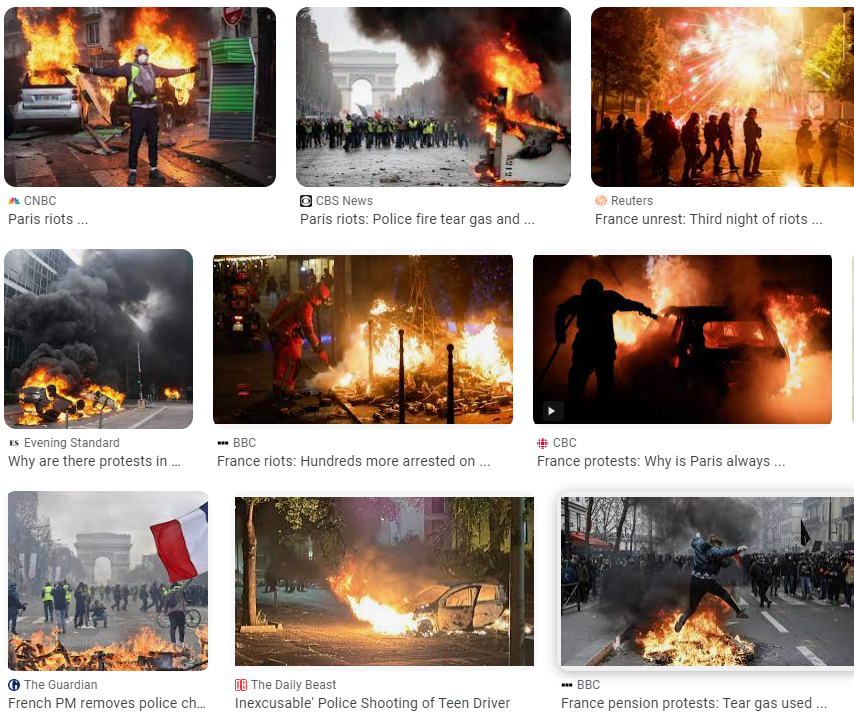
I ran an image search for “Paris rioting” and there was a plentiful supply of fiery, eye-catching photos. Not all of these are from the most recent outbreak of violence, but they are certainly representative of how the legacy media is covering the situation.
The recent violence in Paris and elsewhere, which saw attempts to ram the home of a mayor, once again highlighted the trouble the country has with integration. But the French police union describing themselves as being “at war with vermin” illustrated the different mindset to the English-speaking world, and the far more belligerent approach to the problems of diversity.
Like Britain, the Netherlands, Germany and Sweden, France has had difficulties assimilating the children of immigrants from beyond Europe, yet its recent history has proved especially violent and troubled. Britain has jihadi terrorism – 2017 was especially grim – but it has never reached such intensity. Today, as over 130,000 police officers stand guard to protect the Republic on the day of its celebration, it is worth considering the journey that brought it to such a state.
Analysts have often compared Britain’s state multiculturalism with France’s system of laïcité, which tends to downplay the existence of “communities” even to the point of not taking demographic statistics. Although neither country’s approach has entirely been a success, France’s refusal to recognise immigrants as anything but French has often been blamed for the widespread sense of alienation.
Others point to the housing system, which tends towards concentrations of North and West Africans in suburban banlieues, or the less laissez-faire economic policy which results in higher unemployment (in exchange for better social security).
While they no doubt play a part, the biggest single difference is history, as Andrew Hussey recounted back in 2014 in The French Intifada, in particular France’s history with North Africa. To put it in British terms, imagine that Britain’s rule in Pakistan had involved not a small number of administrators and soldiers but instead hundreds of thousands of British settlers arriving in the country, many with the intention of making it a “new America” (i.e. driving the natives out).
That Britain had declared Pakistan an integral part of the country, and that, rather than scarpering in indecent haste when the empire began to disintegrate, Britain had dug in to preserve its rule in a sadistic war of independence, one in which natives and white settlers committed countless atrocities against each other.
And that this violence had spilled into Britain with assassination attempts and terrorism, by both sides, destabilising the country to the point where there was talk of a coup. And that this was happening just as large-scale immigration to the colonial power was taking place.
Britain experienced nothing like as much violence in the dying days of empire, and indeed the only real comparison with our history was the moment when there was almost all-out conflict between Britain’s Protestant and Irish Catholic populations before the First World War.
If French politicians so casually talk of “civil war” between its right wing and the Algerian-descended population, it is because it has already played out this conflict before – one that was never healed, and so invites a sequel.
Comments Off on The French Intifada
July 13, 2023
QotD: The Annales school of history
The big shift in focus for the Annales school was an interest in charting the experience of society below the level of elites (though the elites are not abandoned either), what is sometimes termed “history from below”, as distinct from traditional elite-centered “great man” history or the more deterministic Marxist models of history at the time. You can see the political implications, of course, in the very early 1900s, of declaring the common man worthy of study; this is generally a history from the left but not the extreme left. That focus in turn demanded new approaches because it turned the focus of social history towards people who by and large do not write to us.
In reaching for that experience, Annales scholars tended to frame their thinking in terms of la longue durée (“the long run”); history was composed of three parts: événements (“events”), conjonctures (“circumstances”) and finally la longue durée itself. Often in English this gets rendered as a distinction between “events” (kings, wars, politics, crises) and “structures” (economics, social thought and at a deeper level climate, ecology, and geography). What Annales scholars tended to argue was that those structures were often more important than the events that traditional historians studied: the farmer’s life was far more shaped by very long-term factors like the local ecology, the organization of his farming village, the economic structure of the region and so on. And then the idea goes, that by charting those structures, you can figure things out about the lives of those farmers even if you don’t have many – or any – of those farmers writing to you.
Important to this was the idea of enduring patterns of thought within a society, what Bloch termed mentalités (“mentalities”, like longue durée, this is a technical term usually used in French to make that fact clear). Mentalités – Bloch’s original example was the idea that kings had a holy healing touch, but this could be almost any kind of social construct or pattern of ideas (indeed, one critique of it is that the notion of mentalités is broad and ill-defined) – can last a long time and can inform or constrain the actions of many actors within a society; think of how successive generations of kings can have their decisions shaped or constrained by their societies view – their own view – of kingship. That view of kingship might be more impactful than any one king and so pervasive that even a king would struggle to change it.
So how does this influence my work? I tend to be very much a “history from below” kind of historian, interested in charting the experience of regular farmers, soldiers, weavers and so on. The distinction between the long-term structures that shape life and the short-term events that populate our history is very valuable to think with, especially for identifying when an event alters a structure, because those tend to be very important events indeed. And I think a keen attention to the way people thought about things in the past and how those mentalités can be different than ours is very important.
That said, the Annales stress on mentalités has in some ways been overtaken by more data-driven historical methods on the one hand or a strong emphasis on local or individual experience (“microhistory”) on the other. Mentalités tend to be very big picture, asking how, say, “the French” thought about something over a period of decades or centuries and seeking to know how that shaped their experience. But archaeology, demographics or economic data can reveal patterns of behavior which might not correspond to the mentalités that show up in written texts; this is fundamentally the interaction that informs the “revenge of the archaeologists” in the study of the ancient economy, for instance. On the other hand, not everyone in that big group thinks the same and a microhistory of an individual or a single village might reveal telling local variations not captured in massive-scale structures.
Fortunately, historians do not need to be doctrinaire in our use of theory, we don’t have to pick one and stick to it. Different projects also lend themselves to different approaches. I think the Annales school offers a lot of really useful tools to have my historian’s toolbox, but they sit alongside military theory, archaeological material culture studies methods, philological approaches, a smattering of economic and demographic tools, etc.
Bret Devereaux, “Referenda ad Senatum: January 13, 2023: Roman Traditionalism, Ancient Dates and Imperial Spies”, A Collection of Unmitigated Pedantry, 2023-01-13.
July 9, 2023
The Destruction of Army Group Center – Week 254 – July 8, 1944
World War Two
Published 8 Jul 2023Operation Bagration continues, smashing the armies of German Army Group Center and taking ever more territory including the prize of Minsk; on Saipan the Americans have taken most of the island when the Japanese resort to a huge suicidal banzai charge to try and turn the tide; and in Normandy new attacks begin try to finally take Caen and St. Lo.
(more…)
Comments Off on The Destruction of Army Group Center – Week 254 – July 8, 1944
July 8, 2023
The Perfect D-Day That History Forgot
Real Time History
Published 7 Jul 2023The summer of 1944 saw the Allies land in France not once but twice. Two months after Operation Overlord, the Allies also landed in Southern France during Operation Dragoon. It was “the perfect landing” and opened up the important ports of Marseille and Toulon for Allied logistics.
(more…)
Comments Off on The Perfect D-Day That History Forgot
July 2, 2023
Allies Liberate Cherbourg – WW2 – Week 253 – July 1, 1944
World War Two
Published 1 Jul 2023Several weeks after the invasion of Normandy began, the Allies finally take a port city there, though the actual harbor has been destroyed. On Saipan the Americans have the advantage, in Finland, the Soviets do, but the big news is the Soviet destruction of huge chunks of German Army Group Center, demolishing entire Army Corps, and surrounding tens of thousands of the enemy.
(more…)
Comments Off on Allies Liberate Cherbourg – WW2 – Week 253 – July 1, 1944
June 28, 2023
The Treaty of Versailles: 100 Years Later
Gresham College
Published 4 Jun 2019The Treaty of Versailles was signed in June 1919. Did the treaty lead to the outbreak of World War II? Was the attempt to creat a new world order a failure?
A lecture by Margaret MacMillan, University of Toronto
04 June 2019 6pm (UK time)
https://www.gresham.ac.uk/lectures-an…A century has passed since the Treaty of Versailles was signed on 28 June 1919. After WWI the treaty imposed peace terms which have remained the subject of controversy ever since. It also attempted to set up a new international order to ensure that there would never again be such a destructive war as that of 1914-18. Professor MacMillan, a specialist in British imperial history and the international history of the 19th and 20th centuries, will consider if the treaty led to the outbreak of the Second World War and whether the attempt to create a new world order was a failure.
(more…)
Comments Off on The Treaty of Versailles: 100 Years Later
June 25, 2023
The Greatest Pincer Movement in Military History – WW2 – Week 252 – June 24, 1944
World War Two
Published 24 Jun 2023The Red Army surges forward in Operation Bagration, a mighty new offensive to destroy German Army Group Centre. Fighting continues in Normandy, Italy, and Finland. The United States Navy tears the heart out of the Imperial Japanese Navy in the Philippine Sea even as the Imperial Japanese Army has success in China. The British and Indian armies lift the siege of Kohima.
(more…)
Comments Off on The Greatest Pincer Movement in Military History – WW2 – Week 252 – June 24, 1944
June 23, 2023
The Combat Engineers of D-Day – WW2 Special Documentary
World War Two
Published 22 Jun 2023How do you blast through the obstacles and minefields on the beaches of Normandy? How do you get thousands of tonnes of tanks, guns, and men into the fight? And what about reopening the shattered French ports? You need men who are as skilled in construction as they are destruction. You need the engineers.
(more…)
Comments Off on The Combat Engineers of D-Day – WW2 Special Documentary
June 18, 2023
Titanic Clash Looms In Pacific – WW2 – Week 251 – June 17, 1944
World War Two
Published 17 Jun 2023Japanese and American navies are heading for a showdown in the Philippine Sea, even as American forces land on Saipan in the Marianas in force. The Japanese have Changsha under siege in China, the Allies advance in both Normandy and Italy, the Soviets advance in Finland, and the massive Soviet summer operation is coming together and will begin in a matter of days.
(more…)
Comments Off on Titanic Clash Looms In Pacific – WW2 – Week 251 – June 17, 1944
June 14, 2023
Michael Wittmann: The Fascination with the Panzer Ace of Villers-Bocage
OTD Military History
Published 13 Jun 2023American historian, Carlo D’Este seemed to have an intense admiration for Michael Wittmann, the SS Panzer ace best known for his actions at Villers-Bocage in Normandy on June 13 1944. This video shows why this problematic and even misplaced.
(more…)
Battle Of The Rivers (1944)
British Pathé
Published 13 Apr 2014Title reads: “Battle of the Rivers”.
Allied Forces invasion of France.
Various shots of mechanised units of the British and Canadian army preparing for assault on the Rivers Odon and Orne. Infantry mount the Sherman tanks and they head along the dusty road. Various shots of Sherman flail tanks passing camera (not flailing). Road bank collapses and one tank rolls onto its side
Various shots of Lancaster bombers over industrial area of Vaucelles. Aerial shots of bombs dropping from planes. Night shot of coloured markers cascading down to light up target area. More aerial shots, including L/S of Lancaster bomber crashing in flames.
Various shots of heavy artillery in action in the fields. Various shots of Royal Engineers putting Bailey Bridge across the Caen Canal. L/S of tanks crossing the bridge. Various shots of badly damaged industrial area near Caen. L/S of Canadian tanks on the move over open countryside and tracks. We see a soldier extinguishing flames where a tank’s grass camouflage has caught fire. The tanks cross a railway line.
Various shots of Winston Churchill being greeted by American officers as he arrives by plane in the Cherbourg area. He then tours the peninsula, looking at structures that were supposed to be V2 sites. M/S of Churchill climbing into spotter plane (“flying jeep”), piloted by Air Vice Marshal Broadhurst. Various shots of Churchill driving around Caen in an open-topped car, with him are Field Marshal Bernard Montgomery (Monty) and General Dempsey. Various shots of Churchill posing with a group of soldiers, he then spends some time chatting to them.
(more…)
Comments Off on Battle Of The Rivers (1944)
June 11, 2023
The Invasion of Normandy begins! – WW2 – Week 250 – June 10, 1944
World War Two
Published 10 Jun 2023The Allies’ gigantic amphibious invasion of France begins and by the end of the week they’ve carved out a decent-sized beachhead. Meanwhile in Italy the Allied advance takes Rome. The Soviets are launching new attacks of their own — now against the Finns, and the Japanese at Kohima … have just plain had enough.
(more…)
Comments Off on The Invasion of Normandy begins! – WW2 – Week 250 – June 10, 1944


