
As the twentieth century drew to a close, the connection between hard scientific fact and public policy became increasingly elastic. In part this was possible because of the complacency of the scientific profession; in part because of the lack of good science education among the public; in part, because of the rise of specialized advocacy groups which have been enormously effective in getting publicity and shaping policy; and in great part because of the decline of the media as an independent assessor of fact. The deterioration of the American media is dire loss for our country. When distinguished institutions like the New York Times can no longer differentiate between factual content and editorial opinion, but rather mix both freely on their front page, then who will hold anyone to a higher standard?
Michael Crichton, “Aliens Cause Global Warming”: the Caltech Michelin Lecture, 2003-01-17.
November 23, 2017
QotD: The rise of junk science
October 26, 2017
The “sacred” Supply Management system Canada is fighting to preserve
The way our politicians talk about the supply management system, you’d think it was one of the founding issues of Confederation. They’re almost literally willing to abandon the NAFTA talks to preserve this encrusted bit of crony capitalist market distortion that hurts most Canadians in the wallet, to keep domestic producers happy. Matthew Lau explains the system our government is willing to crash the entire economy to save:
The United States wants Canada to end supply management, which impedes agricultural imports – dairy, eggs, and poultry. Canada’s trade negotiators and politicians steadfastly refuse, and in their defense of the policy call up an astounding piece of logic: that the less Canadians have, the richer we are.
Canada’s Agriculture Minister insists that supply management is an “excellent system” and that “to deal with anything else is simply a non-starter.” Supporters on the left argue that the policy is necessary to protect domestic farmers from unfair competition from American farmers who receive government subsidies.
Conservatives have argued the same. Current Parliament Member and former International Trade Minister, Ed Fast argued in a recent essay that America simply wants access to the Canadian market “to deal with its own problem of overproduction, to the detriment of Canadian farmers.”
Here is what all proponents of supply management are arguing: If we allow the Americans to send us milk, then their problem of overproduction becomes our problem. Don’t you see how problematic it is, how much poorer we will become if we allow them to send to us the fruits of their overproduction, and at a low price to boot? Don’t you see how much richer we would be if we had less milk?
The less milk we have, the higher the price of milk, the more we can “ensure that producers receive a reasonable return,” as Ed Fast put it – and having ensured that producers receive a reasonable return, certainly we shall all be richer. What could be more reasonable than ensuring Canadian producers receive a reasonable return?
In case the lunacy isn’t quite clear, he also offers a suggestion for a new supply management system for Canadians to “enjoy”:
If we’re made richer by having less dairy, poultry, and eggs, then why stop there? Why not create scarcity in all the other sectors in order to boost the domestic economy? For instance, consider that Ontario’s manufacturing sector has lost several hundred thousand jobs in the past twelve years or so. So according to the supply management logic employed by politicians, how can we revive this industry?
By destroying automobiles of course. And then throw up a tariff to make the purchase of automobiles abroad prohibitively expensive, in order to make sure the Americans, as well as other foreign producers, can’t take “unfair advantage” by inflicting us with cheap automobiles to deal with their problems of overproduction.
The result of such a policy would be that the price of automobiles would rise, thus enabling domestic manufacturers to earn reasonable returns. Destroying automobiles and instituting a tariff would revive the automobile manufacturing industry in Ontario and create thousands of jobs. If the Liberal government thinks supply management is an “excellent policy” they’d probably think this automobile policy is a panacea.
Indeed, the logic, or rather illogic, of the automobile policy is only an amplification and expansion of supply management. Both rest on the idea that we are richer when we have less.
October 21, 2017
Surprise, surprise – exclusive universities draw almost exclusively from rich regions
In the Guardian, Sally Weale, Richard Adams and Helena Bengtsson disclose the shocking news that Oxford and Cambridge select very few students from outside the two wealthiest tiers of society or from outside London and the southeast:
Oxford and Cambridge universities have gone backwards on the socio-economic diversity of their student bodies, with more than four in five students coming from the most privileged groups, a Guardian analysis has found.
Data released to the MP for Tottenham, David Lammy, under the Freedom of Information Act shows that 82% of offers from Oxford and 81% from Cambridge went to students from the top two socio-economic groups in 2015, up from 79% at both universities five years earlier.
Lammy, who has campaigned for greater ethnic and socio-economic diversity at Oxbridge, said he was appalled that the universities were moving backwards on socio-economic background measurements. “This data clearly shows that a privileged background is still the key to getting through the Oxbridge admissions process,” he said.
The data shows huge regional disparities in offers, with some parts of England and Wales failing to secure a single place for years while students in London and the south-east received almost half of all offers.
Despite the two universities’ extensive efforts to increase the diversity of their intake, new research shows there are still swaths of the country with low rates of application and disproportionately fewer offers.
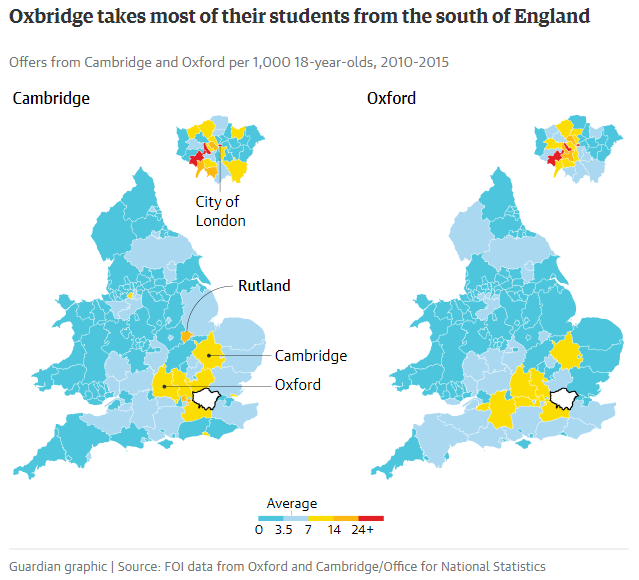
Students from benighted, uncivilized places like Middlesbrough are rarely able to gain admission:
Middlesbrough, where 101 students applied to Oxbridge, secured just 11 places in five years.
Carolyn Yule, the director of A-levels at Middlesbrough College, said that not one of her Oxbridge applicants had been successful in her three years in the job. “One of the students we did a lot of work with, he wanted to read mathematics and he was absolutely fantastic,” she said. “He got an interview and could not have done any more, but he didn’t get in. We didn’t really get a lot of feedback from them. We don’t even feel we know why our students don’t get in.”
However, it’s important to find out how many students applied to make sense of the numbers accepted:
There are 38 colleges at Oxford, 31 at Cambridge (close enough anyway). Given that not everyone with that sort of level of academic achievement actually tries to enter Oxbridge then what do we think should be the offer rate to these Black Britons? It’s most certainly not 4 offers per college per year, is it? Or 6, or whatever 400 divided by 70 is.
Given the small numbers the stats are going to be weird anyway, but what is the number of total offers made by all colleges, related to the total number of people who get 3 A grades? Vriance from that would probably be a good starting point for us.
Lammy does however make a good point:
With this degree of disproportionately against black students, it is time to ask the question of whether there is systematic bias.
I’m certainly willing to believe there is. I am not deluded enough to think that Britain is perfect, nor its education system. But I would probably start with the thought that the bias is in the system that leads to the 400 not with the selection within it.
H/T to Colby Cosh for the link.
October 19, 2017
October 17, 2017
QotD: The problem with modern education – an alien conspiracy?
So, what is going on?
Lots of things. Look, I’m a science fiction writer. It’s easy for me to say “There is a conspiracy by aliens, to make sure we never get to the stars. They infiltrated our education establishment and are destroying competence from within.
Except it’s not just education, and I don’t believe in aliens or that ALL of this is done on purpose.
But Sarah, you’ll say, some of it is, like Bill Ayers redesigning education as a means to bring about a biddable proletariat.
Oh, sure, that might have been how the dumbass conceived it. It’s not why it’s applied though. And dumbass? Yep. Bill Ayers, like most progressives is a clever fool who thinks society spins on words and theories, and not on basic “can do”. This is one of the reasons communist societies QUICKLY become hell on Earth. Because you can’t get rid of everyone who is competent without the rest of society collapsing. The ceiling doesn’t stay up when you remove the walls. People who’ve been educated beyond their competence don’t see that though.
Still, most people who APPLY his poisonous ideas aren’t frankly competent enough to know what they’re doing. No. They’re doing it for other reasons.
Stupidity – the most powerful force on Earth.
There are any number of people who’ll do whatever without thinking because someone in authority tells them not only that they should, but that “it’s the new way of doing things. All the smart people follow it.” And frankly they’re not competent enough to evaluate the “new way of doing things” so they settle for APPEARING smart.
Rapid change.
Even in the village, the teacher often floundered. They’d added pre-history to the curriculum, and she’d never studied it. So… her idea of pre-history was the Flintstones. I came home talking about cars made of stone (I wish I’d had a camera to take picture of dad’s face.) Mom and dad corrected it. NO BIG.
If my kids are maleducated in the same way say, about computers, I can’t fix it. What’s more, I’m not alone. H*ll I found out the model of the atom I learned was superseded and that the physics I learned was not at all like what the kids learned (they thought I was nuts.) AND when Robert came home and told me “We’re sequencing DNA in lab. When you sequenced DNA–”
No, it’s not a complete excuse, no matter what they tell you, but it is PART of it. Not in teachers not being able to keep up, but in parents or even grandparents no longer being able to fill in those deficiencies.
The same applies to just about any type of work, btw, because the methods are so different now that the old codger who walked to the shop and corrected the new hires? He no longer can teach them anything.
A belief in “natural” things and “natural” learning and that if it’s not fun, it’s not right. This apparently is the flowering of the student revolts in the sixties. It is certainly what is destroying marriage as an institution.
You see, every marriage goes through rough patches. I probably have one of the happiest marriages in the world, but yeah, there were days, evenings, and sometimes entire months when I’d have traded the whole thing for ten cents and a pack of chewing gum. It’s just I knew it had been good and would be again.
The same applies to learning. I don’t care how “gifted” you are at math or languages or even writing, you are not gifted enough to intuit the whole thing at our present level. NO MATTER HOW GIFTED YOU ARE, YOU’RE NOT GOING TO RECONSTITUTE AN ENTIRE SCIENCE OR ART WITHOUT LEARNING. And learning means some tedium, some memorizing and the inevitable patch that is difficult, even though everything else came easily.
When the entire establishment goes over for “should be fun” you’re going to fail.
Fear.
People who are mal-educated and conscious of it don’t hire people who know more than they do. Okay, so some do, but not many and those people are exceptional. This is why the whole “The president can be a dumbass if he hires good advisors” always fails, as we have proof daily. People don’t want their subordinates to upstage them. Any of you who EVER corrected a boss knows exactly what I’m talking about.
So, let’s imagine that this started with the student revolts (it started a little earlier, with the busy parents who came back from WWII not passing things on.)
Those people hit the market place and hired people my generation who were LESS prepared than they were. They were AFRAID of being exposed. Then my generation hired people less prepared and then…
Sarah Hoyt, “The War On Competence”, According to Hoyt, 2016-03-04.
September 21, 2017
QotD: Teaching
At every level, our society has been idiotized, in fulfilment of the democratic ideal. As I am reminded by each and every remark, from all candidates in televised political debates, we are now living in Flatworld.
God created, and continues to create, men and women of extraordinary diversity, in natural interests, native motor abilities, and the potential for what the Greeks called “genius.” That is to say, not simply brains, but what can be done with the brain you were provided.
I have noticed from my own teaching experience that, the smaller the class, the harder on a teacher. This is because the needs of individuals can better be discerned. The hardest teaching is under the old, indeed mediaeval, tutoring system: the one-to-one that used to be standard in places like Oxford and Cambridge, which continued to distinguish them from the drive-in, red-brick, fake universities. For at that “tutorial” level, student and teacher are both fully exposed, each to the strengths and limitations of another, non-abstract, human mind. It becomes impossible to “go through the motions.”
And it is like this, ultimately, in the tutoring of Christ Our Saviour. Every one of His students is a difficult case; the smart ones usually the most difficult. And so, likewise, with parent and child; with master and apprentice. It is so, by analogy, wherever men try to teach one another. The sermons and parables, the public lectures, are only the beginning of it. Then comes a process of discovery: “Which part of this do you not understand?”
Compare: the ideal of the “lowest common denominator,” appropriate perhaps for the management of pigs and cattle, on a large industrial farm. But evil when applied to human beings.
David Warren, “Democracy versus God”, Essays in Idleness, 2015-11-10.
September 19, 2017
Even in a progressive educational bubble, this isn’t correct
Holly Nicholas shared this photo, which is said to be from an Alberta school:
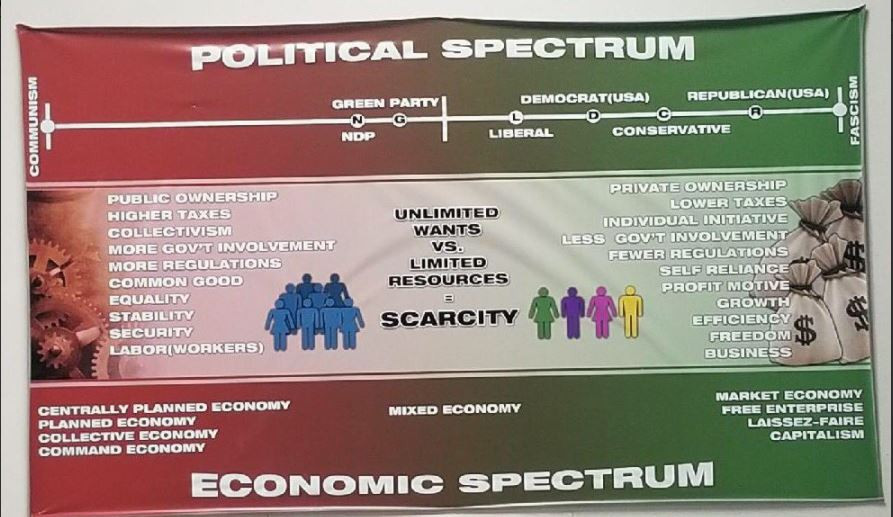
If this is indeed how public schools are presenting the political spectrum (and it’s unfortunately easy to believe that they do), the closest thing to a “centrist” party in Canada is the loony left Green Party … who somehow pip the NDP on the right. The far right end of the spectrum, Fascism, is graphically indicated to be all about “Market Economy, Free Enterprise, and Laissez-Faire Capitalism”, because as we all remember, Hitler and Mussolini were in no way fans of state intervention in the economy, right?
The graphic does, however, support certain shibboleths of the left including implying that libertarians (who are actually in favour of market economies, free enterprise, and laissez-faire capitalism) are in the same economic and political basket as actual fascists. Nice work, faceless agitprop graphic artist!
September 4, 2017
The mental health crisis on campus
In Spiked, Naomi Firsht shares the concerns of Jonathan Haidt about the rise of mental health issues at US universities:
The heightened vulnerability of college students has had a chilling effect on discussion in the academic world, and Haidt sees this in his day-to-day experience on campus. “There is a rapidly spreading feeling that we are all walking on eggshells, both students and faculty. That we are now accountable, not for what we say, but for how anyone who hears it might take it. And if you have to speak, thinking about the worst reading that anyone could put on your words, that means you cannot be provocative, you cannot take risks, that means you will play it safe when you speak… This is what I’m seeing in my classes when topics related to race or gender come up – which we used to be able to talk about 10 years ago, but now it’s painful and there’s a lot of silence.”
This is disastrous for academic life, as Haidt points out: “A university cannot function if people will not put their ideas forth, will not contest ideas that they think are wrong, will not stand up for ideas that they think are right.”
He is keen to emphasise that this is not a right-left issue. “Several people on the left are noticing that college students are less effective politically as activists, as progressives, when they have this morality and this ethos with such heavy concept creep.”Haidt believes there is a mental-health crisis on campus: “I have never seen such rapid increase in indicators of anxiety and depression as we have seen in the past few years”, he says. But his suggested approach is unlikely to find favour with student communities fond of Safe Spaces and therapeutic puppy-petting. “If you think about it as a mental-health crisis”, he explains, “then you might be tempted to say: we need more help, more counselling, more protection for those who are suffering from mental illness. But if you look at it that way you will miss the broader pattern, which is that for 20 to 30 years now, Americans have been systematically undermining the development of resilience or toughness of their children.” Referencing the work of Lenore Skenazy, author of Free-range Kids, he concludes: “We have made our children too safe to succeed.”
In his forthcoming book Misguided Minds: How Three Bad Ideas Are Leading Young People, Universities, and Democracies Toward Failure, Haidt claims that certain ideas are impairing students’ chances of success. Those ideas being: your feelings are always right; what doesn’t kill you makes you weaker; and the world is divided into good people and bad people. “If we can teach those three ideas to college students”, he says, “we cannot guarantee they will fail, but we will minimise their odds at success”.
So how can we resolve the problem of vulnerability among young Americans? Haidt says part of the solution must begin in childhood and will require parents to give their children daily periods of “unsupervised time”. “We have to accept the fact that in that unsupervised time there will be name-calling, conflict and exclusion. And while it’s painful for parents to accept this, in the long-run it will give them children that are not suffering from such high rates of anxiety and depression.”
August 30, 2017
QotD: Democratic education
… a passage transcribed from one of Étienne Gilson’s public lectures in the early 1950s, and let it be said that a man in the Deep South who signs himself N.W. Flitcraft, found it first. (He is here.) Gilson has been one of my own “heroes,” or guiding lights, these last few decades:
“If our school system exists, not in view of a chosen minority, but in view of all, its average level should answer the average level of the population as a whole. Hence the unavoidable consequence that the best gifted among the pupils will be discriminated against. Nor should we imagine that creative minds will multiply in direct proportion to the growth of the school population. The reverse is much more likely to happen. In aristocratic societies, genius has often found access to higher culture, even under adverse circumstances; in democratic societies, it will have no higher culture to which to gain access. Since equality in ignorance is easier to achieve than equality in learning, each and every teacher will have to equalize his class at the bottom level rather than at the top one, and the whole school system will spontaneously obey the same law. It is anti-democratic to teach all children what only some of them are able to learn. Nay, it is anti-democratic to teach what all children can learn by means of methods which only a minority of pupils are able to follow. Since, as has been said, democracy stands for equality, democratic societies have a duty to teach only what is accessible to all and to see to it that it be made accessible to all. The overwhelming weight of their school population is therefore bound to lower the centre of gravity in their school systems. The first peril for democracies, therefore, is to consider it their duty, in order to educate all citizens, to teach each of them less and less and in a less and less intelligent way.”
Pause, gentle, then read that through again, until committed to memory. I cannot think of a better single-paragraph explanation of how John Dewey’s “democratic vistas” sent us all to hell. Verily, I wish I’d been armed with that when asked, some forty-six years ago, why I was leaving school with only a Grade X education (plus, to be fair to me, nearly one full term of Grade XI). It explains everything, in less than three hundred words.
David Warren, “Democracy versus God”, Essays in Idleness, 2015-11-10.
August 27, 2017
Stop Subsidizing Sports!
Published on 25 Aug 2017
Let’s talk about “sports”—that thing where we gather around to watch a muscular stranger put a regulation-size ball in a specific location.
Why are taxpayers forced to pony up cash for athletic ventures that don’t benefit them? Franchise owners routinely extort massive stadium subsidies through threats of relocation and fake promises of economic revitalization. Universities jack up student rates to subsidize athletic programs that should be self-sustaining. And the Olympics is economically devastating to every municipality foolish enough to get suckered by one of the oldest scams around.
Mostly Weekly host Andrew Heaton explores the sports phenomenon and why we should quit throwing other people’s money at it.
Links, past episodes, and more at https://reason.com/reasontv/2017/08/25/stop-subsidizing-sports
Script by Sarah Siskind with writing assistant from Andrew Heaton and David Fried.
Edited by Austin Bragg and Siskind.
Produced by Meredith and Austin Bragg.
Theme Song: Frozen by Surfer Blood.
August 24, 2017
Teaching history in the South – the “Lost Cause” school of historiography
Warren Meyer gives some background on how most people in the Southern US were taught the history of the “War Between the States”:
The Lost Cause School: I want to provide some help for those not from the South to understand the southern side of the statue thing. In particular, how can good people who believe themselves not to be racist support these statues? You have to recognize that most folks of my generation in the South were raised on the lost cause school of Civil War historiography. I went to one of the great private high schools in the South and realized later I had been steeped in Lost Cause. All the public schools taught it. Here is the Wikipedia summary:
The Lost Cause of the Confederacy, or simply Lost Cause, is a set of revisionist beliefs that describes the Confederate cause as a heroic one against great odds despite its defeat. The beliefs endorse the virtues of the antebellum South, viewing the American Civil War as an honorable struggle for the Southern way of life, while minimizing or denying the central role of slavery. While it was not taught in the North, aspects of it did win acceptance there and helped the process of reunifying American whites.
The Lost Cause belief system synthesized numerous ideas into a coherent package. Lost Cause supporters argue that slavery was not the main cause of the Civil War, and claim that few scholars saw it as such before the 1950s. In order to reach this conclusion, they often deny or minimize the writings and speeches of Confederate leaders of the time in favor of later-written revisionist documents. Supporters often stressed the idea of secession as a defense against a Northern threat to their way of life and say that threat violated the states’ rights guaranteed by the Union. They believed any state had the right to secede, a point strongly denied by the North. The Lost Cause portrayed the South as more profoundly Christian than the greedy North. It portrayed the slavery system as more benevolent than cruel, emphasizing that it taught Christianity and civilization. In explaining Confederate defeat, the Lost Cause said the main factor was not qualitative inferiority in leadership or fighting ability but the massive quantitative superiority of the Yankee industrial machine.
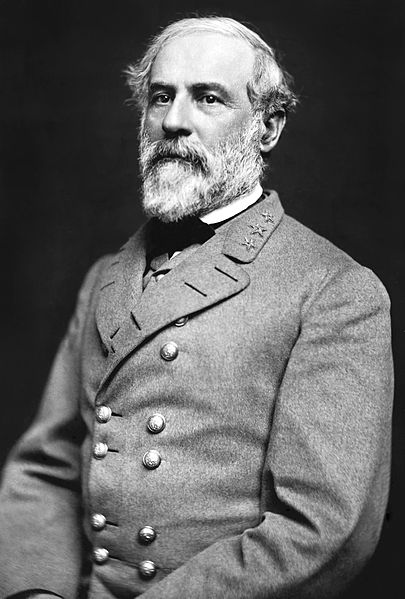
Confederate General Robert E. Lee, commander of the Army of Northern Virginia (via Wikimedia)
Obviously this was promoted by the white supremacists after the war, but in the 20th century many well-meaning people in the South who are not racist and by no means want to see a return of slavery or Jim Crow still retain elements of this story, particularly the vision of the Confederacy as a scrappy underdog. But everything in these two paragraphs including the downplaying of slavery in the causes of the Civil War was being taught when I grew up. It wasn’t until a civil war course in college (from James McPherson no less, boy was I a lucky dog there) that I read source material from the time and was deprogrammed.
The comparisons of the current statue removal to Protestant reformation iconoclasm seem particularly apt to me. You see, growing up in the South, Confederate generals were our saints. And the word “generals” is important. No one I knew growing up would think to revere, say, Jefferson Davis. Only the hard-core white supremacists revered Jefferson Davis. Real lost cause non-racist southerners revered Robert E. Lee. He was our Jesus (see: Dukes of Hazard). Every town in the south still has a Robert E Lee High School. Had I not gone to private school, I would have gone to Houston’s Lee High (I had a friend who went to college at Lehigh in New Jersey. Whenever he told folks in the South he went there, they would inevitably answer “yes, but where did you go to college.”) So Lee was by far and away at the top of the pantheon. Then you had folks like Stonewall Jackson and J.E.B. Stuart who were probably our Peter and Paul. Then all the rest of the generals trailing off through the equivalents of St. Bartholomew or whoever. We even had a Judas, General James Longstreet, who for a variety of reasons was reviled by the Lost Cause school and was blamed for many of Lee’s, and the South’s, losses.
If you want to see the Southern generals the way much of the South sees them, watch the movie Gettysburg, which I like quite a bit (based on the book Killer Angels, I believe, also a good read). The Southern Generals are good, talented men trying to make the best of a losing cause. Slavery is, in this movie, irrelevant to them. They are fighting for their beloved homes in the South, not for slavery. The movie even has Longstreet saying something like “we should have freed the slaves and then fired on Fort Sumter”.
The movie Gettysburg is excellent, but if you don’t know much about the actual battle, you might end up thinking the entire conflict revolved around the 20th Maine …
The Story of Western Philosophy
Published on 26 May 2017
Relevant mystery link: https://youtu.be/myc7eHGg5y4
If you notice any factual errors in this week’s video, please just bear in mind that life is ultimately meaningless in the first place.
August 17, 2017
Words & Numbers: The Illusion of School Choice
Published on 16 Aug 2017
In private schools, as in private enterprise in general, poor performance drives funding away by driving paying customers away. Yet in public schools, poor performance is used as an excuse for increased funding. With incentives like these, is it any wonder that public schools are failing our children so badly? Isn’t it time to inject some competition into the system?
Education for all is a worthy wish. So is food for all. But we don’t force poor people to eat state-produced food. Even food stamp recipients get to choose where to shop. Why shouldn’t beneficiaries of public education spending get to choose where to send their kids?
Our hosts James R. Harrigan and Antony Davies want to know…
August 10, 2017
“[M]ental illness is to grad students as black lung was to Victorian coal miners”
Drew Brown on the less-salubrious aspects of getting your PhD:
There is no higher intellectual pursuit than a PhD. It offers the promise of living a ‘life of the mind’: freedom of thought and inquiry; creative control over your work; middle-class comfort without middle-class drudgery; and above all, a meaningful life in the pursuit of knowledge.
This is the ‘noble lie’ of the Academy. None of this really exists in any meaningful way for most of the people pursuing it, but it is propagated—unwittingly or otherwise—in a manner that maintains what is effectively a pyramid scheme of hyperexploited labour designed to siphon money from children.
Everyone with eyes to see and ears to hear has known for some time that there is a human cost to this arrangement, but researchers have finally given empirical grounding to our ugly suspicions. According to a study in Research Policy from earlier this year, rates of psychological distress and symptoms of mental illness are twice as likely to occur among PhD students as the rest of the “highly educated general population.” Specifically, one in two PhD students surveyed experienced symptoms of psychological distress, while one in three is at heightened risk for developing psychiatric illnesses, especially anxiety and/or depression. According to the study’s abstract “Organizational policies were significantly associated with the prevalence of mental health problems.”
The findings shouldn’t be shocking for anyone who has spent any amount of time among PhD students. Horror stories abound. In reflecting on the full-immersion acid bath called graduate school, one friend of mine quipped that “mental illness is to grad students as black lung was to Victorian coal miners.” Another who left our PhD program two years in told me that he “didn’t realize how miserable school made him until [he] was out,” and I thought about that sentence almost every day until I quit the program myself earlier this year.
H/T to Colby Cosh for the link.


