
The Fraser Institute issued its annual Economic Freedom of the World report last week. It didn’t get much attention; it never does these days. Considered as a league table, the report is very boring and static, and makes poor copy.
The same countries typically appear at the top from year to year, and are separated mostly by microscopic, irrelevant differences. For 2017, whence the data in the new report come, Canada sat in eighth place just a hair above Australia and a hair below the U.K. Ascending to the top, we meet other siblings of the English-speaking world, Ireland and the U.S.; the Swiss Republic stands in its typical fourth; the relatively wild child of the Commonwealth, New Zealand, remains third; and then, in the top two places, you have the twin beacons of radical economic freedom, Singapore and Hong Kong.
Ah, yes, Hong Kong. The Special Administrative Region seems, for now, to have won a short-term victory in its struggle to preserve the conditions of its reunion with mainland China. This has not, ostensively, been a struggle over economic freedom per se, but it is not a coincidence that the rioting ultimately originated in a conflict over bookstores. It is mighty hard to draw a line where “economic” freedom stops and purely personal or civil freedoms begin, and the design of the index reflects this. It has a large basic rule-of-law component, includes mobility rights under the free trade factor, and takes points away for imposing military conscription. (This is surely a tiny tribute to the shade of Milton Friedman, who was one of the originators of the index.)
Even if Hong Kong’s immediate quarrel with China has been resolved for now, it is only a manifestation of what is likely to be a longer game. Clever columnists always like exoticizing talk about how the Chinese think in generations, but when it comes to Hong Kong, the cliché has weight. The 2019 riots, in showing how attached young HKers are to their distinct identity and to the English-speaking world, have revealed a nightmarish, even delegitimizing failure by the Chinese Communists. Mainland influence on Hong Kong education and politics has been used with the intention of prolonging and deepening the spirit of ’97; China, so often deemed the super-country of the future by admiring or fearful intellectuals, has tested the results of this effort in the eyes of the world and been made a laughingstock.
Colby Cosh, “Hong Kong’s still king in economic freedom rankings … for now”, National Post, 2019-09-17.
January 5, 2024
QotD: Hong Kong and the “league table” of world economic freedom
January 2, 2024
QotD: Cigarette smuggling and the powers-that-be
At that point, the Powers That Be were in trouble. Butt-smuggling was cutting into their projected tax revenues — tax revenues which, being governments, they’d already spent several years in advance. That’s bad.
Much worse, though, was the realization that, the more people bought their smokes off the back of a truck in Weehawken, the more those people realized that 99% of law “enforcement” is really “convincing people to voluntarily comply with the law”. As they should’ve realized from Prohibition back in the Twenties, and would soon have the opportunity to learn again with the War on Drugs, 1980-present, lifestyle laws are effectively unenforceable. Not even the most draconian techno-fascists, armed with 100% realtime surveillance, can stop people from getting high off something.
And that’s the worst knock-on effect of all, because the attempt turns “getting high” into a rebellious little thrill. You’re not just getting drunk / burning one down / smoking a Mob-supplied cigarette, you’re sticking it to The Man. If you don’t believe me, watch what happens to pot consumption in college towns once it’s fully legalized. Hint: It’s the same thing that happens to college kids’ alcohol consumption after they turn 21 — now that the cheap little thrill of being the rebel with the fake ID is gone, drinking loses a lot of its charm. Similarly, 99% of the “legalize it!” crowd’s “arguments” are just virtue signaling — they’re letting you know what rebels they are by breaking the pot laws. If you really want to cut down the consumption of intoxicants in a college town, at least, simply legalize ’em all. Your few true addicts will provide a spectacular lesson in Darwinism to the student body, but the vast majority of kids will be all but straight-edge.
Severian, “The Mob, Faux-tism, and the Ever-Rising Costs of Compliance”, Founding Questions, 2021-02-02.
December 26, 2023
QotD: The economic lessons of A Christmas Carol
After all, Tiny Tim and the street children of London don’t run Scrooge out of town like a pariah. Nor does Scrooge abandon his business to dedicate his life to eastern philosophy. Rather, he learns to voluntarily spread his wealth around, not so differently than Bill Gates or MacKenzie Scott might do today.
One could draw the conclusion, therefore, that a businessman who has accumulated vast wealth can do many great things through charity. Today, the “Giving Pledge” signed by Warren Buffet and others, as well as elements of the “Effective Altruism” movement, adopt a model of this sort, which essentially says the best way to do good is to make a lot of money. Scrooge’s belated charitability never would have been possible if London had been home to communist breadlines.
The idea goes beyond charity. In The Constitution of Liberty, the great economist Friedrich Hayek argued that it’s socially beneficial to have a leisure class of wealthy individuals pursuing their idiosyncratic passions or even vanities. Today, Jeff Bezos and Elon Musk plan to take us to the stars with SpaceX and Blue Origin. Will they make it to Mars or beyond? They might not beat the odds, but it can’t happen if they don’t try.
One might apply the same logic to cryptocurrencies. Like Scrooge’s wealth, they make some people uncomfortable, and at the moment they can resemble online gambling. But that doesn’t mean they should be banned or replaced by a boring, government-run alternative. Like Musk and Bezos’s space aspirations, there’s potential for the technology to revolutionize an aspect of life — in this case, financial transactions on the internet. That potential is just as-of-yet unfulfilled.
James Broughel, “The Hidden Economic Lesson in A Christmas Carol“, Foundation for Economic Education, 2021-12-24.
December 24, 2023
QotD: Dreaming of George Bailey’s world while living in Pottersville
This, the most enduring of the many works of Frank Capra, became the Atlantis myth of post-war America. That is, those who, over the course of the last half-century, saw It’s a Wonderful Life on television, knew well that the age of community and connection depicted on their screens had already passed into the realm of legend. Moreover, to add injury to insult, they also knew that, if they wished to enjoy the fruits of a middle-class existence, they would have to live in the manner of vagabonds.
In the movie, slum-lord Henry Potter tries, but fails, to turn the provincial paradise of Bedford Falls into a run-down haunt of spinsters, drunks, and floozies. In the real world, it was Franklin D. Roosevelt who put the kibosh on the original Main Street, USA. To be more precise, the principal achievements of America’s greatest tyrant, the Great Depression and the Second World War, undermined the financial, legal, and cultural foundations of the “wonderful life”. Thus, by the time this process had run its course, inflation had made a fool’s game of simple thrift, the replacement of law with regulation had hobbled private enterprise, and people who had left home for the sake of college, work, or military service found themselves lost in a sea of strangers.
In response to these changes, colleges and universities stepped up to the proverbial plate, happy to offer substitutes for the things that had been lost. They gave young people a chance to obtain certificates that would attest to both their suitability for service in the ranks of corporate minions and their social respectability. At the same time, these institutions gave older people a way to convert their value-losing cash into an asset that promised to pay dividends that would benefit their children (and, indeed, their grandchildren) for decades to come.
Thus arose the people I have come to call the MICE (Mobile, Individualistic, College Educated) people. Bereft of regional accents, productive property, and deep connections to friends and relations, they wandered the world, building networks, acquiring degrees, and padding resumés. However, after two generations of such peripatetic solipsism, the age of the MICE people is coming to an end.
Young men of parts, who realize that college has nothing to do with either liberal learning or vocational training, are simultaneously taking up skilled trades and stocking their MP3 players with learned podcasts. At the same time, young women of quality are beginning to think that the traditional troika of Kirche, Küche, und Kinder offers better odds of deep satisfaction than life as a hormone-hobbled, Starbucks swilling, girl boss.
So, if you know young people like the ones I’ve just described, do posterity a favor, and put them in contact with each other. After all, they deserve a life as wonderful as that of George and Mary Bailey.
Bruce Ivar Gudmundsson, “College, Class, and Christmas”, Extra Muros, 2023-08-06.
December 9, 2023
The coming Micro-Macro culture war … and who’s going to win it
Ted Gioia outlines the dismal state of the “macro” culture — television, movies, newspapers, book publishing and all the big corporations that control them — with the dynamism of the “micro” culture:
In the beginning, all culture was microculture.
You knew what was happening in your tribe or village. But your knowledge of the wider world was limited.
So you had your own songs and your own stories. You had your own rituals and traditions. You even had your own language.
But all these familiar things disappeared when you went off into the world. That was dangerous, however. That’s why only heroes, in traditional stories, go on journeys.
You learn on the journey. But you might not survive.
But all that changed long before I was born.
In my childhood, everything was controlled by a monoculture. There were only three national TV networks, but they were pretty much the same.
When I went to the office, back then, we had all watched the same thing on TV the night before. We had all seen the same movie the previous weekend. We had all heard the same song on the radio while driving to work.
The TV shows were so similar that they sometimes moved from CBS to NBC, and you never noticed a change. The newscasters also looked pretty much the same and always talked the same — with that flat Midwestern accent that broadcasters always adopted in the US.
The same monoculture controlled every other creative idiom. Six major studios dominated the film business. And just as Hollywood controlled movies, New York set the rules in publishing. Everything from Broadway musicals to comic books was similarly concentrated and centralized.
The newspaper business was still local, but most cities had 2 or 3 daily newspapers — and much of the coverage they offered was interchangeable. Radio was a little more freewheeling, but eventually deregulation allowed huge corporations to acquire and standardize what happened over the airwaves. [NR: I suspect the “freewheeling” went away once the government started imposing regulations, and the corporate consolidation was enabled when they “deregulated” the radio licensing regime several decades later.]
When I went to work in an office, back then, we had all watched the same thing on TV the night before. We had all seen the same movie the previous weekend. We had all heard the same song on the radio while driving to work.
And that’s why smart people back then paid attention to the counterculture.
The counterculture might be crazy or foolish or even boring. But it was still your only chance to break out of the monolithic macroculture.
Many of the art films I saw at the indie cinema were awful. But I still kept coming back — because I needed the fresh air these oddball movies provided. For the same reason, I read the alt weekly newspapers and kept tabs on alt music.
In fact, whenever I saw the word alt, I paid attention.
That doesn’t mean that I hated the major TV networks, or the large daily newspaper, or 20th Century Fox. But I craved access to creative and investigative work that hadn’t been approved by people in suits working for large organizations.
The Internet should have changed all this. And it did — but not much. Even now the collapse in the monoculture is still in its early stages.
But that’s about to change.
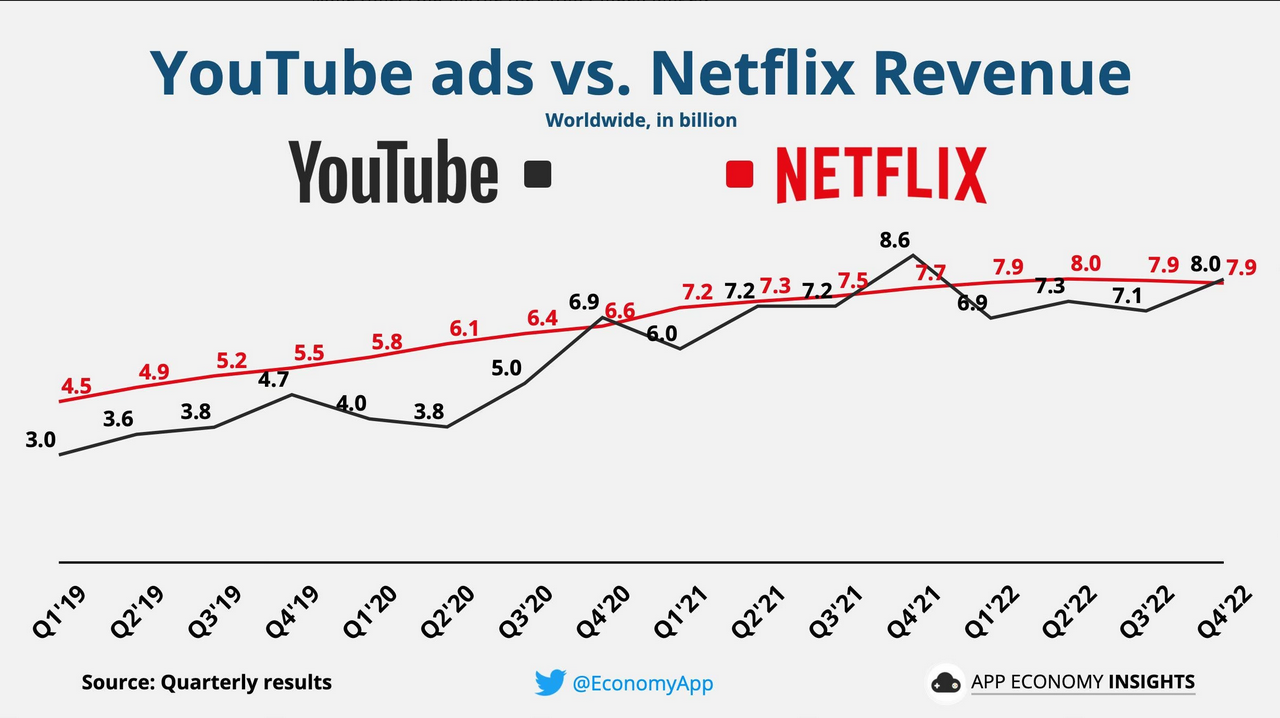
If you don’t pay close attention, the media landscape seems pretty much the same now as it did in the 1990s. The movie business is still controlled in Hollywood. The publishing business is still controlled in New York. The radio stations are still controlled by a few large companies. And instead of three national TV networks plus PBS, we have four dominant streaming platforms — who control almost 70% of the market.
So we still live in a macro culture. But it feels increasingly claustrophobic. Or even worse, it feels dead.
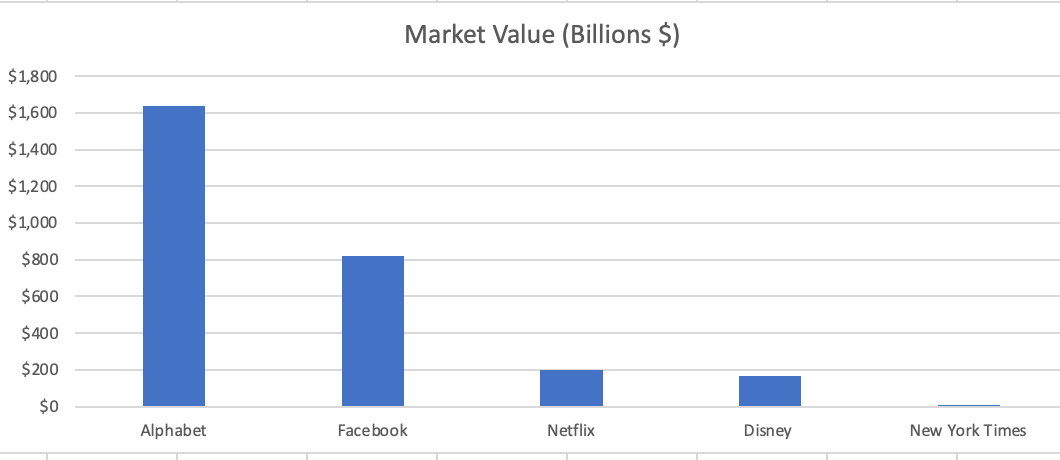
Meanwhile, a handful of Silicon Valley platforms (Google, Facebook, etc.) have become more powerful than the New York Times or Hollywood studios or even Netflix. It’s not even close — the market capitalization of Google’s parent Alphabet is now almost ten times larger than Disney’s.
But here’s the key point — these huge tech companies rely on the microculture for their dominance.
Where is Facebook without users contributing photos, text and video? Where is Google’s YouTube without individual creators?
In terms of economic growth or audience capture, the microculture has already won the war. But it doesn’t feel that way.
Why not?
First and foremost, Silicon Valley is a reluctant home for the microculture. To some extent Alphabet and Facebook are even going to war with microculture creators — they try to make money with them even while they punish them.
- So Mark Zuckerberg needs creators, but won’t even let them put a live link on Instagram and limits their visibility on Facebook and Threads.
- Alphabet needs creators to keep YouTube thriving, but gives better search engine visibility to total garbage that pays for placement.
- Twitter also claims it wants to support independent journalists — but if you’re truly independent from Elon Musk, your links are brutally punished by the algorithm.
This tension won’t go away, and next year it will get worse. The microculture will increasingly find itself at war with the same platforms they rely on today.
And legacy media and non-profits are even more hostile to emerging media. Go see who wins Pulitzer Prizes, and count how many journalists on alternative platforms get honored.
I’ll save you the trouble. They don’t.
December 8, 2023
QotD: Prices as information
Let’s all take another huge toke and return to our Libertarian paradise, where all conceivable information is both completely accurate and totally free to circulate. And since we’re now all so very, very mellow, let’s give Karl Marx due credit. One of his main gripes with “capitalism” is that it “commodifies” everything. Everything has its price under “capitalism”, Marx said, even stuff that shouldn’t – human life, human dignity. Since this is a college classroom and I’m the prof, I can assign some homework. Go google up “kid killed over sneakers”. You can always find stories like that. Put your natural, in-many-ways-admirable young person’s urge to rationalize aside, and simply consider the information. What were those Air Jordans really worth, based on the stuff we’ve learned today?
See what I mean? Marx had a point. What are those sneakers worth, considered from the standpoint of “demand”? Obviously more than whatever a human life is worth, considered from the same standpoint. Hence Marxism’s enduring appeal to young people whose hearts are in the right place. “Commodificiation”, or “reification” as he sometimes called it, is very real, and very nasty …
Severian, “Velocity of Information (I)”, Founding Questions, 2020-12-26.
December 2, 2023
Joe Biden solves the inflation problem, fat!
Like any lying dog-faced pony soldier would know, it’s as easy as saying “Trunalimunumaprzure“:
Inflation is kicking just about everyone in the junk here lately, regardless of whether that junk is an innie or an outie. It’s been rough on a lot of us, but I know just how hard it’s been on me and mine.
Prices are up significantly over the last few years and my income isn’t up nearly as much. This creates issues with our finances. The upside is that it’s forced me to be better with money.
But prices are still higher than Willie Nelson on a SpaceX flight.
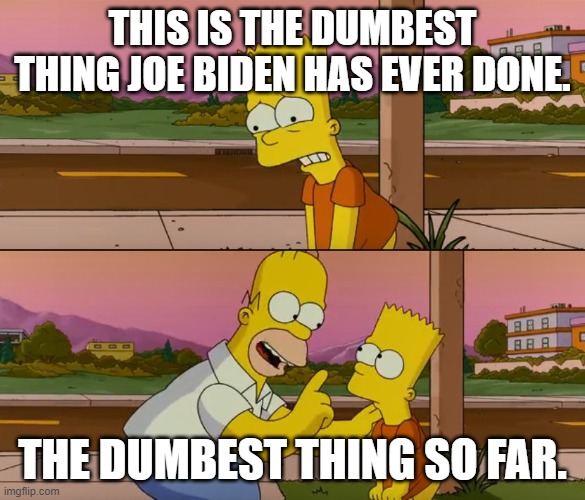
Luckily, President Joe Biden has figured out the solution to all our problems. He’s going to just tell companies to drop prices.
This week, the White House announced the launch of a Council on Supply Chain Resilience, created with the hope to “strengthen America’s supply chains” and “lower costs for families.”
…
President Joe Biden delivered remarks from the White House on Monday to announce the new council’s creation. He touted the lower inflation rate and falling grocery prices but admonished American companies for, in his view, not going far enough.
“Let me be clear: To any corporation that has not brought their prices back down — even as inflation has come down, even as supply chains have been rebuilt — it’s time to stop the price gouging,” Biden warned, imploring them to “giv[e] the American consumer a break.”
Here’s the issue, at least as I see it.
At Thanksgiving, it was noted here that prices are nearly 20 percent higher than in 2019. This while inflation has supposedly decreased. Prices are still high because it’s not so much that inflation has fallen but that the rate of inflation’s increase has fallen. It doesn’t mean prices should drop, only that they should increase at a slower rate.
November 30, 2023
The challenge facing Javier Milei
Craig Pirrong outlines just how much work Argentinian President-Elect Javier Milei will have to accomplish to begin to bring Argentina’s government in line with his electoral mandate:

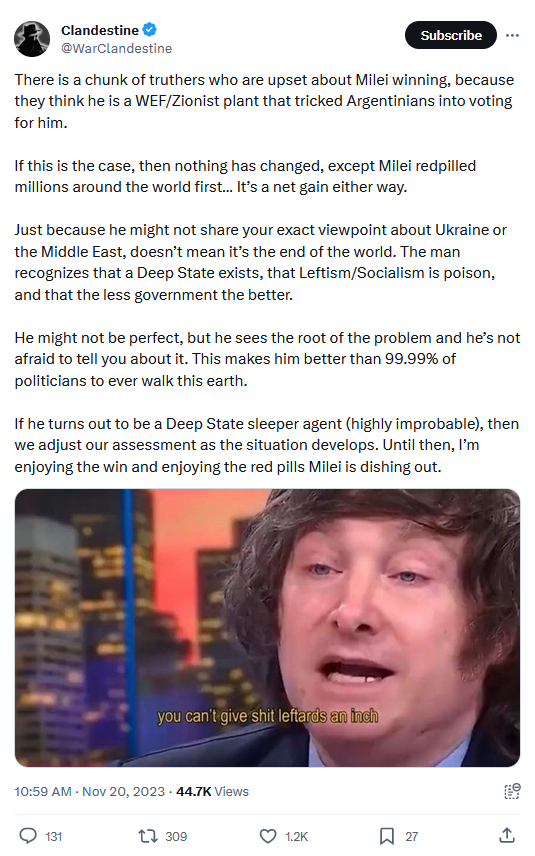
When I wrote Milei is not a leftist, let’s say that rather understates the matter. Milei loathes leftists and leftism, and repeatedly refers to them on television and in public appearances in scatalogical terms, calling them “leftards”. He despises collectivism, and asserts bluntly that leftists are out to destroy you. His mission is to destroy them first.
As someone so vehemently hostile to the left and well outside conventional political categories, Milei’s victory has triggered a mass moral panic, especially in the media. The New York Times coverage was (unintentionally) hilarious: “Some voters were turned off by his past outbursts and extreme comments over years of work as a television pundit and personality.” Well, obviously a lot more weren’t, but I guess one has to take solace where one can, eh, NYT?
Milei’s agenda is indeed a radical one, especially for a statist basket case like Argentina. To combat the country’s massive (140 per cent annualised) inflation, Milei says he will dollarise the economy and eliminate (“burn down”) the central bank. He also wants to reduce radically the role of the state in Argentina’s economy. He says he wants to “chainsaw” the government – and emphasises the point by campaigning with an actual chainsaw.
His election on this programme sparked a rally in Argentine financial markets, with government debt rising modestly and stock prices rallying smartly.
Will Milei be able to deliver? Some early commentary has doubted his ability to govern based on the fact that his party’s representation in the legislature is well below a majority. That may be an issue, but not the major obstacle to Milei’s ability to transform Argentina into what it was at the dawn of the 21st century: an advanced, rapidly growing economy and a relatively free society.
The real obstacle is one that is faced by anti-statists everywhere – the bureaucracy. (I do not say “civil service” because that phrase is at best aspirational and more realistically a patent falsehood. Akin to the Holy Roman Empire that was neither holy nor Roman, the “civil service” is neither civil nor a service.)
Argentina’s bloated state is its own clientele with its own interests, mainly self-preservation and an expansion of its powers. Moreover, it has created a whole host of patronage clients in business and labour. Milei’s agenda is anathema to this nexus of public and private interests. They will make war to the knife to subvert it.
Even a president with an electoral mandate faces formidable obstacles to implementing his agenda. The most important obstacle is what economists call an “agency problem”. The bureaucrats are agents of the chief executive, but it can be nigh unto impossible to get these agents to implement the executive’s directives if they don’t want to. Their incentives are not aligned with the executive, and are often antithetical. As a result, they resist and often act at cross purposes with the executive.
The modern chief executive’s power to force his bureaucratic agents to toe the line is severely circumscribed. At best, the executive can make appointments at the upper levels of the bureaucracy (such as the heads of ministries or departments), but the career bureaucrats who can make or break the executive’s policy are beyond his reach, and not subject to any punishment if they subvert the executive’s agenda.
November 29, 2023
Grover Cleveland – more “republican” than any Republican alive today
Not having studied American history in school, I don’t know a lot about most American presidents, especially those of the 19th century whose names aren’t Jefferson, Jackson, or Lincoln. One of the presidents I only knew about because his name turned up in a lot of original Trivial Pursuit questions was Grover Cleveland, the only man (so far) who has ever been elected to non-consecutive terms:
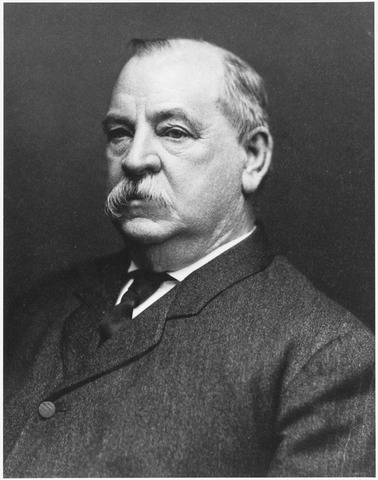
Grover Cleveland (1837-1908), President of the United States, 1885-89 and 1893-97.
Photo from the National Archives and Records Administration (NAID 518139) via Wikimedia Commons.
Cleveland won the White House in 1884 on a platform of restraining federal spending and corruption. Running for re-election in 1888, he won the popular vote but lost to Republican Benjamin Harrison in the Electoral College. A major reason he came out of retirement to run again in 1892 was the reckless spending of the Harrison administration. He beat Harrison that year and became the only man ever elected to non-consecutive terms (1885-89 and 1893-97).
I call to the reader’s attention an article ex-President Cleveland wrote three years after the end of his second term, in June 1901. Titled “The Waste of Public Money”, it was one of half a dozen he penned for The Saturday Evening Post. In this one, he referred to “a malign condition which threatens us,” an “evil” that he saw as “calamitous and destructive to our national character and integrity”.
In 1901, the federal government spent half a billion dollars over the whole year, roughly equivalent in real terms to around $12 billion today. Washington spends that much now in about half a day. Lest you think the feds were misers in 1901, ponder what Cleveland had to say in his article that year:
Probably no one will have the hardihood to deny that the cost of our Government is excessive and wasteful, and that for this condition the heedless neglect and indifference of our people are in some degree responsible … If the aggregate mass of our people are at all blameworthy on account of the present advanced stage of public prodigality, it is largely because they overlooked and tolerated its small beginnings, when at all times they should have been vigilant and uncompromising. A self-ruling people … should constantly remember that nothing multiplies itself more abundantly than national extravagance, and that neither an individual nor a popular government can easily correct or check habits of waste.
The former president did not for a moment believe that only the politicians were to blame for excessive spending. He boldly asserted that many Americans embraced it. They were effectively bought and paid for, guilty of “accepting the bribes of selfish and personal advantage which public waste and extravagance offer”.
Cleveland was often warned by advisers to moderate his stances to avoid controversy. Biographer H. Paul Jeffers quotes him as responding once to such advice by asking, “What is the use of being elected or re-elected unless you stand for something?” When he vetoed a bill to relieve drought-stricken farmers with federal money, he made it plain that “though the people support the government, the government should not support the people”. He saw his job as upholding the Constitution and keeping the federal government in its proper place, not weakening “the bonds of common brotherhood” by robbing Peter to pay Paul.
This was a man who said what he meant and meant what he said, come Hell or high water. He spoke with a clarity of principle that makes a nation great, and the absence of which makes a great nation fail. He understood that no society in history that allowed itself to be bribed by its politicians ever survived such legal larceny.
In the final paragraphs of his June 1901 Saturday Evening Post article, Cleveland admonished his fellow Americans. With these words, he urged them to muster the character to resist being bribed with their own money:
The lessons of extravagance and paternalism must be unlearned; economy and frugality must be reinstated; and the people must exact from their representatives a watchful care for the general welfare and a stern resistance to the demands of selfish interests, if our Government is to be an enduring and beneficent protection to a patriotic and virtuous people.
Many Americans today would undoubtedly dismiss Cleveland’s warnings as “quaint” and “old-fashioned”. They want the government to give them stuff and they don’t think much about who will pay for it. They think even less about how it corrupts the national character.
November 27, 2023
The slackening pace of technological innovation
Freddie deBoer thinks we’re living off the diminishing fumes of a much more innovative and dynamic era:

I gave a talk to a class at Northeastern University earlier this month, concerning technology, journalism, and the cultural professions. The students were bright and inquisitive, though they also reflected the current dynamic in higher ed overall – three quarters of the students who showed up were women, and the men who were there almost all sat moodily in the back and didn’t engage at all while their female peers took notes and asked questions. I know there’s a lot of criticism of the “crisis for boys” narrative, but it’s often hard not to believe in it.
At one point, I was giving my little spiel about how we’re actually living in a period of serious technological stagnation – that despite our vague assumption that we’re entitled to constant remarkable scientific progress, humanity has been living with real and valuable but decidedly small-scale technological growth for the past 50 or 60 or 70 years, after a hundred or so years of incredible growth from 1860ish to 1960ish, give or take a decade or two on either side. You’ve heard this from me before, and as before I will recommend Robert J. Gordon’s The Rise & Fall of American Growth for an exhaustive academic (and primarily economic) argument to this effect. Gordon persuasively demonstrates that from the mid-19th to mid-20th century, humanity leveraged several unique advancements that had remarkably outsized consequences for how we live and changed our basic existence in a way that never happened before and hasn’t since. Principal among these advances were the process of refining fossil fuels and using them to power all manner of devices and vehicles, the ability to harness electricity and use it to safely provide energy to homes (which practically speaking required the first development), and a revolution in medicine that came from the confluence of long-overdue acceptance of germ theory and basic hygienic principles, the discovery and refinement of antibiotics, and the modernization of vaccines.
Of course definitional issues are paramount here, and we can always debate what constitutes major or revolutionary change. Certainly the improvements in medical care in the past half-century feel very important to me as someone living now, and one saved life has immensely emotional and practical importance for many people. What’s more, advances in communication sciences and computer technology genuinely have been revolutionary; going from the Apple II to the iPhone in 30 years is remarkable. The complication that Gordon and other internet-skeptical researchers like Ha-Joon Chang have introduced is to question just how meaningful those digital technologies have been for a) economic growth and b) the daily experience of human life. It can be hard for people who stare at their phones all day to consider the possibility that digital technology just isn’t that important. But ask yourself: if you were forced to live either without your iPhone or without indoor plumbing, could you really choose the latter? I think a few weeks of pooping in the backyard and having no running water to wash your hands or take a shower would probably change your tune. And as impressive as some new development in medicine has been, there’s no question that in simple terms of reducing preventable deaths, the advances seen from 1900 to 1950 dwarf those seen since. To a remarkable extent, continued improvements in worldwide mortality in the past 75 years have been a matter of spreading existing treatments and practices to the developing world, rather than the result of new science.
ANYWAY. You’re probably bored of this line from me by now. But I was talking about this to these college kids, none of whom were alive in a world without widespread internet usage. We were talking about how companies market the future, particularly to people of their age group. I was making fun of the new iPhone and Apple’s marketing fixation on the fact that it’s TITANIUM. A few of the students pushed back; their old iPhones kept developing cracks in their casings, which TITANIUM would presumably fix. And, you know, if it works, that’s progress. (Only time and wear and tear will tell; the number of top-of-the-line phones I’ve gone through with fragile power ports leaves me rather cynical about such things.) Still, I tried to get the students to put that in context with the sense of promise and excitement of the recent past. I’m of a generation that was able to access the primitive internet in childhood but otherwise experienced the transition from the pre-internet world to now. I suspect this is all rather underwhelming for us. When you got your first smartphone, and you thought about what the future would hold, were your first thoughts about more durable casing? I doubt it. I know mine weren’t.
Why is Apple going so hard on TITANIUM? Well, where else does smartphone development have to go? In the early days there was this boundless optimism about what these things might someday do. The cameras, obviously, were a big point of emphasis, and they have developed to a remarkable degree, with even midrange phones now featuring very high-resolution sensors, often with multiple lenses. The addition of the ability to take video that was anything like high-quality, which became widespread a couple years into the smartphone era, was a big advantage. (There’s also all manner of “smart” filtering and adjustments now, which are of more subjective value.) The question is, who in 2023 ever says to themselves “smartphone cameras just aren’t good enough”? I’m sure the cameras will continue to get refined, forever. And maybe that marginal value will mean something, anything at all, in five or ten or twenty years. Maybe it won’t. But no one even pretends that it’s going to be a really big deal. Screens are going to get even more high-resolution, I guess, but again – is there a single person in the world who buys the latest flagship Samsung or iPhone and says, “Christ, I need a higher resolution screen”? They’ll get a little brighter. They’ll get a little more vivid. But so what? So what. Phones have gotten smaller and they’ve gotten bigger. Some gimmicks like built-in projectors were attempted and failed. Some advances like wireless charging have become mainstays. And the value of some things, like foldable screens, remains to be seen. But even the biggest partisans for that technology won’t try to convince you that it’s life-altering.
November 26, 2023
QotD: From Industrial Revolution labour surplus to modern era academic surplus
The great thing about industrial work, though, is that you don’t have to be particularly bright to do it. There’s always going to be a fraction of the population that fails the IQ test, no matter how low you set the bar, but in the early Industrial Revolution that bar was pretty low indeed. So much so, in fact, that pretty soon places like America were experiencing drastic labor shortages, and there’s your history of 19th century immigration. The problem, though, isn’t the low IQ guys. It’s the high-IQ guys whose high IQs don’t line up with remunerative skills.
My academic colleagues were a great example, which is why they were all Marxists. I make fun of their stupidity all the time, but the truth is, they’re most of them bright enough, IQ-wise. Not geniuses by any means, but let’s say 120 IQ on average. Alas, as we all know, 120-with-verbal-dexterity is a very different thing from 120-and-good-with-a-slide-rule. Academics are the former, and any society that wants to remain stable HAS to find something for those people to do. Trust me on this: You do not want to be the obviously smartest guy in the room when everyone else in the room is, say, a plumber. This is no knock on plumbers, who by and large are cool guys, but it IS a knock on the high-IQ guy’s ego. Yeah, maybe I can write you a mean sonnet, or a nifty essay on the problems of labor over-supply in 16th century England, but those guys build stuff. And they get paid.
Those guys — the non-STEM smart guys — used to go into academia, and that used to be enough. Alas, soon enough we had an oversupply of them, too, which is why academia soon became the academic-industrial complex. 90% of what goes on at a modern university is just make-work. It’s either bullshit nobody needs, like “education” majors, or it’s basically just degrees in “activism”. It’s like Say’s Law for retards — supply creates its own demand, in this case subsidized by a trillion-dollar student loan industry. Better, much better, that it should all be plowed under, and the fields salted.
Any society digging itself out of the rubble of the future should always remember: No overproduction of elites!
Severian, “The Academic-Industrial Complex”, Rotten Chestnuts, 2021-05-30.
November 23, 2023
QotD: The Austrian and Chicago schools of economics
War propelled the “Austrian” thinkers westward, and the fall of the Berlin wall propelled the “Chicago” school east. The terms no longer have geographical significance.
What all classical liberals have in common is the passionate vindication and defence of human freedom. That is what makes them, unlike progressives, readable in subsequent generations. Their subject matter cannot become dated. The “Austrians” are also necessary to understand modern history, positively as well as negatively, in the evolution of, for instance, the Christian Democratic movement that conceived a peaceful post-war Europe, in defiance of secularizing bureaucratic trends and mass-man “ideals”. Alas, this was overall defeated by the Eurocratic trend-setters, determined to build a magnificent autocratic monument to themselves.
I have the most enchanting memory of opening the box that contained an American reprint of Human Action (big thick book), which I had ordered at the age of fifteen. I no longer own a copy, but gather it still stands as a monument to the resistance — a study of “praxeology”, or purposeful human choices, stretching so wide that even religion and morality could be touched. (Conventional economics has no time for either.) A half-century later, I can even remember the construction of an earnest reading list, that was soon abandoned when I went on the road.
One may see the great division in Western thought and politics, which the Austrian-school Friedrich Hayek traced back to Bacon and Descartes, and can be traced farther to the Nominalists of the later Middle Ages. Humans live in freedom and make choices, to be restrained only by the plainest moral codes. Or, by the alternative thesis, we are components of a machine, which the man with Power can monkey with, by implanting stimuli here and there.
We are creatures of God, or — we are replaceable parts in a bureaucracy.
David Warren, “Austrian schoolboy”, Essays in Idleness, 2019-09-17.
November 22, 2023
Another look at the “Great Divergence”
The latest book review from Mr. and Mrs. Psmith’s Bookshelf features Patrick Wyman’s The Verge: Reformation, Renaissance, and Forty Years that Shook the World:
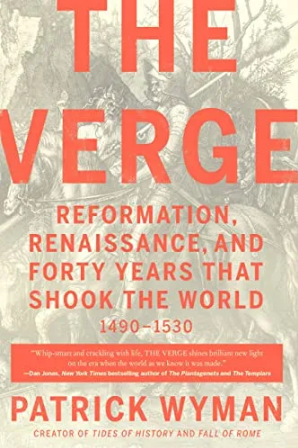
This is a weird Substack featuring an eclectic selection of books, but one of our recurring interests is the Great Divergence: why and how did the otherwise perfectly normal people living in the northwestern corner of Eurasia managed to become overwhelmingly wealthier and more powerful than any other group in human history? We’ve covered a few theories about what’s behind it — not marrying your cousins, coal, the analytic mindset (twice) — but there are lots of others we’ve never touched, including geographic and thus political fragmentation, proximity to the New World, and even the Black Death. So this is also a book about the Great Divergence, but unlike many of the others it doesn’t offer One Weird Trick to explain things. Instead, Wyman approaches the period between 1490 and 1530 through nine people, each of whom exemplifies one of the many shifts in European society, and so paints a portrait of a changing world.
Of course, he does point to a common thread woven through many of the changes: culture. Or, more specifically, the institutions1 surrounding money and credit that Europeans had spent the last few hundred years developing. But these weren’t themselves dispositive: after all, lots of people in lots of place at lots of times have been able to mobilize capital, and most of them don’t produce graphs that look like this. Really, the secret ingredient was — as Harold Macmillan said of the greatest challenge to his government — “events, dear boy, events”.2 Europe between 1490 to 1530 saw an unusually large number of innovations and opportunities for large-scale, capital-intensive undertakings, and already had the economic institutions in place to take advantage of them. One disruption fed on the next in a mutually-reinforcing process of social, political, religious, economic, and technological change that (Wyman argues) set Europe on the path towards global dominance.
Some of Wyman’s characters — Columbus, Martin Luther, Holy Roman Emperor Charles V — are intensely familiar, but he presents them with verve, as interested in giving you a feel for the individual and their world as in conveying biographical detail. (This is an underrated goal in the writing of history, but really invaluable; the “Cross Section: View from …” chapters were always my favorite part of Jacques Barzun’s idiosyncratic doorstopper From Dawn to Decadence.) This is particularly welcome when it comes to the chapters featuring some lesser-known figures: you may have heard of Jakob Fugger, but unless you’re a Wimsey-level fan of incunabula you’re probably unfamiliar with Aldus Manutius. One-handed man-at-arms Götz von Berlichingen becomes our lens for the chapter about the Military Revolution not because he played a particularly significant role but because he wrote a memoir, and small-time English wool merchant John Heritage is notable pretty much solely because his account book happened to survive into the present. But even with the stories “everyone knows”, Wyman takes several large steps back in order to contextualize that common knowledge: for example, were you aware that while before 1492 Columbus didn’t take any particularly unusual voyages, he did take an unparalleled number and variety of them, making him one of the best-travelled Atlantic sailors of his day? Did you know that Isabella’s inheritance of the Castilian throne was far from certain?3
As the book continues, Wyman can reference the cultural and technological shifts he described in earlier chapters. For instance, much of the Fuggers’ wealth came in the form of silver from deep new mines in the Tyrol. Building the mines required substantial capital — for their new, deeper tunnels and the expensive pumps to drain them, as well as for the furnaces and workshops to separate the copper from the silver via the relatively inefficient liquation process — and while everyone knew all along that the metals were there, it took the combination of a continent-wide bullion shortage and a rising demand for copper to cast bronze cannon (look back to the chapters on state formation and the military!) to make it worth anyone’s while to get them out. But it wasn’t only the Fuggers who made their money in these new mines: the money for Martin Luther’s education came from his father’s small-scale copper mining concern in eastern Germany. Grammar school in his hometown, a parish school nearby, and then four years at university cost Luther pater enough that he couldn’t follow it up for his younger sons (and from his point of view the was probably squandered when Martin became a monk instead of the intended lawyer who would be an asset in the frequent mining disputes), but such an education for even one son would have been out of reach if not for the printed texts on grammar, philosophy and law that made it all far more affordable.
Of course, the relationship between Luther and printing goes both ways. While Luther’s very existence as an educated man was enabled by the printing press, it was the intellectual and religious ferment he would kick off that made printing work.
1. Wyman glosses the term as “a shared understanding of the rules of a particular game … the systems, beliefs, norms and organizations that drive people to behave in particular way”, but it’s more or less what I’ve elsewhere called bundles of social technologies.
2. Apparently he may not have said this, but he should have so print the legend.
3. Isabella’s opponent, her half-niece Joanna, was married to King Afonso V of Portugal, so perhaps some degree of Iberian unification might still have followed. On the other hand, Afonso already had an adult son (King João II, widely admired as “the Perfect Prince” — Isabella always referred to him simply as el Hombre, “the Man”) who would have had no personal claim to Castile. Joanna and Afonso’s marriage was annulled on the perfectly true grounds of consanguinity — he was her uncle — after they lost the war, so they never had children, but if she had won perhaps João (who died without legitimate issue) could have been succeeded by a much younger half-Castilian half-brother. Certainly an Isabella relegated to Queen-Consort of Aragon would still have been a force to be reckoned with, but losing the knock-on effects of her reign (Columbus, Granada, the fate of the Sephardim, not to mention the eventual unification of most of Europe under Ferdinand and Isabella’s Habsburg grandson) makes all this a pretty good setup for an alternate history!
Even more fun: before she married Ferdinand of Aragon, there was discussion of Isabella’s betrothal to Richard, Duke of Gloucester. Yeah, that one.
November 21, 2023
Javier Gerardo Milei, President-elect of Argentina
On the current evidence, Argentina has finally decided to turn away from both communism and Peronism to try something radically different in the person of newly elected Javier Gerardo Milei, variously described (disapprovingly) in the English-language press as “far right”, “extreme right”, “Trump-like”, and most alarmingly, “libertarian”. Here’s what Wikipedia had to say about him (before the edit wars get serious on his page):

Javier Milei, 8 October 2022.
Photo attributed to Vox España via Wikimedia Commons.
Javier Gerardo Milei (/miˈleɪ/ mee-LAY, Spanish pronunciation: [xaˈβjeɾ xeˈɾaɾðo miˈlej]; born 22 October 1970) is an Argentine politician, economist, and author who is the President-elect of Argentina.[1] Before rising to political prominence, Milei initially gained notability as an economist, as the author of multiple books on economics and politics, and for his distinct political philosophy.
As an economist, Milei is a vocal proponent of the Austrian School. He has critiqued the fiscal policies of various Argentine administrations and he advocates for reduced government spending. As a university professor, he has taught courses in macroeconomics, economic growth, microeconomics, and mathematics for economists.[2] He is also the author of numerous books and has hosted radio programs, including Demoliendo mitos and Cátedra libre. In 2021, he entered politics and was elected as a national deputy representing the City of Buenos Aires for La Libertad Avanza. During his tenure, he limited his legislative activities to voting, focusing instead on critiquing what he describes as Argentina’s political elite and its propensity for high government spending. Milei has pledged not to raise taxes and has donated his national deputy salary through a monthly raffle. He was a presidential candidate in the upcoming 2023 general election,[3] with Victoria Villarruel as his vice-presidential running mate.[4] He advanced to the run-off of the presidential election, in which he faced Sergio Massa.[5] On 19 November 2023, he won the run-off election with 56% of the vote to Massa’s 44% to become President-elect.[6]
David Warren certainly seems to like the cut of Milei’s jib:
Mr Milei not only swept the “youth” vote, but he did that while declaring: “Killing children is not a human right!” He mocked an accumulation of political corrections, while dropping a few more “flinch bombs” worthy of the XVIIth-century bishops who evangelized that country.
The outgoing president, another tedious Peronist like our pope, shared the old presidential palace with decorative plants. Carlos, my correspondent, claims that he could make Justin Trudeau look intelligent. If true, this would be an extraordinary accomplishment. He also leaves an amazing national debt, hyperinflation, energy shortages, &c.
Mr Milei seems to have won as Mr Trump once did in the United States: by not flinching. A point may be reached in national decline when even the young will pitch out the Peronistas. Godspeed to them, when they reach this point.
Nevertheless, one must continue to despise politics. Carlos echoes Borges: “No matter how bad an Argentine government is, the next will be worse”.
The Buenos Aires Times, quoted by Brian Peckford:
Milei promised to return Argentina, one of the richest countries in the world a century ago, to its former glory, after decades of stagnation, mostly under the populist Peronist coalition – big on welfare and government spending.
The president-elect vowed “a limited government, respect for private property and free trade. The model of decadence has come to an end. There is no way back.”
Milei offered special thanks to former president Mauricio Macri and failed opposition presidential candidate Patricia Bullrich, who threw their support behind him after defeat in the first round and helped bring over their voters to his force.
He also thanked scrutineers from his party and those from the opposition PRO party that had worked to protect and count votes at polling stations.
Milei ended his speech with his traditional trademark rallying call: “Viva la libertad carajo!” (“fucking long live freedom”).
News of the libertarian’s victory prompted wild scenes from supporters on the streets of Buenos Aires. The area around the Hotel Libertador, his traditional bunker for election night, was swamped by revellers celebrating his win.
It’s often said that socialists will dismiss any failures by socialist governments by declaring that it wasn’t “real socialism”. This is equally true for other political and philosophical beliefs:
November 20, 2023
The latest scam – Natural Asset Companies (NACs)
Elizabeth Nickson on the US Securities and Exchange Commission’s plan to magic up some new ways to “financialize” national parks and other federally regulated places for the benefit of the hyper-wealthy and well-connected:

Soon to be a financially performing asset of BlackRock?
Grand Canyon of the Yellowstone, 21 June 2021. Photo by Grastel via Wikimedia Commons.
Delayed but not stopped, the U.S. government is planning a rule that allows for America’s protected lands, including parks and wildlife refuges, to be listed on the N.Y. Stock Exchange. Natural Asset Companies (NACs) will be owned, managed, and traded by companies like BlackRock, Vanguard, and even China.
The deadline was Friday, but earlier this week, the deadline was postponed until January. This is the usual criminal feint from the environmental movement and the administrative state. People are complaining? Let’s put it off till they go back to sleep. Then we will steal their birthright late at night, in precisely the manner we have stolen everything else.
[…]
The entire universe envies the lush interior of the U.S. Increasingly empty, it is filled with a cornucopia of minerals, fiber, food, waters, extraordinarily fertile soil as well as well-ordered, educated, mostly docile people. Worth in the quadrillions, if one could monetize and trade it, financialize it, the way the market has financialized the future labor of Americans, well, it would be like golden coins raining from the sky.
On October 4th, the Securities and Exchange Commission filed a proposed rule to create Natural Asset Companies (NACs). A twenty-one day comment period was allowed, which is half the minimum number of days generally required and when they postponed passing the rule, they did not extend the comment period. “Nope, shut up,” they said.
NACs will allow BlackRock, Bill Gates, and possibly even China to hold the ecosystem rights to the land, water, air, and natural processes of the properties enrolled in NACs. Each NAC will hold “management authority” over the land. When we are issued carbon allowances, owners of said lands will be able to claim tax deductions and will be able to sell carbon allowances to businesses, families and townships. In the simplest of terms, that’s where the money will be made. WE peons will be renting air from the richest people on earth.
The following are eligible for NACs: National Parks, National Wildlife Refuges, Wilderness Areas, Areas of Critical Environmental Concern, Conservation Areas on Private and Federal Lands, Endangered Species Critical Habitat, and the Conservation Reserve Program. Lest you think that any conserved land is conserved in your name, the largest Conservation organization in the U.S., is called The Nature Conservancy, or TNC, which, while being a 501(c)3, also holds six billion dollars of land on its books. Those lands have been taken using your money via donations and government grants, and transferred to the Nature Conservancy, which can do with those lands what it wills.
If this rule passes, America’s conserved lands and parks will move onto the balance sheets of the richest people in the world. Management of those lands will be decided by them and their operations, to say the least, will be opaque.
μολὼν λαβέ, buddy.


