
The economic case against protectionism is practically invincible. While theoretical curiosities can be described in which an import tariff (or an export subsidy) yields to the people of the home country net economic gains, the conditions that must prevail for these possibilities to have practical merit are absurdly unrealistic.
Yet in their efforts to justify punitive taxes on fellow citizens’ purchases of imports, protectionists regularly trot out these theoretical curiosities. And none is more frequently paraded in public than is the assertion that high tariffs imposed by the home government today will pressure foreign governments to lower their tariffs tomorrow, with the final result being freer trade worldwide.
“Our tariffs are the best means for making trade freer and bringing about what Adam Smith and all free traders have desired: maximum possible expansion of the international division of labor!” protectionists declare with straight faces.
This protectionist apology for tariffs is as believable as is the apology often offered by today’s campus radicals for speech codes and the harassment of certain speakers: “Our insistence on silencing conservatives and libertarians is actually a means of promoting campus diversity and inclusion!”
Both declarations are Orwellian.
Don Boudreaux, “Is Trump’s Ultimate Goal Global Free Trade?”, Catallaxy Files, 2019-06-11.
February 20, 2024
QotD: Tariffs and protectionism
February 12, 2024
QotD: The Golden Rule of Canadian Politics
Tristin Hopper, “‘Stick a fork in me; I’m done’: Inside the thoughts of the carbon tax”, National Post, 2023-11-11.
February 8, 2024
North American newspaper economics
Tim Worstall discusses some of the issues ailing Canadian and American newspapers which are not easily solvable (government subsidies, as attempted in Canada, just turn the recipients into an underpaid PR branch of the governing party … not a good look in a democratic nation):
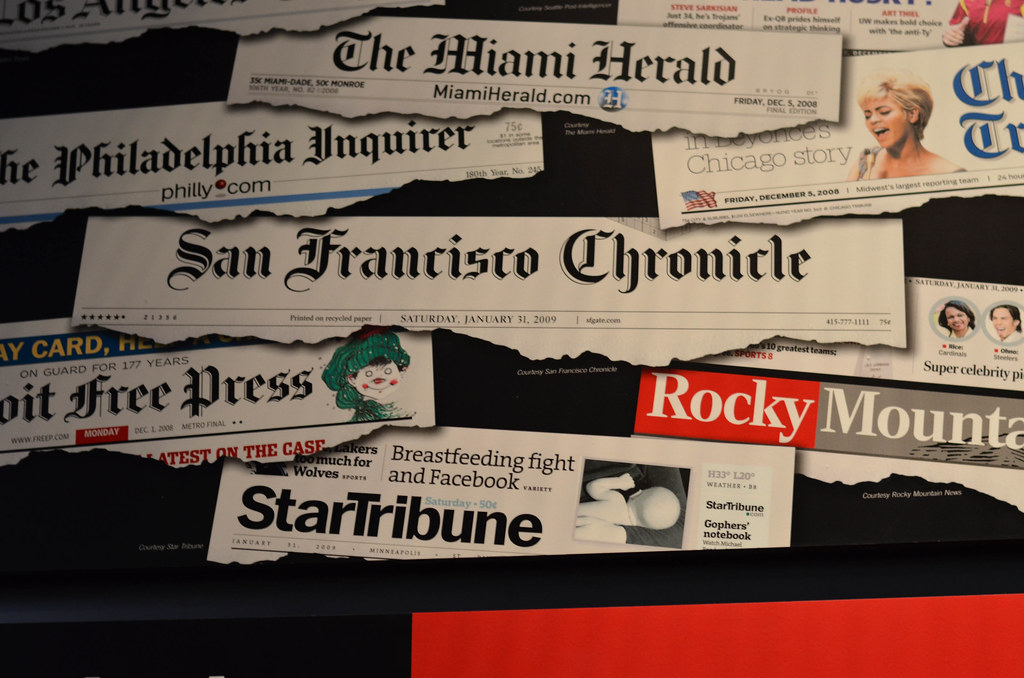


So, as a little corrective, a quick jaunt through what actually ails American journalism. The concentration is upon the big newspapers because that’s where the problem is worst. The conclusion is that it’s gonna get a lot, lot, lot, worse too. Because the industry is facing a base economic problem that it’s not willing to actually face up to. Or, at least, all the journalists writing about it aren’t — there’s the occasional sign that some of the business side of the equation grasp it.
[…]
Before Y2K American newspapers were segmented along geographic lines. The size of the country, the lack of a long distance passenger railroad network, meant that this was just so. If you’re printing a daily paper then you’ve got to deliver it daily. On the day it’s meant to refer to as well. If Chicago is 1,100 miles (no, I’ve not looked it up but that’s within an order of magnitude of being right, which is better than many newspapers manage with numbers) from New Orleans then the same newspaper is going to find it difficult to print and deliver to both markets. Add in the fact that trains take a week to traverse that distance, passenger trains – anyone who has ever travelled Amtrak will say it feels that long at least — included.
You could not and therefore did not have national newspaper (USA Today, with satellite printing plants, was an attempt to deal with this and slightly earlier than our cut off date but doesn’t change the basic story) distributions. What you had was a series of local and regional monopolies. Each one centred on a large population centre and serving the area around it that could be reasonably reached by truck overnight. Chicago and Cincinnati, not 1,100 miles away from each other, did have entirely different newspapers.
By contrast, and just as an example, the British newspaper market was national from pre-WWI. We simply did have overnight at worst passenger rail that covered the country. Partly it’s a much, much, smaller place, partly the passenger rail system was just different. So, printing overnight (and some maintained separate Scottish editions and plants) meant that those papers that came off the press in London at 8pm were on sale in Glasgow at 8 am, those that came off the press in London at 4 am were on sale in London at 8am. That’s not exact but it’s a good enough pencil sketch.
Cincinnati newspaper(s) served Cincinnati. Chicago, Chicago and New Orleans the area of New Orleans. There simply wasn’t a “national press” in the US in that British sense.
OK. But this also meant that American newspapers were much more like a monopoly in their local area than anything else. Network effects still exist even before computer networks after all. The most important of which was the classifieds.
As with Facebook, we’re all on Facebook because everyone else is on Facebook. So, if we’re to join a social network we’re going to be on Facebook where everyone else is — except those three hipsters who are where it isn’t cool yet. This applies to classifieds sections. Folk advertise in the one with the most readers, the widest market. Readers buy the one with the most ads in it, the widest market. You advertise the bronzed baby shoes, unused, where there are the most people looking for bronzed baby shoes, unused.
So, the dominant paper will suck up the classifieds in any particular market. Classifieds, fairly obviously back in the days of prams, cheap used cars, waiters’ jobs and so on being geographically based.
No, this is important. A useful pencil sketch of American newspaper revenues pre-Y2K was that subscriptions produced some one third of revenues. They also, around and about, covered print costs and distribution. They were, roughly you understand, about a face wash in fact.
Display ads produced another one third and classifieds the final one third. Classifieds were also wildly profitable — no expensive journalists to pay, no bureaux, just a few women waiting to get married on the end of the phone line.
February 7, 2024
A disturbing proportion of scientific publishing is … bullshit
Tim Worstall on a few of the more upsetting details of how much we’ve been able depend on truth and testability in the scientific community and how badly that’s been undermined in recent years:
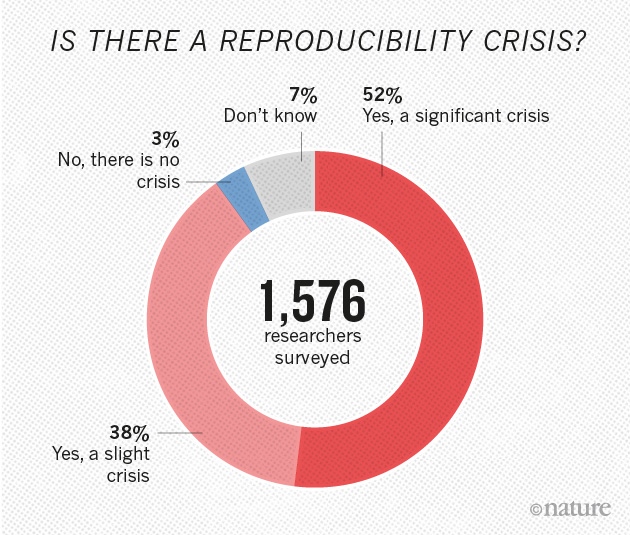
The Observer tells us that science itself is becoming polluted by journal mills. Fools — intellectual thieves perhaps — are publishing nonsense in scientific journals, this then pollutes the conclusions reached by people surveying science to see what’s what.
This is true and is a problem. But it’s what people publish as supposedly real science that is the real problem here, not just those obvious cases they’re complaining about:
The startling rise in the publication of sham science papers has its roots in China, where young doctors and scientists seeking promotion were required to have published scientific papers. Shadow organisations – known as “paper mills” – began to supply fabricated work for publication in journals there.
The practice has since spread to India, Iran, Russia, former Soviet Union states and eastern Europe, with paper mills supplying fabricated studies to more and more journals as increasing numbers of young scientists try to boost their careers by claiming false research experience. In some cases, journal editors have been bribed to accept articles, while paper mills have managed to establish their own agents as guest editors who then allow reams of falsified work to be published.
Indeed, an actual and real problem:
The products of paper mills often look like regular articles but are based on templates in which names of genes or diseases are slotted in at random among fictitious tables and figures. Worryingly, these articles can then get incorporated into large databases used by those working on drug discovery.
Others are more bizarre and include research unrelated to a journal’s field, making it clear that no peer review has taken place in relation to that article. An example is a paper on Marxist ideology that appeared in the journal Computational and Mathematical Methods in Medicine. Others are distinctive because of the strange language they use, including references to “bosom peril” rather than breast cancer and “Parkinson’s ailment” rather Parkinson’s disease.
Quite. But the problem is worse, much, much, worse.
Let us turn to something we all can agree is of some importance. Those critical minerals things. We all agree that we’re going to be using more of them in the future. Largely because the whole renewables thing is changing the minerals we use to power the world. We’re — to some extent, perhaps enough, perhaps not enough — moving from using fossil fuels to power the world to using rare earths, silicon, copper and so on to power the world. How much there is, how much useable, of those minerals is important. Because that’s what we’re doing, we’re changing which minerals — from fossil to metallic elements — we use to power the world.
Those estimates of how much there is out there are therefore important. The European Union, for example, has innumerable reports and task forces working on the basis that there’s not that much out there and therefore we’ve got to recycle everything. One of those foundational blocks of the circular economy is that we’ve got to do it anyway. Because there’s simply not enough to be able to power society without the circular economy.
This argument is nads*. The circular economy might be desirable for other reasons. At least in part it’s very sensible too – if it’s cheaper to recycle than to dig up new then of course we should recycle. But that we must recycle, regardless of the cost, because otherwise supply will vanish is that nads*.
But, folk will and do say, if we look at the actual science here we are short of these minerals and metals. Therefore etc. But it’s the science that has become infected. Wrongly infected, infested even.
Here’s the Royal Society of Chemistry and their periodic table. You need to click around a bit to see this but they have hafnium supply risk as “unknown”. That’s at least an advance from their previous insistence that it was at high supply risk. It isn’t, there’s more hafnium out there than we can shake a stick at. At current consumption rates — and assuming no recycling at all which, with hafnium, isn’t all that odd an idea — we’re going to run out sometime around the expected date for the heat death of the universe. No, not run out of the universe’s hafnium, run out of what we’ve got in the lithosphere of our own Earth. To a reasonable and rough measure the entirety of Cornwall is 0.01% hafnium. We happily mine for gold at 0.0001% concentrations and we use less hafnium annually than we do gold.
The RSC also says that gallium and germanium have a high supply risk. Can you guess which bodily part(s) such a claim should be associated with? For gallium we already have a thousand year supply booked to pass through the plants we normally use to extract our gallium for us. For germanium I — although someone competent could be a preference — could build you a plant to supply 2 to 4% of global annual germanium demand/supply. Take about 6 months and cost $10 million even at government contracting rates to do it too. The raw material would be fly ash from coal burning and there’s no shortage of that — hundreds of such plants could be constructed that is.
The idea that humanity is, in anything like the likely timespan of our species, going to run short in absolute terms of Hf, Ga or Ge is just the utmost nads*
But the American Chemistry Society says the same thing:
* As ever, we are polite around here. Therefore we use the English euphemism “nads”, a shortening of “nadgers”, for the real meaning of “bollocks”.

February 2, 2024
QotD: Financial bubbles
The thing is, economists often disagree at this point. Sure, financial bubbles, they occur. Sure, there’s waste in them. But perhaps the very bubble itself is an either useful or necessary part of the process.
Necessary in that perhaps it needs a mania to get some new technology over the finish line. I tend to think it’s not going to happen with Tesla but it did with Railway Mania. Without speculators searching for easy money the network never would have been built out. Without Dotcom Amazon probably wouldn’t have got funded through the decade it was scratching a living.
It’s also possible that it’s just useful. For the overbuilding in the mania might then leave assets that are repurposed to get other technologies over that finish line into general use. Global Crossing lost a fortune – no, really billions – on building out fibre optic cabling to girdle the world. Which was, after the bankruptcy, bought up by the Googles and the like to carry all this web and video stuff. It’s arguably true that without the previous overinvestment we’d simply never have developed – or perhaps not for decades – such resource and bandwidth-hungry hogs.
Tim Worstall, “Cloud Rendering – The Latest Proof That Investment Bubbles Actually Work”, Continental Telegraph, 2019-03-17.
January 31, 2024
QotD: The inner-most “zones” outside a typical pre-modern city
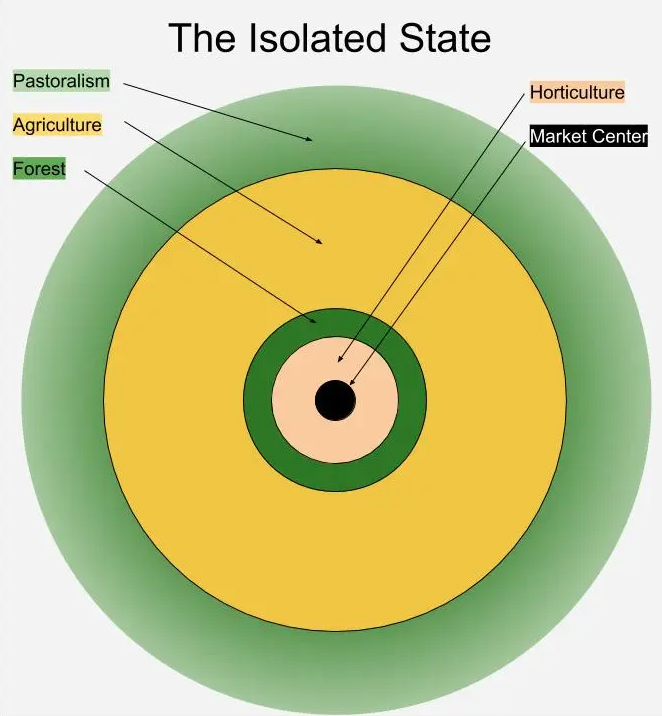
Diagram of von Thünen’s model from The Isolated State, after Morley (1996), 62. The agriculture ring is subdivided by intensity (intensive, long-lay and three-field), but here I have merged them for simplicity. The agriculture zone is wider because it did, in fact, tend to cover a larger area. The fade in the pastoralism zone is meant to indicate shifts from ranching to transhumance.
We’ll start at the inside, right next to the city and move outward. Imagine each “zone” as a wider concentric circle, moving outward from the city (see the image to the right). Because transportation costs (especially overland) are so high, distance from the city plays a dominant role in how the land is used and thus consequently what the countryside around the city looks like. As you move further and further away, transportation costs interact with the structure of agriculture to make different activities make more sense, creating somewhat predictable patterns.
Land very close to the city is valuable because its produce can reach the market with much lower transportation costs (and pretty much always in a single day’s walk). As a result, if the land can support any kind of productive use, it will not be left empty. Instead, the land is going to be put to the most productive use possible. Improvements that – because of cost or labor – might not be attempted on less valuable land further out will likely be done in close proximity to the city. Stepping out of our ideal model for a moment: this is especially true of irrigation, since cities tend to be on waterways (especially rivers) anyway, making irrigation both more valuable due to low transport costs and easier to accomplish.
Thus land in this innermost zone is likely to be heavily improved (irrigation, terracing to get maximum space out of hills, etc). Labor use will also be intensive, both because it is readily available (you are right next to the major population center) and because labor costs are small compared to the high value of the land. If you have managed to get some farmland right outside the city gates, it is very much worth your time to hire whatever labor you need to get the most out of it, so as to recoup the cost of buying or holding such valuable land.
The other improvement one is likely to do in this zone, at least for growing crops, is make extensive use of fertilizer, which in this case generally means manure. The good news is that this zone is directly next to the city, with its intense concentration of animals and people producing manure, making manure cheaper (yes, people did pay for it). Extensive use of manure lets the fields stay under cultivation more often – being fallowed less frequently. At greater distance, the cost of the manure for this begins to outweigh the value of the extra crops, but so close to the city, land this valuable ought to be kept producing as much as possible.
So what kinds of land use does this lead to? The two key activities that von Thünen identifies are horticulture and dairying, to which I’ll add trough-fed animals like pigs (not quite dairy, but as we’ll see, similar from an economic perspective). Why? Horticulture – the intensive growing of fruits and vegetables, often in small “market gardens” – is labor intensive and offers a high economic yield for the space. Land used for horticulture can be kept under almost continual cultivation (if manured, but see above), but gardens can be fussy and demand quite a lot of labor, compared to hardier plants (like maize corn or wheat). Likewise, dairy animals (which, up close to a large city, will be stall-fed rather than grazed or else transported in “on the hoof” and grazed much further out) and pigs (fed by trough) don’t require much space and offer a high economic yield. Both also produce manure which is in demand near the city for the reasons described above.
The other reason to keep these activities so close to the city is access to the market, for two related reasons. First, fresh dairy products, meats and vegetables spoil rapidly, so they must be gotten to market quickly. Remember that this is a world without refrigeration, so as soon as the plant is picked, the cow is milked or the pig is killed, the clock is ticking on spoilage (yes, there are ways to preserve meat, of course – but we’re talking fresh animal products). Precisely because these foods don’t travel or keep well, they tend to be luxury products as well – something produced for the market and bought by rich non-farmers who live in the city.
So what kind of terrain should we see here? Not open grassland or nice wide open fields. Instead, expect small plots, with clustered buildings, typically clinging to the roads leading into the city. Now – especially in the post-gunpowder age – there might be laws forbidding certain kinds of structures close to the city walls (if the city is walled), which might create some open space (but typically not vast). Likewise, when looking at historical city maps, also be wary: this innermost land-use zone was often contained within the city walls of smaller cities.
The next zone – also quite close to the city in von Thünen’s model is – perhaps somewhat surprisingly – a forest zone. That’s not to say that this is generally wild, uncontrolled forest. The reason for a forest zone at such close distance to the city is to provide wood, particularly firewood for heating. Trees might be arranged intentionally along field separations or on spots of agriculturally marginal land close to the city. Forests like these in the Middle Ages would often have been coppiced or pollarded – that is, the trees would have been intentionally cut to produce lots of long, thin straight branches which can be easily harvested to produce nice, evenly sized bits of wood.
Wood is obviously at no risk of spoiling, but it is heavy and bulky, making a close supply valuable. Moreover, the city will need quite a lot of it, for cooking and heating. That said, trees can often be grown either on very marginal (for agriculture) land or else between fields and farms outside of the city, so these patches of forest might often go on land that is a touch too rough or poor for intensive agriculture, or otherwise be squeezed in between land used for other purposes. Still, it is quite common to find spots of forest next to cities and villages alike.
(To answer a quibble in advance: of course this assumes wood is a key heating element. Societies in more arid climates often lack sufficient wood and might use dung, while wet enough areas may use peat. Historically, London shifted over to using mineral coal earlier than most places. All of these choices will impact the role and importance of forest near the city.)
Bret Devereaux, “Collections: The Lonely City, Part I: The Ideal City”, A Collection of Unmitigated Pedantry, 2019-07-12.
January 26, 2024
Javier Milei to the parasites in Davos – You are the problem
Jon Miltimore on Argentine President Javier Milei’s visit to the World Economic Forum in Davos earlier this month:
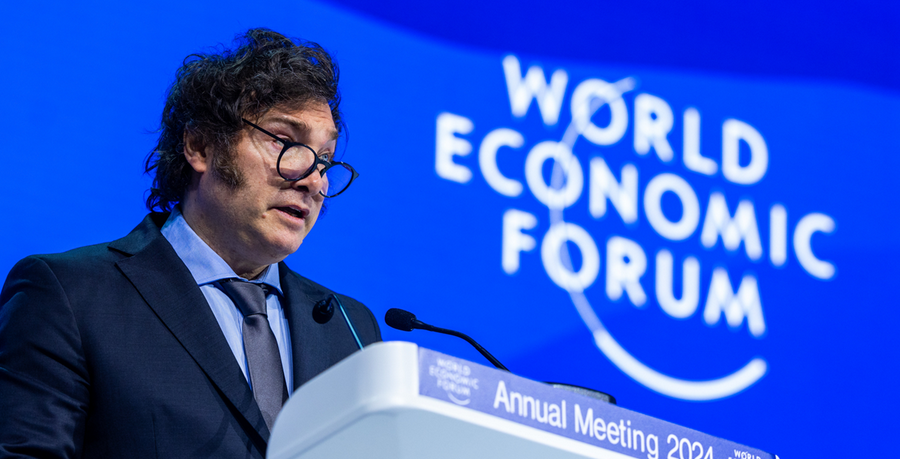
Argentine President Javier Milei speaking at the World Economic Forum gabfest in Davos, Switzerland, January 2024.
Photo by Flickr – World Economic Forum | CC BY-NC-SA 2.0
Javier Milei went to Davos to attend the 54th annual World Economic Forum (WEF) meeting last week.
Attendees of the meetings — often derided as global elites who bask in their pomp, privilege, and luxury as they try to address global problems with collectivist solutions — received a jarring message from Argentina’s newly-elected president: you are the problem.
“Today I’m here to tell you that the Western world is in danger,” Milei said in his prepared remarks. “And it is in danger because those who are supposed to have to defend the values of the West are co-opted by a vision of the world that inexorably leads to socialism, and thereby to poverty.”
[…]
This is just a sprinkling of the topics discussed in Davos, of course, but you’ll notice a common current that runs throughout them: the solution to virtually every problem requires more government and “collective action”, and less freedom.
This is precisely the kind of thinking Milei, a self-described libertarian, took aim at in his speech, which was a clarion call for leaders to reject collectivist thinking and embrace individual freedom.
“The main leaders of the Western world have abandoned the model of freedom for different versions of what we call collectivism,” Milei told the audience. “We’re here to tell you that collectivist experiments are never the solution to the problems that afflict the citizens of the world; rather they are the root cause.”
As Milei pointed out, few can better attest to the failures of collectivism than Argentines. The country surged to prosperity in the latter half of the nineteenth century, only to experience a massive drop in prosperity due to its embrace of Peronism, a blend of fascism and socialism named after the left-leaning revolutionary Juan Domingo Perón (1895–1974) who dominated Argentine politics for decades following his initial ascent to power in 1946.
While many of Milei’s predecessors, such as the jet-setting Cristina Fernández de Kirchner, a self-described Peronist and progressive, were delivering international speeches in Copenhagen about tackling climate change through “a new multilateralism”, Argentines watched their country slowly collapse into poverty.
By embracing protectionist trade policies and rampant government spending, Peronists set Argentina’s economy on fire. By 2023, 40 percent of the population was in poverty and inflation had reached more than 140 percent due to massive money printing. Because of the constantly eroding value of pesos, Argentine merchants are compelled to update prices on chalkboards throughout the day.
The human disaster in Argentina was not caused by climate change or AI or “misinformation”.
It was caused by Argentine politicians and bureaucrats abandoning free-market capitalism, an economic system that brought about unprecedented human prosperity across the globe, and a stark contrast to its various collectivist counterparts — fascism, Peronism, communism, anti-capitalism, etc.
This is why Mr. Milei called capitalism the only “morally desirable” economic system, and the only one that can alleviate global poverty.
Which Is Easier To Pull? (Railcars vs. Road Cars)
Practical Engineering
Published Nov 7, 2023A lot of the engineering decisions that get made in railroading have to do with energy. How does the rolling resistance of a 20-ton freight railcar compare to my little grocery hauler?
(more…)
January 25, 2024
QotD: How Meritocracy morphed into “Meritocracy”
Their efforts pay off for their progeny, but in the harsh competition that is the contemporary economy, they leave everyone else in the dust. Nourished in the hothouse of elite homes and communities, rich children have pulled away from their middle-class counterparts when it comes to academic performance, outscoring them on the SAT by twice as much as middle-class kids outscore poor students. The most elite colleges enroll more students from households in the top 1 percent than from the entire bottom half of the income scale. Those students are first in the pipeline to elite jobs. Top banks go only to the Ivy League, MIT, and Stanford for their recruiting. Top Five law schools are the training grounds for partners at the poshest firms. Meantime, middle-class kids are not only a rare sight on elite campuses; they’re also far less likely to get any college degree. Poor kids do worse still.
The result, says Markovits, is precisely the sort of dynastic elite that the putatively unbiased SAT was supposed to put out of business. To the dismay of his critics on the left, Markovits is not entirely unsympathetic to the winners of the tournament. The rich used to be indolent, he reminds us. The whole point of wealth was to be freed from toil, while peasants sweated in fields and manor kitchens to serve their betters and eke out a living for their undernourished families. These days, by contrast, the rich work 16-hour days and weekends under immense competitive pressure to close the deal, make partner, and take a conference call with Japanese businessmen. “No prior elite has ever been as capable or as industrious as the meritocratic elite that such training produces. None comes close,” Markovits asserts. Yes, a few actresses and real estate barons try to bribe and cheat their children into the palaces of learning, but most Ivy Leaguers have used their privileged upbringing to make their way into these bastions according to the rules of achievement. Given the expensive grooming required to make it to the top campuses, he implies, a squeaky-clean meritocracy would still favor the rich.
Kay S. Hymowitz, “Meritocrats versus Meritocracy”, City Journal, 2019-10-11.
January 20, 2024
The British Empire would have failed a proper cost-benefit analysis
At the Institute of Economic Affairs, Kristian Niemietz is working on a paper on the economics of empire that, as he shows in this article, indicates that the empire was never a winning economic proposition for Britain as a whole, no matter how well certain well-connected individuals and companies benefitted:
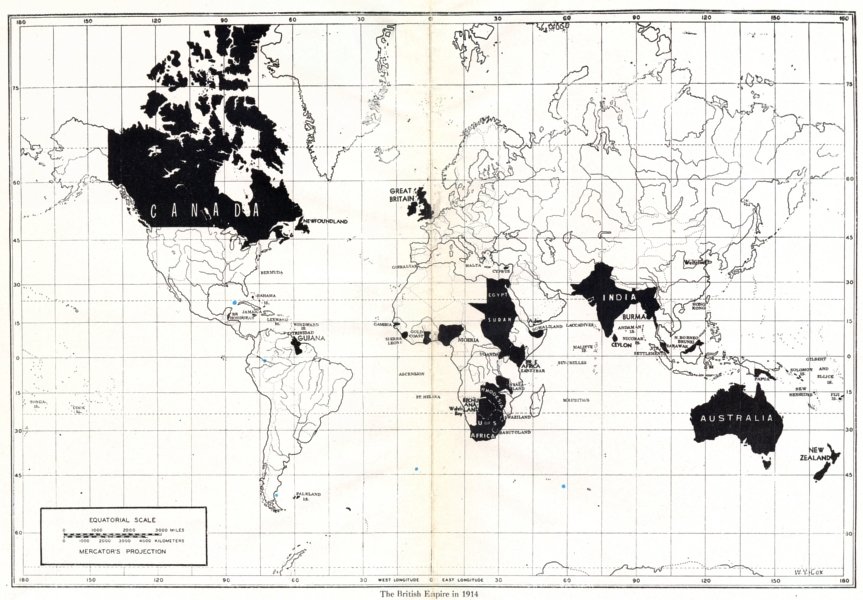
The British Empire in 1914 (via antiquaprintgallery.com)
But is it actually true that imperialism makes countries richer? Does imperialism make economic sense?
This question was already hotly debated at the heyday of imperialism. Adam Smith believed that the British Empire would not pass a cost-benefit test:
The pretended purpose of it was to encourage the manufactures, and to increase the commerce of Great Britain. But its real effect has been to raise the rate of mercantile profit, and to enable our merchants to turn into a branch of trade, of which the returns are more slow and distant than those of the greater part of other trades, a greater proportion of their capital than they otherwise would have done […]
Great Britain derives nothing but loss from the dominion which she assumes over her colonies.
He believed that Britain would be better off if it dissolved its Empire:
Great Britain would not only be immediately freed from the whole annual expense of the peace establishment of the colonies, but might settle with them such a treaty of commerce as would effectually secure to her a free trade, more advantageous to the great body of the people, though less so to the merchants, than the monopoly which she at present enjoys.
The liberal free-trade campaigner Richard Cobden agreed:
[O]ur naval force, on the West India station […], amounted to 29 vessels, carrying 474 guns, to protect a commerce just exceeding two millions per annum. This is not all. A considerable military force is kept up in those islands […]
Add to which, our civil expenditure, and the charges at the Colonial Office […]; and we find […] that our whole expenditure, in governing and protecting the trade of those islands, exceeds, considerably, the total amount of their imports of our produce and manufactures.
If imperialism was a loss-making activity – why did Britain and other European colonial empires engage in it for so long?
Smith and Cobden explained it in terms of clientele politics (or Public Choice Economics, as we would say today). Somebody obviously benefited, even if the nation as a whole did not. And the beneficiaries were politically better organised than those who footed the bill.
This proto-Public Choice case against imperialism was not limited to political liberals. Otto von Bismarck, the Minister President of Prussia and future Chancellor of the German Empire, hated liberals in the Smith-Cobden tradition, but he rejected colonialism in terms that almost make him sound like one of them:
The supposed benefits of colonies for the trade and industry of the mother country are, for the most part, illusory. The costs involved in founding, supporting and especially maintaining colonies […] very often exceed the benefits that the mother country derives from them, quite apart from the fact that it is difficult to justify imposing a considerable tax burden on the whole nation for the benefit of individual branches of trade and industry [translation mine].
In his writing about the economics of imperialism, even Michael Parenti, a Marxist-Leninist political scientist (who is, for obvious reasons, popular among Twitter hipsters), sounds almost like a Public Choice economist:
[E]mpires are not losing propositions for everyone. […] [T]he people who reap the benefits are not the same ones who foot the bill. […]
The transnationals monopolize the private returns of empire while carrying little, if any, of the public cost. The expenditures needed […] are paid […] by the taxpayers.
So it was with the British empire in India, the costs of which […] far exceeded what came back into the British treasury. […]
[T]here is nothing irrational about spending three dollars of public money to protect one dollar of private investment – at least not from the perspective of the investors.”
This leads us to a curious situation. Today’s woke progressives disagree with their comrade Parenti on the economics of empire, but they do agree with Britain’s old imperialists, who argued that the Empire was vital for Britain’s prosperity.
January 19, 2024
Canada “as a white supremacist genocidal settler state” also somehow has an immigration problem
In The Line, Jen Gerson documents what she characterizes as a collapse of the pro-immigration consensus that has been a major part of Canadian political affairs for generations:

A billboard in Toronto in 2019, showing Maxime Bernier and an official-looking PPC message.
Photo from The Province.
Canada created a durable and lasting consensus on immigration by leaning on a shared national mythology: that from a colonial past, we forged a principled multicultural nation in which people from around the world are able to honour their heritage and traditions while building a prosperous and successful life for themselves and their descendants. This narrative requires that all of us — regardless of our divergent ideologies or religious views — cohere around a shared set of post-enlightenment principles: the equality of man, the rule of law, tolerance, and the rest. We take this highly abstract concept of nationhood so for granted that we’ve forgotten how historically rare it is.
This is not to say Canada ever imagined itself to have an unblemished history, but rather that this is a nation that saw itself as a fundamentally good and noble project, and therefore some place worth immigrating to, and a culture worth integrating with.
The last nine years of Liberal government have undermined that vision. Under the Trudeau Liberals, instead what we have been regularly subjected to Canada as a white supremacist genocidal settler state. And, hey, to what extent that historical reckoning is good or necessary is not for me to say: but if “Canada is bad, actually” is the starting position, by what delusion do any of us presume to perpetuate it?
A post-modern nation state that has no sense of itself, and no belief in its own inherent value, is not an experiment worth continuing, now is it? How do we expect to welcome and integrate 500,000 new Canadians annually into a corrupt national project? If “Canadian” isn’t something worth being, why should anyone sublimate their ethnic or religious grievances into this vicious national identity?
I think this is the tension that lies at the heart of this growing unease around immigration, and it’s going to be the most difficult one for the Conservatives to navigate. There will be those within the party that follow this thread directly into white grievance and conspiracies like great replacement theory, the xenophobic fear that “elites” are trying to demographically and culturally replace white people through mass migration.
I think that theory is insane, to be clear, but I’m also noticing it wend its way into politics in weird and destructive ways.
A small example: before the holidays, certain conservative social media circles were put into a state of high uproar over the construction of a 55-foot statue of the Hindu deity Hanuman on a private temple complex in Brampton.
Initially, I was baffled and confused and even a bit amused by the upset. After all, this wasn’t a publicly funded monument. It was on private property, and isn’t respect for private property a sacrosanct value for conservatives? This wasn’t rational.
The controversy was only explicable when we examine the emotional subtext of the complaints: that there was something deeply menacing about Hanuman to these people. They saw him overlooking the suburbs of Brampton with a colonial intent. (Irony abounds!) One of the most telling tweets came from one angry individual who said something to the effect: “They tore down our John A. Macdonald statues, but, sure, Hanuman is great.”
To this gentleman: the fine devout Hindus of Brampton did not tear down your John A. Macdonald statues — and I highly doubt they would any pick bones with historic or civic monuments.
We, Canadians, tore down our own statues (or allowed them to be torn down) as part of an internal process of historical reckoning. Again, immigrants are not doing anything to Canada. They are Canada, and as such, they share in this country’s problems, which are largely self created.
January 15, 2024
The radical anti-state agenda of Argentina’s Javier Milei
Jon Miltimore compares the Venezuelan experience after electing Hugo Chavez in 2007 to Argentina’s radically opposed choice to elect Javier Milei as President late in 2023:

Javier Milei, 8 October 2022.
Photo attributed to Vox España via Wikimedia Commons.
In November, the country elected libertarian Javier Milei as its new president. And whereas Hugo Chavez said, “All that was privatized, let it be nationalized”, Milei is essentially saying the opposite: All that was nationalized, let it be privatized.
Milei started by cutting in half the number of federal ministries in Argentina, reducing them from 18 to nine. This was followed by a massive currency devaluation.
Milei did not stop there. In a recent televised announcement, he said he would “repeal rules that impede the privatization of state companies”.
Those words were backed up by a 300-measure order designed to deregulate internet services, eliminate various government price controls, repeal laws that discourage foreign capital investment, abolish the Economy Ministry’s price observatory, and “prepare all state-owned companies to be privatized”.
Milei capped it off on Wednesday with a 351-page omnibus bill that takes aim at Argentina’s regulatory state and would grant Milei emergency powers “until December 31, 2025”.
Giving any president emergency powers is no small thing, even during a genuine crisis. Though Milei’s bill is designed to curb state power, not to expand it — a notable contrast to the typical crisis response paradigm — history and recent events in El Salvador show how emergency powers can be abused and used to violate human rights and liberty.
Whether Milei can get his full agenda through is unclear, but there’s reason for optimism.
His stunning election is itself evidence that Argentines are hungry for change. He’s already shown an impressive pragmatism to wed to his undeniable political flair, surrounding himself with a slew of talented policy experts. This includes Federico Sturzenegger, a former chief economist of Argentina’s central bank who two decades ago managed to turn around the failing Bank of the City of Buenos Aires. Sturzenegger’s reforms were so effective they became a Harvard case study.
Success is by no means certain, of course.
Recovering from decades of Peronism — a blend of socialism, nationalism, and fascism, which dominated Argentina’s political system for years — will not happen overnight. And Argentina’s political class has spent the last few years making a bad situation worse.
Still, the great economist Adam Smith once observed that the key to economic prosperity is surprisingly simple.
“Little else is requisite to carry a state to the highest degree of opulence from the lowest barbarism, but peace, easy taxes, and a tolerable administration of justice,” the Wealth of Nations author said.
Milei knows this. He has not just read Smith (in addition to Austrian school economists such as Friedrich Hayek and Ludwig von Mises). In a 2017 profile, he dubbed himself “Adam Smith’s heir.”
A heavy dose of Adam Smith is precisely what Argentina needs, and Milei has correctly diagnosed the affliction of Argentina’s once-prosperous economy.
“The state doesn’t create wealth; it only destroys it,” Milei said in a widely viewed 2023 interview.
January 13, 2024
The ongoing encrapification of the internet – “When I hear the phrase ‘web platform’ I reach for my gun”
Ted Gioia used to be a techno-optimist, eagerly looking forward to ever-improving online experiences. He, like so many of us, has reluctantly come to the conclusion that those hopes are fading out of sight:
I once loved new technology. I lived in the heart of Silicon Valley for 25 years, and was bursting with enthusiasm for its free-wheeling mission to transform the world — and have some fun along the way.
When the Worldwide Web made its debut, I thought I’d found Nirvana. It was like tech was turning everything into a game.
But look at me now. When I hear the phrase “web platform” I reach for my gun.
Where did it go wrong? Did I just get old and embittered? Or did something change in the tech world?
Let me share a story that might help us decide.
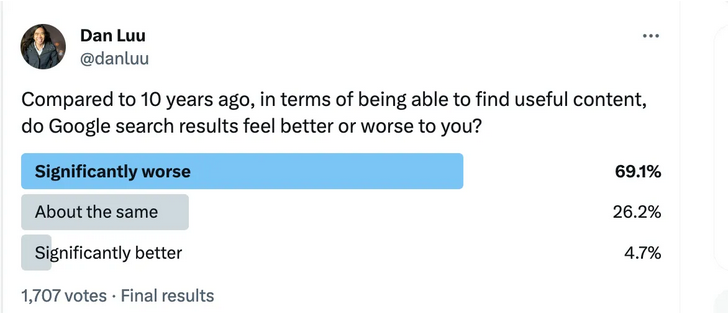
What kind of business spends hundreds of billions over 10 years — just to get worse?
This is a story about the birth of the search engine.
There were no commercial search engines back in 1993. But a Stanford student named David Filo compiled a list of his 200 favorite websites.
His buddy Jerry Yang helped turn this into an online list. They called it “Jerry’s Guide to the Worldwide Web”. Filo and Yang added new websites every day to their list — and classified them according to categories.
This turned into Yahoo.
Here’s my favorite part of the story: These two students didn’t even know they were running a business.
They did it for fun. They did it out of love. They did it because it was cool. “We wanted to avoid doing our dissertations”, Yang later explained.
But a venture capitalist named Mike Moritz heard about Filo and Yang, and tracked them down. The founders of Yahoo were living in total squalor in a trailer littered with stale food and pizza boxes, strewed alongside sleeping bags and overheating computers. A phone rang constantly — but nobody bothered to pick it up.
Moritz was dismayed by this dorm-room-gone-wild ambiance, but he was impressed with the students’ web searching technology. So he asked them the obvious question: How much did they plan to charge users?
Filo and Yang had no answer for this. They wanted to give their tech away for free.
Yahoo wasn’t even selling ads back then. It wasn’t tracking users and selling their private information. It didn’t even have a bank account.
But it was a community and had millions of users.
That was a word you heard frequently in Silicon Valley in the early days. People didn’t build web platforms — they formed online communities.
It was a FUN community. People enjoyed being a member. Even the absurd name Yahoo was part of the game — although early investors hated it.
Yang’s job title was “Chief Yahoo”. Filo’s position was “Cheap Yahoo”.
Investors always hate those kinds of things.
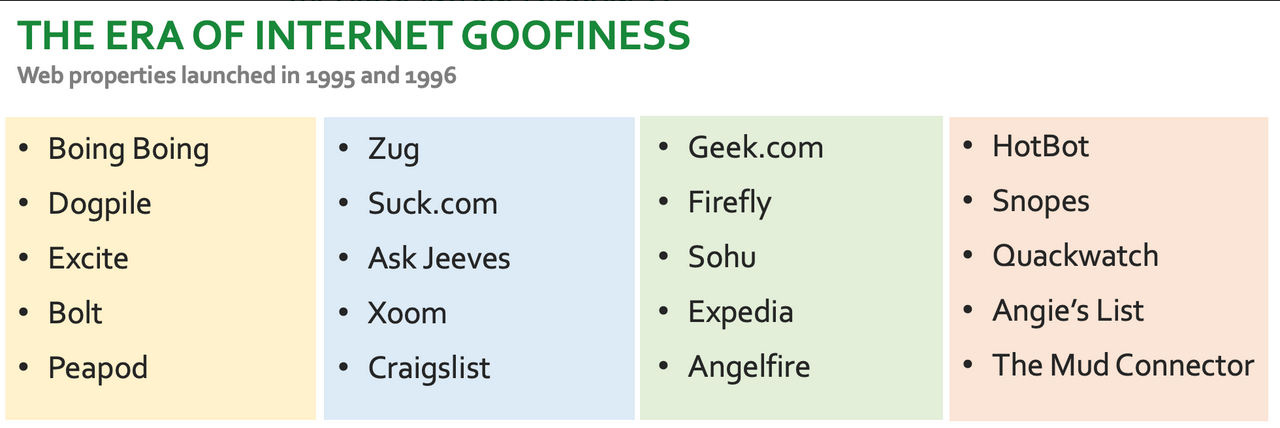
But a new web business, back then, was expected to have a silly name. Here are some of the websites launched in the mid-1990s.
Moritz wanted to turn Yahoo into a business. And the founders realized that their fun community was growing faster than they could handle in their down-and-out trailer. So they sold out 25% of Yahoo for $1 million.
January 10, 2024
QotD: The root of leftism is envy
“Social justice” is sacralized envy.
Which fits a lot better on a Pepe the Frog meme, you must admit.
Note also the slight, but important, change in emphasis — from “hate” to “envy”. Recall that [Economics in One Lesson author Henry] Hazlitt was writing in 1946, when material deprivation was still a thing, even for Americans. Back then it was assumed that the hate sprang from the envy, which meant that the hatred could eventually be dissipated. It implied an endpoint. Hazlitt, like seemingly everyone else on the Right, took Lefties at their word — that some level of “equality”, by which they meant material prosperity, would cause the Left to finally hang up their jocks and hit the showers.
Three quarters of a century later, we know that’s not true. There’s nothing you could give them that would ever satisfy them. Go ahead, do it Jesus-style — turn the other cheek, give them your coat and your cloak, walk with them two miles, all that jazz. You know as well as I do what will happen — they’ll still hate you. It doesn’t matter what the “reasons” are. Before, they hated you because they didn’t have a coat and cloak. Now they’ve got yours, but they still hate you, because you’re right-handed, or blonde, or have webbed toes. Or because you don’t have webbed toes.
Whatever, something, anything. I won’t bother repeating the O’Brien quote from 1984; you’ve heard it enough by now to know what I mean when I say that for the Left, the point of envy is envy. They don’t envy you for what you have. They don’t even envy you for what you are. They just envy. The mere fact that you exist, a separate entity from them, means that they’re not all there is in the world. In other words — French judges, take note — we’re down to three words:
Leftism is solipsism.
They envy your mere existence, since you are the walking, talking proof that not everything in this world is as shriveled and petty and miserable as they are.
Severian, “Crossing the Bar”, Rotten Chestnuts, 2021-04-06.
January 5, 2024
The value of college degrees
Ted Gioia isn’t a college dropout, but he’s seen enough to realize that given how his career has gone, he might well have saved himself a lot of time and money by not going to university in the first place:

I spent almost a decade and huge sums of money — much of it borrowed in the form of student loans — to earn multiple degrees from elite institutions.
But I don’t have a degree in music — the field that became my vocation. And I never took a single course or lesson in jazz (my specialty) during my entire life.
I wasn’t a dropout, not even close. But it’s sobering to consider my life in retrospect, and see how much it relied on what I taught myself outside of the classroom. So I now have a very different view of college than I did back when I was a student.
My more mature view is as follows:
(1) A college degree is more about signaling your worth than about learning.
This is hardly a brilliant insight — many are now saying this. But when you’ve lived it yourself, it changes your perspective on everything.[…]
(2) College provides inspiring role models — but they also exist in other settings.
I was blessed with a small number of teachers and mentors who taught me by example — and most of this happened at high school and college. There is no substitute for seeing greatness in the flesh at close hand.But this can happen outside of college — my wife, for example, had those experiences working as a dancer and choreographer in New York. She learned more from her mentor Erick Hawkins than from any college professor.
[…]
(3) Dropping out is a real option with genuine upside, but it’s not for everybody.
Let me put it as simply as possible: Many successes are dropouts, but few dropouts are successes.I would advise against abandoning your education for simple reasons of avoidance — because classes are a hassle, tests are a bummer, etc. But if you have a genuine vision of your life and the skills to achieve it, college is purely optional. And perhaps even hazardous.
(4) As the college experience becomes more expensive and close-minded, the appeal of alternatives increases exponentially.
At what price does college become a bad deal? I don’t have an answer to that, but we must be close to a tipping point.If I tried to replicate my formal education today, it would cost ten times as much. I would have student loans as large as the national debt of a mid-sized country. That’s just ridiculous.
But this kind of irrational endpoint results when a bloated bureaucracy increases tuition at more than the inflation rate every year — and continues doing so for a half century. The people running our major universities think they can get away with this because customers want impressive diplomas, and can be squeezed to an infinite degree.
But infinity doesn’t actually exist in human affairs. And unsustainable trends eventually prove just that, namely that they are unsustainable.
(5) The smartest people will increasingly bypass the system.
I can’t emphasize this enough. My advice to young people today is very different from what I would have said just 5 years ago.I now tell them to find ways to work outside of bureaucratic legacy institutions.
[…]
(6) Dropouts really do change society.
As someone who invested so much time and money in big-ticket credentials, that’s painful to admit. But I’ve seen too much to ignore the facts. I now grasp that people who are genuine visionaries know at an early stage that they can teach themselves, think for themselves, and manage themselves. Those are more valuable skills than any degree.So maybe I didn’t drop out like my friend’s buddy at Harvard, back in the mid-1970s. But I wouldn’t laugh at the idea nowadays, the way I did back then. And if I had everything to do over again, I might drop out myself.


