Not Just Bikes
Published 6 Oct 2024Chapters
0:00 Intro
1:24 Leaving New York
3:04 On the train
4:03 The views
4:38 Freight trains & delays
5:37 The train is so much more comfortable
7:09 The border crossing
8:17 The Canadian side
9:24 Should you take this train?
10:20 Comparisons to Europe & Japan
11:20 We need more high-speed rail
12:02 VIA Rail is bad … and getting worse
12:58 VIA Rail is expensive!
14:11 The new VIA Rail baggage policy 🤦♂️
15:49 Better train service is important!
17:14 Concluding thoughts
(more…)
January 31, 2025
I Spent Over 12 Hours on an Amtrak Train (on purpose)
January 30, 2025
The MAGA movement as “America’s Thermidorian Reaction”
Fortissax lays out the case for Canada remaining separate from the United States, in what he says is the longest single article he’s written. It is indeed a long piece, from which I’ve selected a small portion that helps identify the US MAGA movement as something other than just pro-Trump activism:

“Canada’s national identity is rooted in Order, as expressed in its national motto, Peace, Order, and Good Government, conceived by Sir John A. Macdonald. This stands in contrast to the United States, whose core value is Liberty, reflecting its liberal and individualist foundations in the pursuit of life, liberty, and the pursuit of happiness.”
The MAGA movement, as explored in my colleague and fellow Canadian Endeavour’s article, can be understood not as a counter-revolutionary or genuinely reactionary force, but as America’s Thermidorian Reaction — a movement within the post-WWII liberal order to purge its own radical excesses. Endeavour draws parallels to the French Revolution, where the Thermidorian Reaction was not a restoration of the monarchy but a moderation of the Reign of Terror’s extremism, and to the Soviet Union’s Destalinization, which sought to distance the regime from Stalin’s radical policies without abandoning communism.
Similarly, MAGA does not aim to dismantle the liberal framework established during the cultural revolution of the 1960s, marked by the Civil Rights Act and Hart-Celler Act, but instead seeks to address the instability caused by the radicalization of this framework during the “Great Awokening” of the 2010s. Its faith in “colourblind meritocracy” is rock solid. Just as the Thermidorians and Khrushchev’s regime sought to preserve their respective systems by eliminating destabilizing elements, MAGA represents an attempt to recalibrate the liberal order by challenging excessive ideological commitments like open borders, identity politics, and globalist policies.
While MAGA appeals to traditionalist sentiments, it ultimately operates within the boundaries of the same liberal system it critiques, lacking the philosophical depth to present a true alternative. Trump’s 2016 campaign was fueled by widespread dissatisfaction with the establishment and a sense of cultural alienation among, working-class European-Americans. As an outsider candidate, Trump faced opposition from both political parties and the media but managed to channel populist anger into an unexpected victory. However, his presidency revealed that he posed less of a threat to the system than many anticipated. Trump’s administration implemented some reforms but fell short of disrupting the liberal order, leading many elites to reframe him as a tolerable alternative to the increasing instability caused by radical left-wing movements. The 2024 campaign differs significantly from Trump’s earlier runs because he has garnered support from influential elite factions. Figures in Big Tech, such as Elon Musk and Peter Thiel, and segments of the Zionist lobby, see Trump as a tool to stabilize the system without fundamentally altering it. While Trump continues to appeal to his populist base, his elite backers are likely to exert more influence over his presidency than grassroots supporters.
The Four Agendas of America’s Elite
Endeavour outlines four major agendas driving the U.S. political landscape, which often overlap but also compete for dominance:
- The Anti-White Agenda (Wokeism)
This agenda promotes diversity, equity, and inclusion (DEI) as core principles, advocating for identity politics, demographic transformation, and the demonization of traditional Western cultural norms. Organizations like the NAACP, SPLC, and Open Society Foundations champion this cause.
- Managerialism
Focused on centralized control, managerialism, coined by James Burnham, expands bureaucratic oversight in both public and private sectors. The COVID-19 pandemic epitomized managerial overreach, as policies enforced compliance on an unprecedented scale. Key proponents include BlackRock, the World Economic Forum (WEF), and the Bill & Melinda Gates Foundation.
- The Zionist Lobby
Primarily concerned with ensuring unwavering U.S. support for Israel, the Zionist agenda overlaps with wokeism in promoting leftist social causes but diverges when these causes conflict with Israeli interests. Organizations like AIPAC and the ADL straddle this divide.
- Big Tech
Initially aligned with wokeism, Big Tech has begun to push back against its most radical elements due to its impact on innovation and competence. Elon Musk’s purchase of Twitter (now X) symbolizes this shift, as does growing discontent with DEI mandates within the tech sector.
While these agendas are not inherently unified, they collectively uphold the liberal framework established in the 1960s, even as they compete for dominance within it. I’ve defined these forces in the past as left-liberalism vs right-liberalism, which I covered here: MAGA & Wokism
Parallels to Historical Thermidorian Reactions
MAGA’s role is likened to historical Thermidorian Reactions, where moderates sought to rein in revolutionary excesses to stabilize their regimes. For example:
- The Thermidorians ended Robespierre’s radical Reign of Terror, easing persecution and executions while maintaining the republic.
- Khrushchev’s Destalinization moderated Stalin’s authoritarian rule but preserved the communist system.
Similarly, MAGA seeks to temper the radicalism of woke managerialism without challenging the core tenets of the liberal order. The “Great Awokening,” characterized by intensified DEI policies, identity politics, and cancel culture, parallels the Reign of Terror and Stalinist purges in its ideological zeal. Trump’s 2024 campaign represents an attempt to dial back these excesses and restore a degree of moderation.
Challenges Facing the Thermidorians
Despite its goals, MAGA faces significant hurdles in moderating the system:
- Demographic Shifts: The growing influence of progressive, non-white voting blocs entrenches leftist policies.
- Institutional Entrenchment: Managerial bureaucracies are staffed with ideologues deeply committed to woke principles, making reform difficult.
- Superficial Reforms: Even if MAGA eases censorship and curbs DEI mandates, it is unlikely to reverse structural changes such as demographic transformation or the Civil Rights Act.
Endeavour contends that MAGA’s moderation of woke managerialism may improve short-term conditions but will not address deeper contradictions in the liberal order. For example:
- The Zionist lobby’s support for both Israeli ethno-nationalism and woke policies in the U.S. creates unsustainable contradictions.
- Universalist egalitarianism remains fundamentally flawed, and attempts to reform it, like Gorbachev’s Perestroika in the USSR, may inadvertently accelerate systemic collapse.
While MAGA may temporarily stabilize the United States, it will not fundamentally alter the trajectory set in motion during the cultural revolution of the 1960s. The deeper issues of demographic change, cultural alienation, and institutional decay remain unresolved. Trump’s vision—and likely that of most within the MAGA movement—is rooted in nostalgia for the 1980s and 1990s, a romanticized era cherished by many baby boomers. This idealized vision imagines a time when race was purportedly invisible, the black middle class thrived, and patriotism unified Americans across racial lines. This narrative conveniently ignores the darker realities of that period, including the L.A. race riots and the rise of militant groups like the Black Panther Party. At the same time, this Thermidorian Reaction is being leveraged to solidify control over America’s imperial vassals, with the Anglosphere serving as its primary appendages and European nation-states as key dependencies. Populist movements across Europe echo rhetoric nearly identical to that of MAGA, with many receiving direct or indirect support from individuals and entities affiliated with the movement. Figures like Elon Musk have actively amplified some of these efforts, like promoting the Alternative für Deutschland party and bolstering independent actors aligned with MAGA’s agenda, thereby expanding its influence across the Western world. Not ideal, but a means to an end for sure.
January 29, 2025
Canadians – “polite lunatics”
In The Line, Mitch Heimpel talks about a Canadian culture from a time before a Canadian PM could get away with maligning the country as having “no core identity”:
In recent days, The Line has spoken of the need for Canada to go “full psycho”. To “Make ‘Canada’s back’ a threat”. And, specifically, to recapture a Canadian identity that was, not long ago, widely shared — Canadians as scary and even dangerous. My own mind had been on similar topics of late, and I’d been thinking, specifically, about how those representations used to show up not just in our pop culture, but in American pop culture.
And in at least one place, you can find it still: Shoresy, a hilarious comedy show about Canadian hockey hosers that has found success on both sides of the border.
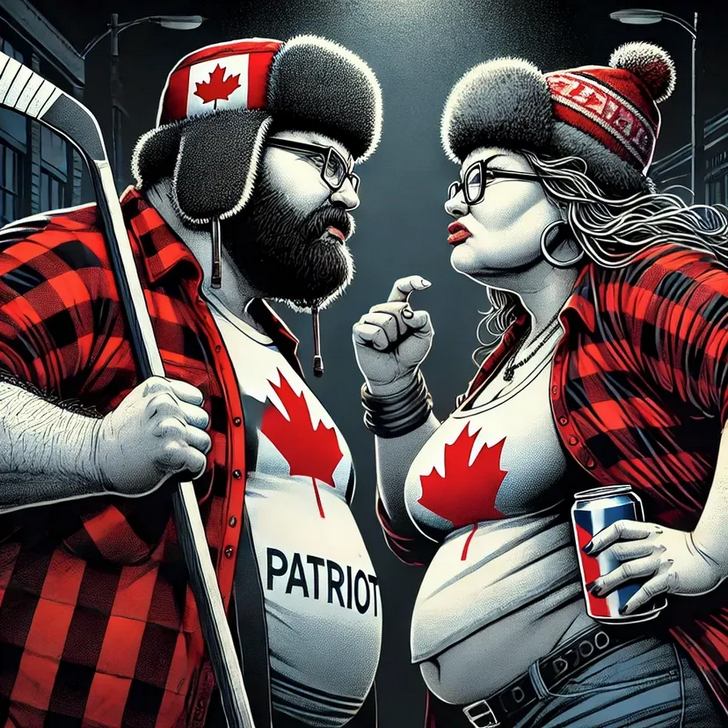
Shoresy is interesting not because it’s new, but almost because it’s retro. Once upon a time, the kind of Canadian identity shown in Shoresy was just … Canadian identity. Here’s a great example of what I mean that I suspect many readers will have seen: 1968’s The Devil’s Brigade, a film about the First Special Service Force, a joint Canadian-American unit that would become the forerunner to the American Green Berets. The film is a remarkable reflection of the attitudes that the two cultures had about each other. In one particular scene, after the Americans (predominantly tough guy actors Claude Akins and James Coburn) have spent days making sport of the Canadians, a new Canadian sergeant — played by Jeremy Slate — is introduced in a mess hall scene. Mild-mannered, lithe, and even bespectacled, the Sergeant sits down next to Akins and begins to insult him. He starts by literally elbowing the American bully for room at the table in the Mess and proceeds to call him a fat tub of lard.
Once Akins has had enough, he attacks the Canadian sergeant, who reveals himself to be the unit’s new hand-to-hand combat instructor, and proceeds to pummel Akins while barely smudging his glasses. After having bruised the American’s body, as well as his ego, he returns to dinner and punctuates it by asking Akins for the salt. Akins hands it over.
This was not a remarkable representation. The Americans used to view us as polite lunatics. This showed up not just in American media, but also our stories about ourselves. Characters like Slate’s sergeant Patrick O’Neill showed up in the songs of Stompin’ Tom, Ian Tyson, and even Gordon Lightfoot. They’re memorialized in the works of Robert Service and Al Purdy. Purdy, in particular, describes this archetype well, both in At the Quinte Hotel and in The Country North of Belleville:
backbreaking days
in the sun and rain
when realization seeps slow in the mind
without grandeur or self-deception in
noble struggle
of being a fool –A country of quiescence and still distance
a lean land
not like the fat south.In those few lines, Purdy captures Canadiana so easily. A people shaped by distance and the harshness of the land. Capable of the toughness needed to endure. With just a little foolishness mixed in for good measure.
Polite lunatics.
January 22, 2025
“If this country MAIDs itself in the next 18 months, we at The Line know what slogan belongs on Canada’s epitaph”
The Line‘s editors gathered up the first day’s worth of Donald Trump II – The Trumpening and sifted out the bits particularly relevant to the dysfunctional Dominion to the north:

Donald Trump successfully trolled Canada’s hypersensitive political class about Canada becoming the 51st state of the union. The anguished butthurt still pains them.
What is happening right now was absolutely foreseeable. No one can claim with a straight face that U.S. tariffs could not have been foreseen on January 21, 2025, a full eight years to the day that Donald Trump was inaugurated for the first time. It’s not 2016, anymore. Nobody was blindsided.
Your Line editors wrote plenty of columns over the past decade noting that even if Donald Trump the man were not re-elected, the protectionist and reactionary currents that pushed him to power were still ascendant in America. The Biden admin was a reprieve, an opportunity for Canada to make necessary internal changes to withstand those currents.
And what did this country do with that time?
Jack all.
We at The Line have been scratching our noggins trying to think of single meaningful Canadian reform or improvement to come out of Trump 1. We did nothing to strengthen ourselves internally by an iota. Not a single lesson was learned.
It’s entirely possible that we were inevitably going to be dinged by some U.S. administration and, perhaps, this was not avoidable. No one can fully mitigate all risks. Granted.
But we can certainly do literally anything to address risks that are highly probable. Instead, we have absolutely degraded both our moral and financial capacity to be resilient in the face of economic threats; and that degradation is the direct result of almost ten years of Liberal party priorities, inactions, or choices ranging on files from crime, to market diversification, to being truly useful to our international allies, to failures on interprovincial trade.
This wasn’t unforeseen. We were willfully blind. That’s different.
We ignored the looming threat in part because our government was distracted by COVID. But also also because Canada’s political culture is too immature to make hard decisions, or to have real debates about trade offs or priorities.
Justin Trudeau is the kind of prime minister who would rather run the kind of country that lets him spout off on Jake Tapper about compassion and $10-day-day daycare and dental programs than NATO spending.
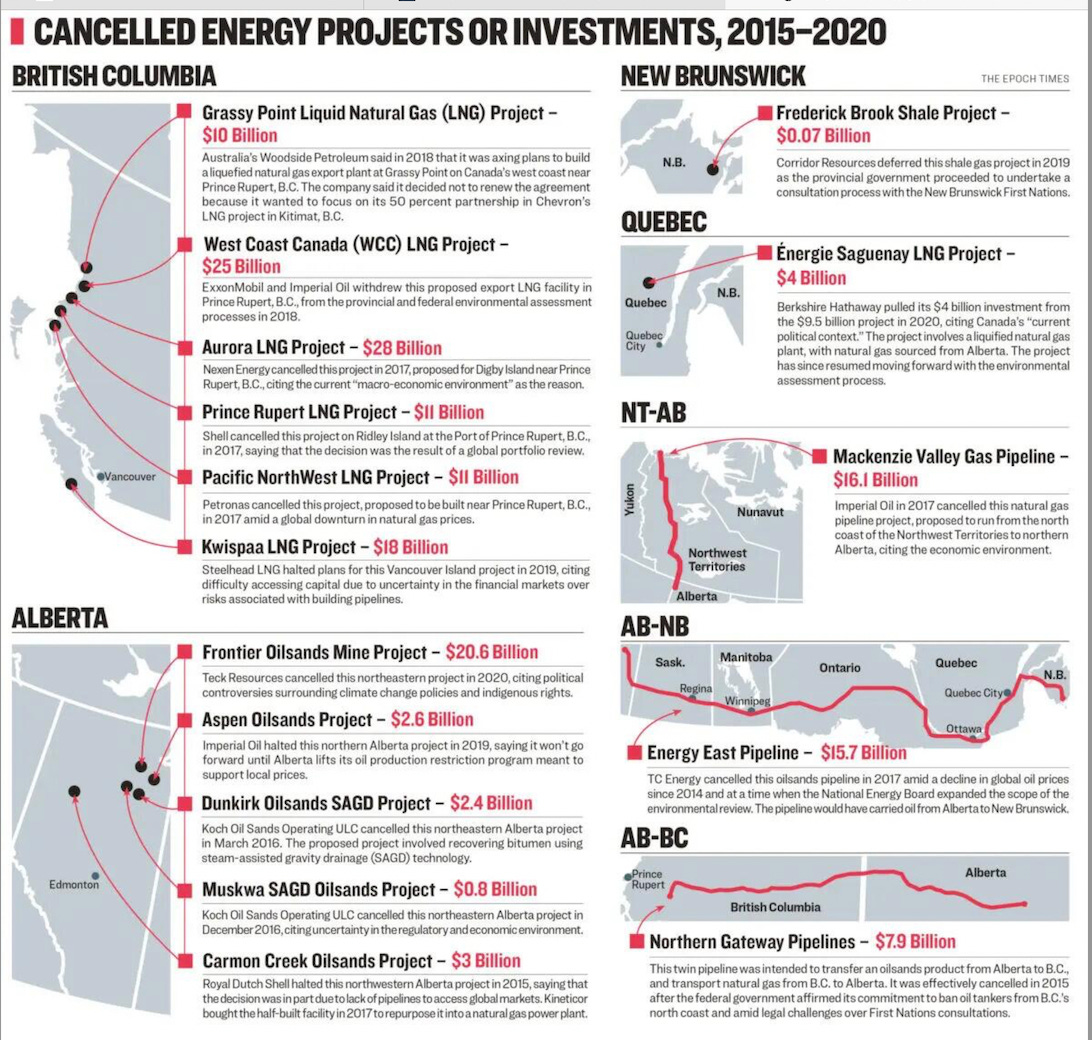
What about the scads of taxpayer cash we’ve squandered on things like “superclusters”? What if we had prioritized strategically crucial projects like Northern Gateway or Energy East, instead of letting them die under the mantra of: “no business case”.
Remember when Germany and Japan came asking after our natural gas supplies in the wake of the Russian invasion of Ukraine? What if we had spent oh, say, $13 billion, on fast tracking some kind of natural gas facility to supply our international allies because doing so served a strategic national interest rather than a pure economic one.
We didn’t pull that number from the air, by the way: that’s what Canada subsequently committed to subsidies for EV plants in southern Ontario — something for which there was a scant “business case” before, and virtually none now that Trump has decided to scrap EV subsidies. It’s looking not-great, Bob. Not great at all.
See, that’s the problem with running a low-productivity, highly centralized griftocracy that is more invested in expanding entitlements, symbolic action and emotional gratification than actually doing anything. We are now severely limited in our capacity to respond in the face of serious economic threats. We can talk a good game. We can bluster. We can invest in more symbolic retaliatory action; but we have utterly squandered the internal resilience required to mount a real fight in even a trade war, much less a kinetic one.
And we at The Line can’t help but note the deafening silence from our international allies as well. They think we’ve got it coming, too. Perhaps there’s “no business case” for sticking their necks out on our behalf.
The first time a big new battery plant was subsidized, I thought it was a bad idea. Then it happened again and again. This is exactly why you don’t want your government at any level “picking winners”! Ross McKitrick had a series of tweets discussing this and other noteworthy executive orders issued (thread on Threadreader, but that may not be available for long):
Discover the ‘Lost’ Big Dipper Rum Cocktail Recipe
Glen And Friends Cooking
Published 2 Oct 2024Today on Cocktails After Dark we explore the fascinating history of Gander Airport’s iconic Big Dipper bar, once a bustling stopover for the world’s rich and famous during the 1940s to 1960s. This video dives into the golden age of aviation when propeller planes made Gander, Newfoundland, a key refuelling point for transatlantic flights. Discover how legends like Marilyn Monroe, Winston Churchill, and Frank Sinatra sipped cocktails at the Big Dipper while planes refuelled, and learn how to make the bar’s signature cocktail using the infamous Newfoundland Screech rum. If you’ve ever been curious about Gander’s aviation history, old-time airport bars, or unique cocktails, this video has it all. Plus, find out how “Screech” became a part of Newfoundland’s folklore. Whether you’re a history buff, cocktail enthusiast, or simply curious about this legendary airport, you won’t want to miss this journey back in time. Grab your shaker, some rum, and let’s make history — one drink at a time!
The Big Dipper
1½ ounces Newfoundland Screech
1 ounce Cointreau
¾ ounce lemon juice
1 teaspoon simple syrup
(more…)
January 21, 2025
Claim – First Nations lived sustainably and harmoniously with their natural environment. Reality – “Head-Smashed-In Buffalo Jump”
Pim Wiebel contrasts how children are taught about how First Nations before contact with Europeans were living fully sustainable lives in a kind of Garden of Eden until the white snakes man arrived and the rather less Edenic reality:
Among the many “proofs” offered in First Nations circles to support the claim of a pre-contact Eden imbued with an ethos of environmental harmony, is the idea that before the Europeans arrived, the buffalo was considered sacred, treated with great respect, and killed only in numbers that would sustain it in perpetuity.
Each of these notions require scrutiny.
For the Great Plains tribes, the buffalo was an essential source of food and of materials for tools, clothing and lodges. It is unsurprising that the buffalo featured prominently in tribal mythology. Among the Blackfoot, the animal was considered Nato’ye (of the Sun) sacred and to have great power. Buffalo skulls were placed at the top of the medicine lodges and prominently featured at communal ceremonies.
It is ubiquitously asserted that the tribes only killed as many buffalo as they needed for their sustenance between hunts, and that every part of the animal was used. A Canadian history website suggests, “The buffalo hunt was a major community effort and every part of the slaughtered animal was used“. An American publication states, presumptuously: “It’s one of the cliches of the West; Native Americans used all the parts of the buffalo. It’s something that almost everyone knows, whether you are interested in history or not.” The Assembly of First Nations weighs in, teaching Canadian school children in their heavily promoted “Learning Modules”, that “Hunters took only what was necessary to survive. Every part of the animal was used.”
But was the Indigenous relationship with the buffalo in reality one of supreme reverence? Was every part of the animal used, and were the buffalo always killed only in numbers that would satisfy immediate needs while ensuring the sustainability of the herds?
The evidence suggests something quite different.
Archaeologists have studied ancient buffalo “jump sites”, places where Indigenous bands hunted buffalo herds by driving them over high cliffs. Investigations of sites from the Late Archaic period (1000 B.C. to 700 A.D.) reveal that many more buffalo than could be used were killed and that rotting heaps of only partially butchered bison carcasses were left behind.
Buffalo jumps continued to be used as a hunting method long after first contact with Europeans. Early Canadian fur trader and explorer Alexander Henry, made the following entry on May 29th, 1805 in his diary of travels in the Missouri country: “Today we passed on the Stard. (starboard) side the remains of a vast many mangled carcasses of Buffaloe which had been driven over a precipice of 120 feet by the Indians and perished; the water appeared to have washed away a part of this immense pile of slaughter and still there remained the fragments of at least a hundred carcasses they created a most horrid stench. In this manner the Indians of the Missouri distroy vast herds of buffaloe at a stroke.”
Alexander Henry described how the buffalo jump unfolded. The hunters approached the herd from the rear and sides, and chased it toward a cliff. A particularly agile young man disguised in a buffalo head and robe positioned himself between the herd and the cliff edge, luring the animals forward. Henry was told on one occasion that the decoy sometimes met the same fate as the buffalo: “The part of the decoy I am informed is extremely dangerous if they are not very fleet runers the buffaloe tread them under foot and crush them to death, and sometimes drive them over the precipice also, where they perish in common with the buffaloe.”
The Blackfoot called their jump sites Pishkun, meaning “deep blood kettle”. It is not difficult to imagine the horrendous bawling of the animals that suffered physical trauma from the fall but did not immediately succumb. Did the hunters have the ability, or even make an attempt, to put them out of their misery with dispatch? We do not know.
January 19, 2025
Mark Carney is a serious man … that doesn’t mean he’d be a good political leader
The Line‘s Jen Gerson likes Mark Carney, but she hastens to add that this isn’t necessarily good news for Mr. Carney as she felt the same way about Jim Prentice who was very briefly Premier of Alberta but “demonstrated the political nous of a chicken nugget” and quickly was out of power:

Then-Governor of the Bank of Canada Mark Carney at the 2012 Annual Meeting of the World Economic Forum in Davos, Switzerland.
WEF photo via Wikimedia Commons.
I learned the most valuable lesson from that period of political reporting, one I try to carry with me unto this very day: Never, never let one’s personal feelings about an individual candidate corrupt one’s political analysis. And if you think about it, this is a very important lesson to learn.
I am not a normal person. That which appeals to me is very unlikely to find purchase with sane, feeling voters who hold ordinary jobs and live lives filled with meaningful human connections and real, not-political conversations.
I was thinking about this as I watched Mark Carney announce his intention to run as Liberal leader in Edmonton on Thursday. Carney is a serious man. He has a real CV and a long list of meaningful accomplishments. He’s a man who seems to understand that the “good old times are over”. He’s a man who has navigated several international crises — as he was keen to point out. He’s a man who despises the excesses of both the right and the left. He’s a man who is is focused on building Canada’s economy.
He’s a man who has correctly identified one of the Conservatives’ core weaknesses, their tendency to channel legitimate anger and grievance into thin slogans that offer few substantive plans toward the kinds of significant changes that this country will be required to make. The fact that Carney is making this critique while coming to the fore without offering any substantive plans of his own is only to be expected considering the timeline’s he’s working with, I suppose.
Regardless, Carney is giving Jim Prentice Energy. Jean Charest Energy. Jeb! Energy.
I like him.
[…]
For that matter, if Carney wants to present himself as a strong supporter of Canada, a defender of our sovereignty in the face of America’s re-articulated expansionist ambitions, why did he preempt his leadership launch with an appearance on The Daily Show? What message are we to take from this: that Carney is well liked and respected by the American political milieu that was roundly trounced by Donald Trump?
It doesn’t signal a lot of faith in Canada as a cohesive cultural concept to soft launch your political leadership campaign through a marshmallow chat with an American comedy host. (As an aside, I realize that foreigners aren’t real to Americans, but I’m begging literally any television journalist on a mainstream U.S. network to stop treating our politicians like kawaii pets [Wiki] on loan from a northern Democrat utopia that exists only in their minds. These people can handle hard questions — even about matters that are important to an American audience; like, for example, Canada’s delinquent NATO spending.)
Did Mark Carney not believe that the CBC that I presume he will be campaigning to preserve was up to the challenge of doing the first interview with him? Look, I wouldn’t turn down a chat at Jon Stewart’s table if I got the call, but if the best possible way to reach potential Liberal leadership voters in 2025 is to pop onto American TV, we might as well pack it in, call ourselves 51 and be done with it.
By the way, in case anyone hasn’t yet pointed it out; the average age of a Daily Show audience member is 63. The audience is in steep decline, and it doesn’t even air on any Canadian TV channels anymore. To watch the Carney clip, Canadians have to seek it out on Apple TV or YouTube. Usually the day after because the target demo is usually in bed by 9 p.m. MST now.
January 18, 2025
Incentives matter even to “objective” scientists
A 2019 Canadian “study” ideally illustrates that scientists are just as human as anyone else where they are incentivized to provide “desired” outcomes:

“The Beer Store” by Like_the_Grand_Canyon is licensed under CC BY-NC 2.0
Earlier this year, a major Canadian study on alcohol policy provided an excellent illustration of this. As news headlines across the country reported, 16 scientists and researchers at various universities and institutions had, through their Canadian Alcohol Policy Evaluation, shown that provincial governments are “failing to address alcohol problems”.
The scientists evaluated provincial government policies and assigned a grade in the “D” range to seven of Canada’s 13 provinces or territories, while five received an “F”. The policy evaluation, however, was a curious one. Strangely, the policy evaluation did not evaluate whether government policies were beneficial to those who want to buy or sell alcohol.
Instead, provincial governments were evaluated more favorably if they devoted greater efforts toward afflicting buyers and sellers of alcohol through punitive taxes, price controls, heavy restrictions on the sale and marketing of alcoholic beverages, higher minimum legal drinking ages, and so on.
Even in the most restrictive markets, the researchers found that alcohol was too cheap, or that its purchase was too convenient, or that governments did not do enough to discourage or restrict its sale and consumption.
Predictably, and perhaps exemplifying Berlinski’s point on scientists grasping for government funds, the report authored by 16 scientists whose livelihoods involve raising public alarm about alcohol consumption concluded that there ought to be more government funding for public education on the dangers of alcohol consumption.
The report also advocated more government funding for bureaucracies to discourage drinking, more government funding for a lead organization to implement restrictive alcohol policies, more government funding for independent monitoring of such implementation, and more government funding to track and report the harm caused by alcohol consumption.
Like the CEO of a domestic automobile company insisting that tariffs against car imports — which would cause a massive wealth redistribution from consumers’ wallets into his own and those of the company’s shareholders — are in the national interest, the anti-drinking scientists insisted in the name of public health and wellness upon income redistribution from taxpayers and consumers to their own industry.
January 17, 2025
Trump’s demands include some things that would be quite beneficial to Canada
In the National Post, Bryan Schwartz suggests that some of the things Trump has raised as issues in Canada/US trade would be economically sensible for Canada to address because they’d reduce costs of doing business in Canada which would be good for all Canadians (except the crony capitalists in the blatantly protectionist “supply management” cartels):

US President-elect Donald Trump trolling about Canada becoming the 51st state of the union does seem to have directed attention to our bilateral trade situation wonderfully.
The threatened Trump tariffs would hurt both the United States and Canada in many ways. But the U.S., with a larger and more productive economy (on a per capita basis), is better able to sustain the immediate pain. The economic pressure on Canada is, therefore, serious and credible.
Canada should first address issues that are of particular importance to the Trump administration. The incoming president tends to emphasize national security, even over economic nationalism. The authority of the president, under the inherent powers of the office and congressional statutes, is greater if the issue relates to national security.
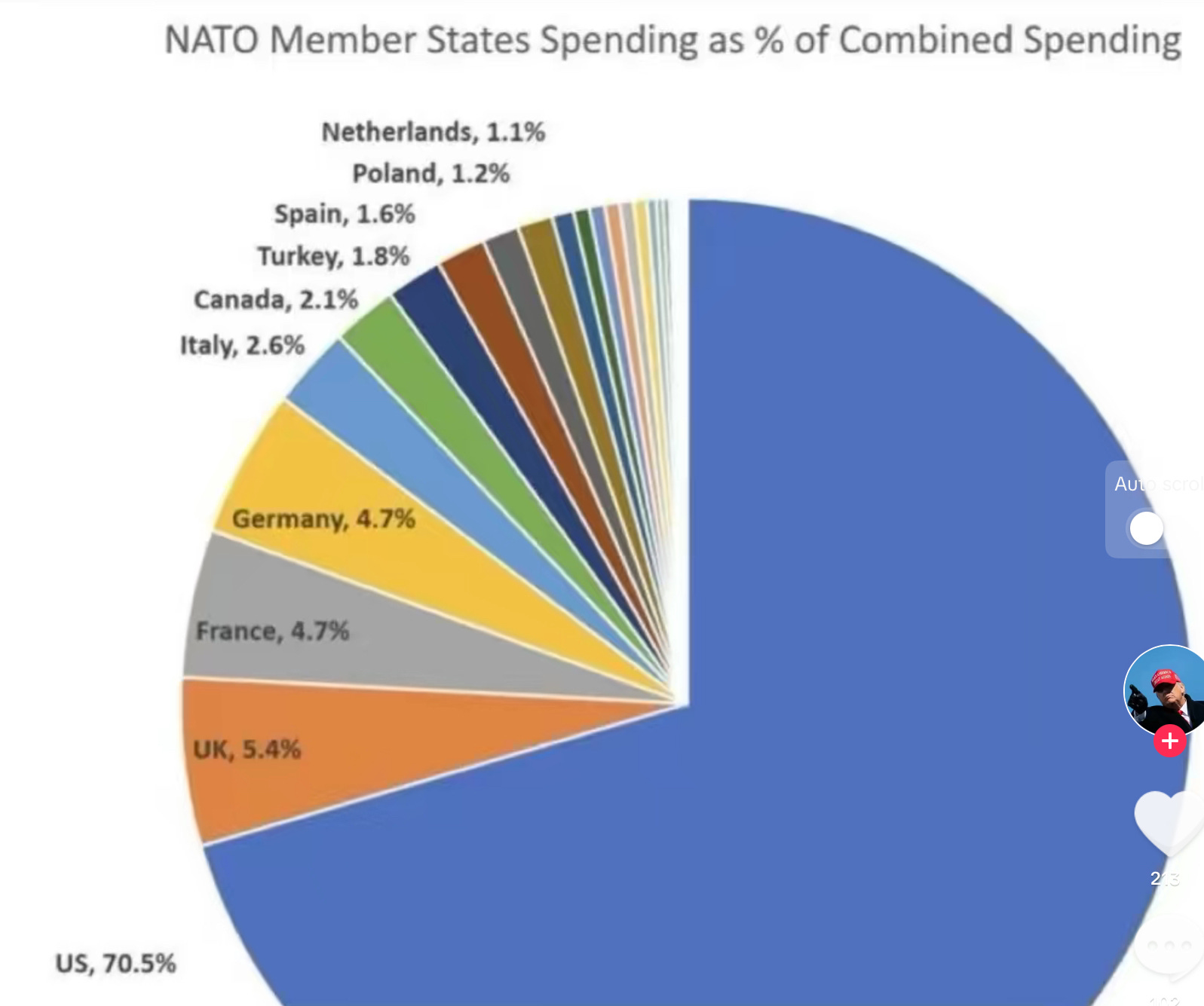
The same holds under international trade agreements. The president can raise issues that Canada can address in a prompt and reasonable manner. These include border security and increasing Canada’s commitment to contributing its fair share to international alliances, which would include increasing military expenditures.
Second, Canada should recognize that external pressures can provide opportunities to do things that are in this country’s own interests, but are otherwise politically difficult. Outside pressures have in the past encouraged Canada to adopt several measures that are good for the country, such as reducing pork-barreling and regional favouritism in government contracting.
Canada’s dairy protectionism provides a good example of a trade concession that would benefit Canada, as it is unfair to lower-income Canadians and, in the long run, hurts the industry itself. An industry more exposed to competitive pressures would be incentivized to be more productive and seek to expand into international markets.
Australia has shown how such marketing boards can be abolished in a manner that gives some time to the industry to adjust and ultimately benefits all concerned. Canada could similarly rid itself of its outdated and counterproductive Freshwater Fish Marketing Corporation, as well. To the extent that the United States pressures us to eliminate such supply management systems, it is actually doing us a favour.
Likewise, given that the U.S. is moving away from suppressing free expression in cyberspace, Canada would benefit from joining such initiatives rather than continuing down the path of having government or big companies effectively engage in censorship under the guise of fighting “disinformation”. The best remedy for any wrongheaded speech is rightheaded speech, not censorship.
At Dominion Review, Brian Graff steals a line from George C. Scott’s portrayal of Patton who said (in the film, not in real life) – “Rommel, you magnificent bastard. I read your book!” after reading the book of Trump’s Trade Representative, Robert Lighthizer:
Lighthizer wrote a book (released in June 2023) about his trade views and experience entitled No Trade Is Free: Changing Course, Taking on China, and Helping America’s Workers, which I just read. I only became aware of Lighthizer in November, in part because of a review of his book in The Guardian.
I don’t think Lighthizer is a bastard (literally or figuratively). He is hardly magnificent, but his book should be required reading for Canadians interested in our upcoming negotiations with the US. Our government would learn how best to counter the US by preparing a strong strategy and going on offence even before negotiations begin.
In short, we should not give away anything for free. This is Lighthizer’s position in matters of trade. For example, Canada should not volunteer to meet the two percent defense spending target ahead of negotiations. If anything, Canada should be accusing the US of whatever complaints we can muster. Trump might complain about the Canadian border being porous when it comes to people and drugs, but we can make the same claims, and add on the fact that the US should do more to stop the flow of illegal guns into Canada across our southern border.
Lighthizer provides a history of the US based around the idea that the US revolution and the constitution were a reaction to the mercantilist policies of Britain, which wanted to export manufactured goods and import only raw materials, while also limiting US trade with the rest of the world. Here is Lighthizer’s essential view:
Today, the tide has turned against the argument for unfettered free trade, in no small part because of the changes we made in the Trump administration. More broadly, evidence and experience have shown us that free trade is a unicorn – a figment of the Anglo-American imagination. No one really believes in it outside of countries in the Anglo-American world, and no one practices it. After the lessons of the past couple decades or so, few believe in it even within that world, save for some hard-core ideologues. It is a theory that never worked anywhere.
This is his critique of the neoliberal free trade approach:
According to the definitions preferred by these efficiency-minded free traders, the downside of trade for American producers is not evidence against their approach but rather is an unfortunate but necessary side effect. That’s because free trade is always taken as a given, not as an approach to be questioned. Rather than envisioning the type of society desired and then, in light of that conception of the common good, fashioning a trade policy to fit that vision, economists tend to do the opposite: they start from the proposition that free trade should reign and then argue that society should adapt. Most acknowledge that lowering trade barriers causes economic disruption, but very few suggest that the rules of trade should be calibrated to help society better manage those effects. On the right, libertarians deny that these bad effects are a problem, because the benefits of cheap consumer goods for the masses supposedly outweigh the costs, and factory workers, in their view, can be retrained to write computer programs. On the left, progressives promote trade adjustment assistance and other wealth-transfer schemes as a means of smoothing globalization’s rough edges.
This section is also key:
… mercantilism and a free market are dramatically different systems, with distinctions that are important to note. Mercantilism is a school of nationalistic political economy that emphasizes the role of government intervention, trade barriers, and export promotion in building a wealthy, powerful state. The term was popularized by Adam Smith, who described the policies of western European colonial powers as a “mercantile system.” Then and now, there are a vast array of tools available for countries seeking to go down this path. Mercantilist governments, for instance, frequently employ import substitution policies that support exports and discourage imports in order to accumulate wealth. They employ tariffs, too, of course, and they limit market access, employ licensing schemes, and use government procurement, subsidies, SOEs, and manipulation of regulation to favor domestic industries over foreign ones.
The focus of the book, and the main villain, is China, followed closely by the World Trade Organization (WTO). Canada gets less than 77 mentions, Mexico gets 99 mentions in the first 352 pages of 576 (the e-book stops counting at 99), and Japan gets 99 mentions in the first 400 pages. Compare this to China, which gets 99 mentions within the first 101 pages alone.
January 13, 2025
Muttering something about “manifest destiny” while glancing north
The Line‘s weekly dispatch is, as usual, mostly behind the paywall but the portion visible to cheapskates contains much of interest:

Manifest Destiny, 2025? Big Serge’s updated map for the old US War Plan Red for a military invasion of Canada.
It’s no coincidence that as Canada’s leadership devolved into its own navel, the very-soon-to-be-inaugurated Donald Trump escalated his provocations. This week, Trump threatened to use “economic force” to push Canada to bend the knee. Meanwhile, we cannot help but notice that the idea of a Canadian state is starting to gain significant traction in even moderate and mainstream American conservative circles. Meanwhile, we’ve got Alberta Premier Danielle Smith supping with Kevin O’Leary and Jordan Peterson down in Mar-a-Lago.
Tap tap. May we suggest that you peruse the safety cards tucked into the back of your seat, buckle up, and take note of your nearest emergency exits?
Whether we are talking about some kind of economic union, or a full-blown annexation, the fact that at least some in America are reviving the term “Manifest Destiny” is a possibility that we can no longer afford to dismiss as mere trolling. While we hope that the Trump administration is going to be so bogged down with other policy priorities that “Canada 51” is soon overshadowed, your Line editors have been game theorying out a host of possible scenarios and … none of them look great. If Trump et al get serious about this idea — and, again, we have no way to know if they will get serious about this idea — then we at The Line fear that Canada is in for some serious turmoil in the coming few months.
As I said in an email to Severian the other week, “… Canada will have very little ability to react to whatever Hitler, er, I mean “Trump” will do as soon as he’s inaugurated. It was clear before this that Trudeau cared very little about ordinary Canadians’ lives, but this really is dereliction of duty on a cosmic scale. If Trump does follow through with that huge tariff, the Canadian economy is likely to collapse, as we’re so deeply intertwined with the US on so many levels. Sadly, this might make it even more attractive to Trump, as it would absolutely encourager les autres on a global scale. If the BOM is willing to destroy the economy of his closest trading partner, what might he do to France? Or Germany? Or South Korea?” Back to the dispatch:
To explain our alarm, let’s first look at another news item to cross the desk. This week, Justin Trudeau travelled south to attend the funeral of Jimmy Carter, and stopped at the CNN studios for a quick interview with Jake Tapper on the way through.
On the whole, we think his interview was fine. Look, Trudeau’s been through a lot in the last few days, and considering the circumstances, it’s not reasonable to expect a breakthrough performance. So we’re being a bit unkind to nitpick, but something he said during that interview deserves scrutiny.
Justin Trudeau got far too comfortable with being treated as a progressive superstar, not only among the sycophants with CBC nametags but even on the international stage … perhaps especially on the international stage. Trudeau was always inclined to the performative in everything he did, and he might well only feel fully alive when cameras are rolling. The evidence certainly seems to point in that direction.
The “most prolific Canadian actor” meme was mildly amusing during Trudeau’s first term in office, as he went out of his way to put on elaborate costumes and to perform for the audience. This sort of thing was understandable if not particularly welcome to those who wanted Canada to be taken seriously by our allies and trading partners. It was clichéd to joke about what novelty socks Trudeau was wearing at any given international event … because it was his trademark. As was the clearly diminished respect he got as his time in office went on.
When asked about Trump’s provocations, Trudeau affirmed Canadians’ pride in their own sovereignty by noting — half jokingly, we presume — that we fundamentally define ourselves as “not American”.
Firstly, this is not a particularly diplomatic jibe to be launched at actual ordinary Americans; it made us wince to consider how it must have landed to CNN’s ordinary watching audience.
Secondly, if the only way in which Canadians can define themselves nowadays is “not-American”, Jeez, that’s an extraordinarily thin peg upon which to hang a hat.
This stuff matters.
It is to wince. However, even that pathetic response was better than launching into yet another diatribe about Trudeau’s firm conviction that Canadians are all genocidal white supremacist morons, I guess.
The ability of a population to withstand neighbourly aggression — “economic force”, if you will — depends on two things. The first is internal social cohesion and identity. The second is what the aggressor is willing to do or offer in order to secure capitulation.
In this case, the second part of that equation is outside our control. So we look to the first: does Canada have a strong sense of self right now? Do its leaders command the moral authority necessary to create the social cohesion required to withstand a period of sustained material sacrifice?
If we are “not Americans”, it rather asks the question why aren’t we Americans? And, more crucially, what are we actually willing to give up in order to preserve that independence?
A people can be rallied to make extraordinary sacrifices for a greater ideal, including the ideal of independent nationhood. Look at the sacrifices of blood and treasure made every day in Ukraine, for example.
If necessary, Canadians can band together and survive on lentils and supply managed dairy and eggs for many months or years. We can pull together through a period of inconceivable material hardship — but only if we’re doing it for something. Canadians, as per usual, can talk a big game, but how many of us are willing to suffer a real collapse of our quality of life to preserve a quasi-ironic, tautological, or negative self-identity?
Before Trudeau’s time in office, I wouldn’t have thought to question Canadians’ pride in their country and willingness to defend it. Nearly ten years later, Trudeau and his minions have done a fantastic job of undermining any kind of patriotic enthusiasms in our “post-national state”, haven’t they?
We at The Line don’t believe there is even a vanishingly small chance of the Americans using martial force to secure Canada — and if they choose to amass a brigade at the border on Monday morning, we’re all taking the Pledge of Allegiance by noon, so let’s not grace this fantasy with a lot of real consideration.
I’d love to refute that, but it’s probably true, at least in the more densely populated areas of southern Canada … the US could send a brigade north to Vancouver, another to Calgary, another to Winnipeg, and one to Montreal. Thanks to the lower lakes, it’d take a bit more to secure Toronto and Ottawa but not a lot more. We literally couldn’t stop them, both because our very limited troops are not positioned to stop an invasion from the south and because they’re not even close to being in a ready-to-move condition. Even our local reserves would have to be notified, travel to their local armouries, be issued weapons and the very limited amount of ammunition kept in local storage and by the time they were ready, there’s a foreign flag waving over Queen’s Park and Parliament hill.
Big Serge’s map at the top of this post vastly overstates the number of US troops necessary to secure the major population areas.
However, it is worthwhile to imagine it as a pure thought experiment: what would you really be willing to give up in order to continue to be “not-American”.
Your investment savings? Your property? Your house? Would you sacrifice the life of your child, or your grandchild, to preserve the legal independence of Canada?
We ask this question not because we think it’s going to come to that, but rather because these questions test the integrity of our national concept. They allow us to examine our resilience, and our willingness to withstand an assault of an economic or moral nature. And, folks, we’re just not convinced that our national resilience is very high at the moment.
Well, I’m sure a lot of new Canadians would want the rest of us to defend the place while they take advantage of all the government and corporate positions that need to be “diversified” … surely us evil white supremacists are willing to lay it all on the line for a more diverse society, right?
It was interesting to us to note, this week, that the most powerful moral appeal for the concept of nationhood was proposed in a Globe and Mail oped by Jean Chrétien. While we salute the old patriot, we can’t help but point out that he’s, well, very old — 91, to be precise.
We at The Line have a sneaking suspicion that Canadian patriotism and, more importantly, a willingness to make serious sacrifices to preserve that patriotism, is going to decline precipitously by age cohort in any well-constructed survey of the topic.
Would the young fight to preserve Canada against the Russians or the Chinese? Yes, we think our fellow Canadians could absolutely be called upon to make serious sacrifices to circumvent the rule of autocrats and dictators. But to prevent being subsumed by the — checks notes — wealthiest and most powerful democratic nation on earth (presuming America stays that way)? A nation that shares almost all of our essential values; one that looks and sounds just like us, and would probably provide a better set of opportunities to our kids? The place an increasing number of us are going to do start business and receive timely medical care?
Why?
Why would we do that? Can someone — anyone — please articulate a vision, here? Is anyone in our leadership class even trying?
It’s been noted many times that people are willing to charge even bare-handed into machine guns and cannons for things like “Liberté, égalité, fraternité“, but nobody is going to man the ramparts for “peace and good government”.
We put a lot of the blame for this on Justin Trudeau, and on the identitarian politics that consciously sought to undermine national legitimacy in the pursuit of progressive ends. But, if we’re being honest, we think this complacency of identity predates these social movements by many decades.
The Liberal Party as an institution owns a lot of it for the ways in which the “Natural Governing Party” has tied national identity to its preferred partisan policy options, at the direct expense of more transcendental and bi-partisan national self concepts. The Liberals have usurped “Canada” into a party brand
The national flag is effectively the Liberal Party flag … thanks Mr. Pearson!
and marshalled the very concept of “patriotism” to build consensus for picayune material entitlements. Trudeau couldn’t even help but do this in his CNN interview with Jake Tapper this week: “We delivered $10-a-day childcare. We’re delivering a dental care program that provides free dental care for people who don’t have coverage. We’re moving forward on a price on pollution that puts more money in the pockets of eight out 10 Canadians.”
We suppose Trudeau found that argument very compelling argument to Americans marvelling at Canada’s inability to meet its basic NATO commitments.
The weird thing is that Trudeau could have deflected a lot of these criticisms by our NATO allies almost painlessly without spending any more money directly on the Canadian Armed Forces — “It’s well known that Justin Trudeau has no time for military issues, but it’s surprising that he hasn’t done a few things that wouldn’t increase the actual spending on the CAF, but would be “bookkeeping” changes that would shift some existing government spending into the military category, like militarizing the Canadian Coast Guard. (That is, moving the CCG from the Fisheries and Oceans portfolio into the National Defence portfolio, not actually putting armaments on CCG vessels. Something similar could be done with the RCMP, switching it from Public Safety to National Defence with no other funding or operational changes.) That Trudeau hasn’t chosen to make even these symbolic changes shows that he actively opposes fulfilling the commitment his government has made twice in the last ten years for reasons of his own.”
This tactic has been very electorally effective for the Liberals, no doubt, but it’s also reduced the idea of “Canada” to a smug transactional exchange. “Canada” as nothing more than what provinces and citizens can wheedle out of the commonweal in transfer payments, equalization cheques, and grandiose but poorly executed national program spending. At least we’re better than America, though, right? We’re “not American!” — we’re so much more thoughtful and compassionate, as evidenced by the entitlements we’ve voted for ourselves, secure in the knowledge that the troglodytes to the south will spend and bleed and die for our coddled asses if Russia lobs a missile from the North.
Canada has become a question of what we, citizens, are able to get, rather than one of what we’re willing to give. And we’re smarmy, preachy assholes about it, to boot. (There’s a very famous political quote we could drop in here about what citizens can do for their countries and vice versa, but you’ll know why we aren’t, if you can guess the quote! It would be a little on the nose.)
A nation that is unwilling to make serious sacrifices of blood and treasure to protect its own sovereignty is a nation that is going to cease to be a nation sooner or later — and if we judge Canada by its commitment to its military, ours is a nation that has regarded itself as a quasi-ironic post-modern punchline for many generations now.
January 12, 2025
Big Serge updates War Plan Red for a 2025 invasion of Justin Trudeau’s “post-national” “genocide” state
After the farcical attempt by outgoing PM Justin Trudeau to pretend that he somehow has changed his mind and now likes and wants to defend the country he’s described variously as a “post-national state” with no core beliefs, steeped in white supremacy and misogyny, and still engaged in “genocide”, Big Serge suggests the US invasion plan should change like this:
When Trump invades Canada, the key will be rapid advances in the opening 48 hours to take advantage of Canada’s odd force disposition.
The country’s political and economic center of gravity is the urban corridor from Toronto to Montreal, but a significant share of the Canadian Army is dispersed, with large garrisons in Quebec, Halifax, and the western provinces. Only handful of brigades are garrisoned in the critical theater.
The war will be won quickly and decisively, without massive destruction of Canadian cities, if American forces can establish blocking positions to isolate the urban corridor from peripheral Canadian garrisons. In this maneuver scheme, we utilize highly mobile elements including 1st Cavalry Division and airborne forces to block the highways into Toronto, while an eastern screening group isolates the urban centers from reinforcements scrambling in from Quebec.
We envision inserting HIMARS at operational depths via Chinook slings, saturating Canadian road traffic with rocketry. A mobile firebase (“Firebase Maple”) will be established north of Toronto near Lake Simcoe that will have a dominant position over the city’s northern approach.
With reinforcements unable to scramble into the critical theater and Toronto severed from the cities in the eastern corridor, the Canadian 31st and 32nd Brigade Groups will be isolated and destroyed. Unconditional surrender is anticipated within 14 days.
If there is a Canadian insurgency, we’re calling it the Maplejideen.
As an addendum, artillery airlifted onto Isle Royale in Lake Superior will support an advance out of Minnesota towards Thunder Bay, which will add an additional level of interdiction on Canadian reinforcements moving eastward by rail.
People are so mad about this!
And after much kerfuffle among the easily trolled, he suggests:
There’s no community note on this post which means it has been fact checked as true by real patriots.
As to why Trump would want to invade a frozen failed state on the brink of bankruptcy, even Big Serge doesn’t have an answer.
Quebec within the British Empire after 1760
Fortissax, in response to a question about the historical situation of Quebec within Canada, outlines the history from before the Seven Years’ War (aka the “French and Indian War” to Americans) through the American Revolution, the 1837-38 rebellions, the Durham Report, and Confederation:
First and foremost, Canada itself, as a state — an administrative body, if you will — was originally founded by France. Jacques Cartier named the region in 1535, and Samuel de Champlain established the first permanent French settlement in North America in Quebec City in 1608. This settlement would become the largest and most populous administrative hub for the entire territory. Canada was a colony within the broader territory of New France, which stretched from as far north as Tadoussac all the way down to Louisiana. It included multiple hereditary land-owning noblemen of Norman extraction.
During the Seven Years’ War, on 8 September 1760, General Lévis and Pierre de Vaudreuil surrendered the colony of Canada to the British after the capitulation of Montreal. Though the British had effectively won the war, the Conquest’s details still had to be negotiated between Great Britain and France. In the interim, the region was placed under a military regime. As per the Old World’s “rules of war”, Britain assured the 60,000 to 70,000 French inhabitants freedom from deportation and confiscation of property, freedom of religion, the right to migrate to France, and equal treatment in the fur trade. These assurances were formalized in the 55 Articles of the Capitulation of Montreal, which granted most of the French demands, including the rights to practice Roman Catholicism, protections for Seigneurs and clergymen, and amnesty for soldiers. Indigenous allies of the French were also assured that their rights and privileges would be respected.
The Treaty of Paris in 1763 officially ended the war and renamed the French colony of “Canada” as “the Province of Quebec”. Initially, its borders included parts of present-day Ontario and Michigan. To address growing tensions between Britain and the Thirteen Colonies and to maintain peace in Quebec, the British Parliament passed the Quebec Act in 1774. This act solidified the French-speaking Catholic population’s rights, such as the free practice of Catholicism, restoration of French civil law, and exemption from oaths referencing Protestant Christianity. These provisions satisfied the Québécois Seigneurs (land-owning nobleman), and clergy by preserving their traditional rights and influence. However, some Anglo settlers in America resented the Act, viewing it as favoring the French Catholic majority. Despite this, the Act helped maintain stability in Quebec, ensuring it remained loyal to Britain during the American Revolutionary War and Quebec was fiercely opposed to liberal French revolutionaries.
British concessions, from the terms of the 1763 Treaty of Paris to the Quebec Act of 1774, safeguarded the cultural and religious identity of Quebec’s French-speaking Catholic population, fostering their loyalty during a period of significant upheaval in North America. Following this period, merchant families such as the Molsons began establishing themselves in Montreal, alongside early Loyalist settlers who trickled into areas now known as the Eastern Townships. These merchant families quickly ingratiated themselves with the local Norman lords and seigneurs.
The Lower Canada Rebellion arose in 1837-1838 due to the Château Clique oligarchy (an alliance of Anglo-Scottish industrialists and French noble landowners), in Quebec refusing to grant legislative power to the French Canadian majority. The rebellion was not solely a French Canadian effort; to the chagrin of both chauvinistic Anglo-Canadians and French Canadians, who in recent years believed it was either a brutal crackdown on French degeneracy, or a heroic class struggle of French peasants against an oppressive Anglo elite. It included figures like Wolfred Nelson, an Anglo-Quebecer who personally led troops into battle.
In response to the unrest following the rebellions of 1837-1838, Lord Durham, a British noble, was sent to Canada to investigate and propose solutions. His controversial recommendation, outlined in the Durham Report of 1839, was to abolish the separate legislatures of Upper Canada (Ontario) and Lower Canada (Quebec) and merge them into a single entity: the Province of Canada. This unification aimed to demographically and culturally assimilate the French Canadian population by creating an English-speaking majority.
However, the strategy failed for multiple reasons, and was given up shortly after. Lord Durham, having neither been born nor raised in the New World, underestimated the complexities of Canadian society, which was a unique fusion of Old World ideas in a New World setting. His assumption that French Canadians could be assimilated ignored their strong cultural identity, rooted in large families, which encouraged high birth rates as a means of survival. While Durham hoped unification would erode divisions, the old grievances between the British and French began to dissipate naturally.
Despite Lord Durham’s intentions, French Canadians maintained their dominance in Quebec. Families averaged five children per household for over 230 years, a trend actively encouraged by the Catholic Church’s policy of La Revanche des Berceaux (the Revenge of the Cradles). This strategy aimed to preserve French Canadian culture and identity amidst the British short-lived attempts at assimilation. In Montreal, British industrialists expanded their influence by forging alliances with French landowning nobles through business partnerships and intermarriage. This blending of elites produced a bilingual Anglo-French upper class that became historically influential.
Such alliances drew on long-standing connections established as early as 1763 and later exemplified by the North West Company (NWC). The NWC in particular is interesting as a prominent fur trading enterprise of the late 18th and early 19th centuries, in that it embodied this fusion of cultures. Led primarily by Anglo-Scots, the company’s leaders frequently formed unions or marriages with French Canadian women, fostering vital ties with the French Canadian communities crucial to their trade. Simon McTavish, known as the “father” of the NWC, maintained alliances with French Canadian families, while his nephew, William McGillivray, and other leaders like Duncan McGillivray followed similar paths. Explorers such as Alexander MacKenzie and David Thompson married French women. These unions strengthened familial and cultural bonds, shaping the broader Anglo-French collaboration that defined this period.
This relative harmony between Anglo and French Canadians continued with the formation of the modern Canadian state in 1867 during Confederation. Sir John A. Macdonald deliberately chose George-Étienne Cartier as his second-in-command. This collaboration contributed to the emergence of Canada’s ethnically Anglo-French elite, who have historically been bilingual. This legacy is evident in the backgrounds of many Canadian politicians, such as the Trudeaus, Mulroneys, Martins, Cartiers, and countless others who have both Anglo-Canadian and French-Canadian roots.
In more recent history, this dynamic has been further solidified by the federal government, where higher-paid positions often require bilingual proficiency. Interestingly, about 20% of Canada’s population is bilingual, reflecting the ongoing influence of this historical coexistence.
The last cannon which is shot on this continent in defence of Great Britain will be fired by the hand of a French Canadian.
~ George Etienne Cartier
January 10, 2025
Even the state-subsidized flappers in the media are glad to see Justin Trudeau go
In The Line, Andrew MacDougall hits the highs and lows — mostly lows — of Justin Trudeau’s prime ministership since 2015:

Justin Trudeau has always had a strong affinity for the symbolic gesture, especially when the media are around to record it.
And so the Trudeau era ends, not with a bang, but a simper.
Prime Minister Justin Trudeau dialled it up to “peak emotive” on Monday during his resignation speech at Rideau Cottage, even if he was only out to sing the tunes nobody wants to dance to anymore. Not even the appearance of a few prime ministerial tears could convince Canadians this day was anything but long overdue.
Much like how 1980s Hollywood cock rock once struggled to cope with the rawness of early 90s grunge, Trudeau’s cloying, self-obsessed mid-2010s Liberalism has run straight into the buzzsaw of mid-20s proto-populism. Trudeau might still label himself a fighter, but if he ever bothered to look around he would see that precious few people remain in his corner. Canadians have simply grown tired of being told how shit they are by the man they feel has done more than his fair share of putting Canada into the shitter.
Whether that’s a fair assessment of Trudeau’s efforts as a leader is beside the point. As Brutus Freeland has taken to saying, it’s all about the “vibes”. Even the quote-unquote “Trudeau media” is gleefully writing his obituary. That’s how bad things have gotten for Trudeau the man. We’re not in 2015 anymore, Toto.
I’m not sure that Justin Trudeau “does” introspection, but it shouldn’t be hard for him to see how he got here from there. Beginning with hypocrisy.
Trudeau promised to do things differently, but kept many of the same governmental command-and-control measures implemented by the hated Stephen Harper. He promised to stop cramming legislation into budget bills and then treated his own budgets as all-you-can-eat legislative buffets. Trudeau promised to be open by default, but tightened the clamps on government information.
Early talk of “sunny ways” and Conservatives being “neighbours”, not “enemies” masked a hyper-partisan who was all too eager to ascribe ill motive to his political opponents. Whether abortion, guns, convoys or trans rights, there was only ever one “correct” position for Trudeau, and anyone on the other side, no matter how well-reasoned or well-intentioned, was a sinner. In Trudeau’s Canada, everyone was a genocidaire, even if they got their citizenship yesterday and had nothing to do with the historic wrongs of residential schools. Black Lives Matter meant everyone else were racists, whether overt or closeted. Every societal wrong was an opportunity for all of us to “learn a lesson”.
But who the teacher is matters in the giving of lessons. And Trudeau, himself once a teacher, didn’t ever appear to learn any of his own.
January 9, 2025
Trump plays fast and loose with numbers over US/Canadian trade
On her Substack, Tasha Kheiriddin refutes some of the big numbers US President-elect Donald Trump has been using in his “make Canada the 51st state” campaign:

US President-elect Donald Trump successfully trolled Justin Trudeau about Canada becoming the 51st state of the union.
“We don’t need their cars. … We don’t need their lumber”, Trump said. “We have massive fields of lumber … We don’t need their dairy products. We have more than they have.”
This is, of course, a giant lie. Canada has plenty of things America needs, including raw materials like oil and food that it refines and transforms. That transformation generates millions of well-paying US industrial and manufacturing jobs. The US also imports nearly $5 billion in fertilizer to boost agricultural production.
And if we don’t have anything America needs, why would Trump want to annex us? Because, he claims, the US trade deficit with Canada is a “subsidy.” Trump asks, “Why are we losing $200 billion dollars a year and more to protect Canada?”
This is a second lie. First of all, trade deficits are not subsidies. A trade deficit represents the difference in the value of imports and exports. Second, the US trade deficit with Canada isn’t $200 billion, or even the $100 billion figure Trump has previously used. In 2023, according to the US Bureau of Economic Analysis, it was $USD 41 billion. And if you remove energy exports, the US actually runs a surplus with us, not a deficit. Energy exports accounted for over $177 billion of Canada’s exports south of the border. Twenty-eight per cent of what we export is energy, namely, over four million barrels per day of oil, the largest amount from any country in the world.
Trump is correct that Canada has benefitted from the American military’s umbrella. We benefit by proximity, because we happen to be next to the US – just like Americans benefit from buying our discounted crude oil, because they happen to be next to us. The US would maintain their military whether we were neighbours or not. They wouldn’t have a smaller military if they annexed Canada; if anything, they’d spend more, because they would be actively engaged across our entire landmass, directly defending our borders. We have also been a steadfast ally in times of war, a fact Trump handily omits.
So Trump’s argument is a lie, but a clever lie. It’s something that will resonate with his voters, with the average American struggling to pay their bills. It’s purportedly about fairness, doing what’s right. Not taking over a sovereign nation, but returning to Americans what’s rightfully theirs.
It’s like Putin saying that the Donbas is full of Russians, so it really should be part of Russia. Or Xi Jinping saying that Taiwan is really part of China, so the two countries should be “reunified”.
It’s also cover for the real reason Trump would like to take over Canada: because we do have a lot of what the US needs, namely oil, water, and critical minerals. He would love to take control of the Arctic, ostensibly for security reasons, but really for the resources that lie beneath. Drill, baby, drill. But Trump can’t say that part out loud, because then he sounds like a communist dictator, not the leader of the free world.
Trump wants to use tariffs to break Canada. Our GDP could drop by two to four per cent and put us in an official recession. Two and half million jobs would be at risk. People would get poorer at a time when two million of us are already using food banks. Throw in a simultaneous diet of pro-annexation propaganda pumped out by Trump’s friends on social media, and the blathering of front groups funded by vested interests, and the 13% of Canadians who favour joining the US could swell to the point where they put political pressure on Ottawa to cave to Trump’s demands.
And then, all bets are off. Trump figures Canadians will beg to join the US, and he may not be wrong. Manifest destiny, achieved — and a YUGE legacy for him.
In the National Post, Carson Jerema wishes the Canadian media would calm the hell down and recognize that Trump is still trolling the heck out of them:
So it turns out Donald Trump doesn’t really want to annex Canada. Seriously. Anyone who watched his news conference Tuesday, and not just the short clip shared on social media, should come away assured, as much as one can be with Trump anyway, that his comments about this country becoming the 51st state really are little more than trolling. Certainly, the U.S. president-elect repeatedly musing about absorbing Canada has never been funny, and the words themselves undermine Canadian sovereignty, but nothing Trump said Tuesday was much different than what he’s been saying for weeks.
Yes, I’m aware that we are supposed to be in crisis mode at Trump’s latest musings, which the Toronto Star called “explosive”, and the Globe and Mail referred to as an “escalation”. Even the National Post’s Wednesday front page played up the president-elect’s comments. A similar response came from Prime Minister Justin Trudeau, who posted on social media that “There isn’t a snowball’s chance in hell” that Canada would merge with the U.S., and Conservative Leader Pierre Poilievre, who posted that “Canada will never be the 51st state. Period”.
As is so often the case, what Trump actually said is less exciting than the reaction it generated.
When asked by a reporter if he was “considering military force to annex and acquire Canada?” Trump responded, “No. Economic force because Canada and the United States, that would really be something. You get rid of that artificially drawn line and you take a look at what that looks like and it would also be much better for national security.”
That response is the sum total of the so-called “escalation”.
It is, at a brief glance, easy to see why so many felt compelled to react the way they did to the president-elect’s comments, but it was the reporter, not Trump, who used the word “force” first, and getting “rid” of the border could mean any number of arrangements, short of a merger. Beyond that, however, there isn’t much in the way of a new development in the supposed annexation crisis of 2025.
January 8, 2025
Canada – “Absurd people facing an absurd political crisis”
At Reason, Liz Wolfe shows her worldly sophistication and disdain for her inferiors as she takes on the emotional labour of thinking about Canada for a brief moment:

US President-elect Donald Trump successfully trolled Justin Trudeau about Canada becoming the 51st state of the union.
I cannot believe I am being forced to care about Canada right now. They call their cops Mounties you know. Absurd people facing an absurd political crisis. Let’s dig in.
Prime Minister Justin Trudeau has, over his nine-year reign, become terribly unpopular. He resigned yesterday. This was semiexpected because all relevant opposition parties had vowed to mount challenges to his leadership come late January/early February, and because Trudeau’s finance minister quit last month after the two clashed.
Canadians are pissed off, like so many others around the world, with the high cost of living, which they attribute to Trudeau. Earlier in his term, he prioritized climate change–related initiatives (like a costly carbon tax) and catering to Indigenous groups. He’s prioritized letting in lots of immigrants, which many Canadians have soured on. When the pandemic hit, provincial governments imposed economically ruinous lockdowns, and Trudeau himself imposed a vaccine mandate for all those entering the country, as well as the entire federal work force. The vaccine mandate for all border-crossers, which was in place from October 2021 to October 2022, spurred the Canadian trucker convoy, an occupation of Ottawa that attempted to protest the government to change this freedom-trampling policy. Trudeau’s response was to freeze the bank accounts of people involved, in an attempt to suppress the peaceful dissent.
When he first came to power in 2015, the nepo baby (son of another former prime minister) was widely admired due to his purported good looks and charm. When Donald Trump took office in the U.S. in January 2017, Trudeau quickly positioned himself as a foil to Trump, earning adoration from America’s #Resistance left. Now, those people’s opinions don’t really matter (if they ever did at all), and normal Canadians have seen first-hand the impacts of Trudeau’s policies. He sees the writing on the wall and is attempting to minimize the damage to his party.
“This country deserves a real choice in the next election and it has become clear to me that if I’m having to fight internal battles, I cannot be the best option in that election,” he said in a press conference yesterday. In order to do that, he’s prorogued Parliament — suspending it without dissolving it.
“To allow his party’s thousands of members to choose his successor, a lengthy process that will involve campaigning, Mr. Trudeau suspended Parliament until March 24. A general election is expected to follow,” reports The New York Times. “Holding a party leadership election before a general one is par for the course in countries with parliamentary systems like Canada’s. Suspending Parliament to hold such an election is far less common. By doing so, Mr. Trudeau wards off the likely collapse of his minority government and gives the Liberals time to choose a leader unburdened by his dismal poll numbers.” In other words: Suspending Parliament is a political ploy to stop the bleeding and help his allies stay in power.
This final act seems par for the course for a man who prefers playing politics to crafting sound policy. It’s possible someone more freedom-appreciating will replace him (though I’m pretty sure 90 percent of the population qualifies as more freedom-appreciating than Trudeau). But this comes at a difficult time for Canada, as Trump mulls slapping 25 percent tariffs on all Canadian goods, partially blaming our northern neighbors for an influx of migrants and fentanyl. It remains to be seen whether Trudeau will be replaced with someone better and whether Canadians can dig themselves out of this terrible economic hole that’s been wrought by seemingly endless government spending.
On the social media platform formerly known as Twitter, John Carter links to a thread by Julius Ruechel on the Canadian system of governance:
What Julius Ruechel said:
Nothing about [Canada’s] dysfunctional parliamentary system makes a shred of sense (a thread🧵):
1/ Trudeau “resigned” today. And shut down parliament.
So, now we effectively have a kind of custodial govt for the next few months. Run by Trudeau.
2/ Only now, with parliament shut down, Trudeau and his cabinet continues to run the govt, issue govt contracts, control the treasury, and negotiate on the world stage on Canada’s behalf … but without any parliamentary oversight.
How do you hold a govt to account without a parliament? The police won’t do it — they’ve more than proven that over 9 years of rampant govt corruption and abuse.
3/ The Governor General (who is supposed to ensure that Canada has a functioning government) gave Trudeau the green light to shut down (prorogue) parliament without triggering an election. Even as the country continues to unravel and as Canada’s finances continue to spiral towards an inflationary debt and currency crisis … “go ahead, get your party in order, Canada can wait (paraphrasing)”
4/ What a lovely gift from the Governor General … all so that the same party that could have ousted Trudeau for 9 disastrous years, but didn’t, has time to pick a new leader to continue to govern us.
Remember, Trudeau’s resignation does not automatically trigger an election, only a leadership race within the Liberal Party (lasting a minimum of 3 months during which Trudeau still remains as Prime Minister). The winner of that race emerges to govern the country without having to face a general election open to all Canadians.
Throughout all of this fiasco, there has not been a non-confidence vote to trigger the fall of the govt. The Liberal Party retains its mandate to govern Canada (despite their leadership race) because the other left-wing parties (NDP, Greens, and Bloc Quebecois) continue to prop up Trudeau’s Liberal govt.
And now, with parliament prorogued, the other parties couldn’t trigger a non-confidence vote even if they wanted to. Parliament would need to sit again before that can happen.
5/ In other words, the Governor General (the only one who currently has the power to trigger an election) is keeping Canada in crisis in order to accomodate a political party that has lost all its legitimacy to govern.
But guess who appointed the Governor General … yup, Trudeau.
It gets worse …
6/ Voting in the Liberal leadership race is open to children as young as 14. And to foreign nationals living in Canada that don’t even have citizenship or residency. How is that even legal? What could possibly go wrong?
7/ By shutting down parliament, Trudeau has also effectively shut down the ongoing parliamentary investigation into foreign interference. Based on a govt report, there are at least 11 MPs (plus multiple support staff) who have been compromised yet continue to work in our govt. But, the Liberals have refused to release their names. Or to fire them.
And now, thanks to Trudeau’s prorogation stunt, we won’t know their names ahead of the next election.
8/ The Conservative party is likely to challenge the proroguation of parliament to try to trigger an immediate election. But 7 of Canada’s 9 Supreme Court judges were appointed by … you guessed it again … Trudeau.
9/ And if the Conservatives come to power under Pierre Poilievre when we finally do get another election, the legislation they want to pass requires the Senate to sign off on it.
But 90 of Canada’s 105 senators are appointed by Trudeau, with another 8 open seats that will likely also be filled by Trudeau during this “transition” period. Yes, he still has the power to do that … without parliamentary oversight.
10/ At the 1:15:50 mark of his January 2nd YouTube interview with Jordan Peterson, Pierre Poilievre even openly admitted that (because of the Liberal bias in the Senate) the Conservatives need Canadians to help him pass legislation by becoming much more politically active — specifically he needs them to put pressure on their senators to “motivate” them to support his economic reforms.
That might work in the US where senators are elected. But how do Canadians “put pressure on senators” when Canadian senators are appointed by the Prime Minister and serve for life (until age 75)?
11/ Nonetheless, at the 24:35 mark of the same interview with Jordan Peterson (https://youtu.be/Dck8eZCpglc?si=y268pZaYSBG0gPKR&t=1475), the leader of Canada’s official opposition party, Pierre Poilievre, proudly proclaimed that :
“we have … the best system of govt in the history of the world — the parliamentary system. Not the best govt, but the best system of govt.”
How reassuring … 🤦♂️
In the National Post, Carson Jerema argues for the abolition of the Liberal Party of Canada, the self-imagined “National Governing Party”:
The corrupting influence of the Liberal party has become all encompassing. When this or that cabinet minister gets uppity about being responsible with public money (Bill Morneau), or about interfering in criminal prosecutions (Jody Wilson-Raybould), they are simply replaced with someone more pliant, until that replacement is no longer useful, and is then kicked to the curb (David lametti, Chrystia Freeland). Ministers who had distinguished, or at least not humiliating, careers before politics, say a Bill Blair or a Marc Garneau, have been reduced to the role of yelping sycophant.
The illness radiates outward turning anything even remotely connected to government into a client or an arm of the Liberal party.
The explosion in the size of the federal bureaucracy, the vast expansion of corporate welfare into preferred Liberal businesses (read, green), Ottawa’s aggressive invasion into what’s left of provincial jurisdiction (dental care, pharmacare, energy and natural resources), has all been conducted for the benefit of the party.
Nothing happens in this country unless it benefits the Liberals. No one is hired, no cavity is filled, no money is invested and no child is educated, without partisan approval. And, it is only approved, if there is some electoral gain, however narrow. The rapid increase in immigration over the past decade could, as it has in the past, create a longterm base of Liberal voters. It is hard to believe the Liberals being as enthusiastic about immigration, if it didn’t have this prospect.
As government grows and grows and grows, it isn’t meeting any sort of public service need, or any ideological end, it is simply patronage on a grand scale. The entire state, and everyone in it has been turned into a beneficiary of the Liberals, all of us, part of the machine. Even Sir John A. Macdonald, fresh off the Pacific Scandal, would be embarrassed by this state of affairs.
All governments advance policies for electoral advantage, but there is something otherworldly about what the Liberals have done. Moreover, when what they do is plainly indefensible, such as dismissing Chinese election interference, or subordinating foreign policy to the preferences of Jew hating-pro-Hamas protesters, they can’t understand why anyone would ever question them. Large segments of the news media are always happy to comply and help the government gaslight the electorate.