
Both cliodynamics and psychohistory assume these differences and problems “come out in the wash” over a long enough period and a big enough sample. It doesn’t take much of a counterfactual thought experiment about how small changes by individuals could lead to enormous historical differences to see that they don’t. The defense that cliodynamics only deals in probabilities is little comfort here: in fact the apparent randomness (which one may argue is merely complexity on a scale that is beyond simulation) swallows the patterns. One could easily argue, for instance, that the extremely unlikely career of our fellow Temujin is a necessary cause (albeit merely one of many, several of which might be considered deeply improbable) for the fact that all commercial pilots and air traffic controllers worldwide have to learn a form of English (which one may well assume has its own structural knock-on effects in terms of the language used for business and from there the outsized cultural impact of English-speaking countries).1 No one in 1158 was likely to have supposed that English – a language at that time not even spoken by the English nobility (they spoke French)! – would become the first truly global lingua franca (and arguably the only one, though here caveats may overwhelm the claim) and thus the language of aviation. But that is precisely the kind of big structural change that is going to be really impactful on all sorts of other questions, like patterns of commerce, wealth, culture and influence.
Such complex causation defies general laws (even before we get into the fact that humans also observe history, which creates even more complexity) with such tremendous import from such unlikely events in an experiment which can only be run once without a control.
The other problem is evidence. Attempting to actually diagnose and model societies like this demands a lot of the data and not merely that you need a lot of it. You need consistent data which projects very far back in history which is accurate and fairly complete, so that it can be effectively compared. Trying, for instance, to compare ancient population estimates, which often have error bars of 100% or more, with modern, far more precise population estimates is bound to cause some real problems in teasing out clear correlations in data. The assumptions you make in tuning those ancient population figures can and will swallow any conclusions you might draw from the comparison with modern figures beyond the fairly obvious (there are more people now). But even the strongest administrative states now have tremendous difficulty getting good data on their own lower classes! Much of the “data” we think we have are themselves statistical estimates. The situation even in the very recent past is much worse and only degrades from there as one goes further back!
By way of example, I was stunned that Turchin figures he can identify “elite overproduction” and quantify wealth concentration into the deep past, including into the ancient world (Romans, late Bronze Age, etc). I study the Romans; their empire is only 2,000 years ago and moreover probably the single best-attested ancient society apart from perhaps Egypt or China (and even then I think Rome comes out quite solidly ahead). And even in that context, our estimates for the population of Roman Italy range from c. 5m to three to four times that much. Estimates for the size of the Roman budget under Augustus or Tiberius (again, by far the best attested period we have) range wildly (though within an order of magnitude, perhaps around 800 million sestertii). Even establishing a baseline for this society with the kind of precision that might let you measure important but modest increases in the size of the elite is functionally impossible with such limited data.
When it comes to elites, we have at best only one historical datapoint for the size of the top Roman census class (the ordo equester) and it’s in 225 BC, but as reported by Polybius in the 140s and also he may have done the math wrong and it also isn’t clear if he’s actually captured the size of the census class! We know in the imperial period what the minimum wealth requirement to be in the Senate was, but we don’t know what the average wealth of a senator was (we tend to hopefully assume that Pliny the Younger is broadly typically, but he might not have been!), nor do we know the size of the senatorial class itself (formed as a distinct class only in the empire), nor do we know how many households there were of senatorial wealth but which didn’t serve in the Senate because their members opted not to run for public office. One can, of course, make educated guesses for these things (it is often useful and important to do so), but they are estimates founded on guesses supported by suppositions; a castle of sand balanced atop other castles of sand. We can say with some confidence that the Late Roman Republic and the Early Roman Empire saw tremendous concentrations of wealth; can we quantity that with much accuracy? No, not really; we can make very rough estimates, but these are at the mercy of their simplifying assumptions.
And this is, to be clear, the very best attested ancient society and only about 2,000 years old at that. The data situation for other ancient societies can only be worse – unless, unless one begins by assuming elite overproduction is a general feature of complex, wealthy societies and then reads that conclusion backwards into what little data exists. But that isn’t historical research; it is merely elevating confirmation bias to a research methodology.
As noted, I have other nitpicks – particularly the tendency to present very old ideas as new discoveries, like secular cycles (Polybius, late 2nd century BC) or war as the foundation of complex societies (Heraclitus, d. c. 475 BC) without always seeming to appreciate just how old and how frequently recurring the idea is (such that it might, for instance, be the sort of intuitive idea many people might independently come up with, even if it was untrue or that it might be the kind of idea that historians had considered long ago and largely rejected for well established reasons) – but this will, I hope, suffice for a basic explanation of why I find the idea of this approach unsatisfying. This is, to be clear, not a rejection of the role of data or statistics in history, both of which can be tremendously important. Nor is it a rejection of the possible contributions of non-historians (who have important contributions to make), though I would ask that someone wading into the field familiarize themselves with it (perhaps by doing some traditional historical research), before declaring they had revolutionized the field. Rather it is an argument both that these things cannot replace more traditional historical methods and also that their employment, like the employment of any historical method, must come with a very strong dose of epistemic humility.
Psychohistory only works in science fiction where the author, as the god of his universe, can make it work. Today’s psychohistorians have no such power.
Bret Devereaux, “Fireside Friday: October 15, 2021”, A Collection of Unmitigated Pedantry, 2021-10-15.
1. For those confused by the causation, the Mongols are considered the most likely vector for the transmission of gunpowder from China, where it was invented, to Europe. Needless to say, having a single polity spanning the entire Eurasian Steppe at the precise historical moment for this to occur sure seems like a low probability event! In any event, European mastery of gunpowder led directly into European naval dominance in the world’s oceans (its impact on land warfare dominance is much more complex) which in turn led to European dominance at sea. At the same time, the English emphasis on gunnery over boarding actions early in this period (gunpowder again) provided a key advantage which contributed to subsequent British naval dominance among European powers (and also the British navy’s “cult of gunnery” in evidence to the World Wars at least), which in turn allowed for the wide diffusion of English as a business and trade language. In turn, American and British prominence in the post-WWII global order made English the natural language for NATO and thus the ICAO convention that English be used universally for all aircraft communication.
January 17, 2024
QotD: Did Hari Seldon live in vain?
January 16, 2024
Mark Twain’s Huck Finn
In Quillette, Tim DeRoche re-reads Huck Finn after finally engaging with Harriet Beecher Stowe’s Uncle Tom’s Cabin, and finds the two books are not in opposition but should be read as complementing each other:
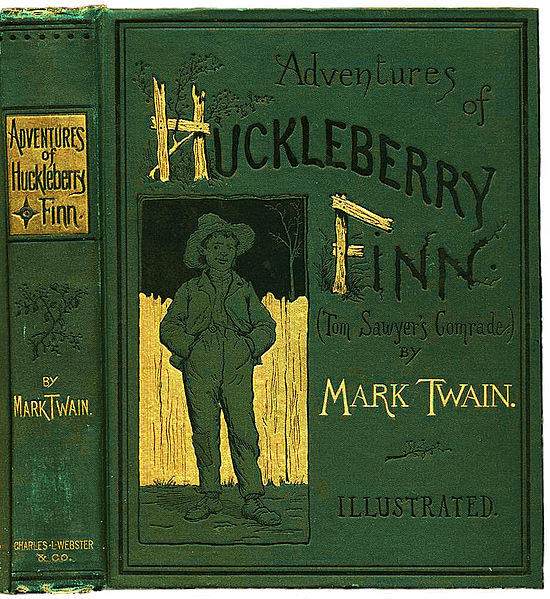
Mark Twain’s Adventures of Huckleberry Finn, 1884.
Image from Wikimedia Commons.
Twain scholar Laura Trombley (now the President of Southwestern University in Texas) once told me that Huck Finn isn’t about slavery. “It’s about an abused boy looking for a safe haven,” she said. It was daring for Twain to give a voice to the untutored, unwashed son of the town drunk.
You don’t know about me without you have read a book by the name of “The Adventures of Tom Sawyer”; but that ain’t no matter. That book was made by Mr. Mark Twain, and he told the truth, mainly. There was things which he stretched, but mainly he told the truth. That is nothing. I never seen anybody but lied one time or another …
Huck’s voice, often described as “realistic”, is actually a highly stylized literary device and a brilliant riff on how real boys talk. In these first few sentences, Twain inserts himself into the story and sets his protagonist up to be an unreliable narrator, as Huck admits that there will be “stretchers” of his own along the way.
Huck Finn is our national epic, much like The Odyssey is for Greece or the Nibelungenlied is for Germany. Like those older epics, Huck Finn can be read as version of a Jungian myth, in which the hero descends into the Underworld, undergoes trials and tribulations, and returns to us reborn. This story of two travelers on an epic journey is an archetype of our culture, which is why it is retold with such frequency. It’s possible to read every American road novel or movie as a reworking of Huck Finn.
Twain may not have written in verse, but Huck’s narration is beautiful and lyrical and so distinctively American that it has influenced generations of American writers, both popular and literary. That indelible voice, at once innocent and highly perceptive, is the fixed moral point from which Twain can then satirize so many different segments of his beloved country — preachers, con men, politicians, actors, and ordinary gullible Americans.
The book has been criticized as one of the first “white savior” narratives, but this gets it exactly backwards. Huck doesn’t save anyone in the novel. (One of Jane Smiley’s criticisms, in fact, is that Huck doesn’t “act” to save his friend.) It is actually Jim, the slave, who saves Huck — both literally and figuratively. It is Jim who provides Huck with a safe haven, and it is Jim who calls Huck to account when Huck treats him as less than human: “En all you wuz thinkin ’bout wuz how you could make a fool uv ole Jim wid a lie. Dat truck dah is trash, en trash is what people is dat puts dirt on de head er de fren’s en makes ’em ashamed.”
Huck eventually humbles himself before Jim and tells us, “I didn’t do him no more mean tricks, and I wouldn’t done that one if I’d a knowed it would make him feel that way.” Huck may be the protagonist of this story, but the slave Jim is its moral hero. It is Jim who reveals himself to be a fugitive slave so that Tom Sawyer can get medical attention for his gunshot wound. And after he is freed from slavery, Jim heads home to assume his responsibilities as a husband and father.
In contrast to Jim, Huck yearns for adventure and escape. Forced to live with the Widow Douglas and Miss Watson at the start of the book, he resents their attempts to “sivilize” him. He feels “all cramped up” by the clothes they make him wear, and he dismisses their Biblical teaching because he “don’t take no stock in dead people”. Instead of returning home with Jim, Huck tells us that he intends to “light out for the territory”. He represents one aspect of the American spirit — ironic, secular, individualistic.
January 15, 2024
Grave Error
In the latest SHuSH newsletter, Ken Whyte calls our attention to an important book on a major Canadian topic … that has been ignored by the Canadian media establishment (as one would expect if it contravenes the official narrative):
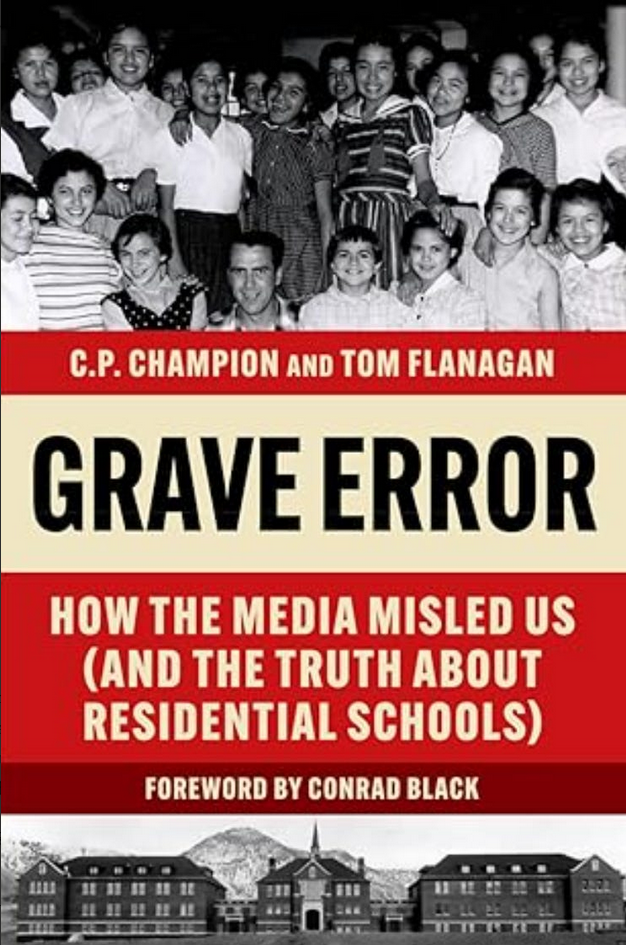
Have you read Grave Error? Have you seen it on the shelves in your local bookstore? At the library, perhaps? Did you notice coverage of it in the Globe or hear someone talking about it on CBC?
I’d bet ninety-eight out of a hundred SHuSH readers would answer “no” to all those questions.
The full title of the book is Grave Error: How the Media Misled Us (and the Truth About Residential Schools). Its authors are former University of Calgary political scientist and Harper aide Tom Flanagan and Chris Champion, editor of the Dorchester Review. The book takes strong exception to commentary by media, politicians, and Indigenous leaders on the subject of unmarked graves at a former Kamloops Indian Residential School. I first noticed it over the holidays, several weeks after publication, when it was the overall #1 bestseller on Amazon.
It’s not easy to become the top-selling book on Amazon. You’re competing against Colleen Hoover and Prince Harry and the entire world of books, published and self-published. Grave Error was the only Canadian book, fiction or nonfiction, in Amazon’s top fifty when I came across it. It’s rare to see more than two or three Canadian books in Amazon’s top fifty at any given time.
You won’t have noticed Grave Error in your local bookstore because Amazon is the only outlet that’s selling the book. You won’t have seen coverage of it because no mainstream Canadian media outlet has paid attention to it. Nor does any public library stock it. It has not appeared on any conventional bestseller list, although it has to be a Canadian bestseller — Amazon sells well over half of all books in Canada. Most Amazon sales don’t register on our bestseller lists because Amazon doesn’t cooperate with the organizations that produce the lists.
Grave Error is published by True North, a conservative news website and public policy organization. It is run by Candace Malcolm, who founded True North with her husband, Kaz Nejatian, a former Jason Kenney staffer, now COO of Spotify. It’s published a half dozen hits in recent years, several written by Malcolm herself.
January 13, 2024
Troubled by Rob Henderson
Stephanos Bibas reviews Rob Henderson’s autobiography Troubled: A Memoir of Foster Care, Family, and Social Class for the University of Chicago Law Review:

Life at the bottom is troubled. Charles Dickens, Victor Hugo, and many others have long shown us that. To understand criminal justice, education, and family law, we lawyers typically look to social scientists, and their external expertise does teach us much. But we often neglect lived experience. Occasionally, we should toggle from the dry regressions and clinical detachment of social science to the internal perspective and expertise of those who live through family breakup, foster care, disrupted schooling, drugs, and crime. And that is what Rob Henderson’s breakout memoir, Troubled, gives us: a window on troubled youth.1
Henderson, a brilliant young psychologist, illumines how harmful childhood instability is by reflecting on his own experience. He never knew his father, was abandoned by his drug-addicted mother, and bounced around foster care. After squandering much of his early education and drowning his rage in alcohol, drugs, fights, and vandalism, he managed to make his way through the Air Force to Yale and now Cambridge. But few of his friends escaped the wounds from their childhoods; many wound up unemployed, in prison, or dead. His eye is as keen as his intellect, recalling and reporting how adults in his life kept abandoning him and his fellow foster children and how they in turn acted out. As an outsider to the elites who dominate the Ivies, he also turns his critical eye on the groupthink and victimhood culture that is strongest among the most privileged. And building on literary historian Paul Fussell’s work, Henderson develops his own critique of the shibboleths that educated American elites use to set themselves—ourselves—apart while ignoring the harm to the rest of society.2
Henderson has much to teach us lawyers and legal scholars. He shows us how much we miss by focusing public policy on educational attainment and cost-benefit analysis, overlooking what is priceless: love and emotional attachment. The most important things in life can’t be quantified; at best, outcomes are mere proxies for them. We are more than our résumés! His account undermines our persistent habit of viewing humans as fully informed rational actors — a habit that makes much more sense in corporate law than in criminal law and the like. He showcases how poorly used adult autonomy harms children, leading to broken homes, drug addiction, numbness, and rage.
Lastly, Henderson critiques “luxury beliefs”, the term he coins for sociological opinions that are popular only among those who need not worry about their own survival. These beliefs are status signals to the educated elite who are not harmed by the fallout from any cultural shifts they might cause. But these beliefs corrode the social structures that children need to develop. (He could do more to develop the causal nexus to social harm, but his claims are still powerful.)
In short, Henderson’s memoir powerfully challenges prevalent views of education, family policy, and class. It shows how we hyperfocus on educational outcomes and other quantifiable goals at the expense of softer emotional goods. And it does it all in a plainspoken, understated voice that illustrates his points from his own lived experience and that of his buddies. Many will disagree with Henderson’s conclusions, of course, but scholars should grapple with his challenge.
Part I of this Review summarizes Henderson’s long journey from foster care to Yale. Part II canvasses his argument that adult instability breeds chaotic childhoods, leaving neglected kids to raise themselves in Hobbesian competition, impulsive indulgence, or reckless rage. Part III then develops Henderson’s signature concept of luxury beliefs and how nonjudgmentalism backfires on those at the bottom. Though one can quibble with some of his causal claims, his thrust is compelling. Finally, Part IV considers how Henderson’s account suggests reorienting some criminal justice, education, and family law reforms toward children’s need for stable structures to guide them.
1. Rob Henderson, Troubled: A Memoir of Foster Care, Family, and Social Class (forthcoming 2024) (on file with publisher). All further citations to this work are by page number in parentheticals in the text.
2. See generally Paul Fussell, Class: A Guide Through the American Status System (1983).
January 11, 2024
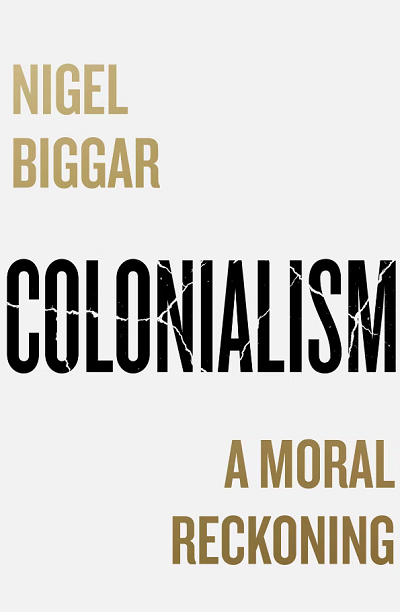
Pushing back against the Colonialism Narrative
At Samizdata, Brendan Westbridge praises Nigel Biggar’s 2023 book Colonialism: A Moral Reckoning:
He examines the various claims that the “de-colonisers” make: Amritsar, slavery, Benin, Boer War, Irish famine. In all cases he finds that their claims are either entirely ungrounded or lack vital information that would cast events in a very different light. Amritsar? Dyer was dealing with political violence that had led to murder. Some victims had been set alight. Anyway, he was condemned for his actions by the British authorities and, indeed, his own standing orders. Slavery? Everyone had it and Britain was the first to get rid of it. Benin? They had killed unarmed ambassadors. Irish famine? They tried to relieve it but they were quite unequal to the size of the task. In the case of Benin he comes very close to accusing the leading de-coloniser of knowingly lying. The only one of these where I don’t think he is so convincing is the Boer War. He claims that Britain was concerned about the future of the Cape and especially the Simonstown naval base and also black rights. I think it was the pursuit of gold even if it does mean agreeing with the communist Eric Hobsbawm.
He is far too polite about the “de-colonisers”. They are desperate to hammer the square peg of reality into their round-hole of a theory. To this end they claim knowledge they don’t have, gloss over inconvenient facts, erect theories that don’t bear scrutiny and when all else fails: lie. Biggar tackles all of these offences against objectivity with a calmness and a politeness that you can bet his detractors would never return.
The communists – because they are obsessed with such things and are past masters at projection – like to claim that there was an “ideology” of Empire. Biggar thinks this is nonsense. As he says:
There was no essential motive or set of motives that drove the British Empire. The reasons why the British built an empire were many and various. They differed between trader, migrant, soldier, missionary, entrepreneur, financier, government official and statesman. They sometimes differed between London, Cairo, Cape Town and Calcutta. And all of the motives I have unearthed in this chapter were, in themselves, innocent: the aversion to poverty and persecution, the yearning for a better life, the desire to make one’s way in the world, the duty to satisfy shareholders, the lure of adventure, cultural curiosity, the need to make peace and keep it, the concomitant need to maintain martial prestige, the imperative of gaining military or political advantage over enemies and rivals, and the vocation to lift oppression and establish stable self-government. There is nothing morally wrong with any of these. Indeed, the last one is morally admirable.
One of the benefits of the British Empire is that it tended to put a stop to local wars. How many people lived because of that? But that leads us on to another aspect. Almost no one ever considers what went on before the Empire arrived. Was it better or worse than went before it? Given that places like Benin indulged in human sacrifice, I would say that in many cases the British Empire was an improvement. And if we are going to talk about what went before what about afterwards? He has little to say about what newly-independent countries have done with their independence. The United States, the “white” (for want of a better term) Commonwealth and Singapore have done reasonably well. Ireland is sub-par but OK. Africa, the Caribbean and the Indian sub-continent have very little to show for themselves. This may explain why Britain needed very few people to maintain the Empire. At one point he points out that at the height of the Raj the ratio of Briton to native was 1 to 1000. That implies a lot of consent. Tyrannies need a lot more people.
The truth of the matter is that talk of reparations is rooted in the failure of de-colonisation. If Jamaica were a nicer place to live than the UK, if Jamaica had a small boats crisis rather than the UK then no one would be breathing a word about reparations or colonial guilt. All this talk is pure deflection from the failure of local despots to make the lives of their subjects better.
Biggar has nothing to say about what came after the empire and he also has little to say about how it came about in the first place – so I’ll fill in that gap. Britain acquired an empire because it could. Britain was able to acquire an Empire because it mastered the technologies needed to do it to a higher level and on a greater scale than anyone else. Britain mastered technology because it made it possible to prosper by creating wealth. That in itself was a moral achievement.
January 10, 2024
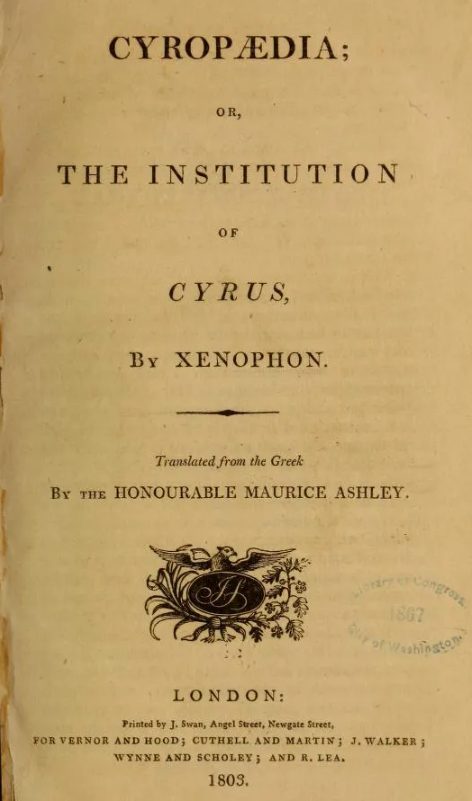
The problem of engaging with “the great classical works”
The first book review for 2024 at Mr. and Mrs. Psmith’s Bookshelf is a look at Xenophon’s Education of Cyrus by John Psmith:
It is easier, given his nature, for a human being to rule all the other kinds of animals than to rule human beings. But when we reflected that there was Cyrus, a Persian, who acquired very many people, very many cities, and very many nations, all obedient to himself, we were thus compelled to change our mind to the view that ruling human beings does not belong among those tasks that are impossible … We know that Cyrus, at any rate, was willingly obeyed by some, even though they were distant from him by a journey of many days; by others, distant by a journey even of months; by others, who had never yet seen him; and by others, who knew quite well that they would never see him. Nevertheless, they were willing to submit to him.
I am not well-read in the classics. My excuse ultimately boils down to the same argument that all the classicists give for why you should be well-read in the classics: reading a book that has been widely admired for a very long time isn’t just reading a book, it’s entering into a “great conversation” taking place across the aeons. I feel awkward reading a book like that without knowing something about the commentaries on the book, all the people it has influenced, all the people who influenced it, the commentaries on the commentaries, and so on. It’s exhausting and overwhelming, and when I ignore all that and plunge ahead, I often don’t enjoy the book and then I feel dumb. A “great conversation” sounds nice, but only if you’re one of the participants and you actually get the inside jokes and references. Otherwise it’s as alienating and isolating as showing up to a party where you don’t know anybody, and where everybody else has already been chatting for a few thousand years.
I don’t remember who recommended Xenophon’s Cyropaedia to me or how it wound up on my reading list, but when it finally made its way to the top of my stack, I saw it and shuddered. How could I possibly appreciate this semi-fictionalized biography of the founder of the Persian Empire without first being familiar with Xenophon’s work as a mercenary for one of Cyrus the Great’s distant descendants? Or with all the ways he was riffing on and responding to the political philosophy of his frenemy Socrates? Or with the complicated politics of the Peloponnesian War, and the way that Xenophon, an Athenian exile and the original Sparta-boo, was actually writing PR for King Agesilaus II, but concealing it within a story about the exotic Persians?1 Or with how this book led to the creation of an entire major genre of books in the Middle Ages? Or with the most famous and subversive instance of that genre, Machiavelli’s The Prince, and with all the hundreds of subsequent works reacting and responding to that one?
You see the problem? One could very easily conclude that it would be impossible for me to appreciate this book. Fortunately, I ignored all that and read it anyway. No doubt I missed all kinds of subtle layers of meaning and nuance, but even read on a totally superficial level by an ignoramus, this book rocks.
The title has the word “education” in it, but the book covers Cyrus’s entire life and reign, and only the first section concerns his education in the literal sense. That first section is very important to what comes next, though, so I’m going to dwell on it a bit. Cyrus, along with the other Persian boys of his social class, is being trained to lead. And so their education is centered around having lots of opportunities to judge, instruct, and coerce others; but also opportunities to serve and obey. If you’re old enough, you might remember when the education of the American leadership class worked this way too, but even those of you who are younger have seen vestiges of it in the bizarrely disproportionate weight given to extracurriculars in US college admissions.
1. If you’re an American, then you’re already familiar with this trick. Most of our debates about the virtues and vices of other nations are just thinly-veiled attempts to “own” domestic political opponents.
QotD: The root of leftism is envy
“Social justice” is sacralized envy.
Which fits a lot better on a Pepe the Frog meme, you must admit.
Note also the slight, but important, change in emphasis — from “hate” to “envy”. Recall that [Economics in One Lesson author Henry] Hazlitt was writing in 1946, when material deprivation was still a thing, even for Americans. Back then it was assumed that the hate sprang from the envy, which meant that the hatred could eventually be dissipated. It implied an endpoint. Hazlitt, like seemingly everyone else on the Right, took Lefties at their word — that some level of “equality”, by which they meant material prosperity, would cause the Left to finally hang up their jocks and hit the showers.
Three quarters of a century later, we know that’s not true. There’s nothing you could give them that would ever satisfy them. Go ahead, do it Jesus-style — turn the other cheek, give them your coat and your cloak, walk with them two miles, all that jazz. You know as well as I do what will happen — they’ll still hate you. It doesn’t matter what the “reasons” are. Before, they hated you because they didn’t have a coat and cloak. Now they’ve got yours, but they still hate you, because you’re right-handed, or blonde, or have webbed toes. Or because you don’t have webbed toes.
Whatever, something, anything. I won’t bother repeating the O’Brien quote from 1984; you’ve heard it enough by now to know what I mean when I say that for the Left, the point of envy is envy. They don’t envy you for what you have. They don’t even envy you for what you are. They just envy. The mere fact that you exist, a separate entity from them, means that they’re not all there is in the world. In other words — French judges, take note — we’re down to three words:
Leftism is solipsism.
They envy your mere existence, since you are the walking, talking proof that not everything in this world is as shriveled and petty and miserable as they are.
Severian, “Crossing the Bar”, Rotten Chestnuts, 2021-04-06.
January 9, 2024
Matt Gurney on what he learned from Geddy Lee
The Line went into holiday mode during the Christmas season and into the first week of the new year. To fill in, the editors invited contributions on things the contributors were grateful for. Matt Gurney included his own piece, encouraged by Geddy Lee’s recent book My Effin’ Life (which I haven’t read, but hope to at some point):
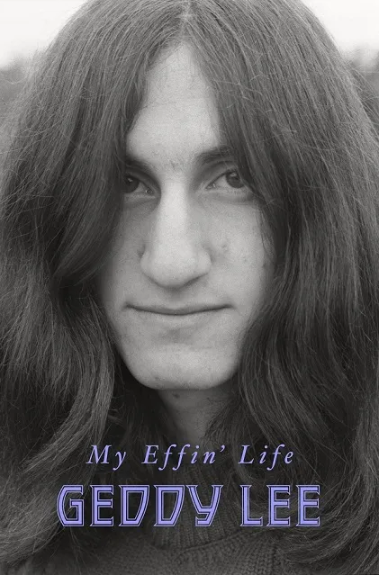
Most Line readers probably know that I am an unrepentant Trekkie. Many of you will not know, but will not be surprised to discover, that I’m also a huge fan of Canadian rock band Rush. (These two things do often seem to go together, I’ve noted.) Last year, Rush bassist and lead singer Geddy Lee published a memoir, playfully titled My Effin’ Life.
Lee began to work on the memoir during the pandemic lockdowns, when we all suddenly found ourselves with a lot of time on our hands. Lee has been very open, both in his memoir and in his public comments, about the sad series of life events that led him to decide to begin writing his memoir in the first place.
The first, of course, was the effective end of Rush, back in 2015. Lee was eager to continue making music and touring. Rush lyricist and drummer Neil Peart, afflicted with some health issues and worried he could no longer perform at the standard he expected of himself, was eager to retire and spend more time with his new, young family. (Rush fans will know the awful story of what happened to Peart’s first family; it’s not necessary to recap it here, but I have absolutely kept it in mind when counting my own blessings.) Lee has been honest about being frustrated and even bitter about the end of Rush’s active career, but the news got worse, when, early in what was supposed to be the second act of Peart’s family life, the drummer was diagnosed with a cruel, terminal cancer. He died in 2020, almost four years ago to this day, after a long, private struggle, a struggle that Lee did his part to keep private. As if that wasn’t enough, not long after the death of his long-time friend and bandmate, Lee lost his mother, Mary Weinrib, a Holocaust survivor and a huge and active presence in Lee’s life until the very end. Weinrib died in 2021.
That’s a lot of loss packed into a short period, and the timing was awful. As COVID hit North America and began to rack up its victims, Lee, like so many of us, retreated inside his own home. While there, he had many ghosts and sorrows to keep him company, and it clearly weighed on him. So he began writing.
And what resulted was, perhaps to the surprise of even Lee, a happy memoir. A story of gratitude and laughter. A memoir full of funny stories, jokes, and things for which he was thankful.
As 2023 was drawing to a close, my father gifted me a ticket to a book reading at Toronto’s Massey Hall, featuring none other than Geddy Lee. The special surprise interviewer and cohost for the evening — though not really that much of a surprise — was Lee’s surviving Rush bandmate and friend of decades, guitarist Alex Lifeson. The two men, both now 70, sat down on the stage and spent the next couple of hours swapping stories, jokes and memories, happy and sad. They strongly hinted, but did not promise, that some version of Rush may reunite and perform again.
And that would be great. I would spend an unwise amount of money to go see that. But it wasn’t my excitement about possible opportunities to see some version of my favourite band perform again that began changing my perspective on 2023. It was just seeing the two of them on that stage. I’m sure these guys have had to deal with all the creeping aches and pains and a need for new contact lens prescriptions that I catalogued above. And I can guarantee you that they’ve both endured more personal loss than I have. But what I saw that evening was simply two old buddies, with 30 years on me, sitting on a stage and having a blast. And I realized that to these guys, something that happened when they were 40 would have seemed like a long time ago. Because they’d lived a lot since then.
January 7, 2024
Evelyn Waugh’s horrible family
In the latest SHuSH newsletter, Ken Whyte explains why Evelyn Waugh drank:
Happy New Year! How were your holidays? Were you as festive as undergraduate Evelyn Waugh kicking off his Christmas break in 1924?
Then I went to Oxford. Drove to 31 St Aldates where I found an enormous orgy in progress. Billy and I unearthed a strap and whipped Tony. Everyone was hideously drunk except, strangely enough, myself. After a quiet day in cinemas, I had a dinner party of Claude, Elmley, Terence, Roger Hollis and a poor drunk called MacGregor. I arrived quite blind after a great number of cocktails at the George with Claude. Eventually the dinner broke up and Claude, Rogers Hollis and I went off for a pub crawl which after sundry indecorous adventures ended up at the Hypocrites where another blind was going on. Poor Mr McGregor turned up after having lain with a woman but almost immediately fell backwards downstairs. I think he was killed. Next day I drank all morning from pub to pub and invited to lunch with me at the New Reform John Sutro, Roger Hollis, Claude and Alfred Duggan. I ate no lunch but drank solidly and was soon in the middle of a bitter quarrel with the President — a preposterous person called Cotts — who expelled me from the club. Alfred and I then drank double brandies until I could not walk. He carried me to Worcester where I fell out of the window then relapsed into unconsciousness punctuated with severe but well directed vomitings. On Wednesday I lunched with Robert Byran at the New Reform and the man Cotts tried to throw me out again. Next day I lunched with Hugh and drank with him all the afternoon and sallied out with him fighting drunk at tea time when we drank at the New Reform till dinner… Next day, feeling deathly ill, I returned to London having spent two months’ wages. I had to dine with Alex, Richard Greene, Julia Strachey … and then back to Richard’s home for a drink. …
[…]
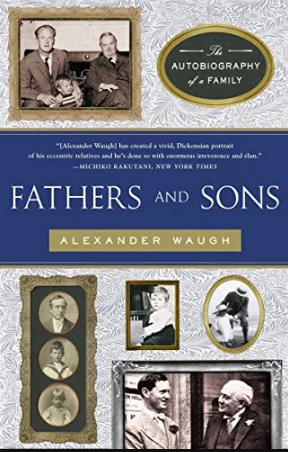
I picked up Alexander Waugh’s Fathers and Sons: The Autobiography of a Family (2004), several weeks ago. I’ve been enjoying it so much that I’m rationing it, reading about ten pages at a time to make it last.
Alexander Waugh is a music writer and biographer, former opera critic at the Evening Standard, son of novelist and Private Eye diarist Auberon Waugh, grandson of the aforementioned Evelyn, the titan of English letters whose brother, Alec, and father, Arthur, were also reasonably famous writers. The book is about the interpersonal relations of these three generations of men who produced about 180 books among them. And it’s wild. These are hugely and incorrigibly flawed people. Often horrible to one another (also to outsiders but they save their best for kin). They are in equal parts perverse and hilarious, and often brilliant, especially Evelyn. I can’t believe people ever behaved this way.
Undergraduates have never required reasons to binge drink, but you can’t read the opening chapters of Fathers and Sons without thinking Evelyn had special motivation. He was the second son of Arthur. His older brother, Alec, was “the firstling”, the “future head of the family”, their parents’ “darling lamb”, and mom and pop didn’t care who knew it, least of all Evelyn.
Arthur and his missus, Kate, had an “unbounded fascination for Alec”, who won all his school honours and was star of the cricket team. Arthur considered the boy a literal gift from God and believed that they could communicate telepathically. He would write him notes like: “I simply go about thinking of your love for me all the time”. Their relationship, writes Alexander, was “hot, clammy and compulsive”, and to the “objective eye their behavior might have resembled a pair of star-crossed teenage lovers”. Indeed, it was romantic in all but the physical sense — Arthur saved his sexual depredations for girls of tender age with whom he played “tickling games” (he also had a fetish involving young women and bicycles).
In addition to being second born, Evelyn made the mistake of being male. His parents had wanted a daughter; they consoled themselves by giving him an effeminate name and dressing him in bonnets and frills long beyond the standard of the day. He was said to be a “warm, bright. sweet-natured and affectionate child”, at least until an awareness of the family dynamic dawned. In Edwardian terms, he was treated as a bastard child by his legitimate parents. His possessions were hand-me-downs. He attended the less expensive school. When eleven-year-old Evelyn asked for a bicycle, his parents bought a bigger and better one for Alec. When Alec asked for a billiard table, space was found for it in Evelyn’s room. Despite winning prizes and becoming head of his house in school, and president of the debating society, and editor of the school magazine, Evelyn remained an afterthought and something of a nuisance in the minds of his Alec-obsessed parents.
Evelyn responded to his circumstances in a clever and self-protective fashion, defining himself against his brother and father. By adolescence, he had an inkling that he was smarter and funnier than both. They could keep their mawkish outpourings of emotion toward one another; he would be hard of head and sharp of tongue. By his early teen years, he was confiding to his diary that Arthur was a fat and “ineffably silly” Victorian sentimentalist. He considered both Alec and Arthur philistines. “Terrible man, my father”, Evelyn said to a schoolmaster. “He likes Kipling.”
To the extent that his parents thought about Evelyn, they were disturbed by his dark moods and lassitude, and intimidated by his cynical wit. Both Alec and Arthur were threatened by Evelyn as a potential literary rival. When Evelyn, in what was becoming a typical act of rebellion, ran up an expensive restaurant tab and had it sent to an outraged Arthur, Alec said: “You know father, if Evelyn turns out to be a genius, you and I might be made to look very foolish by making a fuss over ten pounds, seventeen and ninepence.”
So you can perhaps see how young Evelyn Waugh developed an enthusiasm for drink remarkable even in an undergrad, and why the rare characters killed in gruesome fashion in his fiction tended to be fathers.
January 3, 2024
“One of the oddities of trans healthcare is that it masquerades as progressive”
In The Critic, Victoria Smith outlines the history of medical misogyny from Aristotle to modern-day “trans healthcare”:
The neglect of female bodies in medicine has a long history. The male-default bias, writes Caroline Criado Perez in Invisible Women, “goes back at least to the ancient Greeks, who kicked off the trend of seeing the female body as a ‘mutilated male’ body (thanks, Aristotle)”:
The female was the male ‘turned outside in’. Ovaries were female testicles (they were not given their own name until the seventeenth century) and the uterus was the female scrotum. […] The male body was an ideal women failed to live up to.
As Criado Perez notes, this bias lives on in male-centric medical research and undifferentiated treatment recommendations. “Women are dying,” she notes, “as a result of the gender data gap.” The belief that there is nothing specifically different about female people — cut a bit here, add a bit there, and we’re the same as men — has led to our symptoms being ignored and our pain dismissed.
Over the past few years, there have been a number of books — Elinor Cleghorn’s Unwell Women, Cat Bohannon’s Eve, Leah Hazzard’s Womb, to name a few — which have aimed to correct the imbalance. This is important both to save lives and ease suffering, and because, on a very basic level, it is insulting for half the human race to have our bodies treated as lesser, imperfect versions of a male ideal. We are more than that. We exist in our own right.
There are many in medicine, however, who still seem to think that Aristotle was right. Last week, for instance, the World Health Organisation announced it would be developing new guidelines into “the health of trans and gender diverse people”. While this might sound positive, as Eliza Mondegreen notes, many of those leading the development group hold highly regressive views about sex, gender and bodies. It is only possible to believe that a person could change sex if you have not given much consideration to the “second” sex at all.
One of the oddities of trans healthcare is that it masquerades as progressive despite having evolved from — and continuing to rely on — an understanding of sex difference which is regressive, male-centric and superficial. Because no one wants to admit it, this has led to a plethora of articles along the lines of “Here’s Why Human Sex Is Not Binary” and “Sex Redefined: The Idea of 2 Sexes Is Overly Simplistic“. While these claim to be adding extra detail and nuance to our understanding, what they do in practice is revert back to privileging the male default. Sex is all so varied, all so different, they tell us, we might as well not bother setting any standards for what counts as “femaleness”. We’re all just human, aren’t we? Only some bodies have tended to be considered more human than others. Rebranding “the male default” “the sex spectrum” is a sneaky way of insisting, once again, that female people are nothing more than males with a few minor tweaks.
This is the new medical misogyny, built on the back of the old version. Unfortunately, because it positions itself as anti-conservative and even pro-feminist, many writers of texts that address the old version feel obliged to go along with the new. It’s not difficult to see why. Who wants their work to be undermined by bad faith accusations of transphobia? Isn’t it easier just to say “it’s clear that trans women are women” — as Bohannon has done — on the basis that at least this will enable you to challenge the centring of male bodies elsewhere?
January 1, 2024
Michael Palin’s Great-Uncle Harry
In The Critic, Peter Caddick-Adams reviews Michael Palin’s Great-Uncle Harry:
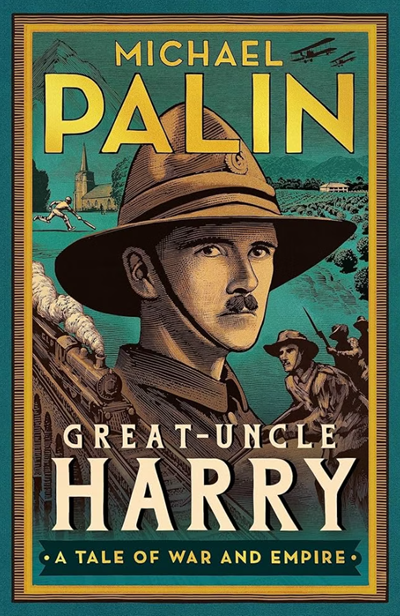
The first of last week’s volumes nestling on my desk, with its immediately identifiable Ripping Yarns cover illustration, was Sir Michael Palin’s story of his forebear, Great Uncle Harry, who travelled the world but disappeared on the Somme. Here, I felt an immediate connection, not least because Michael, I and his Great Uncle Harry Palin had hauled ourselves through the same academy of learning, Shrewsbury School, though at different times. There are plenty of 1914-18 memoirs and tributes around, but this is one of the best. The further the Great War (as it used to be called) recedes, the more we seem to need to torture ourselves with the staggering sacrifices it involved. I read my copy over Remembrance weekend, which made it doubly poignant.
In Great Uncle Harry, Palin’s gift is to give us the hinterland of his ancestor. Many First World War authors, here I could mention the great Lyn Macdonald, Richard Holmes and Martin Middlebrook, all of whom I place on pedestals, provide us with erudite studies, laced with gripping eyewitness accounts. I find myself doing the same with 1939-45, but of necessity there is no room to give the brave and the damned a back story. They are parachuted into the text. They fight and live or die and exit stage left. It is refreshing, therefore, to hold the hand of a first war warrior from birth unto death. Palin was lucky his Great Uncle Harry kept a series of notebooks and diaries of his time in khaki, and was able to research his globe-trotting years before battle. Our man was brought up in Herefordshire, and after school drifted out to British India. He had two stints, first working as a railway manager and latterly as overseer on tea plantations. The reader is fortunate that Palin the documentary-maker filmed in both environments and is able to look over his forebear’s shoulder and summon up the Edwardian social standards of the day, with its solar topees and chota pegs (sunset whiskeys), its heat and its dust. Palin the younger’s many diaries and written travelogues, of which I find New Europe (2007) the best, are equally good.
But Great Uncle Harry Palin was restless. The youngest and most headstrong of seven, he flounced out of each of his two jobs serving the Raj, and ended up trying his hand at farming in New Zealand. There he seemed more settled, but not quite. The Palin under the microscope, notes his great nephew, was one of the first to volunteer for war service with the 12th (Nelson) Regiment, a South Island infantry outfit, in August 1914 and sailed with them overseas, initially to Egypt. There they were absorbed into the Canterbury Battalion, and deployed to Gallipoli, from which Great Uncle Harry emerged without a scratch.
Gallipoli is a conjurer’s name. Now known by the Turks as their Gelibolu Peninsula, overlooking the ancient Hellespont (today’s Dardanelles Strait), its southern tip lies 200 miles from what was then Turkey’s capital, Constantinople, officially Istanbul after 1930. Only since the 1990s has this strategically significant sliver of land, across the Dardanelles from ancient Troy, and guarding entry to the Bosphorus and Black Sea, been opened up for tourists. The 1915 operation was dreamt up by Winston Churchill to break the stalemate of the Western Front. He advocated a naval advance on Constantinople, as a way of knocking the Austro-German alliance out of the war. Such a stratagem would then have offered Paris and London the ability to supply the troops of Tsar Nicholas the Last with modern arms and munitions to prevail against the Central Powers.
Instead of breaking the Western Front, Gallipoli broke Churchill. It was a campaign endlessly refought in the inter-war years, which generally concluded that amphibious warfare had no future, though Lieutenant Colonel George S. Patton in his 1936 General Staff study, The Defense of Gallipoli, found it fascinating. It was one reason why the allies had no maritime landing capability in 1939-40, to Britain’s detriment at Dunkirk, and later Germany’s disadvantage when planning a seaborne assault against southern England. Valuable lessons of what to do, and not to do, had to be relearned before D-Day in 1944 could be a success. My own assessment is right idea, wrong commanders. Gallipoli might have offered the success Churchill desired, but was executed poorly.
The original plan had been to overwhelm Constantinople with battleships, and there is evidence that the Turks were preparing to surrender. However, the Franco-British war fleet encountered German-supplied Krupp cannon along both shores of the Dardanelles and a minefield in the middle, and suffered catastrophic losses. A land campaign was then initiated to clear the Turkish land-based defences. This should have been foreseen and a simultaneous, rather than sequential, maritime-land attack might well have delivered the goods.
Instead, the few Turkish defenders on Gallipoli could see a landing was imminent, called in reinforcements and dug trenches ferociously. On the peninsula, amidst scrub, trench and memorials lie scattered British, Commonwealth, Ottoman and French (yes, they were there too) cemeteries, hinting at stirring tales of derring-do. Last time I was there, I encountered not only rifle cartridges, pieces of pottery rum jars, and shell cases, but human bones. My guide observed, “Probably wild pigs dislodging the topsoil. It happens all the time.” An indication of the 300,000 Allied and 255,000 Turkish killed, wounded and missing in a campaign where illness often took as many as combat wounds. Along the western coast, amidst shards of amphorae from pre-history, lie many wrecks associated with the 1915 campaign in crystal-clear water. It remains high on my recommended battlefields to visit.
December 31, 2023
Justinian I
In The Critic, George Woudhuysen reviews Justinian: Emperor, Soldier, Saint, by Peter Sarris:
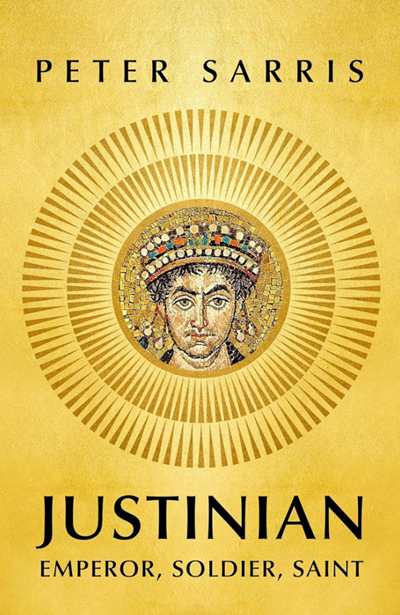
The emperor Justinian did not sleep. So concerned was he for the welfare of his empire, so unremitting was the tide of business, so deep was his need for control that there simply was not time for rest. All this he explained to his subjects in the laws that poured forth constantly from his government — as many as five in a single day; long, complex and involved texts in which the emperor took a close personal interest.
The pace of work for those who served Justinian must have been punishing, and it is perhaps unsurprising that he found few admirers amongst his civil servants. They traded dark hints about the hidden wellsprings of the emperor’s energy. One who had been with him late at night swore that as the emperor paced up and down, his head had seemed to vanish from his body. Another was convinced that Justinian’s face had become a mass of shapeless flesh, devoid of features. That was no human emperor in the palace on the banks of the Bosphorus, but a demon in purple and gold.
There is something uncanny about the story of Justinian, ruler of the eastern Roman Empire from 527 to 565. Born into rural poverty in the Balkans in the late 5th century, he came to prominence through the influence of his uncle Justin. A country boy made good as a guards officer, he became emperor almost by accident in 518. Justinian soon became the mainstay of the new regime and, when Justin died in 527, he was his obvious and preordained successor. The new emperor immediately showed his characteristically frenetic pace of activity, working in consort with his wife Theodora, a former actress of controversial reputation but real ability.
A flurry of diplomatic and military action put the empire’s neighbours on notice, whilst at home there was a barrage of reforming legislation. More ambitious than this, the emperor set out to codify not only the vast mass of Roman law, but also the hitherto utterly untamed opinions of Roman jurists — endeavours completed in implausibly little time that still undergird the legal systems of much of the world.
All the while, Justinian worked ceaselessly to bring unity to a Church fissured by deep theological divisions. After getting the best of Persia — Rome’s great rival — in a limited war on the eastern frontier, Justinian shrewdly signed an “endless peace” with the Sasanian emperor Khusro II in 532. The price — gold, in quantity — was steep, but worthwhile because it freed up resources and attention for more profitable ventures elsewhere.
In that same year, what was either a bout of serious urban disorder that became an attempted coup, or an attempted coup that led to rioting, came within an ace of overthrowing Justinian and levelled much of Constantinople. Other emperors might have been somewhat put off their stride, but not Justinian. The reform programme was intensified, with a severe crackdown on corruption and a wholesale attempt to rewire the machinery of government.
Constantinople was rebuilt on a grander scale, the church of Hagia Sophia being the most spectacular addition, a building that seems still to almost defy the laws of physics. At the same time, Justinian dispatched armies to recover regions lost to barbarian rulers as the western Roman Empire collapsed in the course of the 5th century. In brilliant and daring campaigns, the great general Belisarius conquered first the Vandal kingdom in North Africa (533–34) and then the much more formidable Ostrogothic realm in Italy (535–40), with armies that must have seemed almost insultingly small to the defeated.
If Justinian had had the good fortune to die in 540, he would have been remembered as the greatest of all Rome’s many emperors. Unfortunately for him, he lived. The 540s was a low, depressing decade for the Roman Empire. Khusro broke the endless peace, and a Persian army sacked the city of Antioch. The swift victories in the west collapsed into difficult wars of pacification, which at points the Romans seemed destined to lose.
This library has every book ever published
Tom Scott
Published 11 Sept 2023The British Library is one of the six legal deposit libraries for the UK — and the only one that doesn’t pick and choose, or have to ask for copies. That’s a lot of books to store, and the internet’s only making it worse. ■ The BL: https://bl.uk ■ UK Web Archive: https://www.webarchive.org.uk/
(more…)
QotD: Orwell as a “failed prophet”
Admittedly, if Orwell was aiming to prophesy, he misfired. Oceania is a world in which the ruling elite espouses no ideology except the brutal insistence that “might makes right”. Tyrannical regimes today still promote ideological orthodoxy — and punish public protest, organized dissidence, and conspicuous deviation. (Just ask broad swaths of the citizenry in places such as North Korea, Venezuela, Cuba, and mainland China.) Moreover, the Party in Oceania mostly ignores “the proles”. Barely able to subsist, they are regarded by the regime as harmless. The Party does not bother to monitor or indoctrinate them, which is not at all the case with the “Little Brothers” that have succeeded Hitler and Stalin on the world stage.
Rather than promulgate ideological doctrines and dogmas, the Party of Oceania exalts power, promotes leader worship, and builds cults of personality. In Room 101, O’Brien douses Winston’s vestigial hope to resist the brainwashing or at least to leave some scrap of a legacy that might give other rebels hope. “Imagine,” declares O’Brien, “a boot stamping on a human face — forever.” That is the future, he says, and nothing else. Hatred in Oceania is fomented by periodic “Hate Week” rallies where the Outer Party members bleat “Two Minutes Hate” chants, threatening death to the ever-changing enemy. (Critics of the Trump rallies during and since the presidential campaign compare the chants of his supporters — such as “Lock Her Up” about “Crooked Hillary” Clinton and her alleged crimes — to the Hate Week rallies in Nineteen Eighty-Four.)
Yet all of these complaints about the purported shortcomings of Nineteen Eighty-Four miss the central point. If Orwell “erred” in his predictions about the future, that was predictable — because he wasn’t aiming to “predict” or “forecast” the future. His book was not a prophecy; it was — and remains — a warning. Furthermore, the warning expressed by Orwell was so potent that this work of fiction helped prevent such a dire future from being realized. So effective were the sirens of the sentinel that the predictions of the “prophet” never were fulfilled.
Nineteen Eighty-Four voices Orwell’s still-relevant warning of what might have happened if certain global trends of the early postwar era had continued. And these trends — privacy invasion, corruption of language, cultural drivel and mental debris (prolefeed), bowdlerization (or “rectification”) of history, vanquishing of objective truth — persist in our own time. Orwell was right to warn his readers in the immediate aftermath of the defeat of Hitler and the still regnant Stalin in 1949. And his alarms still resound in the 21st century. Setting aside arguments about forecasting, it is indisputable that surveillance in certain locales, including in the “free” world of the West, resembles Big Brother’s “telescreens” everywhere in Oceania, which undermine all possibility of personal privacy. For instance, in 2013, it was estimated that England had 5.9 million CCTV cameras in operation. The case is comparable in many European and American places, especially in urban centers. (Ironically, it was revealed not long ago that the George Orwell Square in downtown Barcelona — christened to honor him for his fighting against the fascists in the Spanish Civil War — boasts several hidden security cameras.)
Cameras are just one, almost old-fashioned technology that violates our privacy, and our freedoms of speech and association. The power of Amazon, Google, Facebook, and other web systems to track our everyday activities is far beyond anything that Orwell imagined. What would he think of present-day mobile phones?
John Rodden and John Rossi, “George Orwell Warned Us, But Was Anyone Listening?”, The American Conservative, 2019-10-02.
December 28, 2023
War-winning expertise of 1918, completely forgotten by 1939
Dr. Robert Lyman writes about the shocking contrasts between the British Army (including the Canadian and Australian Corps) during the Hundred Days campaign of 1918 and the British Expeditionary Force that was driven from the continent at Dunkirk:
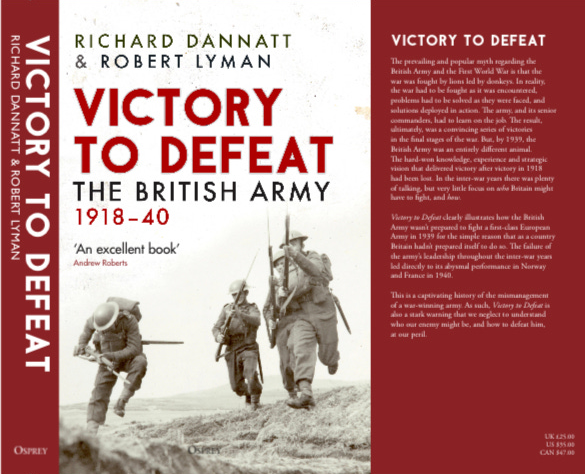
There was a fleeting moment during the One Hundred Days battles that ended the First World War in France in which successful all-arms manoeuvre by the British and Commonwealth armies, able to overturn the deadlock of previous years of trench stalemate, was glimpsed. But the moment, for the British Army at least, was not understood for what it was. With hindsight we can see that it was the birth of modern warfare, in which armour, infantry, artillery and air power are welded together able successfully to fight and win a campaign against a similarly-equipped enemy. Unfortunately in the intervening two decades the British Army simply forgot how to fight a peer adversary in intensive combat. It did not recognise 1918 for what it was; a defining moment in the development of warfare that needed capturing and translating into a doctrine on which the future of the British Army could be built. The tragedy of the inter-war years therefore was that much of what had been learned at such high cost in blood and treasure between 1914 and 1918 was simply forgotten. It provides a warning for our modern Army that once it goes, the ability to fight intensively at campaign level is incredibly hard to recover. The book that General Lord Dannatt and I have written traces the catastrophic loss of fighting knowledge after the end of the war, and explains the reasons for it. Knowledge so expensively learned vanished very quickly as the Army quickly adjusted back to its pre-war raison d’etre: imperial policing. Unsurprisingly, it was what many military men wanted: a return to the certainties of 1914. It was certainly what the government wanted: no more wartime extravagance of taxpayer’s scarce resources. The Great War was seen by nearly everyone to be a never-to-be-repeated aberration.
The British and Commonwealth armies were dramatically successful in 1918 and defeated the German Armies on the battlefield. Far from the “stab in the back” myth assiduously by the Nazis and others, the Allies fatally stabbed the German Army in the chest in 1918. The memoirs of those who experienced action are helpful in demonstrating just how far the British and Commonwealth armies had moved since the black days of 1 July 1916. The 27-year old Second Lieutenant Duff Cooper, of the 3rd Battalion The Grenadier Guards, waited with the men of 10 platoon at Saulty on the Somme for the opening phase of the advance to the much-vaunted Hindenburg Line. His diaries show that his experience was as far distant from those of the Somme in 1916 as night is from day. There is no sense in Cooper’s diaries that either he or his men felt anything but equal to the task. They were expecting a hard fight, but not a slaughter. Why? Because they had confidence in the training, their tactics of forward infiltration, their platoon weapons and a palpable sense that the army was operating as one. They were confident that their enemy could be beaten.
[…]
It would take the next war for dynamic warfare to be fully developed. It would be mastered in the first place by the losers in 1918 – the German Army. The moment the war ended the ideas and approaches that had been developed at great expense were discarded as irrelevant to the peace. They weren’t written down to be used as the basis for training the post-war army. Flanders was seen as a horrific aberration in the history of warfare, which no-right thinking individual would ever attempt to repeat. Combined with a sudden raft of new operational commitments – in the remnants of the Ottoman Empire, Russia and Ireland – the British Army quickly reverted to its pre-1914 role as imperial policemen. No attempt was made to capture the lessons of the First World War until 1932 and where warfighting was considered it tended to be about the role of the tank on the future battlefield. This debate took place in the public arena by advocates writing newspaper articles to advance their arguments. These ideas were half-heartedly taken up by the Army in the later half of the 1920s but quietly dropped in the early 1930s. The debates about the tank and the nature of future war were bizarrely not regarded as existential to the Army and they were left to die away on the periphery of military life.
The 1920s and 1903s were a low point in national considerations about the purpose of the British Army. The British Army quickly forgot what it had so painfully learnt and it was this, more than anything else, that led to a failure to appreciate what the Wehrmacht was doing in France in 1940 and North Africa in 1941-42.


