Sabaton History
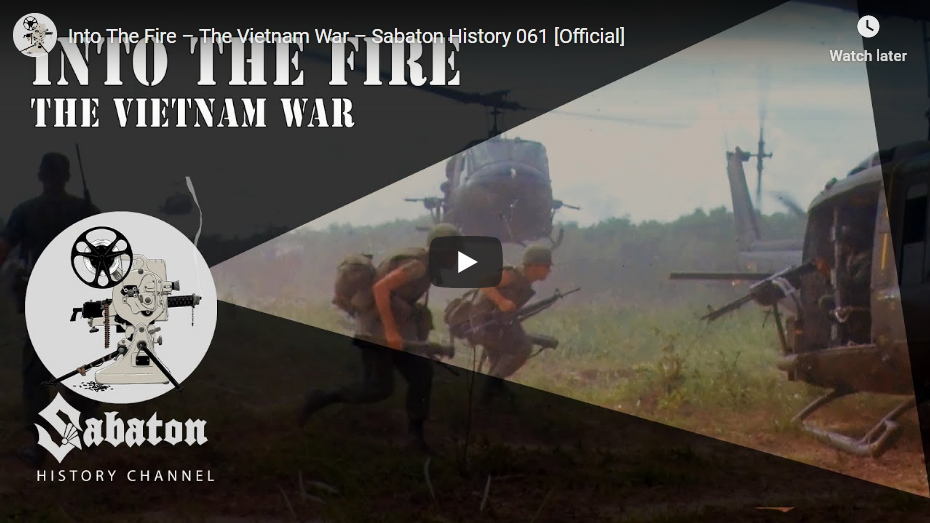
Published 3 Apr 2020During the height of the Cold War, weapons ran hot in the jungles of Vietnam. Combat along the overgrown trails, the wide open fields of rice-paddies or the marshes of the Mekong Delta, was not only exhausting and relentless, but also the place where many of the old doctrines of warfare did no longer apply. The western coalition had to face the elusive guerilla methods of the North Vietnamese forces, who prepared ambushes and traps along the marching routes. The eerie quietness of the jungle was all too often broken by a sudden explosion of violence as troops marched right into the fire.
Support Sabaton History on Patreon: https://www.patreon.com/sabatonhistory
We would like to thank the World of Tanks team for their contribution and help with the video filming. If you’re not yet a World of Tanks player, join the game and get your hands on cool in-game stuff for free via the link: https://redir.wargaming.net/w7fwclmx/…
Listen to “Into the Fire” on the album Primo Victoria:
CD: http://bit.ly/PrimoVictoriaStore
Spotify: http://bit.ly/PrimoVictoriaSpotify
Apple Music: http://bit.ly/PrimoVictoriaAppleMusic
iTunes: http://bit.ly/PrimoVictoriaiTunes
Amazon: http://bit.ly/PrimoVictoriaAmzn
Google Play: http://bit.ly/PrimoVictoriaGooglePlayCheck out the trailer for Sabaton’s new album The Great War right here: https://www.youtube.com/watch?v=HCZP1…
Listen to Sabaton on Spotify: http://smarturl.it/SabatonSpotify
Official Sabaton Merchandise Shop: http://bit.ly/SabatonOfficialShopHosted by: Indy Neidell
Written by: Markus Linke and Indy Neidell
Directed by: Astrid Deinhard and Wieke Kapteijns
Produced by: Pär Sundström, Astrid Deinhard and Spartacus Olsson
Creative Producer: Joram Appel
Executive Producers: Pär Sundström, Joakim Broden, Tomas Sunmo, Indy Neidell, Astrid Deinhard, and Spartacus Olsson
Post-Production Director: Wieke Kapteijns
Edited by: Iryna Dulka
Sound Editing by: Marek Kaminski
Maps by: Eastory – https://www.youtube.com/c/eastoryArchive by: Reuters/Screenocean https://www.screenocean.com
Music by Sabaton.An OnLion Entertainment GmbH and Raging Beaver Publishing AB co-Production.
© Raging Beaver Publishing AB, 2019 – all rights reserved.
April 4, 2020
“Into The Fire” – The Vietnam War – Sabaton History 061 [Official]
January 26, 2020
QotD: An Aboriginal woman’s view of Australia Day
We can project all sorts of fantasies onto our Aboriginal ancestors. There is scant record of their individual exploits or characters, and very few colonial Aborigines left behind a documented account of their experiences. I could, therefore, decide that my foremothers were courageous warriors of the resistance, or mysterious keepers of ancient feminine wisdoms, or I could envision them as victims and martyrs, enduring the humiliations of colonisation with grace and dignity. These romantic fantasies would be accepted as fact, and my “truth” would be applauded. My own (arguably more plausible) vision is that my Aboriginal foremothers had the good sense to form alliances with the settlers, and that they improved their own lives and their children’s prospects as a result.
I don’t begrudge any Aboriginal person a desire to fill in the blanks in their histories with romanticism, particularly given the rewards on offer. The story of white injustice and black tragedy has become the most acceptable Aboriginal tale to tell, and is now the only perspective on Aboriginal history — despite that dearth of documented accounts — that could possibly be accepted as authentic and true. To suggest that our story is not all about victimhood is bad enough; to suggest that modernity was in any way a blessing is double-plus ungood crimethink.
[…]
Those who mourn the demise of Aboriginal culture almost always regard things from the viewpoint of the men, who were indeed dispossessed of their land, and subsequently their traditions and status. Land wasn’t the only item of property they lost, however. They also lost or traded their women to the settlers, and this absorption — along with frontier warfare and disease — rapidly eroded tribal structures and doomed Aboriginal traditions to obsolescence. The settlers arrived with a wealth of goods and a shortage of females, and they were generally less enthusiastic about beating women than was customary in Aboriginal culture. In contrast, the Aboriginal men held no wealth, treated their women appallingly, and there were few taboos to prevent women from straying — and so stray they did. The men lost a lot in the invasion, while the women had little to lose and plenty to gain. Modern-day Aboriginal women who mourn the loss of traditional culture have rocks in their heads. (Metaphorically, that is. Back then, it would have been literally.)
Kerryn Pholi, “Something More: An Alternative Perspective on Australia Day”, Penthouse.au, 2018-01-22.
January 22, 2020
January 14, 2020
The Desert Fox | Rommel’s FIRST Battle in the North African Campaign | BATTLESTORM
TIK
Published 17 May 2016Erwin Rommel faces the might of the British Empire. In 3D animation, we’ll see the units, the battlefield and the tactics The Desert Fox uses to overcome the British and Australian forces at Mersa Brega and throw them out of Italian Libya. Except for Tobruk of course! The video covers Erwin Rommel’s arrival in Italian Libya up to the beginning part of the Battle of Tobruk 1941.
This video is Part 2 of the Western Desert Campaign – Part 1 (Operation Compass) is in the link below
https://www.youtube.com/watch?v=b71kd…Bibliography
Battistelli, Pier Paolo. Erwin Rommel (Command). Osprey Publishing, 2010.
Beckett, Ian F. Rommel: A Reappraisal. Great Britain, 2013.
Beevor, Antony. The Second World War. Phoenix, 2014.
Bickers, Richard Townshend. The Desert Air War: 1939-1945. Endeavour Press Ltd, 2015.
Butler, Daniel Allen. Field Mashal: the Life and Death of Erwin Rommel. Casemate Publishers, 2015.
Dimbleby, Jonathan. Destiny in the Desert: The Road to El Alamein – the Battle that Turned the Tide. Great Britain, 2012.
Liddell Hart, B.H. A History of the Second World War. Pan Books, 2015.
Hastings, Max. All Hell Let Loose: The World at War 1939-1945. HarperPress, 2011.
Jorgensen, Christer. Afrika Korps: Rommel’s 1941 Offensive (Rapid Reads). Brown Bear Books, 2014.
LaFace, Major Jeffrey L. Tactical Victory Leading to Operational Failure: Rommel in North Africa. Pickle Partners Publishing, 2014.
Lyman R. The Longest Siege: Tobruk – The Battle That Saved North Africa. Pan Books, 2011.
Moorehead, Alan. The Desert War: the Classic Trilogy on the North Africa Campaign 1940-43. CPI Group, 2012.
Nash, N. Strafer Desert General: The Life and Killing of Lieutenant General WHE Gott. Pen and Sword Books Ltd, 2013.
Neillands, Robert. The Desert Rats: 7th Armoured Division 1940-45. UK, 2005.
Neillands, Robert. Eighth Army: From the Western Desert to the Alps, 1939-1945. John Murray Publishers, 2004.
Pitt, Barrie. The Crucible of War: Volume 1: Wavell’s Command. Cassell & Co, 2001.
Playfair, Major-General I.S.O. The Mediterranean and Middle East, Volume II, “The Germans come to the help of their Ally” (1941). The Naval & Military Press Ltd, 2004.
Raugh, H. Wavell in the Middle East 1939-1941: A Study in Generalship. USA, 2013.
Reuth, Ralf Georg. Rommel: The End of a Legend. Haus Publishing, 2005.
Thompson, Dennis H. Discarded Victory – North Africa, 1940-1941. Pickle Partners, 2014.
Williamson, Gordon. Afrikakorps 1941-43 (Elite). Osprey Publishing, 2009.
January 11, 2020
Feature History – Emu War
Feature History
Published 25 Jan 2017Hello and welcome to a Feature History special; featuring the Emu Wars, the incompetence of my own country, and my miserable attempt at doing the accent I should have.
Patreon
https://www.patreon.com/FeatureHistory
https://twitter.com/Feature_History
———————————————————————————————————–
The credit for this video goes to Feature History’s employee of the month, me, for the art, animation, script, voice-over.
Music
Kevin MacLeod – “Drankin’ Song”
Kevin MacLeod – “Bama Country”
January 9, 2020
Operation Compass 1940-41 | BATTLESTORM North African Campaign Documentary
TIK
Published 21 Dec 2015The most in-depth look at Operation Compass out there! Using animations and detailed maps, let’s find out what happened in one of the greatest British (and Commonwealth) victories of the war and who was responsible for the destruction of the Italian 10th Army. This video covers the start of the North African Campaign up to the Battle of Beda Fomm.
Sources:
Barnett, C. The Desert Generals. Weidenfeld & Nicolson, 2011.
Bierwirth, J. Beda Fomm: An Operational Analysis. Pickle Partners, 1994.
Christie H. Fallen Eagles: The Italian 10th Army in the Opening Campaign in the Western Desert, June 1940. Pickle Partners 1999.
Dimbleby, J. Destiny in the Desert. Britain 2013.
Moorehead, A. The Desert War: The Classic Trilogy on the North Africa Campaign 1940-43. Aurum Press, 2014.
Playfair, I.S.O. The Mediterranean and Middle East Volume 1: Early Successes against Italy [to May 1941]. 1954.
Wahlert, G. The Western Desert Campaign. Australia, 2011.Music is my own!
January 4, 2020
Australia, the firebug country
Arthur Chrenkoff rounds up the surprisingly numerous reports of arson over the last few months in Australia:

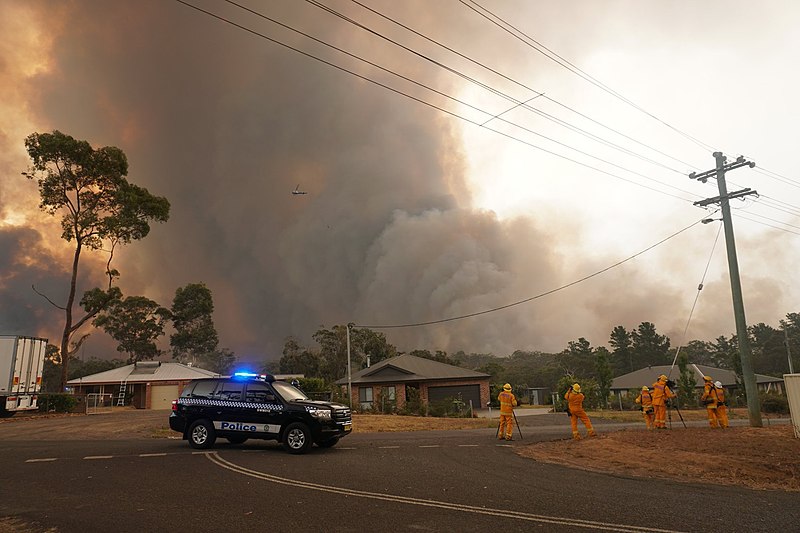
The Green Wattle Creek bushfire moves towards the Southern Highlands township of Yanderra as police evacuate residents from Yanderra Road, 21 December, 2019.
Photo by Helitak430 via Wikimedia Commons
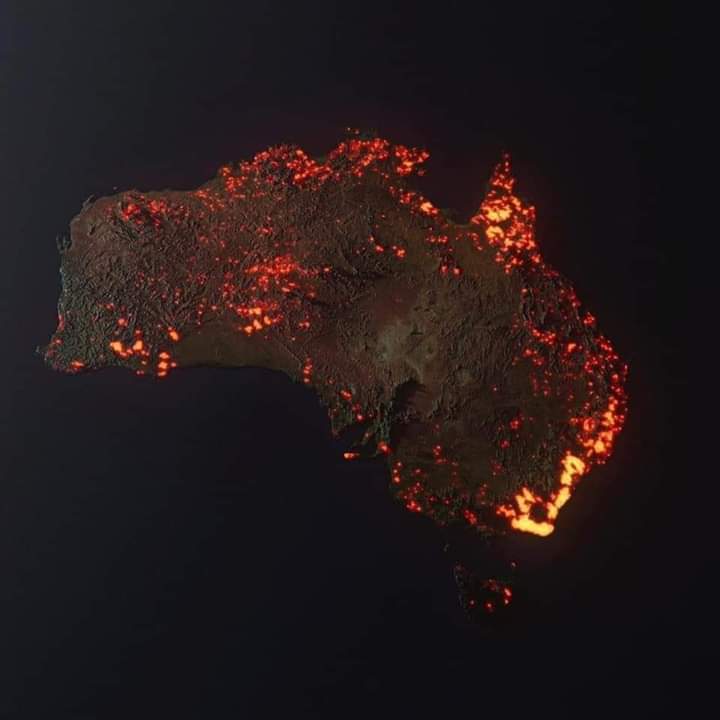
According to my calculations and estimates, the number of individuals around Australia whose arson has contributed to the current bushfire crisis has now passed 200.
This figure is not presented as a counter-argument to those who blame the fires on climate change. Most people (I hope) understand that trees tend not to spontaneously combust, no matter what the air temperature is; when we talk about bushfires starting naturally, we are talking about lightning strikes igniting tinder. The climate change argument posits that the more extreme weather conditions – higher temperatures, drought, etc. – make fires, however started, much more destructive and much more difficult to control and extinguish. These are debates to be had between climatologists, forestry experts and fire fighters. What is painfully clear, however, that Australia has a firebug crisis. It will no doubt be up to future royal commissions and inquiries to calculate exactly what proportion of the current loss and destruction can be attributed to human action, but I suspect it will be a significant one. Man might be making climate change, but man is most definitely making fires start.
Below, a sample of news reports from around the country for the past several months.
[…]
There are no conspiracies here. Though arson has been tried and called for before as a tool of terror, the Australian fires seem to result from the actions of unconnected individuals who are either disturbed or reckless. This is nothing new; as ecological criminologist Paul Read wrote back in November:
A 2015 satellite analysis of 113,000 fires from 1997-2009 confirmed what we had known for some time — 40 per cent of fires are deliberately lit, another 47 per cent accidental. This generally matches previous data published a decade earlier that about half of all fires were suspected or deliberate arson, and 37 per cent accidental. Combined, they reach the same conclusion: 87 per cent are man-made …
If I had to guess, I’d say about 10,000 arsonists lurk from the top of Queensland to the southern-most tip of Victoria, but not all are active and some light fires during winter. The most dangerous light fires on the hottest days, generally closer to communities and during other blazes, suggesting more malicious motives. Only a tiny minority will gaze with wonder at the destruction they have wrought, deeply fascinated and empowered. Others get caught up with the excitement of chaos and behave like impulsive idiots.
As for children, they are not always malicious. Children and youths follow the age-crime curve where delinquency peaks in their late teens. Fire is just one of many misbehaviours. The great majority grow out of it. Four overlapping subgroups include: accidental fire-play getting out of control; victims of child abuse — including sexual abuse — and neglect; children with autism and developmental disorders; and conduct disorder from a younger age, which can be genuinely dangerous.
The more fires, proportionally the more arsonists. And the recent mega-fires are really bringing out all the fire bugs out of the woodwork (or into the woodwork to be more accurate). It is disturbing, but sadly not surprising or unexpected. As some have suggested already, the current crisis, with its large sample of arsonists, provides a good opportunity for more research into the psychology, motivation and behaviour of fire-starters. This might help in the future, but clearly arsonists will always be with us. The task is to make their work more difficult, for example through better management of our forests to make them less combustible. But as much as bushfires are an environmental and land management problem, as we search for solution we can’t forget that they are also a criminal one.
November 26, 2019
“Women’s sports are dying, and very quickly”
Mark Steyn outlines the rise and sudden fall of women’s sports:

Rachel McKinnon on the podium after winning the Union Cycliste Internationale Masters Track Cycling World Championship, October 2018.
When the Olympic Games was revived in 1896, it was assumed by all that, as in the ancient games of Greece, the competitors would be men. The inclusion of women, said Baron de Coubertin, founder of the modern Olympiad, would be “impractical, uninteresting, unaesthetic and incorrect”.
By “uninteresting”, he meant that the innate differences between the male and female bodies ensured that women’s participation would require one to feign interest in races that were slower and jumps that were shorter. In a competitive celebration of excellence, what’s the point? So the first female Olympians were women who could hold their own with men and compete in the chaps’ events — such as Hélène de Pourtalès, who won a gold medal at the 1900 Paris Olympics as part of the Swiss sailing crew. A week later Mesdames Guerra and Moulin competed, unsuccessfully, in the hacks and hunter rounds of the equestrian events. In the croquet competition, seven men and three women participated, with the men taking all the medals.
And then came the tennis, for which they introduced a ladies’ singles event, at which Miss Charlotte Cooper (a five-times Wimbledon champ) prevailed.
These were the two models for female sportsmen, if you’ll forgive the expression: Compete in mixed events and spend most of your life losing to blokes, or compete only against other women where the lesser achievements are, as M le Baron saw it, “uninteresting”. In the case of certain activities, male sports felt obliged to spin off more genteel and (in Coubertin terms) even less interesting female variants — softball and netball, rather than baseball and basketball.
In the second half of the twentieth century, the latter model — female-only sports — prevailed, as part of what was understood by the general trend of “women’s rights”, loosely defined, and indeed more explicitly so by things like America’s Title Nine legislation.
In the second decade of the twenty-first century, the Charlotte Cooper model is collapsing, very fast. Women are back to losing to rivals who, whatever their lipstick, skirts or breast implants, are biologically male with all the inherent advantages. Miss Hannah Mouncey, for example, is six-foot-two and 220 pounds, which is rather heavier than me and an inch taller. The average Australian woman is five-foot-four-and-a-quarter and just under 157 pounds. If you have to catch a ball, standing six inches above anybody else on court comes in helpful:
Seleção feminina de handebol da Austrália.
.
É só isso o tuíte.— Ana Paula Henkel (@AnaPaulaVolei) November 23, 2019
Did Miss Mouncey procure her advantages over her sisters through a rigorous workout regime? No. She gained them by being born male. She played for Oz’s national men’s handball team until 2016, when she revealed she was transitioning and thus would henceforth play for the women’s team. She also announced she was taking up Aussie football, again for the ladies.

November 22, 2019
Battle of Savo Island 1942: America’s Worst Naval Defeat
Montemayor
Published 26 Aug 2017(Animated Map) – WARNING: lower the volume if you are using headphones. sorry for the audio.
I do not own the rights to the songs or images. This video is purely for educational purposes.
No copyright intended, all image rights go to:
-Wikipedia Commons
https://commons.wikimedia.org/wiki/Ba…-Naval History Heritage and Command
https://www.history.navy.mil/-Portrait of Richmond K. Turner
https://www.ibiblio.org/hyperwar/Onli…–USS Jarvis
http://www.navsource.org/Images contained on this site that are donated from private sources are © copyrighted by the respective owner. Images credited to the National Archives (NA, NARA); Naval History & Heritage Command (NHHC), formerly Naval Historical Center (NHC); and U.S. Navy (USN) are believed to be in the public domain. Some images credited to the United States Naval Institute (USNI) are from © copyrighted collections, the rest are believed to be in the public domain.
All songs by Ross Budgen https://www.youtube.com/channel/UCQKG…
-“Welcome to Chaos”
-“House Lannister Theme” – Game of Thrones Season 4 (Original composition)
-“Run”
-“Parallel”Sources-
Hammel, E. (2017, March 6). “First Battle of Savo Island: The U.S. Navy’s Worst Defeat”. Retrieved August 25, 2017, from http://warfarehistorynetwork.com/dail…
Hornfischer, J. D. (2011). Neptunes Inferno: the U.S. Navy at Guadalcanal. New York: Bantam Books.
Newcomb, R. F., & Newcomb, R. F. (2002). The Battle of Savo Island. New York: H. Holt.
Stille, M. (2013). The Naval Battles for Guadalcanal 1942 (Vol. 225). Oxford, UK: Osprey Publishing.
Toll, I. W. (2016). The Conquering Tide: war in the Pacific Islands, 1942-1944. New York: W.W. Norton & Company.
USMC Casualty list taken from:
https://www.ibiblio.org/hyperwar/USMC…
November 20, 2019
Sterling Meets Owen: The Australian F1 Submachine Gun
Forgotten Weapons
Published on 20 Sep 2019http://www.patreon.com/ForgottenWeapons
Cool Forgotten Weapons merch! http://shop.bbtv.com/collections/forg…
The Australian Owen submachine gun was once of the best overall SMG designs of the Second World War, and when Australia decided to replace them in the 1960s, the new F1 design had big shoes to fill. The basic configuration of the top-mounted magazine remained, but coupled with elements of the Sterling SMG. The F1 used a simple sheet metal tube receiver with elements welded on, and a typical open bolt, blowback operating system. The unique rear system of separating the recoil spring from the main receiver body in the Owen was not included, instead using a basic open tube and large diameter mainspring. The sights are curiously still mounted to the right side of the gun, with a thin folding rear sight and a front sight affixed to the magazine well. These simplifications did have the effect of lightening the F1 compared to the Owen, which is a nice improvement. The F1 was manufactured from 1962 until 1973, with a total of about 25,000 made. It served in Vietnam and through the 1990s, when replaced by a variant of the F88 Austeyr. All reports are that it was a perfectly adequate submachine gun, but it did not earn the affection of troops like the Owen had.
Contact:
Forgotten Weapons
6281 N. Oracle #36270
Tucson, AZ 85704
November 11, 2019
Too Late and Not Much Better: the Austen Mk II SMG
Forgotten Weapons
Published on 12 Sep 2019http://www.patreon.com/ForgottenWeapons
Cool Forgotten Weapons merch! http://shop.bbtv.com/collections/forg…
The story of the Austen submachine gun did not end when the Mk I guns were pulled from combat service in 1944. The manufacturer continued to work on an improved version, which would be ready in 1946, after the end of World War Two. Only 200 were made total, and they were both adopted and declared obsolete in August of 1946.
The changes made to the MkII Austen mostly involved increasing the use of die cast components, which fit the manufacturer’s tooling and experience. The front grip and magazine well casting was enlarged, and the whole rear assembly was made into a second cast part integrating the rear sight, stock mounting and latch, and fire control group. The one significant internal change was to remove the firing pin from the telescoping recoil spring assembly and make it an integral feature of the bolt face.
Many thanks to the Royal Armouries for allowing me to film this very rare artifact! The NFC collection there – perhaps the best military small arms collection in Western Europe – is available by appointment to researchers:
https://royalarmouries.org/research/n…
You can browse the various Armouries collections online here:
https://royalarmouries.org/collection/
Contact:
Forgotten Weapons
PO Box 87647
Tucson, AZ 85754
November 10, 2019
The Diggers’ Dismay: Austen Mk I SMG
Forgotten Weapons
Published on 11 Sep 2019http://www.patreon.com/ForgottenWeapons
Cool Forgotten Weapons merch! http://shop.bbtv.com/collections/forg…
When World War Two began, Australia saw little threat of invasion from Germany (obviously), and sent a substantial number of firearms to Britain to help arm the Home Guard there, which was seriously concerned about the possibility of a German invasion. When Japan and Australia declared war in December 1941, the situation immediately became much more serious for Australia, and the government began looking for arms.
At the start of the war, there were effectively no submachine guns at all on the continent — just a couple examples. These included an MP38 somehow confiscated by Australian customs, which would take on a significant role. Australia looked to Britain for arms, and they were sent a technical data package to produce the Sten MkII — but found the design pretty underwhelming. Australian manufacturers decided to make their own improvements to it, using elements of the MP38 — specifically the sealed telescoping recoil spring system and underflowing stock. They also gave the gun a pair of pistol grips for improved handling.
The Owen SMG was going into production at this time, and had been in development for a while under private civilian supervision. The Australian Sten, called the Austen, lacked that developmental track record and it went into production without passing proper trials. It faced significant manufacturing delays and reliability problems, and was not well liked by troops — in contrast to the excellent Owen. The Austen was ultimately made in smaller numbers than the Owen (19,914 of the MkI guns) and pulled from combat use in August of 1944.
Many thanks to the Royal Armouries for allowing me to film this rare artifact! The NFC collection there — perhaps the best military small arms collection in Western Europe — is available by appointment to researchers:
https://royalarmouries.org/research/n…
You can browse the various Armouries collections online here:
https://royalarmouries.org/collection/
Contact:
Forgotten Weapons
PO Box 87647
Tucson, AZ 85754
November 5, 2019
Dragons – The Origin of Dragons – Extra Mythology
Extra Credits
Published 4 Nov 2019Check out MinuteEarth’s video on the biology of dragons! https://www.youtube.com/watch?v=3n1DC…
Dragons are one of the most popular creatures of myth and legend and for good reason! These guys are everywhere! Almost every culture has some form of dragon tale. From the wicked wyrms of western Europe, the benevolent Lung dragons of China, the feathered serpent Quetzalcoatl, to the Rainbow Serpent of Aboriginal myth, dragon like figures take on many different forms and roles. But how and why do these serpentine beasts and gods appear in so many different legends? Gather round the campfire and let’s chat!
Join the Extra Mythology Patreon! https://www.patreon.com/extramythology
October 29, 2019
Greenland to USA, Australia to war, and French Colonies to…? – WW2 – OOTF 004
World War Two
Published 27 Oct 2019In another edition of our Q&A format, Indy answers some questions about Greenland after the German occupation of Denmark, the state of Australia and the fate of the French Colonies.
Ask your own question for OOTF: https://community.timeghost.tv/c/Out-…
Join us on Patreon: https://www.patreon.com/TimeGhostHistory
Or join The TimeGhost Army directly at: https://timeghost.tvFollow WW2 day by day on Instagram @World_war_two_realtime https://www.instagram.com/world_war_t…
Join our Discord Server: https://discord.gg/D6D2aYN.
Between 2 Wars: https://www.youtube.com/playlist?list…
Source list: http://bit.ly/WW2sourcesHosted by: Indy Neidell
Produced and Directed by: Spartacus Olsson and Astrid Deinhard
Executive Producers: Bodo Rittenauer, Astrid Deinhard, Indy Neidell, Spartacus Olsson
Creative Producer: Joram Appel
Research by: Rune Vaever Hartvig
Edited by: Mikołaj Cackowski
Map animations: EastoryColorisations by Norman Stewart and Julius Jääskeläinen https://www.facebook.com/JJcolorization/
Eastory’s channel: https://www.youtube.com/channel/UCEly…
Archive by Screenocean/Reuters https://www.screenocean.com.Sources:
IWM: H 10569, A 1524, CM 64A TimeGhost chronological documentary produced by OnLion Entertainment GmbH.
From the comments:
World War Two
3 days ago
We get a ton of questions about the war on a daily basis. A lot of them are already answered in the YouTube comments to you all directly, but because some questions are very interesting indeed, we like to showcase some of them on the channel. Because the YouTube comments are hard to navigate, we have made a section on our forum where you can submit questions to be covered in Out of the Foxholes. You can do that here: https://community.timeghost.tv/c/Out-of-the-Foxholes-QsCheers,
The TimeGhost team
August 26, 2019
Australian fertilizer run-off and the (remains of the) Great Barrier Reef
The Great Barrier Reef used to be one of the natural wonders of the world, but as we were told about ten years ago, unless Australians gave up fossil fuels (or was it electricity?), the reef had bare months to survive. As we’re years past that inflexible deadline, we have to assume that the reef is now dead, dead, dead. Yet there are apparently still state or federal regulations in place to protect the (former) reef that Australian farmers are struggling against:

Great Barrier Reef by James_W_Thompson
“IMG_5035-1” by James_W_Thompson is licensed under CC BY-NC-SA 2.0
Our man in Tolga (north Queensland) has written to the local press on the absurd green tape tying up farmers.
QUOTE
The ever-tightening regulatory stranglehold on farmers by governments “for the health of the Reef” (The Express, 21/8) is based on what Professor Peter Ridd has called “faulty science”.Fertilisers are expensive and they aren’t used wastefully. They’re plant food; if the crops don’t consume them then the neighbouring vegetation, on land or in waterways, will – long before they get to the Reef.
If fertilisers were running off farms there’d be big green plumes leading downhill from them, easily visible on Google Earth. There aren’t. Likewise with herbicides and pesticides, there’d be big plumes of dead flora or fauna visible to drones. Again; there aren’t. It may have happened in the past, but these aren’t current problems.
Terrestrial silt run-off is a different matter to fertilisers and herbicides/pesticides. It has been pluming out from rivers since time began. The coastal reefs have always experienced it.
Just 15,000 years ago during the last ice-age the seas were 120 metres lower, the Reef’s current site was a coastal plain, and the Reef clung to the edge of the continental shelf. Everything that came out of the rivers washed over the whole Reef. And, yes, there was a lot of silt during the ice-age. CO2 was much lower due to the cooler seas (Henry’s Law), so plants were sparser. It was colder and drier so there was less rain to water what plants there were.
Aboriginal tribes were doing it tough, so they used firestick farming to get what small game there was. That left a lot of bare earth which blew as dust into valleys and was washed out to sea when the rains did come.
But it’s different now. Much of the main Reef area is 40 to 70 kilometres out to sea, and as Professor Ridd said, the prevailing south-easterly wind and currents keep terrestrial run-off much closer to shore. Professor Ridd also notes that more clean ocean water flows through the Reef each day than flows from our rivers each year.
Nonetheless, the mud-meme is being heavily promoted at present; “Earlier this year, a muddy plume of polluted water hit our Reef. It was so big you could see it from space.” Search the internet for “Muddy plume extends to Great Barrier Reef images from space” and there’s several alarmist websites (including “our” ABC) showing just one obviously-modified image.