Quotulatiousness

August 12, 2019

Australia’s government broadband fiasco might be a useful lesson for Senator Warren

Filed under: Australia, Business, Economics, Government, Politics, Technology, USA — Tags: , , — Nicholas @ 03:00

In the race for the Democratic party’s presidential nomination, Senator Elizabeth Warren recently proposed a government-provided broadband rollout across the United States to compete with or supplant the existing private ISPs. Arthur Chrenkoff suggests that looking at Australia’s experience with a very similar plan might encourage her to abandon her proposal after a brief airing on the campaign trail:

Senator Elizabeth Warren speaking at the Iowa Democrats Hall of Fame Celebration in Cedar Rapids, Iowa, on 9 June, 2019.
Photo by Lorie Shaull via Wikimedia Commons.

Maybe Senator Warren should have a pow-wow first with IT experts from Australia, who could enlighten her about our country’s 12-years-and-counting saga of the National Broadband Network, a Labor government initiative that the -then leader of the opposition, Tony Abbott, described as “a white elephant on a massive scale” but later adopted and continued while in government.

It started in 2007 as a policy for a government-rolled out broadband network, in most areas duplicating internet services already provided by private sector providers (mainly through the existing copper wire telephony network), which would be available as an option to all Australian households. In most cases it would be achieved through wired technology (fibre to the premises, later downgraded to a cheaper fibre to the node) with a satellite connection available to the most remote areas where cabling was impractical.

I remember thinking then that the project was an absurd waste of taxpayers’ money for a service of the type that telecommunication companies would be able and willing to provide in any case. At most, there was an argument that the government could step in and provide the infrastructure in some country areas where there was no commercial case for the private providers to proceed. Call me a clairvoyant but it was pretty clear to me that “broadband for all” would take a lot longer to roll out that planned, would cost significantly more than initially budgeted, and would very likely be technologically obsolete by the time it was finished.

August 6, 2019

QotD: Sheep and goats

Filed under: Australia, Britain, Cancon, Humour, Quotations, USA — Tags: , — Nicholas @ 01:00

… the major English-speaking countries of the world (England, the USA, and to a lesser extent because of their longer history as colonies, Canada and Australia (no, New Zealand isn’t “major” yet, but it’s getting there)) have tended to be more inclined to view their people as citizens who can make their own decisions in most things than as subjects who need to be told what to do. Despite the depredations of power-hungry bureaucrats and politicians, all these nations are still in many ways more free than almost the entirety of the rest of the world. None of us have official bodies telling us what words we can use or what the proper spelling of new words is.

It’s the little things like this that point to the mindset under them. Or as Pratchett memorably put it in Small Gods: “Sheep are stupid and have to be driven. But goats are intelligent, and need to be led.” European nations treat their people like sheep. The USA treats its people more like goats, although the would-be shepherds keep pushing. Pratchett did not add that trying to drive goats will often earn the would-be driver a kick in the nadgers, but it’s worth remembering. Because Americans are goats. We can be led by the right people for the right reasons. Try to drive us, and you will find your family jewels suffering.

Kate Paulk, “The Difference Between Citizens And Subjects”, Kate Paulk, 2017-07-17.

July 26, 2019

Post-Brexit, consider CANZUK

Filed under: Australia, Britain, Cancon, Economics — Tags: , , — Nicholas @ 03:00

Tom Colsey explains why in a post-Brexit world, CANZUK might be an attractive economic alternative:

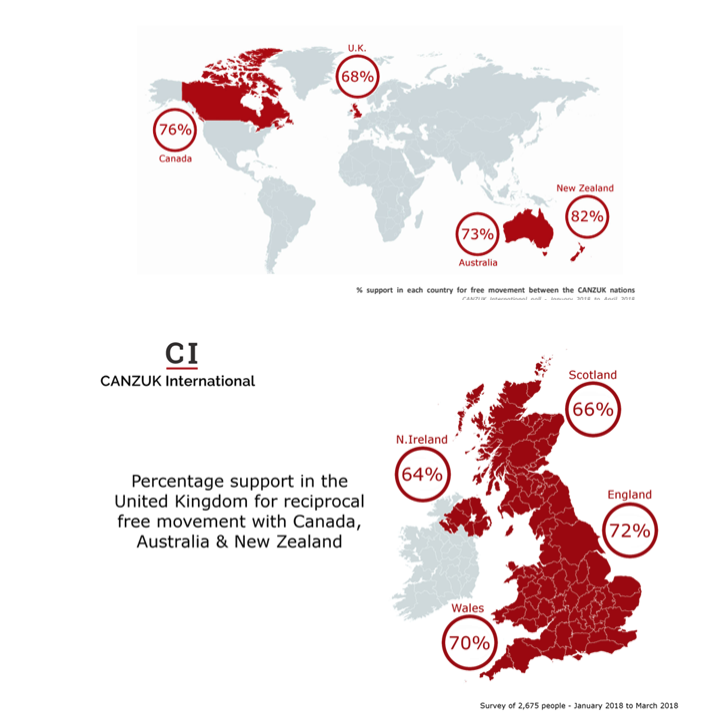
One possible option would mean the island nation would initially turn away from Europe toward certain anglophone Commonwealth nations and former colonies. I talk, of course, of the promising CANZUK proposal that would see Canada, Australia, New Zealand, and the United Kingdom band together with voluntary agreements on multilateral free trade and movement, forming a bloc that would singularly hold the third largest nominal GDP in the world.

The Free Movement Proposal

What makes CANZUK unique is how viable and well-thought-out it is on every level. Unlike within the EU, the grouping would not be consolidated through impositional treaties laced with unpleasant footnotes delegating political power to a bureaucratic institution. Freedom of movement would assist meeting labor market demands across the countries, yet this would be prohibited to those with serious criminal records.

Everything the EU seemed to get wrong about forming unions under a liberal-internationalist pretense, CANZUK proposals seem to get right. They account for social attitudes and the dangers of becoming impositional, eroding national sovereignty. Free movement within the European Union had been widely reviled by the domestic population — and is part of the reason Britain now is set to leave. Yet the very same population overwhelmingly favor the same principle, alternatively implemented, across the CANZUK nations, polling outright majorities in favor in every region.

Perhaps a reason for this is that while the nations are extremely close culturally, they are also resoundingly similar socio-economically. Despite their distances, the states could have been separated at birth (of course, they do share the same monarch).

July 16, 2019

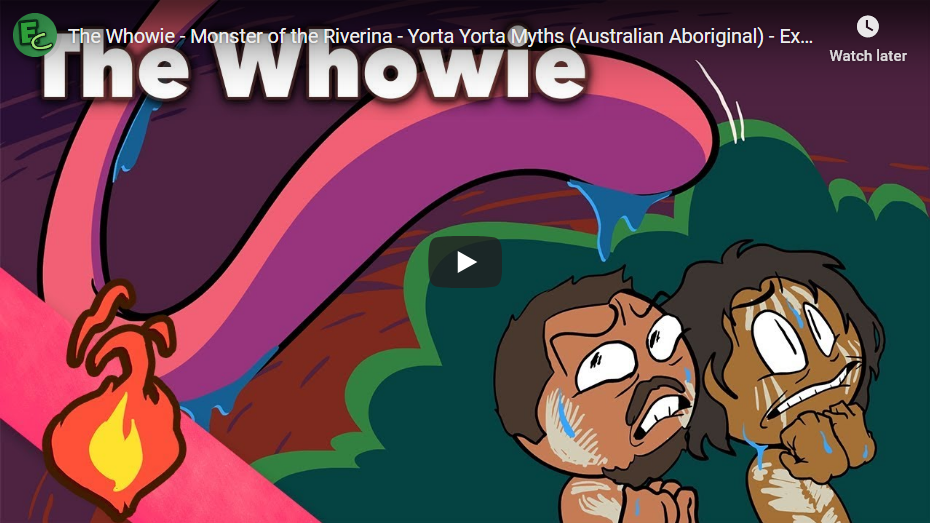
The Whowie – Monster of the Riverina – Yorta Yorta Myths (Australian Aboriginal) – Extra Mythology

Filed under: Australia, History — Tags: — Nicholas @ 04:00

Extra Credits
Published on 15 Jul 2019

Join the Patreon community! http://bit.ly/EMPatreon

Once, the Tongala River, which most maps now call the Murray, was a place of peace where the Water-Rat Tribe could live with ease. But then one day appeared the Whowie: a great frog-headed lizard, long and fat and slow, prowling the banks.

July 13, 2019

Local Boy Saves Nation: The Australian Owen SMG

Forgotten Weapons
Published on 8 May 2019

Preorders now open for my book, Chassepot to FAMAS: French Military Rifles 1866-2016! Get your copy here: https://www.kickstarter.com/projects/…

http://www.patreon.com/ForgottenWeapons

Cool Forgotten Weapons merch! http://shop.bbtv.com/collections/forg…

The Owen submachine gun is one of the ugliest SMGs ever designed, and yet also one of the most beloved by its users. The original basis for the gun was a .22 rimfire submachine gun designed by 23-year-old Australian Evelyn Owen. That prototype was found by his neighbor Vincent Wardell after Owen left for military service. Wardell was the manager of Lysaght Works, an engineering firm, and thought that the gun might be the basis for a useful military SMG. As it turned out, he was right – it became the standard SMG of The Australian military through World War Two and the Korean War, and was one of the best such guns of that period. For more details on the history of the Owen, see my full article:

https://www.forgottenweapons.com/subm…

Thanks to Movie Armament Group in Toronto for giving me the opportunity to bring you this video! Check out MAG on Instagram: https://instagram.com/moviearmamentsg…

http://www.moviearms.com

Contact:
Forgotten Weapons
PO Box 87647
Tucson, AZ 85754

July 2, 2019

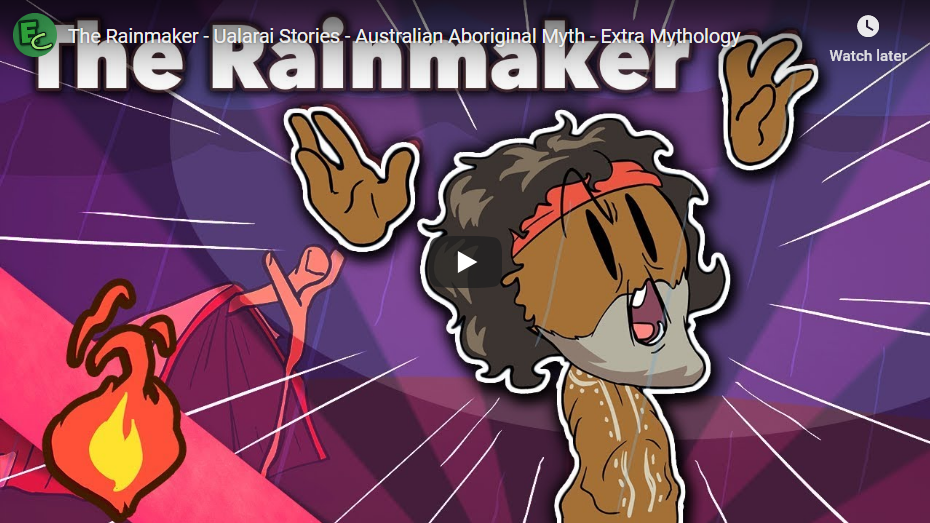
The Rainmaker – Ualarai Stories – Australian Aboriginal Myth – Extra Mythology

Filed under: Australia, History — Tags: , — Nicholas @ 04:00

Extra Credits
Published on 1 Jul 2019

Join the Patreon community! http://bit.ly/EMPatreon

During a terrible drought, the people wondered why Wirreenun, the Rainmaker, was doing nothing, if he was the one who could bring the rains back. It turned out that he really needed to do an extremely complex elaborate ritual to make the people learn how to take care of themselves.

June 29, 2019

Determining who the “original” inhabitants were

Filed under: Africa, Americas, Australia, Europe, History, Pacific, Science — Tags: , , , — Nicholas @ 03:00

It’s become quite common in some countries to pay formal lip service to the “original” peoples who inhabited the land before being dispossessed of that territory by various Europeans. Actually determining who were the first human inhabitants, however, is much more fraught … you can’t exactly expiate some residual guilt of your culture by acknowledging the previous culture if the previous culture in their turn dispossessed an even earlier group, can you? How far down the rabbit hole do you need to go? Tim Worstall explains:

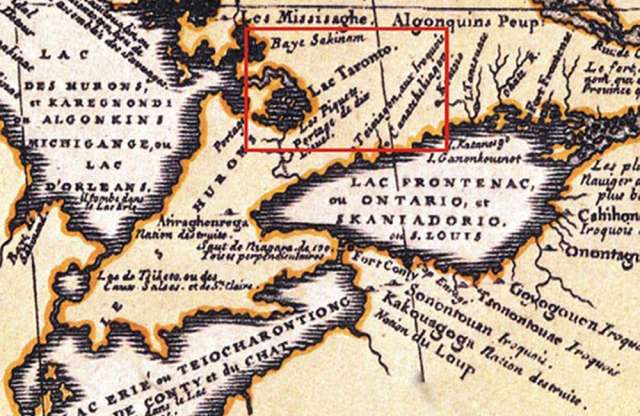
Detail from a 1688 map of western New France by Vincenzo Coronelli that locates “Lac Taronto” at Lake Simcoe.
City of Toronto Culture Division/Library and Archives Canada via the National Post

… within all that the accurate answer to “Whose land are we on?” is the land of the latest bunch of murderous bastards who killed all the previous inhabitants. Perhaps moderated to say the peeps who killed all the previous men then dated the remaining womenfolk. Because once we’ve got past that nullius stage that’s the way it has been. The Moriori are in short supply these days on the Chatham Islands given that the Maori decided to eat them.

The original inhabitants of the British Isles, the Beaker Folk, were entirely replaced by the next lot, the Iron Age Celts and similar. The Angles displaced to the west the Romano Celts in their turn, detailed DNA studies showing rather more of the female side of the R-C’s bred into the new population than the male. The Franks weren’t indigenous to France, the Allemani to Germany, the Turks to Turkey.

In fact, we’ve between little and no proof that the varied Amerinds were the original inhabitants of the lands where the White Europeans found then from 1492 onwards. In the case of both the Incas and Aztecs as political powers, proof they weren’t. And horses and Plains Indians simply weren’t a thing until the Eurasian horse was introduced post 1492.

Basically, this is indeed true. Anywhere is the possession of simply the last group of people to have slaughtered, or outbred, the previous group.

An interesting observation – if we apply the oft stated Americas example elsewhere, that Whitey stole it all and should give it back, then the Bantu should be back in Nigeria and Central Africa returned to the Pygmies, Southern to the Khoi San. We don’t say that and for the life of me I can’t work out why.

June 4, 2019

QotD: Freedom of speech and “balancing” competing rights

Filed under: Australia, Cancon, Liberty, Quotations, USA — Tags: , , , — Nicholas @ 01:00

“They used to pay lip service to the Voltaire argument,” [“I disagree with what you say, but will defend to the death your right to say it”] says Steyn, “but now they say that every other right trumps freedom of speech. The rights of identity groups take precedence. Since there is no document in the British Commonwealth to support free-speech absolutism, as you have in the United States, what’s happened in our time is that there is a view of competing rights. Section 13 in Canada. Section 18 in Australia. Human rights commissions everywhere. And it’s all done in the name of ‘striking a balance’. The minute you talk about striking a balance, you are on the wrong side of the line, because that cure is worse than the disease. We have to take chances with repellent and repulsive speech in order to retain free speech.

“And actually it’s no better in the United States. On the one hand you have the absence of a monarchy and free-speech absolutism, but on the other hand you prostrate yourselves before judges. I’m in the fifth year of a lawsuit that started with a 140-word blog post — there’s not much of a First Amendment when that happens. And then, on your college campuses, you have the debate about ‘acceptable’ and ‘safe’ speech. You have a tiny little Canada on each campus, with the same sort of shrunken, shrivelled public discussion. ‘Safe speech’ is a road to hell. Their goal is the abolition of hate — the abolition of a human emotion. They want everyone to have this glassy-eyed look, celebrating diversity. And they don’t recognise their own totalitarianism.”

Mark Steyn, interviewed by John Bloom, “Mark Steyn, Cole Porter and Free Speech”, Quadrant, 2017-05-11.

May 7, 2019

Arthur Chrenkoff relates his own economic “a-ha!” moment

Filed under: Australia, Economics, Europe, Italy — Tags: , , , , — Nicholas @ 03:00

He says he’s never had a religious or spiritual revelation, but he did have one that was pure economics:

By way of background, you have to remember that I grew up under declining communism. As someone has once wryly remarked, in a planned economy everything is planned except for the economy. In Poland of my childhood and early teenage years virtually everyone was employed by the state and so virtually all the income was derived from the state, except, of course, for the rampant black market. Shops were few and generally poorly stocked. Some goods were unobtainable, others required queuing and a lot of luck (or connections) to get, and either way most were of inferior quality to that in the West. Even if you have managed to save enough money, you had to get onto a waiting list to acquire an apartment, car, or household goods. The wait could take decades. Life’s necessities were more widely available but quite haphazard in their distribution. During the crisis years of the 1980s, most food items required ration cards. People literally had to scheme and plot to get their hands on toilet paper. Sure, the Eastern European socialism for most part managed to provide everyone with a bare minimum of subsistence so that no one starved anymore, but beyond that the economic system was shambles, never managing to produce the sufficient quantity and quality of what people needed and wanted. We all knew that the West, by comparison, was a kingdom of plenty, thanks the workings of that scary capitalism, but as a kid I wouldn’t be able to explain to you how, by contracts to our socialism, it somehow managed to produce in abundance all those cars, toys and oranges and bananas. We were told by the authorities that it was all a sham, built on exploitation of workers and resulting in widespread poverty. But we knew enough to know that everything is relative. When the Jaruzelski regime in the early 80s trumpeted in the government-run media (there were no other legal ones) its charity initiative to send sleeping bags to the homeless of New York, an anonymous wag somehow managed to place and ad in one of the papers “Will swap a two bedroom apartment in Warsaw for a sleeping bag in New York”.

I was 15 when I left, unbeknownst to me two years before the fall of the Wall, and spent 16 months in Italy before finally arriving to start a new life in Australia. For a kid from Eastern Europe, Italy was a revelation; I didn’t know enough about anything then to realise that the country we thought was a paradise has always in reality been somewhat of a hot mess. Australia at the end of the decade of wide-ranging economic reforms, which really opened the country to the world and unleashed its creative potential, was even more of contrast to the drabness, shortages and absurdity of the “real socialism” I grew up under.

The story of my economic experience is very brief: one day, not long after settling in Australia, I was in a car, being driven somewhat off the beaten path, through what can be described as a light industrial area. Then, all of a sudden, among all the rather anonymous sheds and buildings I saw a large, free standing store. I can’t remember its name but I remember it was selling carpets. And that’s all. I grew up with few shops around, which, no doubt in part because European cities tend to be a lot more condensed, occupied the same space as the living. But here, here was a whole store, a very large store that specialised in one product only – floor coverings – and it was, relatively speaking, sitting in the middle of nowhere. That it was in business, that it somehow managed to operate, indicated to me that people, many people, actually drove over here, from some distances away, for no other purpose than just to buy one thing – a carpet. So strange. So peculiar. This was my revelation, my economic epiphany in a back seat: this whole capitalist system must truly be incredibly complex and magnificent – and superior to all the alternatives – if it means a shop like this can thrive selling one particular type of product to people who don’t live anywhere near it.

January 16, 2019

A Tourism Video For Australia (Made By A New Zealander)

Filed under: Australia, Humour — Tags: , — Nicholas @ 02:00

chrisdrabble
Published on 3 Dec 2018

“A Tourism Video For Australia (Made By A New Zealander)” is my mock tourism video advertising North Queensland, Australia.

“Fancy a swim in a tropical paradise? You can’t do that here because there’s crocodiles.”

So come and explore Australia’s vast range of animals that want you dead, including ‘salties’, ‘stingers’, snakes, spiders, and cassowaries.

Please LIKE, SUBSCRIBE, and turn on NOTIFICATIONS for more mock tourism videos as I set my sights on promoting Australia’s other states, as well my home country, New Zealand.

December 22, 2018

Christmas Dishes From Around the World – Anglophenia Ep 44

Filed under: Australia, Britain, Food, France, Germany, India, Italy, Japan — Tags: , — Nicholas @ 04:00

Anglophenia
Published on 16 Dec 2015

Join us for an international holiday feast, as Anglophenia’s Kate Arnell takes a look at several traditional Christmas dishes from around the world. Starting with the U.K., of course…

December 7, 2018

Australian parliament votes to weaken encryption

Filed under: Australia, Government, Law, Liberty, Technology — Tags: , , — Nicholas @ 03:00

Scott Shackford reports on the latest bit of oddness from the southern hemisphere:

Pretty much every single person in the tech industry, human rights circles, and academia warned the Australian government that forcing online platforms to weaken encryption would lead to disastrous results. Nonetheless, lawmakers are pushing forward — and it’s not just Australians who will suffer as a result.

Last night, Australia’s parliament rushed through the Assistance and Access Bill of 2018 right as their session was coming to a close. The bill gives various government agencies the authority to demand that tech and communication platforms provide them secret bypass routes around encrypted messages.

This is what is known as an encryption “backdoor,” and it’s a bad idea. Governments insist such tools are needed to fight crime and terrorism. The problem is that an encryption backdoor doesn’t care who uses it: If there’s a mechanism to bypass privacy security on a communication system, it can be exploited by anybody who knows how. That includes hackers, thieves, officials from authoritarian governments, and all sorts of dangerous people (including, of course, the very government people who insist they’re trying to protect us). That’s why tech companies have spent years fighting against the idea.

Weak encryption is a threat to the health of any tech platform that involves transferring data, and governments know that. So they insist they’re not demanding encryption backdoors while attempting to enact policies that pretty much demand them.

The Assistance and Access Bill won’t just grant the Australian government the power to demand that everybody from Facebook to Whatsapp help them bypass security to access private communications. The bill will let officials order companies, through “technical capability notices,” to alter their programming to facilitate snooping. And it gives the government the authority to force the tech employees who implement the changes to keep them secret. Break that secrecy, and the employees can face up to five years in jail.

November 30, 2018

QotD: A university education is not for everyone

Filed under: Australia, Education, Quotations — Tags: , , — Nicholas @ 01:00

We went through a generation in this country where parents discouraged their children from going into trades, and they said to them, “the only way you will get ahead in life is to stay at school until year 12, go to university.” Year 12 retention rates became the goal, high year 12 retention rates became the goal. Instead of us as a nation recognising there are some people who shouldn’t go to university, and what they should do is at year 10, decide they are going to become a tradesman. They will be just as well off, and from my experience and observation, a great deal better off than many others. I think we have to change that, and it’s a very big challenge because 30 years ago, we started getting this foolish bind that everybody had to go to university. Everybody doesn’t have to go to university, and a lot of people will be a lot better off if they don’t go to university and they recognise that at age 15 or 16, and go down the technical stream.

John Howard, interviewed by Mark Riley, 2005-03-06.

November 2, 2018

QotD: Modern men are “the sorriest cohort of masculine Homo sapiens to ever walk the planet”

Filed under: Africa, Australia, Books, Quotations, Science — Tags: , — Nicholas @ 01:00

A new book claims even modern athletes could not run as fast, jump as high, or have been nearly as strong as our predecessors.

The book, Manthropology: The Science of the Inadequate Modern Male, by Australian anthropologist Peter McAllister, describes many examples of the inadequacy of the modern male, calling them as a class, “the sorriest cohort of masculine Homo sapiens to ever walk the planet.”

Given spiked running shoes, Indigenous Australians of 20,000 years ago could have beaten today’s world record for running 100 and 200 meters. As recently as last century, some Tutsi males in Rwanda could have easily beaten the current high jump world record, and bodybuilders such as Arnold Schwarzenegger would have been no match in an arm wrestle with a Neanderthal woman.

Twenty thousand years ago six male Australian Aborigines chasing prey left footprints in a muddy lake shore that became fossilized. Analysis of the footprints shows one of them was running at 37 kph (23 mph), only 5 kph slower than Usain Bolt was traveling at when he ran the 100 meters in world record time of 9.69 seconds in Beijing last year. But Bolt had been the recipient of modern training, and had the benefits of spiked running shoes and a rubberized track, whereas the Aboriginal man was running barefoot in soft mud. Given the modern conditions, the man, dubbed T8, could have reached speeds of 45 kph, according to McAllister.

McAllister also presents as evidence of his thesis photographs taken by a German anthropologist early in the twentieth century. The photographs showed Tutsi initiation ceremonies in which young men had to jump their own height in order to be accepted as men. Some of them jumped as high as 2.52 meters, which is higher than the current world record of 2.45 meters.

Lin Edwards, “Modern men are wimps, according to new book”, Phys.org, 2009-10-21.

October 25, 2018

The History of Australia

Filed under: Australia, Britain, History — Tags: , , , , , — Nicholas @ 02:00

History With Hilbert
Published on 23 Aug 2017

The entire history of Australia from the earliest humans until somewhere after World War II where I lost interest.

« Newer PostsOlder Posts »

Powered by WordPress