Quotulatiousness

October 29, 2013

Colby Cosh on IQ

Filed under: Japan, Science — Tags: , , , — Nicholas @ 00:01

In his latest Maclean’s column, Colby Cosh talks about the odd evolutionary advantages that accrue as you get further from the equator:

A new study in the biometric journal Intelligence presents surprising data from Japan that reveal that IQ, imputed from standardized tests given to a large random sample of Japanese 14-year-olds, varies strongly and persistently with latitude. The Japanese are usually thought of — even by themselves — as being quite homogenous ethnically; the myth of the sturdy, super-cohesive “Yamato race” has not yet been entirely obtruded out of existence. But it turns out that the mean IQs of students in Japanese prefectures apparently vary from north to south by two-thirds of a standard deviation — a spread almost as large as the “race gaps” in cognitive performance which trouble education scholars in multicultural countries like ours. Sun-drenched Okinawans, as a group, do not test as well as the snowbound citizens of Akita.

It is an article of liberal faith that IQ is a bogus tool cooked up by white supremacists to justify imperialism and slavery. I am happy to nod along, but the monsters who developed IQ tests certainly never planned on creating strife between the two ends of Honshu Island. Kenya Kura’s study demonstrates the usual statistical connections between IQ and social outcomes, including physical height, income, and divorce and homicide rates. IQ may be a phony racist artifact, but if shoe size predicted life success as well as those stupid little logic puzzles do, every middle-class parent you know would have one of those Brannock foot-measuring thingies mounted proudly on the wall. That is why IQ persists in the top drawer of the psychometrics toolbox.

October 24, 2013

Explaining Japanese culture – “Freud would have a field day”

Filed under: Japan, Media — Tags: , , , , , — Nicholas @ 09:08

It’s commonplace to say “Japan is weird” (I’ve said it myself many times), but even with the constant repetition, I didn’t realize just how weird Japan has become (somewhat NSFW … better not watch this at the office):

Published on 22 Oct 2013

Japan is a country that is dying — literally. Japan has more people over the age of 65 and the smallest number of people under the age of 15 in the world. It has the fastest negative population growth in the world, and that’s because hardly anyone is having babies. In these difficult times, the Japanese are putting marriage and families on the back burner and seeking recreational love and affection as a form of cheap escape with no strings attached. We sent Ryan Duffy to investigate this phenomenon, which led him to Tokyo’s cuddle cafes and Yakuza-sponsored prostitution rings.

October 3, 2013

Postwar horror – the misery didn’t stop with VE day or VJ day

Filed under: Books, Europe, Germany, History, Japan, Media, Pacific, WW2 — Tags: , , , — Nicholas @ 08:38

In the last couple of years, I’ve read several books about the aftermath of World War Two, including Tony Judt’s Postwar: A History of Europe Since 1945, Ronald Spector’s In the Ruins of Empire: The Japanese Surrender and the Battle for Postwar Asia, and David Stafford’s Endgame, 1945: The Missing Final Chapter of World War II. When you concentrate on the combat side of war, you can easily miss the destructive side-effects of that combat and it’s hard to imagine how long it can take for a city or a region to recover from being a battlefield. What is even more interesting is the complex interplay of humanitarian, political and social pressures on the winning side, too often leading to actions that we would have called war crimes if they’d happened just days or weeks earlier. In the New York Times, Adam Hochschild looks at an interesting new book covering the immediate postwar period:

Ian Buruma’s lively new history, Year Zero, is about the various ways in which the aftermath of the Good War turned out badly for many people, and splendidly for some who didn’t deserve it. It is enriched by his knowledge of six languages, a sense of personal connection to the era (his Dutch father was a forced laborer in Berlin) and his understanding of this period from a book he wrote two decades ago that is still worth reading, The Wages of Guilt: Memories of War in Germany and Japan. His survey rambles over a wide expanse of ground, from sexual behavior (imagine millions of Allied occupation troops in a Germany where women outnumbered men by eight to five), to British and American soldiers unintentionally killing thousands of liberated concentration camp inmates by feeding them more than their shriveled intestinal tracts could handle, to the Allies’ blindness to how much of their cornucopia of food and supplies found its way into the hands of Italian, French and Japanese gangsters, restoring some of their prewar power.

Despite the lofty democratic aura of World War II, Buruma points out that the Allies spent much of the latter half of 1945 reviving colonialism. After Algerian Arabs began an uprising on V-E Day, demanding equal rights, some of the troops the French governor general called in to suppress them included an elite infantry regiment that had just taken part in the final assault on Germany. Rebellious towns and villages were bombed, or shelled by naval vessels; in two months of fighting as many as 30,000 Algerians may have been killed. Thousands were made to kneel before the French flag and beg forgiveness.

On the other side of the world, inhabitants of the Dutch East Indies demanded freedom just after the Japanese surrender. But the Dutch government answered with troops, aided by soldiers from Britain’s large Indian Army, British battleships and abundant American military supplies. Fighting continued for four years. And in Vietnam, where a crowd of more than 300,000 gathered to hear Ho Chi Minh declare independence from France, the story would of course eventually become even bloodier. In 1945 British troops were crucial to restoring the colonial order in Vietnam, with help from French Foreign Legion detachments. These included many German volunteers, recruited from P.O.W. camps, who had recently been fighting the Allies in Europe or North Africa.

Meanwhile, the victorious Allies were uprooting some 10 million ethnic Germans from parts of Eastern Europe, where they had lived for generations, and forcing them to move to a shrunken Germany, with perhaps a half-million or more dying in the process from hunger, exposure or attacks by vengeful neighbors. Buruma, like others before him, notes the paradox of the Allied armies carrying out something that echoed “Hitler’s project . . . of ethnic purity.”

August 12, 2013

The controversy over Japan’s latest “destroyer”

Filed under: China, Japan, Military — Tags: , , — Nicholas @ 10:32

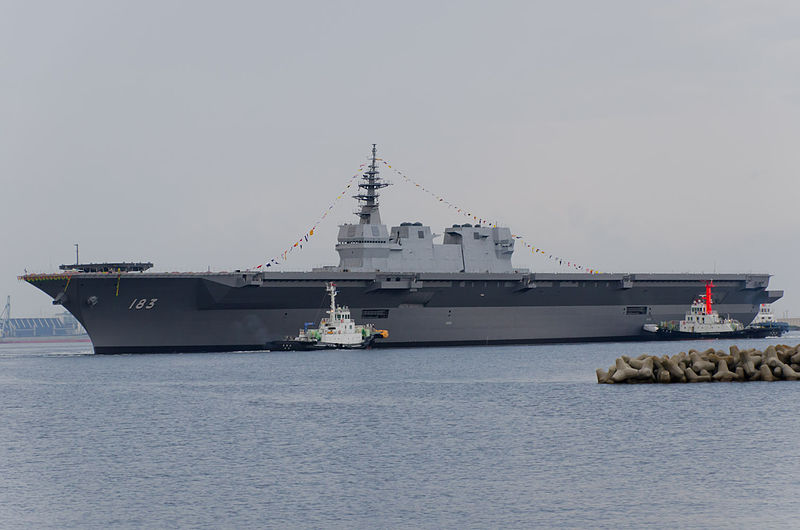
Apparently our eyes can deceive us. For most people looking at this image — at least if they know much about naval vessels — the description that comes to mind is “aircraft carrier”:

JS Izumo DDH-183

JS Izumo DDH-183

However, for constitutional reasons she is officially classified as a “destroyer”. In the South China Morning Post, Stefan Soesanto explains why this classification matters:

The Izumo‘s distinctive features certainly do not resemble anything one would typically classify as a destroyer. Indeed the warship currently under construction in Yokohama harbour is an aircraft carrier in anything but in name. Its size, tonnage and speed are closer to the US Essex aircraft carrier class, than to any of the two previous helicopter destroyers Japan has built so far.

At a cost of US$1.14 billion, the Izumo is officially conceptualised to host up to 14 helicopters whose missions would range from anti-submarine warfare and maritime border surveillance to humanitarian relief operations. In this regard, the Izumo‘s objectives are identical to the two Hyuga-class helicopter destroyers that were put into service in 2009 and 2011.

The current discussion among analysts and military brass as to whether Japan’s helicopter destroyers are considered aircraft carriers is not new. According to The Japan Times, Maritime Self-Defence Force chief of staff Admiral Keiji Akahoshi stated in 2009 that the Hyuga-class falls outside the conventional definition of an aircraft carrier because it lacks a fair degree of offensive functions. This argumentation has been notably employed by the Japanese government to circumvent Article 9 of the peace constitution to portray its helicopter destroyers as purely defensive military assets.

While Beijing’s criticism towards the Hyuga-class has been largely used as a means to support its own aircraft carrier expansion plans, the unveiling of the much larger Izumo has prompted widespread fears in China. Major Chinese media outlets went to great lengths to link Japan’s militaristic past to plans by the Japanese government towards constitutional revision. Indeed, the Chinese defence ministry even put out a statement saying that it is “concerned over Japan’s constant expansion of its military equipment”.

Reflecting on its own aircraft carrier plans, however, Chinese experts such as Li Daguang, professor at the National Defence University of the People’s Liberation Army, seem to make a simple leap of faith by suggesting that “the Chinese aircraft carrier Liaoning was mainly built for training purposes while the Izumo was built for real war”.

Of course, this isn’t a new thing, as a quick glance at the JS Hyūga also shouts “aircraft carrier” rather than “destroyer”:

JS  Hyūga

JS Hyūga

August 5, 2013

Nepotism … you’re soaking in it

Filed under: Government, Japan, Politics, USA — Tags: , , — Nicholas @ 09:57

Steve Chapman makes a case against nepotism in the modern world:

It would be silly to make Caroline Kennedy the White House science adviser: She’s not a scientist. It would be silly to name her fire commissioner of New York City: She has no background in public safety.

The standards are different in other fields. Kennedy has no previous known interest in Japan, Asia or international relations and is not a diplomat. But Barack Obama has chosen her to be the next ambassador to Japan.

Liz Cheney, likewise, is not inhibited by anything she lacks. She went to high school in northern Virginia, college in Colorado and law school in Chicago, before taking up residence in the Washington, D.C. area. Under George W. Bush, she held a couple of State Department jobs for which she had no obvious qualifications. But now she’s running for the U.S. Senate from Wyoming.

You could pick a name out of the phone book and find someone with better credentials. But these names are not random. They are household names, made famous by their fathers: John F. Kennedy and Dick Cheney. So the daughters carry an aura of expertise and gravity.

They benefit from “branding” — their association with the genuine accomplishments of famous relatives. But the logic behind that appeal only goes so far. Just because you wear Nike shoes doesn’t mean you’d buy a can of Nike beans. A Cheney’s virtues, if any, may not be present in another Cheney.

July 1, 2013

The rise and fall of economic powers

Filed under: China, Economics, History, Japan — Tags: , , , , , — Nicholas @ 10:30

Charles Hugh Smith has a guest post at Zero Hedge, talking about the theme of economic decline of great powers:

Our collective interest in the rise and fall of empires is not academic. The meteoric rise of China and the financialization rotting out global capitalism are just two developments that suggest we are entering an era where some great powers will collapse, others will remake themselves and others will gain ascendancy.

[. . .]

In 1987, pundits were predicting that Japan’s “5th generation” computing would soon dominate what was left of America’s technological edge. They were spectacularly wrong, as the 5th generation fizzled and Japan became an also-ran in web technology, a position it still holds despite its many global electronic corporations and vast university research system.

Japan’s modern economy was set up in the late 1940s and early 1950s to exploit the world of that time. Sixty years later, Japan is still a wealthy nation, but its relative wealth and power have declined for 20 years, as its political-financial power structure clings to a model that worked splendidly for 40 years but has not worked effectively for 20 years.

The decline is not just the result of debt and political sclerosis; Japan’s vaunted electronics industry has been superseded by rivals in the U.S. and Korea. It is astonishing that there are virtually no Japanese brand smart phones with global sales, and only marginal Japanese-brand sales in the PC/notebook/tablet markets.

The key dynamic here is once the low-hanging fruit have all been plucked, it becomes much more difficult to achieve high growth rates. That cycle is speeding up, it seems; western nations took 100 years to rapidly industrialize and then slip into failed models of stagnation; Japan took only 40 years to cycle through to stagnation, and now China has picked the low-hanging fruit and reverted to financialization, diminishing returns and rapidly rising debt after a mere 30 years of rapid growth.

There is certainly evidence that China’s leadership knows deep reform is necessary but the incentives to take that risk are low. Perhaps that is a key dynamic in this cycle of rapid growth leading to stagnation: the leadership, like everyone else, cannot quite believe the model no longer works. There are huge risks to reform, while staying the course seems to offer the hope of a renewal of past growth rates. But alas, the low hanging fruit have all been picked long ago, and as a result the leadership pursues the apparently lower-risk strategy that I call “doing more of what has failed spectacularly.”

Though none of the historians listed above mention it, there is another dangerous dynamic in any systemic reform: the very attempt to reform an unstable, diminishing-return system often precipitates its collapse. The leadership recognizes the need for systemic reform, but changing anything causes the house of cards to collapse in a heap. This seems to describe the endgame in the USSR, where Gorbachev’s relatively modest reforms unraveled the entire empire.

February 7, 2013

Japan scrambles fighters after two Russian aircraft intrude

Filed under: Asia, Japan, Military, Pacific, Russia, WW2 — Tags: , , — Nicholas @ 09:39

Japan’s military forces are getting quite a workout these days, with the standoff with China over the Senkaku Islands and now the Russians are getting aggressive about probing Japanese airspace:

Two Russian fighter jets have violated Japanese airspace, prompting Tokyo to scramble its own aircraft, reports say.

Japan lodged a protest after the planes were detected off the northern island of Hokkaido for just over a minute.

The incident happened after Japanese PM Shinzo Abe said he was seeking a solution to a territorial dispute with Russia over a Pacific island chain.

Russia’s military denied the incursion, saying the jets were making routine flights near the disputed islands.

Mr Abe was speaking on the anniversary of an 1855 treaty which Japan says supports its claims to the islands.

The four islands — which Russia calls the Southern Kurils and Japan calls the Northern Territories — are the subject of a 60-year-old dispute.

Because of the dispute, the two nations have not yet signed a peace treaty to end World War II.

February 5, 2013

Japan lodges formal protest after Chinese ship targets Japanese ship near Senkaku/Diaoyu islands

Filed under: China, Japan, Military — Tags: , , — Nicholas @ 09:13

The BBC has the details:

“On 30 January, something like fire-control radar was directed at a Japan Self-Defence Maritime escort ship in the East China Sea,” Mr Onodera told reporters on Tuesday.

The minister said Japan’s Yuudachi vessel and the Chinese frigate were about 3km (one mile) [ed: conversion error here, 3km is about 2 miles] apart at the time, Japan’s Kyodo News reports.

Asked about the delay in filing the protest, Mr Onodera said it took the ministry until Tuesday to determine that a fire-control radar had indeed locked on the Japanese ship.

He added that a Japanese military helicopter was also targeted with a similar type of radar by another Chinese frigate on 19 January.

“Directing such radar is very abnormal. We recognise it would create a very dangerous situation if a single misstep occurred,” he said.

Senkaku/Diaoyu Islands

January 28, 2013

Japanese finance minister: “elderly are an unnecessary drain on the country’s finances”

Filed under: Government, Health, Japan — Tags: , , , — Nicholas @ 11:32

The Guardian reports on recent comments by the new finance minister in Japan:

Japan’s new government is barely a month old, and already one of its most senior members has insulted tens of millions of voters by suggesting that the elderly are an unnecessary drain on the country’s finances.

Taro Aso, the finance minister, said on Monday that the elderly should be allowed to “hurry up and die” to relieve pressure on the state to pay for their medical care.

“Heaven forbid if you are forced to live on when you want to die. I would wake up feeling increasingly bad knowing that [treatment] was all being paid for by the government,” he said during a meeting of the national council on social security reforms. “The problem won’t be solved unless you let them hurry up and die.”

Aso’s comments are likely to cause offence in Japan, where almost a quarter of the 128 million population is aged over 60. The proportion is forecast to rise to 40% over the next 50 years.

[. . .]

To compound the insult, he referred to elderly patients who are no longer able to feed themselves as “tube people”. The health and welfare ministry, he added, was “well aware that it costs several tens of millions of yen” a month to treat a single patient in the final stages of life.

Cost aside, caring for the elderly is a major challenge for Japan’s stretched social services. According to a report this week, the number of households receiving welfare, which include family members aged 65 or over, stood at more than 678,000, or about 40% of the total. The country is also tackling a rise in the number of people who die alone, most of whom are elderly. In 2010, 4.6 million elderly people lived alone, and the number who died at home soared 61% between 2003 and 2010, from 1,364 to 2,194, according to the bureau of social welfare and public health in Tokyo.

The government is planning to reduce welfare expenditure in its next budget, due to go into force this April, with details of the cuts expected within days.

Sadly, expect more of this kind of comment from hard-pressed governments as the baby boomers move out of work and into retirement.

December 7, 2012

Revisiting Pearl Harbour

Filed under: History, Japan, Military, Pacific, USA, WW2 — Tags: , , , , — Nicholas @ 10:38

In a History Today article from 2001, Dan van der Vat looks at the actual history rather than the film treatments of the Japanese attack on Pearl Harbour in 1941:

To recount what actually happened blow by blow, as in the exhaustive Tora, Tora, Tora!, is one thing; to use the event as the backdrop to an avowed fiction, as in From Here to Eternity, is equally legitimate. But to play fast and loose with history by presenting fiction as fact is at best confusing and at worse dangerous — especially when the event is still within living memory, affects current policy and needs to be understood by the young if the lessons of history are to be truly learned.

On Roosevelt’s ‘date that will live in infamy’, six Japanese carriers launched 350 aircraft to immobilise the US battlefleet at the very moment talks were due to resume in Washington. The Americans knew Japan’s propensity for surprise attack (Korea in 1895, the Russians’ Chinese enclave at Port Arthur in 1904, Manchuria in 1931, China in 1937). They were forewarned by their Tokyo embassy of the inclusion of Pearl Harbor in Japan’s war-plans, and they intercepted signals exposing its intentions. Yet the Japanese achieved strategic surprise. But their strategic blunder in not bombing repair facilities and fuel dumps spared the US Navy the crippling embarrassment of having to withdraw 2,200 miles eastward to the continental West Coast.

[. . .]

Initial American reaction to Pearl Harbor included not only rage at Japanese duplicity but also incredulity based on racism. Many witnesses insisted they had seen swastikas on the bombers; surely the Germans must have been behind such a sophisticated stroke. Inability to cope with the reality of America’s most spectacular lost battle led to a flourishing conspiracy industry which sprang up within hours of the bombing.

Even today, extreme revisionists claim that British frogmen came in on the midget Japanese submarines that almost gave the game away by trying to attack before the bombers. That at least one batch of intelligence intercepts from 1941 has not yet been released is taken as proof that they must conceal the ‘smoking gun’ the revisionists so stubbornly seek to this day.

Update: MHQ has the story of the most effective Japanese spy who reported on the comings and goings of US Navy ships at Pearl Harbour:

At 1:20 a.m. on December 7, 1941, on the darkened bridge of the Japanese aircraft carrier Akagi, Vice Admiral Chui­chi Nagumo was handed the following message: “Vessels moored in harbor: 9 battleships; 3 class B cruisers; 3 seaplane tenders, 17 destroyers. Entering harbor are 4 class B cruisers; 3 destroyers. All aircraft carriers and heavy cruisers have departed harbor….No indication of any changes in U.S. Fleet or anything unusual.”

[. . .]

Astonishingly, such critical intelligence was not the work of a brilliant Japanese superspy who had worked his way into the heart of the fleet’s installation. Rather, Takeo Yoshikawa, a naval officer attached to the consulate and known to the Americans, had simply watched the comings and goings of the fleet from afar, with no more access than a tourist. He made little effort to cloak his mission, and almost certainly would have been uncovered if American intelligence had been more on the ball, or if America’s lawmakers had recognized the mortal threat Japan presented. Instead, he raised little suspicion, and his observations helped the Japanese piece together an extraordinarily detailed attack plan, ensuring its success.

November 24, 2012

Japan’s demographic time-bomb has detonated

Filed under: Economics, History, Japan — Tags: , , — Nicholas @ 11:58

Remember the Japan of the 1970s and 1980s? The world-spanning colossus of economic might? The nation that had Wall Street wetting its collective pants with every bold move?

That was then. This is now:

Less than a quarter-century ago, Japan was the economic envy of the world. In 1989, Tokyo-listed shares represented nearly half the planet’s equity value, while the land beneath the city’s royal palace was worth more than all of California. American nightly news anchors practically misted up when they had to report that Rockefeller Center was turning Japanese.

Two lost decades and massive property- and stock-bubble explosions later, Japan is a one-word cautionary tale. Caught in economic and demographic atrophy — and stewarded by countless false-start prime ministers — the country has become a hub for zombie banks, a generation of disenchanted youth, and fading brands such as Sony, Sharp, and Panasonic.

Last year, for the first time, sales of adult diapers in Japan exceeded those for babies.

November 15, 2012

Latest advances in “trouser-cough suppression”

Filed under: Health, Japan, Technology — Tags: — Nicholas @ 10:34

Lester Haines has a bit of fun with this “news” article:

Pairs of fart-absorbing underpants designed to contain the copious trouser cough output from Irritable Bowel Syndrome sufferers have proved a hit with Japanese businessmen.

Manufacturer Seiren expressed pleasant surprise that their guff-busting smalls had attracted the attention of suits more accustomed to allocating most of their underwear budget to schoolgirls’ used knickers.

Spokeswoman Nami Yoshida said: “It took us a few years to develop the first deodorant pants that are comfortable enough to wear in daily life but efficient in quickly eliminating strong smells.

September 9, 2012

Midway: the turning point of the Pacific War

Filed under: Books, History, Japan, Military, Pacific, USA, WW2 — Tags: , , , , — Nicholas @ 09:33

An interesting sketch of the importance of the 1942 Battle of Midway in the Spectator from Richard Freeman:

For many of us the Battle of Midway is just one more Hollywood spectacular in, to paraphrase Neville Chamberlain, a far-away sea of which we know little. But having recently taken a closer look at the battle I am struck both by what was at stake and what the consequences of the American victory were for the Allies at the time and geopolitics since then.

[. . .]

Because the Americans were the victors at Midway, it is easy to forget how near they came to losing the battle. On the day of the main action they attacked the Japanese carriers from dawn until 10.20 am without inflicting any serious damage. Then, between 10.20 am and 10.25 am, the American planes caught three of the Japanese carriers without adequate fighter protection. All three were completely disabled in just five minutes in what has been called ‘the miracle of Midway’.

[. . .]

Now suppose — and it almost happened — that the Japanese carriers, with their vastly superior fighter planes, had caught the American carriers off guard. The loss of those carriers and the destruction of the Midway airbase would have compelled America to give a much higher priority to the Pacific. A direct consequence of that would have been a slower build-up of American power in, first North Africa, and then Europe.

Shortly after the North African landings, there was the other great turning point of the war: Germany’s surrender at Stalingrad. From then on one of the great questions of the war was where the Russians would meet the Allies. Had America suffered a massive defeat at Midway, the Allies advance in Europe would have been slower. (As it was, D-day strained the Allies to the limit. Even a small reduction in ships, tanks, planes or men would have forced its delay.) In these circumstances it is not inconceivable that the Soviet Union would have taken the whole of Germany

I just finished reading one of the few accounts of the battle from the Japanese perspective, Midway: The Battle That Doomed Japan by Mitsuo Fuchida and Masatake Okumiya. Because I couldn’t remember Fuchida’s co-author’s name, I Google searched on the title of the book, only to find the top item after Fuchida’s Wikipedia entry was this:

The Western accounts of the Japanese side of the battle have heretofore been built around three primary sources: The after-action log of Admiral Nagumo (“The Nagumo Report”); the interviews with Japanese naval officers conducted after the war by the United States Strategic Bombing Survey (“USSBS”); and Mitsuo Fuchida’s book, Midway: The Battle That Doomed Japan, which was published in the United States in 1955. These three sources, augmented by fragmentary survivor accounts, have formed the backbone of the Japanese account for all Western histories up to this point.

Unfortunately, one of these sources — Fuchida’s Midway — is irretrievably flawed. Fuchida’s misstatements, which have lain undetected in the West until very recently, have had manifold negative effects on the veracity of the standard English-language battle accounts. His were not minor errors of omission that can be brushed off or explained away — they were fundamental and willful distortions of the truth that must be corrected. Intriguingly, Fuchida’s account was overturned and discredited in Japan more than twenty-five years ago. Yet in the West, he has remained as important as the day his book was first published.

September 3, 2012

Military-political jockeying in the East China Sea

Filed under: China, Japan, Military — Tags: , , , , — Nicholas @ 10:26

At sp!ked, James Woudhuysen has a long essay on the many tiny islands in the East China Sea (and South China Sea) that may feature in future shooting wars:

Outside East Asia, very few people know where the Senkaku islands are. But inside East Asia, the Senkaku prompt great bitterness between Japan, China and Taiwan. At stake is the national pride of each country, which believes that it alone owns them. At stake also are each country’s hopes that it might find oil or gas nearby, and its desire to sail round them unimpeded. But there is more. The Senkaku, and islands like them, signify how, among all the continents in the world, Asia’s past century has been the most enduringly explosive — and how its next could follow the same pattern.

Two hundred nautical miles (nm) west of the Japanese prefecture of Okinawa, 200 nm east of the province of Fujian in the People’s Republic of China, and just 120 nm north-east of Taiwan, there lies an archipelago of five uninhabited islands, covering just seven square kilometres and covered in jungle. Coming from Tokyo, a team of 25 city officials, surveyors and — inevitably — estate agents circled the islands just this weekend, hoping to reinforce Japan’s control over them. In the past, similar moves by both Japan and China have prompted fury, and not a little diplomatic concern elsewhere.

In mid-August, a group of Chinese sailed to the islands in order to uphold Beijing’s claim to them, only to meet with deportation at the hands of Japan. A little later, 150 Japanese nationalists came by in a flotilla and 10 of them swam ashore to raise the Japanese flag. Then, in the latest of a series of tit-for-tat episodes stretching back years, demonstrators in several Chinese cities insisted that Japan get out of the islands. All that’s missing now is that, on top of Tokyo’s rule over what it calls Senkaku and Beijing’s claim over what it calls Diaoyu, is a Taiwanese incursion over what they call the Diaoyutai.

What’s going on? Could all this lead to some kind of fearsome war between Japan, China and Taiwan? And why are there disputes not only in the East China Sea, but also in the South China Sea? There, south-east of Hainan Island (China) and east of Vietnam, China controls the Paracel Islands and resists the complaints of Taiwan and Vietnam about them. There, too, all three parties occupy and are in contention over the myriad Spratly islands, which, lying west of the Philippines and north of Malaysia and Brunei, are also partly controlled and certainly contested by these three nations.

September 2, 2012

The (mostly) forgotten Soviet-Japanese conflict of 1939

Filed under: China, History, Japan, Military, WW2 — Tags: , — Nicholas @ 11:17

Japan’s conduct of the opening stages of World War 2 were literally schizophrenic: the Imperial Japanese Navy viewed their primary opponent as the United States, while the Imperial Japanese Army viewed their primary opponent as the Soviet Union. The army’s fears were based on a little-known but very significant campaign in an undeclared war fought between Japan and the Soviet Union in 1939:

In the summer of 1939, Soviet and Japanese armies clashed on the Manchurian-Mongolian frontier in a little-known conflict with far-reaching consequences. No mere border clash, this undeclared war raged from May to September 1939 embroiling over 100,000 troops and 1,000 tanks and aircraft. Some 30,000-50,000 men were killed and wounded. In the climactic battle, August 20-31, 1939, the Japanese were crushed. This coincided precisely with the conclusion of the German-Soviet Nonaggression Pact (August 23, 1939) — the green light for Hitler’s invasion of Poland and the outbreak of World War II one week later. These events are connected. This conflict also influenced key decisions in Tokyo and Moscow in 1941 that shaped the conduct and ultimately the outcome of the war.

This conflict (called the Nomonhan Incident by Japanese, the Battle of Khalkhin Gol by Russians) was provoked by a notorious Japanese officer named TSUJI Masanobu, ring-leader of a clique in Japan’s Kwantung Army, which occupied Manchuria. On the other side, Georgy Zhukov, who would later lead the Red Army to victory over Nazi Germany, commanded the Soviet forces. In the first large clash in May 1939, a Japanese punitive attack failed and Soviet/Mongolian forces wiped out a 200-man Japanese unit. Infuriated, Kwantung Army escalated the fighting through June and July, launching a large bombing attack deep inside Mongolian territory and attacking across the border in division strength. As successive Japanese assaults were repulsed by the Red Army, the Japanese continually upped the ante, believing they could force Moscow to back down. Stalin, however, outmaneuvered the Japanese and stunned them with a simultaneous military and diplomatic counter strike.

[. . .]

But what if there had been no Nomonhan Incident, or if it had ended differently, say in a stalemate or a Japanese victory? In that case, the Japanese decision to move south might have turned out very differently. A Japan less impressed with Soviet military capability and faced with choosing between war against the Anglo-American powers or joining Germany in finishing off the U.S.S.R., might have viewed the northern course as the best choice.

If Japan had decided to attack northward in 1941, that could well have changed the course of the war, and of history. Many believe that the Soviet Union could not have survived a two-front war in 1941-1942. The Soviet margin of victory in the Battle of Moscow, and at Stalingrad a year later, was excruciatingly thin. A determined Japanese foe in the east might have tipped the balance in Hitler’s favor. Furthermore, if Japan had moved against the Soviet Union in 1941, it could not also have attacked the United States that year. The United States might not have entered the war until a year later, under circumstances in Europe far more unfavorable than the actual grim reality in the winter of 1941. How then would Nazi domination of Europe been broken?

« Newer PostsOlder Posts »

Powered by WordPress