
The history of Britain and Germany has certainly had some peaks and valleys since the first “German” king was crowned in London in 1714. Prussia and Britain managed to team up most memorably in 1815 to defeat Napoleon in the Waterloo campaign, but things got much less clear after the Franco-Prussian War that heralded the rise of a unified German state. As long as Prince Bismarck was the guiding hand behind German ambitions, Britain could look at Germany as a relatively reliable continental ally. After the accession of Kaiser Wilhelm II, however, things got rockier quickly. Bismarck got sidelined soon afterwards and the Kaiser decided that the one thing he really, really wanted was to build a navy to rival the British Royal Navy. That, in my opinion, more than anything else pushed Britain into exploring other diplomatic channels and eventually deciding to ally (in all but name) with France. The cover of Jan Rüger’s Great Powers shows the future conflict zone that ensured Britain would view Germany as a threat and not a potentially valuable ally:
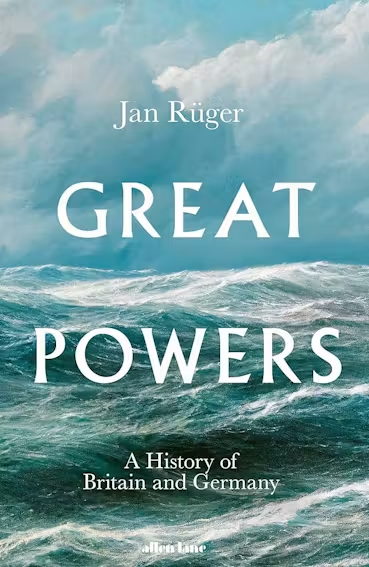
As an explicit criticism of the nonsense of great powers rising and falling as if “a timeless truth”, that offered for example by Paul Kennedy, Graham Allison, and Brendan Simms, Rüger, Professor of History at Birkbeck, emphasises the role of individuals and contingencies. His is a book that emphasises human agency, and at every level from that of nations to individuals.
[…]
For the period on which I am a specialist (and Rüger is not), the eighteenth century, there is a degree of nonsense. For example, George I did not have a “reliably anti-French stance” contributing to British “nation-building”. Instead, there was alliance with France from 1716 to 1731, the deployment of French troops into “Germany” to protect Hanover against Prussia and Austria was sought in 1727 (George II was similarly concerned in 1729), and so on. Nor were British interests successfully ringfenced to protect against their use for Hanoverian ends. Any detailed consideration of British foreign policy, or, indeed, the despatch of warships to the Baltic would suggest otherwise. Nor is Rüger correct to suggest that “at the heart of Britain’s national interest” was Britain choosing both Continental interventionism and trans-oceanic policies. Walpole’s determination to keep Britain out of European war, notably in 1733-35, and the beneficial consequences that flowed from this, demonstrates the contrary; as, indeed, did the earlier non-engagement, as in the Thirty Years’ War or against France in 1675-78. Rüger’s Whiggishness draws on a failure to understand the range of views in and on the eighteenth century.
From a German perspective, I would scarcely describe this book as a Bavarian or a Swabian viewpoint. Nor is there sufficient engagement with the extent to which Germany for long in Britain meant the Empire and thus included Austria. That only really ceased in the nineteenth century. Thus, there is on the part of Rüger a degree of anticipation that is misleading. Prussia takes far too central a position too early. This is linked to his misleading account of Prussia as a great power by the end of the Seven Years’ War. Not so, it was more significant by then than Bavaria and Saxony both of which had had their search for status crippled by defeat. However, Prussia also had had its vulnerability amply displayed, notably so to Russia. Furthermore, in terms of “reach”, Prussia in 1763 in no way matched Austria, Britain, France or Russia. Instead, it only became a great power as a result of developments from the 1860s. 1871 still seems to be the lens through which most Germans view their history. That includes Rüger, and is misleading.
So, lots to the good, particularly (but not only) for the post-1871 period; but with significant weaknesses, and notably so for the eighteenth century.


