
Forgotten Weapons
Published 14 Dec 2016I may be a bit biased here, but I believe that the Vickers gun is one of the best all-around firearms ever made. It was designed during an era of experimentation and craftsmanship, with a quality and care that would make it today prohibitively expensive. It was exemplary in action, and served in every environment on earth through six decades and in the hands of 50 different nations. It was an infantry gun, an aircraft gun, an armored vehicle gun, and a shipboard gun.
Captain Graham Hutchison recorded this account of the Vickers in action during an attack on High Wood in August 1916 (exerpted from “The Grand old Lady of No Man’s Land by Dolf Goldsmith):
“For this attack, [ten] guns were grouped in the Savoy Trench, from which a magnificent view was obtained of the German line at a range of about 2000 yards. These guns were disposed for barrage. On August 23rd and the night of the 23rd/24th the whole Company was, in addition to the two Companies of Infantry lent for the purpose, employed in carrying water and ammunition to this point. Many factors in barrage work which are now common knowledge had not then been learned or considered. It is amusing today to note that in the orders for the 100th Machine Gun Company’s barrage of 10 guns, Captain Hutchison ordered that rapid fire should be maintained continuously for twelve hours, to cover the attack and consolidation. It is to the credit of the gunners and the Vickers gun itself that this was done! During the attack on the 24th, 250 rounds short of one million were fired by ten guns; at least four petrol tins of water besides all the water bottles of the Company and urine tins form the neighborhood were emptied into the guns for cooling purposes; and a continuous party was employed carrying ammunition. Private Robertshaw and Artificer H. Bartlett between them maintained a belt-filling machine in action without stopping for a single moment, for twelve hours. At the end of this time many of the NCOs and gunners were found asleep from exhaustion at their posts. A prize of five francs to the members of each gun team was offered and was secured by the gun team of Sgt. P. Dean, DCM, with a record of just over 120,000 rounds.”
The attack on the 24th of August was a brilliant success, the operation being difficult and all objectives being taken within a short time. Prisoner examined at Divisional and Corps Headquarters reported that the effect of the Machine Gun barrage was annihilating, and the counterattacks which had attempted to retake the ground lost were broken up whilst being concentrated east of the Flers Ridge and of High Wood.
In 1963 in Yorkshire, a class of British Army armorers put one Vickers gun through probably the most strenuous test ever given to an individual gun. The base had a stockpile of approximately 5 million rounds of Mk VII ammunition which was no longer approved for military use. They took a newly rebuilt Vickers gun, and proceeded to fire the entire stock of ammo through it over the course of seven days. They worked in pairs, switching off at 30 minute intervals, with a third man shoveling away spent brass. The gun was fired in 250-round solid bursts, and the worn out barrels were changed every hour and a half. At the end of the five million rounds, the gun was taken back into the shop for inspection. It was found to be within service spec in every dimension.
During its service life, the Vickers was made in .303 British, .30-06, 0.50 Vickers, .50 High Velocity, 7×57 Mauser, 7.65×53, 8mm Mauser, 8mm Lebel, 7.7 Japanese, 6.5×54 Dutch, 7.9x57R Dutch, 7.62 NATO, 7.62x54R, 8x52R Siamese, 11mm Vickers, and three different 40mm cartridges.
The Vickers was retired from British military service in 1968, having finally become obsolete. Its GPMG role was taken over by the FN MAG, and its long range indirect fire role performed by 3″ mortars. The Vickers was a weapon which required training and dedication to master, but rewarded its users with phenomenal endurance and a wide range of capabilities. Among all contenders, only the Browning machine gun can attempt to compare to the outstanding qualities of the Vickers, and even the Browning fails to match the elegance of the stalwart Brit.
November 18, 2025
Vickers Heavy Machine Gun
QotD: Echoes of the Thirty Years’ War
It’s much easier to attack cultural institutions than political ones, and because the Church was also a political institution — a big one — it was convenient to attack a guy like Cardinal Wolsey, Tetzel the Indulgence Merchant, and so on. You can always frame it in the traditional medieval way: “The king has been led astray by his evil counsellors”. It’s not a coincidence that Reformed polities were also the most politically efficient; the Prods won the Thirty Years’ War, thanks in no small part to very Catholic France (under Cardinal Richelieu) adopting Protestant attitudes, strategies, and tactics.
The analogy only extends so far, of course. Hillaire Belloc has argued that the dissolution of the monasteries in England kicked out one of the three legs supporting English culture — by putting all that land and money under the State’s direct control (that “Tudor revolution in government” again), the State and the Economy are inextricably merged. It’s proto-fascism (recall that The Servile State was written in 1912). Not only is this true, it doesn’t go nearly far enough. Back in 1912, the Church was still alive as a cultural force. The Media was still at least somewhat capitalist — in competition for eyeballs — and in many cases led The Opposition, which also still existed as a cultural force.
Nowadays, of course, not only are the State and the Economy indistinguishable, they’re also indistinguishable from The Media. There IS no “opposition”; whatever anemic resistance to The State is stage managed like pro wrestling. Real dissidents are in the positions of recusants in Tudor England, except that the Church, instead of sending priests to minister to us in secret, is sending battalions of Inquisitors to help hunt us down.
In short, there’s no entry point for a new “Reformation”. As bad as the Period of the Wars of Religion was, gifted leaders had structural ways to achieve their objectives and keep the peace. Henry of Navarre could proclaim that “Paris is worth a mass”; Cardinal Richelieu could proclaim raison d’etat; the old Peace of Augsburg system — cuius regio; eius religio — could work well enough with a prince who understood his people and chose not to push too hard. “Separation of Church and State” wasn’t articulated as a formal political principle until the 19th century (and only there because it was badly misconstrued), but as a practical solution to politico-cultural problems it works just fine …
… provided you’ve got the structures in place to handle it, and we don’t. The Church, the State, the Economy, the Media, Academia, Technology … who can say where the one ends and the other begins? It’s all Poz, and there’s no aspect of our lives that the Poz doesn’t touch, because instead of separate and often competing socio-governmental structures, they’ve all merged. They’re ALL Poz.
Severian, “Reformation”, Founding Questions, 2022-03-07.
November 17, 2025
The US Supreme Court considers whether Trump’s tariffs are legal
Thanks to the staggering incompetence (and/or deliberate provocation for domestic political advantage) of the Carney government’s dealings with President Donald Trump, the current case before the Supreme Court is of significant interest to those of us on the north side of the US-Canadian border. On his Substack, David Friedman discusses the issues before the court:

There are three things wrong with Trump’s tariffs. The first is that they cannot be expected to provide the benefits claimed, can be expected to make both the US and its trading partners poorer; the arguments offered for them depend on not understanding the economics of trade. For an explanation of why that is true, see an earlier post.
The fact that the tariffs make us poorer may be the most important thing wrong with them but it is irrelevant to the Supreme Court; nothing in the Constitution requires the president to do his job well. The questions relevant to the Court are whether what Trump is doing was authorized by past Congressional legislation and whether it was constitutional for Congress to authorize it.
What Counts As An Emergency?
Tariffs are under the authority of Congress, not the president.1 Trump’s justification for setting them himself is congressional legislation, the International Emergency Economic Powers Act.
(a) Any authority granted to the President by section 1702 of this title may be exercised to deal with any unusual and extraordinary threat, which has its source in whole or substantial part outside the United States, to the national security, foreign policy, or economy of the United States, if the President declares a national emergency with respect to such threat.
(b) The authorities granted to the President by section 1702 of this title may only be exercised to deal with an unusual and extraordinary threat with respect to which a national emergency has been declared for purposes of this chapter and may not be exercised for any other purpose. (IEEPA, 50 U.S. Code § 1701, emphasis mine)
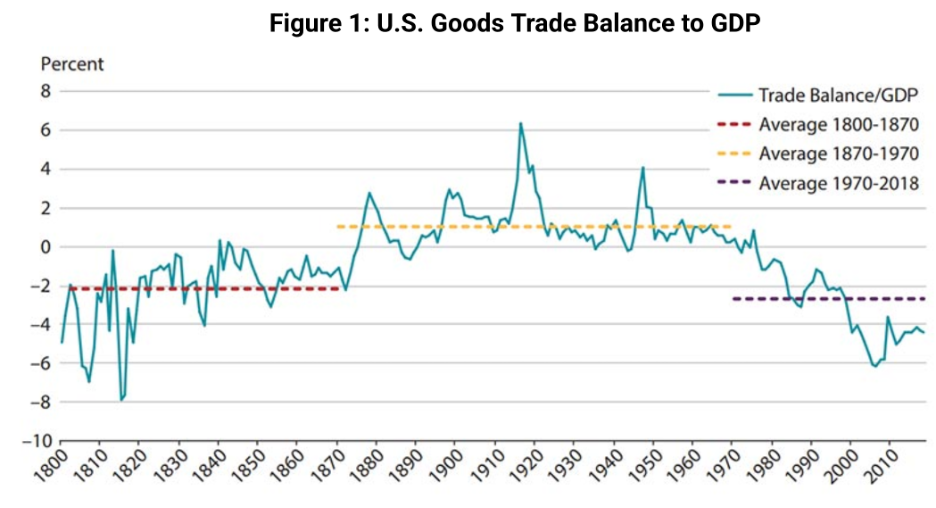
Trump declared that his Worldwide Reciprocal Tariffs were intended to deal with the US trade deficit.2 Whether the deficit is a threat and whether tariffs are a good way to deal with it are questions for economists3 but whether it is unusual is relevant to judges, since if it is not the IEEPA does not apply.
[…]
The Court on Trial
Delegating to the president the power to impose tariffs, a power explicitly given to Congress in the Constitution, is a major question. Under doctrine proclaimed by this court that means that the legislation claimed to delegate that power must be read narrowly. On a narrow reading, on anything but a very broad reading, the legislation fails to apply to President Trump’s tariffs for two independent reasons:
It only grants power in an emergency, which under the language of the Act neither the trade deficit nor the illegal drug problem is; the deficit has existed since 1970, the War on Drugs was proclaimed in 1971.
The powers granted to the president in the Act do not include the power to impose tariffs.
If the six conservative justices believe in the principles they claim, the administration will lose the case 9-0.
- The Congress shall have Power To lay and collect Taxes, Duties, Imposts and Excises … To regulate Commerce with foreign Nations … (U.S Constitution, Article I, Section 8).
- “I found that conditions reflected in large and persistent annual U.S. goods trade deficits constitute an unusual and extraordinary threat to the national security and economy of the United States that has its source in whole or substantial part outside the United States. I declared a national emergency with respect to that threat, and to deal with that threat, I imposed additional ad valorem duties that I deemed necessary and appropriate.” (Executive Order July 31, 2025).
- The answers are no and no.
Cyprus on Fire: The 3-Way War That Broke an Empire – W2W 053
TimeGhost History
Published 16 Nov 2025Cyprus, 1950s–60s. An island divided between Greek Cypriots, Turkish Cypriots, and the British Empire becomes the battleground for one of the Cold War’s most explosive regional crises. What begins as a struggle for independence soon spirals into a three-way conflict of nationalism, colonial strategy, and clashing identities — with Archbishop Makarios III, paramilitary groups, Athens, Ankara, and London all pulling in different directions.
In this episode of War 2 War, we uncover how Cyprus became:
- A central front in the decline of the British Empire
- A stage for espionage, guerrilla warfare, and political assassinations
- A diplomatic nightmare for NATO
- A struggle where UN peacekeepers become critical to preventing total collapse
- A conflict whose consequences still shape Europe and the Eastern Mediterranean today
We’ll trace the rise of EOKA, the reaction in the Turkish Cypriot community, the impossible balancing act of Makarios III, and how superpower pressure from the USA and USSR escalated an already volatile situation.
This is the hidden story of how one island’s crisis reshaped the politics of an entire region — and marked the end of Britain as a global imperial power.
(more…)
Yet another example of the Liberal focus on symptoms rather than underlying problems
The Liberals under both Justin Trudeau and Mark Carney have amply demonstrated that they care far more about appearances than achievements. The immigration crisis is merely the latest example of the government reaching for something that will look good on TV and in the newspapers rather than addressing the root cause of the problem:
Perhaps the most intractable policy disaster handed to Prime Minister Carney by the Trudeau government is the immigration file. The ugliest detail in that file is undoubtedly the astronomic increase in temporary residents (largely foreign workers, international students, and asylum seekers) – a population that expanded from 3.3% in 2018 to 7.5% in 2024. The Carney government’s solution is to limit the inflow of new temporary residents significantly, while at the same time giving permanent residency to many of the ones already on Canadian soil.

The base problem is far too many people entering the country, driving up demand for housing, overloading healthcare facilities, absorbing more and more government assistance at a time the government is running record deficits, and undercutting young Canadians for entry level jobs while youth unemployment is skyrocketing. But this “solution” will look like firm action as it will be presented by the tame media, so from the point of view of the government, it’s “mission accomplished”.
The Carney government’s first annual Immigration Levels Plan commits to “reducing Canada’s temporary population to less than 5% of the total population by the end of 2027”. To this end, Canada’s annual intake of new temporary residents will be cut from 673,650 in 2025 to 385,000 in 2026, and 370,000 in 2027 and 2028. This cut will hit international students the hardest, with annual new study permits cut in half from over 300,000 to 155,000 in 2026, and 150,000 in 2027 and 2028.
This major cut will ease the strain on Canada’s housing, healthcare, food banks, roads, and social services – a strain that is no longer denied by politicians, and is freely acknowledged across the political aisle. But, as is the case with many policies, the devil is the details. It turns out that one of the ways which the federal government intends to shrink the size of the temporary resident population is by making a large number of them permanent residents.
In the recently released 2025 Annual Report to Parliament on Immigration, Immigration Minister Lena Diab says the Carney government intends to “give priority for permanent residence to temporary residents already living and settled in Canada, further reducing the number of new arrivals”.
How many temporary residents will get permanent residency under this plan is unclear, but we can extrapolate from the data we have.
The Carney government’s Immigration Levels Plan sets the annual permanent resident rate at 380,000 for the next three years – or, a total of 1,140,000. The very last Immigration Levels Plan of the doomed Trudeau government – which committed to transitioning many temporary residents to permanent residency – predicted that temporary residents would account for “more than 40% of overall permanent resident admissions in 2025”.
If the Carney government is heralding the idea of transitioning more temporary residents as a way to slow down the catastrophic population growth Canada has experienced in recent years, we can safely assume that this proportion will be at least a little bit higher than the Trudeau government’s rate. A rate of 50%, say, would mean that 570,000 temporary residents will receive permanent residency over the next three years.
See, Canadians are telling the government that there are too many temporary immigrants, so by waving a magic wand and transforming the bulk of the temporary immigrants into permanent residents, the government can pretend they’ve solved the problem. And the sycophants, fluffers, and cheerleaders in the media will laud them to the skies for their brilliant solution.
What did Cowboys Eat on the Open Range?
Tasting History with Max Miller
Published 10 Jun 2025Slow-cooked pinto beans and dense cast iron skillet cornbread
City/Region: United States of America
Time Period: 1896The cook for a cattle drive, often called “cookie”, was usually a former cowboy himself, having aged out of the profession by 25. They’d wake up around 3:00 AM to get breakfast ready, then pack up and drive ahead about 15 miles to prepare supper.
These beans are very simple, and surprisingly delicious. Honestly, the garlic doesn’t do a whole lot (who only uses half a clove?), but they’re still very good. Feel free to use however hot a red pepper you like, and the beans are a perfect accompaniment to the Chuck Wagon Cornbread (below). Mighty fine, indeed.
FRIJOLES.
1 cup Mexican beans.
1/2 clove garlic.
1 long red pepper.
1 thin small slice bacon.
Soak beans over night; boil slowly until soft—from eight to ten hours. Add red pepper, garlic, and bacon, and bake.
— Manual for Army Cooks, 1896
QotD: Turns out Judaism isn’t the peaceful exception among Abrahamic montheisms
Yevardia @haravayin_hogh
Thread w/excerpts of Israel Shahak’s Jewish History, Jewish Religion.
Shahak was an award-winning organic chemist & Classical Liberal. Born in Poland, his family moved to Israel as displaced persons in 1945.
For this book, he received death-threats for the rest of his life.Quoted thread is absolutely fascinating.
Like many American gentiles who grew up in the 1950s and 1960s, I have a fondness for Jewish culture as it manifested in this country. The food, the humor, the intellectual tradition. I read Mad Magazine as a kid and “The Joys of Yiddish” as a young man and cheerfully adopted some Yiddishisms into my idiolect.
It’s always been slightly difficult for me, though, to reconcile my fondness for the Jewish influence on American life with what I believe about monotheisms in general and Abrahamic monotheisms is in particular. Which is, basically, that they are pits of evil. Infectious insanities that bring mob violence, horror and death whenever they have actual power.
Judaism looked like an at least partial exception, a monotheism with a curious lack of horrific violence in its backstory. I thought this might be explained by its absence of coercive power ever since the destruction of the Second Temple — 2000 years of oppression by others teaching Judaism the virtue of tolerance the hard way.
Now comes Israel Shahak to tell me it wasn’t like that at all. That until historically recent times – basically, post-1800 — Judaism wasn’t tolerant and rational. Not even close. These are virtues of the secularized Jew, in reaction to traditional Jewish shtetl and ghetto communities that could best have been described as violently evil religious despotisms.
Shahak says gentiles — and many Jews — don’t know how terrible life was under pre-modern rabbis because Judaism has done a bang-up job of expurgating and sanitizing its own history.
Nobody talks about the fact that until the 19th century, rabbis routinely used the self-governance afforded them by a lack of state interest in universal secularized justice to abuse, torture, and often murder Jews they found to be in violation of religious law. I certainly had no idea of this, despite being quite well read in history and comparative religion.
Thought control, too. We think of Jews as readers and scholars, but it turns out the pre-modern rabbinate deliberately kept communal Jews ignorant of history, geography, science, and indeed all secular literature.
Shahak brings the receipts, with extensive quotation from primary sources. Even his critics — and there are many — can’t accuse him of making up these reports. They claim he misinterprets the evidence. But they can’t make the evidence go away.
In a way this comes as a relief to me. I no longer have to wonder why Judaism looks like an exception to the general evil of monotheisms. Because it isn’t one — like Christianity, it looks benign only to the extent that it’s been denatured by modernity and secularism.
On the other hand … I miss the Judaism I thought I knew. I’m disturbed that the evidence was so effectively suppressed, and that it took reading excerpts from Shahak to clue me in.
Damn shame copies of Shahak’s book are so rare that you can only find them for over a grand each. I’d like to read the whole thing, but everybody should read the excerpts in this thread.
ESR, The social media site formerly known as Twitter, 2025-08-15.
November 16, 2025
North Africa Ep. 8: The Forgotten Battle of Mersa El Brega
World War Two
Published 15 Nov 2025At Mersa Brega a thin British screen, one reinforced battalion with guns, holds a superb defensive choke point until Stukas, artillery, and Panzer Regiment 5 grind it down. Cemetery Hill falls under bombardment, counterattacks stall, and a northern flank probe finally forces a retreat: Rommel’s first major victory in the desert, bought against strong ground and stubborn infantry.
(more…)
3D printing and firearms
On the social media site formerly known as Twitter, ESR discusses a recent user notification from one of the 3D printer companies to their users:

I’m told that 3D printed gun parts are far more sophisticated than this Liberator from 2013, but I’m sure nobody would actually do that, right? It would draw the attention of various government agencies for sure.
The recent flap about FlashForge attempting to forbid its customers from printing gun parts means it’s time for another reminder about technological risk.
Their weasel-worded climb-down carefully avoids stating that they never collect data on what you print. They only say they don’t collect data during your prints. The wording is so careful that I think we can conclude they do in fact ship telemetry on your print jobs when g-code arrives at the printer, immediately before printing.
So I repeat a warning I’ve given previously: never buy a 3D printer that requires an internet connection to function. And, always assume that if the printer’s firmware isn’t open-source, it is written to spy on you and could at any time prevent you from printing disapproved objects.
Oh, and never trust FlashForge again or buy their products, no matter how much groveling they do. After this, it’s safest to assume that anything they say about respecting the privacy and autonomy of their customers will be a lie. Hear that, @ff3dprinters
?We need to make a public example of FlashForge. Other vendors need to hear that shit like this will not be tolerated, that attempting to constrain what their customers print will do them permanent and irreversible damage.
It’s possible that this was merely a blunder on FlashForge’s court, and the attempts they’ve made so far to recover are compounding blunders, but they have sincerely repented of trying to control their customers. That’s too bad; in order to create the right incentives bearing on the future behavior of other vendors, we must show no mercy. We must make them hurt – ideally, to the point of being driven out of business.
And really these warnings apply to all “smart” devices, not just 3D printers. Unless you can audit the source code, the only safe assumption to make is that the firmware is spyware, controlware, and malware.
Device vendors need to know that we do not forgive, and will not forget.
In response, Hopalong Ginsberg posted this helpful item:

Hand tool woodworkers: Are you using the wrong plane?
Rex Krueger
Published 10 Jul 2025Get your rough work plane today: https://tooltrader.net/
Compass Rose Toolworks: https://www.compassrosetools.com/
Check out my Courses: https://rexkrueger.retrieve.com/
Patrons saw this video early: patreon.com/rexkrueger
Follow me on Instagram: @rexkrueger
QotD: Elon the gambler
Each of these bets might have been a smart one in a statistical sense, but it still requires a special kind of person to take a $200 billion market cap and bet it all on black. So why has Elon done this? Does he just not believe in the St. Petersburg paradox, like Sam Bankman-Fried claimed to do? No! It’s actually very simple: remember all that stuff about how SpaceX is less of a company and more of a religious movement, with a goal of making life multi-planetary? Elon and SpaceX behave the way that they do because they believe that stuff very sincerely. A version of SpaceX that merely became worth trillions of dollars, but never enabled the colonization of Mars, would be a disastrous failure in Elon’s eyes.
Every bit of company strategy is evaluated on the basis of whether it makes Mars more or less likely. This fully explains all the choices that look crazy from the outside. SpaceX does things that look incredibly risky to conventional business analysts because they reduce the risk of never getting to Mars, and that’s the only risk that matters. This has the nice side-benefit for shareholders that it’s revolutionized space travel several times and built several durable monopolies, but if Elon decided that actually blowing up the business increased the odds of getting to Mars, he would do it in a heartbeat. He’s said as much. This all has very important implications that we will return to in a moment.
A necessary, and to me charming, component of this approach is an utter disregard for bad press. Most corporate communications departments live in flinching terror of the slightest whiff of negative PR. Meanwhile, SpaceX’s puts out official blooper reels of exploding rockets. More seriously, one of the company’s lowest points came in the aftermath of the CRS-7 mission, when a rocket exploded two and a half minutes after launch and totally destroyed its payload. Most companies would do everything possible to minimize the risk of the following “return-to-flight” mission. SpaceX instead used it to debut a completely untested overhaul of the rocket and to attempt the first ever solid ground landing of an orbital-class booster. (It succeeded.)
Hopefully by now it’s not a mystery why SpaceX is a far more effective organization than NASA, but I think this last point is underappreciated. NASA, unfortunately, has boxed itself into a corner where it cannot publicly fail at anything.2 But if you aren’t failing, you aren’t learning, and you certainly aren’t trying to do things that are very hard. SpaceX, conversely, rapidly iterates in public and blows up rockets to deafening cheers. Permission to fail in public is one of the most powerful assets an organization has, and it flows directly from the top. This, too, is something for which Musk deserves credit.
The last thing I’ll say about Elon is that he is notably, uhhh, unafraid to disagree with people. In fact, this book literally has a chapter subheading called “Musk versus the entire human spaceflight community”.3 This quality can be a bit of a two-edged sword, but it’s safe to say that without it the company would never have gotten anywhere. Practically from the moment SpaceX came into existence, its enemies were trying to destroy it. Anybody who followed space policy in the early-to-mid 2010s knows what I’m talking about — politicians like the imbecilic NASA administrator Charles Bolden and the flamboyantly corrupt US Senator Richard Shelby did everything in their power to make life difficult for SpaceX and to smother the newborn company in its crib.
It’s a sign of how total SpaceX’s victory has been that some of those old episodes feel surreal in hindsight. Not just the antics of clowns like Bolden and crooks like Shelby, but also the honest-to-goodness competition in the form of Boeing and Lockheed, who fought dirty from the very beginning. For instance, they lobbied hard to block SpaceX from having any place to launch rockets at all, and dispatched their employees to stand around SpaceX facilities mocking and jeering while taking photographs of operations. In those early, desperate days, it would only have taken one or two successes of Boeing’s massive lobbying team to lock SpaceX completely out of government contracts and starve them of business. It was only Elon’s reputation as “a lunatic who will sue everyone” that prevented NASA from awarding the entire Commercial Crew Program to Boeing despite SpaceX offering to do it for about half as much money.4 And of course Elon actually did sue the Air Force when under intense lobbying they froze SpaceX out of the EELV program.
All of this is ancient history now. SpaceX’s competitors are no longer trying to stop the company with lawfare, because SpaceX no longer has any meaningful competition. But there are still people trying to slow down and sabotage the company; they’re just doing it for ideological rather than economic reasons. In the early days of SpaceX, the “deep state” of unelected bureaucrats who direct and control the United States government were huge supporters of the company, because back then the reigning ideology of that set was a sort of good-government technocratic progressivism and the idea of a scrappy new launch provider disrupting the incumbents genuinely pleased and excited them. A few years later, the state religion changed, and a few years after that, Musk revealed himself to be a definite heretic. And so, in utterly predictable and mechanistic fashion, the agencies that once made exceptions for SpaceX now began demanding years of delays in the Starship program in order to study the effects of sonic booms on tadpoles and so on.
One might be tempted to rage about how detrimental this all is to the rule of law. Think of the norms. Berger is certainly upset by it, and he ends his book (published in September 2024) by urging Musk to self-censor and stop antagonizing powerful forces with his political activism. Implicit to this demand is the advice, “If you just act like a good boy and stop making trouble, they’ll go back to leaving you alone.” Obviously, Musk did not take this advice. He instead further kicked the hornet’s nest by redoubling his support for Donald Trump. By October, the social network formerly known as Twitter was teeming with employees of US spy agencies and their allies demanding that SpaceX be nationalized and that Musk be deported.5 Given that Trump’s election was no sure thing, why would he take this risk?
There was a famous uprising against the Qin dynasty that happened when two generals realized that (1) they were going to be late, and (2) that the punishment for being late was death, and (3) that the punishment for treason was … also death. Elon Musk thinks being late to Mars is just as bad as being deported and having his companies taken away from him. He has already gambled the entire future of SpaceX on a coin flip five or six times, because he considers partial success and total failure to be literally equivalent. When it became clear that an FAA empowered by a Harris administration would put one roadblock after another in front of him, his only choice was to rebel and to flip the coin one more time.
When I saw Musk charging into the lion’s den back in October, I immediately thought of the Haywood Algorithm and its dreadful, stark simplicity. “Make a list of everything you need to do in order to succeed, and then do each item on your list.” When you run a normal company, the algorithm sometimes demands that you stay late at work or come in on a weekend. When you run a rocket company, the algorithm sometimes demands that you buy Twitter6 and use it to take over the United States government. It’s far from the riskiest thing Musk has done on his path to Mars. At this point, it might be wise to stop betting against him.
John Psmith, “REVIEW: Reentry, by Eric Berger”, Mr. and Mrs. Psmith’s Bookshelf, 2024-12-09.
- “Propellant densification” may sound like a nerdy topic, but it’s actually one of the most interesting subplots in the entire book. In the interest of making the Falcon 9 the highest performing rocket ever, and especially in the interest of improving the economics of booster landing and reuse, SpaceX decided to try to just pack more fuel and oxidizer into the tanks. The way you fit more of a gas or liquid into a given volume is by making it colder. So they developed a way to chill liquid oxygen down to -340 degrees Fahrenheit, way colder than anybody had ever made it before. What they weren’t prepared for was that at these temperatures, liquid oxygen starts making all kinds of horrible, eerie noises that made the engineers not want to be around it.
- Remember propellant densification? NASA considered it in the 80s and 90s, but dismissed it. Not for technical reasons, but because the need to destructively test pressure vessels might result in negative news stories.
- The subject of this section is whether it’s acceptable to fuel a rocket when the astronauts are already inside. The position of “the entire human spaceflight community” was that fueling can be dangerous, so better to complete propellant loading first, wait for everything to settle, and only afterwards being the astronauts on board. Seems sensible enough, but remember propellant densification? SpaceX’s ultra-cold liquid oxygen immediately begins heating up after loading, so the only practical way to use it is to load at the last minute and then immediately launch the rocket. Densification was vital to eking out the last bit of performance margin that makes rocket reuse possible, so Musk stuck to his guns. So far zero astronauts have died as a result.
- NASA’s pretext for favoring Boeing over SpaceX was the former’s “reliability” and “experience” and “technical superiority”. In the decade since then, SpaceX has completely dozens of missions flawlessly, while Boeing has yet to actually make it to the International Space Station and back.
- It’s hard to tell when the radical centrists mean things “seriously but not literally”, but I sincerely think that had Trump lost the best case outcome for Musk would be something like Jack Ma: chastened, humiliated, wings clipped, freedom of action greatly reduced.
- It’s become fashionable to mock Musk for running Twitter into the ground, but control over the social network’s content policies probably had a major effect on the election outcome. Even if Twitter literally becomes worth zero dollars (which given Musk’s track record I doubt), surely you can imagine how when you have a tremendous amount of money, $44 billion might seem like a small price to pay to have the President of the United States owe you some major favors.
November 15, 2025
There’s not much room for men and boys in the “Female Future”
Janice Fiamengo responds to a recent discussion between former Fox News host Tucker Carlson and happiness coach Chris Williamson which was intended to be about men’s lives but “quickly becomes a conversation about what women want”:
Chris Williamson: “It’s very hard to try and put forward something that doesn’t sound like putting the brakes on women. And I don’t think that’s what either of us …”
Here is the problem in a nutshell. We must never say No to a woman, no matter the social atrophy and misery she and her sisters are causing. Carlson, in turn, gives the only permissible response: “Are women happier than they were?”
A conversation about men’s lives quickly becomes a conversation about what women want.
**
Men’s issues have long been the purview of a tiny group of outliers who gained traction in the early days of the internet and were popularized in Cassie Jaye’s The Red Pill.
Following in the footsteps of iconoclasts like Ernest Belfort Bax (The Legal Subjection of Men, 1896), Esther Vilar (The Manipulated Man, 1971), and Warren Farrell (The Myth of Male Power, 1993), they questioned standard feminist wisdom, focusing on male disposability (see also here) and the empathy gap. For years, they were voices crying in the wilderness.
Now, decades into our Female Future, it’s becoming harder to ignore the suffering and plummeting fortunes of men and boys — and their knock-on social effects. But what happens when the red pill begins to go mainstream?
As the recent discussion between former Fox News host Tucker Carlson and happiness coach Chris Williamson makes clear, most hard truths get leached away, and we’re left with half-hearted calls for a compassion that the influencers themselves seem unable to maintain.
Spoiler Alert: “Chris Williamson’s Guide to Being Happy, and Debunking the Feminist Lies Sabotaging You” doesn’t debunk any feminist lies. Even the MeToo movement, which harmed or destroyed thousands of men’s lives through unproven accusations (some of them almost inconceivably ridiculous and trivial), is accepted as an attempt to “sanitize the toxic elements of male behavior”. Accusers’ falsehoods, ‘Poor-me-I’m-so-desirable’ showboating, manipulations, and blithe indifference to evidence are all passed over in feminist-compliant silence.
Sadly, the discussion is full of feminist lies.
**
Near the beginning of the discussion, Williamson expresses frustration that in order to acknowledge any of the troubles of men and boys in the modern world, it has become obligatory first to rehearse women and girls’ (always at least equal, if not greater) suffering. Unfortunately, Williamson is a prime example of such gynocentric genuflecting, visibly uncomfortable every time the conversation seems to be moving into non-feminist territory.
In order to talk about the drastic decline in men’s higher education attainment, for example, Williamson seems to think it necessary to point out that women were at some point in the past discouraged from getting university degrees. Both Williamson and Carlson refer to men’s diminishing earning power, but pivot immediately to stressing how hard this is on professional women looking for marriageable men.
The sexual revolution is alleged to have mainly benefited men who can now, with impunity, “use and abuse women”; nothing is said about women’s rampant OnlyFans activity or their exploitation of men in divorce.
It goes on and on like this: for every male suicide, divorce-raped father, falsely accused or incarcerated man, there must be at least one woman somewhere who felt at some point that she wasn’t encouraged to do something.
There is a small amount of criticism directed at women, but only when women act badly towards other women, as is the case, according to Carlson, with female bosses. But about female cruelty to men or children (over half of child maltreatment, for example, is female-perpetrated), we do not hear anything.
There is a good deal said about women as a civilizing force, how much women bring to family life, how women are better with social cues, how they are “unbullshittable.” Carlson even gushes about how kind women are to their hubbies: “They wash your underwear. They listen to you snore,” he rhapsodizes. For the considerable number of men who have rarely had a kind word from any woman or who have gone through a hellish marriage and/or divorce with a vindictive shrew, the adulation seems quite unhelpful.


Canada’s flawed Industrial and Technical Benefits scheme – “We’re architects of our own dependency”
Posted a few days ago, but still of interest — Omar Saleh discusses a part of Canada’s defence acquisition process that provides the illusion of military self-reliance while actually allowing foreign companies to control more and more of our domestic defence manufacturing capacity:
Graphic stolen from Small Dead Animals.
On November 4, the federal government tabled one of the most consequential defence budgets in Canadian history: an $81.8-billion expansion over five years, anchored by a $6.6-billion Defence Industrial Strategy, procurement overhauls, and a vow to claw back sovereignty from decades of polite deferral. It was framed as a national awakening – an overdue recognition that geography is no longer a moat, Russian submarines are testing our Arctic resolve, and allies are no longer willing to pretend Canada is pulling its weight.
But buried underneath all the ambition is a policy that will quietly sabotage it: the Industrial and Technological Benefits (ITB) framework – the mechanism Canada uses to ensure foreign defence contractors reinvest in the Canadian economy and the quiet architecture of our own dependency.
On paper, it’s a sound industrial strategy. So much so that other countries like Saudi Arabia and the UAE – both of which are aggressively seeking to onshore the lion’s share of their own defence spending – have implemented very similar policies as part of their respective Vision 2030 programs.
In practice, however, Canada’s ITB is a compliance machine that has mastered the art of doing nothing loudly. It is a mechanism through which American and European primes deepen their control over Canada’s industrial base while giving Ottawa the comforting illusion of self-reliance. We’re not victims of clever contractors. We’re architects of our own dependency, moralizing away the muscle to build someone else’s blueprint.
The numbers are damning. Since 2011, more than one hundred thousand industrial activities have generated over $64 billion in promised economic activity. And for all of that motion, not a single global defence technology titan has emerged. The work done in Canada – machining, composites, test benches, components – is real, but when the world shifts and architectures evolve, the capability evaporates. It was never ours. The most strategically important capabilities are designed abroad, integrated abroad, and updated abroad. We have activity without ownership – a nation performing sovereignty instead of exercising it.
Call it what it is: Phantom Capacity. The illusion of industrial muscle – until the country is forced to lift something heavy.
The core flaw is structural. ITB rewards dollars spent, not capability created, even as it dangles multipliers of up to 9x for R&D and startup work. A prime receives one-to-one credit for $5 million in routine machining, yet could theoretically earn nine times that for backing a Canadian breakthrough. But the theory collapses in practice. Multipliers accounted for less than one per cent of fulfillment between 2015 and 2019, and auditors still cannot prove they delivered any meaningful innovation. The system does not discriminate between activity and advancement. And when a system does not discriminate, the market follows the path of least resistance.
Predictably, primes funnel work to the safest, most administratively convenient suppliers. It is the industrial equivalent of a potluck where everyone insists on homemade dishes but quietly prefers the store-bought tray. Innovation is welcomed rhetorically and ignored in practice.
This leads to the second, more corrosive consequence: Canadian startups are structurally excluded from shaping Canada’s defence future. They move on six-month innovation cycles. Their technology evolves. Their architectures iterate. But in a system where every offset must be pre-approved, credit-verified, documented, and mapped against a prime’s global program calendar, startups cannot operate on their own terms. They must reshape their roadmaps to fit into architectures designed abroad, updated abroad, and controlled abroad. The result is not partnership but subordination.
A Canadian company can build a breakthrough sensor, a next-generation autonomy stack, or a northern detection layer – but it cannot enter a Canadian program of record unless a foreign prime decides to adopt it. The startup becomes a module inside someone else’s strategy. Sovereignty becomes subcontracting with better branding.
Marlin 1897 Bicycle Rifle
Forgotten Weapons
Published 23 Feb 2016Marlin’s 1892 lever action rifle in .22 rimfire caliber proved to be a very popular firearm, and so the company released an improved version in 1897, offered only as a rimfire takedown model. The 1897 would also prove very popular, and the same basic design would continue later as the Model 39.
One interesting variant of the 1897 offered was a Bicycle Rifle. While the rifle was generally available only with fairly long barrels, the bicycle version had a 16″ barrel and full-length magazine tube. This was sized specifically to fit in a special case (disassembled) underneath the top bar of a bicycle frame, allowing kids to easily use their bicycles to take these rifles to their favorite shooting spots.
While the 1897 itself was popular, the bicycle variant was not, with Marlin sales records showing only 197 sold.
QotD: The innovation of infiltration tactics in trench warfare
The mature form of this tactical framework is often called “Hutier” tactics, after German general Oskar Emil von Hutier, though he was hardly the sole or even chief inventor of the method. In its mature form, the technique went thusly: instead of attacking with large waves of infantry which cleared each objective in sequential order, attacks ought to be proceeded by smaller units, carefully trained with the layout of the enemy positions. Those units, rather than having a very rigid plan of attack, would be given those general objectives and left to figure for themselves how to accomplish them (“mission tactics” or Auftragstaktik)1, giving them more freedom to make decisions based on local conditions and the ground.
These elite spearhead units, called Stoßtruppen or “Stormtroopers” were well equipped (in particular with a higher amount of automatic firearms and hand grenades, along with flamethrowers). Importantly, they were directed to bypass enemy strong-points and keep moving forward to meet their objectives. The idea here was that the follow-up waves of normal infantry could do the slow work of clearing out points where enemy resistance was strong, but the stormtroopers should aim to push as deeply as possible as rapidly as possible to disorient the defenders and rapidly envelop what defenses remained.2
These sets of infantry tactics were in turn combined with the hurricane barrage, a style of artillery use which focused on much shorter but more intense artillery barrages, particularly associated with Colonel Georg “Breakthrough” Bruchmüller. Rather than attempting to pulverize defenses out of existence, the hurricane barrage was designed merely to force enemies into their dugouts and disorient the defenders; much of the fire was directed at longer ranges to disrupt roads and artillery in the enemy rear. The short barrage left the ground relatively more intact. Meanwhile, those elite infiltration units could be trained to follow the creeping barrage very closely (being instructed, for instance, to run into the shell explosions, since as the barrage advantages, no gun should ever strike the same spot twice; a fresh shell-hole was, in theory, safe). Attentive readers will recognize the basic foundations of the “move fast, disorient the enemy” methods of the “modern system” here.
So did infiltration tactics break the trench stalemate? No.
First, it is necessary to note that while infiltration tactics were perhaps most fully developed by the Germans, they were not unique to them. The French were experimenting with many of the same ideas at the same time. For instance, basic principles of infiltration were being published by the French General Headquarters as early as April, 1915. André Laffargue, a French infantry captain, actually published a pamphlet, which was fairly widely distributed in both the French and British armies by the end of 1915 and in the American army in 1916, on exactly this sort of method. In many cases, like at the Second Battle of Artois, these French tactics bore significant fruit with big advances, but ran into the problem that the gains were almost invariably lost in the face of German counter-attacks. The Russians, particularly under Aleksei Brusilov, also started using some of these techniques, although Brusilov was as much making a virtue of necessity as the Russians just didn’t have that much artillery or shells and had to make do with less and Russian commanders (including Brusilov!) seem to have only unevenly taken the lessons of his successes.
The problem here is speed: infiltration tactics could absolutely more efficiently overrun the front enemy lines and even potentially defeat multiple layers of a defense-in-depth. But after that was done and the shock of the initial push wore off, you were still facing the same calculus: the attacker’s reinforcements, shells, artillery and supplies had to cross broken ground to reach the new front lines, while the defender’s counter-attack could ride railways, move over undamaged roads and then through prepared communications trenches. In the race between leg infantry and trains, the trains always won. On the Eastern Front or against the Italians fighting under the Worst General In History at Caporetto (1917), the already badly weakened enemy might simply collapse, producing massive gains (but even at Caporetto, no breakthrough – shoving the enemy is not a breakthrough, to qualify as a breakthrough, you need to get to the “green fields beyond” that is open ground undefended by the enemy), but against a determined foe, as with the 1918 Spring Offensives, these tactics, absent any other factor, simply knocked big salients3 in the line. Salients which were, in the event, harder to defend and brought the Germans no closer to victory. Eventually – often quite rapidly – the front stabilized again and the deadlock reasserted itself. Restoring maneuver, the actual end-goal of these tactics, remained out of reach.
None of this is to say that infiltration tactics were useless. They represented a real improvement on pre-war infantry tactics and continue to serve as the basis for modern infantry tactics. But they could not break the trench stalemate or restore maneuver.
Bret Devereaux, “Collections: No Man’s Land, Part II: Breaking the Stalemate”, A Collection of Unmitigated Pedantry, 2021-09-24.
- Because it doesn’t fit anywhere else, I want to make a rather long note here. There is an odd tendency which I find quite frustrating, in which military concepts, unit designations and terminology from other languages are all translated into English when used, except for German terms. I suspect this has to do with the high reputation German military thinking holds in among the general public and some military practitioners. I do not share this view; both the German Imperial Army and the Nazi Wehrmacht (another term we never translated yet we feel no need to call the French army l’armée de terre) managed to lose the only major wars they were in, leading to the end of the states they served. Both armies were capable at some things and failed at others; their record certainly does not make German some sort of Holy Language of War. Nevertheless, where German technical terms are notable, I will include them so that the reader will know, should they encounter them elsewhere, that this is a term they are already familiar with, albeit in translation.
- It should be noted that the emphasis here remained on envelopment and destruction rather than on disorientation. The latter is a feature of subsequent systems based on German maneuver warfare, but was not a goal of the doctrine itself initially.
- A salient is a bulge in the line such that your position is bordered by the enemy on three sides. Such positions are very vulnerable, since they can be attacked from multiple directions and potentially “pinched off” at the base.


