Quotulatiousness

November 21, 2025

The “spat” between China and Japan is far more important than western media are reporting

Filed under: China, Japan, Media, Military, Pacific, USA — Tags: , , , , , — Nicholas @ 03:00

Claire Berlinsky explains why we should be paying far more attention to what our media are treating as a minor diplomatic spat as Beijing reacts furiously to the new Japanese PM’s comments:
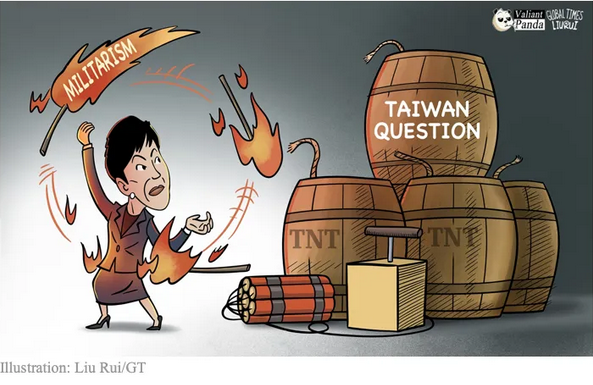
You need to see the Chinese media today to get a feel for this. Front pages of the relevant organs are devoted to frothing in fury at Japan. They’re rectifying bad thoughts like a house on fire.

Here’s why I’m worried by this. Both the Chinese- and Japanese-language press are treating this as a major diplomatic incident. (In English, it’s mostly being described as “a row” or “spat” — then back to Trump and Epstein.) Let me walk you through what it looks from Beijing and Tokyo, with help from ChatGPT on the translations.

The trigger was a comment in by the new Japanese prime minister, Sanae Takaichi. She told a parliamentary committee that a Taiwan contingency involving the use of force might constitute a “sonritsu kiki jitai” (a “survival-threatening situation” — I think we’d use the phrase “existential threat”) for Japan under its 2015 security laws, and justify the exercise of collective self-defense, using Japan’s self-defense forces.

Beijing exploded. China summoned the Japanese ambassador in Beijing for a formal démarche, and it allowed the PRC consul general in Osaka, Xue Jian, to post a (now-deleted) tweet calling for her decapitation—”that dirty head that trespassed should be cut off, are you ready?” The Xue Jian post has, of course, become a media event of its own. Beijing issued a travel advisory urging Chinese citizens to avoid Japan, and told students to “carefully reconsider” study plans. It stepped up coast-guard activity near the Senkakus, and cancelled the Xi–Takaichi bilateral at the G20.

But this arid account doesn’t begin to convey the way the Chinese and Japanese media are talking about this. The Chinese coverage is nothing short of hysterical. To read the Party-line outlets, you’d think Takaichi had just ordered the immediate re-invasion of Manchuria. Her comment, they said, was an evidence of a “dangerous rightward turn” in Japanese politics. They’re calling it a “sky-collapsing opening“, accusing her of “reckless ranting” and tearing up the China-Japan relationship.

The headline in a widely circulated China Daily article:”If China and Japan go to war, Japan will be destroyed“. They found the inevitable panel of “peace-loving international friends” — including Okinawan peace activists and pro-PRC overseas Chinese — to denounce Takaichi as the reincarnation of “Japanese militarism”. The peace activists dutifully warned that the Japanese people would be “dragged into catastrophe” by their government. A CNR column accuses her of “brazen provocation”, and claims that “Taiwan compatriots are also outraged” at the prospect of Taiwan being turned into a battleground between China and a “militaristic” Japan.

The Party line: Taiwan is a “settled” internal issue; any talk of Japanese collective self-defense in the Strait is aggression and a “serious violation” of the post-1945 order. Takaichi represents “unrepentant militarism.” Chinese pieces quote her opponents at length to argue that “sober Japanese elites” are deploring her recklessness. Chinese-language coverage of the travel advisory is not treating it as a minor consular notice. They’re claiming it’s the first coercive step.

In Japan, this is front-page foreign policy news, not a minor gaffe. Mainichi ran an editorial saying, more or less, that Takaichi’s words were legally consistent with the 2015 security laws, but prime ministers should be more discrete about hypothetical military contingencies and show more prudence. Opposition figures are saying she “went too far” and threw the relationship into “a very grave state”. They called it “frivolous” for a commander-in-chief to talk so specifically about use-of-force scenarios.

On the other hand, there’s clearly a domestic constituency that sees this as long overdue. Some in her party see any hint of retraction as “weakness toward China”, and they’re praising her for drawing a firm line on Taiwan. (The coverage about whether to expel Xue Jian is divided: His post was a death threat, obviously, but the Foreign Ministry seems reluctant to escalate this further.)

TV explainers are reminding viewers that the 2015 security legislation already contemplated a Taiwan contingency — what’s new is that the prime minister has now said this out loud. And a prime minister with an openly revisionist profile — that’s definitely new.

So there’s a lot of signaling going on. Beijing is signaling to its own public: “We’ll never again let Japanese militarism threaten China. The Party is the bulwark against a repeat of the 1930s.” To Tokyo: “We’ll punish any step toward military involvement in the Strait, first with economic coercion — then worse. We are not kidding about this.” To the wider region and Washington: “Japan is a destabilizer — this woman isn’t right in the head. If things go wrong in the Taiwan Strait, blame Tokyo. Remember Pearl Harbor.”

Update, 23 November: Welcome, Instapundit readers! Please do have a look around at some of my other posts you may find of interest. I send out a daily summary of posts here through my Substackhttps://substack.com/@nicholasrusson that you can subscribe to if you’d like to be informed of new posts in the future.

URZ: Czech Prototype Universal Modular Weapon

Forgotten Weapons
Published 7 Jul 2025

The URZ (Univerzální Ruční Zbraň, or Universal Hand Weapon) was a 1966 project designed by Jiří Čermák (designer of the vz.58 rifle). He envisioned a weapons system family with largely interchangeable elements that could be configured as a service rifle, carbine, light machine gun, vehicular machine gun, or precision rifle. The Czech military was not interested, but Čermák was able to convince the government to allow its development for export instead.

The design is a delayed-blowback system using rollers, and belt-fed. The first few examples were made in 7.62x39mm, but development switched to 7.62x51mm NATO in a rather surprising move. Presumably this was intended for sale to unaligned nations who were interested in the NATO cartridge, but still — seeing its development in then-communist Czechoslovakia is pretty unusual. Ultimately only 9 examples were built before the project was abandoned.

Thanks to the Czech Military History Institute (VHU) for graciously giving me access to this one-of-a-kind prototype to film for you! If you have the opportunity, don’t miss seeing their museums in Prague:
https://www.vhu.cz/en/english-summary/
(more…)

QotD: Why did the (western) Roman Empire collapse?

Filed under: Europe, History, Military, Quotations — Tags: , , , , — Nicholas @ 01:00

But if the Roman Empire (in the West) went down fighting, why did it collapse? Of course there is no simple answer to that question. The mass migrations of the fourth and fifth century clearly played a very large role, but then the Romans had defeated other such migrations (recall the Cimbri and the Teutones) before. There are strong indicators that other factors, unrelated to our current topic were also at play: the empire had been economically weakened by the Crisis of the Third Century, which may have disrupted a lot of the trade and state functions that created the revenue to fund state activity. At the same time, the Crisis and the more challenging security situation after it meant that Roman armies grew larger and with them the burden of paying and feeding the soldiers which further hurt the economy. Meanwhile, long exposure to Roman armies on the frontiers of the empire had begun to erode the initially quite vast qualitative advantage the Romans enjoyed; the gap between Roman and “barbarian” military capabilities began to shrink (although it never really vanished altogether in this period). But some of the causes do bear on our topic but in quite the other direction from what the Niall Fergusons of the world might assume.

Let’s start with the foederati.

After the Constitutio Antoniniana, there was no longer much need for the auxilia, as all persons in the empire were citizens, and so the structure distinction between the legions and other formations fades away (part of this is also the tendency of the legions in this period to be progressively split up into smaller units called vexillationes, meaning that the unit-sizes wouldn’t have been so different). But during the fourth century, with frontier pressures building, the Romans again looked for ways to utilize the manpower and fighting skill of non-Romans. What is striking here is that whereas in some ways […] the auxilia had represented almost a revival of the attitudes which had informed the system for the socii, the new system that emerged for using foreign troops, called foederati (“treaty men”) did not draw on the previously successful auxilia-system (which, to be clear, by this point had been effectively gone for more than a century). Instead, the Romans signed treaties with Germanic-speaking kings, exchanging chunks of (often depopulated, war-torn frontier) land in exchange for military service. Since these troops were bound by treaty (foedus) they were called foederati. They served in their own units, under their own leaders, up to their kings. Consequently, all of the mechanisms that encouraged the auxilia to adopt Roman practices and identify with the Roman Empire were lost; these men might view Rome as a friendly ally (at times) but they were never encouraged to think of themselves as Roman.

The reason for this different system of recruitment seem to be rooted in financial realities. The Roman army had already been expanded during the Crisis of the Third Century and only grew more under Diocletian and Constantine, probably by this point being between 400,000 and 500,000 men (compared to 300,000-350,000 earlier in the empire). Moreover, Diocletian had opted to reform the empire’s administration with a much more intensive, top-down, bureaucratic approach, which imposed further costs. Taxes had become heavy (although elites were increasingly allowed to dodge them), the economy was weak and revenues were short. The value of the foederati was that the empire didn’t have to pay them; they were handed land (again, in war-torn frontier zones) and expected to use that to pay for their military support. At the time, it must have seemed a brilliant work-around to get more military power out of a dwindling tax-base.

(I feel the need to note that I increasingly regard Diocletian (r. 284-305) as a ruinous emperor, even though he lacked the normal moralizing character flaws of “bad emperors”. While he was active, dedicated and focused, almost all of his reforms turned out to be quite bad ideas in the long run even before one gets to the Great Persecution. His currency reforms were catastrophic, his administrative reforms were top-heavy, his tax plan depended on a regular census which was never regular and the tetrarchy was doomed from its inception. Diocletian was pretty much a living, “Well, You Tried” meme. That said, to be clear, Diocletian wasn’t responsible for the foederati; it’s not quite clear who the first foederati were – they may have been the Franks in 358, which would make Julian (as a “Caesar” or junior-emperor under Constantius) the culprit for this bad idea – he had a surplus of those too.)

The problem, of course, is right there: the status of the foederati made it impossible for them to ever fully integrate into the empire. They had, after all, their own kings, their own local laws and served in their own military formations. While, interestingly, they would eventually adopt Latin from the local population which had already done so (leading to French, Spanish and Italian) they could never become Roman. That wasn’t always their choice, either! As O’Donnell (op. cit.) notes, many of these foederati wanted to be “in” in the Roman Empire; it was more frequently the Romans who were busy saying “no”. It is striking that this occurs in a period where social class in the Roman world was generally calcifying. Whereas citizenship had been an expanding category, after the Constitutio Antoniniana, the legal categories of honestiores and humiliores (lit. “respectable” and “humble” people, but in practice, “wealthy” and “commoners”) largely replaced citizenship as the legal dividing lines of Roman society. These were far less flexible categories, as economic social mobility in the ancient world was never very high. Even there, the tax reforms of Diocletian (with some “patches” under Constantine) began, for tax purposes, to tie tenant farmers (“coloni“) to their land, essentially barring both physical and economic mobility in the name of more efficient tax collection in a system that strongly resembled later medieval serfdom.

Nevertheless, the consequence of this system of organization was that as often as the foederati provided crucial soldiers to Roman armies, they were just as frequently the problem Roman armies were being sent to address. Never fully incorporated into the Roman army and under the command of their own kings, they proved deeply unreliable allies. Pitting one set of foederati against the next could work in the short-term, but in the long term, without any plan to permanently incorporate the foederati into Roman society, fragmentation was inevitable. The Roman abandonment of the successful older systems for managing diverse armies (on account that they were too expensive) turned the foederati from a potential source of vital manpower into the central cause of imperial collapse in the West.

Bret Devereaux, “Collections: The Queen’s Latin or Who Were the Romans, Part V: Saving and Losing and Empire”, A Collection of Unmitigated Pedantry, 2021-07-30.

November 20, 2025

“Oh my God, the Conservatives support children starving at school”

In the National Post, Chris Selley profiles my local MP, Jamil Jivani:

A screengrab from MP Jamil Jivani’s video that is critical of the Liberals’ national school-lunches program. Photo by Jamil Jivani/X

A few eyebrows raised earlier this year when Toronto-area MP Jamil Jivani, long heralded as an essential younger voice in the Canadian conservative movement, wasn’t offered a critic role by party leader Pierre Poilievre. There are 74 official Opposition critics, which is more than half the Conservative caucus. And if Poilievre and Jivani don’t see eye to eye, one might still have thought Jivani’s relationship with U.S. Vice-President JD Vance would be a useful resource.

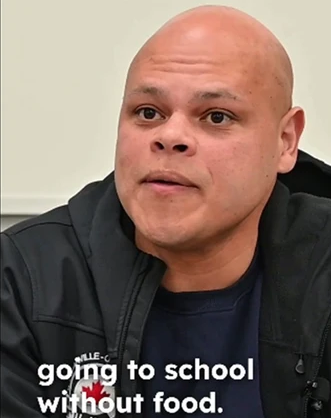
There’s also the fact that Jivani is rather good at defending conservative policy, especially on the social side — better, one might argue, than Poilievre. On Monday, Jivani posted a video of himself arguing that Canadian children should go hungry at school. Or at least, that’s how certain hysterics chose to interpret his opposition to the Liberals’ national school-lunches program.

“It should frighten us that there are parents who can’t buy their own kids lunch,” he tells a constituent in the video. “(But) the government shouldn’t be your daddy; the government shouldn’t be your mother. We have families, and families should be strong enough to provide for their children, and when they’re not that should break our hearts. … It should not be used as a justification for the government to have even more influence, even more input, even more control over our lives.”

The program is already underway, with $1 billion in funding over five years committed as transfers to the provinces in 2024 — three years after the Liberals first promised it. And the Liberals recently announced plans for more. “Permanent” funding of more than $200 million is set to kick in in 2029.

The response anywhere to Jivani’s intervention, anywhere to his left, in a nutshell: “Oh my God, the Conservatives support children starving at school”. Even among some conservatives we hear the traditional timid refrain: Is this a “winning issue”? Or is the party just making itself look callous? What will the media think? Jivani, unlike many more seasoned Conservatives, seems not to care so much about the potential blowback.

Lunches served at school — paid or subsidized — are hardly a brand-new statist invention. They’ve been around forever, although they’re more common in certain kinds of schools than others. A 2013 Queen’s University study looked at 436 Canadian schools and found only 53 per cent had a cafeteria. (When I was a kid, many of my friends walked home for lunch and back afterwards.) And Jivani concedes in the video that many Canadians will like the sound of a national school-lunch program. Who would argue against it? It’s obviously far more important that kids eat breakfast and lunch (and dinner) than it is who provides it.

But that assumes a national school-lunch program, or even a provincial or local school-lunch program, is the quickest and easiest way to make sure kids are fed. It obviously isn’t, but trust in government, somehow, is a tough nut to crack in this country. Mass pandemic-era supports like CERB weren’t unalloyed successes, but they proved governments at least know how to shovel money out the door when they feel it absolutely necessary.

Especially since so many Canadian schools don’t have cafeterias — 53 per cent of elementary schools in the Queen’s study, and 82 per cent of combined elementary-secondary schools — it would make much more sense just to mail every parent who needs one a subsidy and let them pack the lunch, or the lunch money, that their kids need.

I’ve mentioned many times that I’m not a Conservative, but I don’t mind Mr. Jivani as my Member of Parliament because he doesn’t seem to me to be a typical Canadian Conservative (I thought it was significant that the PPC chose not to run against him once he became the Conservative candidate). In my YouTube recommendations, this video appeared with some sensible views from the Deputy Leader of His Majesty’s Loyal Opposition, Melissa Lantsman:

The trouble, as always with parties in opposition, is that they can sound like they’ve got great ideas and will energetically address the problems they identify while not in government … but once they go into office, sound remarkably like the government they just defeated and little or nothing actually changes.

Our free-speech documentary has been cancelled! | A London cinema has banned Think Before You Post

Filed under: Britain, Liberty, Media, Politics — Tags: , , — Nicholas @ 04:00

spiked
Published 19 Nov 2025

Our new documentary, Think Before You Post, about the rise of the British speech police, was due to have its premiere in London next week. Last night, the venue got in contact to say it would be cancelling our booking, because the event does not align with its “values”.

Here, spiked‘s Tom Slater tells all.

We are working flat-out to find a new venue for the same night. So if you bought tickets, do bear with us. But if we can’t find somewhere else in time, we’ll refund everyone and postpone it for a later date. If you’d like a refund now anyway, get in touch and we’ll process it.

At least they’re proving our point …

About spiked:

Founded in 2000, spiked was a pioneer of 21st-century journalism – the first online-only political magazine in the UK.

Now edited by Tom Slater, spiked reaches millions around the world with hard-hitting articles, incisive essays and a growing roster of podcasts and videos.

Military necessity and the “right to repair”

Over the last few decades, more and more companies have been discovering the financial wonders available to them if they separate the items they sell from the ability to repair those items … so you buy a widget but if it breaks, you have to pay the manufacturer to get it fixed. You have no option to fix it yourself — even if you have the technical know-how and the necessary tools — nor can you find a cheaper alternative, because the manufacturer has blocked any possible competition to their often highly profitable scam revenue stream. It’s bad enough in the civilian marketplace, where consumers are demanding the “right to repair” from legislators because the cost and inconvenience are far too high.

Now imagine you are onboard a US Navy ship in the western Pacific and some critical piece of technology breaks down … but you can’t fix it yourself because the manufacturer sells repair services and will have to be paid to send out a civilian repair crew with the necessary tools and parts. No need to imagine it: it’s the situation the US military is finding itself in more and more often:

If you want to get an otherwise reserved and laconic farmer to get excited and talkative about a subject, ask them about the issue of “right to repair“.

    … Wilson and others accuse John Deere of blocking farmers and everyday mechanics from fixing equipment without going through John Deere dealers. Although the company doesn’t prohibit users from fixing equipment themselves, the lawsuit claims it locks users out of repairs because of the limited access to software that only dealerships can access. The lawsuit says that makes most fixes nearly impossible. A lot like cars, the farming equipment is equipped with sensors. The John Deere tractors, for instance, run on firmware that is necessary for basic functions, according to the lawsuit. If something is wrong with the equipment, a code will appear on a display monitor inside the machine. The suit says interpreting the error codes on tractors, for instance, requires software that “Deere refuses to make available to farmers”.

    Right-to-repair advocates say the digitization of agricultural equipment — with its various computers and sensors — has made self-repair almost impossible, forcing farmers to depend on the manufacturers. Wilson, for example, said he has to rely on his local John Deere dealership, which he said takes longer and charges more than an independent repair worker.

    … a pending lawsuit the Federal Trade Commission filed Jan. 15 claims the company falls short of that promise. The complaint accuses it of unlawful business practices that have “inflated farmers’ repair costs and degraded farmers’ ability to obtain timely repairs”.

    “I would have some farmers close to tears recalling the time they lost a whole harvest because they weren’t able to fix their own tractor and weren’t able to go to a local repair shop,” said former FTC Chair Lina Khan, who helped launch the suit.

OK, it is bad enough to have to wait as through time and experiencing a degrading quality of harvest to repair your tractor … but what if instead of Mother Nature, you have to deal with 50,000 screaming Chinamen?

Senator Tim Sheehy (R-MT) is trying to get ahead of this problem.

    U.S. defense contractors have launched a lobbying and public relations blitz to defeat a provision in the Senate-passed NDAA that would set strict new rules for how the Pentagon accesses their intellectual property.

    The issue is among the last unresolved matters facing House and Senate negotiators who aim to reconcile before December the House and Senate fiscal 2026 NDAAs.

    The Senate’s so-called right-to-repair provision states that the Pentagon may not, with certain exceptions, enter into a contract unless the deal requires the company to provide the government with the data needed to operate and sustain the equipment.

    That data means a lot to the contractors because it is worth many billions of dollars over time. To a servicemember it also means a lot: Being able to fix a weapon can mean the difference between life and death. And the cost of such repairs is a major driver of defense budget growth, experts have long said.

These are the same defense primes who are spending billions of dollars on stock buybacks, and already have a track record of contract maintenance that is not impressive.

Update, 21 November: Welcome, Instapundit readers! Please do have a look around at some of my other posts you may find of interest. I send out a daily summary of posts here through my Substackhttps://substack.com/@nicholasrusson that you can subscribe to if you’d like to be informed of new posts in the future.
C-130 Hercules Progress Report (1955)

Filed under: History, Military, Technology, USA — Tags: , , , — Nicholas @ 02:00

Charlie Dean Archives
Published 24 Jul 2014

C-130 Hercules Progress Report (1955) – Department of the Air Force. This film is a Lockheed Aircraft report covering C-130 production; fatigue, structural, temperature and environmental tests; cargo and transport capability demonstration; and the development of ski-wheels. The film also shows a C-130 takeoff, flight and landing.

CharlieDeanArchives – Archive footage from the 20th century making history come alive!

QotD: What happened to the “Lucky Country” when the luck ran out?

I used to think that being born Australian was the greatest blessing in history.

Without thinking too deeply about it, I sensed we had inherited some of the best British qualities: we understood that a batsman should walk when he knew he was out, regardless of the umpire’s decision; and that the best hangover cure began with a cup of tea.

We ridiculed our friends because there was no greater compliment than offensive humour, but didn’t overdo it because brevity was the soul of our wit. (Google it, Abdul.)

Then I discovered that the British colony in Australia was founded 12 years after Americans declared that all men (not just American ones) are created equal, and with certain inalienable rights, and realised that their belief in liberty, too, was part of our precious heritage.

By developing in lockstep with them and marching to every subsequent war alongside them, we had been imbued with Americans’ rugged individualism, but cleverly managed to avoid their gullibility for life’s more superficial panaceas.

For a while, we even gave the Americans a run for their money in the pursuit-of-happiness caper. Our island continent had more room, stranger animals and nicer cities, and we had a bigger middle class, which confirmed to us that egalitarianism, the bedrock of our culture, worked.

Then, in 1983, the crew aboard the Australia II yacht showed the New York elite that their unlimited money was no match for our gritty ingenuity.

What a time to be alive! How brilliant were we! We were six-foot-four and full of muscle, and we thought it would last forever.

That it hasn’t is partly our fault. We constantly called ourselves The Lucky Country, conveniently forgetting that Donald Horne coined the name as a warning, that one day the luck would run out. That’s what luck is: it changes.

We revelled in our prosperity and mocked the idea, fundamental to our founders, that prosperity is a two-way deal.

And we lazily imported “vibrancy” instead of building on the sophisticated western civilisation, going back to Socrates and Aristotle, we were unbelievably fortunate to inherit.

But for all our complacency, at least we never deliberately sought our own demise, which, it is now clear, is what our own government is doing with grim determination and sinister skill.

As a free and prosperous nation with unlimited resources, Australia should have the pick of the richest, cleverest, most urbane migrants in the entire world. Instead, it has opened the door to millions of low-skilled peasants from Third World countries who aren’t even slightly interested in assimilating, if they don’t outright hate our culture and want to subjugate us.

There is more to this than Labor merely symbiotically importing freeloaders whose votes can be bought with unaffordable largesse. […]

As the brilliant Adam Creighton said on X last week, referring to our demographic transformation: “The Australia of your youth won’t remotely exist in 20 years. It will still have nice weather, at least”.

Our cultural suicide aside, this record intake of migrants reduces our already inadequate amount of available housing.

By how much? The Australian Bureau of Statistics isn’t saying. Its biennial Survey of Income and Housing was due out about now, but will not be released at all because of “data collection issues”.

In other words, ABS staff were unable to survey the people most affected by unprecedented levels of immigration because those people kept shifting between city laneways and homeless shelters.

Fred Pawle, “All They Can Manage is Decline”, Fred Pawle, 2025-07-21.

November 19, 2025

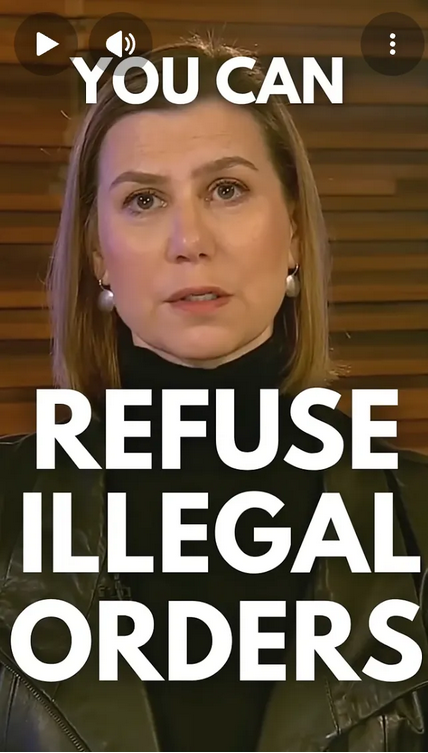
US Democrats issue clarion call to the military: “You must refuse illegal orders”

Filed under: Government, Law, Military, USA — Tags: , , , , — Nicholas @ 05:00

Well, thank goodness that someone remembers Nuremberg! Apparently President Trump has been issuing illegal orders to the US Army, Navy, and Air Force, and these brave legislators are putting their careers — and even their lives — on the line to defend democracy. I’m unaware of what these specific orders may be, but as Chris Bray points out, he’s the Bad Orange Man so pretty much anything he orders must be illegal:

Note what they don’t say. They say that the American military is being “pitted against” their own countrymen, and they say to servicemembers that “you can refuse illegal orders …”

… they don’t say, even once, even in a pretty clear hint, precisely what illegal orders Trump has issued. He’s being vaguely bad, so you don’t have to obey him. The serious version would look like this: On [date here], the President of the United States ordered [unit name] to enter [place name] for the purpose of [specific action], and that order violated [explicit citation of US Code]. They mushmouth around a set of feelings-signals about Mean Orange Something, but they never quite manage to spit it out. What’s the illegal order anyone is supposed to disobey, and what makes it illegal? News reports suggest that they mean to refer to the boat strikes, but click on that link if you want to see more vagueness and weak hinting.

This is exactly what the Catholic bishops just did in their own stupid virtue performance, the precise mark of an absence of seriousness in a coven of drama queens, as they declared that they’re very concerned about questions that have arisen regarding certain situations involving immigrants. More mush from the wimps. Donald Trump is very bad, because mumble mumble mumble. Be precise and clear, or be silent.

This is an age of unseriousness, and here’s another heaping plate of it. Soldiers, you don’t have to obey the orders of your military superiors if you feel that they, that they, uh, oh hey look at the time anyway I have to go. It’s passive-aggressive bad girlfriendspeak as politics. I guess if you feel like you have to obey, that’s fine. No, it’s fine! I’m not mad! Let’s just go to dinner!

We want to speak directly to members of the military, but we don’t actually have anything to say. Just, you know, disobey the president. Small thought, not a big deal.

High school drama club president Elissa Slotkin has been banging on this drum in an especially insistent way, as she holds town hall meetings with veterans who mumble their own vague slogans about Trump bein’ against the Constitution real hard and stuff.

But all of their descriptions are stupid. Sending a few hundred National Guard troops to a city of hundreds of thousands of people with narrow orders about protecting federal facilities and personnel or patrolling to deter violence isn’t military conquest of the population or the militarization of all law enforcement. The hyperbole renders the argument insane. Related, the veterans in Slotkin’s video talk about the “systematic removal” of military leaders, and the “purge of the generals”. The US military has over 800 flag officers; the Trump administration has removed about 15. There’s a desperate stupidity to all of this panic-mongering that just renders it deeply tiring.

Actual servicemembers will be familiar with the rhetorical style of the shithouse lawyer, the idiot in the barracks who tells you that akshully they can’t order you to do that, it’s totally illegal.

You should just tell your drill sergeant that you refuse! He can’t even do nothin’ about it! He’ll just back right down!

The Korean War Week 74: The US Wants To Prolong The War – November 18, 1951

Filed under: China, History, Military, USA — Tags: , , , , , , — Nicholas @ 04:00

The Korean War by Indy Neidell
Published 18 Nov 2025

UN Commander Matt Ridgway has everyone in Washington worried because of his refusal to play ball with the Communist side at the peace talks. The Communist side aren’t exactly playing nice either, lobbing insults at the UN delegates, but the newspapers of the world wonder if the US actually even wants a truce, since bloody headlines implying impending vengeance come out in American papers timed suspiciously with possible breakthroughs at the talks.

Chapters
00:00 Intro
00:43 Recap
01:12 Ridgway Disagrees
04:29 Insults at Panmunjom
06:50 What The Troops Think
09:05 Ridgway’s Statement
10:11 POW Repatriation
12:50 Summary
13:06 Conclusion
(more…)

Ken Burns’ The American Revolution gets the Howard Zinn seal of approval

Filed under: Britain, History, Military, USA — Tags: , , , , , — Nicholas @ 03:00

CDR Salamander is persuaded, against his better judgement, to watch the latest Ken Burns documentary … and discovers that it’s somehow still 2018-2022 in Burns’ world:

So, I’ve watched the two episodes of Ken Burns’s documentary, The American Revolution, in spite of my stated zero desire to do so. Why? If you are not up to speed with the MSNBCification of Ken Burns over the last decade, catch up.

Anyway, as Mrs. Salamander knows more about the American Revolution than 99.7% of people out there, she insisted we watch it. I’ve been married for over three decades for a reason, so I sat down with her to watch.

FFS.

… and … it started with a land acknowledgement. ISYN.

It doesn’t get better.

By the end of episode two we’ve gotten through the Battle of Bunker Hill, yet there has been no mention of John Locke, Montesquieu, or any of the other philosophical drivers of the revolution. They have plenty of time to quote the memories of an old man about what he thought of George Washington when he ran into him when he was 8 (it wasn’t good).

Let’s pause there a bit. It is clear that they made a decision that for every good thing they say about GW in the first two episodes, they insist on finding a way to smear him with presentism. It is also clear that he really wants to do a documentary on African Americans in the Revolutionary War, but couldn’t get the funding for that. Instead there is a constant referring back to slavery and racial issues. Just overdone to the point of being obvious, given that they were, at best, tertiary issues during the war. It deserves mention, but not in this ham-fisted, patronizing manner it is being done … and done mostly to smear GW up.

The presentism and biased scholarship is not shocking if you’ve read my reports at my Substack over the years about the absolute woke-soaked state of American historical organizations such as the American Historical Association. (see my FEB 2021 Substack, “The War on (Military) History: Half a Century In” for reference.)

The smearing of GW like this is more than “balance” — it is emblematic of the presentism that makes so many modern virtue signaling tiresome — and exactly meets the low expectations I had for this documentary.

There is also the pettiness of their choices of what to comment on, and how — the smug New England perspective of the Acela Corridor that is Ken Burns’ intellectual terrarium. Just one example from the second episode: the arrival of the Virginians to support the patriot forces around Boston. Might as well have called them rednecks.

Even Mrs. Salamander, halfway through Ep. 2, had about enough of the shoehorned in identity politics of “inclusion” … as if everyone ever got over the fever of 2018-2022.

Julia: A Feminist Retelling of 1984?

Filed under: Books, Britain, Media, Politics — Tags: , , , , — Nicholas @ 02:00

Feral Historian
Published 11 Jul 2025

Julia, a 2023 novel by Sandra Newman, does more than just retell Orwell’s 1984 through Julia’s eyes. That perspective switch presents an Oceania that is both more mundane and more familiar. It’s certainly a companion piece more than a stand-alone work, but it does have something to offer both in how it examines Orwell and a few times, how it contradicts him.

00:00 Intro
02:18 a Different Perspective
09:30 Caught in a Trap
12:45 Backstory
15:40 Departures
20:18 Endings and Beginnings
(more…)

QotD: Rum Sodomy & the Lash

Filed under: Britain, History, Media, Quotations — Tags: , , , — Nicholas @ 01:00

Released 40 years ago by London Irish legends the Pogues, the album is named not after a decent night in old Soho, as the title would suggest, but an apocryphal quote of Churchill’s. “Don’t talk to me about naval tradition,” he’s purported to have said. “It’s nothing but rum, sodomy, and the lash”. For many years, listening to the album while writing and drinking in this adopted riverside local, I’d no idea it was recorded a stone’s throw away in Elephant Studio, in the basement of Metropolitan Wharf. Or that the pubs of the area, such as this one, were frequented by Pogues musicians: their frontman and chief songwriter Shane MacGowan and the album’s producer Elvis Costello.

The album was even launched on the river, upstream, on board HMS Belfast with the band wearing Nelson-era naval regalia. They’d been ferried to the moored cruiser from Traitor’s Gate, arriving to find the assembled journalists (one of whom ended up, temporarily, in the Thames) already tearing into the drink. After the gig, MacGowan’s admiral’s hat vanished; in one story settling onto the river bed with all that other historical debris. At the time, the album felt like a raucous act of vandalism. Now, it’s viewed almost universally as a stone-cold classic.

The cover, a remade version of Géricault’s The Raft of the Medusa, where the band themselves are among the wretched shipwrecked crew, acts as a framing device. What Rum Sodomy & the Lash does is allow erased, abandoned or sidelined histories to erupt — the piratical and press-ganged, the adventurous and the damned — in a way that gracefully, modestly hides the band’s self-taught virtuosity and the lyricist’s songwriting genius. It was an album that, at that time, socially and politically, shouldn’t have existed, but through courage and sheer force of nature had to.

The Thames may not forget, but society is all too willing to. There are, alas, few signs of gratitude or even recognition of the colossal impact the Irish have had on London. A statue of Oliver Cromwell, the Butcher of Drogheda, stands pride of place outside the House of Commons, but there’s scarce trace of his Hibernian victims. It took the London Irish Centre to erect a plaque in Camden Square, in 2017, to the “Forgotten Irish”, “who left their homes, counties and country … to work and rebuild this city and country, ravaged and destroyed by war … Many would never return to Ireland”.

[…]

Even at the time of the album, in fact, the Pogues ran into opposition, and not just among musical snobs and gatekeepers in England. In Ireland, their adversaries were two-fold — traditionalist embalmers of folk music, and cringe-beset “cosmopolitans” who were mortified with anything too Irish, too plebian, too diasporan. Ironically, it turned out that the Pogues were far more effective custodians of Irish traditional music, and more authentic examples of cosmopolitan hybrid-culture, than their adversaries, exemplifying the maxim that, “Tradition is not the worship of ashes, but the preservation of fire”.

At the heart of Rum Sodomy & the Lash‘s success and legacy is embrace of apparent opposites: high and low culture, Ireland and England, city and rural, home and exile, intellect and soul, sacred and profane, debauchery and dignity, stars and gutter. So you get “Navigator”, a tribute to the Irish workers who built the railways, and MacGowan’s rowdy “Sally MacLennane”, a tribute to his uncle’s Irish pub in Dagenham, the Irish car-making workforce it served and the real-life characters he encountered, some less than salubrious. There’s also a fierce and atmospheric instrumental, “The Wild Cats of Kilkenny”, inspired by Spaghetti Westerns, or else the industrial hangover of Ewan MacColl’s “Dirty Old Town”, especially poignant at a time of deindustrialisation.

The true legacy of the Pogues exists not in print, of course, but in music. Their inheritors include the drone and conscience of the modern band Lankum, the otherworldly transformations of the past in the music of Lisa O’Neill and John Francis Flynn, and the pulse of the new in Fontaines DC. But the album also impels its listeners to articulate discontent, defy the rot, preserve the fire, to genuinely transgress, to face reality in surreal or raw terms, to lament and howl not in the transience of placards or social media, but in an art form that hits far deeper, than rusting plaques, and lasts much longer. It’s all out there, more than ever, out of sight, below decks or at the bottom of the river, waiting to escape.

Darran Anderson, “The Pogues soundtracked Irish London”, The Critic, 2025-08-05.

November 18, 2025

Canada’s divide isn’t left versus right, it’s old versus young

Older Canadians seem to be taking joy in sticking up their elbows and robbing younger Canadians of opportunities, jobs, and hope. It’s quite literally un-Canadian, but the Boomers have always been a generation apart and this is merely the latest manifestation of their self-centred worldview. Alexander Brown wonders if this divide can be fixed before the country itself is ruined:

“eLbOwS uP!”

“Talk to your parents,” the host of an event for Pierre Poilievre joked on Saturday in Vancouver — an event I happened to attend. “But be patient. Be kind.” And he’s right.

The cross-talk, the rock’em sock’em robots, the continued slap-fight between warring consultant tribes, it isn’t getting us anywhere, clearly. When the present iteration of the party of the status quo wedges a nation against itself, and denies a reform election after a decade of haphazard redistribution, non-growth, and abject decline, you get a traditional voter-demographic breakdown flipped entirely on its head.

The party of seemingly endless opposition dominated with youth, held strong with the 35-54s, but found itself walloped 52% to 34% among those aged 55+. Since then, those 55+ numbers have only widened, as the “safe” choice, that more stately actor (when he’s not radicalizing those who don’t know any better with claims of false invasion) can do little wrong, even coming out of “middling” budget heading to a vote Monday, and with a nation remaining pessimistic about its future prospects.

If the Liberals are voted down Monday, they would likely relish that opportunity to seize on a majority. The spin is already built in.

    The Conservatives don’t want to stand up against Trump!

    At a time like this, when we should be coming together, it’s un-Canadian …

    We’re supposed to be one Team Canada right now (offer void in British Columbia, Ontario, and Quebec), we can’t afford Pierre Poilievre’s divisive Trumpiness.

On and on. Yada and yada.

Nowhere in that comms exercise, drummed up by those who spend more time in America or the Arab Emirates, or meeting with Chinese proxies than they’d publicly care to admit, would there be a defence of younger Canadians, of those still on the launch pad, worried about, say, supposed ‘fixes’ to immigration riddled with creative accounting and more of the same.

Nowhere would they address housing, set to get much, much worse, under both the federal Liberals and targets they’re admitting they won’t come close to hitting, and Ontario’s ‘Conservative’ premier who leads the galaxy in not getting off his ass to get out of the way on starts and lowering punitive development costs.

Nowhere would one find a stout defence against “deconstruction“, or the daily humiliation ritual of flags flying that aren’t our own, or imagined and inflated woke excess meant to sully the memory of our war dead and marginalize normal people.

Following recent debates sparked by Without Diminishment, where we’ve argued a version of “it’s not just the economy, stupid,” when it comes to what’s animating young people and young conservatives — actually talk to them, and half of them are trending towards fascism with how alienated they feel by a lack of upward social mobility, or a society without rules or those willing to enforce them — it’s been easier for some serving in established camps to mischaracterize these conversations as focusing too much on culture, or, ridiculously, “blood and soil nationalism”. But we’re not. If one is dealing in good faith, it’s plain to see we’re trying to talk about both.

Of course, the Liberals survived Monday’s budget vote … for now:

When I saw Elizabeth May stand up and ask Mark Carney what looks like a completely planted question, I assumed the budget would pass and I was correct. Planted questions normally come from government MPs and are a soft way for the government to push their agenda.

This time, it wasn’t a Liberal MP, well at least not a Liberal MP in name and fact. Instead it was Green leader, or deputy leader, or let’s be honest the lonely lady in the corner who is the only Green MP asking the question.

That statement put the Liberals one vote closer to passing their budget and of course May later confirmed ahead of the vote that she would back the budget. This was after saying couldn’t back the budget, might back the budget, would probably back the budget, definitely wouldn’t back the budget and finally would back the budget.

How anyone can take Elizabeth May seriously is beyond me.

How the other votes went…

Ahead of the vote there were lots of questions about how things would go. Would all MPs show up or be able to vote online? Would people abstain? Would MPs vote for the budget without crossing the floor?

In the end, the budget passed 170 to 168 with two NDPers abstaining. That leaves five votes not accounted for and we will figure out.

Here is how the vote went.

Now, some members who were not in their seats did vote electronically. I didn’t see Matt Jeneroux vote electronically and I’m told that he is in British Columbia with is family. Also not voting, Conservative MP Shannon Stubbs.

Conservatives Andrew Scheer and Scott Reid both voted no but only in the time that is allowed for MPs voted electronically to claim tech problems. They were both in the House, so why were didn’t they vote in person?

Regardless, the NDP rushed out to say they voted against the budget but also made sure that it passed with their two abstensions.

As for all this talk of a Christmas election, had the government lost this vote and the PM gone to see the Governor General tomorrow, the earliest election date would have been December 25.

A Christmas election.

Canada’s major projects announcements are an economic “hostage release” program

On the social media site formerly known as Twitter, David Knight Legg vents about Dear Leader Carney’s penchant for even-more-Trudeauesque-than-Justin performative governing. Far more emphasis is put on the PR value of an announcement than on the common sense practicality of the thing being announced. And Carney is also starting to re-announce already announced “projects” as if speaking it aloud will magically manifest it into reality:

Canada’s major projects announcements are a national embarrassment — an economic “hostage release” program — that tells the world just how uninvestible Canada has become under the Liberal party.

1970s central planning Liberal govt arrogance is at an all time GDP destroying high.

Try naming another OECD nation (we’re at the bottom now) where the press waits with bated breath for a “dear leader” politician who has never built anything in his life to fly in to grant a bureaucratic benediction on a few projects his bureaucrats will allow past the gate of the caps, taxes, green rules and red tape his govt imposes on everything.

Idea: set up the Major Dumb Redtape office in Calgary instead and get rid of the 10 anti-business rules written into law by the Montreal green alarmist fringe that’s holding Canadian energy, ag, forestry, and manufacturing back while other nations grow …

But PM Carney seems to like his bureaucratic power over what used to be a leading free market economy. Even while our GDP grinds down to the worst in the OECD.

The arrogance is breathtaking.

So is the ineptitude. This same central planning genius just punched a record new $78billiom hole through our public finances because he can’t manage basic public service delivery without more crushing debt.

The budget is a train wreck solidifying the final year of a Liberal decade steeply eroding purchasing power, national wealth, personal security and living standards and public services.

The irony is that this has driven Canada to ever-greater 51st state economic dependency. Donald Trump didn’t do that. They did.

But he’s been a too-convenient way to con the elderly with “elbows up” PR.

But should the next generation really be forced to lend this govt another $78bn in addition to the 1 trillion they’ve already taken to fund their failed decade of central planning, green slush funds and EV mandates while real infrastructure projects wait years for the Liberal party to bless them?

It’s not going to last.

Fitch just questioned the sustainability of all this. Unlike our lacklustre press they aren’t buying “net debt” or “operating/investment” Liberal financial illiteracy.

I had high hopes PM Carney would return fiscal sanity to Canada after openly borrowing Conservative policies to get elected by cutting the carbon and cap gains taxes.

But this budget, this major projects farce and his inability to kill a dozen economy killing rules of his own govt is showing the work how uninvestible Canada has become — and it’s accelerating national economic decline.

2026 is the end of the Liberal lost decade. First recession. Then debt downgrade. Then an election. And Carney can go back offshore to his assets and all the other global investors who like him don’t invest in Canada under Liberal mismanagement.

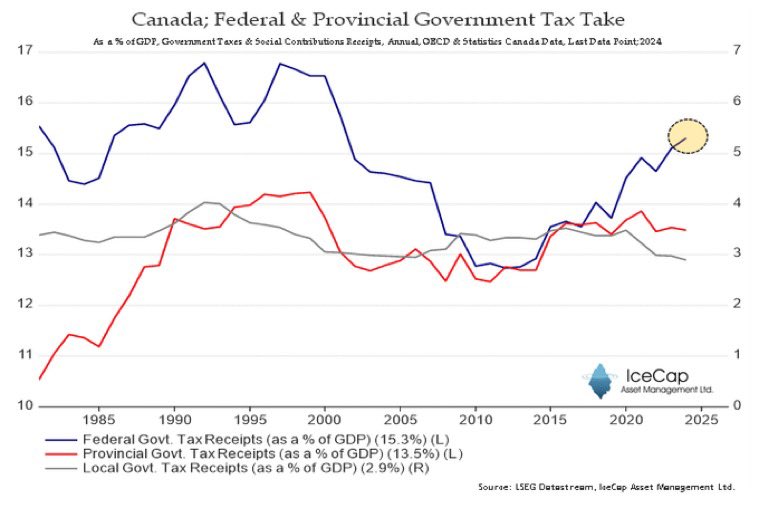
@SteveSaretsky thx for the brilliant line chart as usual.

A day later, after his post got significant attention on the social media site formerly known as Twitter, he posted this follow-up:

This angry post I wrote a day ago got 300,000 views.

Canadians are tired of the fake “major projects” PR by the same people who prevented those projects for a decade with their green taxes and prohibitions.

Announcing the release of 7 hostage projects is a joke. Some of these projects aren’t major and most aren’t new. None needed the govt to do anything but get out of the way from the beginning.

All the several hundred major projects still in purgatory need is for this govt to reverse their anti-job and anti-infrastructure tanker ban, industrial carbon tax, emissions cap, and electricity regs.

Oh — and also clarify by law that in Canada property rights are not overridden by leftist judges and UN wishful thinking.

Then get out of the way so a couple trillion dollars can flow in, major projects can get built and the govt revenue will flow to better public services — and to pay down that debt they just added $78bn to.

« Newer PostsOlder Posts »

Powered by WordPress