
Even that 1990s desktop is too frou-frou for me now, let alone the excessively cute GUIs that replaced it.
My desktop layout doesn’t have a background, or icons, or action buttons, or gradients, or any of that crap. It barely even has color.
I’m not going to name my window manager here, because I don’t want to sound like I’m evangelizing for a particular one. The important part is that it’s all tiled windows all the way down with an absolute minimum of dead space and visual noise.
And I am so much happier than I was with conventional desktop GUIs. I love not having that visual noise constantly pull at my attention.
In hindsight, we spent decades being obsessed with UI details that were just meaningless, distracting fluff. That not only didn’t help us get work done, they were actually a drain on our concentration.
Only part of that can be blamed on pixel-pushing “UX” designers who got erections every time they changed the color or shape of a button. The rest of it’s on us, on people who bought into this glittery fake progress. I used to be guilty of this myself, but I’ve learned better.
Fancy visually-noisy desktop GUIs that suck your attention are the enemy. Fuck all that sideways with a chainsaw. Go simple, go tiled, go minimalist — stop abusing your brain!
Eric S. Raymond, Twitter, 2024-05-28.
May 14, 2025
QotD: To hell with visual distractions on your desktop GUI
May 13, 2025
Checking on the parlous state of German democracy this week
First, Sabine Beppler-Spahl points out how difficult it was for the new ruling coalition to get their candidate for Chancellor actually installed:

German Chancellor Friedrich Merz, 5 May 2025.
Photo by Sandro Halank for Wikimedia Commons.
The spectacle in the Bundestag this week sent shockwaves through Germany’s political establishment. For the first time in modern German history, a chancellor candidate – Christian Democratic Union (CDU) leader Friedrich Merz – failed to get elected by parliament. In the first round of voting, he received just 310 out of 621 votes – six votes short of the necessary majority. A total of 18 members of his own coalition brazenly refused to support him.
A second round of voting was then called and Merz managed to scrape through with 325 votes. But this was a stinging embarrassment for both Merz himself and the new coalition government more broadly. “Never before has there been a political car crash on such a scale”, wrote Berthold Kohler, editor of the conservative FAZ.
In hindsight, Merz’s failure shouldn’t have been such a surprise. From the beginning, the new government was always going to be in for a rough ride. For a start, it is made up of two parties that both received phenomenally bad results in February’s federal elections. The CDU suffered its second-worst result since its founding. Meanwhile, the CDU’s coalition partner, the Social Democrats (SPD), received its worst result ever.
Worse still, the coalition was losing even more support in the polls in the weeks running up to the chancellor vote. At times, the governing parties barely managed 40 per cent between them. Hermann Binkert, head of the INSA polling institute, described this as a “loss of approval like never before in the period between a federal election and the formation of a new government”.
Many commentators are now questioning whether Merz and his coalition will ever truly recover from this humiliation. The fiasco certainly confirms that Germany is in a deep political crisis, which isn’t going anywhere. It also undermines the smug assertions of Europe’s anti-populist establishment, which has been claiming, against all evidence to the contrary, that German politics is less prone to populist upheavals than those of other Western democracies.
Outside parliamentary machinations, the move to declare the largest opposition party to be a formal threat to German democracy isn’t going smoothly either:

The anti-AfD protest in Essen on Sunday, photographed carefully lest the viewer see how small it was.
On 2 May, the Federal Office for the Protection of the Constitution (BfV) yielded to intense pressure from their boss, Interior Minister Nancy Faeser, and declared Alternative für Deutschland to be a “confirmed right-wing extremist organisation“. The media filled with hit pieces and leftoids began a new round of shouting and morally hyperventilating about the evil fascist Nazi Hitler party. I thought we might be seeing the beginning of an earnest campaign to prohibit the AfD and that over the coming weeks the momentum would just build and build.
Instead it’s kind of fizzled out.
One thing that went wrong, was the roll-out. The AfD immediately filed suit with the Cologne Administrative Court to have their extremist status lifted, and the BfV ended up temporarily suspending their assessment for tactical reasons – above all, to avoid a temporary court injunction that the AfD could portray as a victory. I’ve said many times that a lot of the media pressure against the AfD seems to be coordinated by the constitutional protectors themselves. Now that they’re no longer agitating behind the scenes, the steady drumbeat of pearl-clutching news stories has ground to a halt.
The second thing that has gone wrong, is the publicity campaign. You may remember that the constitutional protectors have produced a 1,100-page assessment documenting the right-wing extremism of the AfD. This dossier, however, remains entirely secret, and so journalists have been leaking choice passages from its pages instead. Their leaks strongly suggest that this document is little more than a vast assemblage of public statements by AfD politicians and functionaries that people in the BfV find untoward.
First we had the three leaks in Welt, which I covered in my first post on this topic. These featured people saying such benign things as “There is more to being German than simply holding citizenship papers” and “Failed migration policy and asylum abuse have led to the importation of 100,000 people from deeply backward and misogynistic cultures”.
That did not impress anybody, so Der Spiegel rushed out a new round of leaks. This piece tells us, breathlessly, that “politicians from the party have been ‘continuously’ agitating against refugees and migrants”, that “they have made xenophobic and Islamophobic statements” and that they have an “ethnic-ancestral understanding” of human descent groups that “is not compatible with the free democratic basic order”. They particularly deplore the use of terms like “knife migrants” (“Messermigranten“) which “attribute an ‘ethnocultural propensity for violence to entire groups'”. They say that the party does not consider Germans “with a migrant background from Muslim-influenced countries” to be equal citizens and that the AfD thus “devalues entire population groups in Germany”, violating their human dignity.
Mao Wins the Civil War – Chinese Civil War Part 4 – W2W 28
TimeGhost History
Published 12 May 2025By early 1949, Chiang Kai Shek’s Kuomintang is falling apart. Hundreds of thousands of Nationalist troops surrender as city after city fall to Mao Zedong. Beijing falls without a fight and the Communists cross the Yangtze. Chiang’s final plan is escape and he moves tons of gold and his best troops to Taiwan. Meanwhile, Mao declares victory and the birth of the People’s Republic of China.
(more…)
For boys, sometimes a touch of competition is all that’s required
Jon Miltimore was concerned when a report from his son’s school indicated that his son was lagging behind in reading compared to his classmates:
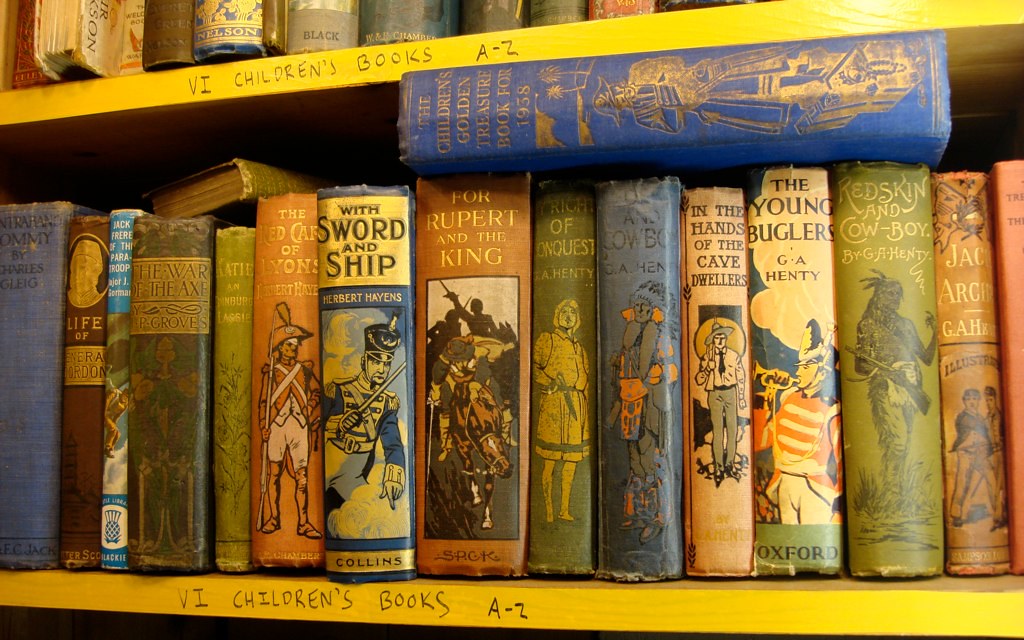
“Old Victorian Childrens’ Books” by pettifoggist is licensed under CC BY-SA 2.0 

 .
.
So the fact that my own son — who is quite bright and scores extremely high in math — was struggling hit me a little, but it was not a surprise. Like many children, he had fallen behind in reading during the pandemic, and our efforts to get him caught up at home were pretty ineffective. Part of the problem was that as parents we did not do a good enough job of finding the right books to naturally kindle his interest and curiosity, but another issue was that at some point he began to feel self-conscious about this reading, which created an aversion to books.
[…]
A few months later, I had just finished reading a story to my 6-year-old son, who shares a bedroom with his older brother. I went to flick the light off when my older son said something I’d never heard before.
“Can I read for just ten more minutes,” he pleaded, showing me his book on pro football players.
I quickly gave my approval, then went downstairs to tell my wife. She was not as surprised as I was.
“They’re doing a reading competition at school. It’s boys against girls,” she said. “Every minute he reads is now added to their score. So now he wants to read — because it’s a competition.”
My wife did not say this disapprovingly, but she said it in a way that said of course he wants to read now. (My son is competitive.)
Over the next several weeks I watched as my son made a point of reading every night. Oftentimes he’d ask — just like on that first night — if he could read just 10 more minutes. Many nights he’d fall asleep with a book on his chest.
I have to admit that at first I found this strategy a tad cynical, but then I got the results. Over the span of seven weeks, my son leapt nearly two reading levels. He’s reading comfortably at the third-grade level and we’re now focusing more on reading comprehension than reciting sentences. He’s asking for books on World War I, World War II, and Vietnam for Christmas.
“His fluency has improved so much! I am so proud of him,” his teacher later told me.
Competition as a Virtue
I don’t doubt that some will look on this strategy with disdain.
We’re taught today that competition is crass, even harmful. George Soros, in a highly read piece from the 1990s published in The Atlantic, could have been speaking for many when he wrote that competition can “cause intolerable inequities and instability”. For many, competition is a dirty word, a sinister force to be suppressed and controlled.
This is nonsense, of course. Competition isn’t just innate to humans; it brings out the best in us.
It’s the force that drove Roger Bannister to break the four-minute mile. It’s given us the achievements of Michael Phelps and Michael Jordan. Socially, competition is what prompted the Brooklyn Dodgers to do the unthinkable and sign Jackie Robinson, breaking the color barrier and forever changing sports and America.
Gout – The Disease of Kings
Tasting History with Max Miller
Published 7 Jan 2025Sliced roast venison with a spiced red wine sauce and a sprinkling of salt
City/Region: England
Time Period: 1723Gout has plagued people for thousands of years, but mostly the rich people. It often follows an indulgent diet full of red meat and alcohol, so for a long time only the rich had regular access to a gout-inducing food.
This recipe from 1723 is delicious, as well it ought to be as it flies in the face of the rules you should follow to prevent gout with venison (red meat) served with a wine sauce (alcohol). Venison is best when it’s not cooked past medium, and this recipe is tender and flavorful with the rosemary coming through. The sauce could really go on anything, and you could swap out the red wine for something different. Port would be delicious, though I would reduce the amount of sugar a bit.
I don’t expect most people will have a larding needle on hand, and I think you could probably skip the larding and still end up with a flavorful, tender dish.
To roast a Haunch of Venison.
First lard it with Bacon, and stick it thin with Rosemary; then roast it with a brisk Fire; but let it not lye too near it; bate it with fresh Butter; then boil a Pint of Claret with a little beaten Ginger, Cinnamon and Sugar, with a half a dozen whole Cloves, and some grated bread; and when they have boil’d enough, put in a little Salt, Vinegar and fresh Butter; dish your Venison, strew Salt about the Dish, and serve it with this Sauce.
— The Cooks and Confectioners Dictionary: Or, the Accomplish’d Housewives Companion by John Nott, 1723
QotD: The song is correct – video did kill the radio star
One reason for this assumption is youth culture. In liberal democracy, the young are treated like gods, in the same way novel social ideas are treated as gifts from the gods, so whatever young people like is heralded as pure and beautiful. Young people, especially children, are first drawn to images, then sounds and finally as they mature into adults, the written word. In modern liberal democracies, therefore, video platforms are treated like sacred altars where our most sacred members perform.
The youth culture phenomenon has co-evolved with the rise of mass media. In the days before mass media, young people were at the bottom of the cultural hierarchy. The first flicker of youth culture in America was the jazz age, but even there the people driving it were old by modern standards. The characters in The Great Gatsby, for example, are mostly early middle-aged. It was after the war with the explosion of Hollywood that youth culture blossomed into the centerpiece of modern life.
Another reason why video maintains a privileged place at the top of our social hierarchy is Baby Boomer culture. For Boomers, for whom mass media evolved, video was always the top. In the golden age of television, for example, the whole country would watch popular television programs. No newspaper or radio broadcaster had the reach of a popular television program. Hitting the big time in the field of news or entertainment meant getting on TV or in the movies.
As much as young people, and not so young people, complain about the Baby Boom generation, the Boomers still control the culture. That is plainly obvious with the panic over the Chinese virus. If the Boomers were twenty years younger, the virus would rate a few mentions in the New York Times science section. Since Boomers are now deeply involved in the health care system, anything medical is going to be of utmost importance to everyone. It is why nurses are now heroes.
The Z Man, “Thoughts on Modern Media”, The Z Blog, 2020-05-09.
May 12, 2025
The rise of the Hansa
At Works in Progress, Agree Ahmed describes the conditions in northern Europe in the Middle Ages that helped create the Hanseatic League:
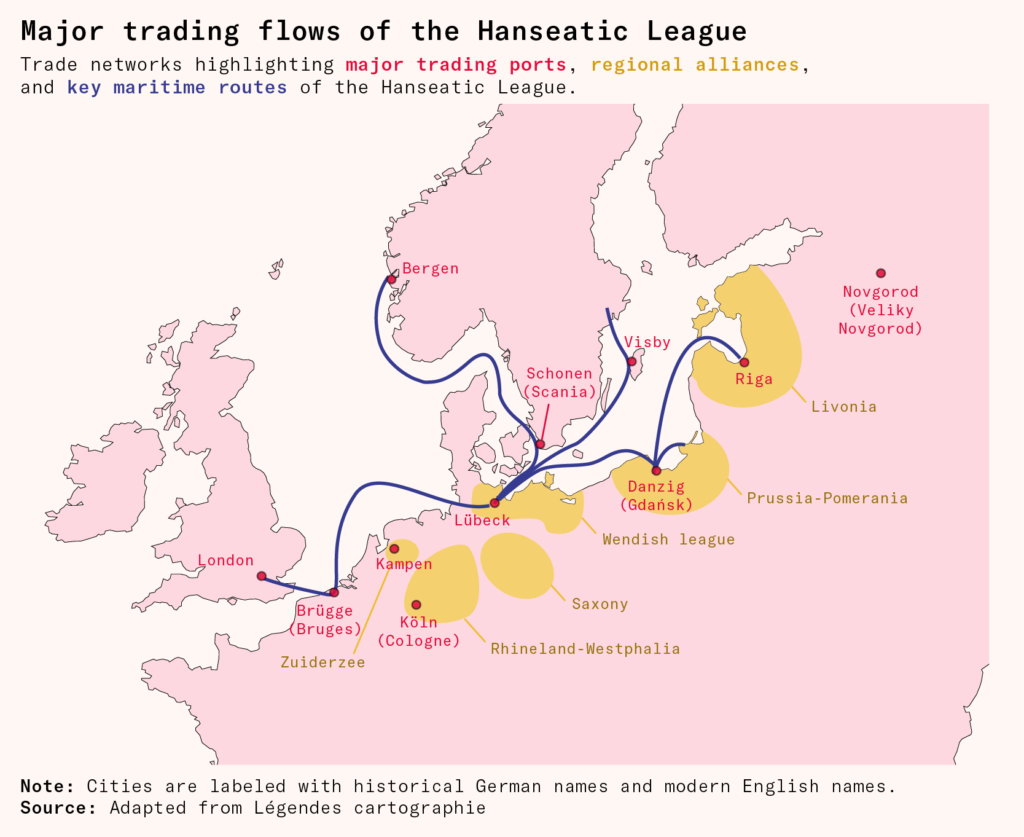
Today, we typically think of coalitions in the context of modern electoral politics. So it might be surprising that one of the greatest case studies in the history of coalitions is a community of medieval German merchants known as the Hansa.
Starting as individual traveling traders, the Hansa built up coalitions for collective bargaining, collective action, and collective security. Through this process, they formed Northern Europe’s first ever long-distance trade network.
Without corporate structures, they built supply chains that distributed goods between Northern Europe’s major ports, with capillaries that spread into each city’s hinterlands. Without formal territory, their laws governed trading hubs spanning thousands of miles, from London all the way to Western Russia. And, despite being composed of hundreds of member cities, the Hanseatic League had no head of state. Yet the Hansa still managed to sign treaty after treaty with foreign rulers and, a few times, even fought (and won!) wars.
[…]
Better climate, more arable land, and better farming techniques lifted Europe’s crop yields to above subsistence levels for the first time since the Roman period. After several centuries of decline, Europe’s population grew from 18 million in the 600s to over 70 million by the 1300s – nearly triple the population of the Roman period. The nutritional surplus allowed for Europe’s first significant artisan class since the Roman empire. Each town had common craftsmen like blacksmiths, leatherworkers, and carpenters. But local skills and resources allowed for the emergence of specialized crafts, which were unique to specific regions and could therefore be traded.
Tax-hungry lords across Europe began to set up permanent marketplaces for their growing communities. And so hundreds of towns formed in Europe, filled with workers who had flocked from countryside manors. These towns were the first substantial permanent markets in Northern Europe’s history.
As production accelerated, so did shipping. The warmer climate meant waterways in the North and Baltic Seas were navigable for longer stretches of the year. Meanwhile innovations in boatmaking dramatically improved shipping capacity. Excavations of the few surviving ships from this era show that, in the span of a few centuries, vessels tripled their average tonnage from 10 to 30 while dropping the number of rowers required by a factor of four.
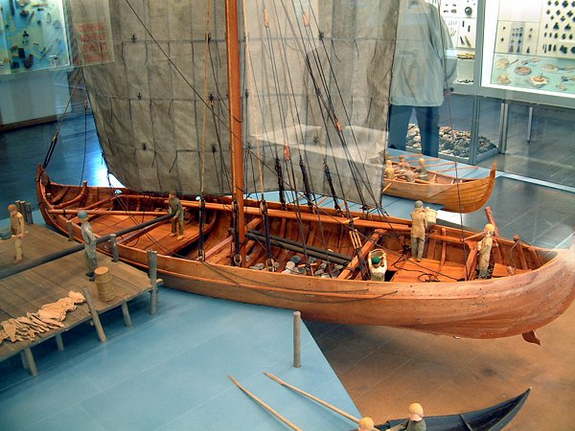
The breakthrough in tonnage starting in 900 can be credited to the knarr, a Viking-style ship that was shorter and wider than the longboat that preceded it, allowing it to load substantially more cargo with a smaller crew. Prior to the knarr, trade convoys had to carry cargo on longboats, which were agile but could only carry small fractions of what the knarr could.
A model knarr in the Hedeby Viking Museum in Germany.
Image Source: Europabild via Wikimedia.When Northern Europe’s first long-haul merchants set off on their voyages, they faced a world that had not yet been ordered for trade. Sailors had to worry about pirates in the Baltic and shipwrecks at icelocked winter ports.
Riverways gave merchants access to inland communities, where they could find products at lower prices to then sell for a profit in major port cities. But riverside towns were more interested in their own engineering projects or grinding their grain and so would block rivers with dams and water mills, and they would redirect water to irrigate fields.
And even if a river were clear of obstructive mills or dams, it might be heavily punctuated by toll stations. The Rhine River, a key shipping artery that connected inland Germany with the Baltic coast, had tolls approximately every five kilometers.
Under the laws of the Holy Roman Empire, the right to collect tolls on the Rhine could only be granted by the Emperor. But unauthorized tolling stations, or tolls levied in excess of what was authorized, were so rampant that the malpractice had a name: the lonia iniusta (Latin for “unjust tolls”). Some local authorities enforced toll collections along rivers by running chains from bank to bank, making it impossible for a boat to pass without paying. Others would patrol the river on their own boats and deny vessels passage until they paid up.
In the first four years of the Great Interregnum Period (1250–73), when the Empire had no emperor, the number of toll stations on the Rhine doubled to 20. This is the origin of the term “robber baron”: local barons, operating out of riverside castles, would set up illicit toll stations and demand significant shares of merchant cargo in order to pass.
The journey on land wasn’t much easier. Toll booths were similarly common. Nominally, these were to pay the landowner for the maintenance of the roads and bridges but in reality they were usually left dilapidated. Merchants voyaging on land had to load their wares on the backs of mules and horses (which were about a third the speed of ships). The narrow widths of medieval roads meant these caravans stretched out in long lines, leaving animals and cargo physically exposed. These vulnerable, slow moving, value-dense caravans attracted bandits who roamed the isolated roads between towns. It was nearly guaranteed a caravan would face an attempted robbery – either illegally by bandits or (somewhat) legally in the form of a toll shakedown – over the course of a sufficiently long trip.
As a matter of safety, Northern European merchants learned to move together in armed groups. These traveling merchant bands were called hansas, a Lower German word meaning “company” or “troop”. When a hansa formed for a trip, they elected an alderman (literally “elder man”) who would speak on behalf of the group to the various authorities – lords, princes, bishops, and other rulers – they might encounter along the way.
Once they completed the arduous journey, the merchants had to deal with the local governments of their destination cities, each of which had different and constantly changing laws. To protect the local merchants and craftsmen within their city walls from competition, princes might demand exorbitant taxes from foreign merchants or deny them access to the city altogether. Merchant bands had to negotiate collectively to secure the right to trade within each city in which they wished to conduct business. And if they made it into the city walls, they might not make it out: capricious lords might suddenly imprison foreign merchants (as happened to German merchants in England in 1468 and Novgorod in 1494), raid their offices, or seize their merchandise.
Local laws threatened foreign merchants more than they protected them. Most town courts, themselves newly formed, had minimal experience adjudicating long distance commercial disputes. When such disputes did arise, courts could take weeks or months to arbitrate them, and were heavily biased towards locals over foreign traders. Without sovereign states, merchants were left dealing with a fractured landscape of town courts, where each market had its own idiosyncratic laws. And because foreign traders could evade punishment by fleeing overseas, courts in England, France, Italy, and the Holy Roman Empire often collectively punished foreign merchant communities for the unpaid debts of their countrymen.
The lack of early medieval records makes it difficult to quantify just how much Northern European commerce grew as a result of continuous long distance trade. Before the late medieval period, Northern Europe’s archaeological record of trade shows just several dozen sites known as emporiums: small, temporary settlements outside of towns where foreign merchants traded with locals. But starting in the late medieval period (1300 to 1500), Lower German merchants began to change this.
H/T to Niccolo Soldo for the link.
Is modern fiction in any way intended to be read by a male audience?
I belong to several genre-specific groups on various social media platforms, most of which appear to be disproportionally female in membership, and I read very little new fiction of any sort these days, partly for diminished interest and largely from diminished disposable income. I’ve often seen the assertion that men no longer read much fiction, but is it actually true?
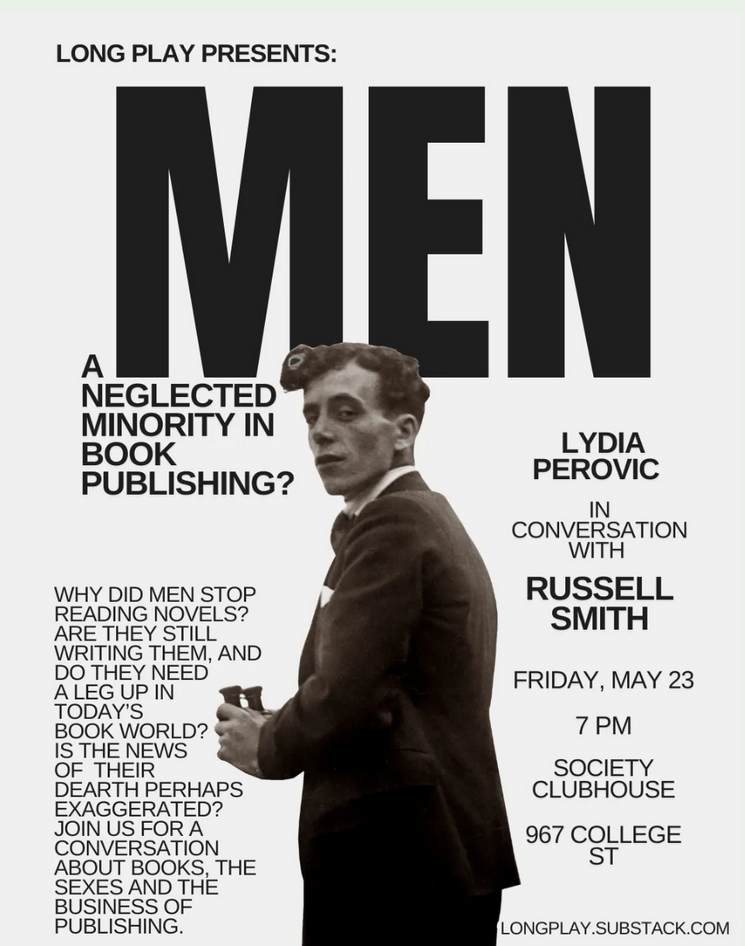
You can see here some of the challenges involved in measuring reading habits. Are we talking reading books or purchasing books? Does buying correlate to reading or are women better gift givers? What about those hugely popular 20-part, 60-page-per-instalment romance series that might ratchet up purchases by women — anything like that in the fiction market for men? Should we base assumptions about readership of literary fiction on data about readership of general fiction, as many of the articles I’ve read do?
All we can safely say is that it does seem men read somewhat less fiction than women; they also read fewer books of any kind. As a person in the book industry, I wish that weren’t so, but it may not be a cultural calamity.
The most interesting article I came across in last night’s binge was published in 2009 by the University of Saskatchewan’s Virginia Wilson in Evidence Based Library and Information Practice. She undertook a small study of boys aged four through twelve, interviewing them about their reading habits. Her theoretical perspective was that if anyone was ever going to understand the reading habits of boys, they needed to recognize that the experts were the boys themselves. She quizzed forty-three of them about their book collections, what they liked and didn’t like, and their motives for reading.
Each of the boys had a personal collection of books. These ranged from eight to 398 volumes, with a median of 98. All but one of the boys had fiction in his collection. The most prominent genres were fantasy, science fiction, sports stories, and humour. The boys had no time for love stories, books about groups of girls, and such classic children’s fiction as The Adventures of Robin Hood.
Asked about their favourite books, most of the boys pointed to a non-fiction title: joke books, magic books, sports books, survival guides, science books, references, atlases, dinosaur books.
The boys also read a good deal of non-book material: comics, manga, magazines, sticker books, puzzle books, and catalogues. A number mentioned reading video game manuals, both to learn more about the games, but also to heighten their enjoyment of the narratives within the games.
The manuals were part of a bent toward pragmatic reading, something they found useful as much as pleasurable. The boys often read to support another hobby — Pokémon, for instance. They also appreciated non-linear texts and plenty of illustrations.
Interestingly, many of the boys tended to discount their own reading. They often described the informational stuff they liked—those video game manuals or computer guides or research materials for science projects—as “not really being reading”. Serious reading, in their minds, involved novels and conventional non-fiction books.
Wilson’s conclusion was that at least part of the “boys and reading problem” might come down to what counts as reading. Informational nonfiction, comic books, computer magazines, graphic novels, and role-playing game manuals were “not necessarily privileged by libraries, schools, or even by the boys themselves”.
Of course, as Wilson notes, one shouldn’t generalize too much from a small qualitative study involving forty-three boys. There’s nothing definitive to be learned here about Trump or contemporary masculinity (although I’ve read several lengthy screeds based on less).
Wilson’s paper simply reminds us that reading is complicated, and most of the available research on reading habits isn’t. Survey respondents are typically asked if they read books for leisure, or if they’ve read a book in the last year. There are many reasons to read other than for leisure. There are many things to read other than books. And not all books are equal.
I haven’t seen a study that tracks if men spend more minutes per day reading sentences than women. Or one that drills down to find who reads the most newspapers, magazines, websites, newsletters, contracts, annual reports, research papers, instruction manuals, catalogues, and cereal boxes. Each of those formats is as potentially edifying (if not as much fun) as Morning Glory Milking Farm: A Monster Bait Romance, with its 47,570 enthusiastic ratings on Goodreads.
I read so many concerns for and condemnations of contemporary males last night that it came as a surprise to learn that our most reliable measure of reading competence, the Program for the International Assessment of Adult Competencies, finds no real difference in literacy of men and women aged 16 to 64 in the US or Canada. We should all revisit that baseline before assigning responsibility for the state of civilization to whoever is or isn’t reading or buying contemporary fiction. (PIAAC did find that while Canadian literacy scores have been stable, US scores have slipped 5 percent since Trump was first elected. Make of that what you will.)
Does the men-and-fiction problem exist? I think yes, and my sense is that it’s one of both supply (what’s getting published) and demand (what men will read). I thought I’d have more than that to say. This is my kind of issue — the whole point of SHuSH is ill-considered opinion drawn from shaky evidence on a weekly timetable — but I can’t compete with what I’m reading, so I’m backing off for now.
I certainly find myself reading almost nothing that has been published recently with a few exceptions for well-researched and well-written histories and military histories. My preferred genre reading got taken over by the “jam the narrative into every story” crowd a few decades back, so I stopped buying SF and fantasy titles except those from authors I’d already read.
Hiding Sir John A. from the woke mob
Woke iconoclasm swept across the country, but the statue of Sir John A. Macdonald outside the Ontario Legislature in Queen’s Park was hidden away inside a plywood box. James Pew catches up on the situation inside Queen’s Park Crescent:
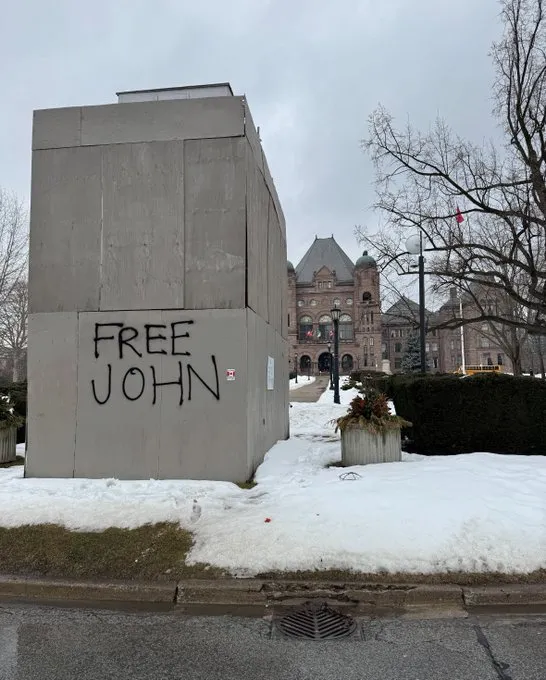
“Free John” spray painted on the plywood boards covering the statue of Sir John A. MacDonald in Queen’s Park Toronto.
It’s not just historical content distorted by bad actors, it is the entire way history is thought about, taught, and used to legitimize all sorts of nefarious agendas, which forms a broader set of concerns. For instance, a Toronto man recently found himself in trouble over a meaningful act of non-destructive civil disobedience involving a monument to a beloved and needlessly contentious Canadian historical figure. Daniel Tate is an ardent patriot and founder of a civic advocacy group called IntegrityTO, who describe themselves as “a coalition of concerned citizens who want to restore integrity-driven leadership so that Toronto can be a great city once again”. In a minor act of public vandalism, and in a moment of frustration over the disrespect shown to Canada’s boxed up father of confederation, Tate spray painted “Free John” on the plywood hoarding covering the statue of Sir John A. Macdonald at Queen’s Park in Toronto. No paint touched the statue itself, just the plywood that hides it away from the public, and protects it from the angry and destructive social justice mob.
Sir John A’s Queen’s Park statue initially became the unseen centerpiece of the current unsightly plywood enclosure after an incident which took place in 2020; three radical social justice activists splashed it with pink paint. It is worth pointing out that this cherished monument to the father of confederation was first installed in 1894. And although Black Lives Matter activists Daniel Gooch, Danielle Smith, and Jenna Reid initially found themselves in hot water over their costly and disrespectful acts of public vandalism (they also painted statues of Egerton Ryerson and King Edward VII Equestrian), all charges were withdrawn in 2021. In their statement to the media the group said, “along with a coalition of artists, the group artistically disrupted statues of slaveholders and monuments to colonialism at Ryerson University and at Queen’s Park”. One would think Daniel Tate should be extended the same leniency for his “artistic disruption”.
Image of Black Lives Matter activists vandalizing the Queen’s Park statue of Sir John A. MacDonald, (via CBC)
As it stands, Tate has been criminally charged with mischief under $5000 which carries a maximum penalty of two years in prison. Still in the preliminary stages, his next court appearance is scheduled for June 30.
Last month Tate appeared on AM 640’s The Oakley Show where he remarked, “The sad irony of it, people were defacing and vandalizing national monuments with impunity … four or five years ago. No Charges. We were all watching aghast at how this was all happening. And, it was acceptable somehow. And here I am five years later. I didn’t even deface a statue or a monument, it was literally a piece of plywood – the cheapest plywood you could find. And now I’m clogging the criminal justice system with this completely frivolous charge.”
While covering Tate’s case, independent journalist Daniel Bordman said, “This is a great example of 2-Tier policing because if he wrote Free Palestine instead he’d probably be given the key to the city”. And journalist Anthony Furey posted the following on X: “There has been so much lawlessness and disorder on Toronto streets in recent years that goes totally unchecked … But if you write FREE JOHN on a boarded up statue of Sir John A, police handcuff and arrest you on the spot – which is what happened to Daniel Tate the other week”.
This begs the question, if security was on-site to arrest Tate in the immediate moments that followed his minor spray paint transgression, why does Sir John A. need to be boxed up at all? One security guard around the clock would suffice. Does the Queen’s Park premises not already have security? It appears they keep a close eye on Sir John A’s unfortunate wooden container. So, why not free John? Beef up security a little if necessary, but let our first Prime Minister once again be visible and unadulterated in his rightful place of honour. For the sake of our blessed Holy Peter, it’s been five bloody years!

(A Few of) The Many Faces of the Dutch M95 Carbine
Forgotten Weapons
Published 16 Jun 2015When the Dutch military adopted the M95 Mannlicher rifle, they made a rifle for standard infantry, and a variety of carbines for specialist troops. These included artillery, cavalry, bicycle, engineers, and colonial service carbines. During World War I they attempted to standardize these and reduce the number of different designs, but met with only limited success. By the time World War II began, there were at least 13 different variants of M95 carbine in service with the Dutch military.
QotD: The Gracchi
But it is also generally the only reading students get and it is not the only valid reading of the evidence we have. So for this week, I want to complicate the Gracchi, presenting some of the details that often get left out of introductory surveys. In particular, we’re going to discuss the problems that Tiberius Gracchus’ key law, the Lex Sempronia Agraria was designed to solve and I am going to argue that Tiberius was attempting to solve a problem that didn’t exist (though he couldn’t have known it), a view which is now quite common in the scholarship but almost entirely absent in how we tend to teach the Gracchi.
But more to the point, I am going to argue that Tiberius and Gaius Gracchus’ behavior did, in fact, violate the norms of the Republic and that it was not entirely unreasonable for the senatorial elite to conclude these men, in their unrestrained and nakedly ambitious approach to politics, represented a real threat to the Roman political order and that they might be aiming for something approaching a “soft coup” in the context of a political order whose features – including the democratic ones – worked through an unwritten constitution of norms (what the Romans called the mos maiorum, “the customs of the ancestors”), which both brothers actively undermined. The claim that the Gracchi threatened to make themselves tyrants was not an empty claim and that is the dark reflection of their role as well intentioned reformers.
In short, then, if the only version of the Gracchi you have encountered is that of the near-saintly, then martyred proto-progressive reformers, that’s not quite the complete picture (and the left-coding of their ideas is decidedly anachronistic). Naturally, in trying to complicate this picture, I am essentially taking the position of prosecutor, so this “take” is going to be far more negative on the Gracchi than how I would, say, teach them in class or, indeed, how I regard them myself.
So the way we’re going to approach this problem is first to discuss the problem that Tiberius Gracchus thought he was addressing (and some of the issues there), before walking through the means he used to push forward the Lex Sempronia Agraria. Then I want to look at some of the wide-ranging laws proposed by Gaius Gracchus to assess the degree to which those laws cohere and ways we might understand his program and actions, potentially rather more negatively.
Bret Devereaux, “Collections: On the Gracchi, Part I: Tiberius Gracchus”, A Collection of Unmitigated Pedantry, 2025-01-17.
May 11, 2025
The devastating toll of Trump’s reckless plan to dismiss transgendered members of the armed forces
Chris Bray called this to our attention back in November, as President-elect Donald Trump foolishly planned to purge the US military of transgendered troops, regardless of the vast impact it was predicted to have on military readiness:

We’ll practically have no military left! It would be like a whole infantry division suddenly just vanishing: 15,000-plus transgendered service members.
You’re going to see this number a lot in the weeks ahead. The New Republic, today: “Donald Trump’s plan to ban transgender people from the military would have a devastating effect: At least 15,000 members would be forced to leave.”
That number comes from a 2018 report by the now-defunct Palm Center, a pro-LGBT independent research institute in California, which reached this conclusion: “Transgender troops make up 0.7% (seven-tenths of one percent) of the military (Active Component and Selected Reserve)”. Their best guess about a total number: 14,707. The media is just rounding that number up to the next thousand.
And … Chris Bray follows up on his November post, documenting the huge, unimaginable scale of long-term damage to US military preparedness:
As the new Trump administration prepared to issue an order forbidding transgender people to serve in the armed forces, a bunch of profoundly stupid news stories issued panicked warnings that military readiness would DEVASTATED by a giant purge of at least 15,000 transgender servicemembers, the very core of our military strength. Warplanes grounded! Ships trapped in port as all their trans sailors were tossed out! Whole artillery batteries sitting silent! […]
The removal of trans servicemembers would inflict such a ghastly crisis on the armed forces that it would take twenty years to recover our military strength! Destruction and ruin and crisis and collapse!
[…]
Now the removal of transgender troops is actually underway, and guess what?
The number is “up to” 1,000. It’s in the hundreds.
So. When — quite recently! — dozens of panicked news stories reported as fact that 15,000-plus transgender servicemembers were about to be purged, the news was frankly and nakedly a complete invention. They made it up. They sold an invented panic. The “news” was entirely fake.
Remember that, and apply that lesson widely.

Why Yugoslavia Fell in Just 11 Days?
World War Two
Published 10 May 2025In this Fireside Chat, Indy and Sparty answer questions on the German invasions of Yugoslavia and Greece. Why did the Yugoslav state fall so quickly? Why were the Greeks able to hold out so much better? And why was the airborne assault on Crete so chaotic on both sides?
(more…)
Will Amtrak survive the DOGE treatment?
J.D. Wong outlines Amtrak’s never-ending financial difficulties:

“Amtrak” by Mike Knell is licensed under CC BY-SA 2.0 .
Founded 54 years ago, Amtrak set out on a bold adventure to see if passenger trains could be profitable. Fast forward to today, this experiment has been unsuccessful. Politicians have often crafted routes to win votes rather than attract riders. As a result, Amtrak has been squandering taxpayer money since its start in 1971.
Take, for instance, the Infrastructure Investment and Jobs Act of 2021. It allocated a monumental $66 billion to bolster passenger rail. Yet, even with this backing, Amtrak’s losses soared from $1.12 billion in FY2019 to $2.12 billion in FY2024. This financial drain isn’t new; America’s passenger trains have lost money for 79 years.
Amtrak asserts that it is “on-track to reach operational profitability”. Yet, this is a bald-faced lie. While Amtrak reported a loss of $705.2 million for FY2024, it didn’t include:
- $966.2 million in depreciation;
- $447.3 million in “Project Related Expenses”;
- $314.1 million in state subsidies, which it classified as “revenue”;
- $26.9 million in Office of Inspector General funding
By omitting these costs, Amtrak paints an optimistic view of its financial health. In reality, Amtrak needs larger subsidies than ever before. In fact, Amtrak has been deceiving Congress with its “path to profitability” since 1990.
Although Amtrak touted a “ridership record” for FY2024, this figure is misleading too. Ridership numbers don’t reflect the average length of each passenger’s trip. A more insightful metric is passenger-miles, which measures how far people are traveling. In fact, Amtrak only transported 6.54 billion passenger-miles in FY2024. This is a decrease of 3.40 percent since FY2013.
Amtrak often attributes its financial struggles to its long-haul routes. Yet, the outlook is even bleaker for its short-haul, state-supported routes. Amtrak reported a $251.5 million loss for these routes in FY2024. Yet, with $314.1 million in state subsidies included, the true loss hits $565.6 million. This represents a shocking 94 percent increase from the $291.7 million lost in FY2019.
Amtrak’s advocates often cite highway “subsidies” to explain its financial debacles. But Amtrak guzzles about 39 times more subsidies per passenger-mile than highways do.
Amtrak asserts that freight trains “interfere” with its passenger services. However, Amtrak often makes questionable route choices despite having legal priority over freight. Between Chicago and Los Angeles, the Desert Wind lost less money than the Southwest Chief. Despite this, Amtrak favored the Southwest Chief, which passed through more congressional districts. It discontinued the Desert Wind in 1997, leaving Las Vegas with no train service.
History of Britain, I: Hail Prettanike! Early References to the British Isles
Thersites the Historian
Published 6 Jan 2025The natural starting point for examining the history of Britain is to look at how the island and its inhabitants first entered the historical record.


