
Thersites the Historian
Published 15 Jan 2025In this episode, I briefly examine the presence of prehistorical megaliths on the British Isles and talk about the religion of the Celts, which was ascendant at the time that Britain entered entered the historical record.
May 24, 2025
History of Britain, II: Stonehenge; The Druids, Vates, and Celtic Religion
Comments Off on History of Britain, II: Stonehenge; The Druids, Vates, and Celtic Religion
QotD: Comparing living standards and technology between the Roman period and medieval western Europe
The first crucial question here is exactly when in the Middle Ages one means. There is a tendency to essentialize the European Middle Ages, often suggesting that the entire period reflected a regression from antiquity, but the medieval period is very long, stretching about a thousand years (c. 500 to c. 1500 AD). There is also the question of where one means; the trajectory of the eastern Mediterranean is much different than the western Mediterranean. I am going to assume we really mean western Europe.
While I am convinced that the evidence suggests there was a drop in living standards and some loss of technology in the immediate aftermath of the collapse of the Roman Empire in the West, most of that drop was fairly short-lived. But exactly when development in medieval Europe meets and then exceeds the same for antiquity (typically we’re comparing the second century height of the Roman Empire) also depends on exactly what kind of measure is being used.
If the question, for instance, is agricultural productivity on a per capita basis (the most important component of per capita economic production), medieval Europe probably moves ahead of the Roman Empire fairly quickly with the introduction of better types of plow and widespread use of watermills for grinding grain. My understanding is that by c. 1000 AD, watermills show up fairly frequently in things like monastic charters, suggesting they were reasonably widespread (the Romans used watermills too, though their spread was uneven) and by that point, plow technology had also moved forward, mostly through the development of plow types better suited to Europe’s climate. So as best we can tell, the farmer of c. 1000 AD had better tools than his Roman predecessors and probably had such for some time.
If the question is technology and engineering, once again what you see depends on where you look. Some technologies don’t appear to have regressed much, if at all, ironworking being one example where it seems like little to nothing was lost. On the other hand, in western Europe, the retreat in architecture is really marked and it is hard to say when you would judge the new innovations (like flying buttresses) to have equaled some of the lost ones (like concrete); certainly the great 12th/13th century Cathedrals (e.g. Notre Dame, the Duomo di Sienna and I suppose the lesser Duomo di Firenze, if we must include it) seem to me to have matched or exceeded all but perhaps the biggest Roman architectural projects. Though we have to pause here because in many cases the issue was less architectural know-how (though that was a factor) as state capacity: the smaller and more fragmented states of the European Middle Ages didn’t have the resources the Roman Empire did.
If one instead looks for urbanization and population as the measure of development, the Middle Ages looks rather worse. First and Second century Rome is probably unmatched in Europe until the very late 1700s, early 1800s, when first London (c. 1800) and Paris (c. 1835) reach a million. So one looking for matches for the large cities and magnificent municipal infrastructure of the Romans will have rather a long wait. Overall population is much more favorable as a measurement to the Middle Ages. France probably exceeds its highest Roman population (c. 9m) by or shortly after 1000AD, Italy (c. 7.5m) by probably 1200; Spain is the odd one out, with Roman Hispania (est. 7.5m) probably only matched in the early modern period. So for most of the Middle Ages you are looking at a larger population, but also a more rural one. That’s not necessarily bad though; pre-modern cities were hazardous places due to sanitation and disease; such cities had a markedly higher mortality, for instance. On the flip-side, fewer, smaller cities means less economic specialization.
So one’s answer often depends very much on what one values most. For my own part, I’d say by 1000 or 1100 we can very safely say the “recovery” phase of the Middle Ages is clearly over (and I think you could make an argument for setting this point substantially earlier but not meaningfully later), though even this is somewhat deceptive because it implies that no new technological ground was being broken before then, which is not true. But the popular conception that the whole of the Middle Ages reflects a retreat from the standards of antiquity is to be discarded.
Bret Devereaux, “Referenda ad Senatum: August 6, 2021: Feelings at the Fall of the Republic, Ancient and Medieval Living Standards, and Zombies!”, A Collection of Unmitigated Pedantry, 2021-08-06.
Comments Off on QotD: Comparing living standards and technology between the Roman period and medieval western Europe
May 23, 2025
Yasukuni-jinja, Japan’s most controversial historical site
Nigel Biggar on the Yasukuni-jinja in the Imperial Gardens in Toyko, where the Japanese shrine to their war dead also celebrates fourteen convicted WW2 war criminals:
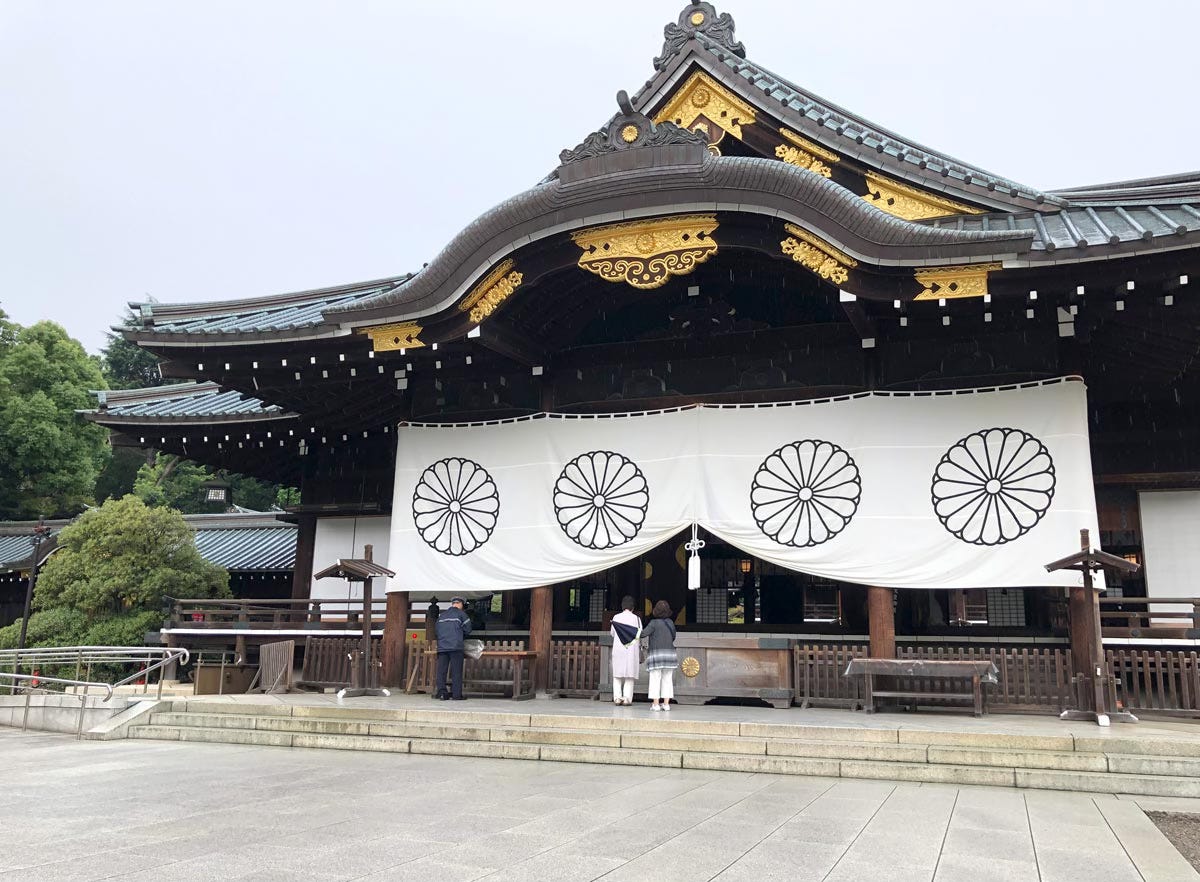
The Yasukuni Shrine in the Imperial Gardens, Tokyo.
Photo by Pierre Hazan
If ever you find yourself in the centre of Tokyo, make your way to the north-west corner of the Imperial Gardens, and turn left. A few minutes will bring you to the Yasukuni-jinja, Japan’s most controversial site. This is the national shrine to the war-dead, whose two and half million resident “glorious souls” include fourteen Class A war criminals.
A hundred yards to the right of the main shrine stands a museum, the Yushukan. Upon entering it, a visitor finds himself immediately face to face with a locomotive.
Now, when an Anglo-Saxon puts together Japan, Second World War, and locomotive, he arrives at one thing only: the “Burma Railway”. This is the railway that was hacked through the Burmese jungle partly by Allied prisoners-of-war, who were treated as slave labour and perished in their thousands. Over 12,000 Westerners died — about one in five — alongside perhaps 90,000 Asians.
So our Anglo-Saxon visitor beholds the locomotive with a mixture of disbelief, rising horror, and curiosity. He approaches the machine, looking for an explanatory text. Finding it, he learns that this locomotive is one of ninety that ran along the Burma Railway. He also learns the name of the military unit responsible for the railway’s construction. But of the Allied prisoners, the slave-labour, and the number of their deaths he learns nothing at all.
The Burma Railway wasn’t Auschwitz, either in genocidal intent or in murderous scale. But it was similar in its cruel contempt for human life. So the experience of confronting this Tokyo locomotive is analogous to stepping into a museum in Berlin and being confronted by one of the trains that shipped Jews to Auschwitz, and then reading an explanation that omits any mention of its cargo or the nature of its destination. If there were such a museum in Berlin, I’d have found it.
When our Anglo-Saxon ventures deeper into the Yushukan, he eventually discovers the exhibition on the 1930s and World War Two in the Far East. And here he learns that Japan’s imperial expansion was in fact a war of liberation, waged on behalf of subjugated Asian peoples, against Western colonial domination. And he learns that, even though Japan lost the war militarily, she won it politically, since the example of her early victories over the French in Vietnam, the Americans at Pearl Harbor, and the British at Singapore helped to inspire anti-colonial movements worldwide and so succeeded in ridding the world of European empires.
He also learns that what is known outside Japan as “the Rape of Nanking” (1937-8) is referred to demurely in the museum as “the Chinese incident”. And that whereas the “Rape of Nanking” is reckoned to have involved the indiscriminate massacre by Japanese troops of about 300,000 Chinese civilians, “the Chinese incident” only involved the severe treatment of Chinese troops who had violated the laws of war by disguising themselves in civilian clothes.
Comments Off on Yasukuni-jinja, Japan’s most controversial historical site
Did Germany Just Choose a King? – Rise of Hitler 17, May 1931
World War Two
Published 22 May 2025May 1931: 150,000 Stahlhelm men parade through Breslau before Crown Prince Wilhelm and other imperial relics, reviving monarchist hopes. Hitler hails his SA and calls for eastern expansion. But it’s economic collapse that dominates — Austria’s top bank nears default, threatening Germany’s own system. As Berlin pushes for a reparations pause and clings to its customs union with Vienna, France stands firm. And in Oldenburg, the Nazis take their first Landtag.
(more…)
Comments Off on Did Germany Just Choose a King? – Rise of Hitler 17, May 1931
“‘[D]isrupting traditional ideas’ of what a ‘triumphant figure’ is”
William M. Briggs uses the most recent installation of a statue of a black woman in highly public spaces to explore the idea that even black people “have Black Fatigue”:
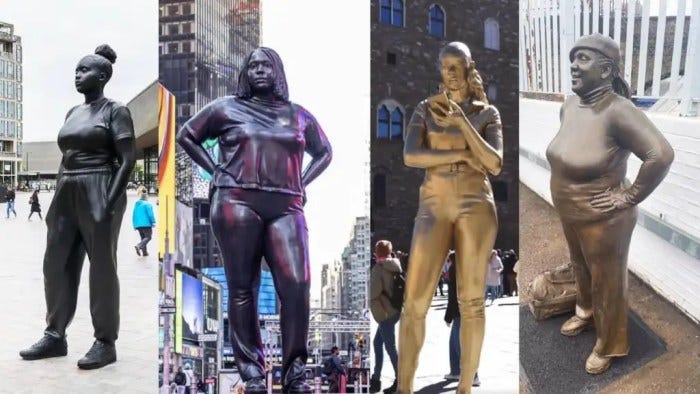
Statues of fat ugly lumpen surly ill-kempt statues of black women, all in poses to accentuate their quarrelsome uselessness, are being placed in prominent places in the West. The Latest, rising like a creature in a 1960s Japanese monster movie, is in Times Square. The person who created these blots of bad taste said they were “a way of ‘disrupting traditional ideas’ of what a ‘triumphant figure’ is”.
He’s right. These figures do represent triumph. DIE requires elevating the least and representing them as the best, and forcing all to pretend the charade is real. Indeed, it is difficult to think of a more perfect representation of the true spirit of DIE than these misshapen piles of metal. They demand you say they are equivalent to great men whose statues we are no longer allowed to have.
If it were only statues, there would be no story. But everybody knows that bad black behavior of all kind is being ignored, excused or outright celebrated.
One example will suffice. After the lifelong thug and criminal lowlife George Floyd met his expected end — poisoning himself with drugs and engaging in all manner of misbehavior — our rulers and “elites” fell to their knees, even in Congress itself, to show their adoration of black criminality. Not to mention Floyd’s own statues which cropped up like poisonous mushrooms, each encouraging emulation of Floyd’s exasperating antics.
It’s so bad now that parents of white kids murdered by blacks rush out to forgive or excuse the killers, lest anybody dare to think they would condemn bad black behavior.
The question is why.
Before you answer, understand this is not only your “racist” Uncle Sergeant Briggs asking this question. Blacks themselves are asking.
There is an entire growing genre of YouTube videos of blacks telling us they grow weary of the constant misadventure of “ratchet blacks” (their word, not mine) and our culture’s welcoming attitude toward them. Take “Why Black Fatigue Is On The Rise“. Black fatigue is the natural exhaustion from having to deal routinely with with misbehaving blacks, where “dealing with” means having to pretend, while in polite society, we are not seeing what we are all seeing.
Watch just the first two minutes if you haven’t the time for more. The man in the inset quite rightly points out that blacks are now, as everybody always wanted, being judged by the content of their character, and not the color of their skin. The problem is the content of their character, or at least the character of those who are celebrated for misdeeds. As one commenter to the video said, the problem are blacks who are “Offended by everything. Ashamed of nothing. Entitled to everything. Responsible for nothing.”
The natural desire for separation, and to be with ones’ own, leads blacks to label blacks not confirming to expected behavior as “acting white”. The natural solution would be a formal separation: you go your way, we go ours. That, of course, would never be countenanced, and is anyway not desired by the majority. One thing absolutely demanded by our elites is “diversity”, by which they mean strict uniformity of belief. Our betters weep fake tears over things like colonization, which we know are fake because when we ask them to let us go our own way they say no.
If we can’t separate, then we have to find a way to get along with each other. Whatever this way is, it can’t have a basis in transparent lies.
Comments Off on “‘[D]isrupting traditional ideas’ of what a ‘triumphant figure’ is”
Bill Bailey – The Doctor Who theme re-imagined as Belgian jazz
Royal Ballet and Opera
Published 29 Jul 2021Comedian Bill Bailey re-imagines the Doctor Who theme as Jacques Brel-esque Belgian jazz. Taken from his DVD Bill Bailey’s Remarkable Guide to the Orchestra.
Comments Off on Bill Bailey – The Doctor Who theme re-imagined as Belgian jazz
QotD: The decline of the photography business
There are playful souls among them but they tend to be more than averagely earnest. There’s an historical reason for that. In the early days of photography it was derided by fine artists as mere mechanical trickery. Painters and sculptors thought of photographers as the Church had once thought of them — as low class artisans unworthy of respect and to be cheated of their pay wherever possible. In consequence photographic pioneers longed to be seen as artists too and paid a lot of attention to “serious” subjects and “social” issues.
[…]
In amateur photography, the comfortable pensions of teachers and university lecturers mean there are far too many of them in a leisure field that requires a certain amount of investment in kit — adding further layers of pseudo-intellectual pomposity, musty from a lifetime of never being challenged. I am a member of the Royal Photographic Society, but though I enjoy a few of its workshops from time to time, mostly find its members smug and insufferable. I hesitate every year before renewing. Its beautifully produced magazine, for example, unquestioningly peddles the conventional thinking of the BBC class. I have learned to appreciate the images while ignoring the priggish text around them.
Tom Paine, “Where we are and what we see”, The Last Ditch, 2020-05-20.
Comments Off on QotD: The decline of the photography business
May 22, 2025
Lucy Connolly, political prisoner
I’m no firebrand on social media — I’d probably have a lot more followers if I were — but I can easily imagine a situation like the one that got Lucy Connolly sent off to the British gulags for an ill-judged social media post:
In what has become an emblematic case of the UK’s betrayal of free speech, Lucy Connolly has now lost her appeal for early release. This mother and childminder had posted an offensive tweet in the direct aftermath of the Southport murders, in which a psychopath brutally attacked children with a knife at a yoga class. She had believed the false claim that the perpetrator was an asylum seeker, and written online that she had no objection to people burning down hotels where immigrants were residing.
The tweet was taken as evidence that Connolly had intended to “stir up racial hatred” and incite violence during the febrile climate of the summer riots. It had been deleted within hours, no violence occurred as a result, and yet she was sentenced to 31 months in prison. Given that the severity of Connolly’s sentence was doubtless related to unofficial government pressure on the judiciary, many have made the case that Connolly is a political prisoner.
For all our shared revulsion at the tweet, we must remember that we are still talking here about words, not actions. It was completely right that Philip Prescott, a man who attacked a mosque as part of a mob during the riots, was sentenced to 28 months in jail. But Connolly has received an even longer sentence having committed no acts of violence at all. Many rapists and paedophiles have been treated far more leniently. I know of no sound argument that could possibility justify this state of affairs. It is the very definition of two-tier justice.
Let’s get the caveats out of the way. Nobody is defending what Connolly wrote. It was unpleasant, rash, misjudged, and much else besides. Here is the post in full.
Grim stuff. But it by no means fulfils any serious definition of incitement to violence. For one thing, she is not calling on hotels to be torched, but is rather making clear that she would not care if that occurred. This distinction is key, but has been overlooked. Moreover, Connolly has zero influence or clout. It is not as though anyone reading this could have taken it as an instruction or order and acted accordingly. Those wishing to appreciate the full context of why Connolly behaved as rashly as she did should read this excellent piece by Allison Pearson for The Telegraph.
It should go without saying that in a free society some people are going to say ghastly things. That’s the price we pay for liberty. The judge in this case made a statement in his ruling that has been widely interpreted as political: “It is a strength of our society that it is both diverse and inclusive. There is always a very small minority of people who will seek an excuse to use violence and disorder causing injury, damage, loss and fear to wholly innocent members of the public and sentences for those who incite racial hatred and disharmony in our society are intended to both punish and deter.”

Comments Off on Lucy Connolly, political prisoner
Trump, “the American Mussolini”, versus ever-so-democratic Mark Carney
In the National Post, John Robson contrasts the authoritarian dictator at the helm of the American ship of state with our peaceful, democratic, and fully accountable to the voters prime minister:

President Donald Trump greets Prime Minister of Canada Mark Carney, Tuesday, May 6, 2025, at the West Wing entrance of the White House.
(Official White House Photo by Gabriel B Kotico)
It was the best of budgets, it was the worst of budgets, it was the age of restraint, it was the age of profligacy, it was the epoch of the legislature, it was the epoch of the executive, it was the season of open debate, it was the season of closed doors, it was the spring of Canada, it was the winter of America. Or possibly the other way around.
The confusion arises because as a patriotic Canadian I keep hearing how U.S. President Donald Trump is an American Mussolini who has abolished the last vestiges of the old Republic, so we should drink rye not bourbon or some other decisive action easily performed while sitting down. Yet the news media mysteriously insist that the Bad Orange Man is having trouble getting his budget through some quaint relic called the United States Congress while Green Mark Carney isn’t bothering to get his spending plans rubber-stamped by some quaint relic called the Canadian Parliament. How can it be?
Tuesday’s the Morning newsletter from the New York Times, which is no MAGA outlet, reads: “Speaker Mike Johnson has a math problem. He wants to pass a megabill before Memorial Day to deliver President Trump’s legislative agenda.” But with only three spare votes in the House, “there are way more than three G.O.P. dissenters, and they don’t agree on what the problem is. Some think the cuts to Medicaid are too large. Others think they’re too small. Some want to purge clean-energy tax breaks. Others want to preserve them because their constituents have used them.”
Likewise The Atlantic, part of the thundering herd of independent liberal American minds, says: “The struggle to pass Donald Trump’s second-term agenda in Congress has never been between Republicans and Democrats … it’s been a battle between the House and Senate GOP, between moderates and hard-liners, and, most salient, between Republicans and reality.”
Egad. What manner of rambunctious folly is this? Open debate within the Maximum Leader’s own party? Dictatorship! By contrast here in decorous Canada can someone remind me which inane or malicious measures from former prime minister Justin Trudeau were ever put at risk by the principled courage, truculence or mere pandering even of his NDP coalition non-partners, let alone the trained seals in red?
Periodically one would bark. But which ever bit? To be sure, as the Canadian Press noted on Sunday, “Prime Minister Mark Carney says the Liberal government will present a federal budget in the fall, allowing time for clarity on some key economic and fiscal issues to emerge”. But if there’s going to be a brawl, it will be inside his office, or head, with his finance minister promising to brush aside Parliament with an “economic statement” before Carney overrode him, saying the government would introduce “a much more comprehensive, effective, ambitious, prudent budget in the fall”.
Comments Off on Trump, “the American Mussolini”, versus ever-so-democratic Mark Carney
Landstad 1900: A True Semiautomatic Revolver
Forgotten Weapons
Published 3 Jul 2024The Landstad Model 1900 is a magazine-fed, semiautomatic revolver designed by Norwegian Halvard Folkestad Landstad, who lived in Kristiana (now called Oslo). He designed the gun on his own dime, and presented it to military trials in 1901, which it failed miserably. The gun has a six-round detachable box magazine of 7.5mm Nagant cartridges, a two-chamber cylinder, and a simple blowback action. Its firing cycle is to chamber a round from the magazine into the bottom cylinder chamber by manually cycling the action. The trigger is a long double-action type which rotates the cylinder 180 degrees so the cartridge is in line with the barrel and releases the striker to fire the round. Upon firing, the bolt cycles open, extracting and ejecting the empty case, rechecking the striker, and chambering a new round from the magazine into the bottom of the cylinder.
The purpose of this overly complex system was to provide a semiauto action which did not ever leave a live cartridge under the striker, in the name of safety. Only one example was made, and its bolt broke after just 5 or 6 rounds fired. It was repaired almost immediately, but the Norwegian military had was not interested in further development, and nothing more came of the program. A few years later in 1908 Norway would institute a more serious semiauto pistol trials program which led to adoption of the Kongsberg 1914 (a slightly modified Colt 1911).
Thanks to Jan for allowing me to disassemble and film this one-of-a-kind piece for you!
(more…)
Comments Off on Landstad 1900: A True Semiautomatic Revolver
QotD: Public goods
Or, the internet was originally set up to provide a secure comms network when the bombs all went off — that routing in packets was the whole point, being able to route around the polished glass that used to be Indianapolis. GPS was funded by the Navy to have precise coordinates to lob our own bombs at. Both difficult things to profit from so government did them.
Then along came some entrepreneurs and they saw that it was good. Some use could be made of the existence of those things. And this is — it’s essential to understand this — exactly what an entrepreneur is. Someone who takes extant assets and resources, possibly combining them in new ways, and sets out to end up with hot and cold running Ferraris from having done so. We consumers then end up vastly richer than our starting point. One, wholly serious, measurement of the value of search and free email (so, roughly, Google) is $18,000 per person per year. No, there are not too many zeroes there, eighteen thousand of those big fat United States dollars per person per year.
OK. So we institute government to gain public goods. We get public goods from government. Entrepreneurs then do their job, picking up extant assets to use in novel ways that enrich all of us out there. Excellent, the system is working. The system is making us out here the richest society living highest on the hog that has ever existed.
Tim Worstall, “Mazzucato: ‘BUT WHERE IS MY SECOND DOZEN PAIRS OF LOUBOUTINS?'”, It’s all obvious or trivial except …, 2025-02-12.
Comments Off on QotD: Public goods
May 21, 2025
AI hallucinations capture the Chicago Sun-Times summer reading list
Good luck finding some of the highly recommended books on the Chicago Sun-Times list of summer reading … they don’t actually exist (yet):
Critics aren’t perfect.
Sometimes they get facts wrong. Sometimes their judgment is faulty. Sometimes they dangle their modifiers or split their infinitives with everybody watching.
I’ve been there. And it’s awkward.
But I’ve never seen anything as embarrassing as the “Summer Reading List for 2025” in the Chicago Sun-Times.
It gave glowing reviews to books that don’t exist. And I bet you can guess why.
Yes, the newspaper relied on AI to write the article.
The article starts with a recommendation for Tidewater Dreams by Isabel Allende. This is Allende’s “first climate fiction novel” where “magical realism meets environmental activism”.
It’s a shame that Allende never wrote this book. Nor did anyone else — the book simply doesn’t exist.
(I’ll predict, however, that an AI-generated book with this title will show up on Amazon within a few days. When you live in a world of AI hallucinations, this is how the business model plays out.)
The next book on the Sun-Times list is The Last Algorithm by Andy Weir. This novel is also non-existent. But the storyline — about rogue AI that gains consciousness — makes me think that the bots are now mocking us.
It doesn’t get better. The first 10 books on the summer reading list are entirely hallucinated.
As the story of the fake reviews spread on social media, the Sun-Times got into damage control mode. It issued a public statement denying responsibility.
But that just makes matters worse.
Why are they publishing garbage without vetting it? And the denial is also implausible.
Somebody at the newspaper must have given the okay to this. The printing presses don’t run themselves (although maybe that will be the next stage of the AI business model).
How is this happening?
We are now several years into the AI revolution. I’m constantly hearing about new, improved bots that are smarter than super-geniuses, and can replace lowly humans.
But the bizarre lapses are getting worse — and more dangerous.
AI is routinely making stupid, nonsensical mistakes that even the most incompetent employee would never make. I’ve met some incompetent journalists over the years, but none would make a boneheaded move of this magnitude.
And this is after a trillion dollars has been sunk into AI by the most powerful corporations in the world. This is after they have soaked up much of the energy grid. This is after all the training and vetting and upgrading.
We’re not talking about beta testing or first generation AI. Silicon Valley is actually bragging about this tech — but it’s stupider than the worst journalist in the country.

Comments Off on AI hallucinations capture the Chicago Sun-Times summer reading list
The Korean War Week 48 – Cut Off. Outnumbered. Doomed – May 20, 1951
The Korean War by Indy Neidell
Published 20 May 2025The Chinese Spring Offensive reignites, and it does so with a vengeance, kicking straight into high gear, and also totally surprising the UN forces by hitting them heavily much further east than they had ever expected — in the high Taebacks. Units find themselves, cut off, sandwiched, or broken … although a redeployment means that already by the end of the week, a UN counterattack is in the cards.
Chapters
00:00 Intro
00:50 Recap
01:28 The Offensive Begins
07:39 Van Fleet Reorganizes
11:03 ROK 3rd Corps Breaks
12:55 A Counteroffensive
14:13 The Joint Chiefs Speak
16:31 Summary
16:46 Conclusion
(more…)
Comments Off on The Korean War Week 48 – Cut Off. Outnumbered. Doomed – May 20, 1951
Canadian voters got fooled again
Roxanne Halverson on Canadian voter gullibility that Mark Carney and the Liberals took full advantage of in the election campaign:

Offer not applicable in Canada, apparently.
Liberals voters on your elbows up crusade — do you feel foolish, do you feel shamed? Are you ready to admit that you were duped? That you were played like the fiddle in the Devil went down to Georgia. How does it feel to know that you fell for Mark Carney’s fear mongering fabricated crisis that made him Prime Minister. Or is your Trump Derangement Syndrome so severe that you cannot recognize how the Liberals used it and used you to win an election they didn’t deserve to win. It wouldn’t be so bad if only you had to pay the price, but unlike the phony COVID mantra, of we’re all in this together, we really are all in this nightmare together for another possible four years of Liberal rule and corruption, and we’re all going to pay the price. That includes those of us who didn’t get fooled again, but most of us are the same ones who also didn’t get fooled in the last three elections that gave the country the Liberals under Justin Trudeau for a decade of destruction.
Did you see the interview Prime Minister Mark Carney did with Sky News Australia?
You really should watch it. Because in it he admits what those of us who didn’t vote for him knew, and what he, himself also knew. There was never any real threat from Trump to annex Canada. And when pushed on it by the Sky News interviewer Samantha Washington who asks if he inflated the threat as political tool to inflame voters who hated Donald Trump, Carney dances around it saying one minute it wasn’t a threat and the next minute, well he thought it was and so did the Canadian people and well maybe he did use it to kind of stir them up. Essentially he was trying to dodge the fact that he lied and knew all along that Trump wasn’t really going to make Canada the 51st state.
So, let’s begin with the Trump threat — the existential threat to the existence of our country! According to Carney, Trump “wanted to take Canada, he wanted to break it“. But when asked by Washington about that ‘existential threat’, Carney walked it back. In his words, “No the existence is not at stake, it was more of economic crisis, and had a heavy element of national security comes with it, the extent to which we will be cooperating with others, particularly with the United States“.
Now wait a minute, Carney told voters — the elbows uppers — that Canada’s existence was at stake. And now he’s adding in a national security element? I don’t recall Trump ever saying anything about invading Canada or threatening our national security, in fact it was quite the opposite, he said the United States would always protect Canada for any foreign threat. His interest in national security had to do with Canada’s porous border and the fentanyl trade that the Liberals chose to ignore. This response is a typical Carney word salad dancing around answering the question. Something he seems to have in common with his predecessor Justin Trudeau. But at its core, he says, no Canada’s existence was never in danger.
Yet, he repeatedly told crowds at rallies that the US wanted to break us, when it was really just an economic crisis — something Canada has faced many times before, often due to bad Liberal policies.
But that’s what Mark Carney, with the help of his cartel media echo chamber, drummed into the heads of the elbows up crowd during his leadership campaign and during his entire election campaign. Trump was going to come and take our country — “he wants our resources, he wants our land, and he wants our water“.
Now here’s another word salad, walking back the ‘threat’ from Trump. When Washington asked him why he met with Trump when he was still disrespecting Canada by talking about making it the 51st state, even during their meeting in the Oval Office, which he said it, as she described it, “right to your face“. According to Carney this was ‘different’, and then he delivers another word salad because apparently, “Trump was expressing a desire … he had shifted from an expectation to a desire for that to happen. He was also coming from a place where he recognized that that wasn’t going to happen. I made it clear to him in that context.”

Comments Off on Canadian voters got fooled again
The Butt Report – Nadir of the RAF – The Bomber War Episode 3
HardThrasher
Published 15 Dec 2023As the powers that be on YT have decided that this video is Evil and naughty they’ve removed the ads — which, like, is great from your point of view but a bit shite from mine. So if you wanted to it’d be awesome if you’d consider either hitting the Super Thanks button or consider becoming a super cool kid and joining my Pateron.
If you’d like to email me send a message to lordhardthrasher@gmail.com
In this episode, the Butt Report, what happened next and the arrival of Bomber Harris. Despite this being more than 50 minutes, I’ve skipped some detail e.g. The Singleton Report which basically said “eh – bit difficult this bombing thing” nor Tizard’s rubbishing of Cherwell’s Memorandum, nor really the detail of the Cherwell Memorandum. You’ll live. However if you want more on the subject then I recommend the Official History of Bomber Command to get more into the civil service fire fights.
(more…)
Comments Off on The Butt Report – Nadir of the RAF – The Bomber War Episode 3


