
… for now I am tempted amidst the “darling buds of May” to ponder with affection the proverbial injunction “Eat drink and be merry!”
Many people consider that a fair summary of the Epicurean philosophy, named for its founder, the Athenian philosopher Epicurus who lived from 341-270 B.C., a few generations after Plato. It is a natural mistake. After all Epicurus did say that “Pleasure is the starting-point and goal of living blessedly.”
A common Greek word for pleasure is “hedone,” whence our word “hedonism.” A hedonist, we know, is someone who devotes himself to sensual pleasure. Add that to the fact that Epicureanism is a deeply materialistic philosophy — “all good and bad,” Epicurus says, “consists in sense experience” — and it is easy to see why people often conclude that Epicureanism advocates sensual abandon.
Easy, but mistaken.
For in fact, Epicureanism is a deeply ascetic philosophy. It preaches the gospel of pleasure. But it defines pleasure in such a way that no hedonist worth his salt would embrace it.
A hedonist is someone devoted to pleasure in the positive sense: he seeks to gratify his senses.
An Epicurean is devoted to pleasure in the negative sense: he seeks to avoid pain. “We do everything we can,” Epicurus wrote, “for the sake of being neither in pain nor terror.”
It is a melancholy fact that the human frame, while capable of great joy and pleasure, is susceptible to even greater pain and misery. The pleasures afforded us are delicate blossoms; the pains we are susceptible to are like a raging wildfire in comparison. Epicurus and his followers took note of this fact. Indeed, it was a fact that mesmerized their imaginations.
Epicurus says that pleasure is the goal of life. But what he taught was immunity to pain. “The removal of all feeling of pain,” he wrote, “is the limit of the magnitude of pleasures.” There was a core of common sense about the Epicurean approach to life. He advised his followers to live simple, healthy lives, to shun extravagances of all sorts. Of course, that is something many philosophers, indeed many friends and parents, would also advise. There is nothing distinctively Epicurean about the injunction to live simply and soberly.
There are three things distinctive about Epicureanism. One is its identification of pleasure with the absence of pain. Another is its emphasis on sense experience as the ultimate reality. The third is its identification of tranquillity as the aim or goal of life. (The Greek word is “ataraxia,” i.e., not troubled, not disturbed: note the privative character of the Epicurean ideal.)
If it is to succeed, Epicureanism must deliver us not only from physical pain but also from anxiety and mental anguish. The prospect of death, Epicurus knew, upset many people. Hence he and his followers expended a great deal of effort trying to remove the sting, the fear, from the prospect of death.
Epicurus offered two things to battle the fear of death: an attitude and an argument. The attitude was one of mild contempt: the right sort of people, he implies, do not get in a tizzy about things, not even about death. The argument is equally compelling. “Get used to believing,” he says, “that death is nothing to us.”
Roger Kimball, “Coronavirus, Flynn and Epicureanism”, American Greatness, 2020-05-02.
August 4, 2020
QotD: Epicureans are not hedonists
August 3, 2020
Recycling is a SCAM!
J.J. McCullough
Published 29 Jun 2019Recycling is a disaster. This video was sponsored by Loonie Politics! Sign up using the code word “McCullough” for 25% off! https://looniepolitics.com/register/
Visit the channel of guest star Demetrios: https://www.youtube.com/channel/UCNKV…
An in-depth look at Canadian recycling:
https://globalnews.ca/news/5199883/ca…The Vice video I mentioned:
https://www.youtube.com/watch?v=Pv1UP…FOLLOW ME:
🇨🇦Support me on Patreon! https://www.patreon.com/jjmccullough
🤖Join my Discord! https://discord.gg/3X64ww7
🇺🇸Follow me on Instagram! https://www.instagram.com/jjmccullough/
🇨🇦Read my latest Washington Post columns: https://www.washingtonpost.com/people…
🇨🇦Visit my Canada Website http://thecanadaguide.com

Romanticizing the past
Sarah Hoyt points out that the past really is a foreign country and they do things very differently there … and for good reasons:
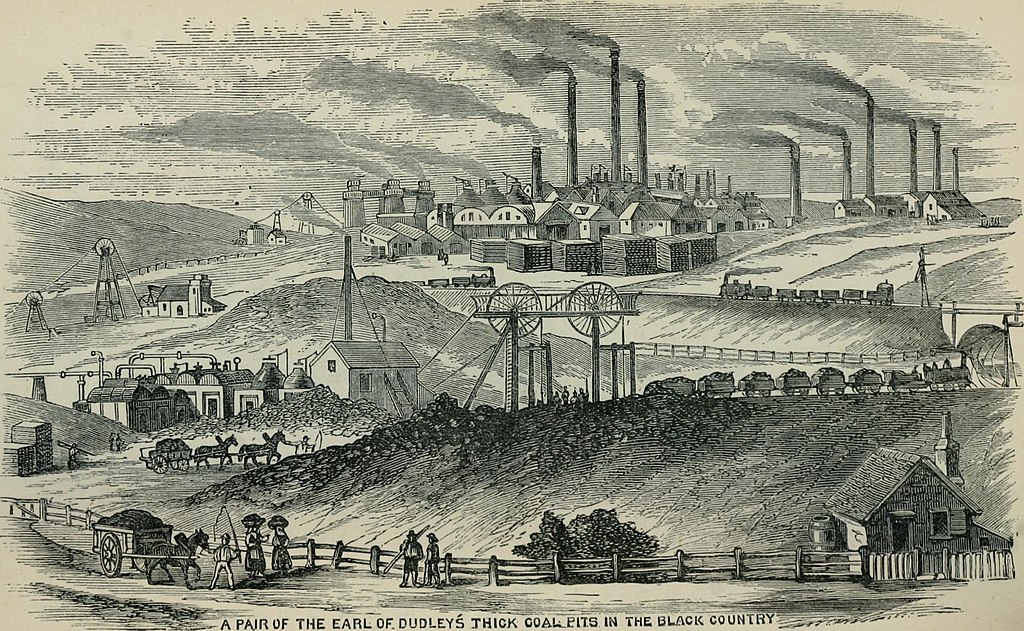
An image of coal pits in the Black Country from Griffiths’ Guide to the iron trade of Great Britain, 1873.
Image digitized by the Robarts Library of the University of Toronto via Wikimedia Commons.
So, quickly: The industrial revolution was not a disaster to your average peasant. It was a disaster for landowners.
Yes, yes, the conditions in the factories were terrible. By our standards. The lifespan was very short. By our standards. The anomie of the big cities, yadda yadda. When compared to what? Small villages? Ask those of us raised in them. Yes, there was child labor. As compared to what at that time? Other than the life of the upper classes?
Look, we don’t have to guess about this stuff. In India, in China, in other places that came to the industrial revolution very late, we’ve seen peasants leave the land where their ancestors had labored, to flock to the big cities, to take work we find horrible and exploitative at wages we find ridiculous.
And even if China has added “labor camp” and prisoner wrinkles to it, note that’s because China is a shitty communist country, not because the migration wasn’t there before. Also the labor camp aspects, as much as one can tell (and it’s hard to tell, due to the raging insanity of the regime) seem to have grown as the people grew more prosperous, as a result of the industrial revolution and thereby demanded higher wages, which positioned China more poorly as the “factory of the world.”
In fact, idealizing “living off the land” has been in place since at least the Roman empire, and probably before. It’s also been MISERABLE at least since then and probably before.
Because pre-industrial revolution farming sucked. It sucked horribly. And it kept you on the edge of subsistence. It double sucked when you were subjected to a Lord. Look, systems of serfdom, etc. didn’t come about because living in a Lord’s domain was so great, and everyone wove wreaths and danced around maypoles all the time, okay?
The bucolic paradise of a farmer’s life was mostly a creation of city dwellers, often noblemen, who saw it from the outside.
There are estimations that most people had trouble rearing even one child, and most of one generation’s peasants were people fallen from higher status. I don’t know. That might be exaggerated. Or it might not.
Even during the industrial revolution, it was normal for ladies bountiful to take baskets of food to tenant farmers because … they couldn’t make it on their own.
And btw, the more the industrial revolution pulled people to the cities, the more the Lords and “elites” talked about how great the countryside was and how terrible the factories/cities/new way of living were.
A lot of artists and pseudo bohemians jumped in on this bandwagon and so did Marx, who was both a pseudo bohemian, by birth “elite” (Well, his family had a virtual slave attached to him. He impregnated her too, as was his privilege), and by self-flattery intellectual.
Therefore the factories were the worst thing ever, the men who owned them, aka capitalists were terrible, terrible people — mostly because Marx wasn’t one, and probably because they laughed at him — and the proletariat they exploited horribly would rise up and —
All bullshit of course. Later on his fiction needed retconning by Anthony Gramsci who, having the sense to realize the “workers” weren’t rising up, just getting wealthier and escaping the clutches of the “elites” more made the “proletariat” a sort of “world proletariat” centered on poorer/more dysfunctional countries. This had the advantage of making the exploited masses always be elsewhere (or the supposed exploiters) and therefore made it easier to pitch group against group to the eternal profit of rather corrupt “elites.” Mostly political classes which are descended from “the best people.”
Creating the Dovetailed Frame for the Bench Top | The Picnic Bench Project
Matt Estlea
Published 2 Aug 2020In this video, I get the dovetailed frame for the bench top in place and answer some of your concerns from the previous video!
► Buy the Ridge Wallet here: https://www.ridge.com/ESTLEA
Use the Promo Code ‘ESTLEA’ to claim your 10% off!
_________________________________________________________________
Support what I do by becoming a Patron! This will help fund new tools, equipment and cover my overheads. Meaning I can continue to bring you regular, high quality, free content. Thank you so much for your support! https://www.patreon.com/mattestlea
Don’t want to commit to a monthly direct debit but still want to help out? That’s fine!
You can make a one time donation here: www.mattestlea.com/donate
You can donate us biscuits here: www.mattestlea.com/wishlist
_________________________________________________________________
BUY THE WOODWORKING BIBLE HERE:
www.mattestlea.com/the-woodworkers-manual
_________________________________________________________________SOCIAL MEDIA
Instagram: www.instagram.com/mattestlea
Twitter: www.twitter.com/mattestlea
Patreon: www.patreon.com/mattestlea
Pinterest: www.pinterest.com/mattestlea
LinkedIn: www.linkedin.com/in/matt-estlea-b6414b11a/
_________________________________________________________________
See what tools I use here: www.mattestlea.com/equipment
My Website: www.mattestlea.com
_________________________________________________________________My name is Matt Estlea, I’m a 24 year old Woodworker from Basingstoke in England and my aim is to make your woodworking less s***.
I come from 5 years tuition at Rycotewood Furniture Centre with a further 1 year working as an Artist in Residence at the Sylva Foundation. I now teach City and Guilds Furniture Making at Rycotewood as of September 2018.
If you’re interested in studying at Rycotewood, view their courses here:
www.mattestlea.com/rycotewoodI also had 5 years of experience working at Axminster Tools and Machinery where I helped customers with purchasing tools, demonstrated in stores and events, and gained extensive knowledge about a variety of tools and brands. I discontinued this at the start of 2019 to focus solely on video creation and teaching.
During the week, I film woodworking projects, tutorials, reviews and a viewer favourite ‘Tool Duel’ where I compare two competitive manufacturers tools against one another to find out which is best. I also have a Free Online Woodworking School which you should definitely check out!
www.mattestlea.com/school
I like to have a laugh and my videos are quite fast paced BUT you will learn a lot, I assure you.
Lets go make a mess.

The Magic of Terry Pratchett by Marc Burrows
Rachel Cunliffe looks at a recent biography of the great science fiction/fantasy author Terry Pratchett by Marc Burrows:

A satirical sci-fi/fantasy writer might not seem the obvious choice to dissect the world-changing magnitude of an unforeseen pandemic — or so you might think if you’ve never read any of his books. But anyone familiar with the Pratchett’s oeuvre will know that the scouring wit and the unflinching grasp of humanity at its best and worst found within his pages would be the only true way to understand what has happened to our world since the start of the year.
Alas, we will never know how Sir Terry would have woven the government’s dysfunctional pandemic response, the etiquette of social distancing, mask and anti-mask culture or the mass shift to remote working into the realm of the Discworld (although we can be fairly confident that he would have done). But glimpses can be found in The Magic Of Terry Pratchett, a new biography by writer and comedian Marc Burrows.
This is the first full biography of the great man, from his upbringing in the quintessentially English hamlet of Forty Green, Buckinghamshire, to his battle with Alzheimer’s (which Pratchett dubbed “the Embuggerance”) and ferocious campaign for a law change to allow assisted dying — and featuring a whistle-stop tour of his 60-odd books.
It is, as Burrows admits from the start, the project of a committed fanboy. The author never actually got to speak to his literary hero (“This book is my chance to meet Terry Pratchett. It’s yours as well,” he explains early on), and has instead pieced together his life story through old interviews, archives, and conversations with friends and contemporaries.
The result is an engaging quest to get to know the man that both explores and adds to the mythology surrounding him. Pratchett was, as Burrows makes clear, a storyteller first and foremost, and some of his oft-repeated anecdotes — such as encountering a dead body age 17 on his first day as a junior reporter, or filing his copy from a shed on the roof — may have been based more on fantasy than reality. Where he cannot verify, Burrows sticks to the strategy taken by Tony Wilson in the film 24 Hour Party People: “When you have to choose between the truth and the legend, print the legend”.
As such, while this book will no doubt be of greatest interest to Pratchett fans, even those who have never opened a Discworld novel will find themselves entertained by its numerous detours — encompassing the educational apartheid of the 1950s, a surreal stint doing PR for Britain’s nuclear industry, and the once vibrant, now sadly endangered local journalism ecosystem.
Ultimate French Cleat Tool Wall
Ben Tardif
Published 29 Feb 2020I have finally moved tools into the workshop! First thing to do is get organized, so I built this French Cleat Wall to store all of the tools that will get used most frequently. This is designed to be a grab and go wall, so tools are set up and ready to be used right away. This is just the first step in organizing my new workshop. Enjoy!
Follow me on Instagram:
https://www.instagram.com/bentardif/Music by: David Cutter Music – http://www.davidcuttermusic.com

QotD: History or “Her” story?
In my last year in college, I had American Literature taught by a Fullbright exchange professor. I will never forget the moment the poor man — talking to a class of 36, all women as such classes often are — let slip the innocent word “him” to mean an indeterminate gender. He paused, went white, his eyes widened, and he said, “I mean, I mean, he or she.”
Meanwhile, the class of 36 was staring at him in puzzlement. It took us a while to take it all apart and realize he thought we’d be offended by the use of “he” to mean someone generic, of indeterminate gender.
I think we patted him kindly on the shoulder and told him that no, really, we weren’t offended. The usage was the same in Portuguese and we’d been told it was the same in most Indo-European languages. And who on Earth would get offended over semantics? The language was the language. It meant nothing about us personally.
This was of course before I married, came to the U.S. and found that for the American woman circa 1985, the language was not just personal, it was personally offensive.
I remember standing in horror underneath a bookstore section proudly labeled Herstory.
Of course the etymology of the word history is not his + story, the sort of pseudo-clever deduction about language that I was used to from the near-illiterate elderly people in the village. (It would be too complex and involve Portuguese, but there was this old farmer who had somehow deduced from the Portuguese word for farmer that farmers were the only ones who would be saved at the end of time.)
History, of course, is not originally an English word. It comes from the Latin historia — meaning a relation of events — by way of the French estoire, meaning story. Note please that in neither of those languages does “his” mean “belonging to him.” And that making the same sort of illiterate assumptions about the French word, we’d get “It is oire.”
I thought that the store must have hired an illiterate employee, but no, over the next ten years, in various circumstances, and possibly still except for the fact that I’ve learned to silence such fools with a death glare, I’ve come across the same smug-idiot assumption and “corrections” of the English word, so as to “fight against the patriarchy.”
That this is done by people who paid more money than I make in a couple of years for a college degree, and who, doubtlessly, think that etymology is a dish made with onions, or perhaps a conspiracy of the patriarchy fills me with a sort of dull rage that has no outlet.
Sarah Hoyt, “The Semantic Whoredom of the Left”, PJ Media, 2018-05-11.
August 2, 2020
Japan is Getting Hungry, Barbarossa is Confused – WW2 – 101 – August 1, 1941
World War Two
Published 1 Aug 2020Japan needs resources for its seemingly endless war in China, but where to look for them? And who might have a problem with it? Meanwhile in the Soviet Union, Hitler’s forces have been diverted from the Moscow Road, and are on the move in the north and the south.
Join us on Patreon: https://www.patreon.com/TimeGhostHistory
Or join The TimeGhost Army directly at: https://timeghost.tvFollow WW2 day by day on Instagram @World_war_two_realtime https://www.instagram.com/world_war_two_realtime
Between 2 Wars: https://www.youtube.com/playlist?list…
Source list: http://bit.ly/WW2sourcesWritten and Hosted by: Indy Neidell
Director: Astrid Deinhard
Producers: Astrid Deinhard and Spartacus Olsson
Executive Producers: Astrid Deinhard, Indy Neidell, Spartacus Olsson, Bodo Rittenauer
Creative Producer: Joram Appel
Post-Production Director: Wieke Kapteijns
Research by: Indy Neidell
Edited by: Iryna Dulka
Sound design: Marek Kamiński
Map animations: Eastory (https://www.youtube.com/c/eastory)Colorizations by:
– Julius Jääskeläinen – https://www.facebook.com/JJcolorization/
– Norman Stewart – https://oldtimesincolor.blogspot.com/
– Jaris Almazani (Artistic Man) – https://instagram.com/artistic.man?ig…
– Dememorabilia – https://www.instagram.com/dememorabilia/
– Carlos Ortega Pereira, BlauColorizations – https://www.instagram.com/blaucoloriz…
– Olga Shirnina, a.k.a. Klimbim – https://klimbim2014.wordpress.com/
– Daniel WeissSources:
– Mil.ru
– Narodowe Archiwum Cyfrowe
– Bundesarchiv, CC-BY-SA 3.0 – Bild_101I-265-0024-21A, Bild 146-1976-080-13A
– Yad Vashem 1295/1Soundtracks from the Epidemic Sound:
Gunnar Johnsen – “Not Safe Yet”
Rannar Sillard – “Easy Target”
Johannes Bornlof – “Magnificent March 3”
Fabien Tell – “Break Free”
Brightarm Orchestra – “On the Edge of Change”
Wendel Scherer – “Growing Doubt”
Philip Ayers – “Under the Dome”
Philip Ayers – “Trapped in a Maze”Archive by Screenocean/Reuters https://www.screenocean.com.
A TimeGhost chronological documentary produced by OnLion Entertainment GmbH.

Words are verbal tools, but tools can be weaponized
In this week’s newsletter, Andrew Sullivan analyzes the roots of wokeness:

In the mid-2010s, a curious new vocabulary began to unspool itself in our media. A data site, storywrangling.org, which measures the frequency of words in news stories, revealed some remarkable shifts. Terms that had previously been almost entirely obscure suddenly became ubiquitous — and an analysis of the New York Times, using these tools, is a useful example. Looking at stories from 1970 to 2018, several terms came out of nowhere in the past few years to reach sudden new heights of repetition and frequency. Here’s a list of the most successful neologisms: non-binary, toxic masculinity, white supremacy, traumatizing, queer, transphobia, whiteness, mansplaining. And here are a few that were rising in frequency in the last decade but only took off in the last few years: triggering, hurtful, gender, stereotypes.
Language changes, and we shouldn’t worry about that. Maybe some of these terms will stick around. But the linguistic changes have occurred so rapidly, and touched so many topics, that it has all the appearance of a top-down re-ordering of language, rather than a slow, organic evolution from below. While the New York Times once had a reputation for being a bit stodgy on linguistic matters, pedantic, precise and slow-to-change, as any paper of record might be, in the last few years, its pages have been flushed with so many neologisms that a reader from, say, a decade ago would have a hard time understanding large swathes of it. And for many of us regular readers, we’ve just gotten used to brand new words popping up suddenly to re-describe something we thought we knew already. We notice a new word, make a brief mental check, and move on with our lives.
But we need to do more than that. We need to understand that all these words have one thing in common: they are products of an esoteric, academic discipline called critical theory, which has gained extraordinary popularity in elite education in the past few decades, and appears to have reached a cultural tipping point in the middle of the 2010s. Most normal people have never heard of this theory — or rather an interlocking web of theories — that is nonetheless changing the very words we speak and write and the very rationale of the institutions integral to liberal democracy.
What we have long needed is an intelligible, intelligent description of this theory which most people can grasp. And we’ve just gotten one: Cynical Theories: How Activist Scholarship Made Everything About Race, Gender and Identity, by former math prof James Lindsay and British academic, Helen Pluckrose. It’s as deep a dive into this often impenetrable philosophy as anyone would want to attempt. But it’s well worth grappling with.
What the book helps the layperson to understand is the evolution of postmodern thought since the 1960s until it became the doctrine of Social Justice today. Beginning as a critique of all grand theories of meaning — from Christianity to Marxism — postmodernism is a project to subvert the intellectual foundations of western culture. The entire concept of reason — whether the Enlightenment version or even the ancient Socratic understanding — is a myth designed to serve the interests of those in power, and therefore deserves to be undermined and “problematized” reason whenever possible. Postmodern theory does so mischievously and irreverently — even as it leaves nothing in reason’s place. The idea of objective truth — even if it is viewed as always somewhat beyond our reach — is abandoned. All we have are narratives, stories, whose meaning is entirely provisional, and can in turn be subverted or problematized.
During the 1980s and 1990s, this somewhat aimless critique of everything hardened into a plan for action. Analyzing how truth was a mere function of power, and then seeing that power used against distinct and oppressed identity groups, led to an understandable desire to do something about it, and to turn this critique into a form of activism. Lindsay and Pluckrose call this “applied postmodernism”, which, in turn, hardened into what we now know as Social Justice.
Was Roman Concrete Better?
Practical Engineering
Published 29 Oct 2018Comparing modern concrete to that of the western Roman empire.
In this video, I discuss a few modern techniques that help improve design life of concrete, including roller compacted concrete (RCC) and water reducing admixtures (superplasticizers). There are a whole host of differences between modern concrete and that of the western Roman empire that I didn’t have time to go into, including freeze/thaw damage. This is such an interesting topic, so here are some references if you’d like to learn more:
– http://www.romanconcrete.com/
– https://www.usbr.gov/tsc/techreferenc…
– https://en.wikipedia.org/wiki/Roman_c…-Patreon: http://patreon.com/PracticalEngineering
-Website: http://practical.engineeringTonic and Energy by Elexive is licensed under a Creative Commons Attribution License
Source: https://www.youtube.com/watch?v=U6fBP…

QotD: Marx’s imperfect economic understanding
We can find, if we look properly, Marx’s insistences of how appalling monopoly capitalism would be in Smith. They’re both right too, it would be appalling. But we do have to understand what they both mean by this. In modern terms they mean monopsony, more specifically the monopoly buyer of labour. What is it that prevents this? Competition in the market among capitalists for access to the labour they desire to exploit. That very competition decreasing the amount of grinding of faces into the dust they’re able to do. Henry Ford’s $5 a day is an excellent example of this very point.
Ford wanted access to the best manufacturing labour of his time. He also wanted to have a lower turnover of that labour, lower training costs. So, he doubled wages (actually, normal wages plus a 100% bonus if you did things the Ford Way) and got that labour. At which point all the other manufacturers had to try and compete with those higher wages in order to get that labour they wanted to expropriate the sweat of the brow from. Marx did get this, he pointed out that exactly this sort of competition, in the absence of a reserve army of the unemployed, is what would raise real wages as productivity improved.
Smith also didn’t like the setting of wages as it precluded just such competition and such wage rises.
Where Marx went wrong was in not realising this power of markets. He knew of them, obviously, understood the idea, but just didn’t understand their power to ameliorate, destroy even, that march to monopoly capitalism.
[…]
The thing we really need to know on this bicentenary about Karl Marx is that he was wrong. He just never did grasp the power of markets to disrupt, even prevent, the tendencies he saw in capitalism. Specifically, and something we all need to know today, the power of competition among capitalists as the method of improving the lives of all us wage slaves. You know, that’s why we proletariat today, exploited as we are and ground into the dust, are the best fed, longest lived and richest, in every sense of the word, human beings who have ever existed. Something which is, if we’re honest about it, not a bad recommendation for a socio-economic system really. You know, actually working? Achieving the aim of improving the human condition?
Tim Worstall, “Marx At 200 – Yes, He Was Wrong, Badly Wrong”, Continental Telegraph, 2018-05-04.
August 1, 2020
Why incompetent people think they’re amazing – David Dunning
TED-Ed
Published 9 Nov 2017Check out our Patreon page: https://www.patreon.com/teded
View full lesson: https://ed.ted.com/lessons/why-incomp…
How good are you with money? What about reading people’s emotions? How healthy are you, compared to other people you know? Knowing how our skills stack up against others is useful in many ways. But psychological research suggests that we’re not very good at evaluating ourselves accurately. In fact, we frequently overestimate our own abilities. David Dunning describes the Dunning-Kruger effect.
Lesson by David Dunning, directed by Wednesday Studio, music and sound by Tom Drew.
Thank you so much to our patrons for your support! Without you this video would not be possible!
Juan, Jordan Tang, Kent Logan, Alexandra Panzer, Jen, Ellen Spertus, Ryan Mehendale, Mary Sawyer, Scott Gass, Ruth Fang, Mayank Kaul, Hazel Lam, Tan YH, Be Owusu, Samuel Doerle, David Rosario, Katie Winchester, Michel Reyes, Dominik Kugelmann, Siamak H, Stephen A. Wilson, Manav Parmar, Jhiya Brooks, David Lucsanyi, Querida Owens.
Masking stupidity
In The Critic, Patrick Fagan talks about the dehumanizing aspect of mandatory facemask orders:

“Utrecht: Facemask Store” by harry_nl is licensed under CC BY-NC-SA 2.0


In Joost Meerloo’s analysis of false confessions and totalitarian regimes, The Rape of the Mind, he coins a phrase for the “dumbing down” of critical resistance – menticide. “In the totalitarian regime,” he wrote, “the doubting, inquisitive, and imaginative mind has to be suppressed. The totalitarian slave is only allowed to memorise, to salivate when the bell rings.”
[…]
Face masks can now be added to the list of mandates that make you stupid. As if Piers Morgan feverishly promoting them weren’t evidence enough, here are the facts on why you absolutely, categorically should not wear a face mask. They make you suggestible; they make you more likely to follow someone else’s direction and do things you wouldn’t otherwise do. In short, they switch off your executive function – your conscience.
A great example comes from a study by Mathes and Guest (1976), who asked participants how willing they would be, and how much they would have to be paid, to carry a sign around the university cafeteria reading “masturbation is fun” (this being 1976, doing such a thing would be considered embarrassing; these days it will probably earn you a course credit!). The results showed that when people wore a mask, they were more likely to carry the sign and required less money to do so ($30 compared to $48, on average).
Meanwhile, Miller and Rowold (1979) presented Halloween trick-or-treaters with a bowl of chocolates and told them they were allowed to take only two each. When the children thought they weren’t being watched, they helped themselves. Children without a mask broke the rule, taking more chocolates, 37% of the time, compared to 62% for masked children. The authors concluded that masks “lead to lower restraints on behaviour”.
The effect has similarly been found online: the online disinhibition effect refers to the tendency for people to act antisocially when anonymous online (Suler, 2004). There is even an infamous trolling movement calling itself Anonymous and using a mask as its symbol.
The disinhibiting effects of wearing a mask are described by psychologists in terms of a suspension of the superego’s control mechanisms, allowing subconscious impulses to take over. Saigre (1989) wrote that masks “short-cut” conscious defence systems and encourage “massive regression” to a more primitive state; Castle (1986) wrote that eighteenth century masquerades allowed mask-wearers to release their repressed hedonistic and sexual impulses; and Caillois (1962) similarly wrote about European masked carnivals involving libidinal activities including “indecencies, jostling, provocative laughter, exposed breasts, mimicking buffoonery, a permanent incitement to riot, feasting and excessive talk, noise and movement”. In the 12th Century, Pope Innocent III banned masks as part of his fight against immorality; and in 1845, New York State made it illegal for more than two people to wear masks in public, after farmers wore masks to attack their landlords.
From a neuroimaging perspective, masks are known to inhibit identity and impulse control – both associated with executive function in the prefrontal cortex (e.g., Glannon, 2005; Tacikowski, Berger & Ehrsson, 2017). In other words, masks silence the Jiminy Cricket in the brain.
EP Thompson: The Foremost Marxist in History | Historians who changed History
The Cynical Historian
Published 1 Nov 2018Today let’s talk about Marxist historians. Edward Palmer Thompson makes perhaps the best introduction to the realm of Marxist history. His work on the English Labor Class, allows for a better understanding of the Marxist project, and how understanding class consciousness can lead to revolution.
————————————————————
references:
Beard, Charles. “Written History as an act of Faith”, The American Historical Review 39, no. 2 (January 1934), 219-231.Marx, Karl. The Essential Marx. ed. Leon Trotsky, abridgment of Das Kapital, Vol. I. 1939; Mineola, N.York: Dover Publications, 2006. https://amzn.to/2MWygco
Thompson, E.P. “The Moral Economy of the English Crowd in the Eighteenth Century”, Past and Present, No. 50 (Feb., 1971), 76-136.
Thompson, E.P. The Making of the English Working Class. New York: Pantheon Books, 1963. https://amzn.to/2KFSESC
Special thanks to Dr. Colleen Hall-Patton for proofreading the script for this episode.
————————————————————
Support the channel through Patreon:
https://www.patreon.com/CynicalHistorian
or pick up some merchandise at SpreadShirt:
https://shop.spreadshirt.com/cynicalh…LET’S CONNECT:
https://discord.gg/Ukthk4U
https://twitter.com/Cynical_History
————————————————————
Wiki:
Edward Palmer Thompson (3 February 1924 – 28 August 1993), usually cited as E. P. Thompson, was a British historian, writer, socialist and peace campaigner. He is probably best known today for his historical work on the British radical movements in the late 18th and early 19th centuries, in particular The Making of the English Working Class (1963). He also published influential biographies of William Morris (1955) and (posthumously) William Blake (1993) and was a prolific journalist and essayist. He also published the novel The Sykaos Papers and a collection of poetry. His work is considered to have been among the most important contributions to labour history and social history in the latter twentieth-century, with a global impact, including on scholarship in Asia and Africa.Thompson was one of the principal intellectuals of the Communist Party in Great Britain. Although he left the party in 1956 over the Soviet invasion of Hungary, he nevertheless remained a “historian in the Marxist tradition”, calling for a rebellion against Stalinism as a prerequisite for the restoration of communists’ “confidence in our own revolutionary perspectives”. Thompson played a key role in the first New Left in Britain in the late 1950s. He was a vociferous left-wing socialist critic of the Labour governments of 1964–70 and 1974–79, and an early and constant supporter of the Campaign for Nuclear Disarmament, becoming during the 1980s the leading intellectual light of the movement against nuclear weapons in Europe.
————————————————————
Hashtags: #History #Marx #EPThompson #ClassConsiousness #Materialism #TheMakingOfTheEnglishWorkingClass
“All style and no substance made it the perfect match for Trudeau”
Andrew Lawton on the Prime Minstrel’s performance in “explaining” his role in the WE scandal:

“Don’t look at me – I’m just the prime minister.”
That about sums up Justin Trudeau’s defense in a Canadian scandal starring grifters, shell corporations, virtue signallers and a federal ethics probe.
The WE-Scam, as it’s come to be known in Canadian circles, is, on its surface, a simple one.
Trudeau’s government created a $912 million government program to pay students to volunteer – formerly known as “working” if memory serves – and outsourced the administration of it to WE Charity, one of those purported international development charities more known for holding glitzy, celebrity-filled parties than digging any wells in Africa.
All style and no substance made it the perfect match for Trudeau.
WE would have netted about $44 million from the program had the government not pulled the plug amid the backlash. The charity would also have had a budget to pay teachers up to $12,000 each to funnel their students into the paid volunteer channels.
The program itself was a boondoggle, but bad policy became a scandal because Trudeau and virtually everyone in his immediate family have personal and financial connections to WE, as do at least two of his cabinet ministers, not to mention his chief of staff – all of whom say their relationships had nothing to do with WE getting the sole-sourced contract.
After weeks of ducking scrutiny from his political opponents, Trudeau made a rare appearance before the parliamentary finance committee Thursday, though his testimony was heavy on the sanctimony and light on the details.


