
I don’t think the PUA crowd has any solution to the problem of how men and women can stop treating each other like shit. Nor do they claim to; the PUA attitude is that you just have to play your cards as best you can under a set of constraints that is intrinsically tragic. But I think the spotlight glare they’re putting on actual mating behavior — as opposed to the lies we tell ourselves about how we behave, or how we think we ought to behave — is a valuable first step.
The truth hurts, but it also helps. Understanding that you’re being yanked around in unhelpful ways by your instincts is the necessary first step to gaining more control of your choices. This is why I think the people who should be paying most attention to PUA theory are women — and not for the most obvious defensive reasons, either.
If you are female, you may be thinking “OK, I should learn game so jerks won’t be able to play me”. Well, that’s nice, but almost completely irrelevant. Because what both evolutionary psych and PUA tell us is that in cold fact you want to be played by an alpha – and failing that, at least someone a bit taller, a bit older, a bit smarter, and a bit higher-status than you. The fact that you want to be better at detecting imitation alphas changes nothing essential; women have been polishing that counter-game as long as men have been practicing theirs.
No. The reason women need be paying attention to PUA goes much deeper than just notching up another escalation in the jerk-vs.-bitch arms race. It’s because until women stop lying to themselves about their actual behavior, they won’t have any prayer of becoming self-aware enough to change the sexual reward pattern they present to men. In pervasive female self-honesty begins the only hope of not training up more generations of jerks. And it’s there that the pitiless, revealing glare of the PUA spotlight might help.
Yes, I know what kind of reflexive screaming that last paragraph is going to trigger. Feminists will lash at me for suggesting that this is womens’ problem to solve; shouldn’t at least half the burden of self-awareness and change fall on men?
In fact, it can’t be that way, and it can’t be for a brutally simple reason. If you are reading this, you are almost certainly a member of a culture in which women have far more power to control mens’ sexual experience than the reverse. The only exceptions to this rule have been barbaric hellholes in which women were treated as chattel.
Ladies, with having more power over sexual outcomes there comes more responsibility. And there’s this, too; just suppose the great mass of men stopped thinking with their dicks and 99% of them suddenly became sensitive New Age guys eager to commit. Until most women stopped being cruel to betas and rewarding men who behave like dominating jerks with sex, nothing … nothing would change. PUA game would still work. The tragedy to which it is a minimax response would still be in motion.
I don’t have any final answers either. But, gentle reader … if you’re a beta male and not a natural, learning some PUA game might sound icky but it would sure beat masturbating to porn for the rest of your life. And if you’re female, think hard about the last guy you slept with and the last guy you friend-zoned. Maybe you owe yourself a rethink and friend-zone guy an apology, of the kind best delivered naked.
Eric S. Raymond, “A natural contemplates game”, Armed and Dangerous, 2011-03-03.
January 9, 2024
QotD: Women versus PUAs
January 3, 2024
“One of the oddities of trans healthcare is that it masquerades as progressive”
In The Critic, Victoria Smith outlines the history of medical misogyny from Aristotle to modern-day “trans healthcare”:
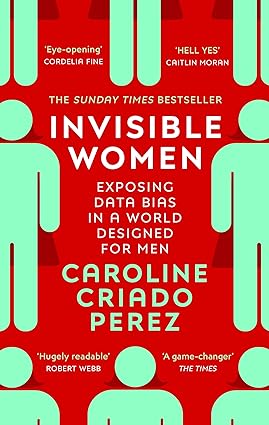
The neglect of female bodies in medicine has a long history. The male-default bias, writes Caroline Criado Perez in Invisible Women, “goes back at least to the ancient Greeks, who kicked off the trend of seeing the female body as a ‘mutilated male’ body (thanks, Aristotle)”:
The female was the male ‘turned outside in’. Ovaries were female testicles (they were not given their own name until the seventeenth century) and the uterus was the female scrotum. […] The male body was an ideal women failed to live up to.
As Criado Perez notes, this bias lives on in male-centric medical research and undifferentiated treatment recommendations. “Women are dying,” she notes, “as a result of the gender data gap.” The belief that there is nothing specifically different about female people — cut a bit here, add a bit there, and we’re the same as men — has led to our symptoms being ignored and our pain dismissed.
Over the past few years, there have been a number of books — Elinor Cleghorn’s Unwell Women, Cat Bohannon’s Eve, Leah Hazzard’s Womb, to name a few — which have aimed to correct the imbalance. This is important both to save lives and ease suffering, and because, on a very basic level, it is insulting for half the human race to have our bodies treated as lesser, imperfect versions of a male ideal. We are more than that. We exist in our own right.
There are many in medicine, however, who still seem to think that Aristotle was right. Last week, for instance, the World Health Organisation announced it would be developing new guidelines into “the health of trans and gender diverse people”. While this might sound positive, as Eliza Mondegreen notes, many of those leading the development group hold highly regressive views about sex, gender and bodies. It is only possible to believe that a person could change sex if you have not given much consideration to the “second” sex at all.
One of the oddities of trans healthcare is that it masquerades as progressive despite having evolved from — and continuing to rely on — an understanding of sex difference which is regressive, male-centric and superficial. Because no one wants to admit it, this has led to a plethora of articles along the lines of “Here’s Why Human Sex Is Not Binary” and “Sex Redefined: The Idea of 2 Sexes Is Overly Simplistic“. While these claim to be adding extra detail and nuance to our understanding, what they do in practice is revert back to privileging the male default. Sex is all so varied, all so different, they tell us, we might as well not bother setting any standards for what counts as “femaleness”. We’re all just human, aren’t we? Only some bodies have tended to be considered more human than others. Rebranding “the male default” “the sex spectrum” is a sneaky way of insisting, once again, that female people are nothing more than males with a few minor tweaks.
This is the new medical misogyny, built on the back of the old version. Unfortunately, because it positions itself as anti-conservative and even pro-feminist, many writers of texts that address the old version feel obliged to go along with the new. It’s not difficult to see why. Who wants their work to be undermined by bad faith accusations of transphobia? Isn’t it easier just to say “it’s clear that trans women are women” — as Bohannon has done — on the basis that at least this will enable you to challenge the centring of male bodies elsewhere?
December 14, 2023
Whatever it is, it sure ain’t Stoicism …
Freddie deBoer doesn’t have a catchy name for this, but you’ll recognize it instantly from the description:
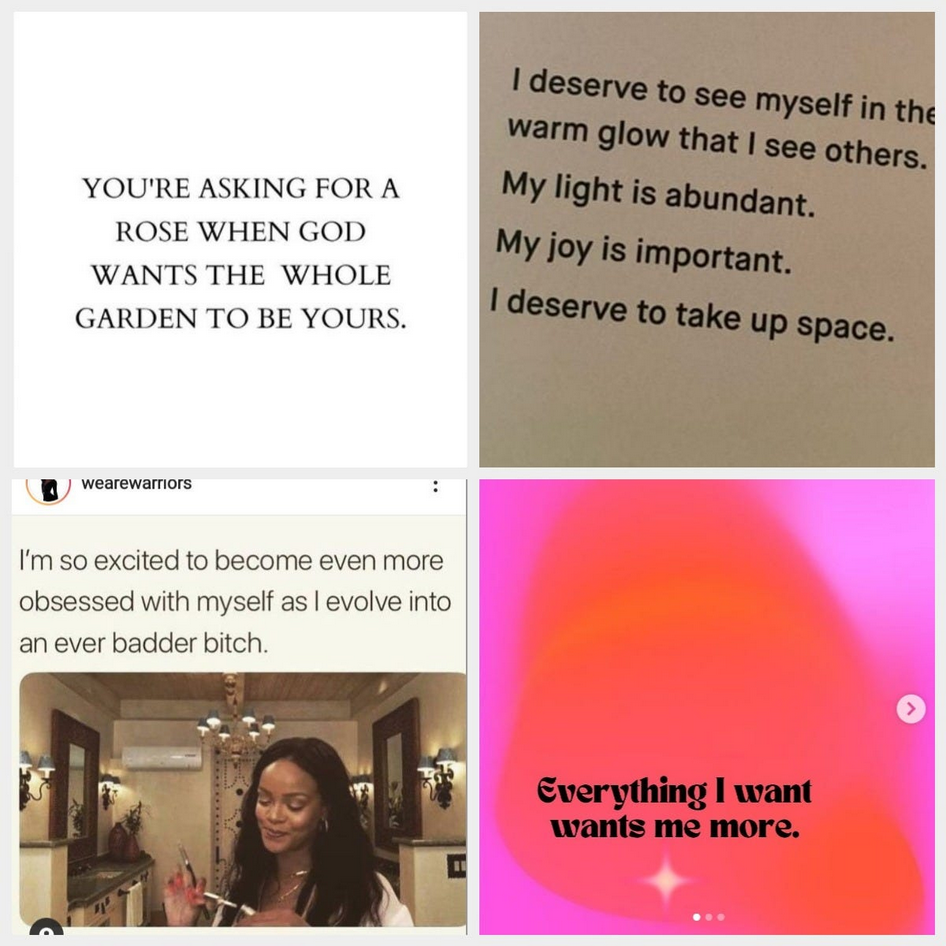
For years now, I’ve written once or twice annually about a phenomenon that I’ve struggled to name but which everyone understands. It’s a particular kind of social and aesthetic culture, not exclusive to Instagram but very heavily associated with it, that merges girlboss feminism with the contemporary therapeutic imperative, a strange syncretic mysticism involving horoscopes and “manifesting”, and a blanket excuse for narcissism and selfishness dressed up in quasi-political and self-help terms. You know what I mean.
Some of these memes are comically ridiculous, most of them are fairly innocuous, and a few of them make me deeply sad. But they all reveal a tangle of conflicting attitudes and ideas that are quite confused. You would never assemble these various impulses into a life philosophy on purpose; they’ve been grafted together mostly thanks to the weird rhythms and path dependence of social media. Either way, I’ve argued that they present an essential problem with any kind of “I can have it all” philosophy — millions of people absorb this stuff, and because many of the things we want in life are zero sum, not all of them in fact can have it all. Almost all of them, in fact, will get very much less than it all. You have this absurd manifesting/The Secret stuff, where grown adults genuinely convince themselves that they can will what they want into being simply through wanting it. Well, alright: what if two people want the same promotion at work, and they’re both manifesting it? The clod philosophy this is all attached to says that whoever wins wanted it more, and since wanting can’t be quantified, no one can ever prove that isn’t true. (Convenient!) Regardless, in the case of the singular promotion and two people manifesting for it, only one of the people who has read endless memes like these actually ends up being self-actualized by success. This is OK; life can be full of contentment and disappointment at the same time. Part of what makes this kind of messaging pernicious, though, is that it suggests that not getting everything you want is always a personal failure you shouldn’t accept.
It is not possible that God promised the whole garden to everyone. (That’s not how fractions work, even for God.) It is not socially responsible to believe that you are entitled to the whole garden. And setting yourself up to see anything short of the whole garden as failure is a recipe for making yourself miserable.
That’s related to another point I’ve made, which is that these memes create an unachievable expectation that healthy, successful women aren’t in possession of ordinary confidence but of lunatic confidence, a kind of confidence rarely seen outside of Michael Jordan or bipolar mania. In a particularly perverse irony of the sort that seems to usually afflict women, this demand for outrageous self-confidence becomes just another bar that women feel like they can’t meet. A whole affirmational culture that ostensibly exists to help and affirm and praise women ends up being just one more on the long list of expectations that our society heaps on them: hard-charging and career-oriented but always putting family first, well put-together but always effortless, sexy but not slutty, Madonna and whore, you know the whole deal. I’m sorry that this stuff is so gendered, but it is, and I’m sorry that I’m the wrong messenger on this topic, but no one else is making these arguments, so I must. Yes, I concede that for most people who indulge in this stuff, it’s a harmless hobby that maybe pushes them to be a little better to themselves. But as time goes on, the messaging has grown more and more deranged, and young people are very susceptible to this sort of thing. And my job is to worry.
December 5, 2023
“Why should a criminal act be punished more or less severely depending on a victim’s ability to emote in public about it?”
Janice Fiamengo with a column that, had it been written by a man, would merit universal condemnation from the mainstream media (instead, if they pay any attention to it will probably dismiss it with hints of “false consciousness” or “Stockholm syndrome”):

For years, activists told us that part of the horror for sexual assault survivors was the fear of not being believed, the feeling that one was alone with an experience no one else understood or even acknowledged. Fair enough. Now, decades into the near-constant discussion of all varieties of such assault, many quite trivial yet treated with great seriousness, women don’t seem to have become any better at dealing with the ostensible horror — quite the opposite. The unending focus on sexual victimization seems only to have created more victims.
A case in point involves the infamous sexual crimes of Dr. Vincent Nadon, a now-disgraced GP at the University of Ottawa Health Clinic, who in late 2018 was sentenced to eight years in prison after he pled guilty to many dozens of counts of voyeurism and sexual assault during a 28-year medical practice. (The exact number of charges was hard to determine, seeming to change in every report). Much of what Nadon pled guilty to — mainly the recording of women via his cellphone while they were undressing or undergoing breast exams — was a type of deeply unprofessional conduct that might have gone forever unnoticed by the victims if one intrepid woman had not seen the cellphone’s recording light winking at her from a cabinet and gone to investigate. There were also allegations of sexual assault nearly indistinguishable in their details from regular medical touching — the main distinction being that the touching was “for sexual purposes”. Witnesses at Nadon’s sentencing hearing spoke of what had occurred, in some cases many years previously, as if it had been the worst possible betrayal.
A report of the sentencing hearing described women wiping away tears as they told of “feelings of powerlessness, embarrassment and even guilt”. Others said they had become distrustful of men after learning of Nadon’s actions. One woman, having been shown by police a cellphone recording made of her in Nadon’s office, claimed that she felt physically ill and “has not been able to go to another doctor, and is uncomfortable undressing, even in front of her husband”. Another woman said she felt “violated and betrayed”, and now “looks for hidden cameras everywhere, is obsessed with locking doors, and has developed a medical condition that can be caused by stress”. Many alleged that they feared seeing videos of themselves on the internet though there is no indication Nadon ever uploaded any of his recordings.
In a separate report about fallout from the charges against Nadon, some women expressed outrage at authorities they saw as complicit in their victimization, with one woman complaining that University of Ottawa Health Services failed to “help [her] tell [her] story and come forward”. This woman, who told how she had not been provided with a gown to wear during a pap smear procedure with Nadon, was also furious at the University of Ottawa for failing to more closely monitor its health service provider. Her anger was sustained and wide-ranging: “Obviously I’m super traumatized. I feel extremely violated and so sick to my stomach. It’s really, really disgusting.” “It’s even hard for me now to find a therapist I can trust.”
I can’t get inside these women’s heads, of course, but their statements seem hysterical and irrational, far in excess of the facts, and perhaps willfully exaggerated in order to garner the maximum of attention and sympathy. It was disturbing to see such statements presented as if they proved something about the severity of Dr. Nadon’s actions. They prove nothing except the climate of alleged female sexual fragility in which we are all now forced to live.
Victim impact statements are often of dubious value in criminal justice proceedings — why should a criminal act be punished more or less severely depending on a victim’s ability to emote in public about it? — but in a case like this, with damsel-in-distress melodrama having already been stoked by multiple media reports at every stage of the investigation, the victim statements took on a particularly staged, formulaic quality. One had to make an effort to remember that many of the complainants would not even have known they were harmed if police hadn’t shown them that they were. Their pain may have been real, but it was also almost entirely self-generated.
The whole story of Dr. Nadon the beloved physician turned super-predator seems to have been largely manufactured, first and foremost by police, who were so eager to find as many complainants as possible that they repeatedly put out calls through the media for more “victims” to come forward. I’ve never seen anything quite like it, with police stating publicly that they feared there were likely more victims, and issuing “a public plea for help”. What did they expect to happen?
November 27, 2023
QotD: The PUA (Pick-up Artist)
One one hand, I recognize techniques like kino escalation. Oh, do I ever! Adroit use of that one has gotten me into the sack more times than I can count. On the other hand, I’m basically incapable of what PUAs call the neg; I can’t insult a woman even by implication unless I think she’s done something to specifically deserve it, and the thought of flinging negs to score sex disgusts me in a very fundamental way.
On the gripping hand … I recognize a harsh truthfulness in a lot of what the PUAs are saying. Crudely put, the “game” advice for most men (the population PUAs call AFCs or “Average Frustrated Chumps”) reduces to behaving like an asshole so women will mistake you for an alpha. I really am an alpha, so I don’t have to asshole-fake it — but it is nevertheless quite clear to me that the PUAs are on to something. This is frequently a successful strategy; I’ve been outcompeted by it myself on several humiliating occasions. Furthermore, the PUAs are probably correct in asserting that for many AFCs it is the best strategy available, and never mind that the thought of running it myself turns my stomach.
In the PUA’s disturbingly persuasive analysis, I’ve had the luxury of not treating women like shit only because I have often had USPs for the brighter-than-average women I was interested in, notably in the combination of alpha-male qualities with high intelligence and expressive skills. Without those USPs, argues the PUA, my choices would have reduced to “frustrated loser” or “sexually successful douchebag” — and, looking at my own experience and that of my less successful peers, I find myself unable to refute this.
That is kind of horrifying if you think about it. Possession of USPs is rare by definition, and if you have one you’re more than averagely likely to be an alpha anyway. The PUA is telling us that human beings are designed in such a way that the most reliable way for the large majority of beta males to get sex is to behave like narcissistic, dominating, emotionally-unavailable jerks. This would be appalling enough as pure theory, but the PUA makes it worse by applying it to actually have lots of sex. “Success” one blog unsparingly observes “is defined by penis in vagina”. Never take your eye off that ball, says the PUA. Much as one might like to dismiss this as crass reductionism, evolutionary theory makes any countercase rather difficult to argue.
How did our poor species get into this hole? The PUA community gravitates to evolutionary-psychology explanations for human behavior as much as I do, it’s one of the interesting things about reading their stuff. It’s remarkable how often they manage to apply facts about human reproductive biology in a tactical way. The use they make of evo-bio concepts like hypergamy, peacocking, and sexy-son theory is, I find, sound and justified. The kind of pitiless clinical eye they turn on human mating interactions could scarcely be bettered by most scientists.
But the PUAs don’t, at least so far as I’ve yet seen, have a generative explanation for why women friend-zone nice guys and fuck bad boys. They accept this as the foundation of game without asking what circumstances in the environment of evolutionary adaptedness stuck women with apparently counterproductive wiring.
I’ve thought about this, and the only plausible explanation I can come up with is that in the EEA, when early humans lived in small hunting bands, the behaviors modern assholes now use to fake alpha must have been reliable indicators of superior status. Perhaps they were much more risky to fake in a small society where beta males were almost constantly under they eye of senior alphas with hard fists.
Meanwhile, back in modernity, we’re stuck with the consequences – men who have been trained to be imitation-alpha jerks and abusers by women who are sexually fickle, manipulative and cruel towards beta males. It’s not a pretty picture, not if you’re looking in from halfway outside it like me and certainly not if you’re stuck in the middle of it as an invisible AFC or a woman wondering why she’s surrounded by douchebags.
Eric S. Raymond, “A natural contemplates game”, Armed and Dangerous, 2011-03-03.
November 25, 2023
“It’s not called the gender empathy gap for nothing”
Janice Fiamengo on the blatant disregard for violence as long at that violence is not directed at women:
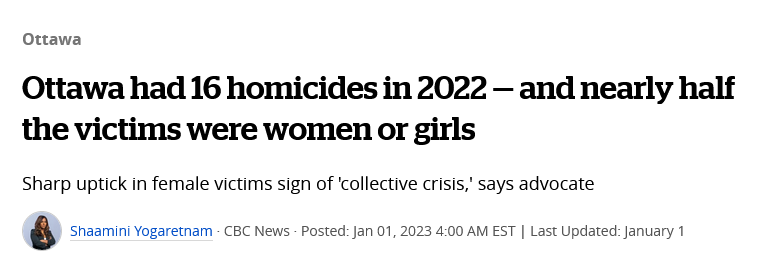
The news headline by the CBC, Canada’s state-funded broadcaster, could hardly have been more blatant: “Ottawa had 16 homicides in 2022—and nearly half of the victims were women or girls“. In other words, more than half of the victims, as is always the case, were boys and men, a state of affairs that no one at the CBC has ever found troubling enough to lament or even notice. Only when the female homicide rate approaches gender parity in one (unusual) year is it a “collective crisis”, as the subheading alleges.
It’s not called the gender empathy gap for nothing.
[Author’s note: Perhaps I should have stopped here. What more is there to say about the extraordinary indifference of most people, men and women, to violence against men and the craven desire to deny female culpability? There’s nothing new in this essay, no new angle or stats, no rousing call to action, nothing beyond the marshalling of dreary evidence and sadly sarcastic observations unlikely to change any mind or cause any gynocentric cheek to blush. I had intended to finish it in time for the International Day for the Elimination of Violence Against Men, on November 18, but was stymied partly by a sense of helpless anger, the weight of which pressed down on every sentence. The section at the end, about the death of Benjamin Rain, was the last straw.]
Feminists have long touted their concern for victims, yet that is never in shorter supply than in their one-sided discussions of violence, in which the only deaths allowed to matter are female deaths, presented for readers’ contemplation with poignant circumstances, names, and expressions of horrified sadness, as in the above-mentioned article. Dead men remain largely anonymous, and few readers could guess from the typical reports of feminist organizations that women are ever lethally violent.
Indifference to male suffering and death are the norm all over the world, of course, but the Anglophone feminist movement has markedly increased it, fudging numbers and manipulating language to focus empathy exclusively on women and girls. The CBC article devotes significant space to discussing the risible concept of femicide, a relatively recent coinage that makes no secret of its female supremacism, purporting to highlight how women and girls are killed “simply for being women” and “primarily by […] men”, as if every woman, even one killed by accident (as we’ll see), is evidence of gender bias.
The idea that women are killed because they are women is preposterous, impossible to support with evidence, and obviously intended to solidify the impression that women outnumber men as victims of murderous violence. An organization called the Canadian Femicide Observatory for Justice and Accountability provides an elaborate taxonomy of forms of femicide to drive the idea home, deliberately blurring the lines between intimate partner homicide, a favored focus, and other killings of women, which are collectively deplored as “brazen acts of hatred“.
Even a cursory reading of the details, however, exposes the vacuousness of the terminology as well as the sleight of hand by which men’s alleged misogyny is misleadingly linked to the totality of the women’s deaths. Only two of Ottawa’s seven murdered women were killed by current or former intimate partners. One of the dead women was attacked and killed by her two adult daughters (an act called “non-intimate femicide”), while another was the victim of a stray bullet that killed her by accident and was probably intended for a man (if you can believe it, the Canadian Femicide Observatory calls this type of death “associated/connected femicide”).
It is impossible to conclude that all or even most of these — certainly unfortunate — deaths can logically be said to have occurred, as the mantra holds, “due to the existence of gender norms and stereotypes, discrimination directed toward women and girls, and unequal power relations across genders“. The determination to find gender discrimination at the root of all female suffering — and thus to justify yet more programs, initiatives, and taxpayer dollars for feminist organizations, as well as more collective shaming of men — seems unstoppable.
November 22, 2023
QotD: American universities, “sportsball”, and wealthy alumni
NOT, I hasten to add, because the Prez and the Trustees (hereafter: The Administration) were some kind of normal folks. Oh God no — quite the opposite, in fact. No open conservative has been hired to any position in academia for the past thirty, forty years; to make it into the ranks of The Administration, you have to be #woker than #woke. Rather, it was because The Administration were among the few mortals privy to the college’s balance sheet. Seriously, those things are more closely guarded than our nuclear launch codes … but The Administration sees them, and draws the only possible conclusion: Without sportsball, the whole university system is toast.
But alas for the bottom line, Intersectionality is a jealous god, and xzhey will have none before xzhem. The Administration knows — they must know, they can’t not know — that all the stuff that makes big league college football go comes from “boosters”, i.e. rich idiots with way more money than sense, and their corporations. But since The Administration is full of even dumber Marxists than the faculty — yeah yeah, I know, I didn’t think it was possible either — they’ve apparently decided to assume, in true Leftist style, that since the money has always just kinda, you know, been there, it will continue to, you know, somehow, someway, continue to be there.
I mean, what are those rich oilmen from Texas gonna do, not watch football?
Severian, “Ludicrous Speed Update: The NCAA”, Rotten Chestnuts, 2021-04-14.
November 18, 2023
Believe all women … unless they’re Israeli
In The Line, Kristin Raworth and Ariella Kimmel protest against the objectively pro-Hamas silence of so many feminist organizations about the terror attacks of October 7th:

On October 7th, 2023, Hamas terrorists infiltrated Israel and committed the worst massacre of Jews in a single day since the Holocaust. More than just a massacre, Hamas tortured their victims, including brutally raping women, young and old. Yet the silence of many women’s organizations and leading voices who stand tall, claiming to be “strong feminists”, is deafening.
When the #MeToo movement started, the mantra was “believe all women”. As high-profile women spoke out, the feminist movement stood with them. So why, in the wake of the most horrific terrorist attack in Israel’s history, which included rape, do these women not deserve the same solidarity?
A month later it is not just the complete silence of the women’s organizations that causes pain, it is the active justification and gaslighting of the Jewish community, which has including denying the truth of what happened on October 7th, by demanding proof, rather than believing survivors. Many may recognize these tactics as those used as abusers against their victims in cases of domestic and sexual violence, a tactic that has become known as “DARVO” — Deny, Attack, and Reverse, Victim Offender.
When reports first surfaced of the sexual assaults committed by Hamas, many of us took to Twitter, the only place where we knew to raise our voices. Immediately our replies were filled with folks who otherwise would believe survivors, but were seemingly comfortable demanding immediate forensic evidence in this case. Survivor accounts were not enough; even a video released by the Israeli government that painted a clear picture of Hamas’ brutality was not enough. Hamas terrorists themselves recounting their actions was not enough.
Sarah Jama, an MPP in Ontario, has gone so far to publicly state that the accounts of rape are a lie pushed forward by the “zionist lobby”.
We have seen people like Ghada Sasa, a former board member of Canadians for Justice and Peace in the Middle East, going on a podcast and not just claiming that Hamas treated civilians fairly, but that Israel was to blame for the massacre at the Nova music festival.
Meanwhile member of Parliament Niki Ashton claimed that a “feminist government” would call for a ceasefire; yet she has not once condemned the use of rape by Hamas as a war crime. This is a highly selective read of feminism.
November 13, 2023
Winners and losers of the “sexual revolution”
Janice Fiamengo missed her trip to London this week due to illness, so she also missed a panel discussion at the ARC (Alliance for Responsible Citizenship) Conference that raised her ire:
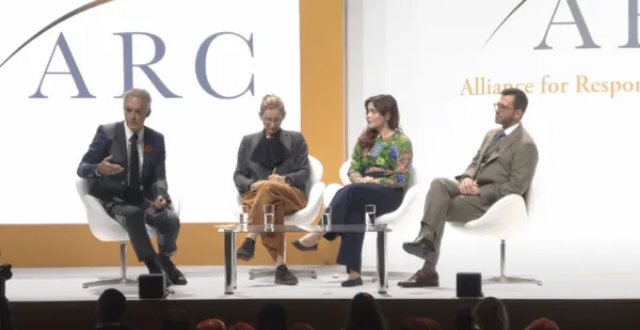
On the subject of widespread sexual promiscuity, family breakdown, and fatherless homes, pundits Jordan Peterson, Louise Perry, Mary Harrington, and Stephen Blackwood carefully ignored the hulking feminist elephant in the room, arguing that the primary victims of the sexual revolution have been women (and children as well, as something of an afterthought). The primary beneficiaries have been a few psychopathic men who have left a trail of broken hearts and rudderless children in their wake. It’s a convenient thesis in a culture terminally averse to criticizing women, but it avoids some important facts.
The whole discussion, actually, begins from a false premise. If there was ever a sexual revolution in which we all simply consented to do what we wanted sexually, as Louise Perry claimed, that revolution ended over 30 years ago when Anita Hill complained before a Senate Judiciary Committee that Clarence Thomas, former chair of the Equal Employment Opportunity Commission, should not be confirmed as a Supreme Court Justice because he had once joked to her about a pubic hair floating on his Coke. At that point, the alleged sexual vulnerability of women, whose sensitive ears must not be subject to comments by male colleagues about pornography or penis size — and the need for legislation to protect and accommodate them at the expense of male freedom of expression — reasserted itself with a vengeance. The feminist claim that women merely wanted equal rights and an end to sexual double standards was exposed as a feeble lie.
Sexual harassment legislation soon made it a potential firing offence for a man to make a female workmate uncomfortable, whether by standing too close, looking too intently, or making the wrong joke or comment. Later, the #MeToo movement proclaimed it righteous that any man who had ever been sexual with any woman (or even just any man, who didn’t even have to know the woman smearing his name) could be accused of sexual misconduct, fired from his job, and permanently disgraced (the DAMN Handbook contains an extraordinary list of celebrity men destroyed by allegations in 2017 alone; see pp. 8-17). Free love, if it ever existed, has been dead for a long time, and some of the same women who cheered on the idea of sexual freedom were the ones who killed it.
But #MeToo, false allegations, the ever-expanding territory of sexual misconduct, and the anti-male tenor of nearly every public discussion about sex—these were emphatically not the focus of the ARC panel, which zeroed in on female sexual victimization. The goals that countless women have proclaimed necessary—sexual freedom, abundant birth control, single motherhood—were criticized as harms for women. We heard that the medium to long-term well-being of women and children has been sacrificed to the short-term gratification of a minority of men; and that these men also tend to be, according to Peterson, possessed of psychopathic, Machiavellian, narcissistic, and sadistic tendencies. Amongst the fallout are the 50% of British children raised in homes without fathers.
It was stirring stuff, certainly, though not exactly a new proposition. Radical feminists like Sheila Jeffries have long argued (in her book Anticlimax: A Feminist Perspective on the Sexual Revolution and elsewhere) that the sexual revolution merely affirmed and updated the victimization of women by men while conservative non-feminists like Phyllis Schlafly pointed out how feminist policies and laws have disadvantaged women.
Yet even those of us without doctorates in psychology might wonder how it could be true that so many women have been the innocent and unwitting victims of men even when they themselves chose those men. Are there not women who engage in abundant casual sex with as much blithe indifference as the men; some of them too psychopathic, narcissistic, Machiavellian and cruel? Why have so many women over the years championed the loosening of sexual mores — including the availability of abortion, never mentioned by any of the panelists — if it was not in their own best interests to do so?
Or are these panelists saying that women cannot be trusted to know their own best interests and those of their children? Why do so many women continue to embrace sexual hedonism, abortion, and divorce? In reality, the epidemic of fatherlessness, as nobody on the panel was interested in exploring, is not the result of the sexual revolution per se, but was made possible specifically by the rise of no-fault divorce and child support laws that, in feminist-compliant family courts, made it highly attractive for women to discard their husbands while still living off his earnings (divorce is today initiated by women in about 70% of cases, and is one of the major reasons so many young men today are averse to marriage). It may well be that nobody’s long-term well being is served by this reality, but it is what women have been choosing with their eyes wide open for many years, and it is a bit rich now to pretend it was something done to them without their consent.
November 7, 2023
Birth Gap, the future none of us expected
Elizabeth Nickson takes the warnings of infertility from BirthGap quite seriously:
Jordan Peterson’s face morphed through a series of changes as he realized that nine out of ten women who don’t have children, wanted them. Ready to blame the culture of narcissism, he stalled confused, wrestling his face to neutral. I knew that fact from experience. For the many women I know who don’t have children, it is an abiding sorrow. From country to country, class to class, race to race, the sorrow is coruscating and it is ignored or diminished.
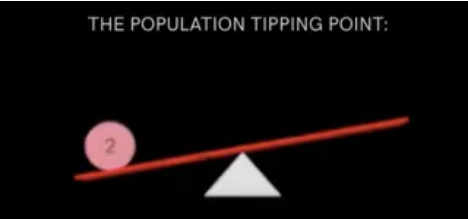
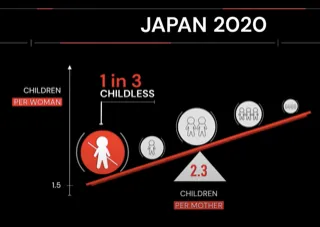
Only one in ten women actually don’t want children. One in ten is infertile, but the rest who don’t have children and that is one-third of us and counting, wanted them. By the time they are in their 40’s and incapable, badly.
Steven F Shaw searches for answers in Birth Gap, his masterwork documentary, the first part of which you can watch here. The most obvious is that they waited too long, thinking it was possible, their “career” taking precedence. He interviews two prominent women in their late 30’s, both journalists. One of whom has a child, and having had one, wanted more but it was too late. “No one told us”, she said. Throughout her childhood and education, no one told her that the hammer would come down, that fertility drops off a cliff in your 30’s. That if you are 30 and childless, there is a 50% chance you won’t have children. The other, Megan McArdle, who writes for the Washington Post, left it too late. McArdle is a brilliant woman. If she didn’t know she was playing with fire, who could?
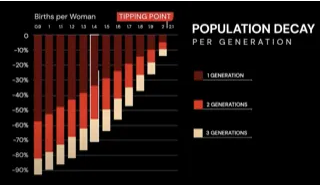
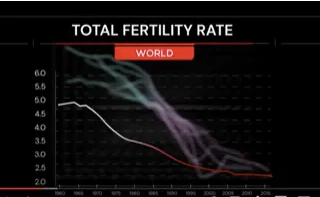
The catastrophic statistics run across all cultures but sub-Saharan Africa. Every industrialized country is racing to the bottom, which is to say extinction within four or five generations. Cities left to ruin, old people without help, decaying schools, hospitals, and no employees to be found. The unretrievable extinction of the culture and its people. I’ll leave it to you to follow Shaw’s math, but it is convincing. And he is by no means, alone in his analysis.
Europe, Japan and especially South Korea are by far the most in trouble. But Spain, Italy, the Scandis, are not far behind. America’s massive migration is masking the effect now, but, as Shaw doesn’t point out, but others have, immigrants quickly default to the current zeitgeist. Even in Muslim countries, pace Mark Steyn, women are choosing to not have children until too late. And forget multiples, even for the devout, it’s no longer on the cards.
To me, one underlying reason is the firehose of overpopulation propaganda that we have endured for the past fifty years. Women, in general, as kids, are good girls, accepting of authority, and compassionate. When told their desire for children is stressing the earth, they are more likely to accept that nonsense without question if it is coming from every authority figure in every sector of the culture. Today from kindergarten on, we are taught that we are a virus, a plague on the earth. Who among us, at the age of 15 or 25, can contravene that level of brainwashing? Contrast Peterson saying this week, “we can make the deserts bloom”. When was the last time you heard that sentiment from anyone in authority?
October 17, 2023
Those problematic “AI girlfriends” – men suck and women suffer because of it
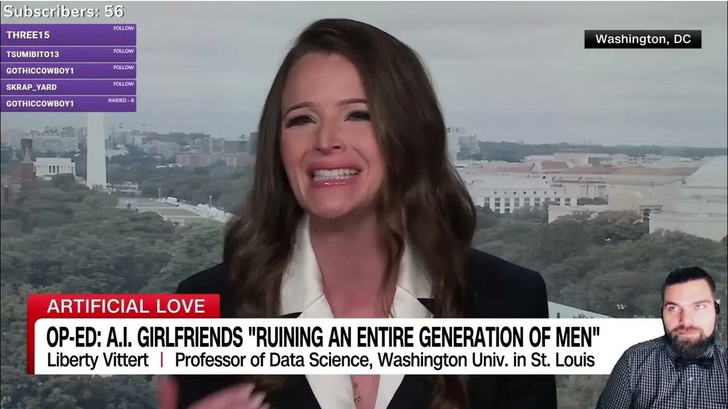
Janice Fiamengo discusses a recent CNN program that woman-splained why young men paying for “AI girlfriends” are yet another way that misogynistic men are harming women:
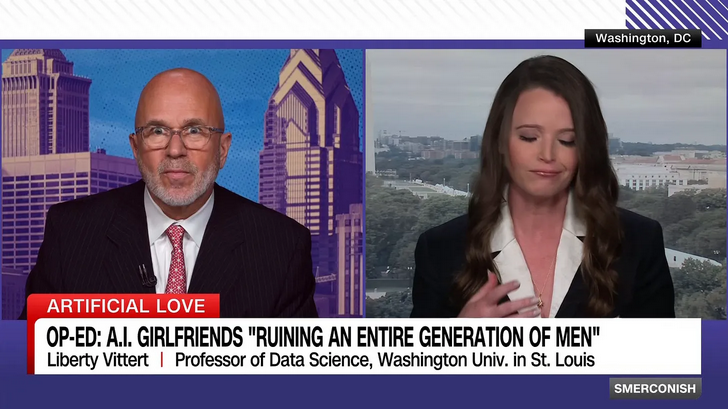
Last week, CNN aired a must-watch episode with the somber headline, “AI girlfriends are here and they’re posing a threat to a generation of men”. If that sounds as if the show might possibly express some compassion for young men and for the “epidemic of loneliness” referred to in the show, it was not to be. Even an expert, Scott Galloway, profiled briefly on how society is “failing men”, felt the need to express contempt for their alleged conspiracy theories, online misogyny, and even (gasp!) climate change denial. With friends like these …
The segment is fascinating, however, for its revelation of some pundits’ uneasy awareness of male discontent.
[…] The expert is Liberty Vittert, a statistician and professor of data science at Washington University’s Olin Business School. But she might as well be an AI feminist, so predictable was her analysis of the male entitlement allegedly driving the turn to AI girlfriends. Though a statistician, Vittert gave no data about the numbers of men who are paying to access AI content. While the CNN host, Michael Smerconish, seemed open to the possibility of exploring men’s points of view, the expert could only emphasize male failure.
She condemned young men for “choosing AI girlfriends over real women”. The choice means, according to Vittert, that “they don’t have relationships with real women, don’t marry them and then don’t have and raise babies with them”.
But wait, aren’t marrying and raising babies a patriarchal imposition on women — part of the “comfortable concentration camp” that Betty Friedan so memorably indicted?
Professor Vittert says nothing about the decreasing number of young women willing to marry and procreate. Her (botoxed) mouth turns down in disapproval as she explains that the increasing realism of AI is “enabling this entire generation of young men to continue in this loneliness epidemic”. It seems that men prefer sterile self-pleasuring and facile scopophilia to the “hard work” of relationships with real women. Like Joaquin Phoenix’s hapless character, these men, she says, are so fixated on perfection that they “are not able to deal with ups and downs, not only in a relationship, but in life in general”. The glibness of the condemnation is remarkable, though far from unusual.
It’s not clear if Professor Vittert has ever talked to actual men about why some of them (not “an entire generation”) might choose an AI relationship. Does she know any young men who have tried for years without success to find a marriageable girlfriend? Many discover that such prizes are remarkably thin on the ground, many of them unsuitable to be considered as future mothers. Even worse, perhaps, does Vittert know anything about what can happen to an inexperienced young man who pursues the wrong woman or women (there are a couple of heartbreaking examples in Sons of Feminism)? How many times does a young man who has failed repeatedly need to hear that no woman owes him love or sex before he starts thinking that giving up on them might not be a bad idea? Meanwhile, women laugh at his loneliness and drink “I bathe in male tears” mugs.
To give him credit, CNN’s Smerconish asks a few questions about the male point of view: “What’s going on with the women?” Has the power dynamic shifted in their favor? Are they less approachable than formerly? These only scratch the surface, but he’s chosen the wrong expert for such a conversation.
Vittert freely admits that there are now many more women than men at university (thanks, affirmative action!) and that far more women than formerly are choosing career over homemaking (thanks, feminist propaganda!). But those are good things, and young men simply need to adapt. Calling any of this debacle women’s fault, she declares, would not be “the right way to go”.
QotD: Representations of sex work in SF
Maybe it’s a relic from when SF was just another facet of Men’s Adventure magazines, or maybe it’s capitalizing on the stereotypical basement-dwelling Geek’s desire to have high quality women to command at the wave of a few credits or gold pieces. Or, more cynically, it’s the desire of Hollywood producers who actually DO have high quality women at their mercy, career-wise, to further normalize the idea that “Sex work is real work” to help smooth away the resistance to their hamfisted efforts on the casting couch.
TV Tropes has a number of entries about this, from “Unproblematic Prostitution” to “High Class Call Girl”. Writers like to call up the imagery of the Geisha, and make their Space Hookers come across as brilliant sexual artists, with additional talents that help the protagonists, such as advanced degrees or connections to corporate executives and high ranking government officials. (Funny how they are not corporate movers and shakers or government officials themselves …). They forget, of course, that Geisha were not actually prostitutes, and only rarely took lovers. There were still actual brothels in Japan for that sort of thing.
Science Fiction has gotten a lot more difficult to write as the frontiers of reality have pushed back against the flights of fantasy. We have had to accept that you can’t get to the moon inside a Victorian upholstered artillery shell, or set foot on the Jungles of Venus. And maybe that’s why a lot of SF in recent decades has turned towards the softer sciences where theories are more prominent than scientific facts, making it simpler to speculate.
However, even in our understanding of society, there are some realities that can’t be ignored. A few of them are listed in the aforementioned “Unproblematic Prostitution” entry. The primary social reality that undermines all of the tropes is that when you commodify sex, you are putting women on sale. Maybe it’s just fractionally, for a few hours out of her lifetime, but when your fantasy/SF hero comes along and waves a few C-notes to get a woman to do what he wants, it’s not the “Combination of Sex and Capitalism” (“… which are you against?” the excuse goes) but the sublimation of Sex TO Capitalism.
“Sex work is real work,” they like to say, but when you turn sex INTO work, it strips it of all of its better qualities. “Do what you love and you’ll never work another day in your life,” is another lie. I’ve known too many artists who go from having a fun hobby to chasing unsatisfying commissions, eventually burning out from endless requests by cretins for illustrations of their vilest fantasies. So the idea that our happy Space Hookers are having fun and getting paid, and what’s wrong with that, turns into burnout in pretty short order, because the kind of guys who go out looking for “That kind of girl” are not interested in the parts of sex that make it as enjoyable as it is for a compatible couple. They don’t have girlfriends for a reason. So the trope that Prostitution is just Sexy Fun Time falls by the wayside in the face of human nature.
SF also likes to postulate that science will make sex consequence free with perfect contraception and cures for all diseases. Writers and Producers fail to see the actual social costs and secondary effects, some of which we are finally running afoul of today, as women are aging out of their “Hookup culture” days and finding themselves alone and with few prospects for a lasting relationship, while at the same time human reproduction is falling below the replacement rate worldwide. And of course, nature being what it is, there will always be new diseases from new planets or new alien races or who knows WHAT our horny young space cadets have been sticking their dicks into. Human biology has less security in its OS than a Commodore 64.
Dr. Mauser, “Space Hookers Must Die!”, Shoplifting in the Marketplace of Ideas, 2023-07-16.
October 9, 2023
Janice Fiamengo finds a reason to watch the Barbie movie
I generally don’t watch movies these days, so I was never in the target audience for Barbie, but Janice Fiamengo has changed her mind about whether you should watch it:
I have changed my mind about Barbie. When I discussed it last week with my good friend Tom Golden (you can see our conversation here), I advised against viewing it.
I now recommend giving it a watch, not for pleasure or even ideological interest — it is too dull and humorless for that, with a senseless plot, wooden dialogue, and a coy voice-over — but for clarification. The high-grossing movie offers a vivid encapsulation of our culture’s view of men and women, complete with its own inadvertent self-subversion. Watching it is a leaden but useful reminder that feminists really are this self-destructively stupid, and really do want to destroy “patriarchy”, by which they mean masculine freedom, self-respect, and leadership. They no longer even pretend to value equality.
Men and boys (and the women who love them), take a good look.
In Barbie, men are at best second-class citizens who by movie’s end, in an improvement over their former nullity, are content to follow banal female directives about their attitudes and identity. In a jaw-droppingly condescending scene after the failed Ken Rebellion, Ken is counseled on how to find himself. He is told that it’s okay to cry (as he bawls like a baby) and is admonished to “figure out who you are without [Barbie/woman]”. He and the other Kens seem grateful for the puerile admonition and willing to be male on Barbie terms: sexless, rudderless, effeminate. They certainly can’t be equal, the film makes clear, because they make a mess when they’re in charge.
Keeping men in check means shielding them even from images of patriarchal (meaning competent, self-directed, masculine) men: Ken runs amok only after seeing a world (the “real world”) in which men are allegedly respected merely for being men, one of the more risible feminist lies in the movie. Feminists have never understood that men earn respect. But in the feminist vision, any possibility that men may perceive themselves as essential to their society — and as owed acknowledgement for the goods they bring — must be suppressed. Only women are essential.
Perhaps the feminist director of Barbie intended the portrayal of the Kens to reflect the situation of women under patriarchy (one searches in vain for a coherent analytical perspective). In Barbie Land, Kens are objects (not sex objects since there is no sex or even heterosexual desire) who exist only to compete, fruitlessly, for Barbies’ attention.
In the real patriarchal past, of course, women were never so reduced precisely because of male sexual longing, love, familial affection, chivalry, religious ideals, empathy, reasoning about justice, and the desire for procreation. All such longings or allegiances are absent from Barbie life. If the Barbies desire children and family — never made clear in the movie, though perhaps gestured to in the final scene when Barbie, now human, visits her gynecologist — theirs will likely be families without Kens. Whether in the real world or in Barbie Land, men are peripheral at best, dangerous at worst, and often mildly contemptible and tiresome with their “egos and petty jealousies”. The only good thing about Kens is that they are easy to manipulate.
The disdain is fathoms deep.
Women, in contrast, are complete in themselves, sufficient for each other in a world in which all positions of power — from President to CEO, doctor, pilot, astronaut, ambulance worker, professional athlete, and Nobel Prize-winning journalist — are occupied by women (and a few trans people, it seems), and in which neighborhoods function without any dirty, dangerous jobs, external threats, heavy machinery, complex repairs, or strenuous labor.
This aspect of the movie, by the way, is a striking illustration of the inability of the feminist mind to remember or even understand what men actually do: the risky, body-wearying and ingenuity-demanding work that feminists only rarely, if ever, advocate for women and which they are frequently hard-pressed even to name. One of the many magic tricks of feminism is its continual disappearing of distinctive male inventiveness, skill, adaptability, and heavy-lifting.
QotD: Roman views of sexual roles
There is always a temptation to emphasise the way in which the Romans are like us, a mirror held up to our own civilisation. But what is far more interesting is the way in which they are nothing like us, because it gives you a sense of how various human cultures can be. You assume that ideas of sex and gender are pretty stable, and yet the Roman understanding of these concepts was very, very different to ours. For us, I think, it does revolve around gender — the idea that there are men and there are women — and, obviously, that can be contested, as is happening at the moment. But the fundamental idea is that you are defined by your gender. Are you heterosexual or homosexual? That’s probably the great binary today.
For the Romans, this is not a binary. There’s a description in Suetonius’s imperial biography of Claudius: “He only ever slept with women.” And this is seen as an interesting foible in the way that you might say of someone, he only ever slept with blondes. I mean, it’s kind of interesting, but it doesn’t define him sexually. Similarly, he says of Galba, an upright embodiment of ancient republican values: “He only ever slept with males.” And again, this is seen as an eccentricity, but it doesn’t absolutely define him. What does define a Roman in the opinion of Roman moralists is basically whether you are — and I apologise for the language I’m now going to use — using your penis as a kind of sword, to dominate, penetrate and subdue. And the people who were there to receive your terrifying, thrusting, Roman penis were, of course, women and slaves: anyone who is not a citizen, essentially. So the binary is between Roman citizens, who are all by definition men, and everybody else.
A Roman woman, if she’s of citizen status, can’t be used willy-nilly — but pretty much anyone else can. That means that if you’re a Roman householder, your family is not just your blood relatives: it’s everybody in your household. It’s your dependents; your slaves. You can use your slaves any way you want. And if you’re not doing it, then there’s something wrong with you. The Romans had the same word for “urinate” and “ejaculate”, so the orifices of slaves — and they could be men, women, boys or girls — were seen as the equivalent of urinals for Roman men. Of course, this is very hard for us to get our heads around today.
The most humiliating thing that could happen to a Roman male citizen was to be treated like a woman — even if it was involuntary. For them, the idea that being trans is something to be celebrated would seem the most depraved, lunatic thing that you could possibly argue. Vitellius, who ended up an emperor, was known his whole life as “sphincter”, because it was said that as a young man he had been used like a girl by Tiberius on Capri. It was a mark of shame that he could never get rid of. There was an assumption that the mere rumour of being treated in this way would stain you for life; and if you enjoy it, then you are absolutely the lowest of the low.
Tom Holland, “The depravity of the Roman Peace”, UnHerd, 2023-07-07.
September 26, 2023
“Passport Bros”
Few online people are less tuned-in to the mainsteam zeitgeist than me, so perhaps I’m once again one of the last people to be clued-in about “passport bros”. Here’s Janice Fiamengo‘s post on the “bros” and the women who apparently spend a lot of time criticizing them:

Female commentary on so-called Passport Bros is not hard to find on the internet: women are angry, contemptuous, and incredulous that men are looking for women overseas and encouraging other men to do the same — not for sex tourism (which feminists loved to criticize until they discovered that women are doing it too, in which case it is acceptable), but for a long-term relationship, including, in many cases, marriage and children. These men will partially or entirely relocate to the women’s home country in order to start a new, non-western (and non-feminist) life. The angry internet women claim not to care personally: let the losers go is their expressed attitude. Yet the sheer number and vehemence of their responses suggests they do care.
The angry commentary follows a standard pattern in which the women claim to know why a significant minority of men are giving up on western women as mates. The reason never has anything to do, of course, with faults in western women or their unrealistic expectations […]
Likewise, the reason never has anything to do with western divorce laws — in which a man can be ejected from his home, imprisoned, forced to undergo a psychiatric exam, fleeced, and deprived of his children by a grasping ex-wife — or with the fact that women are the ones who initiate divorce in upwards of 70% of cases (and are often applauded for doing so).
The reason has nothing to do with women’s openly expressed attitudes of superiority, resentment, and anti-male bigotry, which are rampant in western cultures, especially Anglophone ones. It has nothing to do with the #MeToo/Believe Women climate of baseless accusation that regularly sees men accused and disgraced purely on a woman’s say-so. It has nothing to do with the institutionalized discrimination of “equity” hiring that makes it difficult for men to find and advance in careers in order to be acceptably successful to the kind of women who now deride them for their failure.
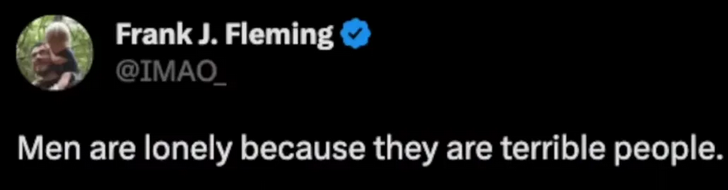
According to the angry women online, men are leaving the west (particularly North America) to find partners because they aren’t good enough for western women. The men are allegedly “terrible, and don’t want to stop being terrible”, according to one gleefully irate commentator. Their only chance is with women so poor as to be grateful for a “terrible” man; in return, such women will have to “subject themselves to [his] advances”, according to another critic’s Victorian-style phrasing.
[…]
Many such women — protected by our pro-woman culture and deferred to by men terrified of female wrath — reach adulthood without ever having received any serious criticism. If and when they are criticized, their response is a howl of outrage and wounded self-regard. This is precisely what is happening in reaction to the Passport Bros.
Underneath the anger, there is perhaps a hint of fear. It’s not fear that men will leave the west in droves (they don’t see that happening yet, and neither do I), but it’s fear that men are not, after all, entirely under female control. Not yet, and maybe never. Some men are sick of the anti-male abuse and starting to do something about it. They are critically examining women’s characters and attitude; they’re drawing back from the acquiescence they’ve always been expected (and been willing) to give. Some are walking away and telling other men to do the same.
These women are used to dishing out the denunciation, reveling in justified grievance; they are infuriated to find that now they are the ones being judged and found wanting.
Don’t be that girl.


