Quotulatiousness

January 19, 2020

Travelling SNCF in the age of the smartphone app

Filed under: Business, France, Humour, Media, Railways, Technology — Tags: , , , , — Nicholas @ 05:00

At The Register, Alistair Dabbs reveals some unfortunate truths about the French railway service (the Société nationale des chemins de fer français or SNCF) and its mobile app:

An SNCF Train à Grande Vitesse (TGV) Duplex DASYE (moteur asynchrone, nouvelle generation de duplex) train at Figueres-Vilafant station, 1May 2011.
Photo by eldelinux via Wikimedia Commons.

Actually, the hotel app is rubbish. The booking system is slow, the property information incomplete and some of the buttons don’t do anything at all. From time to time, the app flashes up a notification inviting you to install the app … er, that you’re already running. Much better to book using a proper computer. Still, flashing the screen around got me the Presidential Disability Suite. Franklin D rocked a wheelchair, remember, and I’m a fan.

This, however, pales into insignificance with the tedious and frankly silly collection of smartphone apps I had to juggle to manage my train journey to get here. Yes, it’s my own fault for trying to navigate my way across France on public transport in the midst of a general strike but surely that’s precisely the kind of thing digital communications ought to be able to help you with, don’t you agree?

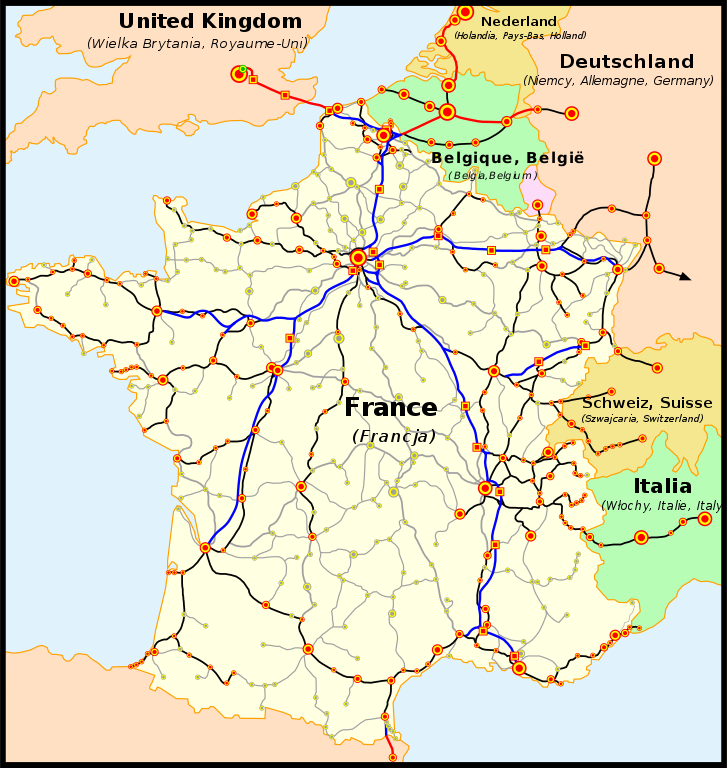
Map of the French railways on which the TGV (LGV: blue; normal tracks: black) and Intercités (grey) SNCF trains run. Only lines going to and from Paris are shown here.
Wikimedia Commons.

The French train company, SNCF, has been doing its best by notifying travellers with bookings every day at 17:00 which of the following day’s trains would be running and which would be cancelled. I’m a lifelong union member myself and I fully support the workers’ rights to … oh buggeration, my TGV’s been rerouted to set off from a city 300km away. Fucking union arsewipes – sack ’em all bastard wankers.

Oh well, I thought, I’ll just have to work out another way. Fire up the SNCF booking app!

A banner at the top informs me that I should seek information about which train services are running by checking its Twitter feed. So I launch the Twitter app. SNCF on Twitter says I should check via the idiotic INOUI brand for TGV bookings. So I launch the INOUI app. This tells me I should check with SNCF or, if I want more information, click on a highlighted link. I click on it: it links to a one-sentence message that tells me there is a strike on and that train services may be affected.

Two hours of thumb-numbing smartphone tomfoolery later, I have worked out my own alternative route via multiple connecting services. This was made more challenging by the SNCF and INOUI apps providing contradictory information about the same journey. Best of all is they can’t agree on where my TGV will actually go. Will it reach its terminus as usual or will it apparently go inexplicably missing from the tracks in the countryside outside Lille? According to SNCF and INOUI, it will do both. It’s Schrodinger’s train.

Just as I go to bed, the Eurostar app sends me a notification reminding me to get to my local station on time tomorrow to catch the TGV that’s been cancelled.

As you can see, my much prolonged, zig-zag route up the country and into Blighty worked, no thanks to these ridiculous apps. It wasn’t all bad: I got to see more French farmland than I expected and experienced first-hand the extraordinarily rich cultural variety of train station beggars that France has to offer the modern rail traveller.

January 1, 2020

The Day The Gauge Changed

Filed under: Business, Economics, History, Railways, USA — Tags: , — Nicholas @ 02:00

The History Guy: History Deserves to Be Remembered
Published 16 Jun 2018

The History Guy remembers the 1886 Southern Railroad Gauge Change, an important moment in railroad history.

The photographs used in the episode are Public Domain images from the age of steam. As photos of actual events are sometimes not available, I will often use photographs of similar events and objects for illustration.

The economic analysis mentioned in the episode is available here: https://www.hbs.edu/faculty/Pages/ite…

Patreon: https://www.patreon.com/TheHistoryGuy

The History Guy: Five Minutes of History is the place to find short snippets of forgotten history from five to fifteen minutes long. If you like history too, this is the channel for you.

Awesome The History Guy merchandise is available at:
https://teespring.com/stores/the-hist…

The episode is intended for educational purposes. All events are presented in historical context.

#railroad #ushistory #thehistoryguy

December 28, 2019

American railways are simultaneously world-beating and terrible

Filed under: Business, Economics, Government, Railways, USA — Tags: , , , , — Nicholas @ 03:00

That’s because, as Sean Smith and Peter Earle point out, there are two very different entities running on America’s rails:

Burlington Northern Santa Fe (BNSF) locomotive 5399, Kansas City Southern (KCS) 4807, and 1890 westbound on the BNSF Emporia Sub near Timberland Blvd West of Northgate Street in Olathe, Kansas.
Photo by Tyler Silvest via Wikimedia Commons.

American railways are the envy of the world.

Many might shake a collective head at that statement. In the case of passenger rail that is an appropriate reaction. Since it was pieced together – a government-constructed Franken-rail system built of numerous bankrupt railways which were essentially nationalized – Amtrak has been a reliable money sink, losing tens of billions of dollars since 1970.

Any traveler that has used Amtrak to any significant extent has firsthand experience with the crumbling infrastructure, frequent delays, and general unpleasantness that accompanies U.S. passenger rail service. Even the oft-cited bright spot of Amtrak, the “high speed” Acela system (which shuttles between Boston and Washington D.C) pales in comparison when compared to high-end passenger rail systems in Western Europe, Japan, and China.

Bullet trains routinely travel at least 200 mph, whereas Acela trundles along at a pedestrian 84 mph, and there is no indication (and probably no intention) of that gap closing anytime soon.

U.S. passenger rail services in general are money-losing and antiquated versus their global counterparts, an inarguable (and to public transport proponents, embarrassing) fact. Passenger rail is just one part of the story, and serves as an excellent example of how not to manage a rail system. In fairness, efforts to turn Amtrak around (mainly through aggressive cost cutting) do seem to be having an impact, as current year losses total a shade under $30 million. It’s an admirable effort to be sure, but decades of losses, poor service, and general mismanagement cannot be ignored.

The U.S. freight railway system, conversely, is the envy of the world, and this is not hyperbole or chest thumping; the facts back it up. Since the Staggers Act of 1980, which deregulated freight rail, improvements have been substantial. U.S. freight railways carry 81% more ton-miles of freight, and costs have fallen 46%. (It isn’t common for an industry to increase its capacity by 81% while reducing costs by nearly half.) That level of success has even been noted by the Community of European Railway and Infrastructure Companies, which might be surprising, given the common assumption that Europe has a monopoly on rail excellence.

Compared side by side, it seems a conundrum: Amtrak limps along, still relying upon billions of dollars worth of taxpayer-financed subsidies, while U.S. freight railways evince growing profitability and capacity amid rapidly falling costs. Why are U.S. freight rails so profitable when U.S. passenger rail – sometimes traveling the same routes, on some of the same rails – remains a perennial money pit?

New Amtrak Viewliner diner Atlanta deadheading on the eastbound Capitol Limited at Point of Rocks in November 2017.
Photo by Mark Levisay via Wikimedia Commons.

December 20, 2019

Repost – Happy holiday travels!

Filed under: Bureaucracy, Humour, USA — Tags: , , , — Nicholas @ 03:00

H/T to Economicrot. Many many more at the link.

November 20, 2019

QotD: Theorizing an American police state

Filed under: Law, Liberty, Quotations, USA — Tags: , , , — Nicholas @ 01:00

With apologies to Margaret Atwood and a thousand other dystopian novelists, we do not have to theorize about what an American police state would look like, because we know what it looks like: the airport, that familiar totalitarian environment where Americans are disarmed, stripped of their privacy, divested of their freedom of speech, herded around like livestock, and bullied by bovine agents of “security” in a theatrical process that has an 85 percent failure rate because it isn’t designed as a security-screening protocol at all but as a jobs program for otherwise unemployable morons.

Kevin D. Williamson, “O’Rourke’s America”, National Review, 2019-10-16.

October 30, 2019

Defending the work of Dr. Beeching

Filed under: Britain, Economics, Government, Railways — Tags: , , , , — Nicholas @ 09:20

Ever the contrarian, Tim Worstall responds to an article calling for the “Beeching Axe” cuts to the British passenger railway network in the 1960s to be reversed:

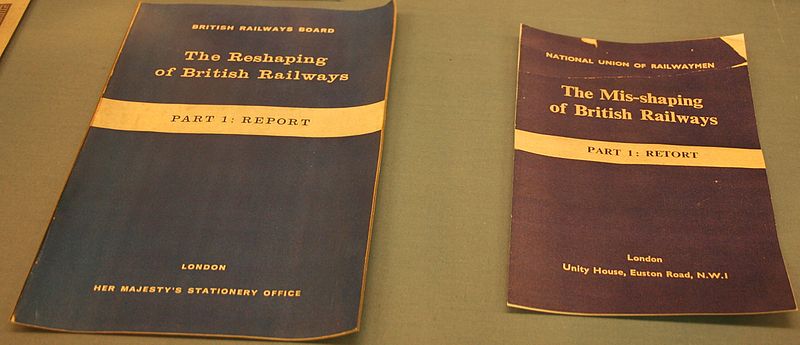
The British Railways Board’s publication The Reshaping of British Railways, Part 1: Report, Beeching’s first report, which famously recommended the closure of many uneconomic British railway lines. Many of the closures were implemented. This copy is displayed at the National Railway Museum in York beside a copy of the National Union of Railwaymen’s published response, The Mis-shaping of British Railways, Part 1: Retort.
Photo by RobertG via Wikimedia Commons.

For background, as the “Beeching Axe” is far less well-known today than it used to be, here’s Wikipedia’s introduction:

The Beeching cuts (also Beeching Axe) were a reduction of route network and restructuring of the railways in Great Britain, according to a plan outlined in two reports, The Reshaping of British Railways (1963) and The Development of the Major Railway Trunk Routes (1965), written by Dr Richard Beeching and published by the British Railways Board.

The first report identified 2,363 stations and 5,000 miles (8,000 km) of railway line for closure, 55% of stations and 30% of route miles, with an objective of stemming the large losses being incurred during a period of increasing competition from road transport and reducing the rail subsidies necessary to keep the network running; the second identified a small number of major routes for significant investment. The 1963 report also recommended some less well-publicised changes, including a switch to containerisation for rail freight.

Protests resulted in the saving of some stations and lines, but the majority were closed as planned, and Beeching’s name remains associated with the mass closure of railways and the loss of many local services in the period that followed. A few of these routes have since reopened; some short sections have been preserved as heritage railways, while others have been incorporated into the National Cycle Network or used for road schemes; others now are lost to construction, have reverted to farmland, or remain derelict.

Worstall says:

[Dr. Richard] Beeching is one of the most universally hated figures in British politics, yet I have no doubt that he was that rare creature, someone working for the state who actually got things about right.

What Dr Richard Beeching mostly did was a cold, analytical report into the railways and recommended cutting large chunks of it that no-one was using. This was done because the railways were losing a fortune every year. And he mostly got it right. He assumed that we would replace trains with buses, which isn’t a bad idea at all. […]

One of the reasons I think Beeching ended up more right than he thought was the arrival of the car. Yes, cars can be environmentally damaging, cause deaths and so forth. Personally, I lean towards the bus or train as a preference. But you can’t ignore the upsides of cars.

The biggest problems with trains are connection time, flexibility and that there’s no market in there. Rail is quite poor at doing their one job: getting a train from A to B. You’d think after 150 years, they’d have it going pretty good, but crew not turning up, signal failures, electrical failures, doors not closing properly. industrial action are not that rare. The problems are certainly more common than if you drive a Toyota Corolla on the motorway to work. Your driver will turn up (because it’s you), the doors will close, the car will run pretty much perfectly. You also have no connection time in that Corolla. You turn off one road straight onto another. You can also go when you please. Middle of the night, middle of the day.

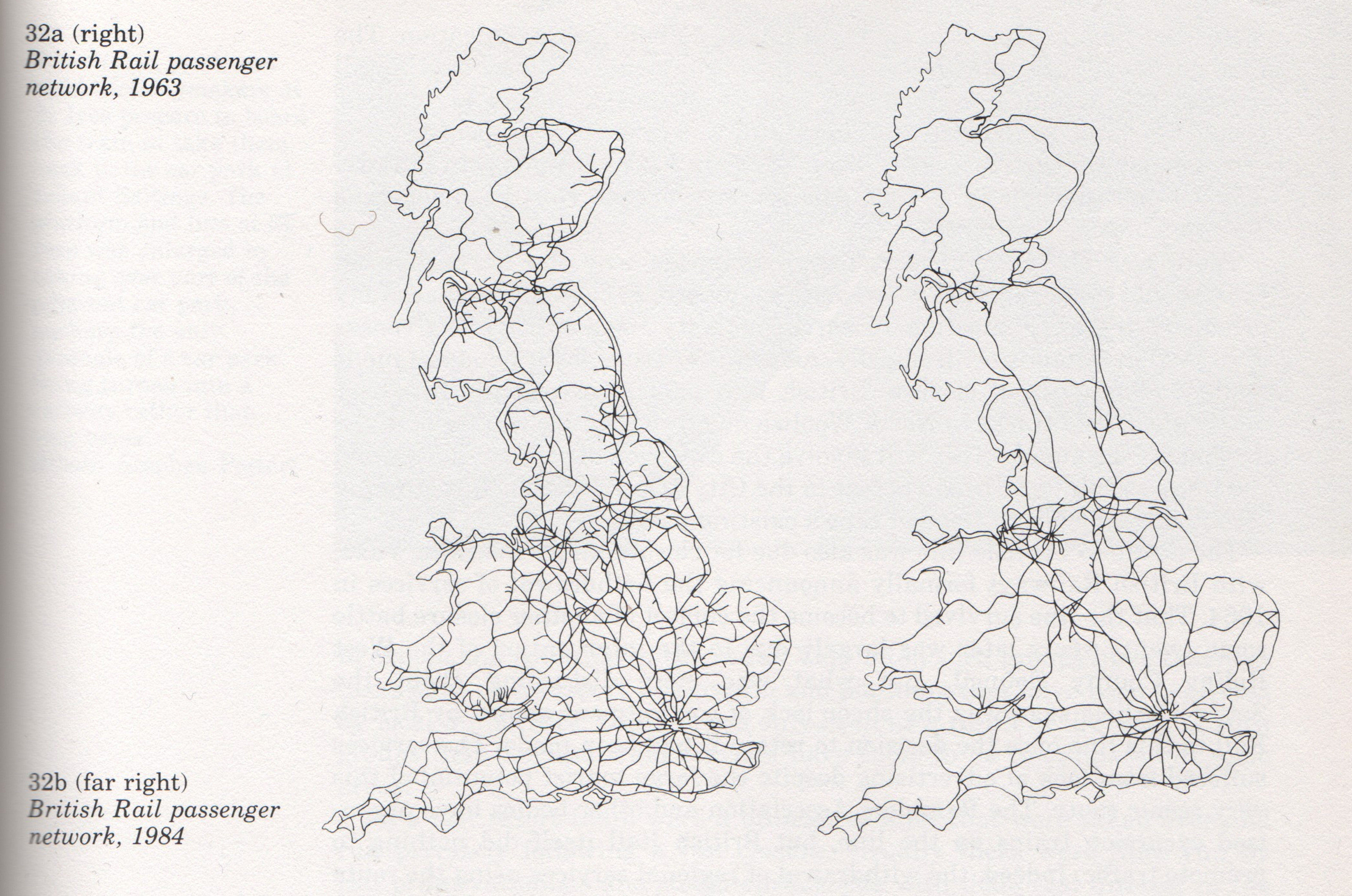
Maps originally from Losing Track by Kerry Hamilton and Stephen Potter (1985), by way of Is Your Journey Really Necessary?, 2012-12-31.
https://isyourjourneyreallynecessary.wordpress.com/2012/12/31/nice-work-if-you-can-get-there/
Click map to enlarge.

August 16, 2019

The CO2-reduced future the elites want for the rest of us

Arthur Chrenkoff outlines the self-imposed hardship of a new Swedish MEP as he struggles to make his 24-hour weekly commute between Stockholm and Strasbourg (because he’s pretending that there are no flights between those two locations) and explains that it’s emblematic of the kind of future “our” leaders want all of us peasants to be living in the future:

Greta Thunberg at the EU Parliament, 16 April, 2019.
European Parliament photo via Wikimedia Commons.

Listen, I’m all for it; if people want to go back in time as a result of their own free choice that’s wonderful. At least these martyrs for Gaia are putting their money where their mouth is – on train as opposed to plane tickets. They are not being hypocrites, unlike the two hundred celebrities who came on 114 private jets and numerous superyachts to Google’s climate change summit in Sicily the other week. Even St Greta herself, the teenage idiot savant of the green movement, will be eschewing plane travel and going to the UN Climate Action Summit in New York in September on a zero-emission yacht. Want to suffer 24-hour Strasbourg-Stockholm regular commutes or a few weeks at sea between Europe and America so as not to sin again the planet, knock yourself out. My problem starts as soon as the environmental flagellanti decide it’s not enough that simply they care and want to start imposing their totalitarian solutions on everyone else.

[…]

This indeed seems to be the vision of an ecommunist utopia now increasingly on offer from its vocal and influential supporters:

  • As Thunberg herself declares in her musical collaboration with the Brit pop band The 1975 released last month (all proceeds to the pests of Extinction Rebellion who have a tendency to glue themselves to busy intersections): it’s “time to rebel” and for “civil disobedience” … “We have to acknowledge that the older generations have failed, all political movements in their current form have failed, but Homo sapiens have not yet failed … Now is not the time for speaking politely. Now is the time to speak clearly.”
  • David Runciman, politics professor at Cambridge University: “If electoral democracy is inadequate to the task of addressing climate change, and the task is the most urgent one humanity faces, then other kinds of politics are urgently needed … Channeling more energy into these other forms of democracy — into citizens’ assemblies and civil disobedience, rather than elections and party-building — will change our politics drastically. But it may be the only way to ensure our planet does not change beyond recognition.”
  • Greenpeace: “We’re not advocating that everyone adopt a ‘meatless’ diet tomorrow. But we all must develop “meat consciousness” and reduce the level of meat in our diets. Shifting to more plant-based foods is essential to combatting climate change, soil, air and water pollution, ocean dead zones, and myriad other problems caused by industrial livestock production.” Sentiments echoed this week by UN’s Intergovernmental Panel on Climate Change.
  • And don’t even mention Alexandria Ocasio-Cortez’s Green New Deal.

This is the future according to eco-warriors: anti-democratic, anti-growth and prosperity, with your options on everything from how (and if) you travel to what you eat restricted by your moral betters.

As my more favourite Scandinavian, Bjorn Lomborg, wrote recently:

    This year, the world will spend $US162 billion ($230bn) subsidising renewable energy, propping up inefficient industries and supporting middle-class homeowners to erect solar panels, according to the International Energy Agency. In addition, the Paris Agreement on climate change will cost the world from $US1 trillion to $US2 trillion a year by 2030. Astonishingly, neither of these hugely expensive policies will have any measurable impact on temperatures by the end of the century …

    Global warming is a real, man-made problem — but it is just one of many challenges facing humanity. We shouldn’t base our policy decisions on Hollywood movies or on scare scenarios but on the facts. According to the UN Intergovernmental Panel on Climate Change, even if we did absolutely nothing to respond to global warming, the total impact by the 2070s will be the equivalent to a 0.2 per cent to 2 per cent loss in average income. That’s a challenge that requires our attention — but it’s far from the end of the world …

    Despite costing a fortune, the Paris Agreement will have virtually no impact on global temperatures. The UN Framework Convention on Climate Change has estimated that even if every country makes every single carbon cut suggested in the Paris treaty to the fullest extent, CO2 emissions would be cut by only 1 per cent of what would be needed to keep temperature rises under 2C. Incurring an annual $US1 trillion cost while failing to rein in temperature rises is a very poor idea.

July 24, 2019

Summer Stupidity: COPENHAGEN (City Review!)

Filed under: Europe, Food, Humour — Tags: , , , — Nicholas @ 06:00

Overly Sarcastic Productions
Published on 23 Jul 2019

It’s Copenhagen time! Hop on your bike and ride around one of Europe’s fanciest cities.

PATREON: https://www.Patreon.com/OSP

MERCH LINKS: https://www.redbubble.com/people/OSPY…

OUR WEBSITE: https://www.OverlySarcasticProductions.com
Find us on Twitter https://www.Twitter.com/OSPYouTube
Find us on Reddit https://www.Reddit.com/r/OSP/

July 21, 2019

History-Makers: Marco Polo

Filed under: China, Europe, History, Humour — Tags: , , , , , , — Nicholas @ 04:00

Overly Sarcastic Productions
Published on 19 Jul 2019

Go to https://NordVPN.com/overlysarcastic and and use code OVERLYSARCASTIC to get 75% off a 3 year plan and an extra month for free. Protect yourself online today!

On this episode of History-Makers, Blue takes a trip alongside the legendary explorer Marco Polo to figure out how the intrepid Venetian merchant made his way to the Mongol Empire and back, and what that means for his written account of those Travels.

What History-Maker do you want to see next? Leave a comment!

NEW MERCH: “Let’s Do Some History” — https://www.redbubble.com/people/ospy…
NEW STORE: https://www.redbubble.com/people/OSPY…

PATREON: https://www.Patreon.com/OSP

OUR WEBSITE: https://www.OverlySarcasticProductions.com
Find us on Twitter https://www.Twitter.com/OSPYouTube
Find us on Reddit https://www.Reddit.com/r/OSP/

July 11, 2019

From Aerobatics to Terror Bombing | Between 2 Wars | 1927 Part 2 of 2

Filed under: History, Technology, USA — Tags: , , , , , , — Nicholas @ 04:00

TimeGhost History
Published on 10 Jul 2019

With thousands of planes left over from World War One, hobby pilots and entrepreneurs set out to create the modern airline industry. Charles Lindbergh, Amelia Earhart, and many more set record after record, while airplane manufacturers start the creation of passenger, freight planes, and a new generation of aerial weapons.

Join us on Patreon: https://www.patreon.com/TimeGhostHistory

Hosted by: Indy Neidell
Written by: Joram Appel and Spartacus Olsson
Directed and Produced by: Astrid Deinhard and Spartacus Olsson
Executive Producers: Bodo Rittenauer, Astrid Deinhard, Indy Neidell, Spartacus Olsson
Creative Producer : Joram Appel
Post Production Director: Wieke Kapteijns
Research by: Joram Appel
Edited by: Daniel Weiss

Archive by Reuters/Screenocean https://www.screenocean.com

A TimeGhost chronological documentary produced by OnLion Entertainment GmbH

July 10, 2019

Summer Stupidity: CHICAGO (City Review!)

Filed under: Food, Humour, USA — Tags: , , , — Nicholas @ 06:00

Overly Sarcastic Productions
Published on 9 Jul 2019

O Chicago, a city near and dear to my heart. And not just because I have a healthy respect for pizza that’s functionally pie.

PATREON: https://www.Patreon.com/OSP

OUR WEBSITE: https://www.overlysarcasticproductions.com/
Find us on Twitter https://www.Twitter.com/OSPYouTube
Find us on Reddit https://www.Reddit.com/r/OSP/

July 9, 2019

“Why can’t America have great trains?”

Filed under: Economics, History, Railways, USA — Tags: , , — Nicholas @ 05:00

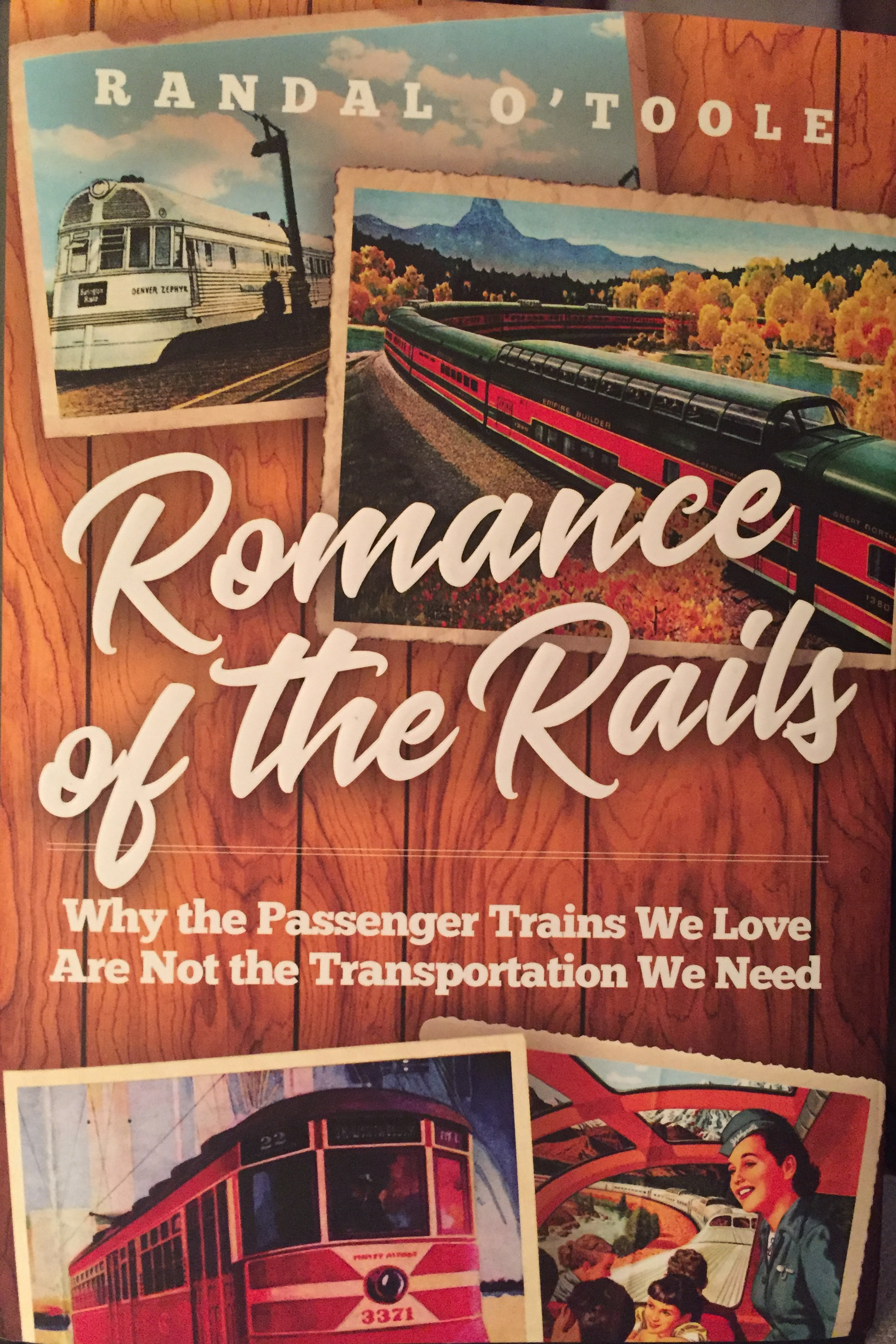
At the very end of his recent book Romance of the Rails, Randal O’Toole regretfully (he really, genuinely is a train fan) answers the question three ways … none of which bolster the hopes that the United States will go back to great passenger railway service:

First, when we had great trains, they were used mainly by the elite, and that remains true of great trains in other countries today. Before 1910, it is likely that a majority of Americans had never traveled more than 50 miles from home, and most had never been on a train, while many others had taken only one or two train trips in their life. As James Hill observed, “the so-called ‘travelling public’ forms in reality but a small, and the more fortunate class of the community.” If he was prejudiced against passenger trains, as some claim, it may have been for altruistic reasons, as the people who relied on freight trains “direct and indirect, include all. Hence justice requires that railway systems … should be cautious not to favor passenger traffic at the necessary expense of freight payers.” It is neither sensible nor fair fo the government to subsidize transportation catering mainly to the wealthy.

Second, new transportation technologies have replaced trains and streetcars. Planes are faster and less expensive for long distances; cars and buses are more convenient and less expensive for short distances; and there is no midrange distance at which passenger rail has an advantage over both cars and planes.

Third, and just as important, other new technologies, including the moving assembly line, telecommunications and the electrical grid, have reshaped our cities so the urban patterns that once made rail convenient to large numbers (though never a majority) of people have been replaced by patterns in which rail makes no sense for passenger travel.

Although we might want great trains in our fantasy of what the world should be like, the reality is we don’t need trains. Most Americans don’t ride the trains we have, nor would they ride them even if they met some arbitrary devinition of “great.” We love passenger trains, and we will remember them in museums and tourist lines. But if the government stays involved in transportation at all, it should be to prepare for the next revolution in transportation, not to try to reverse the previous one.

July 3, 2019

Summer Stupidity: BOSTON (City Review!)

Filed under: Architecture, Food, Humour, USA — Tags: , , — Nicholas @ 04:00

Overly Sarcastic Productions
Published on 2 Jul 2019

The summer stupidity continues with another city review! I hope you like seafood, tea shops, woodlands, college and twisty streets because boston has all this and… not much else!

PATREON: https://www.Patreon.com/OSP

June 26, 2019

Summer Stupidity: LONDON (City Review!)

Filed under: Architecture, Britain, Food, History, Humour — Tags: , , , , — Nicholas @ 04:00

Overly Sarcastic Productions
Published on 25 Jun 2019

For more summer fun, we’re heading to London! Let us know what other fun side-content you’d like to see. We’ll see you with more long-form content on Friday!

PATREON: https://www.Patreon.com/OSP

OUR WEBSITE: https://www.OverlySarcasticProduction…
Find us on Twitter https://www.Twitter.com/OSPYouTube
Find us on Reddit https://www.Reddit.com/r/OSP/

June 19, 2019

Summer Stupidity: NEW YORK (City Review!)

Filed under: Food, Humour, USA — Tags: , , , — Nicholas @ 04:00

Overly Sarcastic Productions
Published on 18 Jun 2019

Welcome to summer break! We’re beta-testing a new kind of video to punctuate our REAL weekly Friday content on lazy summer Tuesdays. Let us know if this brand of fast-talking stupidity is something you’d potentially like to see more of! As always, regular content returns Friday.

PATREON: http://www.Patreon.com/OSP

« Newer PostsOlder Posts »

Powered by WordPress