Quotulatiousness

June 27, 2012

Questions on the Elliot Lake rescue efforts

Filed under: Bureaucracy, Cancon, Media — Tags: , , , — Nicholas @ 08:22

Whether it was just a badly phrased moment in a press conference or not, Toronto’s Heavy Urban Search and Rescue team has not done itself any public relations favours in the aftermath to the partial collapse of the Algo Centre Mall in Elliot Lake:

The story of the collapsed mall in Elliot Lake, where the rescue mission is back on after being suspended on Monday because officials deemed the building too “unsafe,” has so far deviated from romantic tales of heroism and rescue, spiralling instead into talk of delays, strict mandates and “limited resources.”

A spokesman for Toronto’s Heavy Urban Search and Rescue team, Bill Neadles, said on Tuesday the group was still in its “infancy” — that aside from winning some industry competitions and running mock rescues, HUSAR, as it is known, had only participated in one operation: a gas explosion in 2003. He said when he initially told residents on Monday the team had “reached the end of its mandate” he did not mean they were abandoning the operation, he “just didn’t want to lead anybody to believe I was going to come back with a silver claw and walk on water.”

[. . .]

In Elliot Lake, no one has been spirited away alive, at least not yet. One person is thought dead and a dozen are feared missing. At least one is believed to have made a noise amid the rubble on Monday morning.

“One of the things that gives rescue a sort of romance is the idea that you go in and you get the job done … and that’s one of the reasons this Northern Ontario mall story is so 21st century,” said Bob Thompson, a pop culture expert at New York’s Syracuse University. “Here we’ve got this potentially romantic rescue story, and what do we see? Good ol’ fashioned bureaucracy.”

When most Canadians think of rescue, they do not think of government inner-workings: a Ministry of Labour structural engineer suspending a search; provincial officials having to explicitly give the Toronto team the authority to go back in; a premier intervening to make that happen.

“If you had put 100 miners in there, they would have been out by Saturday,” said Greg Dillavough, a retired miner who once worked in mine rescue in the Northwest Territories and Ontario. “You don’t walk away from a site when someone’s alive.”

June 16, 2012

Explosion 1812: “one of the biggest explosions that had ever been witnessed in North America”

Filed under: Cancon, History, Media, Military, USA — Tags: , , , — Nicholas @ 10:22

I may have to make some time to watch TV tomorrow:

This month’s 200th anniversary of the start of the War of 1812 will be marked with a colossal bang: the television premiere of Explosion 1812, a new documentary that argues the intentional detonation of Upper Canada’s main ammunition supply at present-day Toronto in April 1813 — described as “one of the biggest explosions that had ever been witnessed in North America” — is a greatly underappreciated moment in history that was key to thwarting the U.S. conquest of Canada.

The two-hour, Canadian-made film — to be aired by History Television on June 17, the eve of the bicentennial of the formal U.S. declaration of war on June 18, 1812 — recounts how retreating British-Canadian troops at Fort York blew up the colony’s “grand magazine” along the Lake Ontario shore as American forces closed in on Upper Canada’s capital on April 27, 1813.

[. . .]

U.S. soldiers outraged at what they considered an act of extreme treachery — even a war crime because of their comrades’ fatal proximity to the explosion — went on a vengeful rampage in the captured capital, terrorizing the civilian population and pillaging residents’ property.Ê

Those actions, in turn, prompted a similar assault on Washington, D.C., in 1814, when the U.S. capital was stormed by British and Canadian troops who set fire to the White House.

Among the U.S. casualties at York was the famed commander of the invasion force, Gen. Zebulon Pike, an early explorer of the American West whose death — his chest crushed by falling rock from the blasted armoury — would be exploited to rally patriotic sentiment in the U.S. for the duration of the war.

June 15, 2012

The horrific environmental scourge of the plastic bag

Filed under: Cancon, Economics, Environment, Government — Tags: , , — Nicholas @ 12:40

Terence Corcoran on Toronto City Council’s most recent brainfart — banning plastic bags — and the actual environmental impact of same:

Meantime, most Canadians, through the media, would be relying on green activists and demagogic politicians who have been promoting plastic bags as a local and national environmental scourge for more than a decade. There’s not enough space here to review the mindset of politicians, including the inhabitants of Toronto city council, who last week voted 27-17 to ban plastic bags by 2013. Most of the bylaw’s backers would be getting their information from professionals, including Dr. Rick Smith, head of Environmental Defense.

[. . .]

Canadians who answer polls should know that Mr. Smith holds a PhD in green bull. He said Canadians know at a “gut level” that plastic bags are a “not terribly complicated environmental issue.” Well, here are three complications:

Litter The last city of Toronto audit of litter across the city, in 2006, found six plastic bags out of 4,341 items. That’s 0.14% by item. By weight, the percentage would be less.

Waste The 450 million plastic bags Mr. Smith mentions is a 2008 number. The city says the current number of bags is now estimated at about 215 million (the science of calculating this is something else). But even the 450 million-bag total, at about six grams per bag, works out to 2,600 tonnes. As a percentage of the city’s estimated 800,000 tonnes of waste, plastic bags would account for 0.3%. If all plastic bags were eliminated — an impossibility given their necessity as garbage-bin liners and other uses — Toronto’s waste stream would be essentially unchanged. Not a penny will be saved, and costs would likely go up under complications brought on by the ban.

Environment Numerous comprehensive studies by people who are as green or greener than Mr. Smith suggest plastic bags are better than the alternatives — whether paper or cloth. Plastic is less polluting and toxic than paper and cotton, according to a 2011 U.K. Environment Agency report. As for global warming, a cloth bag would have to be reused 327 times, and a paper bag nine times, to match the low warming impact of a high-density polyethylene bag that’s reused as a garbage-bin liner.

June 8, 2012

Toronto City Council’s latest collective brain-fart

Filed under: Cancon, Environment, Government — Tags: , , , , — Nicholas @ 10:01

Terence Corcoran is too kind in his discussion of Toronto’s new ban on plastic bags:

In star-struck liberal green Los Angeles, it took a full-court press by environmental groups, major propaganda efforts, endorsement by the roll-over editorialists at the Los Angeles Times, and deployment of Hollywood stars, such as Julia Louis-Dreyfus and Peter Fonda, to work up the political steam needed to prompt L.A.’s city council to vote last month to ban plastic bags.

In starless Toronto, all it took was a bunch of dumb city councillors who suddenly decided — seemingly out of the blue — to stage a surprise vote.

“Ban the bags,” somebody said. “Good idea. Let’s vote!” Passed: 27 to 17.

No study, no research, no public review, no thought, no concept and no brains. What’s the environmental and fiscal impact of the ban? Nobody knows, although many people say the cost to both the city and the environment will be greater than the cost of using plastic bags.

As I think Adrian MacNair mentioned, one of the most likely outcomes is that people will end up buying less. It’s those little impulse buys that will be curtailed the most, as many folks — especially tourists — won’t have realized they need to bring their own carry bags.

June 2, 2012

The end of a weird week in Canadian journalism

Filed under: Cancon, Media — Tags: , , , , , , — Nicholas @ 10:26

David Akin on all the unusual happenings over the past week:

I suspect Alex felt that way because he and his staff had to deal with a) the ongoing battle between students and Premier Jean Charest b) a grisly murder that forced police in Montreal to issue an international warrant for kitten-killing gay porn star Luka Magnotta c) a freak rain storm that put 70 mm of water on the ground in 30 minutes pretty much flooding most of downtown Montreal for an afternoon. But enough of that, let’s get to God using a bear to deliver God’s own brand of justice [. . .]

“The corpse of a man eaten by a B.C. bear was that of a convicted killer, officials have confirmed.”

[. . .]

“46 mm of rain in half an hour floods Montreal.”

[. . .]

On Friday, heavy rain would contribute to flooding which would end up flooding and shutting down Toronto’s Union Station on Friday causing commuter chaos

[. . .]

The Montreal flash floods occurred as Quebec Premier Jean Charest was trying to broker a deal with post-secondary students who have been “on strike” for more than 3 months because they don’t want to pay an extra $350 or so a year in tuition — over five years. Charest has been over-patient. The students have been, as they say on St. Urbain Street, “stiff-necked”. So the two sides met and then talks broke down.

All that, plus the kitten-killing, body dismembering fugitive porn star…

May 29, 2012

A review of the War of 1812 (non-Canadian-centric version)

Filed under: Britain, Cancon, History, Military, USA — Tags: , , , , — Nicholas @ 00:08

The DiploMad appears to be blogging again, and for proof, here’s a neat little capsule of the War of 1812 without the Canadian aspect being treated as the most significant campaigning area of the war:

The war was brought about by British arrogance and American stupidity. The British were not reconciled to an independent United States, and could not take the place and its bombastic pronouncements about liberty seriously. They basically ignored the USA’s assertion of being a sovereign state, and proceeded to treat American ships and seaman as some sort of Brits gone rogue. The USA, for its part, could not understand that the British were in what they saw as a life-and-death struggle with Napoleon Bonaparte. We did not respect that. We reckoned we could trade and make deals with France, such as the spectacular Louisiana Purchase which filled Napoleon’s coffers and served his aim of helping create a huge potential rival to Britain, without raising British concerns or provoking them into action.

[. . .]

The British, despite the war in Europe managed to put together a more than credible military and naval force against the distant United States. The Americans, in turn, showed a talent that would serve us well in future wars by getting our act together at the last minute and putting on a damn good defense of the country. The US army, however, remained plainly horrendous throughout the war with its corrupt and politicized officer corps, and its half-baked, ill-planned and even worse executed invasion of Canada. The US also set the precedent of burning York — today’s Toronto — which led to the British burning of the nascent US capital which the army failed to defend. The army partially redeemed itself in the Battle of New Orleans, under the otherwise reprehensible Andrew Jackson (Note: Why is he on our $20 bill?)

The US navy, however, proved completely different, and did an amazing job of fighting off the much larger British navy, wreaking havoc on it, carrying the war into British waters, and even eliciting a warning from the Admiralty to the Royal Navy to avoid one-on-one combat with US ships. The US navy also fought a superb campaign on the Great Lakes which resulted in the British fleet withdrawing from those waters.

Minor quibble: the Royal Navy withdrew from Lake Erie, not from all the Great Lakes. Lake Ontario was still the scene of a major fleet-building contest with vessels of up to 130 guns under construction or entering service when the war ended.

May 18, 2012

Reputations take years to create, but can be destroyed overnight as Toronto Police have discovered

Filed under: Cancon, Law, Liberty, Media — Tags: , , , , , , — Nicholas @ 11:09

Chris Selley on how the Toronto G20 protest and the still amazingly bad police response has contributed to the decline in public support for all police organizations:

On July 6, 2010, 10 days after the disastrous G20 summit, Toronto’s City Council voted to “commend the outstanding work of [police] chief Bill Blair, the Toronto Police Service and the police officers working during the G20 Summit in Toronto,” and thank them for a “job well done.” The vote was 36-0. The yeas included then-Mayor David Miller and many other left-wing luminaries. At this point in the G20 post-mortem, this seems a bit hard to believe.

We know much more now about how poorly the security operation was planned and executed: This week’s report from Gerry McNeilly, director of Ontario’s Office of the Independent Police Review, lays it out in painstaking detail. But what we knew 10 days later was bad enough: Thugs had wreaked havoc at will; 400 borderline-hypothermic people were held for hours in the pouring rain for no good reason; police cars were burned; journalists were roughed up and arrested; untold numbers of people were randomly and improperly searched and arrested.

Yet no one on a decidedly left-leaning Council saw fit to vote against the absurd “job well done” commendation (though then-councillor Rob Ford, now Mayor, did complain that the police had been too nice). One has to wonder how much longer politicians’ traditional lockstep support for police is going to last last.

[. . .]

People still call the police in hope of honest and brave assistance, and they almost always get it. But in late March, Angus-Reid asked Canadians how much “confidence [they] have in the internal operations and leadership” of their police forces. A minority of 38% had “complete” or “a lot of” confidence in the RCMP. The number for municipal police forces, taken together, was 39%. That’s about half of what it was in the mid-1990s. The respective numbers in B.C. are below 30%.

If that’s not a credibility crisis, I don’t know what is. Politicians are generally not in the habit of blindly supporting entities with those kinds of approval ratings, and police ought to be worried about that for all kinds of reasons. One of the obvious keys to fixing the problem is, simply, accountability. And it is nowhere to be found — not from the officers who witnessed fellow officers’ misdeeds, not from the commanders, not from Chief Blair, and not from the federal politicians who foisted this debacle on an unprepared and unsuitable city.

At the bottom of this post you can find a litany of complaints about the police handling of the Toronto G20 protests.

May 16, 2012

Toronto Police “violated civil rights, detained people illegally and used excessive force”

Filed under: Cancon, Liberty, Media — Tags: , , , , — Nicholas @ 15:45

Toronto was not a good place to be on a certain weekend in 2010, as the police made many mistakes in trying to control crowds around the G20 gathering. After being too easygoing on Saturday, they flipped completely on Sunday and were on a rampage against protestors, bystanders, and anyone who didn’t obey mindlessly and without hesitation. It’s taken nearly two full years, but we finally have formal acknowledgement from the police watchdog that things were out of control. Colin Perkel writes in the Globe and Mail:

Police violated civil rights, detained people illegally and used excessive force during the G20 summit two years ago, a new report concludes.

The report by Ontario’s independent police watchdog also blasts the temporary detention centre that Toronto police set up for its poor planning, design and operation that saw people detained illegally.

The Office of the Independent Police Review Director found police breached several constitutional rights during the tumultuous event, in which more than 1,100 people were arrested, most to be released without charge.

“Some police officers ignored basic rights citizens have under the Charter and overstepped their authority when they stopped and searched people arbitrarily and without legal justification,” the report states.

[. . .]

“Numerous police officers used excessive force when arresting individuals and seemed to send a message that violence would be met with violence,” the report states.

“The reaction created a cycle of escalating responses from both sides.”

The report takes aim at police tactics at the provincial legislature, which had been set up in advance as a protest zone. It says the force used for crowd control and in making arrests was “in some cases excessive.”

“It is fair to say the level of force used in controlling the crowds and making arrests at Queen’s Park was higher than anything the general public had witnessed before in Toronto.”

I had lots of criticisms of the whole G20-in-Toronto farce, starting even before the event itself. We had the on-again, off-again stupidity of “secret laws“. Then, after the protests actually got underway, the police were refusing to release information about arrests to the media. Followed shortly by the smell of burning police cars. At that point, the police appeared to take a more serious (but still measured) approach, then they stopped pretending to be obeying the law they were supposed to uphold. Even well away from the scene of the protests, police officers were demanding the submission to authority from anyone who happened to be in their way.

And then we started to get a better view of what had actually happened. Having failed in their primary quest to keep the peace, some (many) then took out their frustrations on the citizenry. The courts also failed to exercise their traditional role and threw in with the rogue police actions. And of course we can’t forget “Officer Bubbles“.

March 1, 2012

A “Confederation theme park”? The jokes write themselves

Filed under: Cancon, Government, History, Humour — Tags: , , , , , — Nicholas @ 10:59

In the National Post, Lorne Gunter has a bit of fun with the notion of what kind of attractions to put in a theme park celebrating Confederation:

“It’s easy to mock Preston Manning’s idea for a Confederation Theme Park … for starters, it’s somewhat odd to see the pro-small-government, West-wants-in Reform Party founder to be proposing a large government expenditure on a historically slanted amusement park to be located, of all places, in Ottawa.”

So said the Ottawa Citizen’s Mark Sutcliffe — two years ago!

It’s still easy to mock.

Although ultimately endorsing Mr. Manning’s idea (in his own altered form), Sutcliffe called the project “Epcot Centre on the Ottawa River,” a dig at the multinational exposition at Disney World in Orlando, Fla. (The one lasting impression I have of Epcot is that every pavilion was tedious and getting from one to the other required a lot of uncomfortable, fruitless walking. Hey, maybe that would be a good blueprint for a celebration of Confederation after all.)

Sutcliffe had his own satirical ideas of what rides a Confederation Park might offer. There could be “Universal (Health Care) Studios” and the “Sovereignty Movement Roller Coaster” that soared to the same dizzying highs and plunged to the same gut-turning lows as Quebec nationalism has experienced over the past 40 years. Patrons could also “board the Avro Arrow as it sits on the runway and never takes off!”

[. . .]

Imagine the joy on tots faces when Mom and Dad tell them that instead of going to central Florida for Pirates of the Caribbean, It’s a Small World (gad, I still have that cloying song stuck in my head), Space Mountain, Splash Mountain and Typhoon Lagoon, they’ll be heading to Ottawa in February to watch an animatronic debate between robot John A. Macdonald and robot Joseph Howe over the British North America Act’s division of federal and provincial powers at the authentic recreation of Charlottetown’s Founders’ Hall at the PEI display.

Then there’ll be a ride on the Drop of Western Alienation Doom; the Endless Trip to the Sovereignty-Association Dentist (sponsored by “money and the ethnic vote”); the Constitutional Reform Merry-go-round (also dubbed the Canada Round); topped off by the Centre-of-the-Universe Centrifuge where riders strap themselves into cars resembling Canada’s regions and the entire contraption revolves around Toronto.

February 7, 2012

Terrorist training camp just north of Toronto!

Filed under: Cancon, Media, Politics — Tags: , , , , — Nicholas @ 10:58

According to former Toronto Star editor and Ryerson professor John Miller, we’ll be in the grip of terror later in February:

Here is an extended quote from his rant to show that I’m not taking this out of context one bit:

    “Makes you wonder when was the last time a group of ideological warriors went north to train in the backwoods and plot to storm Parliament, blow up the CBC, seize the airwaves and spread terror across the land. Oh yeah, the Toronto 18 did that. Didn’t police arrest the lot of them and call them the gravest threat to our democracy?

    “I think a weekend with Ezra and friends could be something just like that.

    “The only thing that sets them apart from the Muslim extremists is that Sun Media will be charging you admission.”

Sorry, we’re not planning to storm Parliament. Maybe we’ll talk about writing some letters to our MPs. We’re not planning to blow up the CBC. We just want to privatize it. And we don’t believe in spreading terror across the land. In fact, we support our Canadian troops in the war against terror, and don’t want that little terrorist Omar Khadr let back in from Guantanamo Bay.

Miller ended by saying “the only thing” that makes us different from those terrorists is that we charge admission.

What a disgusting man.

Why did he liken me, my fellow Sun personalities and Sun readers to terrorists? For one reason only: We’re conservative, and we refuse to go along with him and the rest of the consensus media.

The fact that someone as vile as Miller has held senior posts at journalism schools and the largest newspaper in Canada is not surprising. Because both the Star and every j-school in the country believe in a uniform, official left-wing view.

They believe in every type of diversity — racial, sexual, ethnic — except for intellectual diversity.

January 12, 2012

Toronto Hydro takes hostages, threatens eternal darkness if demands not met

Filed under: Cancon, Politics — Tags: , , , — Nicholas @ 12:05

Ah, it must be the time of year for Toronto Hydro to lose its collective shit and start the crazy talk:

Last week, the Ontario Energy Board denied Toronto Hydro’s request for a rate hike for homes within the city limits. The hike, which would have meant a monthly increase of five dollars for a typical household, was necessary, Toronto Hydro said, to renew the city’s electrical transmission grid. Failure to do so, they warned, could result in more, and longer, blackouts.

Not so, the Energy Board ruled. They said that Toronto Hydro had not demonstrated that Toronto’s power grid needed the kind of urgent repairs that were being proposed, and also chided Toronto Hydro for failing to make necessary productivity gains, implying that the requested money was not so much about urgent repairs as needing more cash. Toronto Hydro’s response has been swift: 700 contractors have been let go, and 20% of its workforce is being told that they’re next — that’s another 350 or so jobs. Oh, and without the cash, the city is probably going to go dark.

Do these guys know how to play hardball or what?

January 6, 2012

Weird local story gets a bit weirder

Filed under: Cancon, Randomness — Tags: , , — Nicholas @ 12:33

In Pickering, about 20 kilometres west of here, the regional police found that an abandoned home had been modified to add a “confinement room”. It’s in a fairly secluded area, so there were no immediate leads to who had made the modifications or who (if anyone) had been confined in it. Today, the National Post reported that the “dungeon house” has burned to the ground:

An abandoned Pickering farmhouse that was found to have padlocked dungeon in its basement burned to the ground early Friday morning, adding an unexpected twist to an already bizarre police investigation.

A fire broke out at 140 Concession Rd. 7 outside of Pickering shortly after midnight and soon consumed the desolate building where police had been carrying out an investigation.

[. . .]

Before the blaze, police were trying to determine who built the “confinement-style” room with padlocks affixed to the very thick door, discovered in late November when crews went in to assess the building that had been scheduled for demolition.

Police said the house was last occupied in 2006, but the room was new — believed to have been built within the last year or two.

“I can’t get into what was in the room, but the way it was constructed — the time and effort put into it and the materials used — clearly indicated it was a room designed to hold somebody in,” Durham Regional Police Detective Darren Short said last month.

December 15, 2011

Grim, crime-wracked, post-apocalyptic Toronto ranks … 52nd most dangerous in Canada

Filed under: Cancon, Law, Liberty — Tags: , , , , — Nicholas @ 09:29

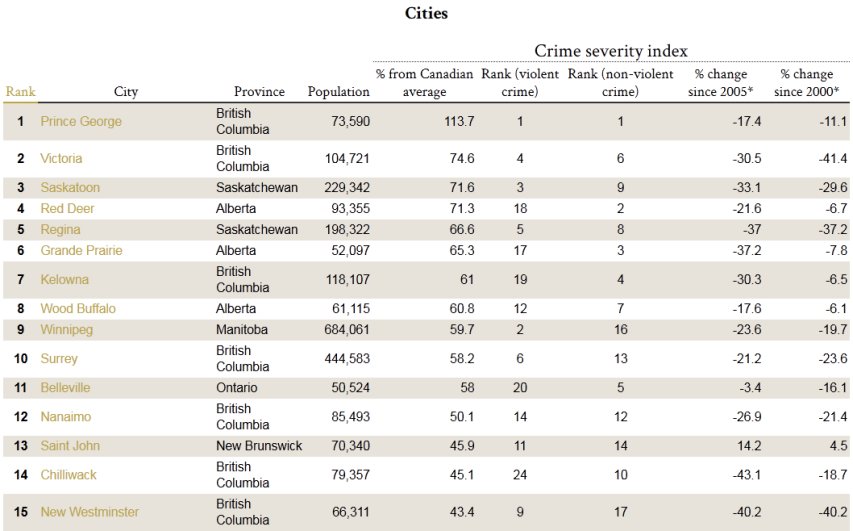
Everyone in Canada knows that Toronto is a cess-pit of crime where the oppressed citizenry huddle in fear, while idyllic Victoria is a benign, peaceful enclave of happiness. But what we know just ain’t so:

Toronto ranks 52nd among cities and towns in the country for the label “most dangerous” according to Maclean’s. Victoria, BC? Far from being a peaceful place, ranks second in the country after Prince George, BC. In fact, BC has four of the top ten dangerous cities, while Ontario’s most dangerous place, Belleville, clocks in at number 11.

November 9, 2011

This is not news: Toronto is Canada’s least-liked city

Filed under: Cancon, Media — Tags: , — Nicholas @ 09:07

In fact, a strong case could be made that hating Toronto is one of the key factors that binds the rest of Canada together:

Ontario’s capital not only had the lowest rate of positive responses, it also had the highest rate of “very negative” responses. “Many Canadians have a hate-on for Toronto,” said Myer Siemiatycki, a Ryerson University politics professor. “Toronto is regarded as totally self-indulgent, so there’s a sort of ‘Who do they think they are believing they’re the centre of the country and the universe?’” Jim Milway, executive director of the Martin Prosperity Institute at the Rotman School of Management, said the poorer perception of Toronto — 19% of respondents gave negative responses — is due to animosity more than anything else. “It’s not necessarily that people like their city more than Toronto,” he said. “It’s that people just don’t like Toronto, period.” Prof. McGrane, of the University of Saskatchewan, said the “grudge” is rooted in historic grievances, particularly harboured by westerners who have long felt “left out.” “It’s not that we hate (Torontonians), but we’re a bit suspicious about them and their motives,” he said.

I can’t claim to have been everywhere in the country, but from Nova Scotia to British Columbia, hatred of Toronto and distaste for Torontonians is almost universal among Canadians.

October 29, 2011

Canadian Air and Space Museum to be evicted in favour of ice rinks

Filed under: Cancon, History, Space, Technology, WW2 — Tags: , , — Nicholas @ 12:20

A sad tale at the CBC website about the impending eviction of the museum and other tenants of the historic (but not historically designated) DeHavilland plant in Downsview:

A building that played a major role in the production of aircraft for the Allies in their fight against Hitler during the Second World War is facing the wrecking ball.

It’s located in Toronto’s Downsview Park and is described in federal heritage documents simply as “CFB Plant .1, Building .1.”

Just one month after the federal government celebrated Canada’s aviation history by reintroducing the name, “Royal Canadian Air Force,” it was sending an eviction notice to a building where RCAF planes were assembled.

Built in 1929, the plant housed the operations of the de Havilland Aircraft company which provided 17 per cent of Canada’s planes during the war years.

[. . .]

David Soknacki, the chairman of Parc Downsview Park, says the building at 65 Carl Hall Road is not currently classified as a heritage building.

Up until Oct. 26., the Canada’s Historic Places website listed the facility as “a recognized Federal Heritage Building because of its historical associations and its architectural and environmental value.”

Then the listing disappeared.

H/T to Michael O’Connor Clarke for the link.

« Newer PostsOlder Posts »

Powered by WordPress


