
For a number of years I have been fighting a lonely one-man (or should I say one-person?) battle against self-esteem — not my own, of course, because I have just the right amount, but as the master key to human happiness.
Of the many possible human qualities, self-esteem, far from being desirable, is one of the most odious. It is much more closely related to conceit and self-importance than it is to self-respect or even self-confidence. People who talk of self-esteem do so as if it were an inalienable human right rather than something to be earned. In other words, self-esteem is like a fair trial: It doesn’t matter what you are like or what you have done, you have a right to it, at all times and in all places.
Of course, people who speak of lack of self-esteem know in their hearts that they are talking bilge. Sometimes patients would come to me and tell me that they had low self-esteem and I would tell them that at least they had one thing right. Instead of growing angry, as perhaps you might have expected, they would laugh, as if they had been caught out in an outrageous prank — which in a sense they had. As old-fashioned burglars in England used to say when caught red-handed by a policeman, “It’s a fair cop, guv.”
“Suppose,” I would ask, “someone told you that he had allowed his children to starve to death because he preferred taking crack to feeding them and that he had stolen all his aged mother’s savings, but that at least he had no problems with his self-esteem, what would you say?”
In fact, this was only just a rhetorical question because I had met many such persons, bursting with self-esteem and quite without any discernible virtues. Indeed, one of the sources of their bad character may have been their self-esteem, insofar as nothing could dent it, not even the hatred or contempt of everyone around them. If I were younger and more energetic, I would found a Society for the Prevention and Suppression of Self-Esteem.
Theodore Dalrymple, “Lose Yourself”, Taki’s Magazine, 2018-11-10.
December 1, 2018
QotD: Toxic self-esteem
November 16, 2018
QotD: Defining hate speech
Then, of course, there is the question of where hate-speech ends and legitimate commentary starts. It is generally easy to recognise the vilest abuse that is intended only to inflame and not to argue, just as it is easy to recognise pure pornography (I use the word ‘pure’ in its chemical, not its moral sense, of course). But often matters are much more complex than this.
For example, I recently saw the following statistic in a serious article on the internet: that Nigerian immigrants to Switzerland are seven times as likely to be convicted for a crime as Swiss citizens. Surely no one who wrote such a thing could think that it was calculated to create warm feelings in the hearts of the Swiss towards Nigerian immigrants, except those very few of Fabian mentality, who see in serial killers a cry for help (from the killers, of course, not from their victims).
The statistic – let us assume – is true. But then let us ask whether it has been corrected for the different sex and age structures of the two populations, that of the Nigerian immigrants and that of the Swiss population.
If it has not (and the article does not say), it is easily conceivable that a better, or at least different, statistic would be that Nigerian immigrants are only twice or three times as likely to be convicted for a crime as Swiss citizens. And if this were in fact the case, would the man who published the article be guilty of hate-speech, or merely of intellectual error? Is the test of hate-speech to be whether something does in fact bring a group into hatred, ridicule and contempt, or whether it is intended to do so?
It is easy to multiply examples. In this country, young Moslem men far out-fill their quota in prison, while young Hindu and Sikh far underperform where criminal conviction is concerned. Is this an interesting and important sociological fact, or an incitement to hatred, ridicule and contempt, or perhaps both?
A further problem is that of judging how sensitive people actually are or should be to perceived slights and insults. Just as the expression of hatred can be self-reinforcing, so can the sensitivity to slight and injury. The more you are protected from it, the more of it you perceive, until you end up being a psychological egg-shell. The demand for protection becomes self-reinforcing, until a state is reached in which nobody says what he means, and everybody infers what is not meant. Temperatures, or tempers, are raised, not lowered. The disgracefully pusillanimous (and incompetent) Macpherson report into the killing of Stephen Lawrence demonstrated the risks we run: it suggested that a racial incident should be defined as an incident which any witness to it believed to be racial, without there being any need for objective evidence that it was. Where a British judge can be so pusillanimously unattached to the rule of law, we can be sure that one day hate-speech will be defined as any speech that anyone finds hateful.
Theodore Dalrymple, “Hating the Truth”, Salisbury Review, 2011-06.
November 6, 2018
QotD: Architectural modernism
In this scholarly, learned but also enjoyably polemical book, Professor Curl recounts both the history and devastating effects of architectural modernism. In no field of human endeavour has the idea that history imposes a way to create been more destructive, or more importantly destructive: for while we can take avoiding action against bad art or literature, we cannot avoid the scouring of our eyes by bad architecture. It is imposed on us willy-nilly and we are impotent in the face of it. Modern capitalism, it has been said, progresses by creative destruction; modern architecture imposes itself by destructive creation.
As Professor Curl makes clear, the holy trinity of architectural modernism — Gropius, Mies and Corbusier — were human beings so flawed that between them they were an encyclopaedia of human vice. They spoke of morality and behaved like whores; they talked of the masses and were utter egotists; they claimed to be principled and were without scruple, either moral, intellectual, aesthetic or financial. Their two undoubted talents were those of self-promotion and survival, combined with an overweening thirst for power.
Their intellectual dishonesty was startling and would have been laughable had it not been more destructive than the Luftwaffe. When they claimed to have no style because their designs were imposed on them by history, technology, social necessity, functionality, economy etc., and like Luther proclaimed they could do no other (which soon became the demand that others could do no other also), they remind me of the logical positivists who claimed to have no metaphysic. But if no given style or metaphysic is beyond the choice of he who has it, to possess a style or a metaphysic is inescapable in the activity of artistic creation or thought itself. And even my handwriting has a style, albeit a bad one.
In like fashion, as this book makes beautifully clear, the modernists were adept at claiming both that their architecture was a logical development to and aesthetic successor of classical Greek architecture and utterly new and unprecedented. The latter, of course, was nearer the mark: they created buildings that, not only in theory but in actual practice, were incompatible with all that had gone before, and intentionally so. Any single one of their buildings could, and often did, lay waste a townscape, with devastating consequences. What had previously been a source of pride for inhabitants became a source of impotent despair. Corbusier’s books are littered with references to the Parthenon and other great monuments of architectural genius: but how anybody can see anything in common between the Parthenon and the Unité d’habitation (an appellation that surely by itself ought to tell us everything we need to know about Corbusier), other than that both are the product of human labour, defeats me.
Theodore Dalrymple, “Architectural Dystopia: A Book Review”, New English Review, 2018-10-04.
October 27, 2018
The architecture of modern Paris
In the latest issue of City Journal, Theodore Dalrymple laments the degraded state of Parisian architecture, particularly the post-1945 monstrosities visible from the Boulevard Périphérique, celebrated in a recent New York Times article by David McAninch:
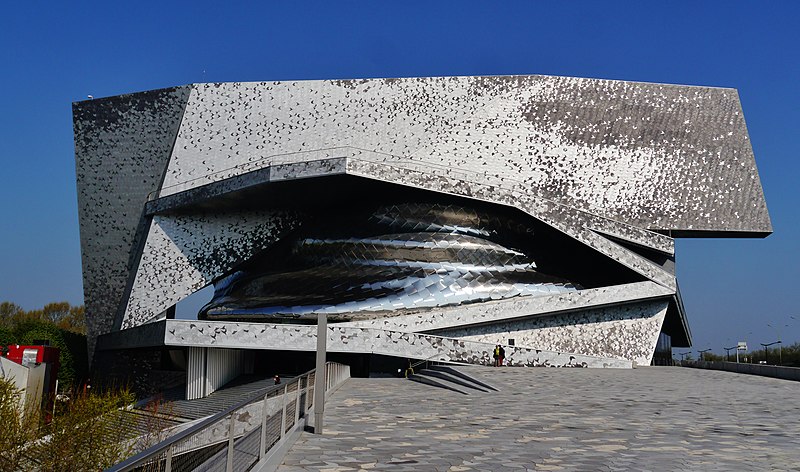
Philharmonie at the Parc de la Villette, Paris.
Photo by Zairon via Wikimedia Commons.
What is startling about McAninch’s description of his tour is its non-mention of what was perfectly obvious to my visitor on first glance, and which never fails to appall me each time I take the B.P., as regrettably often as I do: namely, that practically everywhere the eye looks beyond the confines of central Paris, it is greeted by a modernist mess of gargantuan proportions, and that every occasional building that is not a total eyesore was built before 1945. In other words, there has been a total and utter collapse of aesthetic ability, judgement, and appreciation in France, a country with one of the world’s greatest architectural heritages, extending back many centuries.
McAninch acts as a kind of handmaiden or praise-singer to this collapse, perhaps from fear of making an unequivocal judgment that might cause him to be labelled conservative, backward-looking, or naive. His article commences with a picture of the new philharmonic hall, built at a pharaonic cost, which resembles nothing so much as a vulgar Brobdingnagian silver lamé dress crumpled on the floor after a night of debauchery, as clear an example of modern architectural psychopathy as I know.
The article is full of equivocations, such as “I gazed in awe at some of the most ugly-beautiful Brutalist buildings I’d ever seen” and “I stared open-mouthed for a long while at the modular-looking Neo-Brutalist structure housing the Centre National de la Danse. Designed as a municipal building in 1972 by Jacques Kalisz, the gray concrete behemoth somehow radiated childlike exuberance and dystopian menace at the same time.”
The brutalist buildings at which the author stared in awe (horror would have been a more appropriate reaction) are not ugly-beautiful; they are just ugly, without any possible aesthetic qualification, and grossly dysfunctional, to boot. And anyone who can see childlike exuberance in the building by Jacque Kalisz is capable of seeing the milk of human kindness in a Nuremberg Rally.
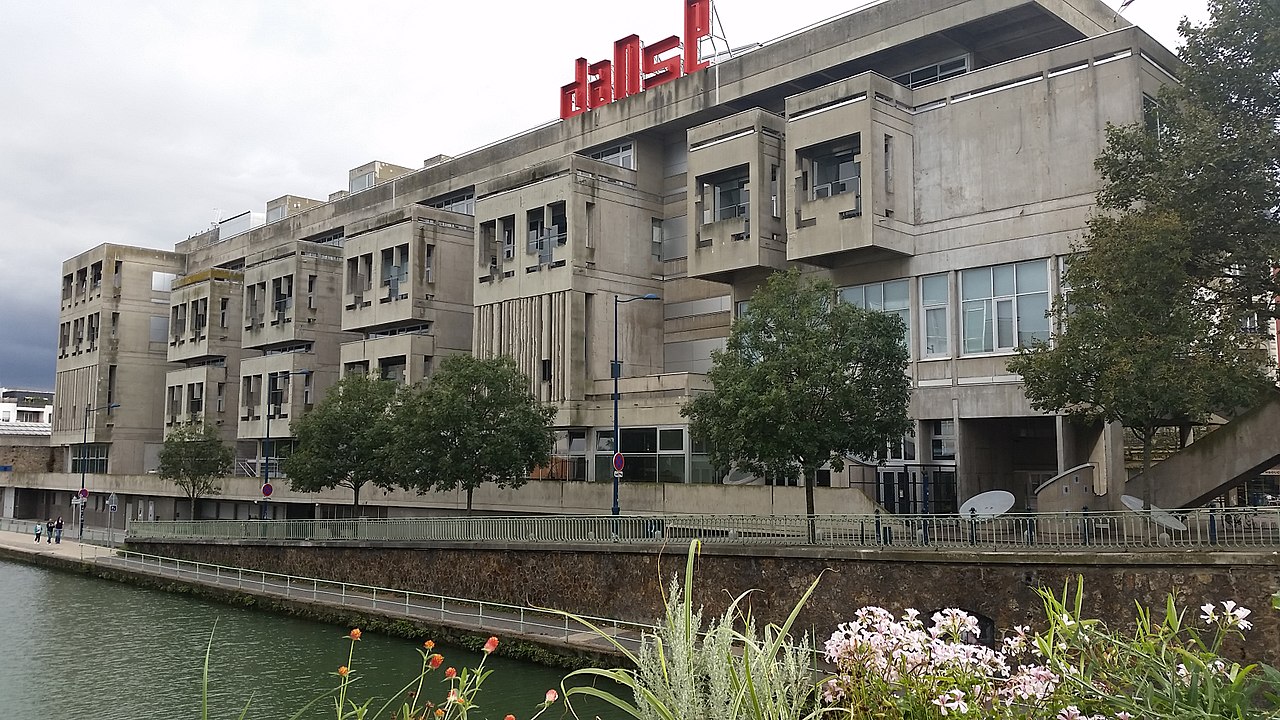
The Centre national de la danse in Pantin (Seine-Saint-Denis), designed by Jacques Kalisz.
Photo by Cinerama14 via Wikimedia Commons.
October 16, 2018
Modernism and the “so-called international style … is the blight of Germany (and of almost everywhere else where it has been tried)”
Theodore Dalrymple on the awful concrete-and-glass monoliths of modern architecture, especially those designs by Le Corbusier, Mies van der Rohe, and Gropius:
The modernism and so-called international style that is the blight of Germany (and of almost everywhere else where it has been tried, which is almost everywhere in the world), and which the author of the article appears to think is apolitical, was hardly without its intellectual, ideological, and political foundations.
And what hideous intellectual, ideological, and political foundations they were! The great figures of modernism — great, that is, in the scope and degree of their baleful influence, not great in artistic or aesthetic merit — were from the first totalitarian in spirit. They were toadies to the rich and bullies to the poor; they were communists and fascists (not in the merely metaphorical sense, either), and by a mixture of ardent self-promotion, bureaucratic scheming, and intellectual terrorism managed to gain virtual control of the world’s schools of architecture. Just try saying in a French architectural school what is perfectly obvious, that Le Corbusier was not a genius except in self-advertisement, that his fascist ideas were repugnant, that he regarded humans in his cities much as we all regard bedbugs in beds, that during the Occupation he suggested deporting millions of people from Paris because he thought they had no business to be there, that his designs were incompetent, and that his constructions were instinct with and the very embodiment of his odious ideas, and see how far you get up the academic ladder! (How, incidentally, were the world’s most beautiful cities and buildings erected without the aid of architectural schools?) Anyone interested in the ideological foundations, as well as effects, of architectural modernism should read James Stevens Curl’s recently published Making Dystopia: The Strange Rise and Survival of Architectural Barbarism (Oxford), a magisterial and to me unanswerable account of one of the greatest aesthetic disasters to have befallen Europe in all its history. A single modernist building in a townscape is like a dead mouse in a bowl of soup, that is to say you cannot very well ignore it however splendid its surroundings may otherwise be.
Ah, you might protest, we have moved on from Mies van der Rohe et al., and so we have. (By the way, Professor Curl is very amusing on the opportunistic evolution of Mies van der Rohe’s name, as well as his equally opportunistic passage from being pro-Nazi to purely careerist refugee from Nazism.) Nonetheless two things need to be said about this supposed moving on from modernism to postmodernism and other isms: first that the damage, reparable only by demolition on a vast and inconceivable scale, has been done, and second that change is not by itself necessarily for the better. The capacity of eminent architects to spend vast sums of money to build aesthetic monstrosities fit to make Vitruvius weep is illustrated by the Whitney Museum in New York and the Philharmonie in Paris, the latter in particular of truly astonishing hideousness, that would have been almost comical had it not absorbed and wasted so much money, in the process becoming for many generations of the future as pleasing an aesthetic experience as a foreign body in the eye.
Philharmonie at the Parc de la Villette, Paris.
Photo by Zairon via Wikimedia Commons.
The mystery is how and why the patrons, those who choose the designs, stand for it. The key, I suppose, is to be found in Hans Christian Andersen — the Emperor’s New Clothes. The patrons are afraid to be thought by the architects not to understand: an accusation that Le Corbusier leveled decades ago at all those who did not approve of his plans to destroy old cities and cover the world with an ocean of raw concrete and a forest of almost identical towers. In other words, it is intellectual and moral cowardice that makes the world go round.
September 16, 2018
QotD: Austria’s share of the Nazi legacy
This ambiguity, or (to put it less kindly) dishonesty, if it really exists, replicates in symbolic fashion the attitude of Austria to its historical record in the 1930s and 40s. Officially, Austria was a victim of Nazi aggression; in reality, it was an enthusiastic participant in Nazi crimes. But whatever crimes Austrians as individuals committed during the war, they committed them as Germans, not as Austrians. They were responding only to force majeure; the Austrian state was not implicated.
Suspicion of Austria runs deep, and with good reason. Everyone thinks (though it cannot be proved or disproved) that Kurt Waldheim, the former Secretary-General of the United Nations, was elected president of the country not in spite of his Nazi past, but because of it. The Austrians claim that they insisted on voting for him because they resented the hypocritical reaction of the outside world to his candidature – surely, they said, powers with the combined intelligence resources of the United States, the Soviet Union, Britain and France must have known of his Nazi past when they accepted him as Secretary-General, so why should the Austrians themselves not accept him as President? Once again the Austrians were able to conceive of themselves as the injured party in the whole business.
Even the Austrian prohibition of Holocaust denial, under which the British Nazi-supporting historian David Irving was (in my view wrongfully) imprisoned until he recanted, or at least pretended to recant, is ambiguous. On the one hand, of course, it is a recognition of the moral monstrosity of what the Nazis did, and of the Austrians’ special responsibility for it; but on the other, it implies a deep mistrust of the Austrian people, who (it must have been feared by those who framed the law) might recant their anti-Nazism if they could.
Of course, there have been Austrians who were deeply disgusted by their countrymen. The greatest Austrian writer of the post-war period, Thomas Bernhard, inserted a famous clause in his will that repays reflection. He ordered that, for the duration of his legal copyright after his death, nothing he had ever written, including his plays, should ever be published or performed:
within the borders of the Austrian state, however that state
describes itself. I categorically emphasize that I want to have
nothing to do with the Austrian state and I safeguard myself
concerning my person and my work not only against every
interference but also against every approach by this Austrian
state to my person and my work for all time to come.‘For all time to come:’ that is a pretty strong injunction, implying as it does that the Austrian soul, or whatever you want to call it, is so tainted by its original sin, or sins, that it is irrecoverably and irremediably evil.
Theodore Dalrymple, “Austria and Evil”, New English Review, 2008-05.
August 11, 2018
Second-hand bookshops
An old Theodore Dalrymple article on the disappearing treasures (to some of us, anyway) of the second-hand book trade:
My love of money is so far unrequited, perhaps because I do not love it quite enough, which is to say to the exclusion of all other possible objects of adoration and devotion. Likewise I remain firm in my admiration of those who do not work exclusively or even principally for money; and among the latter must surely be English provincial sellers of second-hand books
Theirs is indeed a dying trade, and entering their shops – now, alas, fewer and fewer – one cannot help but wonder whether it ever truly lived. As long as I can remember, which is now quite a long time, they have been cold with a kind of irredeemable cold, an absence of warmth upon which no paraffin heater, no pre-war single bar electric heater (of the kind favoured by booksellers), no clement weather, can make the slightest impression. When you take a book from a shelf of one of these bookshops you get a puff of cold air in the face, as well as of dust, as if you had opened a mediaeval tomb complete with a curse against grave-robbers. One associates dust with dry heat, but this, at least where English provincial second-hand bookshops is concerned, is a mistake. They contrive to be cold, dusty and damp at the same time.
It is all the more remarkable, then, that in so materialistic an age as our own people can be found who not only spend, but want to spend, and cannot conceive of not spending, their working lives in such conditions, and all for little monetary reward. True, they are more or less protected by their avocation from the seamier and more violent side of modern society; burglars and armed robbers in even the worst areas for crime do not think to break into second-hand bookshops; and the comings and going of governments do not trouble them. Not for them, either, the shadow-boxing of modern party politics, in which one political mountebank sets himself up as the last bastion against the depredations of another, in truth not very dissimilar, mountebank. Rather they concern themselves with the eternal verities of light foxing, cocking, small tears to dust jackets, and the like. The worst that can happen to them is a gentle slide into insolvency as rents rise (all such shops are now found in the unlikeliest places because they can survive only where rents are low) and readers decline – both in number and in discrimination. For my money (of which, incidentally, they have taken a lot down the ages) they are the unsung heroes of our culture.
Their lives are precarious. For example, the other day I went into one such bookshop in the North of England, run by a husband and wife team, and bought for a sum that nowadays no one – no bourgeois that is – would hesitate to lay out for lunch, a slimmish volume published in 1857, that was in almost pristine condition. The lady was almost pathetically grateful: she said that by my single purchase I had paid half her rent for the day. I felt as if I had almost done a good deed.

Image via Google Maps street view
The majority of my own collection has been bought at used book shops, especially Gryphon Books in Port Hope and Willow Books and Books Galore in Port Perry. I haven’t been travelling much outside my immediate local area for the last several years, so Abebooks has been a very useful addition to my virtual book-buying range. I note, with mild sorrow, a few of my other favourite book shops have disappeared: especially the best military used book store in Ontario, Grenadier Books in Port Perry (moved to Montreal after the death of the founder), and the Book Vault in Stratford (the seasonal tourist traffic wasn’t enough to cope with rising rent).
August 6, 2018
QotD: Voting
Most people vote in elections for the candidate they dislike the least, and perhaps this is as it should be: positive enthusiasm for candidates and politicians in general is likely to give them an inflated idea of their own importance and thereby promote the politicization of life.
Theodore Dalrymple, “Self-Anointed v. Resentful: A view from across the Atlantic”, City Journal, 2016-11-08.
July 16, 2018
Dublin theatres get a bit more egalitarian
Theodore Dalrymple on how the recent decision by the major theatres in Dublin to actively ensure that women are properly represented in the plays they put on:
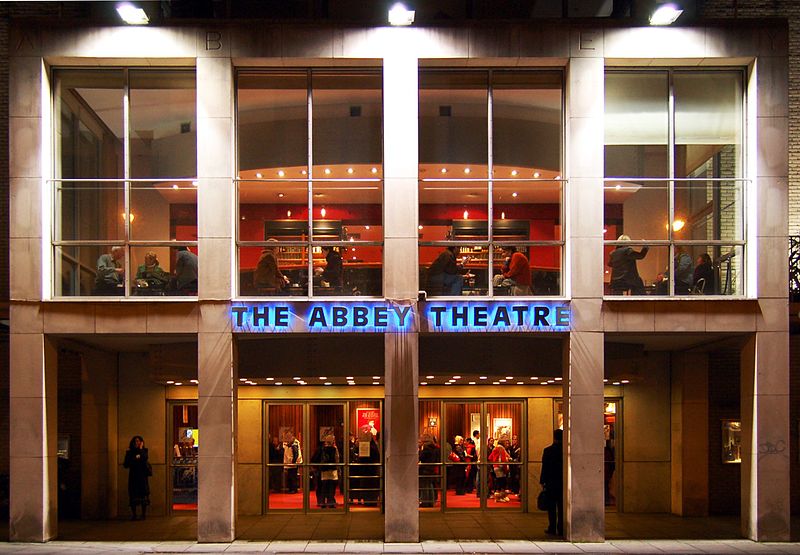
The exterior of the Abbey Theatre in Dublin, also known as the National Theatre of Ireland (Irish: Amharclann Náisiúnta na hÉireann)
Photo by Flickr user bjaglin via Wikimedia Commons.
Henceforth, apparently, the major theaters of Dublin are, as a matter of principle, to commission at least half their new plays from women. At least half of the characters in the plays, and the directors too, will be women. One can only applaud this commitment to equality and social inclusion.
However, without wanting to carp, it seems to me that the gesture does not go nearly far enough. What about the fat, for example? As we know, a high proportion of the population is now fat, and quite a number are grossly obese. Yet how often do you see plays written by the fat, acted by the fat, directed by the fat, and of interest to the fat? The theatrical professions as a whole are pervaded by slim-ism, but there is no intrinsic connection between being slim and literary or acting ability. There is abundant evidence of widespread prejudice against the fat, and it is surely time that this was overcome. My own view is that at least 10 percent of playwrights, actors, and directors ought to suffer from type 2 diabetes.
And then, of course, there is the matter of intelligence. The average IQ of the population is 100, and such is the normal distribution of intelligence that there are as many people of below-average intelligence as above it. Yet how often do you see a play written or directed by those with an IQ of, say, 80? It is true that a play may appear to have been written or directed by someone with an IQ of 80 or below, but in this case appearances are deceptive. A high IQ is perfectly compatible with all kinds of foolishness or worse, after all; but this does not affect the basic argument from social justice. It is about time that people of low IQ be given their chance in the theater.
June 24, 2018
Europe and the refugees
Theodore Dalrymple on the various European governments’ attitudes and actions on the refugee problem:
Europe, despite its Union, is as divided as ever. Recently, when Italy’s new right-wing government — anxious to prove its credentials — refused to allow a boat carrying 629 African migrants to dock in Italy, Spain’s new left-wing government — equally anxious to do the same — accepted the boat. When the French president, Emmanuel Macron, criticized the Italians for their decision, the Italian government accused the French of hypocrisy, inasmuch as they had refused to take more than 9,000 migrants from Italy that they had previously agreed to accept.
This story is revealing in several aspects. The first is that, whatever attitude governments take to the migrants, no one truly believes that they are more of an asset than a liability. Madrid’s action, for example, was taken on “humanitarian” grounds, rather than because it believed that Spain would benefit from the migrants’ presence. When European leaders discuss the migrant question, it is always in terms of sharing the burden, not the assets, equitably. No one speaks of foreign investment in this way, which suggests that European politicians believe, whether rightly or wrongly, that the free movement of people and capital are different in an important way.
The leaders speak of sharing the burden, then, and are incensed when countries such as Hungary and Poland refuse point-blank to take any migrants from Africa or the Middle East. But I have never seen mentioned in this context the question of where the migrants themselves want to go. They might as well be inanimate toxic waste as far as the discussion is concerned, rather than human beings with wishes, desires, ambitions, and so forth. They are but pawns in a political game. Hungary, for example, is deemed duty-bound to take x number of migrants: no one asks whether x number of migrants can be found who want to go to Hungary. Nor is the question ever discussed in public whether Hungary, having open borders, would be held responsible for making the migrants stay there once they had arrived. Short of penning them in, how exactly would you keep them in Hungary, or in Poland?
May 10, 2018
QotD: Langue de bois
The attendees [of a medical leadership conference] would learn about something called “lean management,” one feebly-attempted definition of which is as follows:
If someone tells you that “lean management is this” and not something else, if someone puts it in a box and ties a bow around it and presents it in a neat package with four walls around it, then that someone knows not of what they speak. Why? Because it is in motion and not a framed picture hanging on the wall. It is a melody, a rhythm, and not a single note.
This is the mysticism of apparatchiks, the romanticism of bureaucrats, the poetry of clerks. From my limited observations of management in public hospitals and other parts of the public health care system, it seeks to be not lean, in the commonly used sense of the word, but fat, indeed as fat as possible; nor are large private institutions very much different.
It seems, then, that we have entered, gradually and without any central direction or decree, a golden age of langue de bois or even of Newspeak. Langue de bois is the pompous, vague, and abstract words that have some kind of connotation but no real denotation used by those who have to hide their real motives and activities by a smokescreen of scientific- or benevolent-sounding verbiage. Newspeak is the language in Nineteen Eighty-Four whose object is to limit human minds to a few simple politically permissible thoughts, excluding all others, and making doublethink — the frictionless assent to incompatible propositions — part of everyday mentation.
Langue de bois and Newspeak are no longer languages into which normal thought must be translated; rather they have become the languages in which thought itself, or rather cerebral activity, takes place, at least in the upper echelons of the bureaucracy that rules us. If you ask someone who speaks either of them to translate what he has said or written into normal language, it is more than likely he will be unable to do so: His translation will be indistinguishable from the words translated. It is therefore clear that, where culture is concerned, the Soviet Union scored a decisive and probably irreversible victory in the Cold War.
Theodore Dalrymple, “Life de Bois”, Taki’s Magazine, 2016-09-10.
March 31, 2018
QotD: Workshops and how to avoid them
Kingsley Amis, a man whom, for reasons neither interesting nor publishable, I did not much admire, once said that the word “workshop” summed up all that was wrong with the modern world. He was right, and his comment was both shrewd and prescient. Courses, conferences, away-days, workshops, team-building weekends – they’re all part of the same pathology, and they’ve spread like bacteria on agar gel.
With a regularity bordering on the boring, from many sources, I receive flyers offering me courses to improve myself. I am far from supposing that I cannot improve or be improved, but most of these courses seem more designed to relieve me of money than anything else. They come with pictures of the course leaders (or trainers), happy and smiling and, to my eyes at least, deeply crooked.
A learned journal to which I subscribe always arrives with invitations to courses and conferences. Some, naturally, are of interest: those given by people who are acknowledged experts in their field, and who will provide a convenient digest of the latest research in it. But a high proportion of them are about what one might call para-work: activity that has nothing, or something only very tangential, to do with the ostensible aims of one’s profession.
Theodore Dalrymple, “Workshops and why you must avoid them”, The Social Affairs Unit, 2009-11-18.
March 10, 2018
Carl Jung, “the Madame Blavatsky of psychotherapy”
A few notes on Carl Jung, by Anthony Daniels (more often known by his pen name, Theodore Dalrymple), commenting on a biography from several years ago:
What exactly were [Jung’s] achievements? Oddly enough, although this biography is more than 800 pages long (649 of them are text, each of them so closely printed that they are the equivalent of two normal pages), by the time you finish it you will nevertheless be hard put to say. You will know a lot about the petty quarrels and squabbles in which Jung repeatedly engaged, and about the details of his domestic life, but relatively little about why any of these things matter in the first place. The author therefore assumes not only a familiarity with Jung’s ideas, and a sympathy towards them, but that the reader also assumes that Jung is worthy of such a lengthy biography. This is not an assumption I share, and though the book is written in serviceable prose, it contains not a single humorous remark. From very early on, therefore, I picked it up with some words that Macaulay wrote in a review of a two-volume biography of Lord Burleigh echoing through my mind like the insistent snatch of a tune (I quote from memory): Compared with the labour of reading these volumes, all other labour, the labour of thieves on the treadmill, the labour of children in the mines, the labour of slaves on the plantation, is but a pleasant recreation. That Miss Bair has been diligent is indisputably true; that her diligence has been wisely applied, unfortunately, is a more open question.
Some men are born charlatans, some achieve charlatanry, and some have charlatanry thrust upon them. Jung was decidedly not born a charlatan — or at least, he was not one throughout the whole of his career. True, he grew up in a family with a more than average number of table-rappers, which no doubt inclined him later to the study of the esoteric (for it certainly never occurred to him to wonder why the esoteric was, in fact, esoteric), and was subjected in his youth to that Teutonic windiness which comes so easily, though no means inevitably, to those who think and write in the German language. There is nothing quite like esoteric windiness for creating a penumbra of profundity, to which bored society ladies are drawn like flies to dung: and this no doubt explains how he became the Madame Blavatsky of psychotherapy. At the same time, however, he received a thorough grounding in classics as well as in science, spoke four languages fluently, could read Latin as if it were his native tongue, was not bad at Greek, and contributed several expressions to our daily discourse — complex, collective unconscious, archetypes, animus and anima, persona, introvert and extrovert — which by itself is far more than most of us will ever achieve. This is not the same as saying, however, that he contributed to human knowledge: for it is perfectly possible to give names to non-existent entities.
[…]
One of his patients, who has gone down in history as the solar-phallus man, thought (among many other strange things) that there was a phallus that emerged from the sun, and that by causing this solar appendage to move, he controlled the weather, particularly the wind. Jung subsequently discovered, in his reading about ancient myths, that there was a Persian Mithraic belief of exactly the same kind as his patient’s. Now his patient was not a well-educated or widely read man, so it seemed to Jung impossible that he had learnt of the Mithraic myth from external sources. He therefore concluded that the form of myths was almost — as we should now put it — hard-wired into the human psyche, and he called these forms archetypes. The collective unconscious was full of such archetypes.
Jung was a preternaturally unclear writer and thinker: he would never say anything clearly when obfuscation would do. Whether this was from lack of talent or an unconscious appreciation that clarity led to the possibility of contradiction and even refutation, no one can say, but the precise nature of archetypes, their ontological status as it were, has remained unclear ever since. At any rate, the solar-phallus man’s delusion, which he quoted for the rest of his long life, was the rock on which his theory was built: a somewhat inadequate basis for an entire, far-reaching theory about the mental life of all of humanity. But Jung’s theorizing was always like an inverted pyramid: a mountain of speculation resting on a pin-prick of fact.
There were obvious problems with the theory of archetypes. The theory suggested itself to Jung because of the exact, or very close, correspondence between the madman’s delusion and the original Mithraic myth: but how close did correspondences have to be before they were manifestations of archetypes, which were more platonic forms than actual contents of the mind? Only an analyst can say, of course, and there is no public criterion other than the analyst’s authority.
February 24, 2018
“Oxfam, like many large British charities, has long been a villainous organisation”
Theodore Dalrymple puts the boots to Oxfam:
It is very wrong, morally, to take pleasure in the misfortunes of others, but I cannot disguise from myself the intense pleasure, amounting almost to joy, with which I learned of the public exposure of the wrongdoings of Oxfam in Haiti, Chad, and elsewhere. Its workers, sent to bring relief to the acute and chronic sufferings of those countries, used the charity’s money, partly derived from voluntary contributions and partly from government subventions (the British government and the European Union are by far the largest contributors to British Oxfam), to patronise local prostitutes, some of them underage, and also to conduct orgies, no doubt at a fraction of what they would have cost to conduct at home.
Oxfam, at least in Britain, has long been one of the most Pecksniffian of organisations, much give to auto-beatification. Mr. Pecksniff, in Dickens’ Martin Chuzzlewit, introduces his daughters, called Charity and Mercy, to Mrs. Todgers, adding ‘Not unholy names, I hope.’ It is therefore of the hypocritical Mr. Pecksniff that I think whenever I pass the Oxfam shop in my small town, with its unctuous slogan, Thank you for being humankind, posted in the window. It is only with difficulty that I resist the urge to throw a brick through it.
Of course, Oxfam, like many large British charities, has long been a villainous organisation — and the sexual exploits (or should I say exploitations?) of its workers in Haiti and elsewhere are the least of it. In the moral sense, though not the legal, it has for many years been guilty of fraud, of misleading the public.
I first realised this some years ago when I found a used book dealer of my long acquaintance poring in his shop over Oxfam’s annual accounts.
‘Look at this,’ he said, but I saw nothing until he pointed it out to me.
Oxfam, in common with many other charities in Britain, runs thrift stores in practically every British town and city. Such thrift stores are now more numerous even than Indian restaurants: they allow people to give away their unwanted belongings in the belief that, by so doing, they are furthering a good cause.
My acquaintance pointed out that, despite receiving their goods free of charge, paying practically nothing for their labour (which was voluntary), and paying much reduced local taxes, Oxfam shops made a profit on turnover of a mere 17 per cent, much less than his own, despite his incomparably greater expenses. How was such a thing possible, by what miracle of disorganisation (or malversation of funds)?
Until then, I had carelessly assumed that the great majority of any money that I gave to a large charity went to serve its ostensible end, say the relief of avoidable suffering. I was not alone in this, of course. When I asked the volunteer ladies in a local shop run on behalf of the British Red Cross what percentage of the money I paid for a book there went to the Red Cross, they looked at me as if I were mad.
‘Why, all of it of course,’ piped up one of the ladies.
The real average figure at the time for Red Cross thrift stores was 8 per cent; but the volunteer ladies supposed, because the goods they sold were free to the Red Cross and they themselves were not paid, that (apart from a small amount for unavoidable expenses) all the money raised went directly to victims of earthquakes and the like.
February 1, 2018
QotD: In Britain, crime does pay
Here it is instructive to look at the statistics for house burglary in England and Wales. 750-800,000 such burglaries were known to the police in 2006; the police found the burglars in about 66,000 cases. (The figures for the number of burglaries are underestimated, while those for the numbers of burglaries solved are overestimated, both for technical reasons not necessary to go into, and that we can for the sake of argument ignore.) In that year, just over 6000 burglars received prison sentences. In other words, even if caught, a burglar in England and Wales is not likely to go to prison; but he is even less likely to be caught in the first place. In this sense, then, criminals do indeed have nothing to lose, and possibly much to gain by criminality.
Theodore Dalrymple, “It’s a riot”, New English Review, 2012-04.


