
The idea that you must be a part of a demographic to write about it is contrary to the very nature of reporting: The job of the reporter is to listen to and relay other people’s stories, but it’s also to look for evidence, to dig into claims, to get at the truth. If you want all your stories to come directly from the source’s mouth, enjoy getting all of your news from social media. Besides, if people only wrote about populations they fit in, that would mean that I’m only allowed to write about 35-year-old lesbians from North Carolina and Jesse is only allowed to write about Boston Jews who love the Celtics and, sorry trans writers, but no more cis stories for you. Hope you don’t want to cover politics. According to this logic, the White House press corps would have to be made up of 70-year-old men with giant egos and tiny brains. Anyone writing about immigrant children separated from their families in Texas would have to be an immigrant child separated from their family in Texas. If that’s what people want, okay, but good luck effecting any sort of political change in a media ecosystem like that. You can’t argue for visibility and then claim that no one is allowed to write your stories but you.
Katie Herzog, “Twitter, Trans Kids, Call-Out Culture, and a $10,000 Blunt”, The Stranger, 2018-06-19.
July 14, 2018
QotD: Ridiculous criteria for reporters
May 11, 2018
The impact of universities on Generation X
Last month, Aaron Clarey explained why (in his view) the 1980s were so much better than the 1990s:
For example if you went to the gas station you would buy gas there. If you went to Target you bought staples and everyday supplies. If you went to the coffee store they would serve you coffee. And if you went to a movie theater they would show you a movie. They were simpler times and it made my halcyon childhood days very enjoyable. But then something started happening in the 90’s that would end these blissful, innocent times.
College.
Well, not college unto itself necessarily, but the propaganda…err..umm… “education” my generation (Gen X) would receive in college. For you see, while we were all told we “had to go to college” because it was necessary for us to have any sort of career or professional life at all, at the same time some very conscious and very intentional people in academia had a political agenda. And it was to make sure that we not so much had skills that would land us jobs in the future, but more importantly (to them anyway) that we placed more value on social and political agendas than profit, production, efficiency and reality. So that by the time Gen X graduated from college, and inevitably started taking over the reigns of control of the economy (which we have), we would not be so much concerned with offering the best product at the best prices possible, but what I like to call “Profit Plus Purpose.”
Politics Politics Everywhere! In Your Soup and in Your Hair!
You see this “Profits Plus Purpose” every day in western economies. It is literally unavoidable. If you go to a hotel there is always a sign asking you to “save the planet” by reusing your towels. If you go to a coffee store they cannot help themselves from bragging about their organicfairtradefreetradegaiaunicorn credentials. When you walk into a Target they’re always bragging about how they give back 5% to the community. Even British Petroleum tells you about how environmentally friendly they are at their gas pumps, while Exxon Mobil actually has a “corporate social responsibility page.” Matter of fact, this propaganda is so thorough and so complete Generation Z will be the first generation to be brought up where there has ALWAYS been some kind of secondary political message forcefully embedded into nearly every product and service sold in America.
The reason “Profits Plus Purpose” propaganda was so COMPLETE and UNIVERSALLY successful can be found in its genius genesis. It capitalizes on the egotistical and lazy nature of human beings. Leftist academics and politicians started propagandizing Generation X in college with the beginnings of things like “diversity,” “feminism,” “environmentalism,” “global warming,” etc. (you could almost pinpoint it to the date Captain Planet first aired). Whether you believe in the veracity of these “isms” or not is moot, because their ulterior purpose was to give then-naïve-and-egotistical Gen X’ers immediate gratification, purpose, morality, and ego in exchange for their life-long leftist political loyalty and further advancing said political agendas well into the future.
Why, you weren’t just some rank and file Mechanical Engineering major. You were an environmentalist Mechanical Engineering major.
Why, you weren’t some mass produced business major. You were an empowered, feminist, future business leader.
You weren’t some worthless, math-avoidant liberal arts degree major. You were a pro-refugee activist utterly unemployable liberal arts degree major.
Thus, whereas learning a real skill from a real degree took deterring work, effort, and rigor, immediately subscribing to some kind of moral leftist political crusade was effortless, yet provided immediate value and agency. Gen X couldn’t sign up fast enough and thus virtue signaling and Social Justice Warriors were born.
H/T to SDA for the link.
May 6, 2018
Now I understand why Google calls it a “campus”
I’ve worked in high tech for my entire career, and I’ve never worked at a company that had anything like this kind of non-work-related activity … it sounds much more like a university than a workplace (and I don’t mean that in a positive way):
A recent report in The Wall Street Journal chronicles the drama of a thoroughly politicized and tribal workplace at Google, where activist employee groups stage competing talks on their pet issues, and a growing number of former employees are suing the company for discrimination and bias.
The article opens with an incident that took place in January, when Ingrid Newkirk, the co-founder and president of People for the Ethical Treatment of Animals, was slated to give a presentation at the company’s Silicon Valley headquarters as part of the “Talks at Google” series.
The subject of her talk, which was organized by the “Googlers for Animals” employee group, was how animals can be subject to discrimination and bias just like people are. But another employee group, the “Black Googler Network,” understandably found the premise of the talk offensive and protested it. The talk was canceled at the last minute, as Newkirk was waiting in a parking lot outside Google.
“Such is the climate inside the tech giant, where fractious groups of employees have turned the workplace into a virtual war zone of debate over all manner of social and political beliefs,” wrote the Journal. “Google has long promoted a work culture that is more like a college campus—where loud debates and doctrinaire stances are commonplace—and today its parent, Alphabet Inc., is increasingly struggling to keep things under control.”
Welcome to Google, microcosm of America in 2018. Like nearly every facet of American life these days, Google’s workplace has become politicized, which means the company must now constantly adjudicate every offense that arises from an ever-growing roll call of the aggrieved.
Google reportedly has employee groups for every conceivable cause: “Activists at Google,” which is anti-Trump; “Militia at Google,” which is pushing for the ability to carry guns in the office; “Conservatives at Google,” which claims the company discriminates against right-leaning job candidates; and “Sex Positive at Google,” which doesn’t want explicit content removed from Google Drive file-sharing software. Like other tech companies, Google has cultivated a college atmosphere in the workplace. It seems the company has succeeded, but only in the sense that its workplace has fractured into competing identity groups.
How would anyone get any actual work done with all those competing circus acts clamouring for attention throughout the “work”day?
March 26, 2018
QotD: Virtue signalling
It’s noticeable how often virtue signalling consists of saying you hate things. It is camouflage. The emphasis on hate distracts from the fact you are really saying how good you are. If you were frank and said, ‘I care about the environment more than most people do’ or ‘I care about the poor more than others’, your vanity and self-aggrandisement would be obvious, as it is with Whole Foods. Anger and outrage disguise your boastfulness.
One of the occasions when expressions of hate are not used is when people say they are passionate believers in the NHS. Note the use of the word ‘belief’. This is to shift the issue away from evidence about which healthcare system results in the greatest benefit for the greatest number of people. The speaker does not want to get into facts or evidence. He or she wishes to demonstrate kindness — the desire that all people, notably the poor, should have access to ‘the best’ healthcare. The virtue lies in the wish. But hatred waits in reserve even with the NHS. ‘The Tories want to privatise the NHS!’ you assert angrily. Gosh, you must be virtuous to be so cross!
Comedians make use of virtue signalling of the vituperative kind. With the right audience they can get laughs scorning the usual suspects: Ukip, the Daily Mail, Eton, bankers and the rest. The audience enjoys the caricaturing of all of these, sneering at them and, in the process, joining together as a congregation of the righteously contemptuous. What a delight to display your virtue, feel confirmed in your views, enjoy a sense of community, let off some anger and have a laugh all at the same time! It is so easy, too!
No one actually has to do anything. Virtue comes from mere words or even from silently held beliefs. There was a time in the distant past when people thought you could only be virtuous by doing things: by helping the blind man across the road; looking after your elderly parents instead of dumping them in a home; staying in a not-wholly-perfect marriage for the sake of the children. These things involve effort and self-sacrifice. That sounds hard! Much more convenient to achieve virtue by expressing hatred of those who think the health service could be improved by introducing competition.
James Bartholemew “The awful rise of ‘virtue signalling’: Want to be virtuous? Saying the right things violently on Twitter is much easier than real kindness”, The Spectator, 2015-04-18.
March 15, 2018
Tip-toe around topics so as to avoid “triggering” someone
Matthew Blackwell isn’t alone in finding it necessary to avoid certain topics of conversation when talking with his friends on the left:
Outbursts of emotional hostility from progressive activists – now described as Social Justice Warriors or SJWs – have come to be known as getting ‘triggered.’ This term originally applied to sufferers of Post-Traumatic Stress Disorder, but activists have adopted it to describe the anxiety and discomfort they experience when they are exposed to views with which they disagree. “Fuck free speech!” one group of social justice advocates recently told Vice Media, as if this justified the growing belief among university students that conservatives should be prevented from speaking on college campuses. It’s no secret that, with the rise of the triggered progressive, university professors are increasingly intimidated by their own students. An illustrative example of this alarming trend was provided by the hordes of screaming students who surrounded the distinguished Yale sociologist Nicholas Christakis and demanded his head (which they duly received). Christakis had made the mistake of defending an email his wife had written gently criticizing Yale’s attempts to regulate students’ Halloween costumes. “Who the fuck hired you?!” screamed one irate student in response. “You should step down!”
This sort of my-way-or-the-highway mentality is now spreading well beyond the urban university and into even remote communities. In the small Outback Australian town of Alice Springs where I once lived, agitators have attacked and attempted to silence the local aboriginal town councillor Jacinta Price for her principled efforts to improve the lives of her people. When Price tried to sound the alarm about skyrocketing sexually transmitted diseases, or the adult rape of children in aboriginal communities, she was shouted down as a ‘traitor’ and a ‘coconut’ (a term of disparagement used to describe a person deemed to be black on the outside and white on the inside). These criticisms do not come from the majority of aboriginal people in Alice Springs, but from a minority of furiously offended activists who, in their own little circles, plot to have Price undemocratically removed from the town council. Censorship is now the instrument of choice, and a reactionary authoritarianism increasingly defines what the liberal Muslim activist Maajid Nawaz has termed the ‘Regressive Left.’
So how and why have these activists become so intolerant and horrible to deal with? Part of this hostility can be explained by a wilful ignorance and incuriosity about ideas with which they disagree. Every so often, a progressive friend will peruse my bookshelf in a thought-police sort of fashion. What happens next is fairly predictable. Once they realize that Malinowski’s Melanesian epic The Sexual Life of Savages doesn’t include any erotic pictures, they will turn their attention to the Ayn Rand collection. “Why do you have these?” they ask with an air of indignation, holding up a copy of Capitalism: The Unknown Ideal. “Have you ever read her?” I will ask. “No,” they reliably respond.
The liberal philosopher John Stuart Mill once explained that, “The greatest orator, save one, of antiquity, has left it on record that he always studied his adversary’s case with as great, if not with still greater, intensity than even his own.” Mill held that unless we carefully study the views of those with whom we disagree, we will never really know what they’re right or wrong about. “He who knows only his own side of the case,” Mill wrote in his 1859 book On Liberty, “knows little of that.” Our opponents could be right for all we know or care, because they may know a fact or offer an argument we’ve never thought to consider. And even if they aren’t right, Mill points out that specks of truth may exist among their falsehoods which can guide our minds in new directions.
January 20, 2018
Lindsay Shepherd discovered “that not only are critiques of social justice not taught, they aren’t even to be acknowledged”
In Quillette, Uri Harris writes about the trainwreck Jordan B. Peterson interview on UK Channel 4 with Cathy Newman, where Newman appeared to be unable to engage with his arguments, as though she was previously unaware of their existence. Harris also briefly touches on the background to the WLU kerfuffle with Lindsay Shepherd which I think explains a lot about how that incident was triggered:
When Lindsay Shepherd was reprimanded last year by three Wilfrid Laurier faculty members for showing her class a video clip from a televised debate on gender pronouns, Shepherd’s professor Nathan Rambukkana wrote an apology drawing attention to his teaching style. He wrote: “[T]here is the question of teaching from a social justice perspective, which my course does attempt to do.”
When I contacted Lindsay Shepherd earlier this month, she told me that she didn’t know Rambukkana taught from an explicitly “social justice” perspective. However, after going through the syllabus, she realised he had talked about it in his Week 2 lecture, and that the reading material that week also mentioned it. Yet even then, she said, she was unaware how loaded the term “social justice” is and how it often aligns with censorship and one-sidedness. Her response when I asked her whether she recognised various social justice terms was:
My undergraduate degree is in Communication from Simon Fraser University, and the gist of my program was learning about power; mostly power as it manifests in media and media industries. I was very accustomed to talking about feminism, racism, and oppression. Less so the other terms you mention, which I only became more acquainted with in my graduate degree program, and many of them as a result of the Laurier incident — i.e. I was unaware of any substantial critique of intersectionality, gender theory, and critical theory, as we were only taught them from the “social justice perspective.”
Shepherd had lots of exposure to a social justice perspective, but only from within the perspective itself. She was taught social justice beliefs but had never been taught to critique those beliefs. When she came across a professor who did just that—Jordan Peterson—she found it interesting and new, even while disagreeing with him. (She later came to realise he may have been right about the legislation he was criticising.) So she shared a clip of the debate with her students, and only afterwards did she discover that not only are critiques of social justice not taught, they aren’t even to be acknowledged.
The methodology underpinning much of the social justice perspective is known as critical theory. What’s notable about critical theory is that it specifically distinguishes itself from ‘traditional’ theories through its emphasis on criticism. This makes the apparent unwillingness of its adherents to engage with criticism themselves especially noteworthy. When you explicitly emphasise your criticality and base your theory on a commitment to look beneath appearances and see things as they really are, you don’t get to be selectively critical.
January 16, 2018
QotD: Intersectionality
The term and concept were presented in a 1989 essay by Kimberlé Crenshaw, a law professor at UCLA, who made the very reasonable point that a black woman’s experience in America is not captured by the summation of the black experience and the female experience. She analyzed a legal case in which black women were victims of discrimination at General Motors, even when the company could show that it hired plenty of blacks (in factory jobs dominated by men), and it hired plenty of women (in clerical jobs dominated by whites). So even though GM was found not guilty of discriminating against blacks or women, it ended up hiring hardly any black women. This is an excellent argument. What academic could oppose the claim that when analyzing a complex system, we must look at interaction effects, not just main effects?
But what happens when young people study intersectionality? In some majors, it’s woven into many courses. Students memorize diagrams showing matrices of privilege and oppression. It’s not just white privilege causing black oppression, and male privilege causing female oppression; its heterosexual vs. LGBTQ, able-bodied vs. disabled; young vs. old, attractive vs. unattractive, even fertile vs. infertile. Anything that a group has that is good or valued is seen as a kind of privilege, which causes a kind of oppression in those who don’t have it. A funny thing happens when you take young human beings, whose minds evolved for tribal warfare and us/them thinking, and you fill those minds full of binary dimensions. You tell them that one side of each binary is good and the other is bad. You turn on their ancient tribal circuits, preparing them for battle. Many students find it thrilling; it floods them with a sense of meaning and purpose.
And here’s the strategically brilliant move made by intersectionality: all of the binary dimensions of oppression are said to be interlocking and overlapping. America is said to be one giant matrix of oppression, and its victims cannot fight their battles separately. They must all come together to fight their common enemy, the group that sits at the top of the pyramid of oppression: the straight, white, cis-gendered, able-bodied Christian or Jewish or possibly atheist male. This is why a perceived slight against one victim group calls forth protest from all victim groups. This is why so many campus groups now align against Israel. Intersectionality is like NATO for social-justice activists.
This means that on any campus where intersectionality thrives, conflict will be eternal, because no campus can eliminate all offense, all microaggressions, and all misunderstandings. This is why the use of shout-downs, intimidation, and even violence in response to words and ideas is most common at our most progressive universities, in the most progressive regions of the country. It’s schools such as Yale, Brown, and Middlebury in New England, and U.C. Berkeley, Evergreen, and Reed on the West Coast. Are those the places where oppression is worst, or are they the places where this new way of thinking is most widespread?
Jonathan Haidt, “The Age of Outrage: What the current political climate is doing to our country and our universities”, City Journal, 2017-12-17.
August 13, 2017
No one Everyone (now) expects the Google Inquisition
The decision by Google to fire dissident engineer James Damore over his “Google’s Ideological Echo Chamber” memo will likely have several divergent effects. One, of course, will be to encourage tech workers who may sympathize with some or all of Damore’s views to be more circumspect about expressing them (or even to be suspected of harbouring them). It will probably also encourage a more prosecutorial attitude among those most offended by Damore’s memo. We’re probably not far from the establishment of an inquisition-like body to sniff out the heretics:
What Damore’s termination tells you is that many in your field consider people with your beliefs to be unfit to work with. They hold opinions of you similar to those of former senior Google employee Yonatan Zunger, who wrote about Damore, saying:
“Do you understand that at this point, I could not in good conscience assign anyone to work with you? I certainly couldn’t assign any women to deal with this, a good number of the people you might have to work with may simply punch you in the face, and even if there were a group of like-minded individuals I could put you with, nobody would be able to collaborate with them.” (Emphasis mine.)
If you are on the right, you probably find it hard to imagine that any reasonably person could read Damore’s memo and think that it reveals the author to be sexist, punchable, or a danger to women’s careers. It appears to you that Damore was excommunicated for questioning the progressive diversity narrative in a most respectful manner.
[…]
Many on the right fear SJWs. The website Breitbart, highly influential among conservatives and the Trump administration, interviewed an anonymous Googler who said in part:
“Several managers have openly admitted to keeping blacklists of the employees in question, and preventing them from seeking work at other companies. There have been numerous cases in which social justice activists coordinated attempts to sabotage other employees’ performance reviews for expressing a different opinion. These have been raised to the Senior VP level, with no action taken whatsoever…There have been a number of massive witch hunts where hundreds of SJWs mobilize across the corporate intranet to punish somebody who defied the Narrative…I always fear for my job and operate with the expectation that I will be purged unless something changes…”
Many Business Insider readers won’t trust an anonymous Breitbart interview, but for what’s relevant to this article, please do trust that this Googler’s views accurately reflects how many on the right think about SJWs.
Interestingly, this is similar to how the original Inquisition came about:
The Inquisition was not born out of desire to crush diversity or oppress people; it was rather an attempt to stop unjust executions. Yes, you read that correctly. Heresy was a crime against the state. Roman law in the Code of Justinian made it a capital offense. Rulers, whose authority was believed to come from God, had no patience for heretics. Neither did common people, who saw them as dangerous outsiders who would bring down divine wrath. When someone was accused of heresy in the early Middle Ages, they were brought to the local lord for judgment, just as if they had stolen a pig or damaged shrubbery (really, it was a serious crime in England). Yet in contrast to those crimes, it was not so easy to discern whether the accused was really a heretic. For starters, one needed some basic theological training — something most medieval lords sorely lacked. The result is that uncounted thousands across Europe were executed by secular authorities without fair trials or a competent assessment of the validity of the charge.
The Catholic Church’s response to this problem was the Inquisition, first instituted by Pope Lucius III in 1184. It was born out of a need to provide fair trials for accused heretics using laws of evidence and presided over by knowledgeable judges. From the perspective of secular authorities, heretics were traitors to God and the king and therefore deserved death. From the perspective of the Church, however, heretics were lost sheep who had strayed from the flock. As shepherds, the pope and bishops had a duty to bring them back into the fold, just as the Good Shepherd had commanded them. So, while medieval secular leaders were trying to safeguard their kingdoms, the Church was trying to save souls. The Inquisition provided a means for heretics to escape death and return to the community.
As Karl Marx wrote in The Eighteenth Brumaire of Louis Napoleon:
Hegel remarks somewhere that all the events and personalities of great importance in world history occur, as it were, twice. He forgot to add: the first time as tragedy, the second as farce.
August 9, 2017
QotD: University “studies” programs
As someone who got partway through grad school, I am only a sort of half-layman when it comes to modern European history. On demand I can present an official document that testifies, by implication, that I have spent a certain amount of time in seminars talking about Himmler’s agronomy education or discussing why totalitarian regimes are always sexually puritanical. Even before it was ruined for me by formal training, I was a history buff. So I can sort of reconstruct the process whereby I know what Auschwitz is. But, by the same token, I am less able to know how anyone else comes by the knowledge.
It seems some part of our system for producing intellectually responsible grownups has failed […] That failure is probably not to be found in the extensive education in social work. A degree in social work amounts to a degree in helping people: assuming it is not totally idiotic for our institutions of higher learning to be generating such paper, there must be mastery of some technical arcana involved. I do not know that this would involve instruction in the details of the Holocaust. A nursing education doesn’t; an engineering education doesn’t.
It is, rather, that “social justice and peace studies” business that captures my eye. Wouldn’t the matter, the essential grounding of an education in social justice and peace just be … history? (With particular attention to the topic of concentration camps?) Wouldn’t expertise of this kind require digestion of a mass of information about the flux of war, diplomacy, economies, and ideas? Something Studies items were on the menu already when I began my undergraduate education, and I majored in history partly because, in my innocence, I couldn’t see how you would study anything else about human affairs without that foundation.
But we all know the secret of Something Studies well enough now: it is a way of avoiding the rigour and complexity of a history education, and going straight to the business of striking political stances. It is History For Left-Wing Dummies. And when you see such a degree on someone’s CV, you can be quite sure you have found one.
Colby Cosh, “Some part of our system for producing intellectually responsible adults has failed Alex Johnstone”, National Post, 2015-09-24.
July 23, 2017
Requiem for an SJW heavyweight
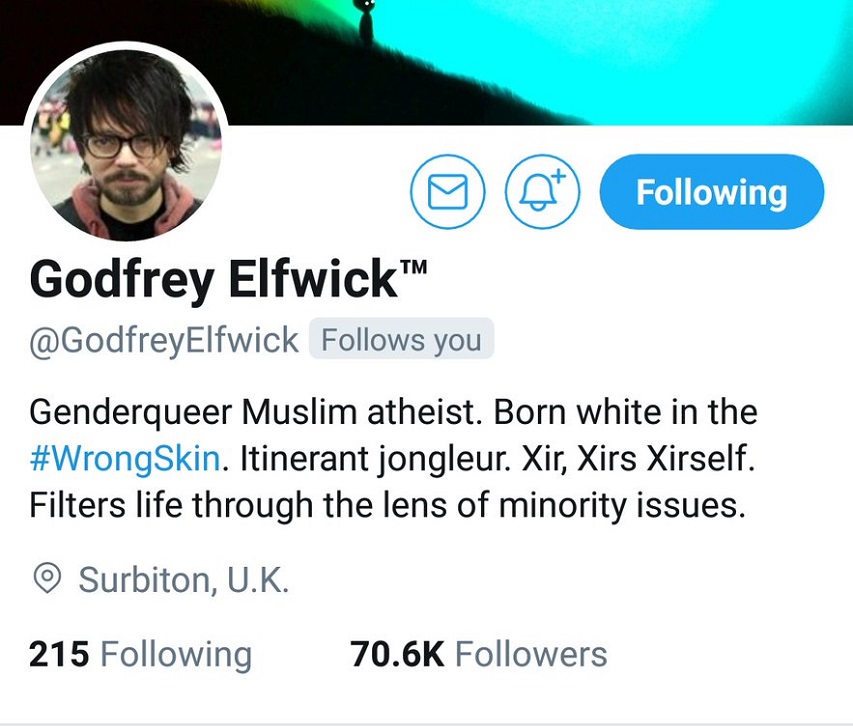
James Delingpole on the Twitter phenomenon Godfrey Elfwick:
Linda Sarsour/Sally Kohn/Graham Linehan/Caroline Criado Perez/Gary Lineker/Diane Abbot/someone from the Guardian/a guy from CNN/ISIS has said something really hateful, stupid, and wrong on Twitter. Again.
Back in the day, this would have been a cause for celebration, not dismay. Why? Because within milliseconds of their fatuous utterance tainting the ether with its embittered, warped, politically correct insanity it would have been endorsed – and simultaneously destroyed – by the mighty Godfrey Elfwick.
Godfrey Elfwick was the funniest and best thing on Twitter.
To have your tweet singled out for praise by Godfrey was the kiss of death. It meant that you were a humorless, self-righteous, deluded, smug, sanctimonious, insufferable Social Justice Warrior. Just like Godfrey purported to be.
Which is why, of course, Twitter had to silence him. Sure, the official reason given for Godfrey’s permanent ban was because he had broken Twitter’s terms of service – apparently having upset a millionaire potato chip salesman called Gary Lineker.
March 17, 2017
Peronism, fascism, and socialism
David Warren is in fine form:
Peronism came to Argentina and never left. Not only have the Partido Justicialista and its avatars dominated Argentine electoral politics, through their various iconic husband-and-wife acts over the last seventy years, but they have contaminated the thinking of the whole country, which adhered to their arbitrary and contradictory doctrines even during the sixteen years they were banned, and adheres to the present day when once again they are nominally out of power. Actually it is a century, now, since Peron’s “Radical” predecessors first won election (dating from Hipólito Yrigoyen, 1916). Moral, intellectual, and material squalour is their chief legacy to a country which was once among the world’s most prosperous and most free. The spiritual equivalent has now migrated to Rome.
This, at least, is the impression I have formed from afar. “Justicialism,” so far as one can read, embodies every sort of rhetorical populism, across the political spectrum, but with a heavy and perfectly consistent bias towards centralized power. It stands for “social justice” — an absolutely imaginary and therefore unattainable ideal. It is on the side of labour and of management, it is Catholic and anti-Catholic, racist and anti-racist, isolationist and aggressive, leftist and rightist and dogmatically nationalist with all the contradictions nationalism entails. Yet it is not unique.
Socialism is leftwing Fascism; Fascism is rightwing Socialism. Other than that, they are the same. They vie for the same voters, and politicians may move comfortably back and forth between their symmetrical (i.e. identical) extremes. The principle underlying both is that the government should control everything, for the government’s idea of the common good. Whether the government technically owns everything is neither here nor there. Indeed, Socialism/Fascism works better, for the government, if private actors can be made to take the blame and the losses for all of the government’s goon-show mistakes. Any “excess” income on which they fall in their government-assigned monopolist stations can then be impounded.
February 27, 2017
QotD: Check your privilege
So who am I betraying by not conforming to the baneful Marxist stereotype of who I should be? Oh, right, the SJWs. That’s okay, I’m fine betraying them. Or at least fighting them. Hard to betray what you never belonged to. And, you know, most of them, even those with exotic names and claiming exotic identities (rolls eyes) are pasty-assed white people with real privilege as defined by having money and having attended the best universities and hanging out with all the “right” people and having the “right” (left) opinions. If they knew the meaning of the word privilege, they’d see it all over themselves.
But there are more egregious definitions of privilege. You see “check your privilege” is a tool of would-be elite whites to keep competition and challengers in check, while riding to glory by defining themselves as champions of the downtrodden. (It’s an old game, in place at least since the French revolution, but it’s the only one they have. Remember they lack both empathy and imagination. And since they have more or less overtaken the press, no one on the street realizes how old and tired this “clever” gambit is.)
However, when that hits academia, it becomes something even more poisonous.
Recently I heard someone talk about a difficult (as in very poor, with two working, Asian immigrant parents barely scrabbling to get by) childhood and say that as they always had books and were pushed to succeed they had “tons of white privilege.”
This person was a graduate of an ivy league school. So, of course, he had internalized the definitions of “white privilege” as meaning “doing that which brings success.”
This is sort of a self-defeating thing. If you want to have a voice in politics, you avoid “white privilege” which means if you want to have a voice in politics, you must not display those traits which logically lead to success in the culture. (You see how this is a tool of the white overclass to avoid competition from anyone else.)
This poisonous, totally unwarranted view of privilege serves only one purpose: to keep everyone else floundering and mute while these not-very-competent, credentialed, correctly-connected, politics-as-a-social good, lacking in empathy, totally devoid of imagination, largely white would-be-aristos lord it over us.
Sarah Hoyt, “The Privilege Of Not Caring”, According to Hoyt, 2015-05-17.
February 20, 2017
“For many years, I DJed BDSM parties, Fetish events, and the like … To quote Blade Runner, I’ve seen things you people wouldn’t believe”
At Instapundit, Sarah Hoyt linked to this post on “the lost children of the west“:
In the manosphere, the various hodgepodge collection of sites emphasizing a return to masculinity for men, I encountered a comment some years ago which stuck with me. In it, a man who had been banging a number of women lamented that every woman he encountered was a Cenobite, one of Clive Barker’s seekers of pain through pleasure. They would say “choke me until I pass out, hit me, spank me until I bleed, cut me…” They would demand ever-greater excesses, because they were unable to feel pleasure if it did not include pain. He didn’t care — all he wanted was to get laid, so he’d do whatever they asked of him — but he didn’t understand why women were this way, or why he could find so few who weren’t like this. He seemed to have a sense that things were not always this way.
In my DJ career, I have spent a great deal of time in communities and scenes that normal folks would regard as underground. For many years, I DJed BDSM parties, Fetish events, and the like. I’ve DJed warehouses and clubs with no names, buried in the wreckage of abandoned industrial parks. The marketplace of sex is one which I know exceedingly well. I’ve been DJing these scenes for the better part of 20 years.
To quote Blade Runner, I’ve seen things you people wouldn’t believe.
As that commenter lamented, so I’ve seen first-hand. These SJWs, the radical feminists who spend their lives fighting the Patriarchy? They come to my clubs to be beaten senseless on crosses, chained to them by men dressed in uniforms very reminiscent of the Nazis. Yes, it’s a thing, as anybody who has ever been to a Goth club can attest. They demand to be tied up, burned, bruised, and battered.
Go on social media, and you will see SJWs telling us that Nazis are everywhere, that they are evil, and foul, and legion. They are in the White House, they are on Youtube, they are on Twitter, they are in Video Games. Nazis, everywhere. And so they march out into the streets, the Black Bloc, Antifascists engaging in what Tom Kratman calls a bit of political theater (not unlike Fascists once did).
But at the end of a long week of fighting the cisnormative heteropatriarchy, they come to be beaten by men dressed as Nazis, to the gritty beats of loud Industrial music in the depths of an Industrial park.
QotD: Privilege
Then there are the charming SJWs (no, it’s not an insult. They called themselves Social Justice Warriors. They don’t get to escape the name when it turns out everyone knows how stupid it is) in my field who call me a race and gender traitor. Children are confused like that. How can you be a traitor to an allegiance that doesn’t exist and which you never swore fealty to.
Doesn’t exist, you say? But race! Gender! Well, they SAY gender is a social construct and as for race, I know enough history (if they don’t) to know it’s a cultural construct. In the nineteenth century they talked of “the Portuguese race” and the “British race.” I understand that under the microscope, absent some kind of marker like sickle cell, you can’t tell anyone’s skin color. You can, interestingly enough, at the cellular level, tell the sex of the cells. But the SJWs tell us it’s a social construct, and they are honorable women and girly men.
Actually what is a social construct are the archetypes they push into those things: females and other races as archetypal oppressed races. As a Samoan e-friend put it, her people weren’t oppressed by whites. They didn’t care what whites were doing. The Portuguese might have been oppressed by the whiter parts of Europe, kind of sort of. I mean, at various times English Literature referred to them as a vile race, the French did whatever the French were doing, and the Germans tried to organize the study of Portuguese literature (among other things.) But in the end, the Portuguese were too busy fighting their eternal enemies, the Portuguese, and occasionally distracted enough to fight the Spaniards, to care overmuch about more remote European countries. They were rather busy not being eaten by Spain, as every other country in the Peninsula was. (Well, technically not being eaten by Castile, but…)
Here do I get oppressed by non-Latin people? Meh. I’d like to see the idiot with enough gumption to try to oppress me. Sometimes they stereotype me and are rude to me, but I ignore them and that works.
Sarah Hoyt, “The Privilege Of Not Caring”, According to Hoyt, 2015-05-17.
January 8, 2017
QotD: “Privilege” means “private law”
Sigh. Hey, guys, privy-lege means “private law.” You know, private law which allows your not-very-competent asses to hold on to positions you’re not qualified for just because you make the right noises. Private law which means your politicians don’t get even rebuked for incompetence and malice that would crucify any one else. Private law means you can enrich yourself while playing at caring for the downtrodden. Private law means you can be an old woman with no accomplishments to your name except marrying the “right” man and then claim to speak for women and youth. Private law means you can play life on the easiest setting, while rebuking everyone with your melanin content (or more) for doing the same, whether you know what they’ve overcome or not.
Privilege means arrogating to yourself the right to judge others, not on behavior, not on their choices, not on their competence or their intelligence, but simply on whether they disagree with you. And to scream “off with their heads” if they don’t.
Privilege means the right to tell people what they should think or feel, and telling people whom they should blame for their plight, even if the people themselves disagree.
Privilege means voting yourself accolades, awards, encomiums, and then relying on your buddies in the press to make you smell like a rose, despite the garbage you roll around in.
Privilege means destroying people and gutting the culture for the privilege (ah!) of standing on top the smoking pyre, being king of the dunghill.
Privilege means being aristos unaware the masses are in pain and – like Antoinette never said – telling them to eat cake.
It’s short lived, though, this sort of privilege, because it destroys that which it feeds upon. And it’s even more short lived in a time when technological change undermines you. For instance, I don’t think the press can shield these aristos much longer. It might last the bastions of the left until the present generation (older than I) retires. Those younger than I, though, banking on it are playing a mug’s game. (Or are simply stupid and as we’ve said, lack both empathy and imagination.)
Long before they inherit, the inheritance will be ashes in the wind.
And the rest of us, the ones who understand the cold equations of economics and culture, of knowledge and power? We’ll be here.
Ça Ira.
Sarah Hoyt, “The Privilege Of Not Caring”, According to Hoyt, 2015-05-17.


