Quotulatiousness

February 15, 2026

The smartphone as a tool to create a real-life Idiocracy

Filed under: Britain, Media, Railways, Technology — Tags: , , , , , — Nicholas @ 05:00

Not being much of a film fan, I’d never seen the movie Idiocracy, but based on the description in Christopher Gage’s rant against the smartphone, I might not need to watch it as it’s happening all around us:

Transport for London, the mythical entity alleged to manage the city’s Tube, has revealed its campaign to tackle the smartphone scourge: sickly posters splashed in kindergarten colours.

The campaign targets the “disruptive behaviour” of passengers who were evidently raised by a pack of snarling hyenas. They blast reels, videos, music. They FaceTime their cackling friends. Not so long ago, a fellow passenger revealed to us — her captive audience — that someone named Sarah had caught the clap from someone named Travis. Syphilis? How literary.

Miraculously, researchers at Transport for London discovered a rare tribe thought to be long extinct: Londoners who communicate with their fellow human beings by making noises with their mouths — one thousand of them, in fact.

Researchers approached these strange beings with a mixture of wonder and trepidation. They prodded them with a stick. That didn’t work. After jabbing them with a cattle prod, they looked up from their phones. Several members landed in Accident and Emergency, complaining of neck strain injuries.

Seventy percent of those surveyed said the constant noise screaming out of smartphones drove them crazy. One responder suggested offenders receive forty lashings in public. That is a bit much. Ten should do the trick.

TFL wavered from such brutal and effective methods. Campaign posters politely ask passengers to wear headphones.


I’m afraid that TFL’s well-meaning campaign hasn’t quite restored sanity on the London Underground.

Last week, I sat next to a grown man grinning at his phone like a Hindu cow. On the screen was a captivating spectacle. Someone, somewhere, makes it their daily business to buy gigantic, waist-height glass bottles of soda. This clearly well-adjusted person then rolls the bottles down a flight of concrete steps. Our friend dissolved the journey between Hammersmith and Leicester Square in a trance. Bottle. Roll. Smash. Bottle. Roll. Smash.

This reminded me of the satirical film, Idiocracy. The plot follows U.S. Army librarian Luke, and prostitute Rita.

After signing up for a hibernation experiment, the two awake in America, year 2500. Mountains of trash litter the landscape. Planes fall out of the sky. The citizens drag their gormless faces between Starbucks (which is now a coffee-serving brothel) and shopping malls even more dementing than those today. Over centuries, the dumb have biologically outgunned the smart.

The citizens of this moronic inferno drain their days glued to hyperactive screens. Their favourite content includes the Masturbation Channel and a reality TV show called “Ow! My Balls!” That show follows a hapless man as he gets whacked in the testicles.

They cultivate high culture, too. The profound film, Ass, zooms in on a pair of bare bum cheeks. The sophisticated audience fizzes with laughter as the bum, for two hours, passes wind.


Back in 2006, Idiocracy was a well-done satire which stretched logical extremes. Today, I’m not so sure it is as ridiculous as it once seemed. Just spend ten minutes on the Tube, inhaling the noxious TikTok fumes spewing from smartphones.

Transport for London has a point. But it is far too late. We are a nation of dopamine addicts. Those dopamine crack pipes stitched to our palms are quite literally designed to suck away as much of our time and attention as possible. An intervention, at this late hour, must be drastic.

How about a campaign outlining the terrifying effects of watching brain-rot content for hours and hours each day? A growing body of research suggests today’s smartphone is tomorrow’s lobotomy. Am I rioting in hyperbole? No.

One study found that watching short-form video is more harmful to our brains than soaking them in booze. At least, the latter indulgence might get you laid.

Several studies link smartphone culture with declines in comprehension, literacy, and the ability to reason. Others link smartphones with rising narcissism and collapsing social capital. And then there’s the nascent research suggesting that smartphone addiction may trigger ADHD and Autism-like symptoms in the addicted.
October 29, 2025

Smartphones don’t belong in the classroom

Filed under: Education, Media, Technology — Tags: , — Nicholas @ 05:00

City Journal, whose articles I’ve been linking to for over 20 years, recently started a Substack to highlight articles including this recent post by Robert VerBruggen arguing against letting schoolchildren use smartphones in class:

Today’s kids are getting cell phones — with constant access to viral videos, gaming, social-media bullying, and potentially contact with strangers — as early as elementary school. My ten-year-old reliably informs me that everyone else has one.

Along with parents like me, schools have been struggling to navigate this issue. Phones have become a major source of classroom distraction. There’s a lot of interest in policy action: Earlier this year, my Manhattan Institute colleagues John Ketcham and Jesse Arm proposed strong restrictions on phones in schools. Some places, including Florida, have led the way in pursuing such policies.

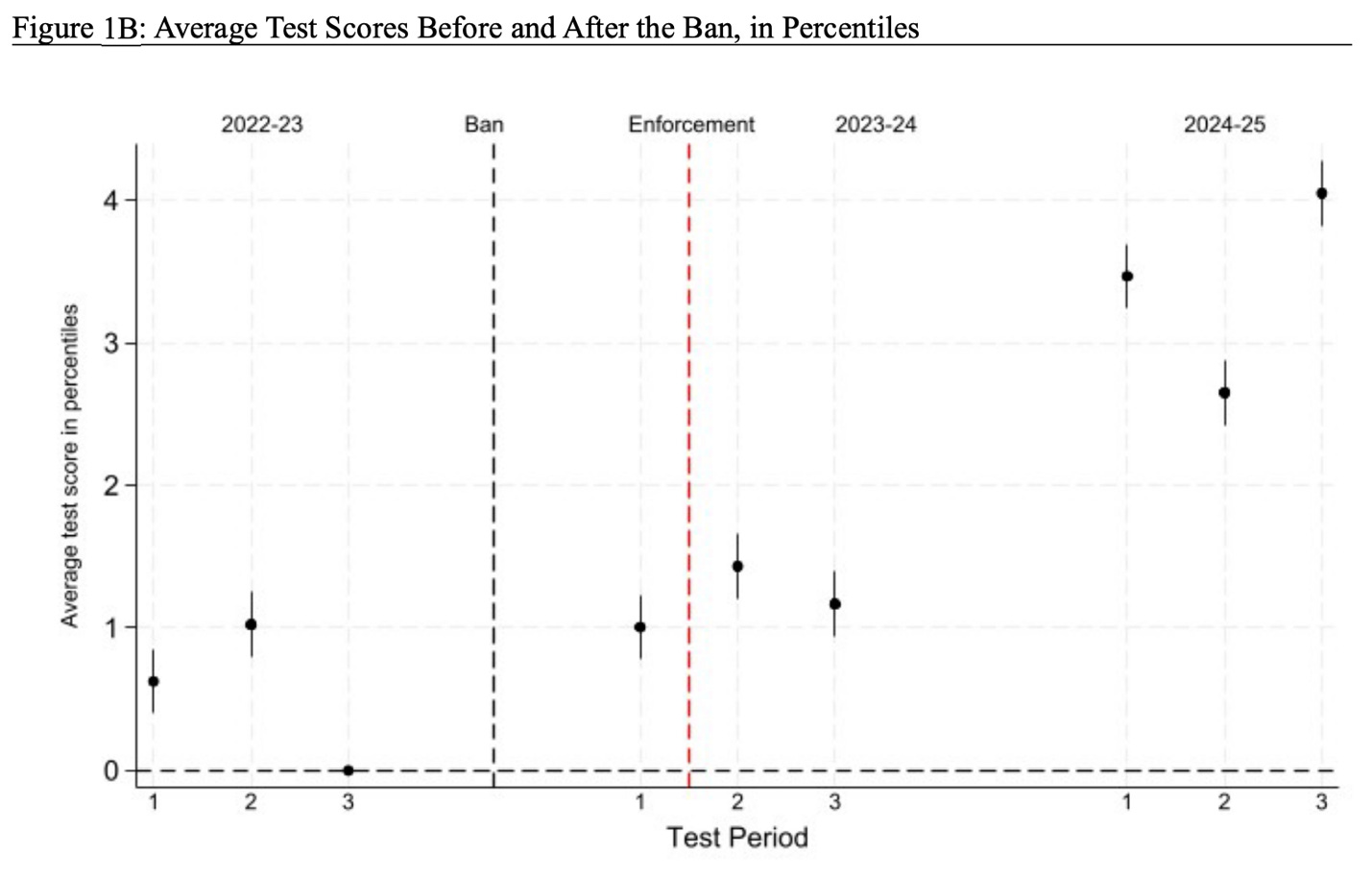
A new study, released as a working paper through the National Bureau of Economic Research, evaluates Florida’s experiment. In the authors’ analysis, the rule drastically reduced student phone use, led to a temporary increase in disciplinary incidents, and improved test scores.

Let’s dig in a little.

The study focuses on an unnamed “large urban county-level school district” in Florida. While the state law restricted phone use only during instructional time, this district went further, requiring phones to be silenced and put away for the entire school day. The policy went into effect in May of 2023 and was enforced with disciplinary measures starting in September of that year.

The change reduced student phone use, measured via phone location data captured from 9 a.m. to 1 p.m. on school days, by about two-thirds. This is a striking victory if you find it self-evident that kids shouldn’t have cell phones on in school.

The transition was a little rough, with disciplinary incidents increasing over the first year—by around 20 monthly incidents per 10,000 students—especially in schools with higher levels of pre-ban phone use. Male and black students were disproportionately affected, though it’s unclear to what extent that stems from behavior vs. enforcement disparities. At any rate, discipline mostly returned to normal in the second year.

That’s also when the test-score benefits manifested. Scores rose a couple of percentiles, on average: a student at the 48th percentile nationally, for example, would tend to end up around the median. The change was largest in schools with higher pre-ban phone use. Student absences also declined and fewer kids switched schools, which may help explain the improvement.

All in all, this looks like a successful policy: Less distracting phone use in schools, better attendance, higher test scores. More effort is warranted, though, to confirm these results elsewhere — and to figure out the best way of implementing and enforcing cell-phone bans.

October 3, 2025

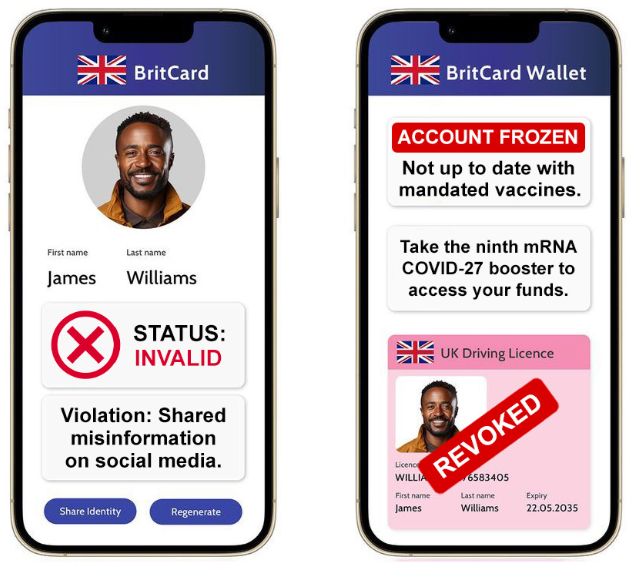
Adding digital ID to the pocket moloch … what could possibly go wrong?

Filed under: Britain, Bureaucracy, Government, Liberty, Technology — Tags: , , , , — Nicholas @ 03:00

On Substack, Andrew Doyle explains why it’s a terrible idea to trust the government — any government — in forcing digital ID on everyone:

An illustration of Jeremy Bentham’s Panopticon prison.
Drawing by Willey Reveley, 1791.

During a trip to Russia in 1785, the philosopher Jeremy Bentham sketched an outline for a new prison design. The cells were arranged around the circular perimeter and, at the centre, he placed his “panopticon”: a watchtower which afforded a view of any of the cells at all times. The prisoners might not always be being observed, but they could never be sure that they weren’t.

Bentham’s design was never directly used, but the idea took hold as a symbol of state overreach and control, most famously in Michel Foucault’s Discipline and Punish (1975). Foucault was alert to the political ramifications of such a concept, and how surveillance might become an internalised experience. With Keir Starmer now pledging to introduce a digital ID system as a mandatory condition for the right to work, are we seeing the first step towards the realisation of Bentham’s vision?

I suppose we are already there. I have seen friends switch off their phones before discussing politically sensitive issues, genuinely convinced that digital eavesdropping is the norm. Many people are mistrustful of the “Alexa” voice assistant, which they are persuaded is recording their every word. While this all seems terribly conspiratorial, I’m sure most of us remember those reports a few years ago about the Pegasus spyware which had been covertly installed on the phones of journalists and government figures, turning the devices into pocket spies.

[…]

Few will be surprised to hear that public trust in political institutions has plummeted. The increasingly authoritarian tendencies of successive governments, our two-tier policing system, public manipulation as embodied in the “nudge unit”, and the corrupt prioritisation of the interests of the political class over the people they serve – perhaps best demonstrated by parliament’s flagrant efforts to overturn the Brexit vote – have all contributed to this climate of mistrust. The bizarre overreach of police during the lockdowns – in which dog walkers were publicly shamed with drone footage, and shopping trolleys were probed for “non-essential items” – has hardly helped matters.

To many of us, it is baffling that anyone at all would support the prospect of the government keeping track of our movements and holding our private details in a database. Starmer claims that the scheme will curb illegal immigration, but we are talking about criminals who already work outside the system and will doubtless continue to do so. Besides, identity cards have been a reality on the continent for years, and have done precisely nothing to resolve the problem. Employers in the UK are already legally obliged to insist on proof of immigration status from workers.

Labour’s digital ID scheme seems more about control than anything else. The possibility of fraud is also a major concern. It’s not as though the government has an unblemished track record of preventing data breaches. We all recall the massive leak of official MOD data regarding Afghans who had worked with the British government during the UK’s military campaigns. And who could forget the senior civil servant who, in 2008, left top-secret documents concerning al-Qaeda and Iraq’s security forces on a train from London Waterloo? Are we really to suppose that the creation of an all-encompassing centralised database will not leave the public open to risk from hackers and hostile foreign powers?

Tim Worstall adds that “they c’n fuck off ‘n’ all”:

So we’ve that wet dream of Tony Blair raising its ugly head again. There should be a national ID system. Actually, it’s not just Blair, T — the bureaucracy has been right pissed at the erasure of the wartime system since the 50s when it was abolished.

For there are two ways of looking at, thinking about, the whole governance thing. One is — the Blair, bureaucrats’, version — that the population are cattle, kine, to be managed. For the benefit of the bureaucracy of course — or at very least to be forced into doing what the bureaucracy thinks they — we — should be doing.

Then there’s that stout Englishman, the Anglo Saxon, version, which is that government are just the slaves we communally hire to make sure the bins get emptied. Well, OK, maybe raise a bit of tax for a Royal Navy to sink the Frenchies. But even then, not too much of that — the Civil War was, after all, triggered by Ship Money. Did the people who would not be slaughtered by the first wave of invading Frenchies — because they had the silly excuse of living 25 miles inland — have to pay the tax to run the Royal Navy to keep the Frenchies at bay or not? The King said yes — the King was right — and not for the first nor last time in British political history the guy who was right had his head cut off for being so.

Digital ID, so which version should we have? That one beloved of Froggie-type bureaucrats who view La Profonde as kine to be corralled? Or the Anglo Saxon version where we just devolve the scut work to a few slaves?

[…]

The reason this never will be proposed is that it doesn’t fit the reasons why our rulers wish to have an ID system. They’re insistent that we be their kine rather than they our. So, the Hell w’ ’em.

But it could be done. Government simply publishes an interface — an API — which says that proof of identity needs to be presented in this format. We’re done as far as whose kine is whose.

Update 4 October: From Samizdata, another illustration of just how toxic Two Tier Keir has become to British voters:

The Guardian reports:

    “Reverse Midas touch”: Starmer plan prompts collapse in support for digital IDs

    Public support for digital IDs has collapsed after Keir Starmer announced plans for their introduction, in what has been described as a symptom of the prime minister’s “reverse Midas touch”.

    Net support for digital ID cards fell from 35% in the early summer to -14% at the weekend after Starmer’s announcement, according to polling by More in Common.

    The findings suggest that the proposal has suffered considerably from its association with an unpopular government. In June, 53% of voters surveyed said they were in favour of digital ID cards for all Britons, while 19% were opposed.

September 29, 2025

Screen addiction – “No drug cartel makes as much money as the screen-and-app companies”

Filed under: Health, Media, Technology — Tags: , , , , , , — Nicholas @ 03:00

Ted Gioia on the eight things about screen addiction that David Foster Wallace tried to warn us about before he took his own life in 2008:

Those same youngsters are now showing up on college campuses, and we can begin to gauge the societal impact of a screen-driven life. It ain’t pretty.

So this is a good time to revisit what Wallace tried to warn us about thirty years ago. He was ahead of his time in the worst possible way, experiencing firsthand all the debilitating symptoms that now plague millions.

That’s why his writings feel so eerily contemporary. They read like commentaries on what’s happening right now.

Of course, Wallace knew very little about the Internet — he deliberately avoided it. He also refused to own a television. He understood how susceptible he was to screen addiction, and took drastic steps to reduce his exposure to all screens.

But he wrote about it — most tellingly in his huge novel Infinite Jest. The title refers to a film that is so addictive that people who watch it can’t stop. They literally watch it to death. It’s an infinite diversion, much like the endless scrolls on today’s social media apps.

He returned to the topic in his final book The Pale King, and also discussed it in interviews and essays. I’ve read through all of these including more than thirty interviews with the author. These allow me to put together a point-by-point summary of what Wallace tried to tell us.

We ignore his warnings at great risk.

(1) Screen technology will cause a crisis of loneliness, especially among young people.
In almost every interview, Wallace eventually talks about loneliness. It was a looming crisis, he insisted. But he was one of the first to link this to the ways we divert ourselves via screens. […]

(2) This will lead to widespread depression.
Wallace also knew this firsthand. He suffered intensely from depression. His inability to find a suitable treatment led to his suicide in 2008. […]

(3) This will also happen at a larger scale. Society will grow more fragmented and disconnected.
As each person falls into an isolated relationship with a screen, larger communities begin to fray. Wallace anticipated a “new vision of the U.S.A. as an atomized mass of watchers and appearers”. […]

(4) Screen technology promises to liberate us, but the reality is that it controls us for the benefit of others.
The most dangerous part of the screen entertainment is the illusion that it serves us. But the reality is that we actually serve tech platforms and their advertisers. […]

(5) The people who control the technology work to hide their purposes and goals.
“They’re trying to lock us tighter into certain conventions, in this case habits of consumption,” Wallace told Larry McCaffery in 1993. “This is McLuhan right? ‘The medium is the message’ and all that? But notice that TV’s mediated message is never that the medium is the message.” […]

(6) Our survival will depend on our ability to remain independent of these forces.
If we abandon ourselves completely to the tech (as many now do), we become pawns in the corporate agenda to monetize us — at a tremendous cost in loneliness, depression, and social disconnection. […]

(7) We don’t have many tools, but kindness and compassion will be the starting point.
We need to replace irony, sarcasm, and cynicism — which have contributed to our self-debasement — with softer, gentler attitudes. Cynicism is useful in criticizing, but is impotent when we need to build something better. Irony only destroys, never builds. […]

(8) Art can help us heal.
He wrote his big books with the hope that they would help us find a way back to a more caring and connected world — but connected via people, not screens. […]

June 28, 2025

Punctuation microaggression

Filed under: Media, Technology — Tags: , , , , , , — Nicholas @ 04:00

We appear to have an entire generation — Gen Z — suffering undue trauma from, checks notes, aggressive and distressing punctuation marks:

“American typewriter keyboard layout” by Любослов Езыкин is licensed under CC BY-SA 4.0 .

What is more delicious than casting sweeping judgements over entire generations? Contrary to prevailing wisdom, studying and mocking the mores and manners of Generation Z is not only morally just but entirely natural. Not to mention good fun.

At the end of this paragraph, re-read this string of sentences. Study the punctuation. You’ll notice that each sentence ends with a satisfying symbol. What Americans call a period and what Britishers call a full stop signifies the end of the sentence — that the sentence contains a complete thought. How lovely.


That unassuming little dot was good enough for Shakespeare, Hemingway, Ibsen, Miller — every writer who mastered the well-mannered violence of the English Language. They understood, too, the writerly compulsion to kneel before that impossible mistress. Submission sets the writer free.

Submission, however, is not in vogue. Submission implies hierarchy, which implies standards — forbidden notions to anyone under 45.

Generation Z. The Zoomers. Those with the misfortune to have spawned here on Earth between 1997 and 2012. This swarm of digital natives has never known a world without the internet. Or, it appears, one with grammatical standards.

According to linguists, Zoomers view the full stop as Bill Clinton views a well-adjusted woman: with intrinsic horror. For Zoomers, the full stop is the mark of unbridled aggression. Zoomers refuse full stops — period.

In The Telegraph, one-linguist-cum-exorcist said that Zoomers find the full stop deeply troubling. That little dot before these seven words provokes a generational panic attack: “Full stops signify an angry or abrupt tone of voice”.

Another expert chimed in. Dr Lauren Fonteyn tweeted, “If you send a text message without a full stop, it’s already obvious that you’ve concluded the message. So, if you add that additional marker for completion, they will read something into it, and it tends to be a falling intonation or negative tone.”

To renew my sense of horror, I probed further. In a 2015 study at New York’s Binghamton University, undergraduates perceived text messages ending with a full stop as “less sincere” than the same message without one.

Language, like the fish, rots from the head. Researchers also found that exclamation marks, those hyperactive symbols of faux cheer, achieved the opposite of full stops. Those employing an exclamation mark appeared “more sincere and engaged”.

March 24, 2025

Postcards from academia’s zombie apocalypse

Filed under: Education, Media, Technology — Tags: , , , , — Nicholas @ 03:00

Ted Gioia points out exactly why them there kids ain’t learnin’ no more:

[High school students] just care about the next fix — because that’s how addicts operate. They have no long term plan, just short term needs.

They can’t get back to their phones fast enough.

How bad is it for educators right now?

Check out this commentary from one experienced teacher, who finds more engaged students in prison than a college classroom.

This comes from Corey McCall, a member of The Honest Broker community who recently posted this comment:

    I saw this decline in both reading ability and interest occur firsthand between 2006 and 2021 … I had experience teaching undergrads who hadn’t comprehended the material before, but hadn’t faced the challenge of students who could read it but who simply didn’t care …

    Since 2021 I’ve been teaching part-time in prison, and incarcerated students really want to learn. They love to read and think along with authors such as Plato, Descartes, and Simone de Beauvoir. I am teaching Intro to Theater this semester (the story of how this happened is interesting, but is irrelevant here) and students have been poring over Oedipus the King and asking why this amazing play isn’t performed more regularly alongside plays like Hamilton and The Lion King.

    I believe that there is hope for the humanities and perhaps for culture more generally, but it will be found in unusual places.

I’ve made a similar claim in this article — where I look outside of college for a rebirth of the humanities. It would be great if it happened in classrooms, too, but I fear that they are now the epicenter of the zombie wars.


Alas, I fear the number of zombie students is still growing — and at an accelerated pace.

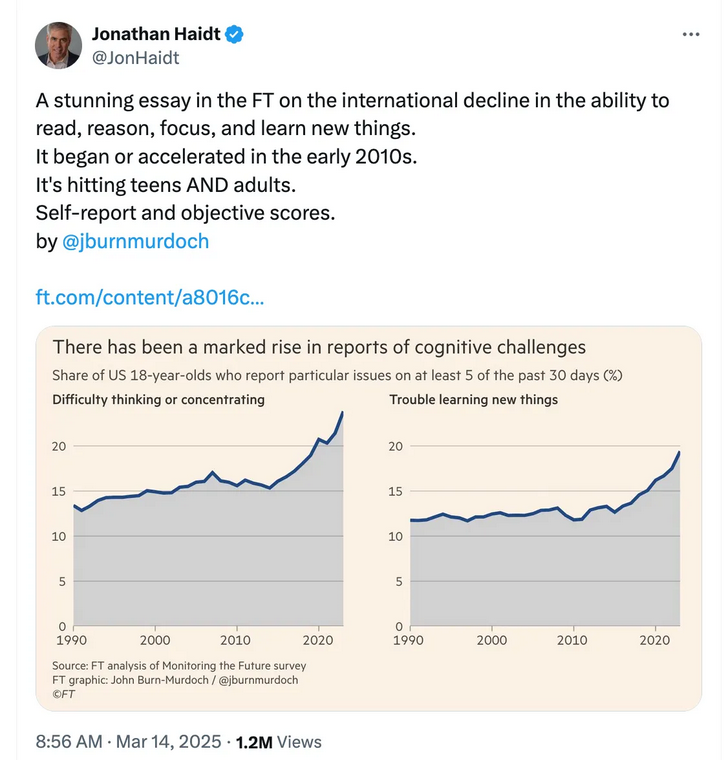
Jonathan Haidt, who has taken the lead in exposing this crisis — and thus gets attacked fiercely by zombie apologists — shares horrifying trendlines from Monitoring the Future.

This group at the University of Michigan has studied student behavior since 1975. But what’s happening now is unprecedented.

Students are literally finding it too hard to think. So they can’t learn new things.

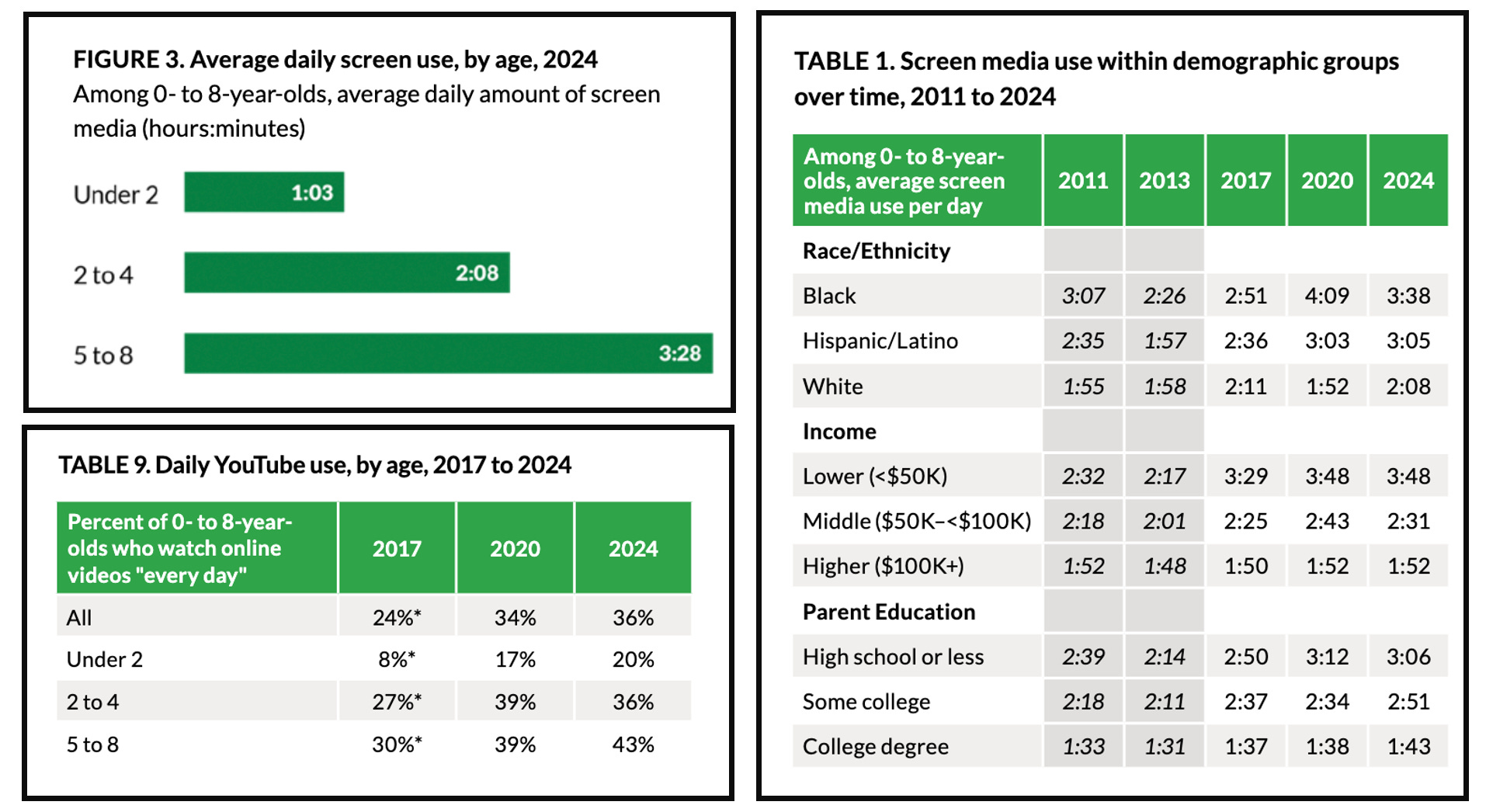
Below are more ugly numbers from another in-depth study — which looks at how children spend their day. It reveals that children under the age of two are already spending more than an hour per day on screens.

YouTube usage for this group has more than doubled in just four years.

Poor and marginalized communities are hurt the most. As your income drops, your children’s screen time more than doubles.

In other words, these children are getting turned into screen addicts long before they enter the school system.

This is why teachers are speaking out. They see the fallout every day in their classrooms.

January 1, 2025

The EU emulates King Canute

Filed under: Bureaucracy, Business, Europe, Technology — Tags: , , — Nicholas @ 05:00

The headline is a bit misleading, as Canute’s failed attempt to control the tides was intended to refute courtiers’ exaggerations about his royal powers. The EU, on the other hand, is determined to impose stasis on a very dynamic and changing field:

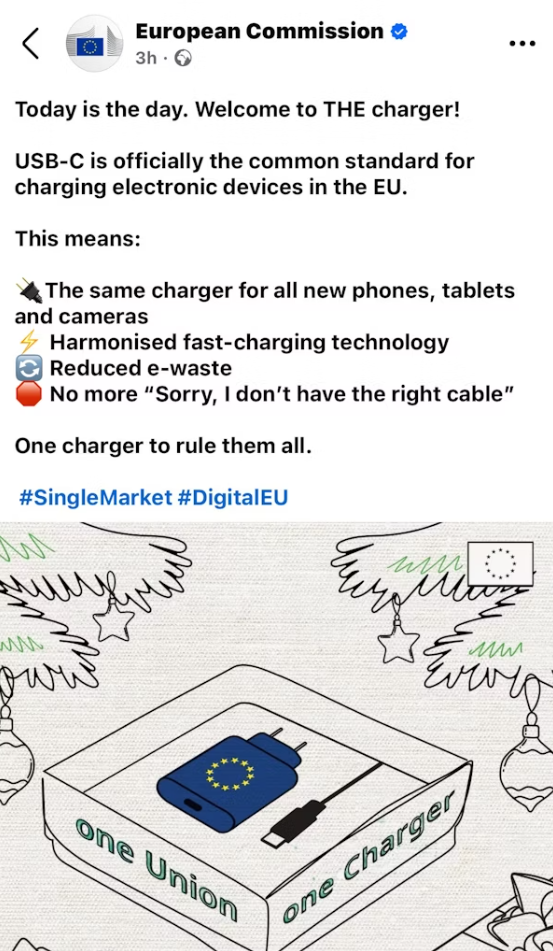
The European Union will have the continent-wide standard for the buggy whip real soon now. That’s the logical conclusion to draw from that recent announcement about USB-C.

For those who’ve not been following along at home the European Commission is very proud of itself. They’ve managed to pass a law mandating that USB-C (don’t worry, it’s a shape of cable) be the only flavour of connector now allowed within the EU. This has caused the less intellectual of our own rulers — St Stella for example — to just quiver, gasp, with excitement. This is proof of the ability of the collective bureaucracy to really stick one to The Man or something. A vast victory over Big Cable it seems.

Well, yes. Those with a little history to their name will know that the EU has been trying to do this for some time now. So much time that they’d originally intended to make Micro-USB the Europe-spanning insistence but it took them so long to make their rules that USB-C had already superseded it.

At which point we might draw a couple of conclusions. Even, suggest an insistence or two. That first insistence would be that a time of rapid technological change is really not quite le moment juste to be insisting upon only the one way of doing things. Because change, d’ye see? No, this is important for we know, absolutely, that there’re people out there just itching to insist upon the one connector for electric vehicles. Who would, in the name of a vapid uniformity, insist upon freezing technology at its current state rather than allow it to develop.

We could, should, also go on to insist that such a legal insistence on the only form allowed means that technological development cannot happen any more. For, in order to advance or even just change it will be necessary to change that law, that definition.

Legal changes in the European Union are not easy. Of course, the Parliament cannot do it — they are not allowed to even propose law changes, let alone enact them. It is necessary first to convince the European Commission of the need for a change. That means convincing the bureaucracy of course. Once that’s done it must pass the Council of Ministers, which is all the national governments. Parliament is then allowed to say yes. Then, and only then, would it be possible to put the new technology — say, a new cable — on the market.

But the only method we’ve got of testing whether a new cable is better is by putting it on the market. That is — no, really — the only process by which we find out whether consumers desire this new cable with all its delights, at the price that suppliers are willing to make it. But in the European system they cannot undertake the basic usefulness test until they’ve convinced a continent full of politicians that the new is in fact necessary and compulsory.

October 5, 2024

Scary words of 2024 – “Luckily, FEMA is on the case”

As I recounted a few days back, I was relieved to hear from my friend in the Asheville NC area after the region absorbed the damage from Hurricane Helene. Tom Knighton had a similar experience:

A friend of mine lives at the edge of where Helene did her worst. He just got power back on yesterday and was finally able to let me know he was OK. I was worried for obvious reasons.

In the deepest, worst parts of where the storm ripped things to shreds, they’re trying to just make it to the next day. They’re struggling to find clean drinking water, food, shelter, the works.

Luckily, FEMA is on the case.

They took to social media yesterday and posted this crap.

That’s right. People who don’t have internet, phone service, or electricity should call, download an app, or log onto the FEMA website.

I won’t ask how stupid can the federal government be, but I’m worried they’d take it as a challenge.

Back in the day, FEMA would roll into a disaster area with paper applications and facilitate all of that right there. While the internet and smartphones are glorious things, this is a prime example of when they’re a terrible option for people.

Right now, American citizens are struggling. They’re thankful to be alive and are working their butts off to keep themselves alive. They’ve paid taxes their entire lives, and now that they need some of theirs back, their federal government is telling them to do what is physically impossible for many of them.

I can’t help but see this and think that their claims of having enough money in spite of spending hundreds of billions on illegal immigrants ring a tad hollow.

If they have the money, why not put boots on the ground getting people signed up for any assistance they may be entitled to?

Honestly, while I’ve commented before about the gross incompetence of the government in disaster response — and I’ll agree that maliciousness is most definitely a possibility, if not a probability in these instances — this is just weapons-grade … whatever, be it stupidity, meanness, or a combination of both.

Heads should roll.

Update: David Warren notes that it’s not merely FEMA incompetence, it’s active deterrence for private relief efforts by all federal agencies.

From the Internet (for instance updates from Elon Musk), we note that non-governmental charitable efforts are not merely “discouraged”. The government is seizing and impounding desperately-needed local goods and services. The rest of the federal bureaucracy is also “chipping in”, to stifle relief efforts. The FAA, for instance, is restricting private aircraft with supplies, and making it almost impossible to fly drones, demanding that flights be individually approved by their slothful trolls. Those who wish to bring help to the survivors have both the wreckage of the storm, and government agents to block them.

This is how things work in this world, and have worked, since the Reformation, when the state took over welfare, hospitals, schools, and all other eleemosynary institutions. Rather than allow inspiring expressions of Christian charity, they became the means for cynical political posturing and control. And with “democracy”, we have detailed laws and policies, to prevent the people from helping themselves — as they would do, by laws of nature.

October 1, 2024

Devastation in the Carolinas

My oldest friend moved to the United States many years ago, moving around the country as his job dictated, but a few years back he and his wife found their perfect house near Asheville, NC. We had emailed to see how they were doing, but got no answer. Yesterday, I got a call from my friend’s cell phone to say that he and his wife were fine and they’d taken in an elderly neighbour until things get back to normal, but they currently don’t have electricity, land line telephone, or municipal water, but they’re otherwise fine. Their house is well above flood level, and he has sufficient camping supplies to keep them going for a while. He loaned his chainsaw to another neighbour who was trying to organize work parties to cut away fallen trees and branches and get more of the local roads open again (my friend recently had lyme disease and doesn’t want to trust his hands doing something as risky as running a chainsaw). We kept the call as short as possible, as he’ll have to manually recharge his phone until power is restored.

Virginia Postrel is originally from that same area of western North Carolina and northwestern South Carolina and reports on how her family in the area is doing in the aftermath of Hurricane Helene:

One of the many examples of the “horizontal forest” on nearly every road in Greenville, SC.
Photo by Virginia’s brother Sam M. Inman IV.

If you read my autobiographical reminiscences, you may have realized that I have family in Upstate South Carolina and western North Carolina, which have been hit hard by the unexpected ferocity of Hurricane Helene. Power has been out in Greenville, SC, for days and roads are nearly impassable because of downed trees on nearly every block.

My brother Sam, who went out in a truck on Friday to buy gasoline for his generator, said only about half the stations that had working pumps and were running out of gas quickly. “Lines of cars around the block … reminiscent of the 1970s”, he texted. He went out again today and found a stark difference between local QuikTrip stations and others. At QT, the lines were longer but flowed faster because stations had closed all but a single entrance and exit. Elsewhere, stations were chaotic traffic jams. At one point, he found himself unable to exit after fueling up because the cars behind and in front of him left no to maneuver room. (He persuaded the one behind him to ease away from his bumper.)

The assisted living place where my mother lives has a generator and at first continued to operate its kitchen and elevators. By today, however, the generator had become unreliable, the lights were flickering, few employees could get to work, and the kitchen was offering dry Cheerios for breakfast. Sam brought our mom to his house, which has no power. He later realized that he needed to return to get her medicine, which usually is delivered daily. I can only imagine how residents who don’t have local family — or who are in the memory care wing! — are managing.

Even people who were prepared with generators, many bought after a blizzard 20 years ago, needed gasoline to power them and, they soon realized, adapters to connect them to household appliances. The adapter aisle at Home Depot was quickly depleted.

The good news is that food is available. Grocery stores are operating more or less as normal, assuming you can get to them. When you sell frozen food, you apparently install large, reliable generators.

Meanwhile, my cousin in Asheville finally got weak cell signal back today. We’d been unable to communicate with her before now. With her husband, pets, and 95-year-old mother, she’s evacuating to Winston-Salem through the weekend, hoping Duke Power will live up to promises that power will be restored by Friday but preparing in case it takes a few days longer.

Although terrible in some areas, the flooding isn’t as bad as it might be, thanks to the region’s many man-made lakes. They absorbed water that otherwise would have flowed into populated towns.

September 30, 2024

QotD: Compound eyes as models of how the surveillance state operates

Filed under: Government, Media, Quotations, Technology — Tags: , , , , — Nicholas @ 01:00

Compound eyes, common with insects and crustaceans, are made up of thousands of individual visual receptors, called ommatidia. Each ommatidium is a fully functioning eye in itself. The insect’s “eye” is thousands of ommatidium that together create a broad field of vision. Every ommatidium has its own nerve fiber connecting to the optic nerve, which relays information to the brain. The brain then processes these inputs to create a three-dimensional understanding the surrounding space.

The compound eye is a good way to imagine how the surveillance state will keep tabs on the subjects in the near future. Unlike the dystopian future imagined by science fiction, it will not be one eye focusing on one heretic, following him around as he goes about his business. Instead it will be tens of millions of eyes obtaining various bits of information, sending it back to the data-centers run by Big Tech. That information will be assembled into the broad mosaic that is daily life.

For example, rather than use informants and undercover operatives to flesh out conspiracies against the state, the surveillance state will use community detection to model the network of heretics. Since everyone is hooked into the grid in some fashion and everyone addresses nodes of the grid on a regular basis, keeping track of someone is now something that can be done from a cubicle. There is no need to actually follow someone around as they go about their life.

For example, everyone has a mobile phone. At every point, the phone is tracking its location, which means it is tracking your location. It also knows the time and day when you go into various businesses. Most people use cards to pay miscellaneous items, so just that information would tell the curious a lot about you. Combine that information with the same information from other phones that come into close proximity with your phone and figuring out the community structure is simple.

Of course, the mobile phone is not the only input device. Over Christmas, millions of Americans were encouraged to install surveillance devices in their homes by friends and family. Maybe it was an Alexa listening device from Amazon or a Nest Doorbell surveillance device from Google. All of these gadgets are collecting data on your life inside and around your home. It is then fed to the same data-centers that have all of your movements and associations collected from your phone.

The Z Man, “The Compound Eye”, The Z Blog, 2020-01-08.

August 18, 2024

QotD: Cell phones on airplanes

Filed under: Business, Quotations, USA — Tags: , , — Nicholas @ 01:00

The thought of people being able to use cell phones on airplanes during flight is almost too horrible to contemplate. But I understand why the airlines are considering it: They’ve run out of new ways to make flying unpleasant. Long lines, inexplicable delays, lost baggage, no food, filthy airplanes, unhappy workers (is anyone else worried about planes being flown by despondent pilots who’ve had their pensions stolen from them?) — allowing people to use their cell phones is the only way for the airlines to freshen up the hell they’ve created for us.

Andrew Sullivan, “Terror Cells”, AndrewSullivan.com, 2005-08-09.

May 20, 2024

The first post-privacy generation in human history

Filed under: Economics, Liberty, Media, Technology, USA — Tags: , , , , — Nicholas @ 05:00

You may have mixed feelings about the Zoomers — even if you happen to be a Zoomer — but it’s beyond argument that they are the first generation who have grown up in a zero-privacy world:

“Privacy” by g4ll4is is licensed under CC BY 2.0 .

Zoomers are the first post-privacy generation in human existence. They will never know a world in which they can try to lose themselves without somehow being tracked. Roughly three years ago, I was speaking with the CEO and founder of a commercial digital advertising company from NYC. He told me that their technology was so powerful that they were able to figure out when people were getting up from their couches to go into another room simply via their own digital advertising software.

It’s very tough to wrap our heads around the complete loss of privacy. For me, I have trouble remembering how it was to be out of instantaneous reach via mobile phone. Pre-mass adoption of cell phones, people would effectively be out of reach i.e. disappear for hours at a time, as the only way to contact them was to call them at home (inb4 beepers, as I never had one). We are constantly tracked and monitored, and our personal data is sold by data brokers all over the globe. One customer of personal ad tracking data is the CIA, as Matthew Petti explains:

    For years, the U.S. government has bought information on private citizens from commercial data brokers. Now, for the first time ever, American spymasters are admitting that this data is sensitive—but they’re leaving it up to the spy agencies on how to use it.

    Last week, Director of National Intelligence (DNI) Avril Haines released a “Policy Framework for Commercially Available Information.” Her office oversees 18 agencies in the “intelligence community“, including the CIA, the FBI, the National Security Agency (NSA), and all military intelligence branches.

    In the 2018 case Carpenter v. United States, the Supreme Court ruled that police need a warrant to obtain mobile phone location data from phone companies. (During the case, the Reason Foundation filed an amicus brief against warrantless snooping.) As a workaround, the feds instead started buying data from third-party brokers.

    Haines’ new framework claims that “additional clarity” on the government’s policies will help protect Americans’ privacy. Yet the document is vague about the specific limits. It orders the agencies themselves to come up with “safeguards that are tailored to the sensitivity of the information” and write an annual report on how they use this data.

more:

    As national security journalist Spencer Ackerman points out in his Forever Wars newsletter, the framework doesn’t require the feds to delete old purchased data. Earlier this year, Sen. Ron Wyden (D–Ore.) called on the NSA to purge all data that it bought without a warrant and without following the Federal Trade Commission’s privacy policies.

    “The framework’s absence of clear rules about what commercially available information can and cannot be purchased by the intelligence community reinforces the need for Congress to pass legislation protecting the rights of Americans,” Wyden tells Reason. “The DNI’s framework is nonetheless an important step forward in starting to bring the intelligence community under a set of principles and policies, and in documenting all the various programs so that they can be overseen.”

Case in point:

    Wyden has been aggressively pushing for transparency on data purchases over the past few years. In 2021, he uncovered that the Defense Intelligence Agency was buying Americans’ smartphone location data. That same year, he sent a letter to Haines and CIA Director Bill Burns complaining about a secretive CIA data collection program. (In an Orwellian turn, the letter itself was classified until 2022.) This year, Wyden revealed more details on NSA data purchases.

    Some of this data is collected and sold directly by the apps. For example, an intelligence company called X-Mode once paid MuslimPro, an app that offers a daily prayer calendar and a compass pointing towards Mecca, to include a few lines of location tracking code. X-Mode then sold the data to U.S. government agencies. MuslimPro claims that it did not intend to sell the data to the government and ended the arrangement after the story broke.

So, yeah … app maker will sell your personal data to a buyer like the CIA.

    In other cases, the data is siphoned from advertising markets. Every time a user opens a website with paid advertisements, their location and attributes appear on a real-time bidding (RTB) exchange, a virtual auction where companies buy ad space. Data brokers posing as advertisers scrape the listings for information on users.

    “Any government with a halfway decent cyber intelligence program is participating in these RTB exchanges, because it’s such an immensely valuable source of data,” says Byron Tau, author of Means of Control: How the Hidden Alliance of Tech and Government Is Creating a New American Surveillance State.

    As a demonstration of how powerful RTB data is, an intelligence contractor used data from the dating app Grindr to track gay government employees from their offices to their homes, Tau reported in his book.

The IRS is in on it too:

    Lawyers for the Internal Revenue Service, on the other hand, have argued that users voluntarily handed over the information, so the government is free to use it. Tau points out that users don’t really know how their data is being resold, and even the RTB exchanges themselves aren’t supposed to be used for data scraping.

    “A lot of these companies that are collecting data from the global population don’t have a real consumer relationship” with the people they’re spying on, Tau says. “Unless you know how to decompile software and you’re technically savvy, you can’t even make informed choices.”

In an increasingly digitized world, the right to privacy becomes wholly unworkable. Think digital payments by way of credit and debit cards vs. cash.

April 20, 2024

QotD: Cyber-addiction

Filed under: Health, Media, Quotations — Tags: , , — Nicholas @ 01:00

Researchers at the University of London Institute of Psychiatry say the distractions of email and such extract a toll on intellectual performance as similar to that of marijuana. The study of 1,100 volunteers found that attention and concentration could be so frazzled by answering and managing calls and messages that IQ temporarily dropped by 10 points. The resulting loss of focus due to “Crackberry”, in fact, was judged to worse than that experienced by pot smokers.

This, of course, cannot really be a surprise. It is a great hallmark of modern life that over-indulgence in practically anything can be turned into pathology given enough time and clinical studies.

Jeff A. Taylor, Reason Express, 2005-04-26.

April 5, 2024

“[T]oo many charlatans of this species have already been allowed to make vast fortunes at the expense of a gullible public”

Colby Cosh on his “emerging love-Haidt relationship” as Jonathan Haidt’s new book is generating a lot of buzz:

If Haidt has special expertise that wouldn’t pertain to any well-educated person, I wonder a little in what precise realm it lies. Read the second sentence of this article again: he’s a psychologist … who teaches ethics … at a business school? Note that he seems to have abandoned a prior career as an evolutionary biology pedlar, and the COVID pandemic wasn’t kind to his influential ideas about political conservatives being specially motivated by disgust and purity. Much of The Anxious Generation is instead devoted to trendy findings from “neuroscience” that it might be too kind to describe as “speculative”. (I’ll say it again until it’s conventional wisdom: a “neuroscientist” is somebody in a newly invented pseudofield who couldn’t get three inches into the previously established “-ology” for “neuro-“.)

These are my overwhelming prejudices against Haidt; and, in spite of all of them, I suspect somebody had to do what he is now doing, which is to make the strongest available case for social media as a historical impactor on social arrangements and child development. Today the economist/podcaster Tyler Cowen has published a delightfully adversarial interview with Haidt that provides a relatively fast way of boning up on the Haidt Crusade. Cowen belongs to my pro-innovation, techno-optimist, libertarian tribe: we both feel positive panic at the prospect of conservative-flavoured state restrictions on media, which are at the heart of the Haidt agenda.

But reading the interview makes me somewhat more pro-Haidt than I would otherwise be (i.e., not one tiny little bit). On a basic level, Cowen doesn’t, by any means, win the impromptu debate by a knockout — even though he is one of the most formidable debaters alive. Haidt has four key reforms he would like to see implemented politically: “No smartphones before high school; no social media before age 16; phone-free schools; far more unsupervised play and childhood independence.”

This is a fairly limited, gentle agenda for school design and other policies, and although I believe Haidt’s talk of “rewiring brains” is mostly ignorable BS, none of his age-limitation rules are incompatible with a free society, and none bear on adults, except in their capacity as teachers and parents.

The “rewiring” talk isn’t BS because it’s necessarily untrue, mind you. Haidt, like Jordan Peterson, is another latter-day Marshall McLuhan — a boundary-defying celebrity intellectual who strategically turns speculation into assertion, and forces us, for better or worse, to re-examine our beliefs. McLuhan preached that new forms of media like movable type or radio do drive neurological change, that they cause genuine warp-speed human evolution — but his attitude, unlike Haidt’s, was that these changes are certain to happen, and that arguing against them was like arguing with the clouds in favour of a sunny day. The children who seem “addicted” to social media are implicitly preparing to live in a world that has social media. They are natives of the future, and we adults are just observers of it.

March 31, 2024

“Nobody trusts the technocracy anymore. People suffer from it.”

Ted Gioia is both surprised and pleased that so many people responded to his recent anti-technocatic message:

When I launched The Honest Broker, I had no intention of writing about tech.

My main vocation is in the world of music and culture. My mission in life is championing the arts as a source of enchantment and empowerment in human life.

So why should I care about tech?

But I do know something about the subject. I have a Stanford MBA and spent 25 years at the heart of Silicon Valley. I ran two different tech companies. I’ve pitched to VCs and raised money for startups. I’ve done a successful IPO. I taught myself coding.

I’ve seen the whole kit, and most of the kaboodle too.

I loved it all. I thought Silicon Valley was a source of good things for me — and others.

Until tech started to change. And not for the better.

I never expected that our tech leaders would act in opposition to the creative and humanistic values I held so dearly. But it’s happened — and I’m not the only person who has noticed.

I’ve published several critiques here about the overreaching of dysfunctional technology, and the response has been enormous and heartfelt. The metrics on the articles are eye-opening, but it’s not just the half million views — it’s the emotional response that stands out.

Nobody trusts the technocracy anymore. People suffer from it.

Almost everybody I hear from has some horror story to share. Like me, they loved new tech until recently, and many worked in high positions at tech companies. But then they saw things go bad. They saw upgrades turn into downgrades. They watched as user interfaces morphed into brutal, manipulative command-and-control centers.

Things got worse — and not because something went wrong. The degradation was intentional. It happened because disempowerment and centralized control are profitable, and now drive the business plans.

So search engines got worse — but profits at Alphabet rose. Social media got worse — but profits at Meta grew. (I note that both corporations changed their names, which is usually what malefactors do after committing crimes.)

Scammers and hackers got more tech tools, while users got locked in — because those moves were profitable too.

This is the context for my musings below on the humanities.

I don’t want to summarize it here — I encourage you to read the whole thing. My only preamble is this: the humanities aren’t just something you talk about in a classroom, but are our core tools when the human societies that created and preserved them are under attack.

Like right now.

Older Posts »

Powered by WordPress