Quotulatiousness

October 11, 2020

“Doctrinaire cuisine is dangerous”

Filed under: Food — Tags: , — Nicholas @ 03:00

Felipe Fernández-Armesto is not a fan of printed recipes, for they quash the creative, adventurous spirit he feels is required for proper cooking:

“The Joy of Cookbooks” by shoutabyss is licensed under CC BY 2.0

I believe in freedom and one of the reasons for my hatred of recipes is their peremptory, commanding tone, as if the writer knew the only way to fashion the dish. Variants from the inflexibly regimented columns of most cookbooks are made to seem like heresies.

Recipes are typically officious and pettifogging, treating readers as idiots, who don’t know how to suit their own taste or adjust traditions.

Many read like nursery-school arithmetic: add x amount of flour and y of milk to z of butter to produce a predictable outcome. Creativity and adventure get no badge. By specifying quantities, the teacher robs cooking of its status as art and turns it into drearily certified schoolkid-science.

Doctrinaire cuisine is dangerous. Friendships founder and marriages crash over differences about whether — for instance — to put onions in Spanish omelette or chillies in curry, or disputes over whether eggs are better scrambled in a deep or shallow dish. I’m happy to leave chacun à son goût in almost everything.

If you want to marmalade your kippers or make mayonnaise with sunflower oil, I’ll despise your mind and denounce your taste, but I’ll defend your right, as thoroughly as if you wanted to vote Republican or learn line-dancing. I’ll tolerate tinned tomatoes in ratatouille, as long as I don’t have to eat it, or rose veal in Wiener schnitzel, or even honey instead of molasses in baked beans.

But there are some abominations that are destructive of happiness, because they deprive eaters of opportunities of enjoyment, or turn wonderful ingredients to waste. Most of them occur in recipes exposed to the internet, where nannies write for nincompoops.

July 27, 2020

Food in Ancient Rome – Garum, Puls, Bread, and Moretum

Filed under: Europe, Food, History — Tags: , , , — Nicholas @ 02:00

SandRhoman History
Published 7 Jul 2019

Food in ancient Rome – the cuisine of ancient Rome is probably not everybody’s cup of tea. Food in ancient Rome was consumed at the mensa, the dining table of the ancient Romans. A usual ancient Roman meal for the upper classes could look like this: puls, one of the main ancient Roman meals. This was essentially a form of porridge, along with that they might have eaten bread, refined with olives and figs. Bread was often eaten with moretum, a spread, made of sheep cheese, a lot of garlic and herbs. Most Roman meals would have been spiced with garum, a fermented fish sauce, to go along with such a meal, the Romans drank water or wine. Beer, called cervisia, in contrast would have been considered barbaric. The wine was usually diluted with water and sometimes spiced with herbs and vinegar. Water with vinegar was called posca, another variant was mulsum, wine spiced with honey.

Ancient Roman food had even more variety, but for now we just made the recipes below. We might make some more ancient Roman food in the future though.

Ancient Roman recipes:

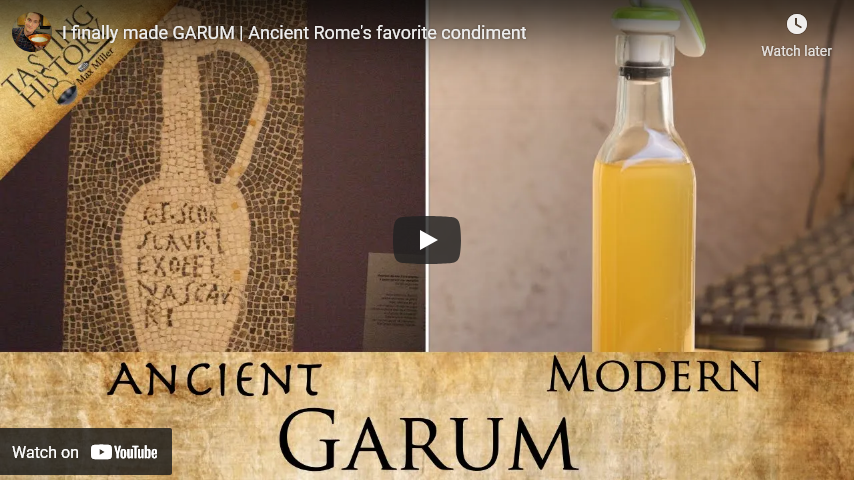
First off: Put garum into everything. That’s actually what the Romans used, usually instead of salt and/or other condiments. [Consider it the ketchup of the ancient world.]

Garum recipe
– 1000 g small fish (sardines, anchovies or similar, fresh or frozen but uncooked)
– 500 g sea salt
– 2 1∕2 tbsp. dried oregano
– 1 tbsp. dried mint
– 1,5 litres water
– 5 tbsp. honey
Put everything in a pot and cook it until the fish falls apart (ca. 15 minutes). Pestle it with a spoon or similar and reduce this broth for at least 20 minutes. Then strain it, let it cool and strain it again. Additionally, you can pour it through a filter cone to refine the garum even further. Keep the garum in the fridge and throw it away if it gets dreggy.

Moretum recipe
– 300 g of ricotta
– 100 g pecorino (or similar hard sheep cheese)
– 3 tbsp. white wine vinegar
– 3 tbsp. sea salt
– 3 cloves of garlic
– a bunch of thyme
– a bunch of rosemary
– a bunch of estragon [tarragon]
– a bunch of coriander
garum
Press the garlic, grind the pecorino and stir all the ingredients until you get a consistent mass. Done!
Pro tip: You might want to be careful with the amount of salt and especially garlic you add. Three cloves make it very intense.

Puls recipe
– 500 g rolled oats
– 1.5 litres of water
– 1 tbsp. olive oil
– 100 g pecorino (or similar hard sheep cheese)
– 1 onion
– 2 carrots
– 150 g mushrooms
– 100 g streaked pork
garum
Chop all the vegetables and cut the pork into strips. Then roast it gently in a bit of olive oil and put it aside. Cook the rolled oats with some water and add continuously as it disperses until you get a porridge-like consistency. Then add the prepared vegetables and meat and fold in the ground pecorino.
If you want to stay somewhat authentic to the Roman recipe use white, violet or yellow carrots: orange ones weren’t known in the occident until the Middle Ages.

Panis militaris castrensis (Roman bread) recipe
Ingredients for one loaf (4 – 6P):
– 500 g spelt flour (whole grain)
– ½ tsp. of salt
– olives
– figs
– 3 tbsp. olive oil
– 1 tsp. honey
– 3 dl water (hand-hot)
– 15 g yeast (or one package of dry yeast)

Mix everything up and knead it for at least 15 minutes. Then let it rise for an hour in a bowl covered with a towel (preferably in a warm spot). Form a loaf, cut six pieces (halfway through) and bake it for 35 minutes at 180°C.

Pro tip: take big olives and lots of them because the whole grain flour will be so dense that they kind of disappear.

Those recipes are taken from a cookbook which has been written about 2,000 years ago. Taking this into account you should be rather careful applying these cooking techniques. We are not to be held responsible for any damage resulting, neither for smelly apartments, nor for health issues.

#food #ancientrome #history #ancienthistory #rome

Twitter: https://twitter.com/Sandrhoman

July 7, 2020

Homemade Flatbread in Minutes – How to Make the World’s Oldest Bread

Filed under: Food — Tags: , , — Nicholas @ 02:00

Food Wishes
Published 17 Nov 2014

Learn how to make Homemade Flatbread in minutes! Visit http://foodwishes.blogspot.com/2014/1… for the ingredients, more information, and many, many more video recipes. I hope you enjoy this easy, homemade flatbread technique!

June 1, 2020

Buffalo Cauliflower Wings with Blue Cheese Dip – You Suck at Cooking

Filed under: Food, Humour — Tags: , — Nicholas @ 02:00

You Suck At Cooking
Published 5 Feb 2020

Buffalo Cauliflower, also known as Buffalo Cauliflower Wings, is based on Buffalo Wings, which are Chicken Wings in Hot Sauce. Who knew that combining food with hot sauce would taste good? Nobody did.

YSAC Book and merch: http://yousuckatcooking.com
http://instagram.com/yousuckatcooking
https://twitter.com/yousuckatcookin

RECIPE
• To make this Buffalo Cauliflower, you can start with a small or medium sized cauliflower.
Rip it apart while making loud grunting sounds.
• Combine two tablespoons of olive oil, 1 tablespoon of water, 2 teaspoons of garlic powder, and some salt in a bowl and wangjangle it until there’s no need for further wangjangling because you did a good job.
• Combine the pre-buffalish elixir to the cauliflower in a bigger bowl and gallop around the house. Alternatively, you could have made the elixir in that big bowl to begin with. Now you’re thinking
Throw that cauliflower onto a parchment papered pan and bake it at 450 for 15 minutes.
• Meanwhile, make the Buffalo sauce: two tablespoons of melted butter and ½ cup of pepper sauce.
• Take that cauliflower out of the oven (unless you have an Automated Oven Sauce Dispenser), and put that sauce on the cauliflower in one way or another. You can brush it, spoon it, slather it, or whatever you want.
• Bake it for another 8 minutes or until it’s the texture you like. A bit less for more of the natural cauliflower crunch, a bit more to make it soggier. The choice is yours, even if you make a bad one.

August 22, 2019

No Wheat? Rice Bread – Gluten Free Recipe

Filed under: Food, History, USA — Tags: , , — Nicholas @ 02:00

Townsends
Published on 18 Jun 2018

Today’s featured cookbook ➧ https://amzn.to/2MCOF6A ➧➧

Visit Our Website! ➧ http://www.townsends.us/ ➧➧

Help support the channel with Patreon ➧ https://www.patreon.com/townsend ➧➧

August 19, 2019

Cooking With Carrow – Episode 02

Filed under: Food, Gaming, Humour — Tags: , , — Nicholas @ 02:00

Zombie Orpheus Entertainment
Published on 11 Jul 2019

“Conjure Milk Raspberry Scones” with Brian Lewis and Christian Doyle, from the recipe by The Gluttonous Geek.

August 13, 2019

How to Make Really Good Garlic Bread

Filed under: Food, Randomness — Tags: , — Nicholas @ 02:00

America’s Test Kitchen
Published on 3 Mar 2019

Keith shows Bridget how to make the absolute best garlic bread.

Get the recipe for Really Good Garlic Bread: http://cooks.io/2I9Anbx
Buy Our Winning Rasp-Style Grater: https://cooks.io/2VrLqlU

ABOUT US: Located in Boston’s Seaport District in the historic Innovation and Design Building, America’s Test Kitchen features 15,000 square feet of kitchen space including multiple photography and video studios. It is the home of Cook’s Illustrated magazine and Cook’s Country magazine and is the workday destination for more than 60 test cooks, editors, and cookware specialists. Our mission is to test recipes over and over again until we understand how and why they work and until we arrive at the best version.

If you like us, follow us:
http://americastestkitchen.com

April 21, 2019

British Ration Week Episode 4: The National Loaf

Filed under: Britain, Food, History, WW2 — Tags: , , — Nicholas @ 02:00

InRangeTV
Published on 23 Jan 2018

One of the major initiatives of the Ministry of Food was ensuring the availability of bread and the supply of wheat to the British Isles. To help stretch the use of wheat, a national bread recipe was instituted, using minimally processed brown flour. This was not a particularly appealing item to most of the British populace, used to highly refined fluffy white bread – but they accepted it as a necessity of war. Interestingly, the National Loaf was not that unlike today’s whole wheat breads which are so popular for their better nutritional value than WonderBread.

Day 4 Menu:

Breakfast: Cheese toast, tea
Lunch: Cheese and Tomato Sandwich, pickle, leftover split pea soup
Tea: Beetroot pudding, tea
Dinner: Leek and Hamburger Gravy over toast

InRange is entirely viewer supported:
https://www.patreon.com/InRangeTV

March 26, 2019

Food Rationing – How to Make Woolton Pie – WW2 Homefront 001 – April 1940

Filed under: Britain, Food, History, WW2 — Tags: , , , — Nicholas @ 04:00

World War Two
Published on 24 Mar 2019

Rationing of goods in Europe started immediately when the war broke out. Lord Woolton, British Minister of Food came up with one of the first substitute dishes… a vegetable pie that was promptly named after him. Our team chef Joram shows you how to do it. To find out how it tasted go here: https://youtu.be/quB0yH8Qhlo

Recipe can be found here: https://the1940sexperiment.com/2016/0…

Join us on Patreon: https://www.patreon.com/TimeGhostHistory
Or join The TimeGhost Army directly at: https://timeghost.tv

Hosted by Joram Appel and created by Wieke Kapteijns

Archive by Screenocean/Reuters https://www.screenocean.com

A TimeGhost chronological documentary produced by OnLion Entertainment GmbH

In about a month’s time (yes, I have my 1:00am and 2:00am posts lined up that far in advance), there’s an eight-part video series from Ian at InRangeTV on British rationing in WW2 that includes a slightly different Woolton Pie recipe.

August 21, 2018

Celebrity chef accused of cultural appropriation

Filed under: Americas, Britain, Food, Politics — Tags: , , , , , — Nicholas @ 03:00

Tim Worstall explains why, despite jerk chicken being something like the national dish of Jamaica, accusing Jamie Oliver of culturally appropriating it makes no sense whatsoever:

Well, here’s a recipe for that jerk chicken which does seem to be close to being the Jamaican national dish.

    Ingredients
    8 -10 pieces of legs and thighs
    1 lemon/lime
    Salt and pepper to season
    ½ tablespoon cinnamon powder
    1 sprig of fresh thyme
    3 medium scallions (green onions) chopped
    1 medium onion coarsely chopped
    2-4 habanero pepper chopped
    1 1/2 tablespoon Maggi or soy sauce
    1 tablespoon bouillon powder optional
    3 tablespoons dark brown sugar
    6 garlic cloves chopped
    1 teaspoon freshly grated nutmeg
    1 tablespoon allspice coarsely ground
    1 1/2 tablespoon fresh ginger chopped
    1 tablespoon coarsely ground pepper

As far as I can tell those ingredients coming from, in order – the chicken, SE Asia via land cultural exchange to Europe and then the Americas by the Portuguese and Spanish. Sure, some evidence of Polynesian delivery but on West Coast only. The lemon, SE Asia, salt everywhere, pepper India or perhaps Indonesia. Cinnamon, SE Asia but introduction to European thus Caribbean cuisines through Ancient Egypt and thus into Greece. Thyme, the Levant and Ancient Egypt, scallions at least as far back as Ashkelon and further east than that. Onions, definitely Eurasian, habaneros definitively Latin American. Soy sauce, think we’ll allow Nippon to claim that, maybe China. Bouillon powder, industrial civilisation somewhere. Sugar, Indian subcontinent, garlic central Asia we think. Nutmeg and allspice the Spice Islands, now Indonesia. Ginger, South and SE Asia.

So, someone who makes this is accusing us of cultural appropriation if we make it?

Oh Aye?

All of which is, of course, to misunderstand the basic point about human beings. We’re apes, ones with a special and remarkable talent. We’ve this readin’ an’ writin’ stuff meaning that when we spot something that works we’re able to tell other people about it. In a manner rather more efficient than just teaching junior to do what we’ve learned to do. This is the secret of our success. That things once learned can be passed onto millions, billions, of other people. If we had to go reinvent the wheel each generation then we’d not all be rolling around in cars now, would we?

The very essence of our being the successful tool using species we are is that we copy. Appropriate that is. So insistences that we don’t “culturally” appropriate are demands that we stop being us, stop being human. Well, you know, good luck with that, however delightful the concept of cultural appropriation is as a method of having something else to shout about.

March 4, 2018

The dirty secret of a lot of “traditional” family recipes

Filed under: Food, Humour, Randomness — Tags: , , , — Nicholas @ 03:00

At Atlas Obscura, Alex Mayyasi spills the beans about a lot of secret family recipes:

When Danny Meyer was gearing up to open his barbecue restaurant, Blue Smoke, there was one recipe he knew he had to have on the menu: his grandmother’s secret potato salad recipe.

“I told the chef, ‘My very favorite potato salad in the world was the one my grandmother made,’” Meyer recalls.

That’s a big statement coming from Meyer, a successful restaurateur who has earned Michelin Stars and founded the fast-casual chain Shake Shack. At the time, his grandmother had already passed away, but Meyer remembered that she kept recipes on three by five index cards. After a search, he found the right card and handed it to the restaurant’s chef, who invited Meyer to try it in the Blue Smoke kitchen.

When Meyer arrived, the sous chefs had a big bowl of potato salad that brought back memories of his grandmother. He tried it, smiled, and told the chefs, “That’s exactly right.” They grinned back at him mischievously. Eventually, Meyer broke and asked, “What’s so funny?” A chef pulled out a jar of Hellman’s mayonnaise and placed it on the table. Meyer looked at it, then realized that the secret recipe his grandmother had hoarded for years was on the jar. It was the official Hellman’s recipe for potato salad.

This actually seems to be a common phenomenon. The television show Friends even features a similar discovery, when one character, Phoebe, realizes that her grandmother’s “famous” chocolate chip cookie recipe came from a bag of Nestle Toll House chocolate chips.

Two months ago, we asked Gastro Obscura readers to send in accounts of their own discoveries. We promised a (loving) investigation of grandparents lying about family recipes. But instead we got a delightful look at the power of imagination, the limitations of originality, and the halo effect of eating a dish or dessert made by family.

March 1, 2016

BrewDog releases all their beer recipies

Filed under: Britain, Business — Tags: , , — Nicholas @ 02:00

Lester Haines on the recent decision by BrewDog to open source their entire beer recipie list:

From humble home-brewing origins, James Watt and Martin Dickie have grown BrewDog to an international craft beer operation. Along the way, they’ve claimed the “world’s strongest beer” title twice, firstly with the 41 per cent ABV Sink The Bismarck!, and then with the liver-bashing 55 per cent ABV The End of History.

The recipes for both (albeit with somewhat less lethal ABVs) are available on BrewDog’s “DIY Dog” PDF (see here), along with other tempting tipples such as Tactical Nuclear Penguin and Albino Squid Assassin.

BrewDog - Sink the Bismark

« Newer Posts

Powered by WordPress