Quotulatiousness

June 16, 2011

QotD: The tendency to riot among Canadians

Filed under: Cancon, Government, Quotations — Tags: , , , , , , — Nicholas @ 09:44

Just as cities have to anticipate trouble, ordinary law-abiding folks who think a trip downtown to watch the fun have to accept that they won’t necessarily be protected from it, or from the police response. Ontario courts are still dealing with cases of people claiming their rights were trampeled when police reacted to the G20 violence by abandoning their own duties and discipline, and lashing out at anything that stumbled into their path. Hearings are being held to sort out what went wrong, and the force is struggling to retain some respect after doing its best to avoid being held accountable for its own indefensible actions. In other words, once the trouble starts, all bets are off, and anyone who thinks they’ll take the kiddies down for a peak, and will somehow be protected when things get out of hand, is deluding themselves.

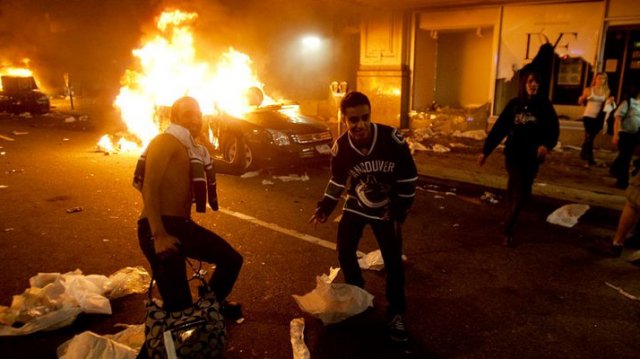
There is something bizarre going on just beneath the surface of our supposedly decent and civilized society. Canada is prosperous and peaceful, and does as much or more than any country to preserve and protect the rights and opportunities of people fortunate enough to live here. There are certainly inequalities and injustices, but anyone who thinks they’ll find a society that tries harder to eliminate them, or is more concerned with trying to spread the benefits equally among all citizens, will have a lengthy search on their hands. It’s doubtful in any case that the dolts who ignited the trouble in Vancouver think that deeply, or have any purpose other than mindless mayhem. They deserve no sympathy, and should be treated by the law as harshly as allowed.

Kelly McParland, “Lessons to learn from dolts at a hockey game”, National Post, 2011-06-16

Welcome to Vancouver. Please ignore the rioters

Filed under: Cancon, Sports — Tags: , , , , , , , — Nicholas @ 08:02

Lord Stanley’s Cup won’t be coming back to Canada this year, but as Brian Hutchison points out, that’s only one of the losses sustained by Vancouver last night:

The season ends, and the worst does come to pass. Vancouver, you have lost. Twice. But the game hardly matters now, does it? The score? Who cares? As I write this, my eyes are stinging, my is throat sore, having breathed in some sort of dispersal chemical that police deployed — in desperation, and perhaps too late. There could be some residual effect from having inhaled acrid, toxic smoke from burning cars, exploding cars, destroyed by lunatics still running crazy on the city’s downtown streets.

Blood in our streets. I saw people on the ground, bleeding. Shattered glass everywhere. Police cars set alight. Major bridges are now closed, preventing public access into the downtown core. Transit is plugged up, there’s no way out. More police and fire crews are arriving, from the suburbs, but again, it seems too late.

And as I write this, the sun has just set. Vancouver, what a disgrace.

Update: A Tumblr page posting photos of the rioters and looters:

The National Post has more photos of the aftermath.

Update: Joey “Accordion Guy” deVilla points out that one of these riots is not like the others. Oh, and a commentary on the most famous photo of the riots (so far).

May 15, 2011

Redefining the word “anarchist” to mean “statist”

Filed under: Economics, Europe, Greece, Media, Politics — Tags: , , — Nicholas @ 11:41

A post at the Cato @ Liberty blog, qualifies as a proper Fisking:

The Washington Post splashes a story about “anarchists” in Greece across the front page today. The print headline is “Into the arms of anarchy,” and a photo-essay online is titled “In Greece, austerity kindles the flames of anarchy.” And what do these anarchists demand? Well, reporter Anthony Faiola doesn’t find out much about what they’re for, but they seem to be against, you know, what the establishment is doing, man:

     The protests are an emblem of social discontent spreading across Europe in response to a new age of austerity. At a time when the United States is just beginning to consider deep spending cuts, countries such as Greece are coping with a fallout that has extended well beyond ordinary civil disobedience.

     Perhaps most alarming, analysts here say, has been the resurgence of an anarchist movement, one with a long history in Europe. While militants have been disrupting life in Greece for years, authorities say that anger against the government has now given rise to dozens of new “amateur anarchist” groups.

Faiola does acknowledge that the term is used pretty loosely:

     The anarchist movement in Europe has a long, storied past, embracing an anti-establishment universe influenced by a broad range of thinkers from French politician and philosopher Pierre-Joseph Proudhon to Karl Marx to Oscar Wilde.

So that’s, let’s see, a self-styled anarchist who was anti-state and anti-private property, the father of totalitarianism, and a witty playwright jailed for his homosexuality.

However you try to twist the word “anarchist” to include the Greek protestors, it still won’t fit:

Real anarchists, of either the anarcho-capitalist or mutualist variety, might have something useful to say to Greeks in their current predicament. But disgruntled young people, lashing out at the end of an unsustainable welfare state, are not anarchists in any serious sense. They’re just angry children not ready to deal with reality. But reality has a way of happening whether you’re ready to deal with it or not.

April 27, 2011

Syrian update

Filed under: Liberty, Middle East — Tags: , , , — Nicholas @ 07:43

With attention focused on Libya, the Syrian situation is still highly volatile:

Bashir Assad clings to power by manipulating the fear within the many factions supporting him that they would have to flee the country, to avoid death or prison, if the current government fell. Then there is the threat that the security forces would use extreme violence to suppress the demonstrations. This, however, could enrage the general population and trigger a bloody civil war. The only thing everyone can agree on is a desire for peaceful resolution of the crises. But Assad and his cronies don’t want to give up power, and they may have to risk everything to find out how far most Syrians are willing to go to force big changes.

Five weeks of escalating violence have left over 200 dead, and over a thousand arrested (and hundreds later released). While nearly all the dead are protestors, more security forces personnel are getting killed. The government is using armed militias (from the groups that have always supported the Assad dictatorship) as well as the police and “special” (secret) police to try and control or terrorize the growing number of demonstrators. There are also said to be small numbers (hundreds) of “security specialists” from Iran. Some Hezbollah gunmen are believed involved as well, and Syrians are accusing these “foreigners” for many of the killings. While most of the leadership posts in the police and army are held by minorities (like the Alawite sect the Assads belong to), most of the troops are majority Sunni Arab. Thus Assad controls management, but has to be careful with the rank and file.

If enough civilians hit the streets, there won’t be enough security forces to confront them, and the entire structure of the Assad police state will start coming apart. Iran might try to stop it, with a massive transfer (by air) of security personnel, and many more from Hezbollah entering by land. Hezbollah loses a lot if it no longer has those land supply routes from Syria. Meanwhile, each Friday (the Moslem Sunday), the demonstrations get larger. The way things have been going, it won’t be many more Fridays before Assad and his crew are gone, or the country is getting blown apart by civil war. It’s unclear if democracy or a new dictatorship will replace the old government. There are many tribes and factions in Syria, and predicting how they will all shake out is not possible.

Update: Just so you don’t forget, at the same time the Syrian government is attempting to suppress the demonstrations, it is running (unopposed) for a seat on the UN Human Rights Council.

April 20, 2011

More on the use of “kettling” by the police

Filed under: Britain, Law, Liberty, Media — Tags: , , , , — Nicholas @ 12:35

Patrick Hayes considers the “kettling” technique beloved of modern metropolitan police forces in the face of protest:

This is not in any way to defend kettling, which restricts basic freedoms of movement and protest. Being kettled is a deeply frustrating experience. You are penned into a small area with thousands of other protesters for hours on end, with no access to toilets or provisions and little to no knowledge of when the police will let you go. This repressive police technique should be abolished.

However, the emergence of kettling does not reflect a new era of police ‘barbarism’ or ‘gross police brutality’, as some have claimed. Rather, the logic behind kettling seems to be an attempt by the authorities to adapt to a new kind of aimless protesting.

[. . .]

The rise of kettling speaks to changes within the authorities too. This tactic reveals a new desire amongst the police to avoid engaging with protesters directly, to avoid beating and controlling them as they might have tried to do in the past. Instead, the police have developed mostly risk-averse, hands-off tactics for demos, of which kettling is a prime example.

Kettling is really a damage-limitation exercise. The hope is that in pinning protesters into one small area they will eventually become sedate or fall asleep after they have let off enough steam. In a bizarre turn of events, the police now even hand out glossy brochures explaining to protesters what kettling is all about and why the police do it. Kettling is analogous to parents sending children to the ‘naughty step’ to get them to calm down.

Indeed, in the absence of any clear collective ideas, protesters have in many ways become reliant on kettling as a focal point for their radicalism. Protests have turned into games of cat-and-mouse, as youths try to avoid being penned in by the police, using Twitter to organise flash mobs and effectively playing peek-a-boo with the police. The protesters achieve a semblance of collectivity through the experience of being trapped together in a kettle.

April 14, 2011

British high court rules 2009 G20 “kettling” illegal

Filed under: Britain, Law, Liberty — Tags: , , — Nicholas @ 09:29

While I may disagree with the protesters and their messages, the police “kettling” technique has always disturbed me far more. Britain’s high court has now ruled that police broke the law while kettling G20 protesters in 2009:

In a landmark judgment on Thursday, high court judges found for protesters who had claimed police treated them unfairly. It also criticised the use of force by officers.

In the case, the court heard that officers used punches to the face, slaps and shields against demonstrators who police chiefs accept had nothing to do with violence. The judgment does not strike down the police tactic of kettling or mass detention, but it will be seen as a rebuff to the Met.

The judgment places limits on the use of kettling. It says: “The police may only take such preventive action as a last resort catering for situations about to descend into violence.”

February 12, 2011

First Tunisia, then Egypt: is Algeria next?

Filed under: Africa, Government, Liberty, Politics — Tags: , , , — Nicholas @ 11:41

The Algerian government is taking a more vigorous approach to protests, by sending in the riot police early:

Thousands of riot police have been deployed in the capital of Algeria to stop an anti-government demonstration from gathering the momentum of the protests that forced out the Egyptian president, Hosni Mubarak.

About 50 protesters managed to reach the square in Algiers where the protest was due to take place but they were surrounded by hundreds of police and some were arrested, the Reuters news agency reported.

Opposition groups have called for a march to demand democratic change and jobs, but it has been banned by government officials and most residents have so far stayed away.

“I am sorry to say the government has deployed a huge force to prevent a peaceful march. This is not good for Algeria’s image,” Mustafa Bouachichi, a leader of the League for Human Rights, said.

Protesters who managed to reach May 1 Square, where the march was due to begin at 11am (10am GMT) shouted “Bouteflika out!” — a reference to the Algerian president — before police arrested some of them.

February 3, 2011

Tools for protest marchers: anti-kettling app

Filed under: Law, Liberty, Media, Middle East, Technology — Tags: , , , , , , — Nicholas @ 07:20

Patrick Kingsley talks to the developers of “Sukey”, a new mobile phone app intended to help protesters avoid being kettled by police:

Cairo, it wasn’t. But at about a quarter to four last Saturday afternoon, on a crowded backstreet in central London, something happened outside the Egyptian embassy that deserves at least a footnote in the annals of protest history. A crowd of students weren’t kettled.

In the context of recent British protests, this was a near-miracle. At each of the previous four major student protests in London since the Millbank riot on 10 November, police have kettled — or, in their terminology, “contained” — thousands of protesters, preventing them from leaving an area for several hours, and often from accessing basic amenities such as food, water and toilets.

Police kettle protesters supposedly to quell violence, but protesters arguably only turn to violence out of frustration at being kettled. Most notoriously, police trapped hundreds of teenage schoolchildren inside a tight grid on Whitehall on 24 November — and only subsequently did a few of them smash up a police van abandoned in their midst.

Saturday’s non-kettle, then, was a victory in itself. But the real excitement wasn’t that it didn’t happen — but how it didn’t happen. It is difficult to pinpoint exactly why police and protesters behave in a certain way at a certain time, but one explanation for the kettle’s failure to form lies with a new communications network, which launched that afternoon: Sukey.

January 28, 2011

Egypt goes dark, shuts down DNS servers

Filed under: Liberty, Middle East, Politics, Technology — Tags: , , , , — Nicholas @ 09:40

Updates added to the bottom of this post

The Egyptian government is attempting to foil protests by eliminating internet traffic. Renesys reports:

Confirming what a few have reported this evening: in an action unprecedented in Internet history, the Egyptian government appears to have ordered service providers to shut down all international connections to the Internet. Critical European-Asian fiber-optic routes through Egypt appear to be unaffected for now. But every Egyptian provider, every business, bank, Internet cafe, website, school, embassy, and government office that relied on the big four Egyptian ISPs for their Internet connectivity is now cut off from the rest of the world. Link Egypt, Vodafone/Raya, Telecom Egypt, Etisalat Misr, and all their customers and partners are, for the moment, off the air.

At 22:34 UTC (00:34am local time), Renesys observed the virtually simultaneous withdrawal of all routes to Egyptian networks in the Internet’s global routing table. Approximately 3,500 individual BGP routes were withdrawn, leaving no valid paths by which the rest of the world could continue to exchange Internet traffic with Egypt’s service providers. Virtually all of Egypt’s Internet addresses are now unreachable, worldwide.

I have seen very little traffic coming to this site from Egypt before the DNS server shutdown (under 40 unique visitors last year, according to FlagCounter), so the following information isn’t likely to be of direct assistance to Egyptians, but hopefully some can be filtered onwards.

The first suggestion (from Shereef Abbas) is to use Google’s Public DNS 2 to change “your DNS ‘switchboard’ operator from your ISP to Google Public DNS”.

John Perry Barlow suggests “more tools to access blocked websites and maintain anonymity”: http://jan25.in/how-to-access-blocked-websites-by-government and https://www.torproject.org/download/download.html.en.

Update: Vice President Joe Biden appears to be missing a wonderful opportunity to shut up.

Biden urged non-violence from both protesters and the government and said: “We’re encouraging the protesters to – as they assemble, do it peacefully. And we’re encouraging the government to act responsibly and – and to try to engage in a discussion as to what the legitimate claims being made are, if they are, and try to work them out.” He also said: “I think that what we should continue to do is to encourage reasonable… accommodation and discussion to try to resolve peacefully and amicably the concerns and claims made by those who have taken to the street. And those that are legitimate should be responded to because the economic well-being and the stability of Egypt rests upon that middle class buying into the future of Egypt.”

Egypt’s protesters, if they’re paying attention to Biden at all, will certainly be wondering which of their demands thus far have been illegitimate.

Update, the second: Live blogging the protests at the Guardian. And several sources are recommending the coverage streamed online from Al Jazeera’s English-language site.

Update, the third: The effectiveness of Egypt’s internet blackout shows why giving the American president (or any national leader) an internet “kill switch” is such a bad idea. To most of us, anyway. I’m sure that to some people it’s an argument in favour.

Update, the fourth: National Post has a graphic showing the locations of the reported activity:


Click to enlarge

January 20, 2011

QotD: The ongoing retreat of freedom of speech in Canada

It used to be there actually had to be a violent protest before public institutions caved in and cancelled controversial events. That was unjustifiable, too. Police and officials should always seek to protect law-abiding speakers and organizers from the angry mob. Those who seek to disrupt events just because they disagree with the speakers should be the ones inconvenienced, not those exercising their constitutional rights.

Now, though, it seems the mere whiff of protest is enough for officialdom to bow to would-be protestors’ demands. Get together a group of unhinged radicals or zealots in someone’s rumpus room, make a couple of angry phone calls and — poof! — you can get your way and silence free speech and free assembly. Organizers, especially those connected with public institutions such as universities, museums and galleries, apparently care not a whit about free expression or individual choice. Their first instinct is to crater to protestors; let the forces of oppression and extremism have their way. Forget about preserving democracy and open debate, officials will act as the forces of censorship want.

Some of this has to do with the increased anger and vehemence of protestors, no doubt. In recent years, young lefties in particular have convinced themselves that only their positions are fact-based and only their positions can save the world. All other opinions are lies, as well as being threats to mankind and the planet. Therefore they are justified in any action they take to stymie opposing views, which they also believe are unworthy of free speech protection. They truly believe they are doing a public service when they shout down speakers or force the cancellation of events by smashing windows or jostling attendees outside the doors.

Lorne Gunter, “We’ve become a wimpy state, as well as a nanny state”, National Post, 2011-01-20

December 13, 2010

Aha! A new conspiracy theory

Filed under: Britain, Law, Politics — Tags: , , , — Nicholas @ 08:27

Following up to this post, Chris Greaves offers both a link, and a theory to explain the link.

The prince’s office also declined to comment, but stressed that the royal couple did not seek medical help after Thursday’s altercation.

Officials are assessing royal security after the attack on Charles and Camilla, whose Rolls-Royce strayed into the path of protesters against tuition fee hikes.

They hit the car with sticks, fists and bottles and chanted “Off with their heads” before the vehicle pushed its way through the crowd and drove off.

One casualty of the review may be the classic Rolls-Royce Phantom VI the couple were using, a gift to the Queen on her Silver Jubilee in 1977. The 33-year-old limousine does not have bulletproof windows or other modern protection features.

So what’s the conspiracy theory, you ask? Here you go:

Liz Windsor: (Thinks) How to get rid of Camela?
(later) I know, I’ll give her a Rolls Royce whose windows are not bullet-proof.
Heh heh.

December 11, 2010

“They came close to drawing their guns on protesters, who were heard to chant ‘off with their heads'”

Filed under: Britain, Law, Politics — Tags: , , , , — Nicholas @ 00:39

The close call reported earlier now seems to have been even closer:

Officers guarding the royal couple were using radios on a different channel from those patrolling Thursday’s student riots, meaning they received no warning that protesters were blocking their route.

As a result, dozens of thugs subjected the convoy to an attack in which the Duchess was jabbed in the ribs with a stick through an open car window as the couple were being driven to the Royal Variety Performance.

Sir Paul Stephenson, the Metropolitan Police Commissioner, praised armed protection officers for showing “very real restraint”, suggesting that they came close to drawing their guns on protesters, who were heard to chant “off with their heads”.

I’m pretty far from being a staunch royalist, but this incident was an “own goal” on the part of the protesters. There are many ways to express your concern and anger, but attacking innocent bystanders will usually lose you the public support you might otherwise be able to depend on. Attacking members of the royal family — who don’t have a constitutional role in setting government policy — is just plain stupid.

H/T to Chris Greaves for the link.

Update: Chris followed up with this observation.

[. . .] just between you and me I was struck by the parallels between the accounts of Charles & Camel, and the minute-by-minute goof-ups of Archduke Wossit and his morgantic wife; the chauffeur taking a wrong turn on the way back from the town hall, the poor security in place, etc.

Any would-be republicans should be blessing their luck that this turned out to be less harmful than the Sarajevo incident in 1914. Had any harm come to the Prince of Wales, British public opinion would (based on past events) have swung heavily in favour of the royal family. Prince Charles is perhaps the least well-liked royal at the moment, but if he’d been “martyred” by the mob, do you think there’d be any hope for getting rid of the monarchy for at least another generation?

November 26, 2010

British Columbia: Canada’s Banana Republic

Filed under: Bureaucracy, Cancon, Government, Politics — Tags: , , , , , — Nicholas @ 13:50

A story in the Globe and Mail on how Elections BC rigged the rules after the fact to reject a petition:

Elections BC rejected a Fight HST recall application as too lengthy — but did so using rules that were drafted after it received the application.

The rejection has led recall organizers to suggest the province’s chief electoral officer deliberately thwarted their attempt to get approval to launch a petition to oust a Liberal MLA who supported the harmonized sales tax, and should step down.

While Elections BC has defended its new rules — which pushed the Fight HST application over a 200-word limit by counting the acronyms MLA and HST as eight words instead of two — recall organizers expressed concern that they were not included in the application form when they downloaded it from Elections BC’s website.

“It’s a total joke. This is the kind of thing they do in banana republics … when they don’t want to have elections or they don’t want people to win. And we’re doing it right here in Canada,” said Chris Delaney, an organizer of the Fight HST campaign.

H/T to Steve Muhlberger for the link.

November 14, 2010

Life replicates art, kinda

As one of the comments on this article in The Cord points out, it’s highly ironic that “at a speech about a book detailing how the police did nothing to uphold the laws of the land the university did exactly the same thing.”

What was scheduled as a speech by Globe and Mail columnist Christie Blatchford turned sour tonight as protesters opposing the journalist’s new book Helpless: Caledonia’s Nightmare of Fear and Anarchy, and How the Law Failed All of Us took over the stage.

Three protesters locked themselves together at the centre of the stage where Blatchford was meant to speak at the University of Waterloo’s (UW) Humanities Theatre in Hagey Hall, with another individual acting as their “negotiator”. A fifth, Tallula Marigold, acted as the group’s media representative.

“We don’t want people who are really, really racist teaching [the people we love],” said Marigold of Blatchford. “And we don’t want that person to have a public forum because it makes it dangerous for others in the public forum.”

If nothing else, the passion of the protesters has persuaded me that I must buy and read Blatchford’s latest book . . .

October 16, 2010

“Officer Bubbles” sues YouTube for defamation

Filed under: Cancon, Law, Liberty, Technology — Tags: , , , , , — Nicholas @ 11:15

The Globe and Mail reports that police constable Adam Josephs has launched a suit against YouTube in an attempt to force them to divulge the identities of posters and commenters:

A Toronto police officer whose stiff upper lip made him an inadvertent YouTube sensation and a symbol of police heavy-handedness at the G20 protests has launched a $1.2-million defamation lawsuit against the website.

Constable Adam Josephs was nicknamed “Officer Bubbles” after a video surfaced of him online admonishing a young protester during the summit for blowing bubbles.

[. . .]

The original video shows Constable Josephs and a number of other officers holding a police line near Queen Street West in front of a crowd of protesters, when a young woman begins blowing bubbles in front of them.

“If the bubble touches me, you’re going to be arrested for assault,” he tells her sternly. When she questions him about the warning, he continues to warn her.

“You want to bait the police. You get that on me or that other officer and it gets in her eyes, it’s a detergent. You’ll be going into custody.”

The video of “Officer Bubbles” intimidating the dangerous bubble-blower:

Update, 18 October: By way of the Twitter feed of Colby Cosh, here’s the link to the actual document.

« Newer PostsOlder Posts »

Powered by WordPress