We must not sneer at Jennifer and Jason, many readers are sure to point out, for choosing IKEA. Their incomes, though high in the global scale, are likely to be lower than their parents’ were, and they often have to move in order to climb the employment ladder. It is only reasonable for them to buy something inexpensive, transportable, and replaceable. IKEA fulfills an important niche in the middle-class market — for cheap furniture that still retains a semblance of respectability. The company has exploited this market to become the global empire that Sweden never had, a kind of Viking revenge on the modern age.
Still, there is a good chance that Jennifer and Jason actually like their IKEA dressers, and prefer them to the old oak chest that their grandparents tried to foist on them. Indeed, the extraordinary popularity of IKEA testifies not only to its convenience but to its ability to appeal to the middle-class self-image. Jennifer and Jason are drawn to IKEA because it reflects who they are: they too are modern, movable, and interchangeable, their wants satisfiable in any neighborhood with a food co-op and a coffee shop. More fundamentally, Jennifer and Jason are untraceable, a “composite material” made from numberless scraps and pieces. They have a long catalog of home towns, and their accents are NPR neutral. They can probably rattle off the various nationalities in their family trees — Dutch, Norwegian, Greek, and Jewish, maybe some Venezuelan or Honduran for a little color. From these backgrounds they retain no more than a humorous word or phrase, a recipe, or an Ellis Island anecdote, if that. They grew up amidst a scramble of white-collar professionals and went to college with a scramble of white-collar professionals’ kids. Their values are defined mainly by mass media, their tastes adorably quirky but never straying too far from their peers’, and like the IKEA furniture that they buy in boxes, they too cut themselves into manageable, packaged pieces and market themselves online. They are probably “spiritual but not religious.” They have no pattern or model of life that bears any relation to the past before the internet. For all intents and purposes, they sprang up de novo in the modern city. Whereas the Veneerings’ high fashion covered over an essential vulgarity, Jennifer’s and Jason’s urbane style masks a hollowness.
It may be tempting to call Jennifer and Jason, and the the group of people whom they represent, “cosmopolitans.” (And indeed, IKEA, with its vaguely exotic Swedish names, provides a dash of cosmopolitanism on the cheap.) However, Jennifer and Jason are something newer and more bizarre than cosmopolitans: as Ross Douthat aptly pointed out in the wake of the Trump election, the increasingly insulated college-educated classes of the coastal cities do not grapple with real, substantive differences in beliefs and values, associating instead with cliques of like-minded classmates. In addition, classic cosmopolitans seek out what is best in others’ traditions while showing a fierce pride in their own — a Jordanian extolling the majesty of Petra, a Mexican diplomat breaking into lines of Octavio Paz, etc. Westerners like Jennifer and Jason show no such pride or attachment, instead leaping at opportunities to mock the foibles of their native lands.
Conversely, we must also avoid cheap epithets. The word “cosmopolitan” is a double-edged sword – long a shibboleth for worldly sophistication, it has lately turned upon its makers, serving as a political weapon against urban liberals; it is not surprising that a Trump spokesman recently attacked the “cosmopolitan bias” of a journalist who questioned the White House’s immigration policies. There is nothing particularly new or insightful about attacking urbanites tainted by association with the foreign, like the Judean exiles railing against the silken whores of Babylon. Still, as shallow and hackneyed as this rhetorical strategy might be, it packs a populist punch because the very concept of “cosmopolitan” is purely relative: since no one, legally speaking, is a citizen of the world, one can be “cosmopolitan” only in contrast to someone else – a “provincial” in the Victorian terminology, or a “xenophobe” in contemporary talk. In other words, the idea of cosmopolitanism carries an unavoidable subtext of class superiority.
Samuel Biagetti, “The IKEA Humans: The Social Base of Contemporary Liberalism”, Jacobite, 2017-09-13.
October 6, 2019
QotD: Modern middle-class “cosmopolitans”
September 25, 2019
The Children’s Crusade against Carbon
Arthur Chrenkoff explains why political movements treasure and actively seek out the youth:
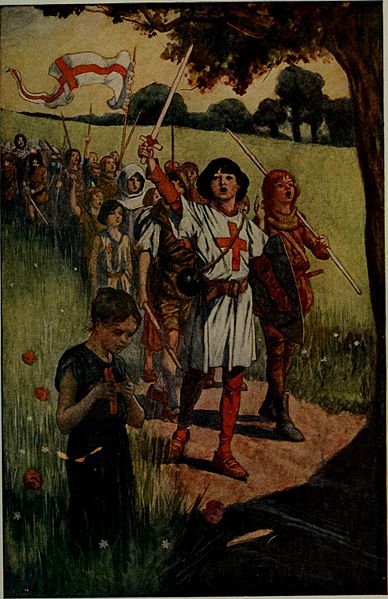
Illustration of the Children’s Crusade from Tales from far and near : history stories of other lands (1915).
York University Libraries via Wikimedia Commons.
It’s really a no-brainer. Revolutionary movements like communism and Nazism, which sought to overthrow the status quo and create a new society, have always placed huge importance on cultivating young following. I consider the green movement, particularly those sections of it that can be described as the Green religion, as a revolutionary movement too, because its main aim is to implement socialism under the pretense of saving the world from an environmental catastrophe.
There are several reasons why children and teenagers are so valued by utopian authoritarians:
1. As the cliché goes, children are the future. Invest in indoctrinating them now and your investment will last a lifetime, certainly outliving the less enthusiastic elders.
2. Children’s minds are more malleable and they are more impressionable, making them more receptive and accepting of your propaganda.
3. Peer group pressure helps to reinforce what the adults instill.
4. Children are (sorry children) ignorant and naive, having neither the sufficient education nor life experience that make adults more difficult to scare, persuade or bullshit into submission and belief.
5. Children have the energy and enthusiasm, which older people often lack.
6. Teenagers go through the proverbial rebellious stage, where they question their parents and other conventional sources of authority. This makes them very useful for the said revolutionary movements, whether fascist or socialist, which need to destroy the old, more conservative way of life so as to create a new social order according to their design.
September 24, 2019
More on the demands from the “climate strike” protests
Arthur Chrenkoff on the far beyond pie-in-the-sky demands coming discordantly from the amorphous climate protest groups coalescing around poor Greta Thunberg and her “climate strike”:

Greta Thunberg at the EU Parliament, 16 April, 2019.
European Parliament photo via Wikimedia Commons.
Fighting “climate change” is a very broad umbrella. What does the Global Climate Strike actually stand for? Greta Thunberg’s (I jokingly referred to her as St Joan of Arc of the Children’s Crusade against Carbon, but the marchers in Paris did carry a poster of Thunberg as a saint) initiative does not offer any extensive manifestos or programs on its website, perhaps not unexpectedly for a child-centric project, but it does provide a brief answer to the question “What are you [as a participant asking for?”:
The climate crisis is an emergency – we want everyone to start acting like it. We demand climate justice for everyone. Our hotter planet is already hurting millions of people. If we don’t act now to transition fairly and swiftly away from fossil fuels to 100% renewable energy for all, the injustice of the climate crisis will only get worse. We need to act right now to stop burning fossil fuels and ensure a rapid energy revolution with equity, reparations and climate justice at its heart [emphasis in the original].
It’s not much, but already more than a great majority of those taking part are probably aware of they were striking for.
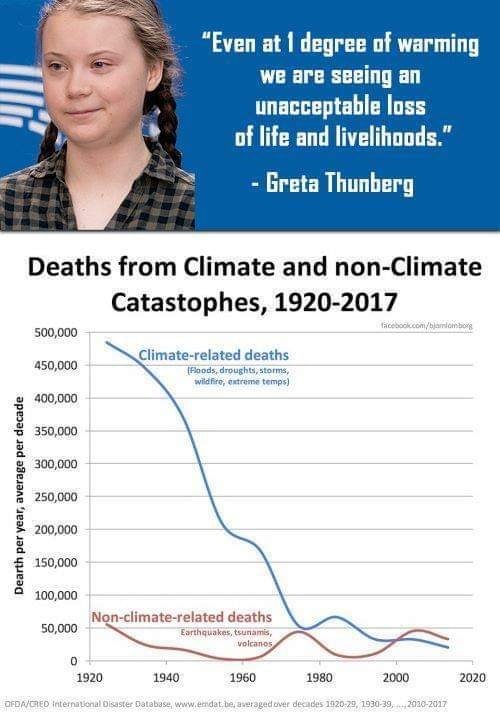
It doesn’t help that some of the more outrageous claims are clearly not true:
What of the other aspects of the Global Climate Strike’s five-sentence program? What exactly is “climate justice”? And what the hell are the “reparations” in this context?
The Strike site doesn’t provide answers, but “climate justice” in the last sentence hyperlinks to the website for The People’s Demands for Climate Justice, which explains itself as “Collectively shaped by people’s movements around the world, these demands are an international statement rooted in southern movements, and with input from numerous climate justice organizations and people’s movements around the world. The People’s Demands lays out a vision for a truly just international climate policy. We must ensure the demands of people, not the fossil fuel industry and other Big Polluters, is what is centered in the lead up to and during COP24 in Poland this December, 2018.” (a case here for updating your website.) While the Global Climate Strike is neither a “convening” nor an “endorsing” organisation among the 403 groups who are, by linking it clearly subscribes to the People’s Demands’ vision. Some of which includes:
Support global efforts for a just and equitable transition that enables energy democracy, creates new job opportunities, encourages distributed renewable energy, and protects workers and communities most affected by extractive economies …
Adopt a technology framework that recognizes the importance of endogenous and indigenous technologies and innovations in addressing climate change, and enables developing countries and communities to develop, access, and transfer environmentally sound, socially acceptable, gender responsive and equitable climate technologies.
Respect and enable non-corporate, community-led climate solutions that recognize the traditional knowledge, practices, wisdom, and resilience of indigenous peoples and local communities, and protect rights over their lands and territories …
Developed countries must make new concrete pledges of public climate finance accompanied by a definite timeline for delivery.
Commit to climate reparations to those most affected but least responsible for climate change.
In addition to fossil fuels, the People’s Demands are also against any market mechanisms to reduce emissions (like emission trading schemes), carbon offsets, carbon sequestration technologies, geoengineering and other “techno-fixes”, nuclear power, biofuels and use of biomass to generate energy, and large scale hydro projects – i.e. most of the potential solutions accepted by the serious mainstream climate change political-scientific consensus. This pretty much leaves only solar and wind, geothermal in a few lucky places (like Iceland, which is sitting on top of volcanoes) and small scale hydro to power the entire world post 2030. In other words, a complete fantasy world of green Luddites.
September 23, 2019
The “Global Climate Strike”
The big “let’s all play hooky from school” event’s Toronto organizers have been getting positive coverage from some of the local media, because of course they have. Here’s Tanya Mok for BlogTO, listing the totally reasonable and not in any way unrealistic “demands” of the movement:
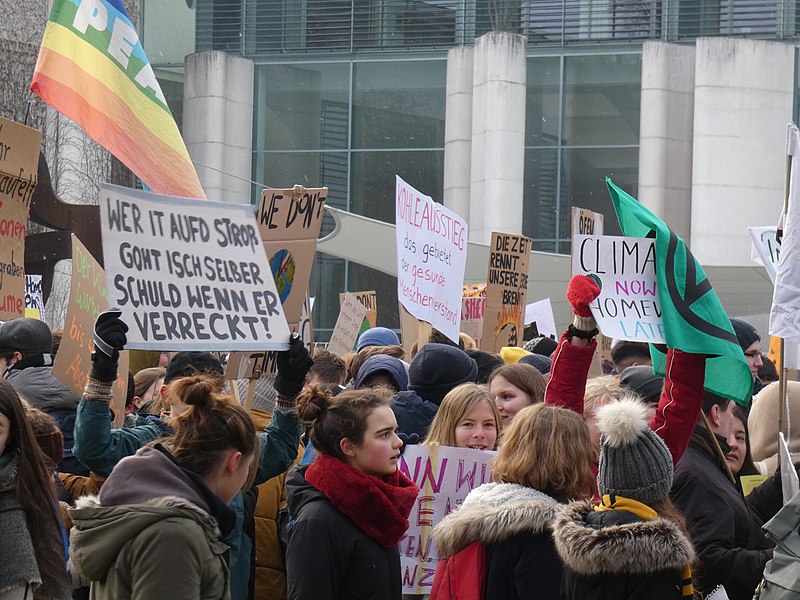
FridaysForFuture Demonstration, 25 January 2018 in Berlin.
Photo by C. Suthorn via Wikimedia Commons.
The coalition has made a list of seven demands, which “reflect the rallying cries of the intersectional movements” they belong to. Some of those demands include:
- Indigenous rights and sovereignty.
- The protection of forests, land, and water sources.
- A shift to publicly-owned renewable energy, and reducing national carbon emission by 65% by 203, reaching zero emissions by 2040.
- A $15 minimum wage for all, and higher taxation on the rich.
- Universal public services like health care and dental care, free university and college, housing as a human right, and free public transit.
- Justice for migrants and refugees, allowing status for all. That includes putting an end to deportations and allowing for the full access to public services.
There will be a concert at Queen’s Park after the rally, as well as a follow-up benefit concert at the Tranzac Club in the evening. A giant street mural project run by Greenpeace will also be taking place prior to the rally, around 10 a.m., at the southern point of Queen’s Park.
September 18, 2019
QotD: Debunking the notion of “peaceful” Vikings
[…]
Which brings us to the next part. All through the exhibit, people told us over and over again that the Vikings were — contrary to legend — peaceful, peaceful I tell you. Most of the Vikings were, after all, farmers and householders.
I wasn’t buying it. Yeah, sure, most Vikings, if you count women, children, and people to old to go aViking, just stayed put. But no civilization where dying in bed gets you sent to Hel (which was cold rather than hot but much like our Hell) is a peaceful one. In the same way I didn’t buy the continuous reassurances there were as many women as men aboard those ships. Cooeeeeee! Really? The men saddled themselves with a liability likely to get pregnant, give birth, etc AND be weaker in battle? That’s … amazing. Oh, I forget. The idiots writing these cards think women are naturally as strong and physically as fast as men and that the “patriarchy” is a six-thousand-year-old conspiracy to hide this. Sure, there probably was the occasional female in a male role. Contrary to much bleating on the left, the patriarchy didn’t enforce strict gender roles, life generally did, and there are always outliers, and Helga the Ugly who could lift a pig under each arm, probably was allowed to join the guys in their expeditions. For one, who was going to tell her no? For another, no guy ever got drunk enough for her to be at risk.
Other than that, sure, there were as many women as men aboard Viking ships. Coming back from a raid. They called those women “slaves.”
[…]
But no, like the beliefs in powerful women Vikings, (who apparently can ONLY be powerful by pillaging and plundering. Being mistress of a farm is not enough), and in peaceful Vikings too they’re simply an upending of long-held beliefs about something. I.e. if Western culture has long believed something, progressives will believe the opposite, because that’s about as hard as any of them can reason, and congruent with their initial mission to topple civilization so perfect communism will emerge.
Sarah Hoyt, “I Aten’t Dead”, According to Hoyt, 2017-07-27.
September 5, 2019
Phony Trudeaumania has bitten the dust
Nico Johnson discusses the dangers of family dynasties in democratic countries:
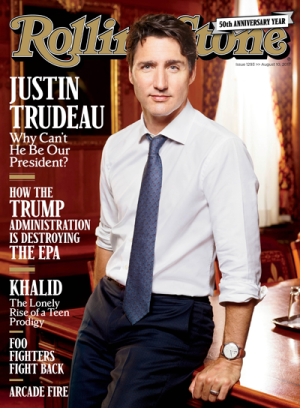
When future political historians look back at the 21st century, Justin Trudeau’s election as a Liberal leader may be regarded as a bland footnote. Despite all the hope Trudeau brought Canadians in his once seemingly eternal, post-election honeymoon, his leadership inevitably toppled into a swamp of sticky scandals and hurried apologies.
Justin Trudeau may still be re-elected. However, the Conservatives can rest easy in the knowledge that Trudeaumania, at least for this current Trudeau, is well and truly dead.
What is noteworthy, however, is the atmosphere of surprise and confusion that has clouded commentators’ judgements surrounding the downfall of Trudeau. In the corridors of Ottawa’s broadcasters, it may have appeared absurd that natural political decline should apply to their darling Prime Minister; the leader of the “woke world.”
Trudeau’s appearance of invincibility, which still makes these commentators swoon (note the SNC-Lavalin coverage) was first created in those blue-skied months following his leadership election in 2013.
Perhaps Justin, with his charisma and handsomeness, seemed like a breath of fresh air to Canadian progressives. Gone were those days of Ignatieff, the drooling philosopher, who rather spectacularly (considering his semi-illiterate predecessor) lost 43 seats forcing the Liberals into third-party status.
With Trudeau’s leadership, the Liberal party would have a candidate who seemed so perfect for Canadian political life that even a eugenicist would struggle to replicate it. With his status as an Anglophone-Quebecois, which managed to pacify the sensibilities of English Canada, whilst having his Quebecois heritage to maintain seat-rich Quebec—Trudeau must have seemed like a divine gift.
Yet even in those early days, Trudeau lacked noticeably in the fundamental requirements that statesmanship should necessitate. He had no political experience after being almost casually elected to the House of Commons. Nor did he possess any working experience, and had been entirely unknown to the Canadian public until the eulogy at his father’s funeral. To put it quite simply, Justin Trudeau would have never become Prime Minister of Canada if his father, Pierre, had not been one too.
August 30, 2019
Communist Revolution in America? – The Red Scare 1919 I THE GREAT WAR 1919
The Great War
Published on 29 Aug 2019Get a free audiobook and 2 Audible Originals with a 30-day trial: http://audible.com/greatwar or text
greatwarto 500 500.The American intervention in the Russian Civil War, the economic hardships of workers and returning veterans and the strikes all over the US in 1919 created a hysteria that we know as Red Scare today. But how realistic was the idea of a Bolshevist revolution in America really?
» SUPPORT THE CHANNEL
Patreon: https://www.patreon.com/thegreatwar
Merchandise: https://shop.spreadshirt.de/thegreatwar/» SOURCES
US Congress. Senate. Bolshevik Propaganda: Hearings before a Subcommittee of the Committee on the Judiciary. 65th Cong., 3rd sess., February 11, 1919, to March 10, 1919
Brecher, Jeremy. Strike! Revised edition. South End Press, 1997.
Hanson, Ole. Americanism versus Bolshevism. New York and London: Doubleday, Page, & Co., 1920.
United States Department of Justice. Red Radicalism as Described by Its Own Leaders, Exhibits Collected by A. Mitchell Palmer, Including Various Communist Manifestos, Constitutions, Plans, and Purposes of the Proletariat Revolution, and Its Seditious Propaganda. Washington: Government Printing Office, 1920.
Cocks, Catherine, Peter C. Holloran, Alan Lessloff. The A to Z of the Progressive Era. Maryland: Scarecrow Press, Inc., 2009.
Dick, William M. Labor and Socialism in America. New York: Kennikat Press, 1972.
Gould, Lewis L. The Progressive Era. New York: Syracuse University Press, 1974.
Hagedorn, Ann. Hope and Fear in America: 1919. New York: Simon & Schuster, 2007.
Jaffe, Julian F. Crusade Against Radicalism: New York During the Red Scare, 1914-1924. New York: Kennikat Press, 1972.
Kornweibel, Jr., Theodore. “Seeing Red”: Federal Campaigns Against Black Militancy, 1919-1925. Indianapolis: Indiana Press University, 1998.
Hawley, Ellis W. The Great War and the Search for a Modern Order: A History of the American People and Their Institutions, 1917-1933. New York St Martin’s Press, 1979.
Murray, Robert K. Red Scare: A Study of National Hysteria, 1919-1920. New York: McGraw-Hill Book Company, 1964.
Powers, Richard Gid. Not Without Honor: The History of American Anticommunism. Yale University Press, 1998.»CREDITS
Presented by: Jesse Alexander
Written by: Jesse Alexander
Director: Toni Steller & Florian Wittig
Director of Photography: Toni Steller
Sound: Toni Steller
Editing: Toni Steller
Mixing, Mastering & Sound Design: http://above-zero.com
Motion Design: Christian Graef – GRAEFX
Maps: Daniel Kogosov (https://www.patreon.com/Zalezsky)
Research by: Jesse Alexander and Jonathan Dunning
Fact checking: Florian WittigChannel Design: Alexander Clark
Original Logo: David van StepholdA Mediakraft Networks Original Channel
Contains licensed material by getty images
All rights reserved – Real Time History GmbH 2019

August 27, 2019
So much for nil nisi bonum
The old Latin phrase De mortuis nihil nisi bonum encourages us to only speak well of the dead. The recent death of libertarian billionaire David Koch has brought forth a torrent of vituperation from many people in media and politics, as James Piereson and Naomi Schafer Riley record:

David Koch speaking at the Defending the American Dream Summit in Columbus, Ohio, 21 August 2015.
Photo by Gage Skidmore via Wikimedia Commons.
“Yesterday David Koch of the zillionaire Koch brothers died … of prostate cancer. I guess I’m going to have to reevaluate my low opinion of prostate cancer.” That was Bill Maher last Friday night, joking before his approving audience. Maher went on to say, “The Amazon is burning up. I’m glad he’s dead.” Maher is not known for his kindness toward those with whom he disagrees. In that sense, he reflects the thinking of a growing number of progressives and leftists who openly despise conservatives and libertarians. David Koch, along with his brother Charles, have for decades been targets of harsh rhetoric from the far Left.
What is it about David Koch that inspired such hatred? “We live in the world that he helped build, and it is on fire,” wrote Sarah Jones in New York, denouncing Koch’s “monstrous legacy.” In Esquire, Charles Pierce writes: “Except for his surviving brother, Charles, no man had a worse effect on American politics since the death of John C. Calhoun. Every malignancy currently afflicting us can be traced in one way or another into their wallets, and that’s not even to mention the lasting damage they’ve done to the planet as a whole.”
This is the kind of language that religious cults reserve for heretics and apostates — and in many ways, David and Charles Koch were blasphemers to the liberal orthodoxy. They believed in smaller government and thus criticized the welfare state, excessive taxation, and a great deal of government regulation. At the same time, they criticized America’s wars abroad, along with high levels of defense spending, and were sympathetic to the causes of gay rights and gay marriage. They were consistent in their views across a range of issues, antagonizing liberals but also vexing conservatives. The claim that David Koch was a reflexive right-winger is a caricature of his beliefs.
The Kochs believed in smaller government. Whether it was gay marriage or land wars in Asia, they consistently argued that less government intervention would produce freer and happier people. Their support for drug legalization and abortion rights irked plenty of conservatives, but it drove few over the edge as their support for lower taxes and greater school choice did for liberals. Perhaps nothing irked liberals more, though, than the Kochs’ fight for less environmental regulation. Blaming Charles and David Koch for singlehandedly destroying the rainforests or raising the temperature of the earth seems to be a common theme among critics — an attribution of immense power beyond the capacity of any man or family or company.
August 23, 2019
Reasons to expect an even weirder (and scarier) US election in 2020 than in 2016
At Rotten Chestnuts, Severian explains why the First World War was inevitable (because of the fecklessness of all the world leaders at the time) and then points out that the same sort of inevitability seems to be playing out in the run-up to the 2020 US elections:

Donald Trump addresses a rally in Nashville, TN in March 2017.
Photo released by the Office of the President of the United States via Wikimedia Commons.
In short, World War 1 was a massive, indescribably bloody dick-measuring contest between a few inbred yokels. To anyone who has met the Sons of Privilege,* or who is passingly familiar with the Peter Principle, this comes as no surprise. Hell, Lenin saw it, and a guy with his egg head further up his own ass you’ll never find.** All you have to do is look at the people, not the paper.
That’s where the modern political landscape gets so terrifying. Looking at the paper from the establishment Democrats’ point of view, their course of action seems obvious. And credit where it’s due, even Slow Joe Biden and Fauxcahontas are smart enough (or, more likely, have hired people who are smart enough) to see the obvious once it gets rubbed in their faces a few dozen times — Slow Joe is playing the above-it-all unifier, while Dances with Socialism has gone on a Hillary-esque “listening tour” for The Media’s benefit. Should they choose, The Media can now memory hole all the “fake Indian” stuff, and yell “racist!” at anyone who tries to dredge it back up …
… but I don’t think they’ll choose to. The human factor always wins, and the humans (using the term in its strictest biological sense) in The Media are fed up close to bursting. The mask is completely off “The Squad,” and The Media couldn’t be happier. I’m sure that, in their heart of hearts, Nancy Pelosi et al don’t have a problem with BDS, or the Green New Deal, or any of the rest of it. But flying to Israel on the taxpayer’s dime to support Palestinian terrorism just doesn’t play in Peoria, and the Establishment Dems know it. The Media, however, do not — just look at the coverage.
I’m also quite confident that Nancy et al are even, in their heart of hearts, ok with “Antifa” shooting at cops and firebombing ICE offices. Nancy, after all, came up in the heyday of Jim Jones’s San Francisco, so she’s no stranger to political violence. But The Media absolutely cream themselves over “revolutionaries.” They’ve kept this stuff under wraps so far — Nancy et al have convinced them it’ll hurt Donald Trump more than it will hurt them if they keep it bottled up — but every single person in The Media had xhzhyr first wet dream about Che Guevara. I doubt they can keep it in their pants too much longer, especially if — as seems all but certain — “Antifa” commits some gaudy, gross atrocity in the 2020 campaign season.
Nor can we discount the human factor regarding Normals. Every day brings a new insult — Twitter colluding with China to suppress democratic protests in Hong Kong while all-but-openly banning anyone to the right of Mao; gender-and-race-swapping comic book characters; anything and everything to throw sand in Normals’ faces. If Trump’s victory in 2016 was The Great Fuck You, I can’t even imagine what it’ll look like in 2020, after four more years of this stuff ramped up way past 11.
It’s not looking good, but since the idiots in charge have never even thought about looking up from the paper, the whole thing is going to catch them completely unprepared. Forget “that’s how you got Trump;” this is how you get the Somme.
* they’re like the Sons of Anarchy, but effete and usually gay.
** though he basically just stole the idea from Hobson, who, though a goofy love-the-worlder, was actually a pretty smart guy.
Loving “science”
At Rotten Chestnuts, Severian explains the differences between how ordinary people view science and many progressives “f*cking love” science:

For the benefit of younger readers: If you think Lefties Fucking Love Science(TM) now, you have no idea of the torrid affair they carried on with it back when the USSR was still a going concern. Karl Marx, of course, pretended that his sub-Hegelian flatulence was the only truly scientific world view, and his disciples have been playing along ever since. “The facts have a liberal bias,” you’d routinely be informed, by people who spent $200 to have their chakras cleansed by a Navajo shaman once every two months.
I can’t think of a better illustration of what I call (for lack of a better term) the Left’s grammar problem. Lefties tend to get nouns and verbs mixed up. “Science,” for instance. I’m not going to go all Vox Day here and start making up words, but when normal people say “science,” we generally mean it as a verb:
“Science” is what scientists do; it’s shorthand for “applying the scientific method.”
This is why, when we’re presented with a startling new find from the white coat guys — that the polar ice caps have all melted, say — we ask to see the lab work. If it’s really science, then we should be able to replicate the experiment ourselves. Or, at the very least, you should be able to show us the satellite photos…
Which nicely highlights the Left’s notion of “science.” To them, it’s a noun:
“Science” is a fixed body of knowledge; upon which “scientists” operate the way theologians work on the Bible.
What “scientists” do in the Left’s world, then, is what normal people call “hermeneutics.” This is why the bizarre phrase “the science is settled!” makes sense to Leftists. You don’t get to see God’s lab work, after all, and you’re not allowed to make up new Scriptures. To them, an ordinary person challenging a “scientist” on a point of “science” is like a layman challenging the Pope on a point of theology.
August 22, 2019
August 14, 2019
QotD: Proto-progressive thought
Thomas Babington Macaulay, “Southey’s Colloquies on Society”, 1830.
August 11, 2019
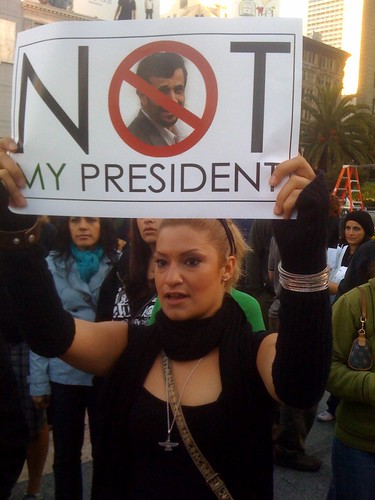
“Saying ‘Donald Trump is not my president’ is like saying that your stepfather isn’t your real dad and slamming your bedroom door”
Colby Cosh looks at the oddly immature and childish meme of “Not my President”/”Not my Prime Minister” declarations that seem to be ubiquitous these days:
“Not my president – #iranelection in San Francisco #gr88” by Steve Rhodes is licensed under CC BY-NC-SA 2.0


If you sent me back to grad school I would love to do some proper research into the history of the “Not My President”/”Not My Prime Minister”-type statements that are everywhere now. They do seem especially popular with liberals, although they are not exclusive to them. A strong memetic influence was obviously the multi-city “Not My Presidents Day” protests that followed Donald Trump’s inauguration. But the indignant, huffy insistence that Trump is “not my president” obviously had to gain traction in the first place.
The theme has been taken up internationally: if you Google “not my prime minister” most of the top hits are Boris Johnson-related (no doubt the “Theresa May: not my prime minister” T-shirts and buttons will sell in the online shops at a significant discount now), and the theme has become a formal slogan of street protest in the U.K. Adding “Trudeau” to the search string reveals a few comment threads. The Canadian politician who gets the most “Not my X” action is certainly Doug Ford. In Alberta, Rachel Notley and Jason Kenney have been getting roughly equal helpings of “Not my premier!”, presumably not from the same people. Who knows, maybe there’s someone out there who feels that his real premier is still Harry E. Strom.
In analyzing this emerging cliché, I suppose one could interpret it as a small act of libertarian or even anarchist rebellion. Is anybody really deserving of being “my” prime minister? Should we not all, in the glorious Utopia, be the prime ministers of ourselves? But the psychological force and intention of the statement that Joe Blow is not “my prime minister” or “my president” is not really anarchistic. The implication of the assertion is always that someone else might really deserve the title, or that there existed past statesmen nobody was ashamed to follow and identify completely with. Saying “Donald Trump is not my president” is like saying that your stepfather isn’t your real dad and slamming your bedroom door.
Meanwhile, of course, your stepfather is probably covering the mortgage and cleaning the eavestrough. “Not my X!” is a defection from democracy more than it is a challenge to the idea of the state. Donald Trump is definitely the lawful, constitutional president of the United States of America, and anyway possesses the powers thereof; those who say it ain’t so are making an incantation, trying to will a state of affairs into existence. If enough people say it, maybe it sorta automatically comes true. There is a lot of this kind of attempted magic going around these days.
August 10, 2019
QotD: Progressives and spontaneous order
Conduct an on-going experiment: whenever well-meaning “Progressives” (of which there are very many) propose this government intervention or oppose that policy of reducing government’s role in the economy, ask if these “Progressives'” stated reasons can be understood to be nothing more than a reflection of a failure to understand the power and range of spontaneous-ordering forces in private-property settings. The answer will almost always be “yes.” Very often, no further explanation for “Progressives'” policy stances is necessary.
“Progressives” simply don’t “get” spontaneous order in human society. They see a problem and leap to the only conclusion that for them is sensible – namely, that that problem’s only realistic “solution” is that it be directly addressed by government officials. Indeed, even “Progressives'” frequent misdiagnoses of the results of trade-offs as being “problems” (or “market failures”) reflect a failure to understand spontaneous-ordering processes. Many phenomena and patterns that “Progressives” assume to be problems – for example, increasing inequality of monetary incomes – are often the benign results of the countless and nuanced individual trade-offs made by individuals. For “Progressives,” though, these “outcomes” are often assumed to be the consequence of sinister designs.
Don Boudreaux, “Bonus Quotation of the Day…”, Café Hayek, 2017-06-24.
July 28, 2019
QotD: Anglo-Italian relations, 1922-1940
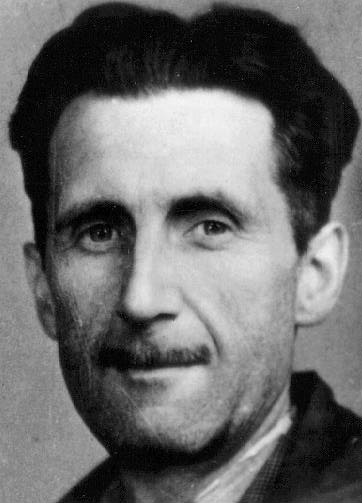
Orwell’s press card portrait, 1943
The history of British relations with Mussolini illustrated the structural weakness of a capitalist state. Granting that power politics are not moral, to attempt to buy Italy out of the Axis — and clearly this idea underlay British policy from 1934 onwards — was a natural strategic move. But it was not a move which Baldwin, Chamberlain and the rest of them were capable of carrying out. It could only have been done by being so strong that Mussolini would not dare to side with Hitler. This was impossible, because an economy ruled by the profit motive is simply not equal to rearming on a modern scale. Britain only began to arm when the Germans were in Calais. Before that, fairly large sums had, indeed, been voted for armaments, but they slid peaceably into the pockets of the shareholders and the weapons did not appear. Since they had no real intention of curtailing their own privileges, it was inevitable that the British ruling class should carry out every policy half-heartedly and blind themselves to the coming danger. But the moral collapse which this entailed was something new in British politics. In the nineteenth and early twentieth centuries, British politicians might be hypocritical, but hypocrisy implies a moral code. It was something new when Tory M.P.s cheered the news that British ships had been bombed by Italian aeroplanes, or when members of the House of Lords lent themselves to organized libel campaigns against the Basque children who had been brought here as refugees.
When one thinks of the lies and betrayals of those years, the cynical abandonment of one ally after another, the imbecile optimism of the Tory press, the flat refusal to believe that the dictators meant war, even when they shouted it from the house-tops, the inability of the moneyed class to see anything wrong whatever in concentration camps, ghettos, massacres and undeclared wars, one is driven to feel that moral decadence played its part as well as mere stupidity. By 1937 or thereabouts it was not possible to be in doubt about the nature of the Fascist régimes. But the lords of property had decided that Fascism was on their side and they were willing to swallow the most stinking evils so long as their property remained secure. In their clumsy way they were playing the game of Machiavelli, of “political realism”, of “anything is right which advances the cause of the Party” — the Party in this case, of course, being the Conservative Party.
All this “Cassius” brings out, but he does shirk its corollary. Throughout his book it is implied that only Tories are immoral. “Yet there is still another England,” he says. “This other England detested Fascism from the day of its birth… this was the England of the Left, the England of Labour.” True, but only part of the truth. The actual behaviour of the Left has been more honourable than its theories. It has fought against Fascism, but its representative thinkers have entered just as deeply as their opponents into the evil world of “realism” and power politics.
“Realism” (it used to be called dishonesty) is part of the general political atmosphere of our time. It is a sign of the weakness of “Cassius”s position that one could compile a quite similar book entitled The Trial of Winston Churchill, or The Trial of Chiang Kai-shek, or even The Trial of Ramsay MacDonald. In each case you would find the leaders of the Left contradicting themselves almost as grossly as the Tory leader quoted by “Cassius”. For the Left has also been willing to shut its eyes to a great deal and to accept some very doubtful allies. We laugh now to hear the Tories abusing Mussolini when they were flattering him five years ago, but who would have foretold in 1927 that the Left would one day take Chiang Kai-shek to its bosom? Who would have foretold just after the General Strike that ten years later Winston Churchill would be the darling of the Daily Worker? In the years 1935-9, when almost any ally against Fascism seemed acceptable, left-wingers found themselves praising Mustapha Kemal and then developing tenderness for Carol of Rumania.
George Orwell, “Who are the War Criminals?”, Tribune, 1943-10-22.