Quotulatiousness

July 21, 2019

Debunking the “common wisdom” about the “Scopes Monkey Trial”

Filed under: Education, History, Law, Media, USA — Tags: , , , , , , — Nicholas @ 05:00

Mark Pulliam explains what really caused the “Scopes Monkey Trial” and what was at stake … which doesn’t match up well at all against what little most people will remember about it today:
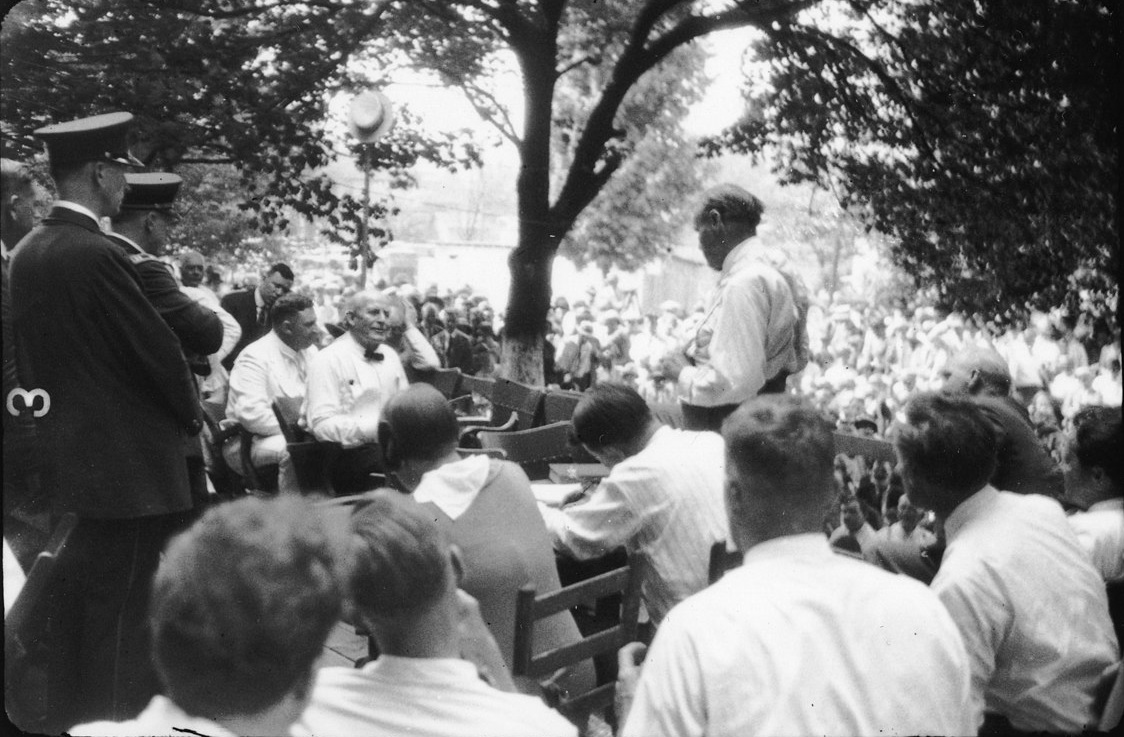
William Jennings Bryan (seated at left) being interrogated by Clarence Darrow, during the trial of the State of Tennessee v. John Thomas Scopes, July 20, 1925. That Monday afternoon, because of the extreme heat, Judge Raulston moved court proceedings outdoors. The session was held on a platform that had been erected at the front of the Rhea County Courthouse to accommodate ministers who wanted to preach during the time of the trial. Defense lawyers for Scopes (John R. Neal, Arthur Garfield Hays, and Dudley Field Malone) are visible seated to the extreme right. One of the men at left, with his back to the photographer, appears to be Scopes. The court reporters are seated at the table.
Photograph by Watson Davis via Wikimedia Commons.

We are again in another contentious period in America where battles over our culture and how we should live together are acrimonious. But there have been many points in our history that indicate we are only re-engaging a form of politics that is quintessentially American. One prominent past episode that occurred in Dayton, Tennessee during the summer of 1925 — the so-called “Scopes Monkey Trial” — has captured the American imagination like few legal proceedings ever have. Noted trial lawyer Clarence Darrow was part of the large legal team representing a 24-year-old substitute high school teacher, John Thomas Scopes, who was accused of violating the state’s Butler Act, which prohibited the teaching of evolution in a state-funded school. The celebrity co-prosecutor was William Jennings Bryan, the three-time Democratic presidential nominee, former Nebraska congressman, and Secretary of State to President Woodrow Wilson. Both Darrow and Bryan were prominent Progressive figures. Bryan, a left-wing evangelical and a fiery orator, is best known for his “Cross of Gold” speech at the 1896 Democratic National Convention.

The trial provided an opportunity for Darrow, whose reputation had been sullied by questionable tactics employed in the defense of radical labor leaders, to vindicate himself before a national audience. Chicago’s WGN radio station broadcast the trial nationwide and hundreds of reporters, some of them from overseas, covered the case. Geoffrey Cowan, author of the exhaustively-researched book The People v. Clarence Darrow, notes that Darrow achieved national notoriety, “won the support of Eastern sophisticates,” and “found new acceptance” as a result of the widely-publicized trial, especially his alleged humiliation of Darrow’s “old hero,” Bryan. This canard, which formed the dramatic crux of the 1960 movie Inherit the Wind, a highly-fictionalized depiction of the trial adapted from the 1955 play written by Jerome Lawrence and Robert E. Lee, is just one aspect of the popular mythology that surrounds the case.

Almost all of the “conventional wisdom” concerning the Scopes trial is false. Contrary to the impression created by Inherit the Wind and other popular accounts (including the sensational reportage of H. L. Mencken of The Baltimore Sun, one of the leading journalists of his day), the trial was not a fundamentalist inquisition, but an ill-conceived publicity stunt by Dayton businessmen who were trying to attract tourists to the small town — to put Dayton on the map. To generate a test case challenging the statute, the American Civil Liberties Union had offered to defend any teacher charged with violating the Butler Act, gratis. Dayton businessmen recruited Scopes to agree to serve as the defendant, even though he was unsure he had actually taught evolution. Nonetheless, Scopes volunteered to be charged. The trial — for a misdemeanor offense — was staged. Celebrity lawyers were solicited to participate for the sole purpose of increasing public interest in the case. The Baltimore Sun paid part of the defense’s expenses because it knew that the spectacle would sell newspapers, and it did. A lot of them.

I think it would be fair to say that H.L. Mencken had a passionate dislike for William Jennings Bryan, even after Bryan’s death a few days later:

It is the national custom to sentimentalize the dead, as it is to sentimentalize men about to be hanged. Perhaps I fall into that weakness here. The Bryan I shall remember is the Bryan of his last weeks on earth — broken, furious, and infinitely pathetic. It was impossible to meet his hatred with hatred to match it. He was winning a battle that would make him forever infamous wherever enlightened men remembered it and him. Even his old enemy, Darrow, was gentle with him at the end. That cross-examination might have been ten times as devastating. It was plain to everyone that the old Berserker Bryan was gone — that all that remained of him was a pair of glaring and horrible eyes.

But what of his life? Did he accomplish any useful thing? Was he, in his day, of any dignity as a man, and of any value to his fellow-men? I doubt it. Bryan, at his best, was simply a magnificent job-seeker. The issues that he bawled about usually meant nothing to him. He was ready to abandon them whenever he could make votes by doing so, and to take up new ones at a moment’s notice. For years he evaded Prohibition as dangerous; then he embraced it as profitable. At the Democratic National Convention last year he was on both sides, and distrusted by both. In his last great battle there was only a baleful and ridiculous malignancy. If he was pathetic, he was also disgusting.

Bryan was a vulgar and common man, a cad undiluted. He was ignorant, bigoted, self-seeking, blatant and dishonest. His career brought him into contact with the first men of his time; he preferred the company of rustic ignoramuses. It was hard to believe, watching him at Dayton, that he had traveled, that he had been received in civilized societies, that he had been a high officer of state. He seemed only a poor clod like those around him, deluded by a childish theology, full of an almost pathological hatred of all learning, all human dignity, all beauty, all fine and noble things. He was a peasant come home to the dung-pile. Imagine a gentleman, and you have imagined everything that he was not.

H/T to “WarEagle82” for the link.
July 16, 2019

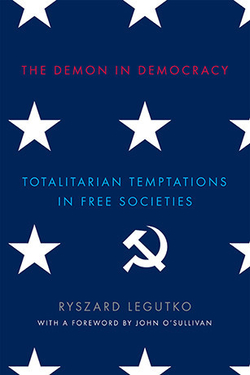
Totalitarian Temptations in Free Societies by Ryszard Legutko

Filed under: Books, Economics, Government, History, Politics — Tags: , , , , — Nicholas @ 05:00

Daniel Pipes reviews a recent translation (from Polish) by Teresa Adelson:

Legutko does not claim liberalism resembles communism in its monstrosity, much less that the two ideologies are identical; he fully acknowledges that the first is democratic and the second brutally tyrannical. After recognizing this contrast, however, he gets down to the more pungent topic of what the two have in common.

He first perceived those commonalities in the 1970s when visiting the West, where he saw how its liberals preferred communists to anti-communists; later, with the overthrow of the Soviet Bloc, he watched liberals warmly welcome communists, but not their anti-communist opponents. Why so?

Because, he argues, liberalism shares with communism a powerful faith in rational minds finding solutions which translates into a drive to improve the citizen, modernize him, and mold him into a superior being. Accordingly, both ideologies politicize, and thereby debase, every aspect of life, including sexuality, the family, religion, sports, entertainment, and the arts. (Here’s a mischievous but deadly serious question: which is the more awful art, the communist or the liberal, Stalin’s or the Venice Biennale’s?) [see below]

Both engage in social engineering to create a society whose members are “indistinguishable, in words, thoughts, and deeds ” from one another, aiming for a largely interchangeable population with no dissidents making trouble. Each sublimely assumes its specific vision constitutes the greatest hope for mankind and represents the end of history, the final stage of mankind’s evolution.

Trouble is, such grand schemes for improving mankind inevitably lead to severe disappointment; human beings, it turns out, are far more stubborn and less malleable then dreamers would like. When things go badly (say, food production for communists, unfettered immigration for liberals), two nasty consequences follow.

July 11, 2019

The genesis of the administrative state during the Great Depression

Filed under: Cancon, History, Law, USA — Tags: , , , , — Nicholas @ 03:00

Leonid Sirota provides some interesting background on the rise of the administrative state during the 1930s:

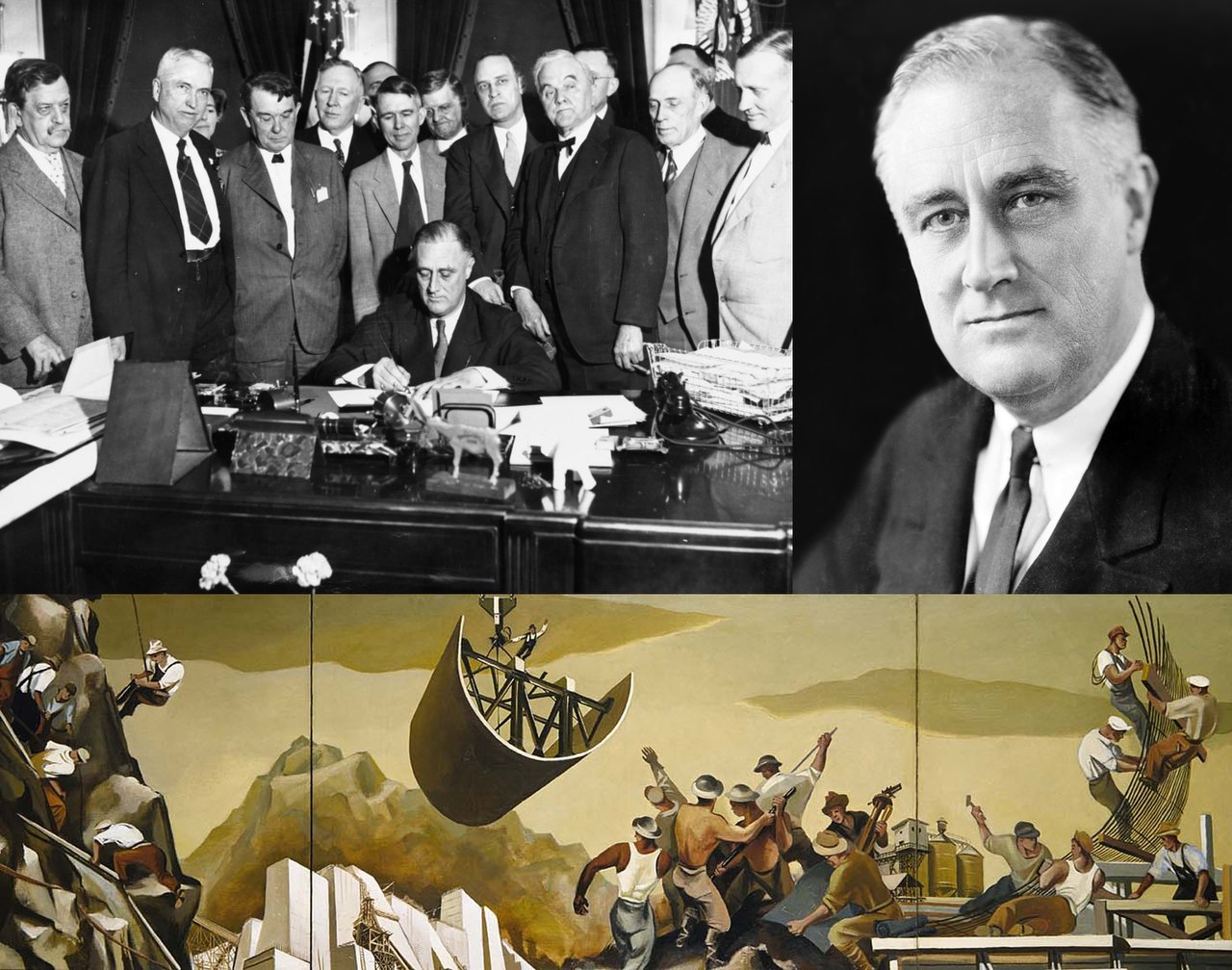
Top left: The Tennessee Valley Authority, part of the New Deal, being signed into law in 1933.
Top right: FDR (President Franklin Delano Roosevelt) was responsible for the New Deal.
Bottom: A public mural from one of the artists employed by the New Deal’s WPA program.
Wikimedia Commons.

To a degree that is, I think, unusual among other areas of the law, administrative law in the United States and, to a lesser extent, in Canada is riven by a conflict about its underlying institution. To be sure there, there are some constitutional lawyers who speak of getting rid of judicial review of legislation and so transferring the constitution to the realm of politics, rather than law, but that’s very much a minority view. Labour unions have their critics, but not so much among labour lawyers. But the administrative state is under attack from within the field of administrative law. It has, of course, its resolute defenders too, some of them going so far as to argue that the administrative state has somehow become a constitutional requirement.

In an interesting article on “The Depravity of the 1930s and the Modern Administrative State” [PDF] recently published in the Notre Dame Law Review, Steven G. Calabresi and Gary Lawson challenge the defenders of the administrative state by pointing out its intellectual origins in what they persuasively argue was

    a time, worldwide and in the United States, of truly awful ideas about government, about humanity, and about the fundamental unit of moral worth—ideas which, even in relatively benign forms, have institutional consequences that … should be fiercely resisted.

That time was the 1930s.

Professors Calabresi and Lawson point out that the creation of the administrative state was spearheaded by thinkers ― first the original “progressives” and then New Dealers ― who “fundamentally did not believe that all men are created equal and should democratically govern themselves through representative institutions”. At an extreme, this rejection of the belief in equality led them to embrace eugenics, whose popularity in the United States peaked in the 1930s. But the faith in expertise and “the modern descendants of Platonic philosopher kings, distinguished by their academic pedigrees rather than the metals in their souls” is a less radical manifestation of the same tendency.

The experts, real or supposed ― some of whom “might well be bona fide experts [while] [o]thers might be partisan hacks, incompetent, entirely lacking in judgment beyond their narrow sphere of learning, or some combination thereof” ― would not “serve as wise counselors to autonomous individuals and elected representatives [but] as guardians for servile wards”. According to the “advanced” thinkers of the 1930s, “[o]rdinary people simply could not handle the complexities of modern life, so they needed to be managed by their betters. All for the greater good, of course.” Individual agency was, in any case, discounted: “the basic unit of value was a collective: the nation, the race, or the tribe. Individuals were simply cells in an organic whole rather than ends in themselves.”

H/T to Colby Cosh for the link.

July 3, 2019

A sneak peak at the new “History of Diversity” course outline at Woke State University

Filed under: History, Humour, Politics, USA — Tags: , , , — Nicholas @ 05:00

At Rotten Chestnuts, Philmon gives us a taste of the new mandatory American history program to be introduced this Fall at WSU:

Photo by “SurlyDuff” via Wikimedia Commons.

… people from other parts of the world had heard about this wonderful place where they, too, could come and be diverse, and they started coming … from China, from Japan, from Mexico, and the Middle East, with only the distant dream of Diversity™ on their minds.

We also created great UniDiversities to increase our knowledge and awareness of Diversity™ (especially after the Democrats freed the slaves!)

But in 1972, the Republican (aka, “Nazi”) Party was founded by Richard Nixon specifically to ban Diversity™ and put to everybody who wasn’t white into concentration camps. Fortunately, the Democrats came roaring back with Jimmy Carter in 1976, who created the Department of Education that has vastly improved Education in the United States by teaching us all to be more Diverse™. Since then our education has become the best in the world! And! he graciously let 52 Americans be the guests of some nice Iranian students for more than a year just so they could become more diverse.

But then Ronald Reagan inexplicably won the election of 1980 (due to a clerical error at Trump, Inc*) and he immediately started a nuclear war with Russia. This was because he was not diverse and they were … well never mind, but it greatly reduced the Diversity™ in the world. Plus, Toxic Masculinity. Which is not Diverse™. Everyone should be more like women. That would be Diverse™.

After 12 years of cruel, oppressive Republican rule during which Reagan coerced some Germans to vandalize an historic, diverse wall, the great Bill Clinton was elected the First Black President™, which Americans thought finally ushered in Diversity™ once and for all.

But alas, it wasn’t to be, because G.W. Bush (aka “Hitler”) stole the election 8 years later by cleverly winning a majority of the votes in the Electoral College (like that was even legal!) and had the CIA fly planes into the World Trade Center and Pentagon so that he could attack Iraq. This was clearly because they were brown and he hated Diversity™, and also for oil. The United Nations had asked Saddam Hussein nicely 17 times to stop killing his own people, but it turned out he was doing it to reduce Iraq’s carbon footprint. Well this was the last straw (before California bravely banned them). Bush viciously attacked and removed Hussein from office because racism. And also blood for oil. Halliburton!!!! By the time he left office he personally had 100% control of all Iraqi oil, which he quickly lost to Dick Cheney (aka “Darth Vader”) in a drunken bet at a bar the night before the next election (Cheney then poured the oil all over Grand Teton National Park just so it could be drilled up again — also because he hates nature and especially fly-fishing).

After that, America came to its senses and elected Barack Obama, Savior of the Universe™, to be the Second First Black President™. Under his wise and kind rule, Americans began to get along Diversely like never before. Some people in Ferguson, Missouri even burned and looted a bunch of minority owned business just so they could get insurance money which they were owed by their former oppressors, who were now forever banished. It was almost the Paradise that Michael Moore proved Iraq was before G.W. Bush (aka “Hitler”) went in and started terrorism as we know it today (and stole all their oil).

July 2, 2019

Antifa strikes back against the White Patriarchy … by assaulting a gay, visible minority journalist

Filed under: Media, Politics, USA — Tags: , , , , — Nicholas @ 05:00

Andy Ngo suffered potentially serious injuries in an assault by Antifa “activists” during a Portland demonstration:

Andy Ngo, a photojournalist and editor at Quillette, landed in the emergency room after a mob of antifa activists attacked him on the streets of Portland during a Saturday afternoon demonstration.

The assailants wore black clothing and masks, and were engaged in a counter-protest against several right-wing groups, including the Proud Boys. Ngo is a well-known chronicler of antifa activity, and has criticized their illiberal tactics on Fox News. He attended the protest in this capacity — as a journalist, covering a notable public event.

According to Ngo, his attacker stole his camera equipment. But video footage recorded by another journalist, The Oregonian‘s Jim Ryan, clearly shows an antifa activist punching Ngo in the face. Others throw milkshakes at him:

Quillette posted their reaction to the attack:

All revolutionary movements seek to sanctify their lawless behaviour as a spontaneous eruption of righteous fury. In some cases, such as the Euromaidan movement in Ukraine, this conceit is justified. But usually their violence is a pre-meditated tactic to intimidate adversaries. Or as Bolshevik theorist Nikolai Bukharin put it, “In revolution, he will be victorious who cracks the other’s skull.”

The Antifa thugs who attacked Quillette editor and photojournalist Andy Ngo in Portland yesterday did not quite manage to crack his skull. But they did manage to induce a brain hemorrhage that required Ngo’s overnight hospitalization. (For those seeking to support Ngo financially as he recovers, there is a third-party fundraising campaign.) […]

Andy Ngo is an elfin, soft-spoken man. He also happens to be the gay son of Vietnamese immigrants — salient details, given Antifa’s absurd slogans about smashing the heteronormative white supremacist patriarchy. Like schoolboy characters out of Lord of the Flies, these cosplay revolutionaries stomp around, imagining themselves to be heroes stalking the great beast of fascism. But when the beast proves elusive, they gladly settle for beating up journalists, harassing the elderly or engaging in random physical destruction.

Antifa’s first prominent appearance was in 2017, when black-clad protestors at Berkeley used violence to shut down an appearance by provocateur Milo Yiannopoulos. This set a pattern whereby their rallies have been presented as counter-demonstrations aimed at “taking back the streets” from right-wing groups. But more and more, this conceit has dissolved into farce — as in Washington last year, when Antifa gangs showed up to protest largely non-existent conservative protestors. “Again and again, small groups of Antifa members harassed, threatened and occasionally jostled reporters,” the Washington Post reported. “The activists demanded not to be photographed as they marched down public streets — even as many of them hoisted their own phone cameras and staged their own photo ops.”

Update: I’m told that this is the lawyer who will be acting on Mr. Ngo’s behalf:

July 1, 2019

QotD: Canada Day, if we have to…

Filed under: Cancon, History, Politics, Quotations — Tags: , , — Nicholas @ 01:00

It is Perfectly All Right that a country should be entirely unable, on the anniversary of its founding as a state, to think of a single reason to celebrate it. It is Perfectly All Right, likewise, that it should be so devoid of fellow-feeling amongst its citizens that its government does not dare mention the reason for the generic celebrations it has ordered up, for fear of alienating one section of the population or another.

The reasons for this bouncy nihilism vary: either because nationalism is icky, or because Canada’s lack of nationalism is in fact a kind of inverted nationalism, a way of distinguishing ourselves from other nations. Anomie is part of our unique cultural identity. Yadda yadda yadda never had a civil war blah blah blah we’re a shy, diffident country yadda yadda something about the wilderness, and we’re done.

It’s interesting that this anti-nationalism, mostly on the left, should coincide with the rise of nationalism — mostly imported, in one of the many ironies of this debate — on the right. The ur-text among the latter is that interview Justin Trudeau gave the New York Times Magazine, in which he referred to Canada as the world’s “first post-national state,” inasmuch as it has no “core identity, no mainstream,” thus confirming populist suspicions of him as a treasonous stooge of globalist elites.

Andrew Coyne, “On Canada Day let us remind ourselves we have done well, even as we strive to do better”, National Post, 2017-07-01.

June 22, 2019

Cuban socialism still gets good press from western progressives

Filed under: Americas, History, Politics, USA — Tags: , , , — Nicholas @ 03:00

Unlike most other socialist states that have fallen out of the good graces of western progressives, Cuba is still frequently treated as a kind of “true socialist state” by those who want western culture to move further in a socialist direction. Why has Cuba maintained its lustre? Kristian Niemietz discusses Cuba’s progressive halo for the IEA:

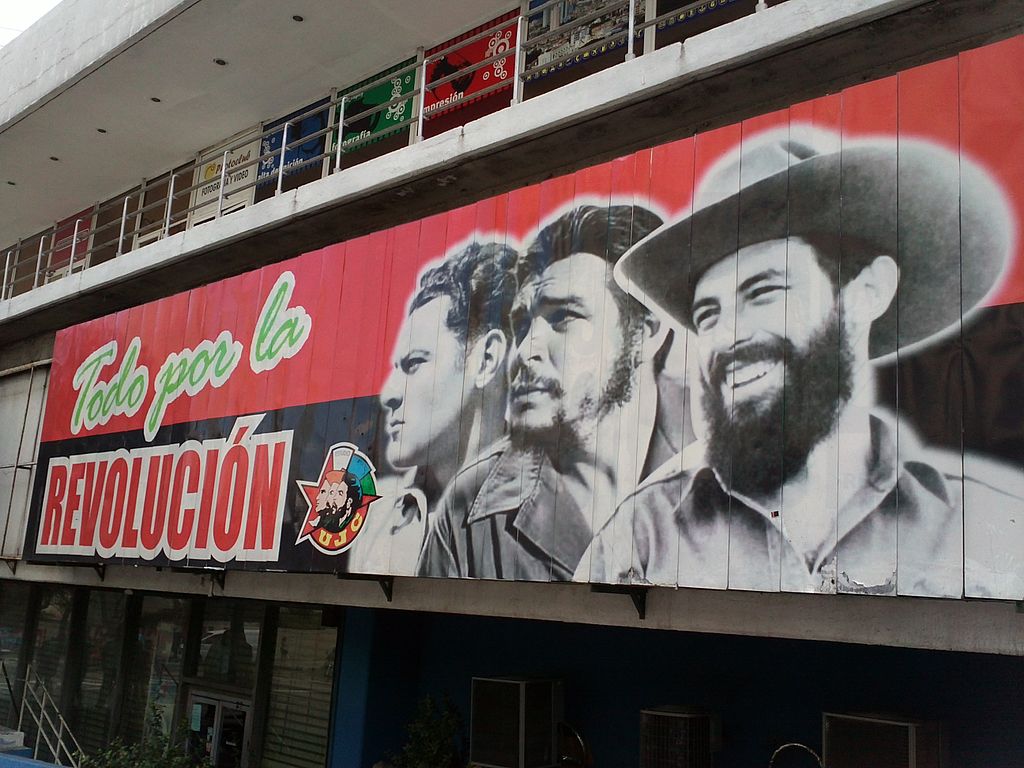
A billboard in Havana, showing Camilo Cienfuegos, Ernesto “Che” Guevara, and Fidel Castro, 4 November 2014.
Photo by Tumpatumcla~commonswiki via Wikimedia Commons.

Last week, Shadow Chancellor John McDonnell gave a speech at the Rail and Maritime Transport (RMT) Union’s “Garden Party for Cuba” event, attended, among other luminaries, by the Cuban ambassador. McDonnell made the following pledge:

    “We’re here in solidarity with the Cuban revolution […] I want to say this to our Cuban comrades. When […] a Labour government is elected, not if, we will be your staunchest allies to support the Cuban revolution. And that means the support, the political support of course, but it means also the support, financial and on trade […] We stand with you comrades.”

This was greeted with chants of “Viva Cuba” and “Viva socialismo“. Just two weeks earlier, when asked about the poor track record of socialism in Cuba, Venezuela and the former Soviet Union, McDonnell had declared that “it was never socialism”.

So which one is it? Is Cuba socialist now, or not? Did it suddenly become socialist in the last two weeks, after 60 years of faux-socialism? Is it an on-and-off kind of socialism, which alternates between the real thing, and the fake version? Is it a Schrödinger’s socialism?

June 16, 2019

QotD: Critical gender studies

The first thing you must understand is that gender is a social construct. “Woman” and “man” are concepts arbitrarily invented by society. They have nothing to do with reality. A child is assigned one of these labels randomly at birth by primitive, backward-thinking doctors who, for no good or objective reason, have decided that a human child with a penis must be a boy and a human child with a vagina must be a girl. These words are all interchangeable, as are the body parts. None of it means anything, really.

But remember that the generic people we meaninglessly call “women” are beautiful and powerful and their arbitrary womanhood should be constantly celebrated. Women must band together and lift each other up. Women must be represented equally in all of our institutions. Women are truly wonderful, splendid, special creatures.

But there is nothing special about women. Literally anyone can be a woman. A woman is not anything in particular. A person with a penis can be a woman. A person with a vagina can be a woman. If a bucket of sand came to life and wanted to be a woman, it could be a woman. There is no aspect of womanhood that is ingrained or biological or inaccessible to males. And womanhood certainly has nothing at all to do with your body parts.

But if you don’t have a uterus then you shouldn’t be giving your opinion on women’s rights. No uterus, no opinion. That’s the motto. We’re tired of men making decisions about women’s bodies.

But there is no such thing as a woman’s body. Transwomen are women, too. A transwoman is just a much a woman as any other woman. There is absolutely no difference between the two and to suggest otherwise is the height of bigotry.

Matt Walsh, “Explaining Progressive Gender Theory To Right Wing Bigots”, The Daily Wire, 2019-05-14.

June 14, 2019

“[P]eople aren’t really arguing about the existence or logic of the Laffer Curve they just hate the empirical answer”

Filed under: Economics, Government, Politics — Tags: , , — Nicholas @ 03:00

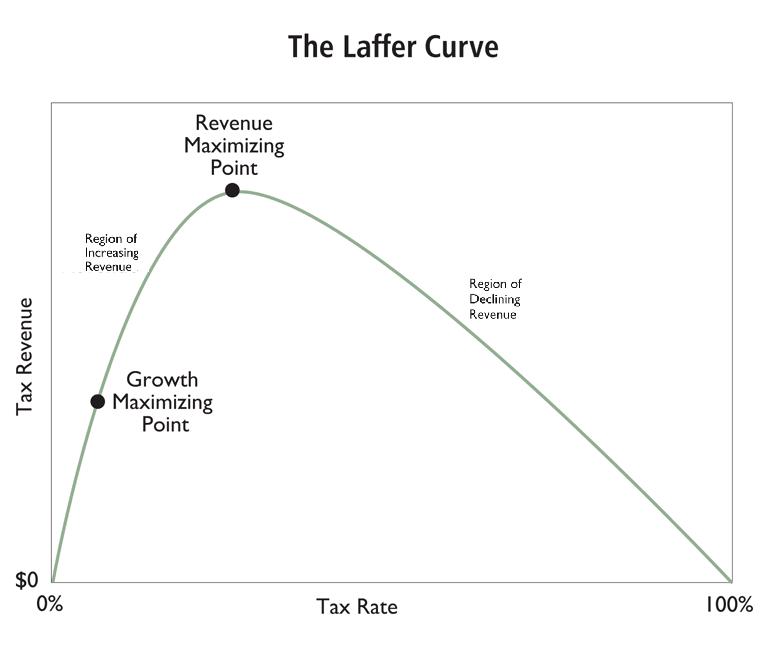
The Laffer Curve is one of those ideas that drives some people mad, because if it’s true (and empirically it appears to hold most of the time), it militates against raising taxes on the wealthy:

That working out where the peak of the Laffer Curve is is difficult is entirely true. That it’s going to be different for each tax in each different legal and societal set up is also true. But that doesn’t excuse drivel like this:

    The ends of the curve are basic enough – at a tax rate of 0, the government will raise $0 in revenue, and at a tax rate of 100, the government will still raise $0 in revenue because people won’t work without take-home pay. At the extremes, the Laffer curve is correct, but that doesn’t tell us anything about the points in the middle. Laffer’s idea, however, was that a “tipping point” existed on the continuum in between, where people’s incentives to work and invest decreased because tax rates were too onerous.

If the end points are true – something admitted – then it’s a matter of simple, pure, and true logic that there are one or more revenue maximising points inbetween. For it’s simple enough for us to observe that there are tax rates which do raise revenue. And if we have tax rates which raise no revenue and tax rates which raise some then there are those one or more rates which raise the most.

So, please, can we stop the drivel?

Sure, Art Laffer himself is incorrect when stating that all tax cuts always pay for themselves through increased economic growth. But that doesn’t invalidate the logic of the curve, only the use to which it is put.

Fifty-four percent. That’s approximately it: the tax maximizing point on the curve when you include all of the taxes on income (including the things they often don’t call taxes — social security, unemployment insurance, and other non-tax taxes — but which are still withheld from paycheques or payable at tax deadline time). Go much above that and the government’s take begins to decrease, defeating the purpose of raising the tax rate in the first place. (Unless the real purpose is just to harm the rich … which might be true in a number of cases.)

June 3, 2019

The state of US academia in juxtaposed tweets

Filed under: Bureaucracy, Economics, Education, USA — Tags: , , — Nicholas @ 03:00

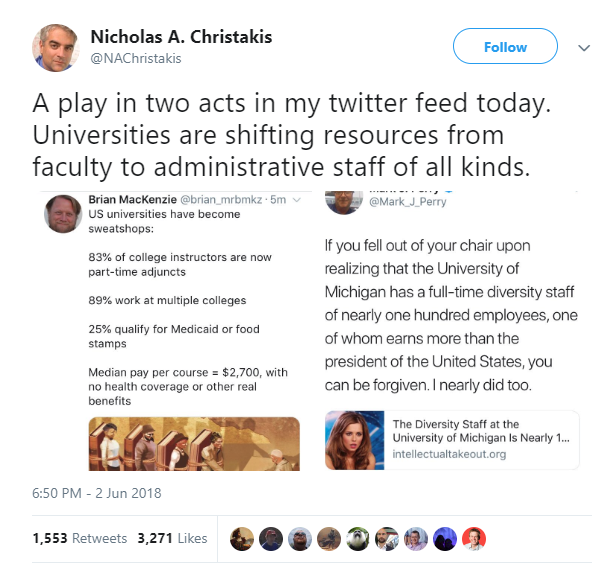
American universities have problems, but the solutions they choose do not seem to be addressing those problems (screencapped, in case the tweet doesn’t load correctly):

May 30, 2019

Moving the Overton window, illustrated

Filed under: Media, Politics, USA — Tags: , , — Nicholas @ 05:00

The Wikipedia entry for Overton window reads:

The Overton window is a term for the range of ideas tolerated in public discourse, also known as the window of discourse. The term is named after Joseph P. Overton, who stated that an idea’s political viability depends mainly on whether it falls within this range, rather than on politicians’ individual preferences. According to Overton, the window contains the range of policies that a politician can recommend without appearing too extreme to gain or keep public office in the current climate of public opinion.

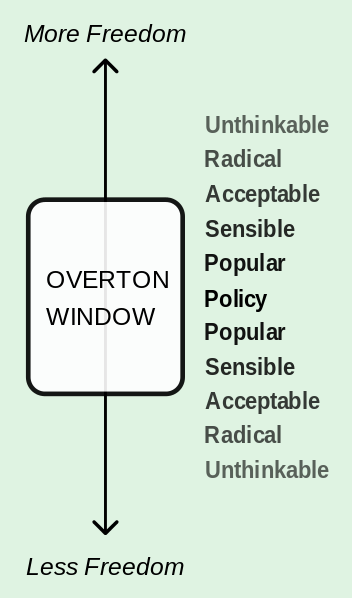
Overton described a spectrum from “more free” to “less free” with regard to government intervention, oriented vertically on an axis, to avoid comparison with the left-right political spectrum. As the spectrum moves or expands, an idea at a given location may become more or less politically acceptable. Political commentator Joshua Treviño postulated that the degrees of acceptance of public ideas are roughly:

  • Unthinkable
  • Radical
  • Acceptable
  • Sensible
  • Popular
  • Policy

The Overton window is an approach to identifying which ideas define the domain of acceptability within a democracy’s possible governmental policies. Proponents of policies outside the window seek to convince or persuade the public in order to move and/or expand the window. Proponents of current policies, or similar ones, within the window seek to convince people that policies outside it should be deemed unacceptable.

There’s also a helpful illustration of the concept:

Diagram of the “Overton Window”, based on a concept promoted by Joseph P. Overton (1960–2003), former director of the Mackinac Center for Public Policy. The term “Overton Window” was coined by colleagues of Joe Overton after his death. In the political theory of the Overton Window, new ideas fall into a range of acceptability to the public, at the edges of which an elected official risks being voted out of office.
Illustration by Hydrargyrum via Wikimedia Commons

To move the Overton window is to shift how the public considers certain ideas, making once unthinkable things merely radical, then acceptable, and so on. Shifting the window is usually something that takes time and media preparation, as a series of tweets from Zach Goldberg handily illustrates:


The full thread can be viewed at this Thread Reader link.

May 27, 2019

A genuine, bona fide electrified, six-car Fisking!

Filed under: Politics, USA — Tags: , , , , — Nicholas @ 03:00

Once upon a time, in the primordial early days of blogging, an artform was evolved that perfectly suited the ecological niche occupied by bloggers: the Fisking. Thanks to his great respect for the ways of the past, David Thompson is a highly skilled modern practitioner of that ancient artform:

    Here’s an idea! Change your parents’ bad voting habits by refusing to breed.

In the pages of Slate, Christina Cauterucci, whose enthusiasms include “gender and feminism,” wishes to share her wisdom:

    The prospect of harnessing one’s sexual and reproductive powers for social good is a tempting one. So, I’d like to present what I humbly consider a much better proposal: Instead of a sex strike, let’s try a grandkid strike.

It’s a “brilliant new weapon of progressivism,” says Ms Cauterucci, and “exactly the kind of radical response today’s radical threats to equity, justice, and humanity demand.” Specifically,

    It’s time to demand that baby boomers and Gen Xers decide which they’d rather have: their vague attachments to policies that have poisoned the earth and will soon make it difficult for anyone but the obscenely wealthy to live healthy, happy lives, or a pack of adorable munchkins in itty-bitty suspenders ready for unlimited tickle fights and cookie-baking sessions.

This is followed almost immediately by,

    I’ve already decided that I’m not having kids,

Which, for the purposes of Ms Cauterucci’s article, is somewhat convenient. This reproductive decision was, we’re told, arrived at because,

    Child care is extravagantly expensive, and paid family leave is a rare luxury. Bringing a new set of chubby cheeks and wonderfully incomprehensible babblings into the world is the most destructive thing one couple can do to the planet. It seems certain that today’s babies will be tomorrow’s survivors of famine, water shortages, unprecedented natural disasters, and refugee crises.

And furthermore,

    It’s unethical, what with climate change and all. And it’s too dangerous — you’ve seen the news reports on school shootings and know how easy it is for violent men to get their hands on guns.

Um, okay then. Apparently, the thought of becoming a parent immediately conjures mental images of famine, earthquakes, shootings and death. Proof, if more were needed, that the exquisitely woke are just like thee and me. Not unhinged in any way.

QotD: The Green death cult

In keeping with all millenarian movements, the extinction-obsessed green cult reserves its priestly fury for ordinary people. Even when it is putting pressure on the government, it is really asking it to punish us. It wants tighter controls on car-driving, restrictions on flying, green taxes on meat. That these things would severely hit the pockets of ordinary people – but not the deep pockets of Emma Thompson and the double-barrelled eco-snobs who run Extinction Rebellion – is immaterial to the angry bourgeoisie. So convinced are they of their own goodness, and of our wickedness, that they think it is utterly acceptable for officialdom to make our lives harder in order to strongarm us into being more “green”. People complaining about Extinction Rebellion disrupting people’s lives in London over the past few days are missing the point – the entire point of the green movement is to disrupt ordinary people’s lives, and even to immiserate them. All in the jumped-up name of “saving the planet”.

And now the green cult has pushed Ms [Greta] Thunberg into the position of its global leader, its child-like saviour, the messiah of their miserabilist political creed. What they have done to Ms Thunberg is unforgivable. They have pumped her – and millions of other children – with the politics of fear. They have convinced the next generation that the planet is on the cusp of doom. They have injected dread into the youth. “I want you to panic”, said Ms Thunberg at Davos, and the billionaires and celebs and marauding NGOs that were in attendance all lapped it up. Because adult society loves nothing more than having its own fear and confusions obediently parroted back to it by teenagers. They celebrate Thunberg because she tells them how horrible they are: it is an entirely S&M relationship, speaking to the deep self-loathing of the 21st-century elites.

Brendan O’Neill, “The cult of Greta Thunberg: This young woman sounds increasingly like a millenarian weirdo”, Spiked, 2019-04-22.

May 15, 2019

“Our” intellectuals and how they got that way

Over at Rotten Chestnuts, Severian says we should blame the eggheads:

Because its goals were impossible, The Revolution didn’t go as planned. For every two self-deluded fools who thought the Soviet Union was a new civilization, there were five who knew exactly what the Communists were about. Bomb-throwing anarchists had terrorized European cities for years before 1917, and Red atrocities during the Civil War were no secret. It was obvious to anyone who cared to look, then, that horrors like the White Sea Canal were features, not bugs, of Communism.

If you’ve read your Festinger, you know what happened next. The True Believers searched frantically for any “explanation” that wouldn’t invalidate their precious Marxism, and Antonio Gramsci gave it to them. Though he didn’t coin the term “false consciousness” (Georgy Lukacs did), Gramsci weaponized it. The reason the Bolsheviks are forced to do all that awful stuff — which we don’t admit they actually did! — is that The People lack the proper revolutionary consciousness. They still believe in stuff like “God,” “free speech,” “not getting starved to death while the Party fatcats drive around in limos,” etc.

And where do they get this “false consciousness,” comrades? Why, it’s the same place the Western proles get theirs, which is also why the Western proles haven’t joined The Revolution (yet!), in fulfillment of the scriptures. Gramsci called the false consciousness installation process “hegemony.” There are a zillion unread academic tomes covering all the nuances, but the basic idea is simple enough: The ruling class controls the institutions; the institutions transmit culture; therefore, the culture takes ruling class values for granted.*

The solution, therefore, is as simple as the diagnosis: Capture the institutions, change the culture.

I trust y’all see where this is going. The best conspiracy theories are the ones that are actually true, and this one is. You want a grand conspiracy to destroy Western Civ? Here it is, laid out as openly as Marxist prose can express it, in excruciating detail. If anything, I’m being unfair to Antonio Gramsci. He put it all together in true kommissar style, but these ideas were everywhere on the Left in the early 20th century. In America, for instance, Progressives like John Dewey had been maneuvering to get control of elementary schools since the late 19th century. Progressives just looooove putting their hands on children. Have you noticed?

Every single insane, culture-destroying, gulag-enabling idea the Left has had in the last 200 years, starting with Karl Marx’s sub-Hegelian flatulence itself, can be traced directly back to some fucking egghead. I’ll repeat that: DIRECTLY. You can find their works, and quote them, because this stuff is in every syllabus of every Humanities class of every college in the Western world. The prose is opaque as only PoMo prose can be, but the main ideas are easy enough to decipher….

…I wrote “ideas,” but there’s really only one “idea.” Since The Revolution obviously ain’t gonna happen — it seems even Leftists can acknowledge one tiny aspect of reality, if you give ’em twelve decades and 100 million bodies — the Left’s entire program, top to bottom, stem to stern, is shit-flinging nihilism. Hey hey, ho ho, Western Civ has got to go — not because it’s Western, but because it’s Civilization.

May 14, 2019

Is Canada ready for a New Green Democratic Party?

Filed under: Cancon, Politics — Tags: , , , , — Nicholas @ 05:00

Ali Taghva explores the notion of the federal NDP and Green parties joining together:

With fundraising and polling numbers in sharp decline at the same time that experienced MPs and staff leave the party, it is evident, even the base of the NDP is beginning to lose faith in the current direction led by Jagmeet Singh.

Worryingly for every single NDP member in the country, this is occurring even when Justin Trudeau’s post-election honeymoon has long ended.

As a result, it appears that the Green Party has become the progressive vehicle gaining the most federal momentum. Their fundraising numbers are on the upswing, and if the trend in the latest by-election in B.C. holds up, they may be the preferred refuge for disenfranchised Liberal voters.

While the Green Party does have momentum, it will not be able to push forward as Canada’s progressive alternative, at least not alone.

The party is still astronomically behind the Conservatives and Liberals when it comes to fundraising, quality of candidates, and polling support.

Even in comparison to the NDP, the Greens are still behind in fundraising and polling, although the distance between the two parties is far more negligible.

With both parties too far back to do anything other than reducing the Liberal vote, ensuring a Conservative majority, it may be time for Canadian progressives to seriously consider a merger between the Green party and the New Democrats.

Okay, but why now? What would be the big draw … oh:

Perhaps most interestingly though, a united alternative progressive party could easily bring on-board the two highest-profile individuals who still have no declared party for the federal election, Jane Philpott and Jody Wilson-Raybould.

With most Canadians believing Jody Wilson-Raybould’s account over that of the Prime Minister’s, her entrance into the race along with Jane Philpott’s could be the final piece which catapults the party into contention for the role of governing party.

Of course, of course … the old celebrity candidates trick. That always works. Well, in urban downtown ridings, anyway.

« Newer Posts — Older Posts »

Powered by WordPress