
The evidence is in. Again. Socialism and government statism is the only way to eliminate income inequality.
As reported in Reuters, a 3 university study of conditions in Venezuela has shown that 90% of citizens now live in poverty. But socialism can only achieve so much. The other 10% must suffer in abject affluence so that the 90% can have income equality.
That in Venezuela income equality necessitates poverty is a design feature of the policy and not a fault.
Venezuela has also demonstrated that socialism can not only eliminate income inequality, it can also eliminate obesity. There was no need to deploying a sugar tax, when the income equalization policies achieved the same ends. You see, Venezuelans reported losing an average of 11 kilograms in 2017. This was on top of losing an average of 8 kilograms in 2016.
Viva Venezuela. Viva Chavez. Viva Maduro.
“I Am Spartacus”, “Nirvana – income equality and a truly fair society”, Catallaxy Files, 2018-02-23.
March 16, 2018
March 15, 2018
March 14, 2018
“[Jordan Peterson has] been described as ‘rightwing’ or ‘far right’ by journalists who have apparently forgotten how to think”
In The Guardian, Gareth Hutchens discusses the rise of Jordan Peterson:
Professor Jordan B Peterson is not yet a household name in Australia.
But he’s in the middle of a speaking tour that has found an enthusiastic audience. All four speaking events have sold out, including his Sydney and Brisbane shows this week. Organisers know they could have booked more venues.
Why are Australians paying to hear him talk?
Peterson loathes identity politics, rails against postmodernism and “neo-Marxism”, and despises gender studies and political correctness. He asserts the biological differences between men and women, and delivers pep talks on how to live a meaningful life and how to find the right partner.
He gives lectures on the truths embedded in myths and legends that are thousands of years old.
To appreciate where he’s coming from, it helps to be familiar with Nietzsche and Dostoevsky and their premonition that the death of mass belief in God would lead to nihilism and/or the rise of totalitarian value systems as alternatives.
I’ve watched Peterson’s online lectures for a while now, after he became an internet celebrity in late 2016.
It’s been fascinating witnessing media outlets trying to come to terms with him. He’s been described as “rightwing” or “far right” by journalists who have apparently forgotten how to think.
Does he belong to the far right because he loathes political correctness, identity politics and postmodernism? Noam Chomsky has made similar criticisms for decades. As did Christopher Hitchens.
Is it rightwing to lament the damage done to the left by the increasing tendency of leftist students on North American campuses to harass people who challenge their ideological orthodoxy? Nicholas Christakis, a sociologist and physician from Yale University, who is a self-confessed progressive, says he can’t understand their behaviour. Bret Weinstein, a former biology professor of Evergreen State College, says he can’t understand it either. He considers himself “deeply progressive” but he says the left is “eating itself.”
Peterson deserves to be taken seriously.
March 2, 2018
QotD: Cronyism
… I would argue that we don’t have truly free trade or, increasingly, a free economy in the United States. The Progressives always look at the rising income inequality and maintain that it’s the inevitable result of capitalism. That’s hogwash, of course, and Proggies believe it because they’re dolts. But the problem in this country isn’t free trade — we have precious little of it — or unrestricted capitalism, since we have precious little of that as well. The issue behind rising income inequality isn’t capitalism, it’s cronyism. Income isn’t being redirected to the 1% because capitalism has failed, it’s happening because we abandoned capitalism in favor of the regulatory crony state and its de facto collusion between big business/banking interests and a government that directs capital to favored political clients, who become “too big to fail”. It doesn’t matter, for instance, whether the president is a Democrat or Republican, because we know the Treasury Secretary will be a former — and future — Goldman Sachs executive.
Indeed, what we call “free trade” nowadays isn’t the Theory of Comparative Advantage in action. It’s corporations being allowed to ship jobs to low wage countries overseas to offset the cost of regulatory burdens in the US that restrict competition from new entrants to the market. That works great for large corporations. Not only do they get to offset the regulatory costs by overseas production, but slower job growth in the US flattens domestic wages, too, and sends millions out of the labor force altogether. For working people, the biggest financial rewards from the current “free trade” regime seem mainly reaped by large business and banking interests. Again, people know if their own lives are better or worse than they used to be, and if the promises of elites have been born out by their own experience.
Dale Franks, “Vote Properly, You Virulent Racist!”, Questions and Observations, 2016-06-28.
February 28, 2018
QotD: Words as “physical violence”
Berkeley. Evergreen. Middlebury. Missou. Yale. Brown. McMasters. Wilfred Laurier. The list goes on. One must wonder where this trend will ultimately take us. There have been several justifications given for this increasing rash of no-platforming, shaming, and at times, physical violence on North American campuses. In essence, these justifications can be distilled into a triad of well-meaning but ultimately flawed theses, namely, 1.) that all discourse is about power and that any speech that renders a listener physiologically uncomfortable therefore rises to the level of a physical attack upon that individual, thereby justifying actual physical violence in response, 2.) that for the sake of historically marginalized voices, persons who are members of historically privileged groups should forfeit their right to free speech or ought to remain silent, 3.) that certain assertions, even if possibly true, are nonetheless morally impermissible to make since to do so will likely create conditions whereby bad-intentioned persons will inevitably and successfully advance their morally heinous projects.
This first thesis — that all discourse is fundamentally about power — finds its philosophical origins in the likes of post-modernists such as Jacques Derrida and Michel Foucault. To quote Foucault, “Discourses are tactical elements or blocks operating in the field of force relations.” Thus, on Foucalt’s view, if all discourse is, at heart, really just veiled force relations between competing groups; if language isn’t fundamentally capable of being about objective truth or about the world in any meaningful sense, then the ink symbols written on the page and the shaped air admitted from one’s mouth in the forms of ‘rationality’, ‘facts’, ‘knowledge’, and ‘truth’ are just another set of weapons in a person’s overall arsenal to seize and maintain power, no different in kind from weapons of a physical sort. To speak then, on Foucault’s view, is to wield a weapon, albeit a subtler and refined one. The uncomfortable physiological feeling of hearing offensive speech, it would then seem, vindicates this view that one is being attacked. One might thus conclude, “Why not attack back with heavier, more effective, and more expedient weapons?”
Michael Robillard, “In Defense of Offense”, Quillette, 2018-02-05.
February 9, 2018
Defining bias
In Quillette, Bo Winegard explains how to define bias:
Bias is an important concept both inside and outside of academia. Despite this, it is remarkably difficult to define or to measure. And many, perhaps all, studies of it are susceptible to reasonable objections from some framework of normative reasoning or another. Nevertheless, in common discourse the term is easy enough to understand. Bias is a preference or commitment that impels a person away from impartiality. If Sally is a fervid fan of the New York Knicks and uses different criteria for assessing fouls against them than against their opponents, then we would say that she is biased.
There are many kinds of biases, and bias can penetrate the cognitive process from start to finish and anywhere between. It can lead to selective exposure, whereby people preferentially seek material that favors their preferred position, and avoid material that contradicts it; it can lead to motivated skepticism, whereby people are more critical of material that opposes their preferred position than of material that supports it; and it can lead to motivated credulity, whereby people assimilate information that supports their preferred position more easily and rapidly than information that contradicts it. Often, these biases all work together.
So, imagine Sally the average ardent progressive. She probably exposes herself chiefly to progressive magazines, news outlets, and friends; and, quite possibly, she inhabits a workplace surrounded by other progressives (selective exposure). Furthermore, when she is exposed to conservative arguments or articles, she is probably extremely critical of them. That National Review article she read this morning about abortion, for example, was insultingly obtuse and only confirmed her opinion that conservatives are cognitively challenged (motivated skepticism). Compounding this, she is equally ready to praise and absorb arguments and articles in progressive magazines (motivated credulity). Just this afternoon, for example, she read a compelling takedown of the Republican tax cuts in Mother Jones which strengthened her intuition that conservatism is an intellectual and moral dead end. (This example would work equally well with an average ardent conservative). The result is an inevitably blinkered world view.
The strength of one’s bias is influenced by many factors, but, for simplicity, we can break these factors into three broad categories: clarity, accuracy concerns, and extraneous concerns. Clarity refers to how ambiguous a topic is. The more ambiguous, the lower the clarity and the higher the bias. So, the score of a basketball game has very high clarity, whereas an individual foul call may have very low clarity. Accuracy concerns refer to how desirous an individual is to know the truth. The higher the concern, on average, the lower the bias. If a fervid New York Knicks fan were also a referee in training who really wanted to get foul calls right, then she would probably have lower bias than the average impassioned fan. Last, extraneous concerns refer to any concerns (save accuracy concerns) that motivate a person toward a certain answer. Probably the most powerful of these are group affiliation and status, but there are many others (self-esteem et cetera).
At risk of simplification, we might say that bias can be represented by an equation such that extraneous concerns (E) minus (accuracy concerns (A) plus clarity (C)) equals bias: (E – (A + C) = B).
February 6, 2018
QotD: The original goal of the minimum wage
For progressives, a legal minimum wage had the useful property of sorting the unfit, who would lose their jobs, from the deserving workers, who would retain their jobs. Royal Meeker, a Princeton economist who served as Woodrow Wilson’s U.S. Commissioner of Labor, opposed a proposal to subsidize the wages of poor workers for this reason. Meeker preferred a wage floor because it would disemploy unfit workers and thereby enable their culling from the work force.
Thomas Leonard, “Eugenics and Economics in the Progressive Era”, Journal of Economic Perspectives, 2005-09.
January 18, 2018
Live in Toronto? Feel undertaxed? Here’s your easy solution to give the city more of your money
Chris Selley points out that in addition to your opportunity to pay more than your fare share of federal tax (Her Majesty, in right of Canada, is always happy to accept any amount you wish to donate), Toronto taxpayers are able to use a simple form to donate money to the city:
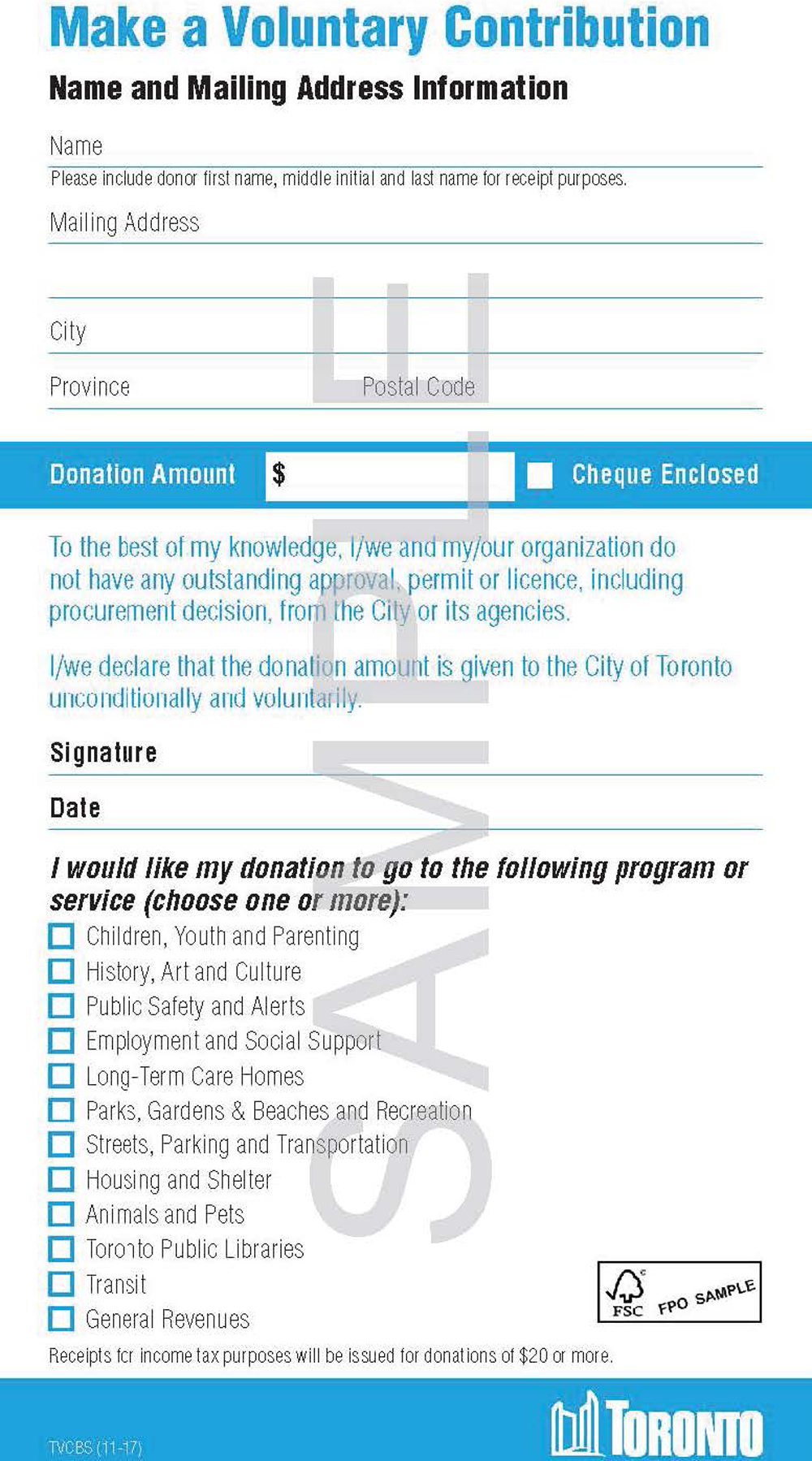
Click to see full-size image.
So here’s a proposal: Torontonians who consider themselves undertaxed should give the city the difference. Every time you get a property tax bill, you get a little blue insert inviting contributions of up to $50,000 to the program of your choice or just into general revenues. Say your house is worth $750,000. Your bill should be around $4,962, or 0.66%. If you think Mississauga’s rate (0.85 per cent) or Brampton’s rate (1.05) per cent is more appropriate, then just cut the city a cheque for the difference ($1,413 or $2,913, respectively), send it back in the envelope provided and watch for your tax receipt. There are a lot of progressive homeowners in this city. It wouldn’t take much before we were talking about real money.
Is this likely to happen? Certainly not. The inserts date from 2010, when council cancelled the vehicle registration tax. A parade of deputants to budget committee said they didn’t want the money back; council gave them an easy way to give it back; almost nobody did, and almost nobody does now. The grand total of voluntary contributions under the property tax envelope program in 2016 was $81,320.77, and one of those donations was for $50,000.
Total contributions to city programs are of course much larger. The Toronto Public Library (which I support, however modestly) issued tax receipts for $3.4 million in donations in 2016, the zoo for $1.1 million. But the city itself only issued $1.35 million in total tax receipts, even as many of us beg it to take more of our money and spend it on council-approved priorities.
It might not be fair to pay more than your neighbour. But when you tell pollsters you want to be taxed more, political strategists don’t believe you. And when Doug Ford can win 33 per cent of the vote after four years of his brother as mayor, it’s tough to say they’re misguided. You can wait for a critical mass of your fellow citizens to come around to your worldview, or you can nudge the process along with your pocketbooks. Your money is as good as anyone else’s.
January 16, 2018
January 6, 2018
QotD: The teacher as social worker
Here we come to one of the most pernicious aspects of identity politics as it reshaped the American university — the confusion of teaching with social work. The issue of improper advocacy in the classroom has never been adequately addressed by the profession. Teaching and research must strive to remain objective and detached. The teacher as an individual citizen may and should have strong political convictions and activities outside the classroom, but in the classroom, he or she should never take ideological positions without at the same time frankly acknowledging them as opinion to the students and emphasizing that all students are completely free to hold and express their own opinions on any issue, no matter how contested, from abortion, homosexuality, and global warming to the existence of God or the veracity of Darwin’s theory of evolution. Unfortunately, because of the failure of American colleges and universities to seek and support ideological diversity on their campuses, the humanities faculties have trended so far toward liberal Democrats (among whom I number myself) that they often seem naively unaware that any other beliefs are possible or credible.
Camille Paglia, “The Modern Campus Has Declared War on Free Speech”, Heat Street, 2016-05-09.
November 27, 2017
Steve Kates on growing up in a communist home
At Catallaxy Files, Steve Kates reflects on how his early upbringing gave him insights into modern political discourse:
The one blessing about being brought up in a communist household is that you understand the left a good deal better than most. It also brings an added measure of concern when I see how easily a public unused to lying as a tactic is influenced by these manoeuvres which are standard practice on the left. My Dad was an expert in agit prop and I grew up understanding the role of the agent provocateur only too well. These are not well-meaning individuals who wish to investigate the truth. They are individuals whose only interest is to disrupt the communications among those on the other side through whatever lies they might find convenient and they hope persuasive.
[…] You will be lied to by the left to the furthest extent they believe they can get away with. That there is not an instantaneous scepticism amongst us on this side of politics from any unverified political story carried by a mainstream media organisation fills me with dread since most of us are so middle class that we find it hard to believe others will lie, distort, or withhold relevant information without the slightest hesitation if it serves their ends. The attitude you need to take when reading anything from an MSM report is the same attitude you might take when buying a used car. Do not trust a thing you are told and make sure you verify everything you can from a separate source.
Dishonesty is the trade mark of the left, not that they have a monopoly, but it is a specific tactic aimed at the fair minded who are seldom as aware as they need to be of the practice, and seldom think of the need to guard against the premeditated lies they tell. […] The interesting part is that for the left to succeed, they can only achieve their ends by lying. For the right, what you hear people say is almost invariably what they believe. The left often mimics the same concerns but it is tactical and never substantive unless for a change good policy overlaps what they see as tactical advantage.
The one valuable part of being on this side of the fence is that with so many out there on the left who will swarm around any genuine falsehood stated by someone on the right, the standard of probity is higher. This is part of the reason why sex scandals, to just name the issue in relation to Roy Moore, are not as common on the right as on the left. Except that when they are caught out – such as with Bill Clinton – it is no longer a scandal and is put to bed as soon as it is practical to do so. They never mean it. It is not hypocrisy, it is a policy of deceit. They are perfectly aware they are lying and just take the rest of us for fools.
November 14, 2017
November 7, 2017
“Paying for” tax cuts
In the latest issue of the Libertarian Enterprise, L. Neil Smith explains why he isn’t a fan of the notion that tax cuts need to be “paid for”:
I am not an economist, nor do I play one on TV, but I know a hand-job when I see one. The mindless mutants who are mangling Donald Trump’s tax plans are dragging this nation and the world into a Da-Daesque vortex we may never get out of. (Only a “progressive” Democrat would stomp a man’s legs, break them in a dozen places, and then make fun of him because he can’t walk.) While lowering almost everybody’s taxes, they want a special bracket appended to the deal to punish people with a million dollars or more to “pay for” everybody else’s tax relief. My question, in an era when government takes too much away from us already, why the bloody hell should it be allowed to steal more?
Even from people who are supposedly hated by the “masses”? (I seriously doubt it. “The Democrat Party masses, more likely. Most right-wing masses — if there is such a thing — aspire to become millionaires, themselves.)
Half a century ago, when I was a shiny new Objectivist warrior, jousting with various statist orcs and trolls on the left, a major concern of theirs seemed to be the big, luxurious houses that rich people built for themselves or bought and lived in. Somehow, there was something evil or sinful in that — “conspicuous consumption” one famous comtard called it — and it needed to be stopped. It didn’t ever seem to have occurred to these feeble-minded pickpockets (who had likely never done an honest day’s work in their worthless lives) that the construction of a big, luxurious house (today, we call them McMansions) requires the skilled services of dozens, if not hundreds, of earth-movers, concrete-workers, framers, finish carpenters, glazers, roofers, plumbers, sheet-rock guys, landscapers, etc., most of whom have families to feed, clothe, and house, themselves.
They need rich people to build big, luxurious houses for.
In general, there are few, if any, ways the most malign “malefactor of great wealth” can spend his money without benefitting someone who needs a job. Even cocaine has to be cultivated and processed by somebody. This lesson was learned the hard way back in 1990 when Idiot-in-Chief George 41 Bush broke his “read my lips” promise and allowed a punitive “luxury tax” to be levied on yachts, big, expensive cars, and assorted other keen stuff like that. Hundreds of jobs were lost. Thousands suffered. One company went from 220 workers to 50 overnight. Within two years those who had stirred up class envy the most energetically were calling for repeal of this “hate the rich” tax. In the same way, millionaires’ money would fly overseas in an instant and vanish from our struggling economy.
October 25, 2017
Climb aboard the invective treadmill!
Megan McArdle tries to point out the urge to call everyone you don’t like a “racist” or “white supremacist” runs you the same trust risk that the boy who cried wolf did:
It’s the inverse of what Steven Pinker has dubbed “the euphemism treadmill,” where we try to find nicer words for something we don’t think is very nice, and find that the new words quickly take on all the old connotations. So “toilet,” turns into “bathroom,” then migrates onward to “rest room.” Only we still know there’s a toilet behind that door, and whatever words we use about it, our feelings don’t change.
This is why attempting to change how Americans feel about illegal migrants by changing the terms we use to describe them is a project doomed to failure; whether they are “illegal aliens” or “undocumented immigrants,” the political realities remain the same. People who feel negatively toward “illegals” feel just as negatively toward “undocumented immigrants.”
The invective treadmill works in a similar fashion, only in reverse.
[…]
During the 2016 presidential campaign, I found myself confronted by a curious problem: Many of my readers simply didn’t take it seriously when I pointed out that Donald Trump was, if not an outright racist himself, at least happily pandering to people who were.
“The media calls every Republican racist,” my conservative readers replied. “They said it about Mitt Romney, they said it about George Bush, so what’s different about Trump?”
They were right. Other columnists had accused Romney and Bush of being racist and pandering to racists. I pointed out that Trump’s racist appeals were different, and much worse, than anything that earlier Republican presidential candidates had been accused of. But it didn’t do any good. The media had cried wolf to condemn garden-variety Republicans; labels like “racist” had been rendered useless when a true threat emerged. We shouted to no avail as Trump coyly flirted with hardcore white supremacists, something no mainstream party had done for decades.
Indeed, it seems to me that critical race theorists have gone to “white supremacy” precisely because the increasingly broad uses of the word “racism” have made it less effective than it used to be at rallying moral outrage. The term still packs some wallop, but less than it once did, because it is now defined so broadly that a Broadway musical could sing “Everyone’s a Little Bit Racist.” White supremacy, on the other hand, is still clearly understood as beyond the pale.
But if we indiscriminately apply the term to everything from the alt-right white nationalist Richard Spencer, to anyone who thinks that football players should stand for the national anthem … for how long will white supremacy still be considered beyond the pale? What happens if people accused of racism start shrugging off the epithet — or worse, embracing it? And when another Richard Spencer comes along, how will we convey how dangerous he is?
QotD: Oligarchies and universal franchise democracy
Fortunately the ideologues had a solution to overcome these minor imperfections of limited franchise democracy… universal franchise.
The more recent concept of Universal Franchise Democracy, is founded on the ridiculous, and incorrect, early 1900’s assumption that all Europe’s problems can be traced back to a limited voting Oligarchy.
Clearly if the ‘ruling classes’ in a state are the rich and powerful – i.e., the naturally conservative propertied elements who make the economy work and provide the productive jobs – then the chattering classes who want change will need to enfranchise the not-rich and not-powerful, so they can ride the wave of demand for change into their ideal world. In fact so they can direct it to provide taxpayer funding for non productive jobs… For people like them.
It is certainly no accident that the modern ‘ruling class’ is the nouveau-rich chattering classes – and the power base they have established in the completely unproductive taxpayer-supported lawyers and civil servants and union officials – who lead inevitably to ‘leaders’ who have the right and duty to lecture their stupid populace for not being politically correct enough… People like Merkel, Obama, and the European Union President. (Go on, name him? He has more practical power to interfere in his ‘citizens’ lives than either of the other two. Who is he?)
It is not just the Australian Union Movement of which we can say ‘they used to consist of the cream of the working class, now they consist of the dregs of the middle class’. All the petty tyrants who gorge in the taxpayers trough, and who try and force the ignorant peasants under their care down the correct path – whether medieval monks selling indulgences, or modern human rights lawyers banning free speech on issues they disapprove of – tend to be the dregs.
The dregs, of the intellectual fervor, of the previous generation, of wrong thinkers.
The dregs of any intellectual movement eventually have to accept that their ideal is hogwash. Even Marxists have started to admit that after a century of promoting Communism, they can no longer hide the hideous nature of Communism. Still, they are not going to give up their world-view just because the evidence against it is so overwhelming that continued attempts to argue in favour of it become ridiculous. Instead they move smoothly to supporting another, equally ridiculous ideology that they think will support their worldview. Say Environmentalism, or Multiculturalism.
Nigel Davies, “The Solution is… European Union/Multiculturalism/Communism… Name your poison!”, rethinking history, 2015-12-26.


