
There’s a reason “social science” is all horseshit, and that reason is: surveys. All of this stuff is based on surveys, and as it happens, I have quite a bit of experience of being on the receiving end of these. You see, back in grad school I was involved with a young lady in the Soash Department — I know, I know, but a man has certain needs, ya feel me? — and so I was always on call to take whatever goofy little tests they dreamed up, as a favor to her and her equally spastic hardcore Lefty friends. Anecdotes aren’t data, of course, but I’ve got a lot of anecdotes, and I can tell you — anecdotally — that there are two huge, self-reinforcing problems with these surveys: a) respondent pool, and b) design.
The respondent pool is, overwhelmingly, college kids taking them for class credit. Knowing what we know about Basic College Girls, who again are the majority of all college kids, is it any surprise that the results just happen to confirm the conclusions the slightly older, but no less Basic, Grad Student Girls were looking for? Throw in the design problem — questions about as subtle as “Do you think all races should be treated equally, or are you a monster?” — and you’ve got scientific proof that Liberals are good people and Conservatives suck.
Severian, “Is vs. Ought II: Moral Foundations Theory”, Rotten Chestnuts, 2021-04-20.
January 28, 2024
QotD: Never depend on “surveys” for real-world issues
January 27, 2024
Modern academics “were perfectly happy to accept that evolution explains the behaviour of every other species on earth, with the exception of humans”
In the National Post, Gad Saad offers an action plan to bring our universities back to a slightly more reality-based view of the world and prevent further postmodernist deterioration:
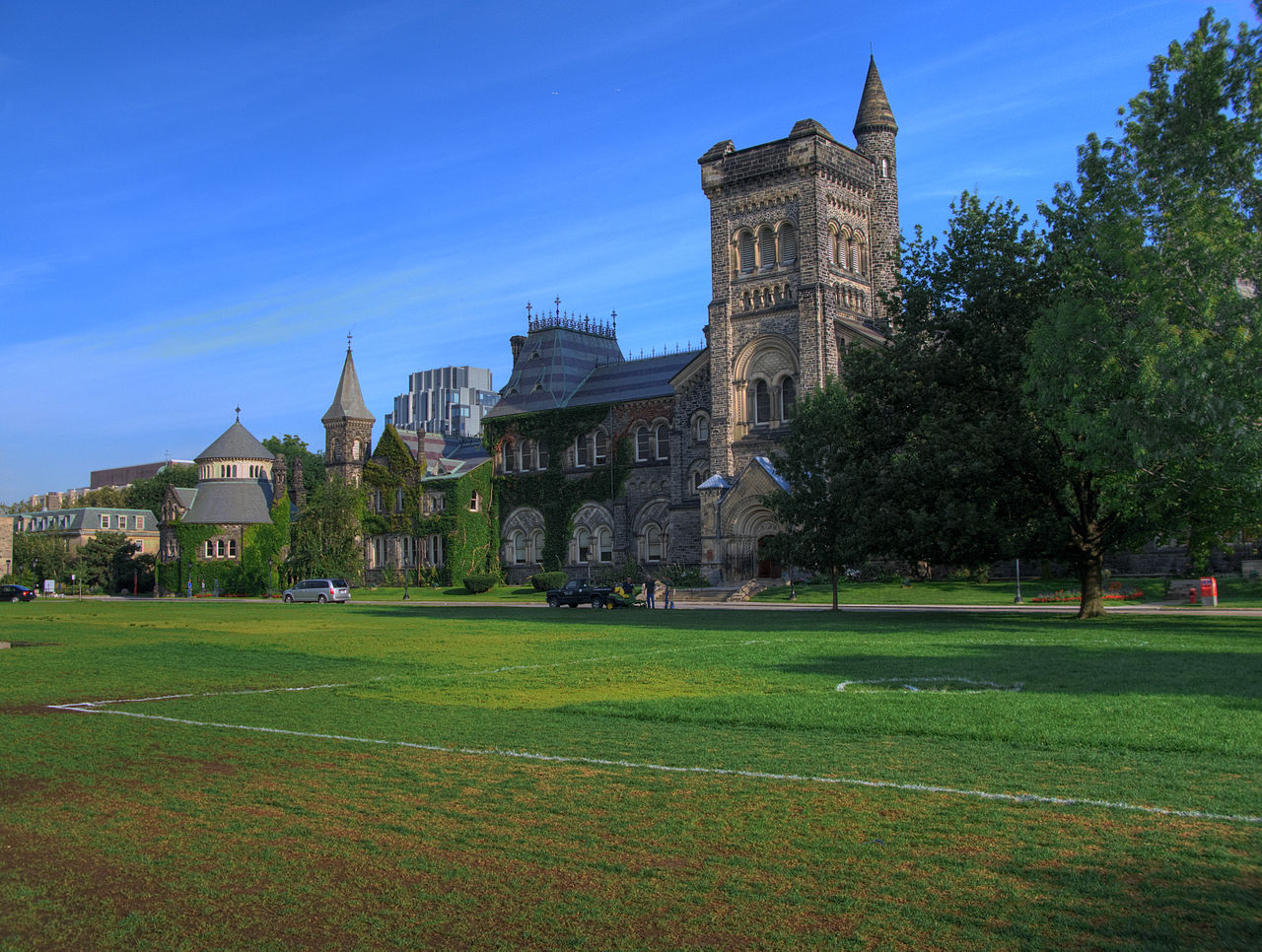
University College, University of Toronto, 31 July, 2008.
Photo by “SurlyDuff” via Wikimedia Commons.
This year, I am celebrating my 30th year as a professor. During those three decades, I have witnessed the proliferation of several parasitic ideas that are fully decoupled from reality, common sense, reason, logic and science, which led to my 2020 book, The Parasitic Mind: How Infectious Ideas Are Killing Common Sense. As George Orwell famously noted, “There are some ideas so absurd that only an intellectual could believe them”. Each of these ideas were spawned on university campuses, originally in the humanities and the social sciences, but as I predicted long ago, they have infiltrated the natural sciences, and now can be found in all areas of our culture.
These destructive ideas include, but are not limited to, postmodernism (there are no objective truths, which is a fundamental attack on the epistemology of science); cultural relativism (who are we to judge the cultural mores of another society, such as performing female genital mutilation on little girls?); the rejection of meritocracy in favour of identity politics (diversity, inclusion and equity (DIE) as the basis for admitting, hiring and promoting individuals); and victimhood as the means by which one adjudicates between competing ideas (I am a greater victim therefore my truth is veridical).
I was first exposed to this pervasive academic lunacy via my scientific work at the intersection of evolutionary psychology and consumer behaviour. Central to this endeavour is the fact that the human mind has evolved via the dual processes of natural and sexual selection. Nothing could be clearer, and yet I was astonished early in my career to witness the extraordinary resistance that I faced from my colleagues, many of whom were perfectly happy to accept that evolution explains the behaviour of every other species on earth, with the exception of humans.
Apparently, human beings transcend their biological imperatives, as they are strictly cultural beings. This biophobia (fear of using biology to explain human phenomena) is the means by which transgender activists can argue with a straight face that “men too can menstruate and bear children”. Biology is apparently the means by which the patriarchy implements its nefarious misogyny, making us all “wrongly” believe that men can on average lift heavier weights and run faster than women, notwithstanding a litany of evolutionary-based anatomical, physiological, hormonal and morphological sex differences.
According to radical feminists, these differences are largely due to social construction. Hence, a man who stands 6-4 and weighs 285 pounds can wake up one day and declare himself to be a transgender woman. Anyone who disagrees with this notion is clearly a transphobe.
January 15, 2024
QotD: Beyond mere superstition, moderns believe in literal magic
Magic dirt: There’s something about the Rio Grande, or the Ellis Island ferry, such that crossing it transforms 70-IQ campesinos into bourgie app developers. Magic shapes: Mold plastic into something that looks like a Glock, and anyone who sees it will be compelled to start shooting people. And of course the granddaddy of them all, magic words: Race, sex, these are all “social constructions”, such that a persyn who says xzhey are a woman really IS a woman, physiology be damned. Within the space of a generation, the same people who were smugly slapping Darwin fish on the bumpers of their Subaru Outbacks have declared the very basics of biology rank heresy.
Everyone knows that Karl Marx called religion “the opium of the masses”. It’s a fun quote, but it wasn’t particularly effective rhetoric back in the 19th century, since drug addiction wasn’t really a thing back then.1 Far more effective was David Hume’s description — “sick men’s dreams” — but even that paled in comparison to the 19th century’s go-to tactic: Implied infancy. If religious belief developed naturally, in a predictable pattern — and who could deny it, having read the formidable logic of E.B. Tylor? — then anyone who still clung to his belief in a Magic Sky Fairy must belong, despite his physical presence here in this best of all possible worlds, to Mankind’s intellectual infancy. Of course we’re not saying that the religion of Aquinas and Galileo, of Newton and Boyle, was all piffle … but come now, old sock, you must admit that the Thirty Nine Articles can only be understood “in a non-natural sense”, as Cardinal Newman (of all people!) put it. Are we not, in the face of all-triumphing science, all Robert Elsmere? Surely no one as obviously intelligent as yourself could possibly still …
Marx had that other quote that fits this situation much better, the one about “second time as farce”. Our Postmodern Elite, the I-Fucking-Love-Science crowd, has gone way past intellectual Luddism. They’re digital infants, chanting their hosannas to magic dirt, watching the same cartoon play out over and over again in Minnesota, in Chicago, soon enough in a neighborhood near you (infants love repetition). Tantrums, nom noms, and whee! A shiny!!
Such are the fruits of rationalism.
Severian, “Digital Infants”, Rotten Chestnuts, 2021-04-16.
1. Despite the easy availability of all kinds of highly addictive shit like opium and cocaine. Ponder that in the dark watches of the night, if you ever feel like giving yourself insomnia.
January 12, 2024
The rise of “anti-woke” comedy
Andrew Doyle suggests we should stop calling Ricky Gervais “anti-woke”:
Stop me if you’ve heard this one. A man’s wife divorces him and shacks up with his boss. Soon after, a friend suggests that he should remarry. “What for?” he asks. “Are you looking for a wife as well?”
It may not be the funniest joke, but that’s because it’s an anecdote from The Lives of the Caesars by the Ancient Roman historian Suetonius. The comedian in this case was a senator called Aelius Lamia whose wife had left him for the Emperor Domitian. For making this casual quip, Domitian had Lamia put to death. Now that’s a bad review.
It might be worth keeping this anecdote in mind when the usual debates flare up about whether comedy “goes too far”. The notion of people being offended by jokes is as old as comedy itself, and often people react angrily if humour isn’t to their taste. The current manifestation of this age-old debate takes the form of a simple dichotomy: “woke comedy” versus “anti-woke comedy”.
Already we are in treacherous waters. It is very unwise to define whole genres by terms that have no settled definitions. The actor Kathy Burke believes that “woke” simply refers to people who are neither racist nor homophobic, which would surely mean that the overwhelming majority of us would happily embrace the term. But for those who have been on the receiving end of the bullying, harassment and intimidation by activists who self-define as “woke”, it is clear this issue is not so straightforward.
Over the past few years, we have seen the emergence of a new comedy movement, one branded by commentators as “anti-woke”, that seeks to push back against the orthodoxies of our time. Its closest historical precedent is the “alternative” comedians of the Eighties, who also took aim at establishment norms and were often similarly blunt in their approach. The key difference today is that there is no broad agreement about where the power in society lies, and so while “anti-woke” comedians see themselves as anti-establishment, their critics insist that the opposite is true.
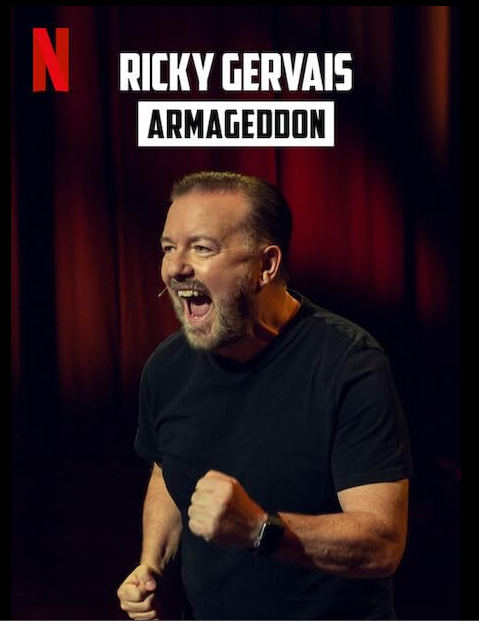
Consider the example of Ricky Gervais, whose new Netflix stand-up special Armageddon has sparked this most recent round of discussions about the supposed red lines in comedy. Some have accused Gervais of taking a reactionary stance, most notably because of jokes relating to migrants and disabled children. Gervais has been branded an “anti-woke” comedian, but I doubt very much that he would see it in such reductive terms. Anyone familiar with his work will know that he has always lampooned closed systems of thought, and it just so happens that “wokeness” currently represents the dominant incarnation. There was a time when many of Gervais’s critics were perfectly happy to see him take a wrecking ball to the certainties of religious faith. It would appear they take a different view when it’s their own belief system taking a battering.
January 11, 2024
The Canadian Armed Forces believe “that they – and the country they serve – are irredeemably racist and oppressive”
The official journal of the Canadian Armed Forces has a … woke … view of themselves and the nation:
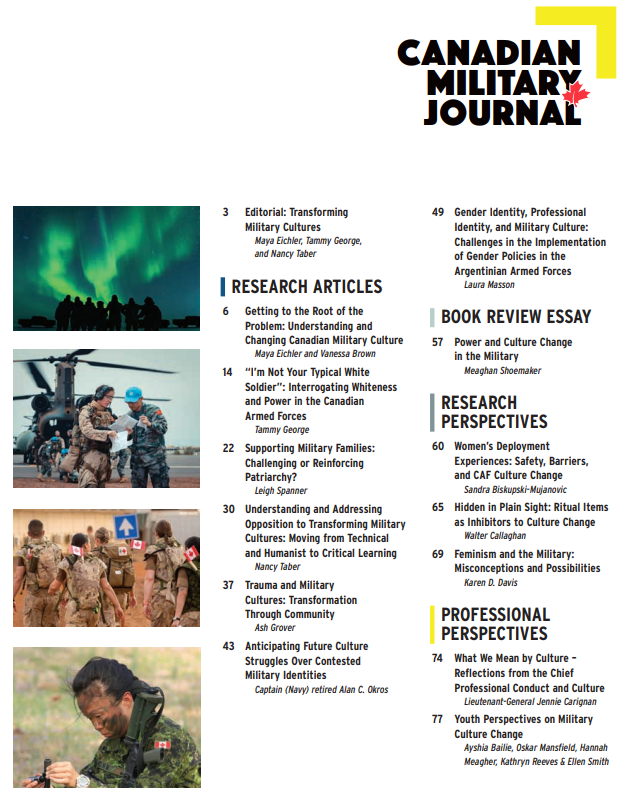
… the latest edition — which was just posted online — contains little to no mention of strategy, geopolitics or the avalanche of contemporary problems facing the Canadian Armed Forces. There’s not a single reference to the recruiting crisis, which has left vacancies of up to 40 per cent in some departments. No mention of the plummeting maintenance standards that recently prompted the commander of the Royal Canadian Navy to declare that his fleet was in a “storm” with no end in sight. No discussion of why Canada is slashing its military budget even as its peer countries do the exact opposite.
Instead — in a signal of just how far the Canadian Armed Forces has embraced far-left “anti-racist” ideology — the entire issue is devoted to how the Canadian military is a racist, patriarchal den of colonialist oppression that needs to be torn down and remade from scratch.
After devoting extended paragraphs to each cultural infraction, Eichler concludes that the Canadian Armed Forces must be remade via an “anti-oppression framework” of “feminist, decolonial, critical race, queer, critical disability, and critical political economy theories”.
Eichler notes this is “not an easy task, but a necessary one if DND/CAF wants to move the yardstick on culture change.”
Another feature, by York University psychotherapist Tammy George, frames the Canadian Armed Forces as being poisoned by “institutional whiteness”.
“In order for meaningful, sustained culture change to occur, there must be a recognition by the white majority of the way in which whiteness organizes lives,” she writes.
Leigh Spanner, a feminist postdoctoral research fellow, wrote that the CAF’s system of supporting military families was anti-feminist and patriarchal.
Ash Grover, a researcher in “feminist anti-militarism”, argues that the military might have fewer instances of post-traumatic stress disorder if they paid closer attention to “anti-oppressive theory” and how “acts of ‘othering’ can result in responses typically associated with post-traumatic stress disorder”.
January 10, 2024
QotD: The root of leftism is envy
“Social justice” is sacralized envy.
Which fits a lot better on a Pepe the Frog meme, you must admit.
Note also the slight, but important, change in emphasis — from “hate” to “envy”. Recall that [Economics in One Lesson author Henry] Hazlitt was writing in 1946, when material deprivation was still a thing, even for Americans. Back then it was assumed that the hate sprang from the envy, which meant that the hatred could eventually be dissipated. It implied an endpoint. Hazlitt, like seemingly everyone else on the Right, took Lefties at their word — that some level of “equality”, by which they meant material prosperity, would cause the Left to finally hang up their jocks and hit the showers.
Three quarters of a century later, we know that’s not true. There’s nothing you could give them that would ever satisfy them. Go ahead, do it Jesus-style — turn the other cheek, give them your coat and your cloak, walk with them two miles, all that jazz. You know as well as I do what will happen — they’ll still hate you. It doesn’t matter what the “reasons” are. Before, they hated you because they didn’t have a coat and cloak. Now they’ve got yours, but they still hate you, because you’re right-handed, or blonde, or have webbed toes. Or because you don’t have webbed toes.
Whatever, something, anything. I won’t bother repeating the O’Brien quote from 1984; you’ve heard it enough by now to know what I mean when I say that for the Left, the point of envy is envy. They don’t envy you for what you have. They don’t even envy you for what you are. They just envy. The mere fact that you exist, a separate entity from them, means that they’re not all there is in the world. In other words — French judges, take note — we’re down to three words:
Leftism is solipsism.
They envy your mere existence, since you are the walking, talking proof that not everything in this world is as shriveled and petty and miserable as they are.
Severian, “Crossing the Bar”, Rotten Chestnuts, 2021-04-06.
January 8, 2024
Vivek Ramaswamy versus the HR team
Chris Bray finds the humour in Vivek Ramaswamy’s most recent viral video moment:
I’m not sure which part of the employee handbook he violated, but Vivek Ramaswamy was obviously called into a conference with HR.
“Mr. Ramaswamy, security will now escort you to your desk to collect your personal belongings.”
Federal debt has now passed $34 trillion, is well over 100% of GDP, and is on track to top $40 trillion in maybe two years. What are we going to do about that? We’re going to spend over a trillion dollars a year in the foreseeable future to cover the interest on that debt. Worth noticing?
The United States fought the Taliban for twenty years, accomplished nothing, and then let them take all of Afghanistan instead of just the half they controlled when we invaded. How did that happen? How did we spend thousands of lives and trillions of dollars on literally nothing? We trained and funded the Afghan National Army, which then turned out to not actually exist at the very first moment it was expected to function without us. Should we work to understand that failure? Should we maybe ask where the money went?
And so on. Pick your own top ten things that need to be discussed and examined. Covid policy, the emerging disaster of learning loss from school closures, the failure and increasingly obvious danger of the mRNA injections, our long history of remarkably unwise foreign interventions, the Frankenstein’s monster of our corporate-state merger and revolving door regulatory capture, the ideological rigidity of academic culture, whatever. There are crushingly obvious and disturbingly consequential failures all over our recent national record.
So our presidential candidates are facing persistent and aggressive questioning about … their willingness to denounce white supremacy. Is racism bad? Is racism bad? Is racism bad? Will you denounce it? Will you denounce it? Will you denounce it, denounce it, denounce it?

January 4, 2024
QotD: Displays of intelligence as a status good
And then that changed, in what is a cultural eye-blink. Forget the crazy slogan. Humans don’t like change. Particularly they hate change that challenges their status. Unable to actually increase their net worth (within the prescribed realms in which noblemen could do such) or stop spending, the nobility instead went for displays of wealth. Big and extravagant ones. And the wigs were … quite, quite insane.
So what does that have to do with Facebook?
For a few generations, since the left captured the academia, entertainment and the industrial-news complex, aka, the opinion makers, to be a leftist has been synonymous with being smart.
And being smart, since the renaissance, but definitely since the world wars has been the greatest social “good” there is.
No, I’m not saying the left was smart. Increasingly, most of them weren’t, because as it became a matter of social display, the easily led started imitating it.
No, I’m saying that to parrot leftist ideas was to be considered smart. Partly because of the left’s conceit that Marxism was “scientific” there has always been, attached to the modern left the idea that to believe as they do is “rational” and “smart” and that their opponents are stupid.
Not only did they hold onto this while their ideas were proven wrong by reality over and over again, but having captured academia, they pushed leftist ideas as synonymous with being educated. I mean, if you’d attended an elite school, you received these ideas, and the way to signal you’ve attended the school is to parrot it. Thus leftism became the old school tie (mostly around the neck of our economy, but never mind.)
While they had full control of the media, be it entertainment or informational, they could reinforce the message, as well as revile anyone who challenged them as stupid, wrong and illiterate, and GET AWAY WITH IT.
With intelligence being the highest status-good in our society, the left had secure status. Forever, they thought.
The change has been very rapid. The fall of the USSR and [the rise of] talk radio were the beginning, and since the internet took off, they’ve been trying to hold on to the tail of the comet, as it streaks away from them.
I’ve said it before and I maintain it. If Mr. Obama had been president in a country where the information tech was the same as in the 30s, all his failures would have been hidden, and people would believe him a staggering genius, instead of the little man who wasn’t there. Because that’s how the industrial-media complex presented him.
And then … And then they went all in for Hillary! They were “With her” 300%.
Unbelievably, it didn’t work.
I think they’d suspected, before, that things had changed. But they could still tell themselves stories, dismiss the opposition, preen on having all the power. And then … it failed.
Since then they’ve been running scared with social insecurity. They display their “brilliance” for all the world, and it didn’t work? Oh. Must signal louder, larger, crazier.
All the “Wokeness” over everything possible (and mostly imaginary) in the last few years? That’s social signaling by a social group losing power and trying to regain it.
The less it works, the more extravagant it will get. I am in premonitory awe over what will happen should Trump beat the margin of fraud in 2020. You thought the Democratic Socialist meeting was funny? You ain’t seen nothing yet. They won’t be able to open their mouths without announcing “point of personal privilege” and their pronouns, and interrupting each other with ever finer intersectional victimhood.
If you think having a woman who won an SF award malign the person the award is named after with a bunch of ahistorical nonsense, and seeing the institution cave within days was peak wokeness, you’re deluding yourself.
Soon and very soon the “Wokeness” displays will be the equivalent of having live birds in your hair.
Because in their subconscious, if they just signal loud enough they’ll regain their status as “smart” and “educated”.
Meanwhile, we’ll be buying popcorn stocks and saying “Is that a ship on your head, or are you that insecure?”
Sarah Hoyt, “Is That A Ship On Your Head?”, Libertarian Enterprise, 2019-09-01.
January 2, 2024
Deplatforming the Substack Nazis
Well-known Substack Nazi Freddie deBoer explains why “we” need to immediately throw all the Nazis off all the publishing platforms to save democracy:

Professional mediocrity Jonathan M. Katz has started a little bit of an echo of 2021-era media handwringing about what kind of content is allowed on Substack. You may remember that in early 2021, when Substack’s (now shuttered) advance program gave money to me and several other disreputable sorts — that is to say, writers who do not enjoy the approval of The Village — it kicked off a minor fuss about, like, male privilege or something. (These things are always a little vague.) Katz thinks Substack has a Nazi problem and should either aggressively prune every writer who doesn’t own a Kamala Harris t-shirt or else the company should be ostracized from the media community. This is a little funny in that it assumes that there will be a media community in another six months, which given financial trends is not a great bet. Mostly the piece just makes me very tired; The Atlantic is of course the perfect venue for such an essay, since 90% of the people who write there are elite liberal art grads who disappeared up their own ass twenty years ago and who derive the lion’s share of their self-worth from writing for a high-falutin place like that. The Atlantic published Frederick Douglass! But now I’m afraid it publishes David Brooks, and I think Spencer Kornhaber is chained to a desk somewhere, forced to churn out five pieces a day about how Beyoncé’s work constitutes a new Black dream imaginarium, or whatever else Tumblr thought six months ago. I’m not impressed, Jonathan, is the point.
Nevertheless, points must be made.
- This will blow over and no one will remember it. Most people who read and write on Substack have no idea there is a controversy and wouldn’t care if they did. If 2020 proved anything, it’s that even the loudest controversies have a habit of suddenly dying down as soon as the news cycle changes. Remember when we were having a racial reckoning, and it was the most important thing ever, and then people were back to blogging about fast fashion and Squid Game? I remember!
- All of this is always panhandling first — everyone who’s ever performatively quit this platform or any other has been doing so to juice subscriptions or generate sympathy that could lead to a staff writer job. It’s one of the most aggressively, shamelessly self-celebratory genres I can imagine.
- A basic part of the point is that, as the past decade and a half proves, contemporary liberals have an incredibly expansive view of what a fascist is. I am a pro-choice, pro-reparations, pro-trans rights, pro-Palestinian, pro-redistribution Marxist, and I am routinely called a fascist by the kind of people who are pushing this line. I promise you that if Substack started banning “literal Nazis”, people would make an effort to include me — it’s happened before on other platforms — and if that effort arose, a lot of people pushing the “we’re only talking about literal Nazis” line would have no problem pushing for me to be deplatformed. Because it’s “only literally Nazis” but then “well Tucker Carlson is basically a Nazi” and then “well Sean Hannity is just like Tucker” and then “well Glenn Greenwald is shrill” and the next thing you know anyone who doesn’t have an Obama bobblehead on their dashboard is banned by policy from these platforms. (Maybe if liberals wanted people to take the fascist threat more seriously they shouldn’t have spent the past fifteen years calling everyone they don’t like a fascist.)
- You cannot censor your way out of extremism, and that is an “is” statement, not an “ought” statement. I highly recommend you click that link. The question of whether we should censor far-right figures off of the internet is irrelevant in the face of the fact that we can’t do that. As I point out in the piece, Germany and France have very aggressive laws against Nazism, and they have never stopped having a significant Nazi problem in their societies. Those laws don’t work! The flow of information cannot be stopped, especially in the era of the internet! We couldn’t shut down ISIS’s communications. China, both one of the most repressive and most technologically advanced societies on earth, have not been able to stop digital communications by activists and resistance groups. There will always, always, always be some sketchy server farm in Chechnya that will host these people, and there will always be Indonesian crypto exchanges with no physical address that will facilitate payments for them. If they can’t stop terrorists, I assure you that they can’t stop those “manosphere” frauds. Whatever hope of total control of information died the day some computer science professor figured out how to send ASCII porn to a colleague. What is it going to take for you guys to understand that there is no button to push marked “shut up all the Nazis”?
- Before malevolent doofus Elon Musk bought Twitter, it was a hive of self-impressed pussyhat liberals who had hegemonic control over the conversation thanks to Twitter’s sympathy towards their position; after he bought Twitter, it became a cesspit of anime racists and crypto scams, and those useless liberals are big mad that their clubhouse got taken over. Now a bunch of people who think they’re entitled to an audience have sat around for a year typing “Guys? … is anyone there?” into Mastodon and they’re really wounded about it all. I absolutely, 100% believe that Twitter’s demise has contributed to the urge to attack Substack. People who enjoyed pride of place on that version of the network are now looking to throw their weight around in the old style, not seeming to understand that without Twitter functioning as the organizing committee, the juice just isn’t there anymore.
- Can someone please tell me who the actual “literal Nazis” are? Katz does a lot more broad gesturing in his Atlantic piece than he does actually proving that there’s a problem or its size. Shouldn’t there be some effort to a) quantify this problem, b) compare it to the size of the platform as a whole, and c) determine if the problem is growing? Is this a crazy thing to ask?
December 30, 2023
Social prosecution … because they can’t send you to the Gulag
Theophilus Chilton reposted an older article from 2019 that clearly still has relevance:

For the past few years, we have been seeing a tremendous increase in a phenomenon which I refer to as “social prosecution”. This has taken place as the Left finds itself in a position of increasing power over the culture and the means of cultural discourse (e.g. social media, flow of information on the internet, etc.). Yet, the Left has not been able to establish more than a relative parity with the nominal Right in the formal political arena. As a result, the Left has had to seek alternative means for punishing its enemies since they don’t have much ability to do so formally yet.
Before I proceed to the main discussion about social prosecution, I’d like to lay a little groundwork first. It’s often said that politics is downstream from culture. In other words, as trends, assumptions, mores, and whatnot within a society’s cultural milieu begin to change, these values will begin to be reflected in the political realm after a bit of lag time. However, an equally salient fact is that culture, in turn, is downstream from power – which is not to be confused with politics.
Power is the ability to shape or change your circumstances in a real way, one that is actually effective. As a result of the Left’s long march through the institutions, they have gained significant (and in some cases total) control over most areas of information control and influence – the academy, entertainment, social media, journalism, and much more. This allows them to alter the direction in which western cultures evolve, which then translates into political change on down the road. That is an exercise of real power, no matter how silly we may be tempted to think Clown World is. But, it’s necessarily a slow process.
We all know the Left would love to be able to persecute and destroy its opponents completely, if only it were in a position to be able to. We know this because that’s what the Left always does when it achieves political power. It even does this to the extent of cannibalising itself of those who are not the “right kind” of leftists, the sort of purity spiraling that was observed in the early portion of Solzhenitsin’s Gulag Archipelago, whereby the Bolsheviks were as quick to purge Social Democrats, Anarchists, and other leftists as they were those on the Right. It’s seen even today in the USA on a smaller scale in the form of intra-leftist fighting and virtue signaling between various intersectional special interest groups.
What we all need to understand is that when it comes to the Left, there is really no such thing as a “moderate leftist” or “left-leaning centrist”. There are only leftists who cannot exercise the power they would like, and therefore cannot reveal their radicalness to the extent they would wish to, but who WILL do so as soon as they sense the opportunity. The default setting for the Left is permanent revolution, whether they are currently able to act on that impulse or not. This is why Cthulhu always swims left – apart from nominal rightist opposition (which, let’s face it, has been purposefully tepid in most of the West for over a generation), there really are no brakes checking the Left’s movement in that direction.
So what can the Left do when it finds itself in the position of having “soft” power (through control of institutions, opinion-shaping, etc.) such that it can influence the culture, but their ability to exercise political power has not “caught up” yet?
This is where social prosecution comes in. It is a technique that the Left uses as a “cheat code” to harm its enemies, even though it would seemingly have no formal power available to really be able to do so (through being restrained by residual constitutionalism, control of political offices by political enemies, etc.). It does so by playing to its strength – power over culture dissemination (which is not the same thing as culture creation, we should remember) and the flow of “social information” via social media, “woke capital,” and so forth. It uses these to create social circumstances in which those with the wrong attitudes, who express the wrong opinions, or are even merely representative of the wrong demographic or cultural idea, can be targeted (akin to Alinksy’s Rule 12 – “Pick the target, freeze it, personalise it, and polarise it”) and neutralised.
December 19, 2023
Henry Dundas, cancelled because he didn’t do even more, sooner to abolish slavery in the British Empire
Toronto’s usual progressive suspects are still eager to rename Dundas Street because (they claim) Henry Dundas was involved in the slave trade. Which is true, if you torture the words enough. His involvement was to ensure the passage of the first successful abolitionist motion through Parliament by working out a compromise between the hard abolitionists (who wanted slavery ended immediately) and the anti-abolitionists. This is enough, in the views of the very, very progressive activists of today to merit our modern version of damnatio memoriae:

Henry Dundas, 1st Viscount Melville.
Portrait by Sir Thomas Lawrence. National Portrait Gallery via Wikimedia Commons.
Henry Dundas never travelled to British North America and likely spent very little of his 69 years ever thinking about it. He was an influential Scottish career politician whose name adorns the street purely because he happened to be British Home Secretary when it was surveyed in 1793.
But after 230 years, activists led an ultimately successful a push for the Dundas name to be excised from the 23-kilometre street. As Toronto Mayor Olivia Chow said in deliberations over the name change, Dundas’s actions in relation to the Atlantic slave trade were “horrific“.
Was Dundas a slaveholder? Did he profit from the slave trade? Did he use his influence to advance or exacerbate the business of slavery?
No; Dundas was a key figure in the push to abolish slavery across the British Empire. The reason activists want his name stripped from Dundas Street is because he didn’t do it fast enough.
[…]
The petition was piggybacking off a similar anti-Dundas movement in the U.K. – which itself seems to have been inspired by Dundas’s portrayal as a villain in the 2006 film Amazing Grace, a fictionalized portrayal of the British anti-slavery movement.
Dundas was responsible for inserting the word “gradually” into an iconic 1792 Parliamentary motion calling for the end of the Atlantic slave trade. A legislated end to the trade wouldn’t come until 1807, followed by an 1833 bill mandating the total abolition of slavery across the British Empire.
The accusation is that – if not for Dundas – the unamended motion would have passed and the British slave trade would have ended 15 years earlier.
But according to the 18th century historians who have been brought out of the woodwork by the Cancel Dundas movement, Henry Dundas was a man working within the political realities of a Britain that wasn’t yet altogether convinced that slavery was a bad thing.
The year before Dundas’ “gradual” amendment secured passage for the motion, the House of Commons had rejected a similar motion for immediate abolition.
“Dundas’s amendment at least got an anti-slavery statement adopted — the first,” wrote Lynn McDonald, a fellow of the Royal Historical Society, in August. McDonald added that, in any case, it was just a non-binding motion; any actual law wouldn’t have gotten past the House of Lords.
The parliamentary record from this time survives, and Dundas was open about the fact that he “entertained the same opinion” on slavery as the famed abolitionist William Wilberforce, but favoured a more practical means of stamping it out.
“Allegations … that abolition would have been achieved sooner than 1807 without his opposition, are fundamentally mistaken,” reads one lengthy Dundas defence in the journal Scottish Affairs.
“Historical realities were much more nuanced and complex in the slave trade abolition debates of the 1790s and early 1800s than a focus on the role and significance of one politician suggests,” wrote the paper, adding that although Wilberforce opposed Dundas’ insertion of the word “gradually,” the iconic anti-slavery figure “later admitted that abolition had no chance of gaining approval in the House of Lords and that Dundas’s gradual insertion had no effect on the voting outcome.”
Meanwhile, the British abolition of slavery actually has some indirect ties to the road that bears Dundas’s name.
The road’s construction was overseen by John Graves Simcoe, the British Army general that Dundas had picked to be Lieutenant Governor of the colony of Upper Canada.
The same year he started building Dundas Street, Simcoe signed into law an act banning the importation of slaves to Upper Canada – and setting out a timeline for the emancipation of the colony’s existing slaves. It was the first anti-slavery legislation in the British Empire, and it was partially intended as a middle finger to the Americans’ first Fugitive Slave Act, passed that same year.
December 13, 2023
QotD: Woke psychiatry
No. Nobody has forgotten that. Because the third thing you notice at the American Psychiatric Association meeting is that everyone is very, very woke.
Here are some of the most relevant presentations listed in my Guidebook:
Saturday, May 18
- Climate Psychiatry 101: What Every Psychiatrist Should Know
- Women’s Health In The US: Disruption And Exclusion In The Time Of Trump
- Gender Bias In Academic Psychiatry In The Era Of the #MeToo Movement
- Revitalizing Psychiatry – And Our World – With A Social Lens
- Hip-Hop: Cultural Touchstone, Social Commentary, Therapeutic Expression, And Poetic Intervention
- Lost Boys Of Sudan: Immigration As An Escape Route For Survival
- Treating Muslim Patients After The Travel Ban: Best Practices In Using The APA Muslim Mental Health Toolkit
- Making The Invisible Visible: Using Art To Explore Bias And Hierarchy In Medicine
- Navigating Racism: Addressing The Pervasive Role Of Racial Bias In Mental Health
Sunday, May 20
- Addressing Microaggressions Toward Sexual And Gender Minorities: Caring For LGBTQ+ Patients And Providers
- Latino Undocumented Children And Families: Crisis At The Border And Beyond
- Racism And Psychiatry: Growing A Diverse Psychiatric Workforce And Developing Structurally Competent Psychiatric Providers
- Sex, Drugs, And Culturally Responsive Treatment: Addressing Substance Use Disorders In The Context Of Sexual And Gender Diversity
- Grabbing The Third Rail: Race And Racism In Clinical Documentation
- Racism And The War On Terror: Implications For Mental Health Providers In The United States
- The Multiple Faces Of Deportation: Being A Solution To The Challenges Faced By Asylum Seekers, Mixed Status Families, And Dreamers
- What Should The APA Do About Climate Change?
- Intersectionality 2.0: How The Film Moonlight Can Teach Us About Inclusion And Therapeutic Alliance In Minority LGBTQ Populations
- Transgender Care: How Psychiatrists Can Decrease Barriers And Provide Gender-Affirming Care
- Gun Violence Is A Serious Public Health Problem Among America’s Adolescents And Emerging Adults: What Should Psychiatrists Know And Do About It?
- Working Clinically With Eco-Anxiety In The Age Of Climate Change: What Do We Know And What Can We Do?
- Are There Structural Determinants Of African-American Child Mental Health? Child Welfare – A System Psychiatrists Should Scrutinize
Monday, May 21
- Community Activism Narratives In Organized Medicine: Homosexuality, Mental Health, Social Justice, and the American Psychiatric Association
- Disrupting The Status Quo: Addressing Racism In Medical Education And Residency Training
- Ecological Grief, Eco-Anxiety, And Transformational Resilience: A Public health Perspective On Addressing Mental Health Impacts Of Climate Change
- Immigration Status As A Social Determinant Of Mental Health: What Can Psychiatrists Do To Support Patients And Communities? A Call To Action
- Psychiatry In The City Of Quartz: Notes On The Clinical Ethnography Of Severe Mental Illness And Social Inequality
- Racism And Psychiatry: Understanding Context And Developing Policies For Undoing Structural Racism
- Trauma Inflicted To Immigrant Children And Parents Through Policy Of Forced Family Separation
- Deportation And Detention: Addressing The Psychosocial Impact On Migrant Children And Families
- How Private Insurance Fails Those With Mental Illness: The Case For Single-Payer Health Care
- Imams In Mental Health: Caring For Themselves While Caring For Others
- Misogynist Ideology And Involuntary Celibacy: Prescription For Violence?
- Advocacy: A Hallmark Of Psychiatrists Serving Minorities
- Inequity By Structural Design: Psychiatrists’ Responsibility To Be Informed Advocates For Systemic Education And Criminal Justice Reform
- Treating Black Children And Families: What Are We Overlooking?
- Blindspotting: An Exploration Of Implicit Bias, Race-Based Trauma, And Empathy
- But I’m Not Racist: Racism, Implicit Bias, And The Practice Of Psychiatry
- No Blacks, Fats, or Femmes: Stereotyping In The Gay Community And Issues Of Racism, Body Image, And Masculinity
- Silence Is Not Always Golden: Interrupting Offensive Remarks And Microaggressions
- Black Minds Matter: The Impact Of #BlackLivesMatter On Psychiatry
… you get the idea, please don’t make me keep writing these.
Were there really more than twice as many sessions on global warming as on obsessive compulsive disorder? Three times as many on immigration as on ADHD? As best I can count, yes. I don’t want to exaggerate this. There was still a lot of really meaty scientific discussion if you sought it out. But overall the balance was pretty striking.
I’m reminded of the idea of woke capital, the weird alliance between very rich businesses and progressive signaling. If you want to model the APA, you could do worse than a giant firehose that takes in pharmaceutical company money at one end, and shoots lectures about social justice out the other.
Scott Alexander, “The APA Meeting: A Photo-Essay”, Slate Star Codex, 2019-05-22.
December 12, 2023
La trahison des intellectuels modernes
Niall Ferguson explains why the situation in Europe in the late 1920s persuaded Julien Benda to publish the famous La trahison des clercs … and how similar the situation in western academia is to a century ago:

In 1927 the French philosopher Julien Benda published La trahison des clercs — “The Treason of the Intellectuals” — which condemned the descent of European intellectuals into extreme nationalism and racism. By that point, although Benito Mussolini had been in power in Italy for five years, Adolf Hitler was still six years away from power in Germany and 13 years away from victory over France. But already Benda could see the pernicious role that many European academics were playing in politics.
Those who were meant to pursue the life of the mind, he wrote, had ushered in “the age of the intellectual organization of political hatreds”. And those hatreds were already moving from the realm of the ideas into the realm of violence — with results that would be catastrophic for all of Europe.
A century later, American academia has gone in the opposite political direction — leftward instead of rightward — but has ended up in much the same place. The question is whether we — unlike the Germans — can do something about it.
For nearly ten years, rather like Benda, I have marveled at the treason of my fellow intellectuals. I have also witnessed the willingness of trustees, donors, and alumni to tolerate the politicization of American universities by an illiberal coalition of “woke” progressives, adherents of “critical race theory”, and apologists for Islamist extremism.
Throughout that period, friends assured me that I was exaggerating. Who could possibly object to more diversity, equity, and inclusion on campus? In any case, weren’t American universities always left-leaning? Were my concerns perhaps just another sign that I was the kind of conservative who had no real future in the academy?
Such arguments fell apart after October 7, as the response of “radical” students and professors to the Hamas atrocities against Israel revealed the realities of contemporary campus life. That hostility to Israeli policy in Gaza regularly slides into antisemitism is now impossible to deny.
I cannot stop thinking of the son of a Jewish friend of mine, who is a graduate student at one of the Ivy League colleges. Just this week, he went to the desk assigned to him to find, carefully placed under his computer keyboard, a note with the words “ZIONIST KIKE!!!” in red and green letters.
Just as disturbing as such incidents — and there are too many to recount — has been the dismally confused responses of university leaders.
December 7, 2023
The only kind of conspiracy theories the media is interested in
Chris Selley points out the obvious bias legacy media polls bring to any investigation into the popularity of various conspiracy theories:
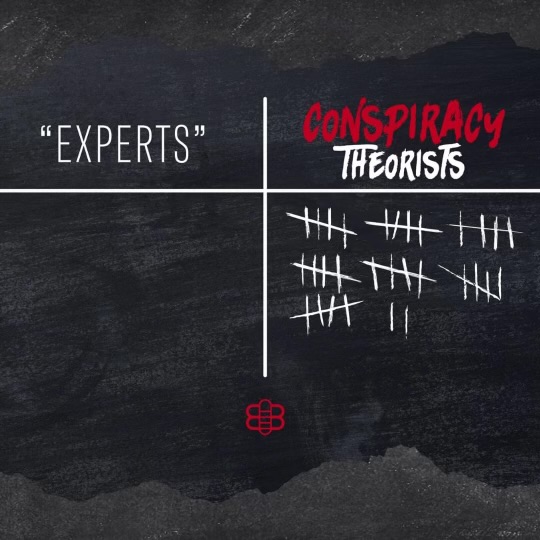
Readers, were you aware that polls show conservative Canadians are more prone to believing in conspiracy theories than liberal Canadians? I’m kidding — of course you were. The pollsters haven’t stopped asking about it since the pandemic hit: Insights West in April 2021, Angus Reid in November 2021, Abacus Data in June 2022, Leger Marketing in the spring of 2022, and again this week. And we in the media can’t get enough of it: “Conspiracy theories are popular in Canada, especially among conservatives, poll says”, was The Canadian Press headline for this week’s Leger poll.
The notion that the Conservative Party of Canada and some of its leading lights are inviting violence through unconscionably heated and conspiratorial rhetoric is endemic in the Canadian newsroom. While I’m no fan of unconscionably heated rhetoric, I very much doubt actual extremists, or potentially violent extremists, see anyone worth choosing among Canada’s federal political leaders. But in any event, it apparently needs saying that not all conspiracy theories are created equal. Some aren’t conspiracy theories at all.
To its credit, The Leger poll released this week mostly confines itself to proper conspiracies: 9/11 Trutherism, a faked lunar landing, etc. Somewhere between 36 per cent (the truth about John F. Kennedy’s assassination was covered up) and five per cent (the earth is flat) believe completely or somewhat in these notions.
But by far the most popular statement among those Leger presented to respondents was as follows: “Mainstream media manipulates the information it disseminates”. Fifty-five per cent of respondents overall agreed with that; the JFK coverup was in a distant second at 36 per cent.
What’s “mainstream media”? If it includes, say, Al Jazeera and Fox News, then the statement is obviously true. (What does “manipulate” mean, for that matter? It doesn’t necessarily imply bad faith.) And the belief is certainly not just confined to Conservative voters: 47 per cent of NDP voters and 53 per cent of Green voters agreed, compared to 69 per cent of Conservative supporters.
What the question definitely does, however, is boost the overall numbers and make them more newsworthy. So Leger (and media) can say “79 per cent of Canadians believe in at least one of the conspiracy theories we asked them about”, and “Conservative voters (94 per cent) are more likely to believe in at least one of the theories”.
That’s a quibble, really. Other polls have, in my view, been utterly shameless about this sort of results-padding.
Take this proposition, for example, which Abacus put to its respondents: “52 per cent think government accounts of events can’t be trusted”.
That is a true statement. It applies to every government in the world, ever.
Even to mention Klaus Schwab’s Great Reset in Canadian political conversation is to risk being branded a conspiracy theorist. But it’s a real-deal “world governance” manifesto, it’s absolutely bonkers from start to finish, everyone from Justin Trudeau to the King (in a previous role) has made approving noises about it, and to the very limited extent it should be taken seriously, everyone should oppose it.
November 23, 2023
Clown world is what you get when children run things in the real world
Theophilus Chilton on the overgrown children who populate what used to be the adult world in the West:
If you’ve been around dissident Right circles for any length of time, you’re probably seen the term “clown world” used to describe the modern Western world. If you’ve paid any attention at all to the state of the world around us, you know just how apt of a description that term really is. Modernity as it is expressed today transcends the types of degeneracy and corruption that have been seen in previous decadent periods and has plumbed to nadirs of human depravity that previous generations would have literally found unspeakable because they would not have had the vocabulary to even describe them. To any rational adult observer of any previous age, no matter how dissolute, today’s western social, political, and moral situation would seem completely clownish and unserious.
That this would be the case is practically inevitable given the type of people involved within the plethora of left-wing causes and intersectionality factions. As a general rule, the political and cultural Left are very childish, not just in their behaviour, but also in their worldview, demeanor, and mindset. Any normal person who has ever dealt with them on social media (or the real world, if you’ve had the misfortune) can abundantly testify to this. Now, I’m not really talking about the “boss lefties”, the people who really run the show concerning left-wing activism. Rather, I’m describing the rank-and-file lefties who fill out the echelons of “ground level” activism – ranging from the antifa street drek to the college students whining about microaggressions to the HR representatives in multinational corporations.
I sincerely believe that to understand the psychology of those on the Left, one must approach the issue from the standpoint of juvenile behaviourism. Observing how and why children – as in actual children – act as they do will shed light on why those on the Left are the way they are. I want to emphasise that what I’m saying here isn’t meant to be the usual derogation that people on opposite sides of the political divide routinely throw at each other. I am literally saying that, for whatever reason, the stunting of the emotional and rational growth of the minds of those who are drawn to the hard core of the Left results in similarities in psyche and behaviour between the two groups.
The first and most obvious similarity revolves around the acceptance of wishful thinking as a credible alternative to verifiable reality. This manifests itself in two related ways – the willingness to believe fantasies that have no credible claims to being truth, and the concurrent unwillingness to accept legitimate evidences which disagree with those fantasies.
Anyone who has kids knows that when a small child wants to believe something, they’re going to believe it, no matter what you say or show them to the contrary. Children do this because they do not have a firm grasp on the nature of reality, since they’re still essentially learning from the world around them what reality even is. They haven’t quite learned yet “how the world works”, so to speak, hence they’re still open to “other possibilities”, and assume that if they want these possibilities to be, then they can be.
Sadly, left-wing activists and SJWs operate on essentially the same set of basic premises. Despite all evidences to the contrary, they will believe that homosexuality is normal, people can actually change their sexes, adult-child sexual relationships are healthy, large-scale third world immigration is enriching, computer simulations that predict extremes of global warming are credible reflections of actual climatological science, and so forth. Instead of accepting that arguments to the contrary can even exist, much less penetrate their self-contained fact space, leftists will attempt to mold reality to their preferences by dismissing contrary arguments with one of more “signaling phrases” (i.e. racist, sexist, transphobic, etc.). In this way, they believe they have negated the very existence of those contrary arguments, thus preserving their preferred perceptions.
Another area of similarity is seen in the social dynamics of cliquishness, which both children and leftists display in social settings. We should understand that cliquishness involves much more than the mere existence of in-groups and out-groups. Everybody has groups to which they belong and do not belong, and that is a fundamental factor in human sociability. What makes cliquishness different is that it involves the purposeful engineering of social dynamics for the objective of establishing the power of and loyalty to one or a small group of actors within a set which normally would act as a broad in-group. In other words, it functions as a way of destructively dividing a body of people who you would typically find bound together by more commonalities than differences. For children, this could be classmates within a school setting. For adults, it could mean anything from an office or church environment all the way up to the national level. Ostensibly, children at a school are all there for the same purpose. In the corporation, workers are, in theory, all supporting the company’s stated goals. Within a nation, a sense of asabiyya, of social solidarity, is supposed to obtain.
The whole purpose of left-wing activism is to destroy social solidarity, and to do so in an ever-changing and unpredictable manner. Within cliques, the accepted in-group is ever-shifting and individual members can be subject to sudden changes in status among the group based on anything from personal whim to the requirements of a newly imposed ideological orthodoxy. This is seen regularly on the Left and serves to demonstrate the fragility of the Left’s intersectionality alliance.


