Quotulatiousness

June 27, 2013

How many “environmental” groups are actually harming the environment

Filed under: Economics, Environment, Media — Tags: , , , — Nicholas @ 00:01

Willis Eschenbach at Watts Up With That:

Now, given that poverty is the greatest threat to the global environment, the inescapable conclusion is that the only way the global environment stands a chance is if poor countries can develop economically.

And that is why the anti-development, pro-expensive energy stance of the large environmental NGOs is one of the great environmental tragedies of our times.

Here’s the chain of causality:

1. Climate alarmists, with the strong support of the major environmental NGOs like Greenpeace and WWF, declared war on CO2.

2. The method that they chose to fight CO2 was to discourage fossil fuel use by making energy more expensive, using a combination of taxation, legislation, international pressure, and expensive subsidies to achieve that end. Obama’s War on Coal, announced today, is just one of hundreds of examples of the wealthy NGOs and the rich governments working to increase the price of energy.

3. Since energy is development, expensive energy keeps poor countries in poverty. When the World Bank denies loans for coal fired plants in India, the poor suffer … but the environment suffers more. Until they can afford to use coal and gas, they’ll run the country on wood … I refer you back to Figure 1 for how well that works out.

4. Expensive energy slows a country’s economic development, and as President Obama pointed out, people worried about money don’t pay attention to the environment.

This ends up in a bizarre position—the actions of the major environmental NGOs are ensuring continued environmental destruction in the developing world.

June 19, 2013

V for Vinegar

Filed under: Americas, Media, Soccer — Tags: , , , , , — Nicholas @ 08:29

The Economist reports on the rising tide of protest in Brazil:

All that changed on June 13th when the state’s unaccountable, ill-trained and brutal military police turned a mostly peaceful demonstration into a terrifying rout. Dozens of videos, some from journalists, others from participants and bystanders, show officers with their name tags removed firing stun grenades and rubber bullets indiscriminately at fleeing protesters and bystanders and hunting stragglers through the streets. Motorists trapped in the mayhem ended up breathing pepper spray and tear gas. Demonstrators found with vinegar (which can be used to lessen the effect of tear gas) were arrested. Several journalists were injured, two shot in the face with rubber bullets at close range. One has been told he is likely to lose his sight in one eye. The following day’s editorials took a markedly different tone.

By June 17th what has become dubbed the “V for Vinegar” movement or “Salad Revolution” had spread to a dozen state capitals as well as the federal capital, Brasília. The aims had also grown more diffuse, with marchers demanding less corruption, better public services and control of inflation. Many banners protested against the disgraceful cost of the stadiums being built for next year’s football World Cup. Brazil has already spent 7 billion reais, three times South Africa’s total four years earlier, and only half the stadiums are finished. “First-world stadiums; third-world schools and hospitals”, ran one placard.

[. . .]

So, why now? One reason is surely a recent spike in inflation, which is starting to eat into the buying power of the great majority of Brazilians who are still getting by on modest incomes, just as a big ramp-up in consumer credit in recent years has left them painfully overstretched. Bus fares have not risen for 30 months (mayors routinely freeze fares in municipal-election years, such as 2012, and in January this year the mayors of Rio and São Paulo agreed to wait until June before hiking in order to help the federal government massage the inflation figures). In fact, the rise in São Paulo’s and Rio’s bus fares comes nowhere close to matching inflation over that 30-month period. But bus fares are under government control, unlike other fast-rising costs such as those for housing and food. Perhaps they were simply chosen as a scapegoat.

More broadly, the very middle class that Brazil has created in the past decade — 40m people have escaped from absolute poverty, but are still only one paycheck from falling back into it, and 2009 was the first year in which more than half the population could be considered middle class — is developing an entirely new relationship with the government. They see further improvements in their living standards as their right and will fight tooth and nail not to fall back into poverty. And rather than being grateful for the occasional crumb thrown from rich Brazilians’ tables, they are waking up to the fact that they pay taxes and deserve something in return. Perhaps their government’s triumphalism over those shiny new stadiums was the final straw.

June 4, 2013

Finland’s cardboard box babies

Filed under: Europe, Health, History — Tags: , , , — Nicholas @ 08:56

An interesting bit of history on the BBC News website:

It’s a tradition that dates back to the 1930s and it’s designed to give all children in Finland, no matter what background they’re from, an equal start in life.

The maternity package — a gift from the government — is available to all expectant mothers.

It contains bodysuits, a sleeping bag, outdoor gear, bathing products for the baby, as well as nappies, bedding and a small mattress.

With the mattress in the bottom, the box becomes a baby’s first bed. Many children, from all social backgrounds, have their first naps within the safety of the box’s four cardboard walls.

Mothers have a choice between taking the box, or a cash grant, currently set at 140 euros, but 95% opt for the box as it’s worth much more.

The tradition dates back to 1938. To begin with, the scheme was only available to families on low incomes, but that changed in 1949.

“Not only was it offered to all mothers-to-be but new legislation meant in order to get the grant, or maternity box, they had to visit a doctor or municipal pre-natal clinic before their fourth month of pregnancy,” says Heidi Liesivesi, who works at Kela — the Social Insurance Institution of Finland.

So the box provided mothers with what they needed to look after their baby, but it also helped steer pregnant women into the arms of the doctors and nurses of Finland’s nascent welfare state.

In the 1930s Finland was a poor country and infant mortality was high — 65 out of 1,000 babies died. But the figures improved rapidly in the decades that followed.

June 3, 2013

“Checking your privilege”

Filed under: Britain, Humour, Media, Politics — Tags: , , , — Nicholas @ 09:14

Sean Thomas outlines the notion of “checking your privilege” before discovering that he is the most underprivileged person in Britain:

The idea of Checking Your Privilege is that the opinions of “underprivileged” people, in any political debate, are deemed to be intrinsically more important and valuable than the beliefs of those who are luckier in life.

This is especially true if the debate relates to an area in which The Underprivileged Person is adjudged to be deprived. Extreme versions of Privilege Theory assert that, in especially sensitive arguments, the more privileged person should say nothing at all. e.g. white people are not allowed to express an opinion on racism.

[. . .]

It’s an impressive list of deprivations. Sometimes, when I look at my life, I wonder if I am [a] talented black saxophone player in the 1950s, or at least a meth dealer in central Baltimore – rather than a writer in north London. Certainly, I am THE most underprivileged person in the UK. And this means that my opinion is the most worthy and important of all, and everyone else must shut up, while I opine.

And my opinion is this: Privilege Checking is stupid. It is vacuous and diseased. It is a duet of moral vanity and bourgeois guilt which symptomizes the decadence and redundancy of what passes, today, for lefty “thinking”. Karl Marx (middle-class, well-travelled, disapproved of Engels’s plebby girlfriend) must be spinning on his Highgate pedestal when he sees what his great discourse has turned into.

I hope that clears things up. Now we can move on; IMHO, of course.

May 26, 2013

Bangladesh needs legal reform and free markets

Filed under: Asia, Bureaucracy, Economics, Law — Tags: , , , , , , — Nicholas @ 10:37

Sheldon Richman discusses the plight of workers — especially poor women workers — in Bangladesh:

According to a report written for the Netherlands ministry of foreign affairs, most Bangladeshis, unsurprisingly, are victimized by a land system that has long benefited the rural and urban elites. “Land-grabbing of both rural and urban land by domestic actors is a problem in Bangladesh,” the report states.

    Wealthy and influential people have encroached on public lands…, often with help of officials in land-administration and management departments. Among other examples, hundreds of housing companies in urban areas have started to demarcate their project area using pillars and signboard before receiving titles. They use local musclemen with guns and occupy local administrations, including the police. Most of the time, land owners feel obliged to sell their productive resources to the companies at a price inferior to market value. Civil servants within the government support these companies and receive some plot of land in exchange.

Women suffer most because of the patriarchy supported by the political system. “Women in Bangladesh rarely have equal property rights and rarely hold title to land,” the report notes. “Social and customary practices effectively exclude women from direct access to land.” As a result,

    Many of the rural poor in Bangladesh are landless, have only small plots of land, are depending on tenancy, or sharecropping. Moreover, tenure insecurity is high due to outdated and unfair laws and policies…. These growing rural inequalities and instability also generate migration to towns, increasing the rates of urban poverty.

Much as in Britain after the Enclosures, urban migration swells the ranks of workers, allowing employers to take advantage of them. Since Bangladesh does not have a free-market economy, starting a business is mired in regulatory red tape — and worse, such as “intellectual property” law — that benefit the elite while stifling the chance for poor individuals to find alternatives to factory work. (The owner of the Savar factory, Mohammed Sohel Rana, got rich in a system where, the Guardian writes, “politics and business are closely connected, corruption is rife, and the gap between rich and poor continues to grow.”) Moreover, until the factory collapse, garment workers could not organize without employer permission.

Crony capitalism deprives Bangladeshis of property rights, freedom of exchange, and therefore work options. The people need neither the corporatist status quo nor Western condescension. They need radical land reform and freed markets.

The war on drugs is “a holocaust in slow motion”

Filed under: Health, Law, Liberty, USA — Tags: , , , , , , — Nicholas @ 08:33

To my surprise, the creator of the TV series The Wire has come out against legalization of marijuana:

David Simon surged into the American mainstream with a bleak vision of the devastation wrought by drugs on his home town of Baltimore — The Wire, hailed by many as the greatest television drama of all time. But what keeps him there is his apocalyptic and unrelenting heresy over the failed “war on drugs”, the multibillion-dollar worldwide crusade launched by President Richard Nixon in 1971.

When Simon brought that heresy to London last week — to take part in a debate hosted by the Observer — he was inevitably asked about what reformers celebrate as recent “successes” — votes in Colorado and Washington to legalise marijuana.

“I’m against it,” Simon told his stunned audience at the Royal Institution on Thursday night. “The last thing I want to do is rationalise the easiest, the most benign end of this. The whole concept needs to be changed, the debate reframed.

“I want the thing to fall as one complete edifice. If they manage to let a few white middle-class people off the hook, that’s very dangerous. If they can find a way for white kids in middle-class suburbia to get high without them going to jail,” he continued, “and getting them to think that what they do is a million miles away from black kids taking crack, that is what politicians would do.”

If marijuana were exempted from the war on drugs, he insisted, “it’d be another 10 or 40 years of assigning people of colour to this dystopia.”

[. . .]

Simon took no prisoners. In his vision, the war on — and the curse of — drugs are inseparable from what he called, in his book, The Death of Working Class America, the de-industrialisation and ravaging of cities that were once the engine-rooms and, in Baltimore’s case, the seaboard of an industrial superpower.

The war is about the disposal of what Simon called, in his most unforgiving but cogent term, “excess Americans”: once a labour force, but no longer of use to capitalism. He went so far as to call the war on drugs “a holocaust in slow motion”.

Simon said he “begins with the assumption that drugs are bad”, but also that the war on drugs has “always proceeded along racial lines”, since the banning of opium.

It is waged “not against dangerous substances but against the poor, the excess Americans,” he said, and with striking and subversive originality, posited the crisis in stark economic terms: “We do not need 10-12% of our population; they’ve been abandoned. They don’t have barbed wire around them, but they might as well.”

April 14, 2013

Alternet: Ten facts about state lotteries and the poor

Filed under: Cancon, Economics, Government, USA — Tags: , , , — Nicholas @ 11:20

While I don’t object to lotteries existing, I still don’t think governments should be running them, but they’re involved in most states and provinces:

State lotteries amount to a hidden tax on the poor. They eat up about 9 percent of take-home incomes from households making less than $13,000 a year. They siphon $50 billion a year away from local businesses — besides stores where they’re sold. And they are encouraged by state-sponsored ads suggesting everyone can win, win, win!

State lotteries, which once were illegal, now exist in most states. What many people don’t know about lotteries is that they prey on those who can least afford it; most people never win anything big; and 11 states raise more money from lotteries than from corporate taxes. Beyond the moral, mental health or religious debates over gambling, lotteries are another example of how society preys on the poor and the working-class.

Let’s look at why state lotteries do far more harm than good — especially at the bottom of the economic ladder.

[. . .]

4. They hit the poorest the hardest. “Simply put, lotteries take the most from those who can least afford it,” wrote economist Richard Wolff. “Instead of taking those most able to pay (the principle of federal income tax in the U.S.), state leaders use lotteries to disguise a regressive tax that falls on the middle and even more on the poor.” A 2010 study found that households with take-home incomes of less than $13,000 spent on average $645 a year on lottery tickets, which is about 9 percent of their income. The reason people play lotteries varies, but it mixes hopes and dreams with desperation: poorer people see it as a slim chance to radically improve their standard of living.

5. Communities of color, less-educated spend the most. Numerous academic studies have found that non-whites spend much more on lotteries than whites, with one study putting the figure at $998 for African Americans and $210 for whites. Household with incomes under $25,000 spent an average of about $600 a year, while $100,000-plus earners spent about $300 year. People who never graduated from college spent the most, about $700 a year, while graduates spent under $200.

Of course, being Alternet, we have to have at least one of our traditional straw men to knock down:

7. They give the wrong message about solving poverty. Lotteries reinforce libertarian political messages, suggesting that everyone needs to take individual action in response to society’s inequities, even though the government has helped well-connected individuals, businesses and industries become rich for decades. This easy money for states diverts political debate away from society-wide analyses and solutions to what prevents people from moving up the economic ladder. Instead, it pushes individuals in marginal circumstances toward gambling as their hope for gain.

I’m not sure what is “libertarian” about corporate welfare, crony capitalism, and other economic distortions on the part of government to favour certain people over others, but setting aside the slur, this is otherwise a valid point. Encouraging people to take individual action? I don’t see buying a lottery ticket as falling into that category.

April 9, 2013

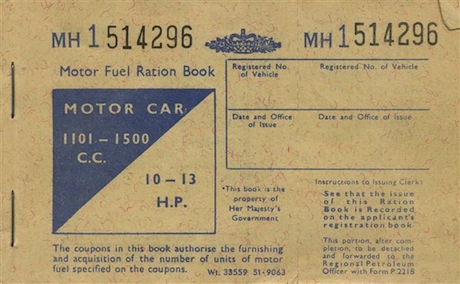
Britain’s wartime rationing was the actual start of the modern welfare state

Filed under: Britain, Bureaucracy, Food, Government, History, WW2 — Tags: , , , — Nicholas @ 08:31

In the Telegraph, Daniel Hannan shows that the wartime coalition government led by Winston Churchill actually laid the groundwork for the post-war “creation” of the welfare state:

British WW2 Fuel ration book cover

It wasn’t the 1945 Labour Government that created the welfare state, that Saturn which now devours its children. The real power-grab came in 1940.

With Britain’s manpower and economy commandeered for the war effort, it seemed only natural that ministers should extend their control over healthcare, education and social security. Hayek chronicled the process at first hand: his Road to Serfdom was published when Winston Churchill was still in Downing Street.

Churchill had become prime minister because he was the Conservative politician most acceptable to Labour. In essence, the wartime coalition involved a grand bargain. Churchill was allowed to prosecute the war with all the nation’s resources while Labour was given a free hand to run domestic policy.

The social-democratic dispensation which was to last, ruinously, for the next four decades — and chunks of which are rusting away even today — was created in an era of ration-books, conscription, expropriations and unprecedented spending. The state education system, the NHS, the Beveridge settlement — all were conceived at a time when it was thought unpatriotic to question an official, and when almost any complaint against the state bureaucracy could be answered with “Don’t you know there’s a war on?”

All quite true, and all quite necessary at the time. Without significant amounts of imported food, Britain could not feed its people. Even with imports, the amount of available food was subject to unpredictable fluctuations as losses at sea interrupted supply and left empty shelves in grocery stores. Although losses were relatively low early in the war (early U boats were unable to stay at sea for long periods, and German bases were a long way from most British trade routes), the writing was on the wall if the war continued for years.

To fight a totalitarian regime, Britain had to emulate some of its methods (ironically, full rationing wasn’t introduced in Germany until much later in the war). For the middle classes, this was an unwelcome intrusion of the state into private affairs, but generally accepted due to the war. For the working classes, in many cases it was actively welcomed. While the rations were small, there was the promise — and generally a fulfilled promise — that some would be made available even in the poorest areas of the country. My mother was nine when the war began, and she remembers seeing more food in the stores of Middlesbrough after rationing was introduced. After the deprivations of the Great Depression, many people in the north and in Scotland were better fed and clothed during the rationing period than they had been for nearly a decade.

Given that information, it should not be surprising that so many people voted for Labour in the 1945 elections: they’d had what they believed to be a live demonstration of the benefits of socialism for six years of war, and didn’t want to go back to the pre-1940 status quo.

April 2, 2013

Revisiting the revisionist view of the “Satanic mills” of the British industrial revolution

Filed under: Britain, Economics, History — Tags: , , , , — Nicholas @ 08:55

Rather in keeping with the sentiments expressed in today’s Quote of the Day post, Emma Griffin explains why the workers generally thought of the industrial revolution as a very good thing indeed:

Writers and academics often show an interesting ambivalence about industrialization. Today, they regard it as a blessing, the single-most-effective way to lift people out of poverty. But in thinking about Britain’s Industrial Revolution, they have tended to reach the opposite conclusion: The rise of the factory, they argue, caused the end of more “natural” working hours, introduced more exploitative employment patterns and dehumanized the experience of labor. It robbed workers of their autonomy and dignity.

Yet if we turn to the writing of laborers themselves, we find that they didn’t share the historians’ gloomy assessment. Starting in the early 19th century, working people in Britain began to write autobiographies and memoirs in ever greater numbers. Men (and occasionally women) who worked in factories and mines, as shoemakers and carpenters, and on the land, penned their stories, and inevitably touched on the large part of their life devoted to labor. In the process, they produced a remarkable account of the Industrial Revolution from the perspective of those who felt its effects firsthand — one that looks very different from the standard historical narrative.

[. . .]

Higher levels of employment also helped change the balance of power between master and laborer. So long as jobs remained scarce, workers, by necessity, obeyed their employers. The price of dissent or disobedience was unemployment. With more jobs, such subservience became less and less necessary. In the booming new industrial towns, workers could, and did, walk out on employers over relatively minor matters, confident that finding more work wouldn’t be difficult. One autobiographer left his position simply because he “grew sick” of the work; another because he didn’t want to “beg pardon” after a falling out with his master; another objected to wasting his precious Sunday mornings at his master’s religious services; and another quit when his master refused to let him take his tea breaks off the premises. All working relationships are defined by a disparity in power between master and servant. But that inequality is rendered more palatable if we’re well remunerated for our services and can leave at will.

The way in which working people described the upheavals of this period provides us with a powerful reminder of the transformative effect of industrialization and of its capacity to improve living standards, even for the poor. Generations of historians have dwelled on the loss of old working patterns and presumed that the introduction of more intensive ones was detrimental to workers’ welfare. But these developments weren’t viewed in such a sinister light at the time. Industrialization promised full employment, and for those used to scraping together a living from the land, this was very good news indeed.

QotD: In praise of cheap, gimcrack, run-of-the-mill manufacturing

For the first time ever, labourers were able to purchase cheap goods for themselves. The first factories focused on mass production of cheap goods for the poor. Shoes, for example, were produced for the proletariat — the rich bought made-to-measure shoes. This was different from France, where the government’s mercantilist product standards, designed to uphold quality, ensured that nothing was produced for the poor at all. In France, mercantilism continued to be state policy for much longer than in England. This is the reason why industrialisation took fifty more years to arrive on France’s shores.

J.P. Floru, Heavens on Earth: How To Create Mass Prosperity, quoted by Brian Micklethwait at Samizdata, 2013-03-29.

March 29, 2013

Demonizing smokers hasn’t forced them to quit … let’s start sending them to psychiatric care instead

Filed under: Britain, Health, Media — Tags: , , , , , — Nicholas @ 09:53

When the all the persuasion, “nudging”, shaming, harassment, and legal shenanigans haven’t worked, try taking a leaf out of the old Soviet Union playbook for dealing with dissidents:

Smoking may be a sign of psychiatric illness, experts say. Doctors should routinely consider referring people who smoke to mental health services, in case they need treatment, they add.

The controversial recommendation from the British Lung Foundation, a charity, comes in response to a major report, Smoking and Mental Health, published this week by the Royal College of Physicians and the Royal College of Psychiatrists with the Faculty of Public Health. It says that almost one in three cigarettes smoked in Britain today is smoked by someone with a mental disorder. When people with drug and alcohol problems are included the proportion is even higher.

The reason is that smoking rates have more than halved over the past 50 years, but the decline has not happened equally in all parts of society.

“Smoking is increasingly becoming the domain of the most disadvantaged: the poor, homeless, imprisoned and those with mental disorder. This is a damning indictment of UK public health policy and clinical service provision,” the report says.

March 14, 2013

Reason.tv: Matt Ridley on How Fossil Fuels are Greening the Planet

Filed under: Environment, Food, Media — Tags: , , , — Nicholas @ 00:01

Matt Ridley, author of The Red Queen, Genome, The Rational Optimist and other books, dropped by Reason‘s studio in Los Angeles last month to talk about a curious global trend that is just starting to receive attention. Over the past three decades, our planet has gotten greener!

Even stranger, the greening of the planet in recent decades appears to be happening because of, not despite, our reliance on fossil fuels. While environmentalists often talk about how bad stuff like CO2 causes bad things to happen like global warming, it turns out that the plants aren’t complaining.

February 25, 2013

Worst. Student movement. Ever.

Filed under: Cancon, Education, Government — Tags: , , , — Nicholas @ 11:04

The FEUQ speeds into the global lead for worst student movement ever:

I’m trying to imagine a worse excuse for a student movement than the one Quebec has at the moment; and I have to say that I’m not sure I can.

I mean, sure, the Canadian Federation of Students has talked some awful crap about how reducing net tuition for poor students is unacceptable, unless richer kids get a break too — really ludicrous stuff, which objectively favours richer students over poorer ones. But so far as I know, they’ve never actively aided and abetted a government that was intent on making universities poorer.

But that’s what FEUQ, and the rest of the Quebec student movement, seem to be doing right now.

[. . .]

FEUQ’s train of thought seems to run something like this: 1) Universities want more money; 2) the provincial government is broke; 3) therefore, new money can only come out of tuition fees; 4) therefore, we’d better oppose this. The problem is, if you concede point 2 you’re more or less screwed in terms of asking something for yourself, like a more generous student aid system (which Quebec certainly needs, at least for dependent students). And you’ve gone and hacked-off one of your most natural allies as far as higher education is concerned.

H/T to Stephen Gordon for the link.

February 11, 2013

A boxplot of First Nations misery

Filed under: Cancon, Economics, Government — Tags: , , , , , — Nicholas @ 09:17

Over the weekend, Colby Cosh posted this depressing box-and-whisker plot (aka “boxplot”) from statistical data on First Nations communities:

First Nations boxplot

Why did I want to look at this information this way? Because Canada actually performed an inadvertent natural experiment with residential schools: in New Brunswick (and in Prince Edward Island) they did not exist. If the schools had major negative effects on social welfare flowing forward into the future we now inhabit, New Brunswick’s Indians would be expected to do better than those in other provinces. And that does turn out to be the case. You can see that the top three-quarters of New Brunswick Indian communities would all be above the median even in neighbouring Nova Scotia, whose FN communities might otherwise be expected to be quite comparable. (Remember that each community, however large, is just one point in these data. Toronto’s one point, with an index value of 84. So is Kasabonika Lake, estimated 2006 population 680, index value 47.)

On the other hand, and this is exactly the kind of thing boxplots are meant to help one notice, the big between-provinces difference between First Nations communities isn’t the difference between New Brunswick and everybody else. It’s the difference between the Prairie Provinces and everybody else including New Brunswick — to such a degree, in fact, that Canada probably should not be conceptually broken down into “settler” and “aboriginal” tiers, but into three tiers, with prairie Indians enjoying a distinct species of misery. (This shows up in other, less obvious ways in the boxplot diagram. You notice how many lower-side outliers there are in Saskatchewan? That dangling trail of dots turns out to consist of Indian and Métis towns in the province’s north — communities that are significantly or even mostly aboriginal, but that aren’t coded as “FN” in the dataset.)

I fear that the First Nations data for Alberta are of particular note here: on the right half of the diagram we can see that Alberta’s resource wealth (in 2006, remember) helped nudge the province ahead of Saskatchewan and Manitoba in overall social-development measures, but it doesn’t seem to have paid off very well for Indians. This isn’t a surprising outcome, mind you, if you live in Alberta; we have rich Indian bands and plenty of highly visible band-owned businesses, but the universities are not yet full of high-achieving members of those bands, and the downtown shelters in Edmonton, sad to say, still are.

February 9, 2013

The domestic food desert

Filed under: Britain, Food, Health — Tags: , , , , — Nicholas @ 10:00

Theodore Dalrymple on one of the more likely culprits for obesity among poor British families:

With the decline of the family — wrought by the policies of successive governments — patterns of eating have changed. Meals in many households, especially those of the relatively poor, are no longer family or social occasions. It has been found that a fifth of children do not eat more than one meal a week with another member of their household; and in such households, which I used sometimes to visit as a doctor, the microwave oven was the entire batterie de cuisine, or at any rate the only cooking implement that was ever actually employed.

Moreover, there was no table at which a meal could have been eaten in common if anyone had thought of doing so. The result was that children became foragers or hunter-gatherers in their own homes, going to the fridge whenever they felt like it and grazing on prepared foods — high, of course, in the evil fructose. Not coincidentally, these households were also the least likely to have what would once have been considered the normal family structure.

Such households also tended to be in areas called “food deserts”, in which fresh produce is either not easily available or unavailable. But those who ascribe the dietary habits of the households I have just described to food desertification put the cart before the horse: for if heroin can reach these areas (and it can), surely the humble lettuce can do so?

It is also sometimes alleged that people buy prepared foods because they are cheap. This is nonsense. In fact, if you go to areas inhabited by poor Indian or Pakistani families you will find stores that sell an astonishing range of vegetables at equally astonishing prices. I used to shop in one such store, at a time when I did not have to concern myself too much over the price of food; I could hardly carry all that I could buy for a few pounds. I remember in particular a 10-kilo bag of onions costing £1.49.

The Indian and Pakistani women bought with discrimination and, taking a maternal interest in me, would sometimes indicate what to look for among what were for me the more exotic vegetables. But I never saw any poor whites shopping there: they went straight to the pie and pizza shops, without so much as a glance at the okra and aubergine.

In other words, food desertification and the supposed cheapness of industrially prepared foods is a consequence, not a cause of, the food habits I have described. Food desertification is a symptom of the culinary ignorance, incompetence and indifference of a substantial minority of our population: ignorance, incompetence and indifference unopposed by any attempt of our educational system to counteract it, for example by teaching girls the elements of cookery. Fat is indeed a feminist issue, but not in the sense that Susie Orbach originally meant it.

« Newer PostsOlder Posts »

Powered by WordPress