
Quotulatiousness

October 17, 2012

The real story of the London Beer Flood of 1814

Filed under: Books, Britain, History, Media — Tags: , , , — Nicholas @ 08:40

When the story isn’t quite as juicy as the recounter would like, there is a common tendency to make shit up to amp up the tale:

I can stake a tenuous family link to the Great London Beer Flood disaster of 1814, which took place exactly 196 years ago today. My great-great-great-great grandfather on my mother’s side, Maurice Donno, was living in Soho, a minute or three’s walk from the Horse Shoe Brewery off Tottenham Court Road, when a huge vat of maturing porter at the brewery collapsed violently and flooded the surrounding tenements, killing eight people. Most, if not all, of those who died were poor Irish immigrants to London, part of a mass of people living in the slums around St Giles’s Church, the infamous St Giles “rookeries” (later to be cleaned away by the building of New Oxford Street in 1847). Maurice Donno was very probably Irish, his surname most likely a variation of Donough or something similar (which would make his first name a common Anglicisation of the Irish Muirgheas). Perhaps he knew some of those who died, or were injured, in the Great Beer Flood, or knew people who knew them. It seems very likely he would have gone across the road at some point after the tragedy, to join the hundreds who came to see the destruction wreaked by that dreadful black tsunami of beer.

[. . .]

Thank you, Eugene Tolstov, for pointing to my mistake, and for not laughing too much at my inability to multiply 3,555 by 36 by 10 and divide by 2,240. But at least my narrative on probably the worst industrial accident involving a British brewery was more accurate than many. The late Alan Eames, for example, in The Secret Life of Beer, claimed that the vat burst “with a boom heard five miles away” – not mentioned in any of the many sources from the time that I’ve read – while “eyewitnesses told of besotted mobs flinging themselves into gutters full of beer, hampering rescue efforts” – no, newspaper reports of the rescue don’t support this at all – and “many were killed suffocated in the crush of hundreds trying to get a free beer” – again, the contemporary reports don’t say this – while “the death toll eventually reached 20, including some deaths from alcohol coma” – no, the newspaper reports from the time make it clear that only eight people died, all women and children, and all killed by the initial huge wave of beer and the destruction it caused to the buildings in the tenements behind the brewery.

Similarly there’s a myth arisen that when those injured after the vat burst were taken to the nearby Middlesex Hospital, “patients already there for illnesses unrelated to the beer disaster smelled the ale and began a riot, accusing doctors and nurses of holding out on the beer they thought was being served elsewhere in the hospital”, while another myth claims that when bodies of those killed were taken “to a nearby house for identification”, so many people turned up to see them that “the floor collapsed under the sheer weight of onlookers” and “many inside the building perished in the collapse.” None of this is in any reports of the accident from newspapers in 1814, and if any of it had happened, you can bet one of them would have written about it.

October 9, 2012

The fight to save booze-soaked Britons from themselves

Filed under: Britain, Health, Media — Tags: , , , — Nicholas @ 08:45

At sp!ked, Tim Black points out that the inconvenient truth is that Brits drink less than they used to, despite all the tabloid coverage of boozy downtown outings:

Not that painting a miserable portrait of our drinking habits is particularly hard today. There seems to be a consensus across political parties and the media that alcohol consumption is indeed a big, big problem. The only discussion centres upon the best way to address it. Prime minister David Cameron, for instance, can announce, as he did earlier this year, that the ‘scandal’ of drunkenness and alcohol abuse needs to be tackled, and no one bats an eyelid. Booze Britain, complete with puking teens and pissed parents, is a given, a fact that simply doesn’t need to be challenged.

Yet it really should be challenged. At the same time as 4Children was busy readying its assault on parents who — shock, horror — like to drink, the British Beer and Pub Association (BBPA) released rather sobering figures. Using tax-receipt data from Her Majesty’s Revenue and Customs and survey material from the Office for National Statistics, the BBPA revealed that reality was rather drier than the drink-soaked fantasists would have us believe. In fact, alcohol consumption in Britain has actually fallen to its lowest level for 13 years. Furthermore, according to The Economist, supping rates have veritably plummeted among the young over the past 10 years. That is, the very people deemed to be vomiting and fighting at the coalface of binge-drink Britannia don’t actually seem to be drinking that much. ‘In 2003’, reports The Economist, ‘70 per cent of 16- to 24-year-olds told interviewers they had had a drink in the previous week; by 2010, just 48 per cent had. The proportion of 11- to 15-year-olds who had drunk in the previous week halved over the same period. Heavy drinking sessions are down, too.’

And this is why the existence of 4Children’s scaremongering report is revealing. In its contorted argument, its counterfactual assertion that there is a big, big problem, it shows how the largely state-backed anti-booze industry, a morass of report-churning quangos and ever-so-concerned charities, is dead set on creating a problem where there really isn’t one. Or perhaps more accurately, it wants to problematise an aspect of our everyday behaviour. It wants to wrest an accepted part of social life from its mundane context, and present it back to us as something weird, harmful, perhaps even sinister.

September 28, 2012

Even when they quote you accurately, they can still miss the point you’re trying to make

Filed under: Economics, Food, Media, Quotations — Tags: , — Nicholas @ 10:11

Tim Worstall, after thanking all the folks who got him to the point he can be quoted (and quoted accurately) in the Los Angeles Times, realizes that they’re using his words to present a point he isn’t trying to make:

I wrote here about the coming bacon famine. My point was that we’ve just had a bad crop and this requires a modest change in how we use that crop that we do have. We’d rather like people to stop feeding the now in short supply grains to pigs to make bacon and leave rather more of it to be eaten directly by humans. Further, I gloried in the fact that we have a system which achieves this. We have the futures markets: the future price of corn and soy and wheat has gone up. Farmers are culling their pig herds to avoid the future higher costs of feeding them. This will cause a shortage of bacon in the future and if not an excess then certainly more grain than otherwise that can be eaten by humans. I do regard this as a good result, yes. But what I am pointing to is the way in which in a market, price driven, system the entirely selfish pursuit of gelt and pelf, the desire purely for filthy lucre, brings about such a desirable result. The sole desire of agricultural commodity speculators is to increase the amount of cash in their wallets and reduce the amounts in those of other such speculators. Yet from this system we get a rebalancing of the use of a scarce resource which leads to more humans leading longer and better lives even if we’ve a certain shortage of pigs. At which point Hurrah! for capitalism and aren’t we all such lucky people.

[. . .]

Which is indeed what I said. However, we’re then told this:

    Worstall doesn’t go so far as to say we should stop eating meat, but his line of thinking is headed in the right direction. If we didn’t use grain as feed for livestock, we could take significant steps toward ending global hunger while also drastically reducing greenhouse gases. Meantime, we’d spare a whole lot of pigs — and maybe even our health.

All of which makes me sound like some kind of hippie, advocating vegetarianism and the equitable distribution of the world’s resources. When what I’m actually applauding is the way in which financial capitalism red in tooth and claw solves our distribution of scarce resources problems.

September 23, 2012

Plagiarism in the Globe and Mail

Filed under: Cancon, Media — Tags: , , — Nicholas @ 10:21

Writing at Maclean’s, Colby Cosh outlines the case against Globe and Mail columnist Margaret Wente and the Globe‘s public editor Sylvia Stead:

Journalistic plagiarism is ordinarily regarded as what a lawyer would call a strict-liability offence. It may not be deserving of a career death penalty in any particular case, but the evidence of plagiarism usually suffices to establish the crime. Stead’s procedure as a public editor appears to involve looking into the soul of the accused and searching therein for gremlins. Does she, one wonders, believe in the objective existence of plagiarism at all? Again, she does not use the term, and she will not believe that Wente had heard even a rumour, even a whisper, of Gardner’s prior work for the Citizen.

Well, it is not likely there will ever be a case in which Stead is presented with close-up video footage of Wente using her mouse to highlight someone else’s words and pressing Control-C and Control-V. That is why the strict-liability standard is usual. If Stead will not apply it — if she is willing to accept any denial from a fellow Globe lifer, however preposterous — then how can she ever, as an impartial judge of journalism ethics, deliver a conviction? Can it be that the whole point is to have the appearance of accountability without the actual possibility of it?

Update, 24 September: Chris Selley in the National Post:

I think I’ve narrowed down my top two discreditable aspects, though: One, Stead’s reference to the fact that Wente “writes three times a week,” which could only pertain to a defence of overwork; and two, this astonishing sentence: “There appears to be some truth to the concerns but not on every count.”

Here’s the thing. I have some experience cornering plagiarists, and these are two of their standard defences: “Most of the allegations aren’t that bad,” which of course says nothing about the worst of them; and “I’m so busy,” which isn’t a defence at all but rather an appeal for clemency. And yet here is Sylvia Stead, Public Editor of The Globe and Mail, effectively raising these arguments on Wente’s behalf. This isn’t public editing; it’s public relations, and inept public relations at that.

September 16, 2012

Reporting on “battleships”, “tanks”, and other military matters

Filed under: Media, Military — Tags: , , , , — Nicholas @ 09:17

Strategy Page on the regularly displayed woeful ignorance of military technology in media reporting:

On September 6th at the U.S. Democratic Party convention a tribute to military veterans featured a retired admiral giving a speech while behind him was projected an impressive image of four warships coming towards the audience. What most people viewing this scene did not realize was that the ships on that screen were Russian, not American. Such an error should not have been a surprise.

This sort of facile military reporting and media presentation of the military has become increasingly common. It goes beyond calling all warships (except carriers and subs) “battleships” (a class of ship that went out of wide use half a century ago) or calling self-propelled artillery (or even infantry fighting vehicles) “tanks” simply because they all have turrets (but very different uses). The bad reporting extends to many other basic items of equipment, training, leadership, tactics and casualties.

It all started back in the 1970s, when conscription in the United States ended and the many World War II veterans in journalism, public affairs and advertising (all of whom help out at major political events) began to retire. The end of conscription meant new journalists were much less likely to have any knowledge of military affairs. It became increasingly easy to make stupid, and embarrassing, mistakes.

The other side of the Philip Roth/Wikipedia spat

Filed under: Books, Media — Tags: , , , — Nicholas @ 08:53

I admit that I didn’t follow this story when it got (for a literary spat) saturation coverage in various media outlets. Here (speaking in a private capacity and not as an official Wikimedia Foundation spokesperson) is Oliver, and he’s got a bit of refuting to do:

First, this is not a fundamental flaw in Wikipedia’s central precepts — this is one author and his agents being unable to navigate the internet and/or report the truth with any degree of accuracy. This is our attempt to make our information not only accurate, but verifiable — to ensure that readers have a hope in hell of actually checking the accuracy of our information. This is not achieved by enabling subjects to become the oracles of truth for any article that mentions them, or telling readers “we know it’s accurate because Philip Roth said so, and you’ll just have to trust us on that”. We don’t want readers to trust us. We want readers to think and be able to do their own research.

Second, maybe (although I doubt it) we need to have a frank debate over how we handle primary and secondary sourcing. But for all of the reasons explained above, Philip Roth and the Editorial of Azkaban is a terrible poster boy for such a debate.

Third: people should perhaps start having a debate about the way authors are treated in “proper” sources. The New Yorker, the Guardian, ABC News and the Los Angeles Times — all respected bodies. And all, without being able and/or willing to do their own research, happily published or republished Roth’s assertions. We rely on these organisations for reporting what our politicians do, what our armed forces do, how entities with the power of life and death over humanity are accountable to the people. And they happily gulp down the glorified press releases of anyone who offers to let them touch his Pulitzer.

There’s also a follow-up post providing more information and explanation.

September 9, 2012

Winner of the Democratic convention? Conservative trolls

Filed under: Media, Politics, USA — Tags: , , , , , , — Nicholas @ 00:04

Dave Weigel on the fascinating fact that a few conservatives were able to successfully troll the Democratic convention in Charlotte:

Whatever lessons the Democrats take from Charlotte, whatever it did for the president or for the ambitious senators and governors who stalked delegate breakfasts and whispered “2016,” this is a fact: The convention was successfully trolled.

I don’t use troll in the pejorative sense. Actually, I may be trying to craft a neutral meaning of troll where none previously existed. The term, in its modern Internet usage, refers to people who want to start fights online to bring the universe into an argument on their terms. It comes not from Grimm literature, but from a fishing technique in which multiple lines are baited and dragged to haul in the maximum amount of cold-bloods.

Democrats did not expect to spend Wednesday arguing about the capital of Israel and the appearance of the word “God” in their platform. There were, reportedly, 15,000 members of the media in Charlotte, of whom maybe 14,980 could have given a damn about the party platform. On Tuesday night, when the Obama campaign and the DNC released its platform, none of the bigfoot media outlets in town spent time on the text.

[. . .]

Maybe the word “historic” is out of place for the modern convention. To say that they’re clichéd and staged is, in itself, a staged cliché. But who thought, just 11 months after the launch of the Occupy movement, that 99 percenters would have less influence on the platform than conservative media?

This is what I mean: We live in the age of trolling. Any comment made online, if it’s given the right forum, is as relevant as any comment made by some media gatekeeper. Think about a politician or a journalist on Twitter, and what he sees. If a colleague wants to tell him something, it appears in his feed with an @ symbol. If someone who just logged on and wants to bait a nerd logs on, he will send a message that appears with an @ symbol. Both are equally valid, at least in how they appear on-screen or on a phone. There is no ghetto-izing of comments into the bottom of a page, or into media that you don’t pay attention to.

September 7, 2012

“When I discover something surprising in data, the most common explanation is that I made a mistake.”

Filed under: Business, Economics, Government, Media — Tags: , , , — Nicholas @ 08:20

John Kay suggests you always ask how a statistic was created before you consider what the presenter wants you to think:

Always ask yourself the question: “where does that data come from?”. “Long distance rail travel in Britain is expected to increase by 96 per cent by 2043.” Note how the passive voice “is expected” avoids personal responsibility for this statement. Who expects this? And what is the basis of their expectation? For all I know, we might be using flying platforms in 2043, or be stranded at home by oil shortages: where did the authors of the prediction acquire their insight?

“On average, men think about sex every seven seconds.” How did the researchers find this out? Did they ask men how often they thought about sex, or when they last thought about sex (3½ seconds ago, on average)? Did they give their subjects a buzzer to press every time they thought about sex? How did they confirm the validity of the responses? Is it possible that someone just made this statement up, and that it has been repeated frequently and without attribution ever since? Many of the numbers I hear at business conferences have that provenance.

[. . .]

Be careful of data defined by reference to other documents that you are expected not to have read. “These accounts have been compiled in accordance with generally accepted accounting principles”, or “these estimates are prepared in line with guidance given by HM Treasury and the Department of Transport”. Such statements are intended to give a false impression of authoritative endorsement. A data set compiled by a national statistics organisation or a respected international institution such as the Organisation for Economic Co-operation and Development or Eurostat will have been compiled conscientiously. That does not, however, imply that the numbers mean what the person using them thinks or asserts they mean.

August 7, 2012

Chick-fil-A and the same-sex marriage debate

Filed under: Business, Media, Politics, USA — Tags: , , , , , — Nicholas @ 09:31

Sean Collins at sp!ked:

As welcome as it was to see many stand up for free speech, the focus on First Amendment rights missed the bigger picture. While making principled references to Voltaire, these critical liberals were still using the Chick-fil-A issue to expand the definition of what it means to be ‘homophobic’, so that it now includes the mere utterance of support for traditional marriage. It is noteworthy that Chick-fil-A does not discriminate on the basis of sexual orientation — it has gay employees and it serves gay customers. A franchisee in Chicago has held fundraisers for gay and lesbian groups.

Advocates for same-sex marriage want expressions of support for traditional marriage to be considered beyond the pale and unworthy of debate. It is amazing how fast this issue is moving. Three months ago, Obama was against same-sex marriage — is anyone who espouses that view today now anti-gay and ‘repugnant’? Obama launched his political career in Chicago — was he out of line with ‘Chicago’s values’ until his conversion to the gay-marriage cause 90 days ago? Same-sex marriage has been voted down in all 31 states where it was on the ballot, including in California — are these states filled with ‘bigoted and homophobic’ people?

Millions of Americans, including many CEOs, do not agree with same-sex marriage. But it is clear that Chick-fil-A’s CEO has been singled out because his restaurant chain fits a Culture War stereotype held by many coastal liberals: a Southern-based establishment led by Christians and frequented by ‘backward’ people. It is revealing how pro-gay marriage protesters took the opportunity to condemn Chick-fil-A customers for committing another of today’s sins — being obese. As the New York Times reported, some protesters held signs with ‘warnings that those chicken sandwiches contain a lot of fat and cholesterol’. Dan Turner of the Los Angeles Times helpfully pointed out that ‘a fairly typical meal — a deluxe chicken sandwich with medium waffle fries, a medium Coke and a fudge brownie — contains about enough calories and fat to support a Tunisian village for a week’. The ease with which commentators went from attacking a certain group of people for their beliefs on marriage to attacking them for their eating habits told us a great deal about the elitism that is fuelling the gay-marriage issue.

August 6, 2012

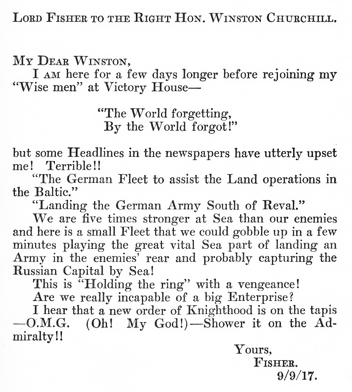
Admiral Fisher: an excitable sort of man

Filed under: Britain, Germany, History, Humour, WW1 — Tags: , , , — Nicholas @ 10:41

Admiral “Jackie” Fisher was a major historical figure in the Royal Navy, advocate of the modern dreadnought battleship and a tad high-strung (“…and on one occasion, the king asked him to stop shaking his fist in his face”). His relationship with Winston Churchill at the Admiralty must have been something to observe, as two of the most influential men in London worked together (for a while). After leaving the Admiralty for the last time, he still kept in touch with Churchill. Here is an example of his communication style:

This is believed to be the first documented use of the now familiar “OMG”.

H/T to Shaun Usher.

July 27, 2012

Bruce Arthur calls for moderation in regard to the London Olympics

Filed under: Britain, Media, Sports — Tags: , , , — Nicholas @ 11:13

In the National Post, Bruce Arthur tries to encourage all of us, in spite of our memories of what British journalists were saying about the Vancouver Olympics, to avoid being nasty about the London games:

But perhaps we in Canada should restrain ourselves, as a nation. Perhaps we should take the higher road. That is, unless the higher road is crammed with traffic in this built-for-horses-and-carriage town. Or the tube is down again.

The Brits did not treat Canada kindly two years ago, it’s true. The Guardian said Vancouver could be the Worst Games Ever three days in, and they based the assessment on refunded snowboard tickets rather than on the preventable death of an athlete. The Guardian also called our glowing totem poles a collection of ice penises, and even the BBC announcer cocked an eyebrow, as it were. The Times of London called us cursed, while the Daily Mail mocked the escalation of the budget. They were, to be honest, kind of jerks about it.

But that doesn’t mean that Canadians should stoop to a similarly savage brand of mockery, beginning with the Opening Ceremony. It doesn’t mean we should make fun of the leaked details of the event, starting with children in hospital beds, which doesn’t seem terribly festive. It doesn’t mean we should make fun of the fact that Muse will apparently play, and even if they do not, that the official song of the Olympics by Muse is a grating, strutting, whining, overcompensatory sneer of a song.

If Boris wasn’t mayor of London

Filed under: Britain, Media, Sports — Tags: , , , , , , , — Nicholas @ 08:53

Lawsmith imagines what Boris Johnson would write about the London Olympics “major international sporting event” in a “certain major city in the UK” if he were not mayor:

I can imagine his perfect article in this alternative history in my dreams. Written in the Spectator and littered with self-deprecation, references to dead or fictitious Greeks, Liverpool and wiff-waff, Boris would have danced across the pages as he gleefully excoriated the Labour administration for the absurd idea of inviting a bunch of prima donna athletes and bureaucrats, most of them foreign, to compete in an outdoor stadium during the coldest, wettest summer in British history.

He might have pointed out that all this would take place in Newham, a place not altogether unlike Portsmouth and, in any case, one most Londoners consider more alien than Paris, with among the highest incidence of robbery and assault in the entire city. He might have joyfully foretold the pain and suffering of millions of income taxpayers on account of the shut-down of major roads and TfL advising know-nothing tourists to hop the tube at rush hour to make the 10 AM events, and seriously questioned the wisdom of erecting a steel wall around Hyde Park for an entire summer before fouling it up beyond recognition.

In our alternative history he would have savaged, rather than prodded, the implementation of widespread censorship undertaken by a hit squad of intellectual property ninjas; he would have lamented the fact that our police were arresting “marginal” (i.e., possibly innocent) suspects – living, breathing, thinking people – on terrorism charges which they might not be able to prove. If he had really driven it home, he would have pointed out that, under normal circumstances, those arrests would never have been made. He would also have asked why nobody seems to care.

By this point, his oeuvre would have been the most hilarious political essay ever written. He would flay alive in full public view the pathetic, uncritical, fawning news-media industry which crafts its Olympic stories with all the creative flavour of an oak plank, their proxy world to escape from our own inadequacies where professional athletes become “heroes” (seriously, find a different word), washed-up “heroes” become “legends,” and civil liberties violations and government largesse are completely ignored.

July 20, 2012

Fellow Canucks: here’s your pre-Olympic angst schedule

Filed under: Cancon, Media, Sports — Tags: , , — Nicholas @ 10:33

Chris Selley explains what will happen with our Olympic team and the media’s saturation coverage of their every effort:

As I write, Canadians are currently warming up their typing fingers and talk radio voices in anticipation of the traditional Olympic psychodrama. Almost certainly, at some point, there will be a paroxysm of angst over a medal drought. Almost certainly people will extrapolate from that certain lessons: We don’t spend enough on amateur athletics. We spend too much on amateur athletics to deserve these bums. We aren’t winning medals because our athletes have been pampered by the welfare state.

If we do win a lot of medals, that will displease a whole other constituency. There are those among us who deride the whole idea of caring that a Canadian might jump higher or run faster than an Italian as an absurd, unbecoming nationalist spectacle. There are those who think winning, and taking pride in winning, violates our traditionally humble nature. Back in 2010, Star columnist Richard Gwyn deplored the Vancouver organizing committee’s stated intention to top the medal standings as “completely and outrageously un-Canadian.” Globe columnist Lawrence Martin lamented that “at the opening ceremonies and elsewhere, it seemed like we were pushing the idea that we are great.” Heaven forbid!

Then there are those, like flamboyantly anti-Olympic Ottawa Citizen columnist Dan Gardner, who insist that those beaming medal-winners are in fact victims of deranged parents, injurious training regimes and childhood-destroying obsession. (This is often the price of excellence in general, I would argue, although it’s true that concert pianists will have much better knees in their 80s than downhill skiers.) It’s all about the money, people complain, and they’re mostly right.

I certainly agree with the haters about the so-called “Olympic Movement,” as presided over by the International Olympic Committee: It’s a putrid, corrupt, manipulative, corporatist scam masquerading as a triumph of the human spirit. The amount of money spent to bid for and stage the Games is literally indefensible — stomach-turning, even, when you consider the better uses to which it could have been put.

July 18, 2012

Toronto’s gun problem

Filed under: Cancon, Media — Tags: , , , , , — Nicholas @ 13:41

No, not a problem with guns per se, but a problem with the image of guns. Jonathan Kay tries to do a quick psycho-analysis of Toronto’s issue here:

The primary tragedy of urban gun violence is, of course, that it kills people — including 14-year-old Shyanne Charles and 23-year-old Joshua Yasay, who were slain in Scarborough this week. A secondary ill effect is that it produces paralyzing anxiety in millions of otherwise unaffected people, largely thanks to sensationalistic media reporting that encourages the idea we are all inhabiting some kind of anything-goes “war zone.” As I’ve written before, gun violence in Toronto is largely confined to a small set of areas, and a small set of social and criminal contexts. For the average citizen, the chance of suicide or death-by-domestic-battery is much, much higher than the chance of becoming collateral damage in a gang killing.

But it’s not hard to figure out why scared housewives are canceling their zoo trips when the Toronto Star is blaring out headlines like “Mass shooting on Danzig puts the lie to Toronto’s ‘safe city’ mantra.”

Combine that headline with the lurid, disturbingly blood-fixated Rosie DiManno column that sits under those words, and a clear message emerges: Torontonians have been living in a dream world, going about their parenting and work lives in blissful ignorance of the warring gangs who are probably just around the corner, ready to march up the street, spraying the whole area with machine gun fire. Even the lemur isn’t safe: They’ll probably shoot him, too.

As I’ve noted, Chicago — a city with a population close to Toronto’s 2.6-million — witnesses about 10 times as many murders every year as Hogtown. And as Marni Soupcoff wrote earlier this week, tiny Detroit has had 184 murders this year, compared to Toronto’s 28. To repeat what’s been written: Among the American cities that witnessed more murders than Toronto in 2011 were Nashville (pop. 616,000), Tulsa, Okla (pop. 393,000), and Stockton, Cal. (292,000). In per-capita terms, Toronto has a substantially smaller homicide problem than Winnipeg and Edmonton.

And one must remember that Toronto has a unique view of itself and its role in the world:

Another factor is Toronto’s bizarrely inflated view of itself as a civic nirvana, to which the rest of the world is constantly gazing as a sort of Light Unto Cities. When anything bad happens, we naturally assume that the entire planet is gasping in horror and disappointment. In 2010, for instance, when a few dozen windows got broken at the G20 Summit here, Canadian journalists truly believed that the news would make banner headlines on other continents — and that we would have a “black eye” that would last for generations.

Regarding the shootings in Scarborough, this Reddit item is worth reading.

Update: Margaret Wente in the Globe and Mail:

… In certain neighbourhoods, a war is on. It’s a war against peace and order waged by the forces of social disintegration. It’s the same war that killed Jane Creba in 2005, two people at the Eaton Centre last month and dozens of other victims who happened to be in the wrong place at the wrong time. The single most significant root cause is not guns or crummy housing or racism or inadequate policing or lenient sentencing or lack of jobs or insufficient social programs. It is family and community breakdown. Most especially, it’s absent fathers.

Social programs are essential. But all the social programs in the world can’t make up for family disintegration.

[. . .]

Family disintegration is not a racial problem. It is an underclass problem. The evidence is plain that children born to unmarried women – of whatever race – do much worse than children with two married parents. They’re less likely to succeed in school and more likely to turn to violence (boys) and promiscuity (girls). The easiest way for them to feel like someone is to grab a gun or have a baby.

So by all means, let’s redevelop public housing, strengthen our policing, hire more youth workers, launch more employment programs, start more basketball programs, help young mothers finish school and teach them how to read to their kids. It makes us feel good to focus on these things because they are things we can actually do something about, and maybe they will make a difference. But let’s not kid ourselves: They’re Band-Aid solutions.

We have a million euphemisms for what’s gone wrong in our so-called “priority” neighbourhoods, a splendidly euphemistic term that has replaced “at-risk,” “disadvantaged,” “underprivileged” and “poor.” By now, it should be obvious that material poverty is not the problem – not when every kid in a priority neighbourhood has a cellphone and a flat-screen TV. Their poverty is of a different, more corrosive kind: a poverty of expectations, role models, structure, consistency, discipline and support.

Even our euphemisms have euphemisms these days. They do nothing to solve the problem, but they allow the problem to be discussed at such a distance from reality that the lack of solution is generally hidden from view.

Until the next shooting.

June 26, 2012

The “Draft Andrew Coyne” movement

I’ve met Andrew Coyne. We had a pleasant chat about political matters a few years ago (although I was one of dozens of Toronto-area bloggers he talked with that night: I doubt he remembers me). I often agree with his writings (and even when I don’t, he’s usually quotable). But how would he fare as a candidate for the Liberal leadership? Abacus ran the numbers:

Nationally, most Canadians told us they didn’t know enough about Mr. Coyne to say whether they had a favourable or unfavourable impression of him. Sixty-four percent were not sure of their opinion while 15% said they had a favourable impression while 21% had an unfavourable impression. Unfortunately for Mr. Coyne, the percentage of respondents who had “very unfavourable” was higher than those who had a “very favourable” impression of him (9% very unfavourable vs. 3% very favourable).

Nonetheless, there are “pockets” of Coynemania out there.

  • Men are slightly more likely to have a favourable impression of him than women (men 18% favourable, women 12% – women were also much more likely to be unsure).
  • There was no significant age difference although older Canadians (no surprisingly) were more likely to be aware of Mr. Coyne.
  • Regionally, he is more popular in Manitoba and Saskatchewan (25% favourable) than in other regions of the country. He is a tough sell in Quebec where his favourable rating is a mere 8%.
  • Considering his occupation and the audience likely to read and watch him, it is no surprise that respondents with a university degree were most aware and favourable to Mr. Coyne. 24% of those with a bachelor’s degree and 29% of those with a post-graduate degree had a favourable impression of the National Post columnist.
  • He is also more likely to be viewed favourably by those who live in urban communities (urban 18% favourable, suburban 13% favourable, rural 12% favourable).
  • Mr. Coyne is also viewed more favourable by those who own stocks, bonds, or mutual funds: 20% favourable vs. 10% among those who don’t own those kinds of investments.
  • Finally, there isn’t a significant partisan difference. Those who voted Liberal in 2011 are only slightly more likely to view him positively than NDP and CPC voters but the differences are marginal. He is a post-partisan candidate!

I don’t know if he’s actually interested in a political career, but he’d at least be a different kind of candidate than the Liberals have had in decades. I’ve never voted Liberal in my life, but I could imagine voting for a Liberal if Andrew Coyne was the Liberal leader. He appears to actually believe in smaller government and free markets — which is why he’d never be able to run as a Conservative. He’s on the record as being almost libertarian in his views on individual rights (especially on Nanny State issues) — which is why he couldn’t run as a New Democrat.

It’s not clear whether there are any members of today’s Liberal Party of Canada who could cope with a classical liberal as leader. But it would create a viable third choice in federal politics: that’s worth a lot in my books.

Update: There’s a Twitter hashtag for the movement: #coyne4lpc, and Jesse Helmer points out that there’s a Facebook group, too:

Update, the second: Apparently Andrew Coyne is getting into the swing of being a big-time politician, having already fired his first campaign manager:

« Newer PostsOlder Posts »

Powered by WordPress

