Quotulatiousness

August 6, 2012

Admiral Fisher: an excitable sort of man

Filed under: Britain, Germany, History, Humour, WW1 — Tags: , , , — Nicholas @ 10:41

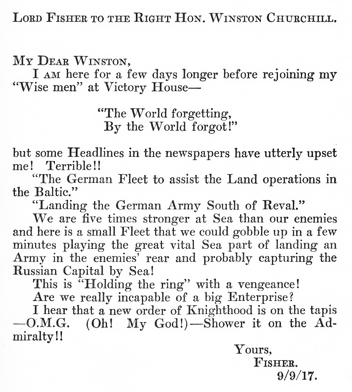
Admiral “Jackie” Fisher was a major historical figure in the Royal Navy, advocate of the modern dreadnought battleship and a tad high-strung (“…and on one occasion, the king asked him to stop shaking his fist in his face”). His relationship with Winston Churchill at the Admiralty must have been something to observe, as two of the most influential men in London worked together (for a while). After leaving the Admiralty for the last time, he still kept in touch with Churchill. Here is an example of his communication style:

This is believed to be the first documented use of the now familiar “OMG”.

H/T to Shaun Usher.

July 27, 2012

Bruce Arthur calls for moderation in regard to the London Olympics

Filed under: Britain, Media, Sports — Tags: , , , — Nicholas @ 11:13

In the National Post, Bruce Arthur tries to encourage all of us, in spite of our memories of what British journalists were saying about the Vancouver Olympics, to avoid being nasty about the London games:

But perhaps we in Canada should restrain ourselves, as a nation. Perhaps we should take the higher road. That is, unless the higher road is crammed with traffic in this built-for-horses-and-carriage town. Or the tube is down again.

The Brits did not treat Canada kindly two years ago, it’s true. The Guardian said Vancouver could be the Worst Games Ever three days in, and they based the assessment on refunded snowboard tickets rather than on the preventable death of an athlete. The Guardian also called our glowing totem poles a collection of ice penises, and even the BBC announcer cocked an eyebrow, as it were. The Times of London called us cursed, while the Daily Mail mocked the escalation of the budget. They were, to be honest, kind of jerks about it.

But that doesn’t mean that Canadians should stoop to a similarly savage brand of mockery, beginning with the Opening Ceremony. It doesn’t mean we should make fun of the leaked details of the event, starting with children in hospital beds, which doesn’t seem terribly festive. It doesn’t mean we should make fun of the fact that Muse will apparently play, and even if they do not, that the official song of the Olympics by Muse is a grating, strutting, whining, overcompensatory sneer of a song.

If Boris wasn’t mayor of London

Filed under: Britain, Media, Sports — Tags: , , , , , , , — Nicholas @ 08:53

Lawsmith imagines what Boris Johnson would write about the London Olympics “major international sporting event” in a “certain major city in the UK” if he were not mayor:

I can imagine his perfect article in this alternative history in my dreams. Written in the Spectator and littered with self-deprecation, references to dead or fictitious Greeks, Liverpool and wiff-waff, Boris would have danced across the pages as he gleefully excoriated the Labour administration for the absurd idea of inviting a bunch of prima donna athletes and bureaucrats, most of them foreign, to compete in an outdoor stadium during the coldest, wettest summer in British history.

He might have pointed out that all this would take place in Newham, a place not altogether unlike Portsmouth and, in any case, one most Londoners consider more alien than Paris, with among the highest incidence of robbery and assault in the entire city. He might have joyfully foretold the pain and suffering of millions of income taxpayers on account of the shut-down of major roads and TfL advising know-nothing tourists to hop the tube at rush hour to make the 10 AM events, and seriously questioned the wisdom of erecting a steel wall around Hyde Park for an entire summer before fouling it up beyond recognition.

In our alternative history he would have savaged, rather than prodded, the implementation of widespread censorship undertaken by a hit squad of intellectual property ninjas; he would have lamented the fact that our police were arresting “marginal” (i.e., possibly innocent) suspects – living, breathing, thinking people – on terrorism charges which they might not be able to prove. If he had really driven it home, he would have pointed out that, under normal circumstances, those arrests would never have been made. He would also have asked why nobody seems to care.

By this point, his oeuvre would have been the most hilarious political essay ever written. He would flay alive in full public view the pathetic, uncritical, fawning news-media industry which crafts its Olympic stories with all the creative flavour of an oak plank, their proxy world to escape from our own inadequacies where professional athletes become “heroes” (seriously, find a different word), washed-up “heroes” become “legends,” and civil liberties violations and government largesse are completely ignored.

July 20, 2012

Fellow Canucks: here’s your pre-Olympic angst schedule

Filed under: Cancon, Media, Sports — Tags: , , — Nicholas @ 10:33

Chris Selley explains what will happen with our Olympic team and the media’s saturation coverage of their every effort:

As I write, Canadians are currently warming up their typing fingers and talk radio voices in anticipation of the traditional Olympic psychodrama. Almost certainly, at some point, there will be a paroxysm of angst over a medal drought. Almost certainly people will extrapolate from that certain lessons: We don’t spend enough on amateur athletics. We spend too much on amateur athletics to deserve these bums. We aren’t winning medals because our athletes have been pampered by the welfare state.

If we do win a lot of medals, that will displease a whole other constituency. There are those among us who deride the whole idea of caring that a Canadian might jump higher or run faster than an Italian as an absurd, unbecoming nationalist spectacle. There are those who think winning, and taking pride in winning, violates our traditionally humble nature. Back in 2010, Star columnist Richard Gwyn deplored the Vancouver organizing committee’s stated intention to top the medal standings as “completely and outrageously un-Canadian.” Globe columnist Lawrence Martin lamented that “at the opening ceremonies and elsewhere, it seemed like we were pushing the idea that we are great.” Heaven forbid!

Then there are those, like flamboyantly anti-Olympic Ottawa Citizen columnist Dan Gardner, who insist that those beaming medal-winners are in fact victims of deranged parents, injurious training regimes and childhood-destroying obsession. (This is often the price of excellence in general, I would argue, although it’s true that concert pianists will have much better knees in their 80s than downhill skiers.) It’s all about the money, people complain, and they’re mostly right.

I certainly agree with the haters about the so-called “Olympic Movement,” as presided over by the International Olympic Committee: It’s a putrid, corrupt, manipulative, corporatist scam masquerading as a triumph of the human spirit. The amount of money spent to bid for and stage the Games is literally indefensible — stomach-turning, even, when you consider the better uses to which it could have been put.

July 18, 2012

Toronto’s gun problem

Filed under: Cancon, Media — Tags: , , , , , — Nicholas @ 13:41

No, not a problem with guns per se, but a problem with the image of guns. Jonathan Kay tries to do a quick psycho-analysis of Toronto’s issue here:

The primary tragedy of urban gun violence is, of course, that it kills people — including 14-year-old Shyanne Charles and 23-year-old Joshua Yasay, who were slain in Scarborough this week. A secondary ill effect is that it produces paralyzing anxiety in millions of otherwise unaffected people, largely thanks to sensationalistic media reporting that encourages the idea we are all inhabiting some kind of anything-goes “war zone.” As I’ve written before, gun violence in Toronto is largely confined to a small set of areas, and a small set of social and criminal contexts. For the average citizen, the chance of suicide or death-by-domestic-battery is much, much higher than the chance of becoming collateral damage in a gang killing.

But it’s not hard to figure out why scared housewives are canceling their zoo trips when the Toronto Star is blaring out headlines like “Mass shooting on Danzig puts the lie to Toronto’s ‘safe city’ mantra.”

Combine that headline with the lurid, disturbingly blood-fixated Rosie DiManno column that sits under those words, and a clear message emerges: Torontonians have been living in a dream world, going about their parenting and work lives in blissful ignorance of the warring gangs who are probably just around the corner, ready to march up the street, spraying the whole area with machine gun fire. Even the lemur isn’t safe: They’ll probably shoot him, too.

As I’ve noted, Chicago — a city with a population close to Toronto’s 2.6-million — witnesses about 10 times as many murders every year as Hogtown. And as Marni Soupcoff wrote earlier this week, tiny Detroit has had 184 murders this year, compared to Toronto’s 28. To repeat what’s been written: Among the American cities that witnessed more murders than Toronto in 2011 were Nashville (pop. 616,000), Tulsa, Okla (pop. 393,000), and Stockton, Cal. (292,000). In per-capita terms, Toronto has a substantially smaller homicide problem than Winnipeg and Edmonton.

And one must remember that Toronto has a unique view of itself and its role in the world:

Another factor is Toronto’s bizarrely inflated view of itself as a civic nirvana, to which the rest of the world is constantly gazing as a sort of Light Unto Cities. When anything bad happens, we naturally assume that the entire planet is gasping in horror and disappointment. In 2010, for instance, when a few dozen windows got broken at the G20 Summit here, Canadian journalists truly believed that the news would make banner headlines on other continents — and that we would have a “black eye” that would last for generations.

Regarding the shootings in Scarborough, this Reddit item is worth reading.

Update: Margaret Wente in the Globe and Mail:

… In certain neighbourhoods, a war is on. It’s a war against peace and order waged by the forces of social disintegration. It’s the same war that killed Jane Creba in 2005, two people at the Eaton Centre last month and dozens of other victims who happened to be in the wrong place at the wrong time. The single most significant root cause is not guns or crummy housing or racism or inadequate policing or lenient sentencing or lack of jobs or insufficient social programs. It is family and community breakdown. Most especially, it’s absent fathers.

Social programs are essential. But all the social programs in the world can’t make up for family disintegration.

[. . .]

Family disintegration is not a racial problem. It is an underclass problem. The evidence is plain that children born to unmarried women – of whatever race – do much worse than children with two married parents. They’re less likely to succeed in school and more likely to turn to violence (boys) and promiscuity (girls). The easiest way for them to feel like someone is to grab a gun or have a baby.

So by all means, let’s redevelop public housing, strengthen our policing, hire more youth workers, launch more employment programs, start more basketball programs, help young mothers finish school and teach them how to read to their kids. It makes us feel good to focus on these things because they are things we can actually do something about, and maybe they will make a difference. But let’s not kid ourselves: They’re Band-Aid solutions.

We have a million euphemisms for what’s gone wrong in our so-called “priority” neighbourhoods, a splendidly euphemistic term that has replaced “at-risk,” “disadvantaged,” “underprivileged” and “poor.” By now, it should be obvious that material poverty is not the problem – not when every kid in a priority neighbourhood has a cellphone and a flat-screen TV. Their poverty is of a different, more corrosive kind: a poverty of expectations, role models, structure, consistency, discipline and support.

Even our euphemisms have euphemisms these days. They do nothing to solve the problem, but they allow the problem to be discussed at such a distance from reality that the lack of solution is generally hidden from view.

Until the next shooting.

June 26, 2012

The “Draft Andrew Coyne” movement

I’ve met Andrew Coyne. We had a pleasant chat about political matters a few years ago (although I was one of dozens of Toronto-area bloggers he talked with that night: I doubt he remembers me). I often agree with his writings (and even when I don’t, he’s usually quotable). But how would he fare as a candidate for the Liberal leadership? Abacus ran the numbers:

Nationally, most Canadians told us they didn’t know enough about Mr. Coyne to say whether they had a favourable or unfavourable impression of him. Sixty-four percent were not sure of their opinion while 15% said they had a favourable impression while 21% had an unfavourable impression. Unfortunately for Mr. Coyne, the percentage of respondents who had “very unfavourable” was higher than those who had a “very favourable” impression of him (9% very unfavourable vs. 3% very favourable).

Nonetheless, there are “pockets” of Coynemania out there.

  • Men are slightly more likely to have a favourable impression of him than women (men 18% favourable, women 12% – women were also much more likely to be unsure).
  • There was no significant age difference although older Canadians (no surprisingly) were more likely to be aware of Mr. Coyne.
  • Regionally, he is more popular in Manitoba and Saskatchewan (25% favourable) than in other regions of the country. He is a tough sell in Quebec where his favourable rating is a mere 8%.
  • Considering his occupation and the audience likely to read and watch him, it is no surprise that respondents with a university degree were most aware and favourable to Mr. Coyne. 24% of those with a bachelor’s degree and 29% of those with a post-graduate degree had a favourable impression of the National Post columnist.
  • He is also more likely to be viewed favourably by those who live in urban communities (urban 18% favourable, suburban 13% favourable, rural 12% favourable).
  • Mr. Coyne is also viewed more favourable by those who own stocks, bonds, or mutual funds: 20% favourable vs. 10% among those who don’t own those kinds of investments.
  • Finally, there isn’t a significant partisan difference. Those who voted Liberal in 2011 are only slightly more likely to view him positively than NDP and CPC voters but the differences are marginal. He is a post-partisan candidate!

I don’t know if he’s actually interested in a political career, but he’d at least be a different kind of candidate than the Liberals have had in decades. I’ve never voted Liberal in my life, but I could imagine voting for a Liberal if Andrew Coyne was the Liberal leader. He appears to actually believe in smaller government and free markets — which is why he’d never be able to run as a Conservative. He’s on the record as being almost libertarian in his views on individual rights (especially on Nanny State issues) — which is why he couldn’t run as a New Democrat.

It’s not clear whether there are any members of today’s Liberal Party of Canada who could cope with a classical liberal as leader. But it would create a viable third choice in federal politics: that’s worth a lot in my books.

Update: There’s a Twitter hashtag for the movement: #coyne4lpc, and Jesse Helmer points out that there’s a Facebook group, too:

Update, the second: Apparently Andrew Coyne is getting into the swing of being a big-time politician, having already fired his first campaign manager:

June 24, 2012

Do your media outlets suffer from ADD?

Filed under: Media, Politics, USA — Tags: , , , — Nicholas @ 10:23

Okay, it’s a trick question: they all do. Gerard Vanderleun pulls out an older piece (originally posted in 2003) that explains how and why your mainstream media became afflicted with ADD:

Recently I became acquainted with a young boy, just turned nine. He’s a brilliant and happy kid, but he has a problem with cleaning up and organizing his room. It isn’t that he can’t do it, he simply has to be told about every five minutes to continue the process. In the course of picking things up to put away he discovers anew their potential to fascinate him.

The Gameboy? “Oh, here’s where I saved that last stage of Turoc. Let’s see if I can get the flame-thrower and…”

Any one of the 3,000 + Lego units? “Gee, I never did get the moon base hemi-dome set up, just let me put these 400 blocks in place and…” Books? “Sure thing and, hey, did Horton ever hatch that egg…”

On it goes until, after the sixth or seventh cajoling instruction, a path has been cleared for the vacuum cleaner. After which, he promptly begins taking everything he has put away out and strews it about the floor once again.

Today’s pop psychologists, addlepated educators and the marketing departments of large drug companies are hard at work trying to convince me children who behave like this have “Attention Deficit Disorder” or ADD. But I know enough to know it is the companies who are obsessed, confused and greedy in about that order.

What this young boy suffers from is no more than being a normal, heedless and all around great nine-year-old boy. He doesn’t have ADD anymore than I have an elephant chained in my back yard. (Yes, I just checked.)

The only group that I can see in the United States that, as a group, is seriously afflicted with ADD is a group of would-be adults — the group we call collectively “The Mainstream Media.” For members of this group ADD is not an option, it is a requirement. Far from being a means to informing and enlightening the public, the primary role of the MSM is to distract it. At this they are very good since they are “Distracted from distraction by distraction” by their very nature. They are “the ADD professionals.” They actually get paid for doing this. Paid well for having a disease.

June 12, 2012

Stop worrying about the approaching police state: it’s already here

Filed under: Law, Liberty, Media, USA — Tags: , , , , — Nicholas @ 13:18

I saw Twitter updates about this, but I assumed it was an Onion story that someone didn’t recognize as being from a parody news site. I was wrong:

The police state is not only here — it is being welcomed with open arms.

Exhibit A: In Aurora, Colorado, police searching for suspected bank robbers locked down an entire intersection, dragooned 40 random motorists out of their cars at gunpoint, handcuffed them and “asked” for permission to search their vehicles. [. . .]

Naturally, no one refused permission.

The action itself is startling: 40 people, guilty of nothing more than proximity, of being in the same general area where a suspected criminal might also be, are literally pulled from their vehicles, shackled and detained for more than two hours — even after it was obvious they were guilty of no crime at all.

Even more startling, however, than these over-the-top tactics is the fact that (apparently) every one of these 40 innocent people complied without a peep of protest. Not one said: “I’m sorry officer, but unless I’ve committed a crime I’d like to be free to go about my business.” Not one said, “I do not consent to any searches.”

None put up a fuss when the cuffs came out.

One woman interviewed by ABC News clucked happily: “Yeah, we all got cuffed (laugh) until they figured out who did what.” No doubt this woman will not object when a gang of armed men kicks in her door, invades her home and holds her family at gunpoint until they figure out who did what. After all, there are criminals about. They could be anywhere. Which means, anything is justified.

In the words of one ABC News blogger, “Sounds like the police did their job — and did it exceptionally well!” And another: “I think the police did a great job in an unusual circumstance and protected the people of the city from a dangerous criminal. Those people should praise the police, not sue them!”

It’s amazing that none of these people who were the victims of an insane amount of police overreaction seem to feel that the police did anything wrong. There must not be a civil liberty equivalent of the ambulance-chasing lawyer.

June 11, 2012

We can’t “save” capitalism, because we don’t “have” capitalism

James Delingpole in the Telegraph (the italicized opening paragraph is a quite from Tim Morgan):

    Reforming capitalism so that it serves the majority, and strengthening the individual against the collectivist and the corporate, are inspiring visions. This is where government should be taking Britain.

Easier said than done, of course — as I was reminded yesterday when I Tweeted it under the headline “How to rescue capitalism….” only to have some Twentysomething smartarse Tweet back “Rescue it? Bury it!”

This is the kind of fifth-form, sub-Banksy political analysis which passes for conventional wisdom these days. It’s the dominant strain of thinking at the Guardian, at the BBC, among the studio audience at Channel 4’s apocalyptically lame 10 O’Clock Live, on Twitter, in the right-on brains of groovester opinion-formers all the way from Ben Goldacre to Graham Linehan to Polly Toynbee — and, of course, across the world in the entire Occupy movement. Capitalism, they all maintain, has failed.

No, capitalism has not recently been tried: that’s the real problem. And what I particularly like about Morgan’s report — well worth reading in full — is that it addresses this extremely important point. What we’re experiencing around the world at the moment is not laissez-faire, self-correcting, authentic, free-market capitalism but an excedingly corrupt and bastardised form thereof.

What we’re seeing is a grotesque stitch up between the banking class, the corporate class and the political class — at the expense of the rest of us.

One day, I like to hope, those of us on the libertarian right will find common cause with (at least some of) the Occupy crowd and unite against our real enemy.

June 10, 2012

QotD: Journalism, in theory and practice

Filed under: Humour, Media, Quotations — Tags: , — Nicholas @ 00:03

In the same way that many children naively assume adults are infallible, I grew up with the fantasy that anything in print must be true. This created some logical conundrums in the supermarket checkout aisle, where I’d see the Weekly World News and wonder, “But if aliens haven’t abducted Elvis, how can they print it?

I mean, if journalists don’t hold themselves to standards of accuracy, why would they take the trouble to print an Errata column for the few minutiae they happened to miss? “In last week’s issue,” such a column would say, “we mistakenly identified the smiling man in the photograph as Nathan Daniels of Ballwin, Missouri. In fact, while he is indeed Nathan Daniels of Ballwin, Missouri, what we called a smile is more of a tempered grin. We sincerely regret the error.”

If that’s the kind of error a newspaper regrets — and sincerely, no less — surely the major facts behind any story are watertight.

But the Errata are a trick, and not even a new trick. I use the same trick to ingratiate myself to my wife when I realize I’ve neglected to do something important for our 1-year-old daughter. “I remembered her shoes and socks,” I’ll say, “but I couldn’t find the pink sippy cup, so I brought the green sippy cup.” By apologizing for this lesser transgression, I’m hoping my wife won’t notice that I’ve forgotten to arrange for our daughter to wear pants.

Adam Ruben, “The Unwritten Rules of Journalism”, Science, 2012-05-25

June 7, 2012

Reason.tv: Bath Salts, Naked Zombie Cannibals & Stupid Senators

Filed under: Cancon, Government, Media, USA — Tags: , , — Nicholas @ 14:53

June 5, 2012

Signs of hope in Mozambique

Filed under: Africa, Economics, Food, Media — Tags: , , , — Nicholas @ 08:36

An article in the Guardian has some good news about the struggle against malnutrition, but it’s wrapped in misleading language:

All the women belong to the Wapsala Association, a 33-strong agricultural collective created to boost local smallholders, ensure a steady, year-round, supply of high-nutrition foodstuffs in an area prone to chronic shortages, and help end the curse of malnutrition that affects about 44% of all Mozambican children under five.

The Wapsala project is seen by some Mozambican nutrition experts as a paradigm to be emulated in similarly disadvantaged areas of the country and other parts of southern Africa.

The collective’s approach, rooted in public and international funding, contrasts sharply with the prioritisation of private-sector investment, as proposed at the recent G8 summit.

Instead of perpetuating the western focus on food security, the farmers of Wapsala provide a working alternative — what Graciela Romero, the international programmes director of War on Want, calls food sovereignty: a move to promote agrarian reform that favours small producers and the landless, and emphasises local markets and self-sufficiency.

As Tim Worstall points out, the way this initiative is being described is rather at odds with its actual goals:

OK, so we’ve got all the buzz words. Cooperatives, self sufficiency, food sovereignty, local markets and it’s very much anti private-sector investment.

And what is it that they actually want to do?

    “We would like to process other people’s cassava but we have no capacity,” he said. “The South Africans want dried cassava and cassava leaves. Market demand is high but we cannot supply it. We are also expanding our nursery business with trees and other plants — they expand our fruit production. But we are limited due to lack of water. It costs a lot to dig a borehole. The nearest is two kilometres away.”

They, err, want investment so they can export. You know, undermine someone else’s food sovereignty?

So, leaving aside the cant what they’re actually doing it trying to create a community of yeomen farmers who trade in local and regional markets. Not a bad idea at all but entirely different from that cant being spouted.

June 4, 2012

The “sex traffic” meme is this decade’s version of the “Satanic panic” of the late 1980s

Filed under: Media, USA — Tags: , , , , , — Nicholas @ 13:03

An interesting post at The Honest Courtesan on the strong similarities between the media freak-out about Satanic ritualists kidnapping children back in the late 1980s and early 1990s and the current media meme about sex trafficking rings:

How well do you remember the “Satanic Panic” of the ‘80s and ‘90s? Do you remember when you first heard about it, and what your reactions were? Do you remember how widespread and exaggerated the claims were, and how seriously everyone took them? The reactions from believers when skeptics pointed out the tremendous absurdities? The decline and fall of the hysteria? I sure do, and if you do as well you’ve probably noticed the strong resemblance of “trafficking” hysteria to its older sibling. Both revolve around gigantic international conspiracies which supposedly abduct children into a netherworld of sexual abuse; both are conflated with adult sex work, especially prostitution and porn; both make fantastic claims of vast numbers which are not remotely substantiated by anything like actual figures from “law enforcement” agencies or any other investigative body; both rely on circular logic, claiming the lack of evidence as “proof” of the size of the conspiracy and the lengths to which its participants will go to “hide” their nefarious doings; both encourage paranoia and foment distrust of strangers, especially male strangers; etc, etc, etc.

[. . .]

Once one is able to examine the hysteria from an historical and sociological perspective, it becomes rather fascinating (though none the less frightening for those of us whose profession is being targeted by the witch hunters). For example, one can see how events that would have been interpreted one way 15 years ago are now seen through the lens of “human trafficking”; this recent trial in which members of a Somali gang were convicted for forcing young female members into prostitution would have been reported as a “gang-related violence” story in the late ‘90s, but is now labeled a “sex trafficking case”. In the ‘80s, every city in America imagined itself overrun with Satanic cultists; now it’s “human traffickers”, and there’s a creepy competition for the title of “leading hub for sex trafficking”, generally on the basis of how many interstate highways pass through or near the city (since none of them have any actual statistics to support their claims). In the past year I’ve heard New York, Dallas, Miami, Portland, Atlanta and Sacramento vying for this dubious distinction, and now Tulsa, Oklahoma is as well.

H/T to Jesse Walker for the link.

Alberta’s prosperity is also Canada’s prosperity

Filed under: Cancon, Economics, Media — Tags: , , — Nicholas @ 10:28

Stephen Gordon at the Worthwhile Canadian Initiative blog on another deliberate attempt to cast Alberta’s oil sands boom as being only good for Alberta and bad for the rest of Canada:

This didn’t pass my sniff test:

    The economic benefits of oil sands development, while considerable, are unevenly distributed across the country, making interprovincial tensions understandable. While provinces other than Alberta are projected to benefit, modelling by the Canadian Energy Research Institute projects that 94 per cent of the GDP impact of oil sands development will occur within Alberta. With so much benefit concentrated in one province, one can hardly call fast-tracking oil sands expansion a nation-building project. Little wonder that the promise of benefits from oil sands development is cold comfort for Ontarians and Quebeckers as the once-dominant manufacturing sector struggles to reinvent and revitalize itself.

Did you read “94 per cent of the GDP impact of oil sands development will occur in Alberta” and interpret it as “94 per cent of the economic benefits of oil sands development will occur in Alberta”? I’m convinced that that the vast majority of the people who read that passage on the Globe‘s op-ed page interpreted it that way. And I’m only slightly less convinced that the author meant his readers to interpret it that way. Of course, that would be the wrong interpretation.

For reasons I’ll get to later, there seems to be a concerted effort to convince Canadians that almost no-one outside Alberta is seeing any economic benefits from high oil prices. For the most part, these efforts appear to be enjoying some measure of success. But the fact of the matter is that the oil sands have increased incomes across Canada to an extent much greater than that paragraph implies.

June 2, 2012

The end of a weird week in Canadian journalism

Filed under: Cancon, Media — Tags: , , , , , , — Nicholas @ 10:26

David Akin on all the unusual happenings over the past week:

I suspect Alex felt that way because he and his staff had to deal with a) the ongoing battle between students and Premier Jean Charest b) a grisly murder that forced police in Montreal to issue an international warrant for kitten-killing gay porn star Luka Magnotta c) a freak rain storm that put 70 mm of water on the ground in 30 minutes pretty much flooding most of downtown Montreal for an afternoon. But enough of that, let’s get to God using a bear to deliver God’s own brand of justice [. . .]

“The corpse of a man eaten by a B.C. bear was that of a convicted killer, officials have confirmed.”

[. . .]

“46 mm of rain in half an hour floods Montreal.”

[. . .]

On Friday, heavy rain would contribute to flooding which would end up flooding and shutting down Toronto’s Union Station on Friday causing commuter chaos

[. . .]

The Montreal flash floods occurred as Quebec Premier Jean Charest was trying to broker a deal with post-secondary students who have been “on strike” for more than 3 months because they don’t want to pay an extra $350 or so a year in tuition — over five years. Charest has been over-patient. The students have been, as they say on St. Urbain Street, “stiff-necked”. So the two sides met and then talks broke down.

All that, plus the kitten-killing, body dismembering fugitive porn star…

« Newer PostsOlder Posts »

Powered by WordPress