Quotulatiousness

August 27, 2013

Hey, Kids! It’s time for back-to-school bad journalism bingo!

Filed under: Education, Humour, Media — Tags: , , — Nicholas @ 10:57

The slow news days of August have reached the traditional back-to-school phase of page filling:

I love back-to-school time: the joy, the energy, the sense of limitless possibilities. It’s almost enough to make you forget about the tsunami of dreadful journalism that accompanies it.

There are basically three reasons for bad back-to-school journalism. First, higher education is complicated; it doesn’t lend itself to the simplistic narratives required for 800-word articles. Second, there’s a serious lack of decent data about higher education in Canada, what with the Millennium Scholarship Foundation gone, HRSDC no longer funding any decent Statscan surveys, and provinces and universities holding on tightly to their own data on the grounds that someone might use it to compare them against other provinces/institutions (and that would never do!). In this data vacuum, interested parties with their own agendas find it easy to peddle all sorts of demented, half-true factoids to journalists; hence, the frequent appearance of stories based on “data” which simply aren’t true.

The third problem is the lack of outcome measures. Everyone wants “good” education, but no one knows what that is. So journalists tend to fall back on input measures: small classes, students per professors, etc., which inevitably lead to a weird mythologizing of university life in the 1970s. Nothing wrong with the 1970s of course, but it somehow never quite clicks with op-ed writers that a major reason life was so great for students back then was that access was restricted to a fairly small elite, and that the comparative “failures” of today’s universities are largely the result of expanded access.

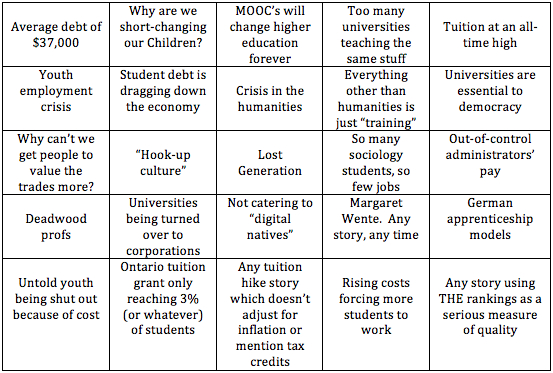
Here’s the Bingo card for you to play along at home:

Back to school bingo

August 26, 2013

Stephen Harper’s media aversion

Filed under: Cancon, Media, Politics — Tags: , , , — Nicholas @ 09:01

Michael Den Tandt seems puzzled that Stephen Harper and his staff treat the media as though they were a bunch of rancid/poisonous/radioactive zombies that would love to eat their brains on live TV:

Stephen Harper, it will sadden some to learn, is not an ogre or a troll. Nor are the members of his staff orcs, goblins, hobgoblins or cave wights out of Tolkien. They are all, shockingly, human beings.

Having spent the last week locked up with them cheek by jowl — the staffers that is, not the prime minister, more on that later — in rattletrap buses, dingy hotel basements and in the belly of a flying tank, I can attest that they work very hard. Managing a tour of the Arctic, on a very tight schedule, observed and criticized at all times by a gaggle of touchy, tired, grumpy journalists, can’t be anyone’s idea of fun. Yet I saw Harper’s staff do that, with good nature, resilience and aplomb for the most part.

But for the incident Friday afternoon, in which a Chinese journalist from a state-owned newspaper was prevented from asking a question of the PM and shoved a female staffer, last week’s Arctic tour, Harper’s eighth as prime minister, went off without a hitch, from a Conservative standpoint. He hit all the thematic and policy notes he intended to, appeared in a series of photo ops that reinforced those themes and policies, and avoided any major missteps. Another job done, on to the next.

That said, they — meaning Harper and the Conservatives — could be doing so much better than this. To watch the PM in action, up close, is to see repeated opportunities missed, for reasons that make little sense. Much of this appears to stem from his aversion to, and discomfort with, the national media.

Why, it’s almost as though Harper has learned not to trust the media or to allow them to get too close. I wonder how he’d have come to that conclusion? It’s a mystery, sure enough.

August 21, 2013

The Guardian gets a taste of the medicine it prescribed for the tabloids

Filed under: Britain, Government, Liberty, Media — Tags: , , , , — Nicholas @ 08:25

In sp!ked, Brendan O’Neill talks about the amazing double standards of Britain’s “chattering classes”:

If there was a Nobel Prize for Double Standards, Britain’s chattering classes would win it every year. This year, following their expressions of spittle-flecked outrage over the detention of Glenn Greenwald’s partner David Miranda by anti-terrorism police at Heathrow airport, they’d have to be given a special Lifetime Achievement Award for Double Standards.

For the newspaper editors, politicians and concerned tweeters now getting het up about the state’s interference in journalistic activity, about what they call the state’s ‘war on journalism’, are the very same people – the very same – who over the past two years cheered the state harassment of tabloid journalists; watched approvingly as tabloid journalists were arrested; turned a blind eye when tabloid journalists’ effects were rifled through by the police; said nothing about the placing of tabloid journalists on limbo-like, profession-destroying bail for months on end; said ‘Well, what do you expect?’ when material garnered by tabloid journalists through illegal methods was confiscated; applauded when tabloid journalists were imprisoned for the apparently terrible crime of listening in on the conversations of our hereditary rulers.

For these cheerleaders of the state’s two-year war on redtop journalism now to gnash their teeth over the state’s poking of its nose into the affairs of the Guardian is extraordinary. It suggests that what they lack in moral consistency they more than make up for with brass neck.

Everything that is now being done to the Guardian has already been done to the tabloid press, a hundred times over, and often at the behest of the Guardian. For all the initial depictions of Mr Miranda as ‘just Glenn Greenwald’s partner’, in fact he was ferrying encrypted information from the NSA leaker Edward Snowden on flights paid for by the Guardian. That is, he was detained and questioned over journalistic material acquired through illegal means. That’s already happened to the tabloids. Over the past two years of post-phone hacking, post-News of the World harassment of tabloid hacks by the state, 104 people have been arrested, questioned, usually put on unjustly elongated bail, and sometimes imprisoned. These include many journalists but also office secretaries and other non-journalist types, like Mr Miranda, who stand accused of handling illegally acquired material. The 104’s crimes include ‘disclosure of confidential information’ – not that dissimilar to what Greenwald and Miranda have done in terms of getting hold of and publishing Snowden’s illegally leaked confidential material. Yet while the redtop writers rot in legal limbo, Mr Miranda becomes a chattering-class cause célèbre.

[…]

But, believe it or not, the double standards run even deeper than that. For today’s outraged defenders of Greenwald, Miranda and the Guardian from a state war on journalism were the architects of the state’s far larger, far more destructive war on tabloid journalism. From the Guardian itself to Labour MP Tom Watson to various influential members of the Twitterati, many of those now shocked to find officials harassing journalists for doing allegedly dodgy things were at the forefront of demanding that officialdom harass redtop hacks for doing dodgy things. If you unleash and cheer a war on journalism by the state, you really cannot be surprised when the warmongers eventually put you and your journalism in the crosshairs, too.

August 20, 2013

“You’ve had your debate. There’s no need to write any more.”

Filed under: Britain, Law, Liberty, Media — Tags: , , , , , — Nicholas @ 10:29

Things are getting surreal at the Guardian:

A little over two months ago I was contacted by a very senior government official claiming to represent the views of the prime minister. There followed two meetings in which he demanded the return or destruction of all the material we were working on. The tone was steely, if cordial, but there was an implicit threat that others within government and Whitehall favoured a far more draconian approach.

The mood toughened just over a month ago, when I received a phone call from the centre of government telling me: “You’ve had your fun. Now we want the stuff back.” There followed further meetings with shadowy Whitehall figures. The demand was the same: hand the Snowden material back or destroy it. I explained that we could not research and report on this subject if we complied with this request. The man from Whitehall looked mystified. “You’ve had your debate. There’s no need to write any more.”

During one of these meetings I asked directly whether the government would move to close down the Guardian‘s reporting through a legal route — by going to court to force the surrender of the material on which we were working. The official confirmed that, in the absence of handover or destruction, this was indeed the government’s intention. Prior restraint, near impossible in the US, was now explicitly and imminently on the table in the UK. But my experience over WikiLeaks — the thumb drive and the first amendment — had already prepared me for this moment. I explained to the man from Whitehall about the nature of international collaborations and the way in which, these days, media organisations could take advantage of the most permissive legal environments. Bluntly, we did not have to do our reporting from London. Already most of the NSA stories were being reported and edited out of New York. And had it occurred to him that Greenwald lived in Brazil?

The man was unmoved. And so one of the more bizarre moments in the Guardian‘s long history occurred — with two GCHQ security experts overseeing the destruction of hard drives in the Guardian‘s basement just to make sure there was nothing in the mangled bits of metal which could possibly be of any interest to passing Chinese agents. “We can call off the black helicopters,” joked one as we swept up the remains of a MacBook Pro.

Update: Charlie Beckett at the LSE’s Polis blog:

The narrative of increasing totalitarian persecution has a few flaws. Firstly, I think it was entirely reasonable for security forces to question someone linked to security breaches. I just think that doing it under terror laws was wrong, especially as Miranda is part of a journalism team.

I am still a little unsure of the Greenwald/Guardian narrative. I am puzzled by why the team chose to fly Miranda through London at all. I am also unclear as to why the Guardian let security officials smash up their hard-drives without making them go down a legal path.* [Someone with more profound doubts about the Guardian and Greenwald is former Tory MP Louise Mensch — good piece by her here]

But those are details. Overall, it’s clear that US and UK officials, long-tortured by WikiLeaks and Julian Assange, are now losing patience with whistle-blowers and their accomplices in the news media. Whatever the absolute truth of the NSA/PRISM revelations it is clear that the security service are pushing the boundaries on what they can do with new technologies to increase their information and surveillance. They are also seeking to reduce scrutiny by journalists, as they told Rusbridger:

    “You’ve had your debate. There’s no need to write any more.”

That in itself may be worrying but it’s hardly surprising. That is what they are there for. We would all be very cross if there was an act of terror missed because of inadequate data collection by spooks or if a press leak endangered our safety. But it’s also journalism’s job to hold these people to account and let the public know the scope of what they are up to. That’s what worries me about the Miranda incident.

August 19, 2013

Glenn Greenwald’s partner detained by UK authorities

Filed under: Britain, Government, Media — Tags: , , , , , — Nicholas @ 08:49

The British government sends a message:

The partner of the Guardian journalist who has written a series of stories revealing mass surveillance programmes by the US National Security Agency was held for almost nine hours on Sunday by UK authorities as he passed through London’s Heathrow airport on his way home to Rio de Janeiro.

David Miranda, who lives with Glenn Greenwald, was returning from a trip to Berlin when he was stopped by officers at 8.05am and informed that he was to be questioned under schedule 7 of the Terrorism Act 2000. The controversial law, which applies only at airports, ports and border areas, allows officers to stop, search, question and detain individuals.

The 28-year-old was held for nine hours, the maximum the law allows before officers must release or formally arrest the individual. According to official figures, most examinations under schedule 7 — over 97% — last less than an hour, and only one in 2,000 people detained are kept for more than six hours.

Miranda was released, but officials confiscated electronics equipment including his mobile phone, laptop, camera, memory sticks, DVDs and games consoles.

Since 5 June, Greenwald has written a series of stories revealing the NSA’s electronic surveillance programmes, detailed in thousands of files passed to him by whistleblower Edward Snowden. The Guardian has also published a number of stories about blanket electronic surveillance by Britain’s GCHQ, also based on documents from Snowden.

Update: The opposition Labour party calls for an investigation into this use of anti-terrorism legislation (but as Charles Stross point out … they passed the laws themselves).

Labour has called for an urgent investigation into the use of anti-terror powers to detain David Miranda, the partner of a Guardian journalist who interviewed US National Security Agency whistleblower Edward Snowden.

Yvette Cooper, the shadow home secretary, said ministers must find out whether anti-terror laws had been “misused”, after Miranda was held for nine hours by authorities at Heathrow airport under the Terrorism Act.

His detention has caused “considerable consternation” and the Home Office must explain how this can be justified as appropriate and proportionate, she said.

[…]

“The independent reviewer of terrorism legislation, David Anderson, has already warned of the importance of using schedule 7 of the Terrorism Act appropriately and proportionately. The purpose of schedule 7 is to determine whether or not someone is involved in or associated with terror activity. The Home Office and police need to explain rapidly how they can justify using that purpose under the terrorism legislation to detain David Miranda for nine hours. This has caused considerable consternation and swift answers are needed.

“The police and security agencies rightly work hard to protect national security and prevent terrorism. But public confidence in security powers depends on them being used proportionately within the law, and also on having independent checks and balances in place to prevent misuse.”

August 11, 2013

Debunking the “Cameron’s gunboat diplomacy” meme

Filed under: Britain, Europe, Media — Tags: , , , — Nicholas @ 09:22

Sir Humphrey points out that the British media’s collective gasp about Royal Navy ships being sent to Gibraltar merely highlights what a slow news month it is:

It’s an amusing irony that the recent row in Gibraltar has suddenly given the Royal Navy more publicity about its forthcoming COUGAR deployment in one evening, than it may have got in several months of deployment. The news that the Response Force Task Group (RFTG) is deploying to the Med has been seen as a clear example of gunboat diplomacy by Fleet Street’s finest, many of whom seem terribly keen on starting a war in order to fill column inches during a slow news month…

Its perhaps worth noting that this deployment is extremely long standing — the sort of planning which goes into deploying a major Task Force will usually commence at around 12 months prior to the event, when the rough outline of a plan is put together on the objectives of the deployment, likely ports, aims and intended outcomes and so on. While maritime power is about flexibility, it’s often forgotten that most RN deployments these days are the end product of months of well co-ordinated planning and staffing to ensure that the UK gets the best possible value from its naval assets.

[…]

What we can perhaps draw from this is that firstly the RN has enjoyed an unexpected boon of coverage, tapping into the nation’s subliminal psyche which holds that sending a grey hull is a key means of solving a crisis, no matter what or where the crisis is. There is perhaps work for some analysts to understand why, almost alone among all major powers, the cries of ‘send a gunboat’ seem to resonate most strongly in the UK (albeit to a lesser extent the same applies with the ‘send a carrier’ debate in the US). While deployments of warships can be seen as a useful indicator of interest in situations, it appears to be held most strongly in the UK — there is, at times, a fervent belief that deploying vessels is akin to the legend of waving the ancient banner three times in order for Arthur and his knights to appear — it makes little practical sense, but is somehow strangely comforting to the people.

August 8, 2013

A brief moment of sympathy for Thomas Mulcair

Filed under: Cancon, Media, Politics — Tags: , , , , , , — Nicholas @ 07:54

Richard Anderson finds a drop of sympathy for the unexpected plight of the leader of Her Majesty’s loyal opposition:

It must be galling to be Thomas Mulcair right now. A decades long career spent climbing the greasy pole of Quebec politics. A quick ascent to the federal level and then, by the oddest stroke of luck, an unexpected death places you into the leader’s role. It seems that with a bit of luck your old nemesis the Liberal Party might be finished after the next election. Happy days to be leader of the Official Opposition.

That is until the MSM started following around the latest bright shiny thing: Justin Trudeau.

While the Once and Future King is touring the sumptuous beauty of British Columbia, poor Tommy is wandering through the backwoods of Northern Ontario. The region is horribly neglected. An afterthought to provincial administrators in downtown Toronto. The area above the French River, sadly, has always failed to capture the imagination of Canadians.

The settlement of the West is one of the great romances of Canadian history, if not the greatest. The charm of the Maritimes is irresistible. The North’s terrible majesty demands admiration. Quebec is Quebec. Southern Ontario is the center of English Canada, Toronto commanding the region like, well, an Imperial Capital around which all else revolves.

Northern Ontario is kind of just up there. Somewhere between Barrie and Winnipeg. What small romance that region conveys is from faded memories of the great mineral boom a century ago, and the twangy recollections of Stompin’ Tom. Only he could make Sudbury Saturday Nights memorable. At least Hamilton has the virtue of being between Burlington and Niagara.

Poor, poor Tommy. There isn’t a major media outlet that gives a damn about his “listening tour.” Leader of the NDP shaking hands with a miners union representative doesn’t make for great copy, especially not when competing with Justin’s adorable family.

July 31, 2013

Vikings training camp in full swing … and evil genius Rick Spielman is proven right again

Filed under: Football, Media — Tags: , , , , , — Nicholas @ 08:58

The Vikings are at their off-site training camp in Mankato this week, and the various fan blogs are doing a great job of covering the event (especially The Daily Norseman which has bloggers accredited and attending all open sessions). 1500ESPN has filled the void left when the great Tom Pelissero moved on to USA Today‘s sports department with Andrew Krammer (to team up with Judd Zulgad), while the main ESPN coverage is by Kevin Seifert. I hit my “maximum number of articles viewed” limit at the Minneapolis Star Tribune earlier this week, so the coverage from the St. Paul Pioneer Press is filling that gap for me until rollover.

I know most of you don’t much care for sports chatter, so I’ll put the rest of this post behind the curtain…

(more…)

July 28, 2013

Snowden is not the story

Filed under: Liberty, Media, Technology — Tags: , , , , — Nicholas @ 10:16

In the Observer, John Naughton makes a few corrections to the way the media is reporting the saga of Edward Snowden and his revelations about the NSA’s global surveillance operations:

Repeat after me: Edward Snowden is not the story. The story is what he has revealed about the hidden wiring of our networked world. This insight seems to have escaped most of the world’s mainstream media, for reasons that escape me but would not have surprised Evelyn Waugh, whose contempt for journalists was one of his few endearing characteristics. The obvious explanations are: incorrigible ignorance; the imperative to personalise stories; or gullibility in swallowing US government spin, which brands Snowden as a spy rather than a whistleblower.

In a way, it doesn’t matter why the media lost the scent. What matters is that they did. So as a public service, let us summarise what Snowden has achieved thus far.

Without him, we would not know how the National Security Agency (NSA) had been able to access the emails, Facebook accounts and videos of citizens across the world; or how it had secretly acquired the phone records of millions of Americans; or how, through a secret court, it has been able to bend nine US internet companies to its demands for access to their users’ data.

Similarly, without Snowden, we would not be debating whether the US government should have turned surveillance into a huge, privatised business, offering data-mining contracts to private contractors such as Booz Allen Hamilton and, in the process, high-level security clearance to thousands of people who shouldn’t have it. Nor would there be — finally — a serious debate between Europe (excluding the UK, which in these matters is just an overseas franchise of the US) and the United States about where the proper balance between freedom and security lies.

These are pretty significant outcomes and they’re just the first-order consequences of Snowden’s activities. As far as most of our mass media are concerned, though, they have gone largely unremarked. Instead, we have been fed a constant stream of journalistic pap — speculation about Snowden’s travel plans, asylum requests, state of mind, physical appearance, etc. The “human interest” angle has trumped the real story, which is what the NSA revelations tell us about how our networked world actually works and the direction in which it is heading.

July 24, 2013

Anti-porn UK MP gets hacked, threatens reporter who publicized the hack

Filed under: Britain, Liberty, Media, Politics — Tags: , , , , , — Nicholas @ 11:13

Apparently British Conservative MP Claire Perry doesn’t know a lot about the way the internet works, despite being described as an “architect” for David Cameron’s proposed porn blocker:

UK MP Claire Perry hacked

Claire Perry is the UK Tory MP who architected David Cameron’s idiotic national porno firewall plan. Her website was hacked and defaced with pornographic gross-out/shock images. When Guido Fawkes, a reporter and blogger, wrote about it on his website, Perry took to Twitter to accuse him of “sponsoring” the hack, and publicly announced that she would be speaking to his editor at the Sun (Fawkes has a column with the tabloid) to punish him for writing about her embarrassment.

Perry is so technologically illiterate that she can’t tell the difference between writing about someone hacking your website and hacking itself. No wonder she’s credulous enough to believe the magic-beans-peddlers who promise her that they’ll keep porn off the British Internet — a feat that neither the Chinese nor the Iranian governments have managed.

July 23, 2013

Future monarchs and present-day “republicans”

Filed under: Britain, Government, Media — Tags: , , , — Nicholas @ 09:48

As you may have noticed, I haven’t devoted any space on the blog to coverage of the Duke and Duchess of Cambridge and their son. It’s not that I’m a rabid republican — I’m as much of a mild monarchist as a libertarian can be. What I have found even more tedious than the celebrity pregnancy coverage of the royal baby is the spitting and moaning coming from the “republican” side. Brendan O’Neill (a noted republican) points out that the moaners don’t actually represent real republicans:

So, the royal baby is finally here, and across Blighty the little people will have made themselves virtually bald through frenzied forelock-tugging, or perhaps busted their backs by bowing and scraping before their mewling future king. At least, that’s the impression that has been given by a certain breed of observer, the ironically public-allergic republicans who seem to hate the monarchy primarily because of the behaviour and emotions it induces in the plebs. Once, being a republican meant trusting the public (the clue was in the name) and believing it had the capacity to think and act rationally. Today, if the ostentatious chattering-class wailing about the mob hysteria over Kate’s baby is anything to go by, it means the opposite — it means despairing of the public and shaking a snobby head over its Stepford-like enthralment to all things monarchical.

As soon as it was announced that Kate was expecting, these shallow republicans started bemoaning the mass hysteria that would ensue. Britain will once again become ‘a nation of forelock-tuggers’, clever broadsheet people warned. Apparently, ‘forelock-tugging is all the rage’ in this supposedly modern nation, where the daft blob formerly known as the public is being kept non-angry about the recession and other horror stories through being dripfed info about Kate, Wills and their baby. In the words of the Mirror’s poetic Brian Reade, ‘Our austere country need not grieve, for Wills’ missus can conceive’. That has been the central message of most of the apparently rad commentary on Kate — that the plebs are easily bought off with photos of a pregnant princess and smiling prince. One columnist wrote of the ‘ready-to-whoop peasants’ waiting for news of Kate’s babe. A writer for the Independent said of Kate’s pregnancy, ‘Everyone laps it up… it makes plebs of us all’.

[…]

There are two annoying things about all this. The first is that it’s plain wrong to depict today’s media and public interest in Kate’s baby as a resuscitation of old-world royalist sentiment. Most of the public relates to Kate in the way they relate to celebs — not as a godly bearer of a babe whom we will one day bow before, but as another preggers celeb in nice clothes we can read about in our spare time; a posher Kim Kardashian, if you will. The House of Windsor has self-consciously cultivated a celebrity image for itself in recent years, sensing that its old imperial, mysterious, God-derived powers and so-called right to rule are on the wane in this era of profound crisis for traditionalism, and that celebrity is now a far more powerful source of authority than kingliness. Indeed, the popularity of Kate as just another celeb, albeit a super-A-list one, speaks to the moral diminution of monarchism as it was once understood, to the emptying-out of its alleged magic and power, not to its rehabilitation.

And secondly, this pleb-mauling republicanism is not republicanism at all. It is very often fuelled by an anachronistic desire to protect Kate from the prying eyes of the princess-hungry throng. We are putting poor Kate in a ‘gilded cage’, lefty columnists fret. Others claim we are hounding her — we have clearly ‘learned nothing since Princess Diana’. It’s a very odd republicanism which feels empathy for individual members of the royal family and disdain for the public. For me, editor of the uber-republican spiked, republicanism is not about sneering, but rather is about engagement, taking ourselves and the public seriously, talking about how society should be run, and by whom. And as the American revolutionary John Adams said, pursuing such republicanism means believing the public can be ‘sufficiently enlightened to disabuse themselves of artifice, imposture, hypocrisy and superstition’. Sadly, too few British republicans believe that these days.

Full points to Private Eye for their royal baby cover:

Private Eye

Update: Charles Stross — another republican — has an almost sympathetic view of the new prince’s future:

The kid is not going to have anything remotely approaching a normal life. For one thing, under current UK law, he isn’t eligible to vote. His ultimate career path is already known and if he doesn’t want to put up with it, tough: the pressure to conform to expectations is enormous — he was born under a life sentence. When he ends up in that final occupation he won’t even be eligible for a passport (for long and complex constitutional reasons). He’s going to be the subject of paparazzi attention for the rest of his life. He’s almost certainly going to be sent to a private boarding school of some variety (probably Eton, as with his father), to ensure that he’s exposed to normal people (for “public schoolboy” values of normality); this is normal for the royal family, and it’s worked on previous generations. The usual recipe is for it to be followed by university, then officer training in one of the branches of the military, before joining the Old Firm and learning the onerous duties of public ceremonies and diplomatic receptions. The royals get a particularly brutal work-out in return for their privileges: what other family business would expect an 87 year old great-grandmother to make over 400 public appearances per year?

But those are the traditional parameters of a crown prince’s upbringing. This prince is going to find things a little different because he’s going to be the first designated future British monarch to grow up in a hothouse panopticon, with ubiquitous surveillance and life-logging …

I expect there to be Facebook account-hacking attacks on his friends, teachers, and associates — and that’s just in the near term. He’s going to be the first royal in the line of succession to grow up with the internet: his father, Prince William, was born in 1982 and, judging by his A-level coursework, is unlikely to have had much to do with computer networking in the late 1990s. This kid is going to grow up surrounded by smartphones, smart glasses (think in terms of the ten-years-hence descendants of Google Glass), and everything he does in public can be expected to go viral despite the best efforts of the House of Windsor’s spin doctors.

July 17, 2013

Keep calm, and don’t panic about bee-pocalypse now

Filed under: Environment, Food, Media, Science — Tags: , , , , — Nicholas @ 08:17

You’ve heard about the mysterious colony collapse disorder (CCD) that has been devastating bee colonies across the world, right? This is serious, as bees are a very important part of the pollenization of many crops. As you’ll know from many media reports, this is a food disaster unfolding before us and we’re all going to starve! Or, looking at the facts, perhaps not:

In a rush to identify the culprit of the disorder, many journalists have made exaggerated claims about the impacts of CCD. Most have uncritically accepted that continued bee losses would be a disaster for America’s food supply. Others speculate about the coming of a second “silent spring.” Worse yet, many depict beekeepers as passive, unimaginative onlookers that stand idly by as their colonies vanish.

This sensational reporting has confused rather than informed discussions over CCD. Yes, honey bees are dying in above average numbers, and it is important to uncover what’s causing the losses, but it hardly spells disaster for bees or America’s food supply.

Consider the following facts about honey bees and CCD.

For starters, US honey bee colony numbers are stable, and they have been since before CCD hit the scene in 2006. In fact, colony numbers were higher in 2010 than any year since 1999. How can this be? Commercial beekeepers, far from being passive victims, have actively rebuilt their colonies in response to increased mortality from CCD. Although average winter mortality rates have increased from around 15% before 2006 to more than 30%, beekeepers have been able to adapt to these changes and maintain colony numbers.

[…]

“The state of the honey bee population—numbers, vitality, and economic output — are the products of not just the impact of disease but also the economic decisions made by beekeepers and farmers,” economists Randal Rucker and Walter Thurman write in a summary of their working paper on the impacts of CCD. Searching through a number of economic measures, the researchers came to a surprising conclusion: CCD has had almost no discernible economic impact.

But you don’t need to rely on their study to see that CCD has had little economic effect. Data on colonies and honey production are publicly available from the USDA. Like honey bee numbers, US honey production has shown no pattern of decline since CCD was first detected. In 2010, honey production was 14% greater than it was in 2006. (To be clear, US honey production and colony numbers are lower today than they were 30 years ago, but as Rucker and Thurman explain, this gradual decline happened prior to 2006 and cannot be attributed to CCD).

H/T to Tyler Cowen for the link.

July 11, 2013

Rupert “Emmanuel Goldstein” Murdoch

Filed under: Britain, Business, Liberty, Media — Tags: , , , , — Nicholas @ 07:57

James Delingpole on the quick march to government control over the British media:

I was listening to Radio 4 news yesterday as with salivating glee it reported the recall of Rupert Murdoch to the Culture Media and Sport Select Committee and I thought to myself, not for the first time: “Britain is losing the battle for press freedom.”

What worries me most is that so few of us seem capable of comprehending a) how we’re losing it and b) why it might be a problem. The default assumption behind the BBC’s reportage — and unfortunately, probably, an accurate one — is that most normal people think that Murdoch is the very type of low-down reptilian evil, that he is primarily responsible for dumbing down our culture and abasing standards within our media, and that every time he gets his comeuppance it’s a jolly good thing.

Needless to say, I disagree totally with this analysis — and not purely because I’d love it if he plucked me from obscurity and gave me an incredibly well paid job, writing, say, the James Delingpole Tells It Like It Is column in the Sun. No, I say it because I sincerely believe it. Tabloid media moguls like Murdoch do not create public taste: they reflect it. And if, like me, you believe in free markets and freedom of choice then we should applaud the farsightedness and tenacity with which he broke the print unions at Wapping, and the way he pioneered satellite viewing in Britain with Sky and the way in the US his Fox channel and his Wall Street Journal fight such a heroic and inspiring battle against the liberal consensus. Sure, I’ve no doubt he’s very good at drowning kittens — he’s a ruthless billionaire businessman, for heaven’s sake — but the benefits this buccaneer has brought to our world economically and socially far, far outweigh any he damage he might have done.

Yet you’d never guess this from his treatment in the media nor from the way he’s represented in public debate. Really, he’s like our very own Emmanuel Goldstein — the all-purpose hate-figure created by Big Brother in Nineteen Eighty-Four in order to channel the people’s discontent in the “correct” direction.

July 9, 2013

Replacing impartial courts with revolutionary tribunals

Filed under: Government, Greece, Law, Media, USA — Tags: , , , — Nicholas @ 08:57

Victor Davis Hanson talks about earlier experiments with tribunals:

In ancient Athens, popular courts of paid jurors helped institutionalize fairness. If a troublemaker like Socrates was thought to be a danger to the popular will, then he was put on trial for inane charges like “corrupting the youth” or “introducing new gods.”

Convicting gadflies would remind all Athenians of the dangers of questioning democratic majority sentiment. If Athenian families were angry that their sons had supposedly died unnecessarily in battle, then they might charge the generals with capital negligence — a warning to all commanders to watch their backs. As in the case of Socrates, a majority vote often led to conviction, and conviction to a death sentence, or at least ostracism or exile. The popular courts freelanced to ensure that “the people” would hold sway over the perceived powerful and elite.

For a couple of years in revolutionary France, a Tribunal Révolutionnaire tried royalists, clergy, the wealthy, and supposed counter-revolutionaries on trumped-up charges of crimes against the people. Their purpose was a more violent version of the Athenian idea that the courts should serve the public by targeting the prominent, influential, or wealthy.

We in the United States are in jeopardy of turning our own criminal-justice system into revolutionary tribunals — fanned by the popular media and public opinion and directed against so-called enemies of the people.

[. . .]

The American court system is insidiously focusing on social transformation rather than individual justice. If Neanderthal reactionaries in California twice voted to reiterate that marriage is between a man and a woman, then leave it to judges and courts to find them bigoted and politically incorrect. In the present revolutionary environment, the degree of the Obama administration’s enforcement of federal laws concerning gay marriage, or illegal immigration, or the new health-care law has hinged on politics and perceptions about social justice — and the courts increasingly predicate their own decision-making on these same considerations. The street can brand a court either an esteemed ally or a reactionary enemy of the people, and so the courts make the necessary adjustments.

Update: The New York Times editorial board expresses its concern about “the laws you can’t see”.

As Eric Lichtblau reported in The Times on Sunday, the Foreign Intelligence Surveillance Court has for years been developing what is effectively a secret and unchallenged body of law on core Fourth Amendment issues, producing lengthy classified rulings based on the arguments of the federal government — the only party allowed in the courtroom. In recent years, the court, originally established by Congress to approve wiretap orders, has extended its reach to consider requests related to nuclear proliferation, espionage and cyberattacks. Its rulings, some of which approach 100 pages, have established the court as a final arbiter in these matters.

But the court is as opaque as it is powerful. Every attempt to understand the court’s rulings devolves into a fog of hypothesis and speculation.

[. . .]

As outrageous as the blanket secrecy of the surveillance court is, we are equally troubled by the complete absence of any adversarial process, the heart of our legal system. The government in 2012 made 1,789 requests to conduct electronic surveillance; the court approved 1,788 (the government withdrew the other). It is possible that not a single one of these 1,788 requests violated established law, but the public will never know because no one was allowed to make a counterargument.

When judicial secrecy is coupled with a one-sided presentation of the issues, the result is a court whose reach is expanding far beyond its original mandate and without any substantive check. This is a perversion of the American justice system, and it is not necessary.

July 4, 2013

Bonfire of the civil liberties

Filed under: Liberty, Media, Politics, USA — Tags: , , , , , , — Nicholas @ 11:06

A recent article by Dan Gillmore in the Guardian was reposted on Alternet yesterday:

No one with common sense believes Obama is planning to become a dictator. But the mail list question was indeed not paranoid — because Obama, building on the initiatives of his immediate predecessors, has helped create the foundation for a future police state. This has happened with bipartisan support from patriotic but short-sighted members of Congress and, sad to say, the general public.

The American media have played an essential role. For decades, newspaper editors and television programmers, especially local ones, have chased readers and ratings by spewing panic-inducing “journalism” and entertainment that helped foster support for anti-liberty policies. Ignorance, sometimes willful, has long been part of the media equation. Journalists have consistently highlighted the sensational. They’ve ignored statistical realities to hype anecdotal — and extremely rare — events that invite us to worry about vanishingly tiny risks and while shrugging off vastly more likely ones. And then, confronted with evidence of a war on journalism by the people running our government, powerful journalists suggest that their peers — no, their betters — who had the guts to expose government crimes are criminals. Do they have a clue why the First Amendment is all about? Do they fathom the meaning of liberty?

The founders, for all their dramatic flaws, knew what liberty meant. They created a system of power-sharing and competition, knowing that investing too much authority in any institution was an invitation to despotism. Above all, they knew that liberty doesn’t just imply taking risks; it absolutely requires taking risks. Among other protections, the Bill of Rights enshrined an unruly but vital free press and guaranteed that some criminals would escape punishment in order to protect the rest of us from too much government power. How many of those first 10 amendments would be approved by Congress and the states today? Depressingly few, one suspects. We’re afraid.

America has gone through spasms of liberty-crushing policies before, almost always amid real or perceived national emergencies. We’ve come out of them, to one degree or another, with the recognition that we had a Constitution worth protecting and defending, to paraphrase the oath federal office holders take but have so casually ignored in recent years.

What’s different this time is the surveillance infrastructure, plus the countless crimes our lawmakers have invented in federal and state codes. As many people have noted, we can all be charged with something if government wants to find something — the Justice Department under Bush and Obama has insisted that simply violating an online terms of service is a felony, for example. And now that our communications are being recorded and stored (you should take that for granted, despite weaselly government denials), those somethings will be available to people looking for them if they decide you are a nuisance. That is the foundation for tyranny, maybe not in the immediate future but, unless we find a way to turn back, someday soon enough.

H/T to Tim O’Reilly for the link.

« Newer PostsOlder Posts »

Powered by WordPress