Quotulatiousness

June 30, 2013

The Observer has an embarrassing day

Filed under: Britain, Media, USA — Tags: , , , — Nicholas @ 10:56

In his Forbes column, Tim Worstall gleefully recounts the steps in a publishing cock-up by The Observer:

It looks like The Guardian/Observer* has managed to get itself mightily stung over a revelation about PRISM and the NSA. Which is all very amusing given the paper’s part in the Glenn Greenwald/Edward Snowden revelations. But what turns it into an absolute joy is that, while the news originally came from someone with, hmm, rather “out there” views, the actual information itself seems to be roughly true. And yet they’ve still taken the piece down.

The story starts here, at a site called The Privacy Surgeon. The site does an interview with an ex-NSA guy called Wayne Madsen. In which he claims that there are various European and other countries that cooperate with the NSA in the collection and then dissemination of information picked up from the monitoring of communications.

[. . .]

So, The Guardian/Observer has published a piece using allegations made by someone we’d already be predisposed to think of as being less than entirely correct in his descriptions of the real world. And, as a result, they’ve taken the piece down:

    This article has been taken down pending an investigation.

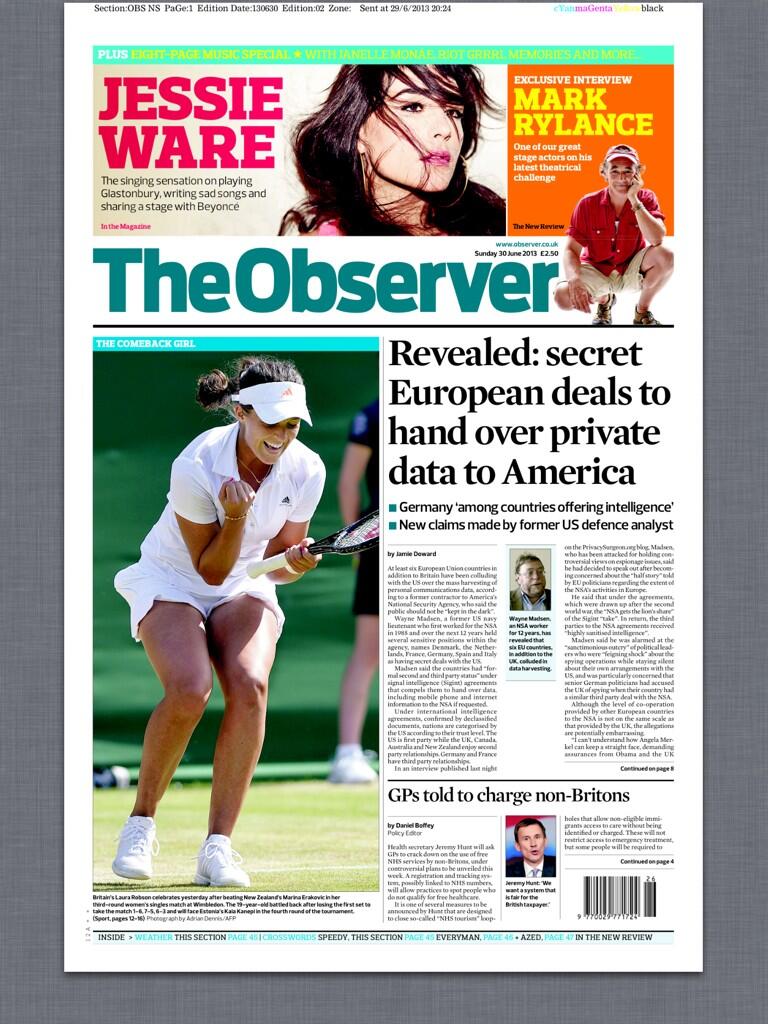
So far so good, just as in any other walk of life you think you’ve made a mistake you try to correct it. Just as Mother always told you you should. The slightly unfortunate thing is that the Sunday papers in the UK print quite early on the Saturday evening. Thus we get this front page of the physical paper:

Observer front page 20130630

The paper is now running as its front page a story that it has already retracted online. This is something of an “Ooops!” moment and as such one to be treasured as an example of the fallibility of both human beings and organisations that contain them.

However, the story really gets even better than this.

Steps towards a police state

Rick Falkvinge thinks that the United States is at the point of no return as far as civil liberties are concerned:

While this may seem a trivial observation, it is critical in this context: people tend to be focused on what affects them in the here and now. While some people can connect the dots and follow the line with their eyes into the future, the vast majority of people don’t bother with something that doesn’t affect them directly, personally, and in the present. In 1932, families were still skating in the park in Berlin on weekends. All that nasty stuff was theoretical, rumored, and somewhere else. People who look ahead and try to sound the alarm bell tend to be regarded as tinfoil hats, eccentric, and nuts.

One of the first things that happens past the point of no return into a police state is the persecution of reporters. As a society is closing down, those persecuted first are those with the audience and an interest in reporting the worrying trends that society seems to be closing. This is the proverbial canary in the coal mine. This is the alarm bell. Once that happens, get out of the mine.

An event horizon is a term from astrophysics. It is the edge of a black hole – so the event horizon appears like a black sphere, if you like. Nothing, not even light, can escape from within the event horizon – hence the term black hole. But if you were traveling through space, in direction of the black hole (which may be as large as an entire solar system), then you would notice absolutely nothing as you crossed the event horizon. You would pass a point of no return, and register not a single thing while doing so. The analogy is depressingly apt.

I’ve written before that I believe that the U.S. is lost to encroaching totalitarianism, which it will likely endure for a number of years before it collapses under its own weight (as all empires do sooner or later). With Edward Snowden being hunted relentlessly across the globe for leaking evidence of systematic abuse of power, Glenn Greenwald – who published Snowden’s leaks – was recently criticized for aiding and abetting the leak itself. This is a key choice of words, for aiding and abetting a crime is itself a crime – the wording suggested that the reporter who published evidence of abuse of power is himself a criminal.

June 28, 2013

Edmonton and Calgary – united by mutual dislike

Filed under: Cancon, Media — Tags: , , , , — Nicholas @ 13:51

When the flooding hit Calgary, some of the first responders to the scene from outside the city were soldiers from Edmonton. There were several jokes on Twitter about the war of words between the two cities, and a few “invasion” hints, but for those of us outside Alberta local politics, we just didn’t know:

Calgary and Edmonton mutual dislike

I think we have a new meme.

June 27, 2013

Calgary’s mayor Naheed Nenshi gets praise from unexpected source

Filed under: Cancon, Government, Media — Tags: , , , , , — Nicholas @ 09:23

The Calgary Sun gets all gushy and enthusiastic over the mayor they usually like to beat up:

No one goes after the mayor of this city harder than we do.

We don’t apologize for that. It’s our job and we like to think we do it louder than most.

But it’s never personal.

So, with that as background, we would like to take this space today to commend Mayor Naheed Nenshi for his amazing leadership under the most trying of circumstances.

He has been a beacon of strength, support and optimism as Calgary battles the affects of the single-biggest disaster to hit our city.

The mayor, as always, has been a great communicator.

Through social media, traditional media and constant briefings, Nenshi has made it his personal undertaking to deliver the most up-to-date information to all Calgarians through all mediums.

June 23, 2013

Ecuador press law to mandate coverage of government propaganda items

Filed under: Americas, Law, Liberty, Media — Tags: , , , , , — Nicholas @ 10:28

Ecuador has a new law on the books that may force the media to carry government propaganda or risk prosecution:

Under Ecuador’s new Communications Law, however, journalists may have to pay far more attention to ribbon-cutting ceremonies and other government PR events. Article 18 of the law forbids the “deliberate omission of … topics of public interest.” But this wording is so vague that nearly any action by local, state, or national government official could be considered of public interest.

“Newspapers don’t have enough journalists or space to cover all these events. Radio programs don’t have enough air time,” Paúl Mena, president of the Ecuadoran Journalists’ Forum, told CPJ. “If the government starts demanding coverage, there are going to be problems.”

More conflict between the media and the Correa government seems inevitable under the Communications Law, which was approved by the National Assembly on June 14 and will go into effect next month. Not only does the law create a state watchdog entity to regulate media content, but it is filled with ambiguous language demanding that journalists provide accurate and balanced information or face civil or criminal penalties. “This is completely crazy,” Monica Almeida, an editor at the Guayaquil daily El Universo, told CPJ. “The law is designed to regulate everything we do.”

[. . .]

The 44-page law contains 119 articles. In interviews with CPJ, Ecuadoran journalists were at a loss to pick out the worst provisions since they view nearly all of them as serious violations of press freedom.

For example, under the law reporters are now required to earn a journalism degree. Rather than serving as a neutral referee, the Superintendence of Information and Communication — the government’s new watchdog agency — could be used by Correa to simply bash the press. And reporters are especially incensed by Article 26 that prohibits “media lynching.” This is defined as “the dissemination of concerted and reiterative information … with the purpose of undermining the prestige” of a person or legal entity. Media outlets found violating this provision could be ordered to issue public apologies and would be subject to criminal and civil sanctions that are not specified in the legislation.

One magazine editor in Quito, who asked to remain anonymous, said the article seems designed to thwart investigations. That’s because such in-depth reporting often requires publishing a series of stories over several days or weeks that could be construed as harassment.

June 20, 2013

Supreme Court refuses to hear appeal of Rob Ford’s conflict-of-interest case

Filed under: Cancon, Law, Media, Politics — Tags: , , , , , — Nicholas @ 11:07

The Toronto Star must be feeling devastated by this:

The Supreme Court of Canada says it will not hear an appeal in a conflict-of-interest case against Toronto Mayor Rob Ford.

The court dismissed it with costs, but did not give reasons for the ruling.

Lawyer Clayton Ruby was trying to restore a lower court decision from November 2012, in which Superior Court Justice Charles Hackland ruled Ford be removed from office.

However, as part of Ford’s appeal, the decision was overturned by an Ontario Divisional Court panel in January 2013.

Deputy mayor Doug Holyday said this was all about antagonizing the mayor.

“There was no reason to take this to the Supreme Court; there was very little likelihood of it every getting put before the Supreme Court,” Holyday said.

Update: The CBC reports that Ford feels vindicated by the decision:

Toronto Mayor Rob Ford expressed relief Thursday that a conflict challenge that previously threatened to oust him from office won’t be revived in the country’s top court.

“I’m so happy this is finally over. I’ve been vindicated and we can move on,” Ford told reporters in Toronto, about two hours after the Supreme Court of Canada rejected an application to hear a final appeal in the much-publicized conflict case that began last year.

As is customary, the Supreme Court gave no reasons for dismissing the appeal, but legal experts — including the lawyer who filed the application himself — had acknowledged the odds of reviving the conflict of interest case were a long shot.

The court only accepted 12 per cent of appeal requests made last year.

Toronto resident Paul Magder filed an application in an Ontario court last year, alleging that Ford had violated conflict of interest legislation when he participated in a council vote that absolved his need to pay back funds donated to his private football foundation.

June 3, 2013

Turkey’s unexpected wave of protests

Filed under: Europe, Government, Media, Politics — Tags: , , , — Nicholas @ 08:51

The Economist explains what is happening in Turkey:

The wave of unrest was completely unexpected. The protestors cut across ideological, religious and class lines. Many are strikingly young. But there are plenty of older Turks, many of them secular-minded, some overtly pious. There are gays, Armenians, anarchists and atheists. There are also members of Turkey’s Alevi Muslim minority. What joins them is the common sentiment that an increasingly autocratic Mr Erdogan is determined to impose his worldview. The secularists point to a raft of restrictions on booze; liberals to the number of journalists in jail (there are more journalists in prison than in any other country in the world). Thousands of activists of varying stripes (mainly Kurds), convicted under Turkey’s vaguely worded anti-terror laws, are also behind bars. Then there are those incensed by mega urban-development projects, including a third bridge over the Bosphorus, which will entail felling thousands of trees. Scenting the public mood, retailers announced that they had pulled out of the planned arcade in Taksim Square. “This is not about secularists versus Islamists — it’s about pluralism versus authoritarianism,” commented a foreign diplomat.

Mr Erdogan wants to be elected president when the post comes free in August 2014. And he has made no secret of his desire to boost the powers of the presidency “a la Turca” as he put it, spurring accusations that what Erdogan really wants is to become a “Sultan”.

“Tayyip [Erdogan] istifa”, a call for the prime minister to resign, was the slogan most commonly chanted by the protestors. Not that most Turks would have known. Media bosses fearful of jeopardising their other business interests shunned coverage of the protests for nearly two days, opting instead to screen programmes about breast-reduction surgery and gourmet cooking. Faced with a public outcry, the main news channels began broadcasting live from Taksim Square. But pro-government papers continue to point the finger of blame at provocateurs and “foreign powers” bent on undermining Turkey. It seems an odd description of the thousands of housewives leaning over their balconies clanging their pots.

May 29, 2013

QotD: It’s time to go, Rob

Filed under: Cancon, Media, Politics, Quotations — Tags: , , , — Nicholas @ 15:37

Yes, the media is out to get Rob Ford. It’s politics. Most hacks are not militantly left-wing, though their political assumptions are broadly statist. What almost all successful reporters have, no matter what their political inclinations, is a sixth sense about good copy. They can smell blood from miles away. Even the most right-leaning member of Ford Nation, who has a slight tinge of journalistic ability, can sense Rob Ford is a headline generating machine. More than that he generates the right kind of headlines: Cheap, simple and easy to understand.

He’s a big fat white guy who keeps getting himself into trouble. The man is an elected Fox sitcom.

That’s why he has to go. Hopefully to be replaced by someone with his values but also with a modicum of common sense. When faced with allegations, whether absurd or serious, the instinctive reaction of the Mayor has been to whine like a petulant child and to blame a vast-left-wing conspiracy. It never seems to have occurred to the Mayor, who has a penchant for self-pity, that this same media complex is also besieging Tim Hudak, Stephen Harper, Jason Kenney, John Baird and Danielle Smith. Whatever you think of those politicians, each is enough of a professional to deal with the media they’re stuck with, rather than wish for a media that has never existed.

For the good of Toronto, Rob Ford needs to go.

Richard Anderson, “He Needs To Go”, The Gods of the Copybook Headings, 2013-05-29

“One imagines this isn’t the response the administration was expecting”

Filed under: Government, Liberty, Media, USA — Tags: , , , — Nicholas @ 10:01

In the Wall Street Journal, James Taranto talks about the surprising recent uniformity of opinion among media outlets:

Hey, kids! What time is it? “TIME TO GO: HOLDER OK’D PRESS PROBE,” shouted the always subtle homepage of the Puffington Host last Thursday evening. It was in response to the news, broken by NBC, that Attorney General Eric Holder had participated in “discussions” about “a controversial search warrant for a Fox News reporter’s private emails.” That’s in contrast with the Associated Press phone-log subpoena case, from which Holder told Congress he had recused himself.

The New York Times‘s reaction, while not as breathless, was more dramatic. The paper’s editorial appeared a week ago tomorrow — before Holder’s involvement had publicly emerged — under the headline “Another Chilling Leak Investigation.” The editorial was straightforward and reasonably argued. That may not sound like a great compliment, but this is the New York Times editorial page we’re talking about.

The editorial was remarkable as much for what it didn’t say as for what it did. There were no snide asides about Fox News, or qualifications along the lines that “even Fox” has First Amendment rights. Nor did the Times editors take any shots at George W. Bush, congressional Republicans or any other familiar antagonist. They simply defended Fox News‘s right to engage in news-gathering and denounced the Obama administration’s assault on it.

One imagines this isn’t the response the administration was expecting.

May 26, 2013

Reporting (and omitting to report) certain news items

Filed under: Britain, Media, Religion — Tags: , , , , , — Nicholas @ 09:59

Mark Steyn on what was top of the issue-sheet for journalists discussing the Woolwich murder and the Swedish “youth” riots:

For the last week Stockholm has been ablaze every night with hundreds of burning cars set alight by “youths.” Any particular kind of “youth”? The Swedish prime minister declined to identify them any more precisely than as “hooligans.” But don’t worry: The “hooligans” and “youths” and men of no Muslim appearance whatsoever can never win because, as David Cameron ringingly declared, “they can never beat the values we hold dear, the belief in freedom, in democracy, in free speech, in our British values, Western values.” Actually, they’ve already gone quite a way toward eroding free speech, as both prime ministers demonstrate. The short version of what happened in Woolwich is that two Muslims butchered a British soldier in the name of Islam and helpfully explained, “The only reason we have done this is because Muslims are dying every day.” But what do they know? They’re only Muslims, not Diversity Outreach Coordinators. So the BBC, in its so-called “Key Points,” declined to mention the “Allahu akbar” bit or the “I”-word at all: Allah who?

Not a lot of Muslims want to go to the trouble of chopping your head off, but when so many Western leaders have so little rattling around up there, they don’t have to. And, as we know from the sob-sister Tsarnaev profiles, most of these excitable lads are perfectly affable, or at least no more than mildly alienated, until the day they set a hundred cars alight, or blow up a school boy, or decapitate some guy. And, if you’re lucky, it’s not you they behead, or your kid they kill, or even your Honda Civic they light up. And so life goes on, and it’s all so “mundane,” in Simon Jenkins’s word, that you barely notice when the Jewish school shuts up, and the gay bar, and the uncovered women no longer take a stroll too late in the day, and the publishing house that gets sent the manuscript for the next Satanic Verses decides it’s not worth the trouble … But don’t worry, they’ll never defeat our “free speech” and our “way of life.”

One in ten Britons under 25 is now Muslim. That number will increase, through immigration, disparate birth rates, and conversions like those of the Woolwich killers, British-born and -bred. Metternich liked to say the Balkans began in the Landstrasse, in southeast Vienna. Today, the Dar al-Islam begins in Wellington Street, in southeast London. That’s a “betrayal” all right, but not of Islam.

May 23, 2013

Pollster finds about 1/3 of Canadians trust the media

Filed under: Cancon, Media — Tags: , , , — Nicholas @ 14:49

However, as Richard Anderson points out, they prefer to trumpet the finding that only eight percent of Canadians trust what they hear from bloggers:

According to the referenced survey only 8% of Canadians trust bloggers.

Which begs the obvious question, indeed so obvious that the professional pollster quoted above didn’t bother asking it: Have 8% of Canadians even read a blog?

Those of us who comprise the mostly unpaid army of bloggers are perfectly aware that we are a niche. Really thousands of little niches. Most people do not get their news or commentary from blogs, or at least from blogs not affiliated with an MSM outlet. It’s why we call the MSM the MSM, they’re the mainstream and we’re the outsiders. So when you ask Bob and Mary Canadian do you trust bloggers, a term they’re probably only vaguely familiar with, they’ll say no.

Does anyone trust something they know almost nothing about?

What’s impressive is that the MSM has trust ratings in the 32-33% range, despite decades of incumbency and powerful distribution networks. When most people are very familiar with your product, and still think you stink, that’s a huge credibility issue. Bloggers are doing this for the hell of it and some spare change. The MSM is doing this for a living. If upstart amateurs have one-quarter the trust level of professional journalists, that says far more about journalists than bloggers.

Pollsters, ironically, scored lower than journalists.

May 20, 2013

Neil Reynolds, RIP

Filed under: Cancon, Liberty, Media — Tags: , , , — Nicholas @ 08:25

Although he was much better known for his career in journalism, I first got to know Neil Reynolds when he joined the Libertarian Party of Canada to contest the 1982 by-election in Leeds-Grenville. Here is his obituary from the Kingston Whig-Standard:

Neil Reynolds is being remembered Sunday night as one of the top editors in Canadian newspaper history, and for being the person responsible for turning the Whig-Standard into a great small-city daily that won national awards and international recognition.

Reynolds died on Sunday in Ottawa. He was 72.

“He was the great editor of Canada from the mid-’70s to the early-2000s because of his ability to improve papers,” said Harvey Schachter, who became editor of the Whig after Reynolds’ departure in 1992.

Reynolds had been city editor of the Toronto Star in 1974 when he suddenly left to return to Kingston and take on an editing job with the Whig-Standard. By 1978 he was planning to move on when publisher and Whig owner Michael Davies offered him the top newsroom job.

Reynolds promptly hired Schachter, Michael Cobden and Norris McDonald to fill out the editors’ ranks.

“The Whig was really the start,” said Schachter. “Why the Whig stood out is he took it from a pretty mundane paper to being the top small-town paper in North America.”

Reynolds’ political career didn’t last long, as he joined the LPC in 1982, held the party leadership for a year, then returned to full-time journalism. His Wikipedia page says that his 13.4% of the vote in that by-election was the highest percentage of the vote achieved by an LPC candidate.

May 17, 2013

Toronto mayor denies crack cocaine allegations

Filed under: Cancon, Law, Media — Tags: , , , — Nicholas @ 08:47

I woke up to some fascinating news … Toronto’s Mayor Rob Ford is alleged to have been videotaped while smoking crack cocaine:

The U.S. website gawker.com published an article late Thursday alleged it had been offered a video of Ford “smoking crack cocaine” — and the Toronto sellers were hoping to get six-figures for the video.

“First of all, I’ve spoken to the mayor yesterday and secondly, he denies any such allegation,” Ford’s lawyer Dennis Morris told the Toronto Sun Friday.

Morris wasn’t sure if Ford would address the allegations Friday.

“We’ll just have to see how that unfolds,” he said.

Asked if the mayor plans any legal action, Morris said they’re at the “bottom rung of the ladder of anything of that nature now.”

[. . .]

In the wake of the gawker.com story, the Toronto Star published a story Friday morning by two reporters who state they were shown the alleged video earlier this month and alleging Somali drug dealers are shopping the video around.

While I’m far from a Rob Ford fan, I do find this story to be hard to believe. Ford has managed some awesome face-palm moments during his term in office but I can’t credit that any politician would put himself into this kind of situation. Either way, Toronto politics have been much more interesting since Ford was elected.

Update: Here’s the Toronto Star story:

The footage begins with the mayor mumbling. His eyes are half-closed. He waves his arms around erratically. A man’s voice tells him he should be coaching football because that’s what he’s good at.

Ford agrees and nods his head, bobbing on his chair.

He says something like “Yeah, I take these kids . . . minorities” but soon he rambles off again.

Ford says something like: “Everyone expects me to be right-wing, I’m . . .” and again he trails off.

At one point he raises the lighter and moves it in a circle motion beneath the pipe, inhaling deeply.

Next, the voice raises the name of Liberal Leader Justin Trudeau. The man says he can’t stand him and that he wants to shove his foot up the young leader’s “ass so far it comes out the other end.”

Ford nods and bobs on his chair and appears to say, “Justin Trudeau’s a fag.”

The man taping the mayor keeps the video trained on him. Then the phone rings. Ford looks at the camera and says something like “that better not be on.”

The phone shuts off.

Update the second: Popehat calls it the “most wonderful legal threat ever”:

Various journalists are claiming they have seen a video of Toronto Mayor Rob Ford smoking crack.

This led to the most darling legal threat ever from a lawyer named Dennis Morris — who has represented Ford for some time — to Gawker

[. . .]

This is delightful, like that video of the kitten freaking out when it sees a lizard.

First, nobody ever governed themselves accordingly based on a threat from a hotmail account. Second, are you using some sort of comma-based operating system? Third, what the fuck are you talking about?

This sets a high bar.

May 14, 2013

Peter Worthington’s final column

Filed under: Cancon, History, Media — Tags: , , — Nicholas @ 10:00

It was suggested that Peter Worthington write his own obituary:

If you are reading this, I am dead.

How’s that for a lead?

Guarantees you read on, at least for a bit.

When the Sun’s George Gross died suddenly in March 2008, at age 85, there were few of his contemporaries left alive to recall the old days, when he was in his prime and his world was young. I was one of the few who knew him then.

After attending his funeral I half-facetiously remarked to the Toronto Sun’s deputy managing editor, Al Parker, that I had been around so long that no one was left who knew me back then, and I had better write my own obituary.

“Good idea!” said Parker with more enthusiasm than I appreciated.

I mentioned it to my wife, Yvonne, who approved.

So here it is, not exactly an obit but a reflection back on a life and a career that I had never planned, but which unfolded in a way that I’ve never regretted.

QotD: Litmus testing political scandals

Filed under: Media, Politics, Quotations — Tags: , , , — Nicholas @ 09:27

Dear friends in the media.

Come on.

I mean, come on.

You and I know what’s going with the Benghazi thing. Let me share something that I first put into play during the “was Anthony Weiner’s Twitter account hacked” debate, but that comes from watching the Lewinsky scandal, the where-did–Mark-Sanford-go scandal, the why-is-David-Wu-dressed-in-a-tiger-suit scandal, and a wide variety of wrongdoing committed by politicians:

When there is evidence of scandalous or bizarre behavior on the part of a political figure, and no reasonable explanation is revealed within 24 to 48 hours, then the truth is probably as bad as everyone suspects.

Nobody withholds exculpatory information. Nobody who’s been accused of something wrong waits for “just the right moment” to unveil information that proves the charge baseless. Political figures never choose to deliberately let themselves twist in the wind. It’s not the instinctive psychological reaction to being falsely accused, it’s not what any public communications professional would recommend, and to use one of our president’s favorite justifications, it’s just common sense.

Jim Geraghty, “The Mask Is Ripped Off of ‘Hope and Change'”, National Review, 2013-05-14

« Newer PostsOlder Posts »

Powered by WordPress