Quotulatiousness

July 21, 2020

“Journalists” and photographers in the media

Filed under: History, Media, Politics — Tags: , , — Nicholas @ 03:00

David Warren considers the decline of boots-on-the-ground reporting and the rise of comfortable bourgeois “journalism”:

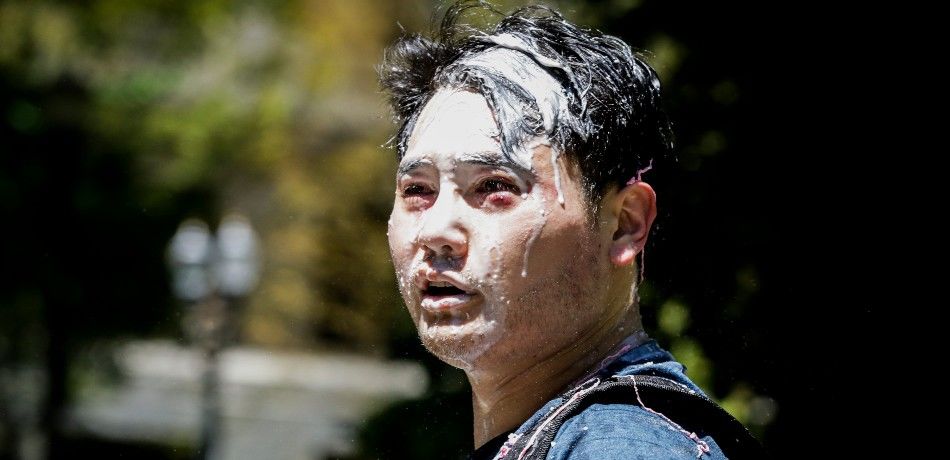
Andy Ngo after being assaulted during Antifa protests in Portland, Oregon on 29 June 2019.

When I was a “journalist” — God help me, but it was an increasingly long time ago — my understanding was that the job involved getting into the riot. Andy Ngo may be the only journalist left, unless we count “talking heads” and “scribblers.” Well-informed, at first hand, on events in such towns as Seattle and Portland — where the bourgeoisie now enjoy their “summer of love” — he has been beaten up a few times. For journalism was meant to be a dangerous sport, quite unlike ping-pong.

Alas, and already in Vietnam, I discovered that only the photographers looked directly on the face of battle. This is because they were getting paid for the pics — in cash, but sometimes in prizes. The people who wrote the (frequently misleading) captions were safe in a bar, back in Saigon, or more likely, in the editorial suites of New York. It interested me that the photographers were often rightwing crazies. Whereas, the scribblers were, generally, leftists to a man, or in those days, the very occasional woman. I liked to get my information from photographers, whenever possible, but the scribblers did not. In possession of a fully-formed “narrative” from New York, they had already written their stories.

Am I exaggerating? Less than usual. My caricature points to a flaw in the meejah — cowardice, ignorance, arrogance, and malice, stirred into a rather potent brew. Then we had “editors,” to do the distillation.

July 12, 2020

QotD: “Getting tough on crime”

Filed under: Law, Media, Politics, Quotations, USA — Tags: , , — Nicholas @ 01:00

Whenever some crime becomes prominent in the public eye, some politician inevitably promises to fix it by getting really tough on criminals. No more of this namby-pamby mollycoddling! This time, we’re going to make it so miserable to be a criminal that no one will dare.

It is a bipartisan habit; progressives may talk enthusiastically about ending mass incarceration, but switch the topic to male sex offenders (or, say, 2008 bankers) and what you’ll hear often sounds like a recap from some Republican law-and-order conference, circa 1984. The belief that crime is a soluble problem if we’re willing to be mean enough is apparently nestled deep in the human psyche.

Megan McArdle, “Killing drug dealers won’t stop the opioid epidemic”, Washington Post, 2018-03-20.

June 13, 2020

QotD: The liberal media

Filed under: Humour, Media, Politics, Quotations — Tags: , , , , — Nicholas @ 01:00

As I have pointed out myself, the more one knows about a subject, the more conservative one becomes towards it. Conversely, the less one knows, the more liberal he becomes, and inclined to embrace “progress” and “reforms.” Even a Communist may prove a very conservative stamp collector, once he learns something about philately. It’s only economics he knows nothing about.

This is a universal principle. Everyone knows something about something, and is very backward on that which he knows. The one exception may be journalists, who know nothing about anything, and are therefore liberal all round.

David Warren, “I’ll be a Welshman”, Essays in Idleness, 2018-03-01.

June 3, 2020

QotD: From “the media’s” point of view

Filed under: Business, Cancon, Media, Quotations — Tags: , , — Nicholas @ 01:00

But what if they’re right? The media are most often accused of three things: bias, sensationalism and negativity.

Bias. Everyone leans a certain way politically. Ideally, that wouldn’t affect the way a reporter covered a city council meeting or a police news conference. But to tell the truth, I’ve probably worked with 10 times more liberal-leaning journalists than conservative-leaning journalists over the past three decades. The profession attracts people with an affinity for underdogs. That has to have some impact on the stories we choose to do and the ones we don’t.

Sensationalism. It depends how you define it. If we talk to the relatives of a murder victim, are we doing it to make money? I hope we’re there because we’re trying help the community grieve together. But let’s face it, that story is going to be well-read so maybe it will make more money in some click-based, page-view algorithm that I’ll never understand.

Negativity. We don’t make cars crash. We don’t bomb civilians. The world can be an ugly place and these things won’t stop if we ignore them. On the other hand, I haven’t met many reporters who would rather cover a parade than a murder trial. Darker stories seem, by their nature, more important. So maybe we are negative.

But I’ve already fallen into the trap of thinking in terms of “us” and “them.” There should be no distinction. It’s here where the media are their own worst enemies. We tend to think we’re infallible because we’re doing God’s work. But if we want more people on our side, we could do a much better job of showing the public what we do, why we do it and how we do it. We like to crow about open courts, but what about open newsrooms?

Maybe we should trust people enough to let them in on the process. To boil it down to one example, if the police shoot an Indigenous man and we decide to mention his race in coverage, we should tell people why we thought it was relevant and maybe admit that we agonize over such decisions. It might not stop the haters but it would at least give “them” a chance to understand “us.”

Cam Fuller, “Do people really hate us and if so, why?”, Saskatoon StarPhoenix, 2018-03-03.

May 2, 2020

Saigon memories

Filed under: Asia, History, Media, Military — Tags: , , — Nicholas @ 06:00

I had no idea that David Warren had some brief journalism experience in Vietnam before the US pulled out their military forces:

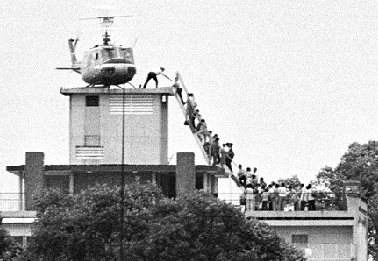
A member of the CIA helps evacuees up a ladder onto an Air America helicopter on the roof of 22 Gia Long Street on April 29, 1975, shortly before Saigon fell to advancing North Vietnamese troops.
Hubert van Es photo via Wikimedia Commons.

An article in the New York Post (here) brings one historical event back into view, with a bitterness I haven’t yet overcome. It is only an aside on an old photo-caption, which like so many others from the Vietnam War was, shall we say, inaccurate. Taken for a symbol, it has passed into our electronic folk memory, as one of innumerable lies it contains. I wasn’t there, of course, but I had visited that country, and once, too briefly, lived in Saigon. The (very consequential) deceit, dishonesty, and faithlessness of “the mainstream media” was among the lessons I took from my apprenticeship. My ludicrous ambition, to “correct it” some day, will never be fulfilled. But to the link: my praise to one writer who did his homework. Let me be grand and say, the truth has set him free.

It will soon be fifty years since I first attended the “Five O’Clock Follies” at “MAC-V,” where the best hamburgers in South-east Asia could be obtained for the price of a chocolate bar. This press conference format — bluster and counter-bluster — has not changed in all this time. Everything in that vast sprawling compound of military administration was sprayed, swept, and polished; I always entered with wide eyes. There, and in bars along Tu-Do Street (the old rue Catinat, once an exquisite ribbon from the Cathedral down lines of fragrant tamarinds), was where I first fell in with “real professional journalists,” practising their trade.

Those I met were, by and large, pathological liars, and extremely vain. They were also coarsely disrespectful, much like our journalists today: rudely cynical and sarcastic. The only serious exceptions I came to know were a couple of religious weirdos — one a Lutheran ex-pastor from West Germany, the other a reject from a Catholic seminary in southern France. They, like me, had strayed into the field, from a misplaced sense of adventure.

At all levels, and on all sides, I was witnessing a freak show — there and wherever I wandered outside the Unreal City. I owned a reliable Nikkormat camera, that would sometimes earn me much-needed cash, but was quite unsuccessful as a print journalist. My earnest despatches, sent to newspapers on spec, were routinely “spiked” — not, I think, because I was so young (they didn’t know that), but because I kept, often unknowingly, writing things that contradicted what the New York Times and CBS were reporting.

Not only was I learning that the “mainstream” was all lies, but too, that it invariably followed an agenda. The self-appointed purpose of the press was to sabotage the American war effort. (That of the life-or-death desperate Viets was, at best, ignored.)

But then, I was deceitful, too. I was pretending to be over 18 when I was still only 17, in order to get a press pass.

April 4, 2020

The media’s grasp of modern logistics

Kurt Schlicter — who, spoiler, isn’t a fan of our news media in general — on the demands by newsbeings for the impossible to be done immediately:

We Americans are truly blessed by having a mainstream media full of brilliant renaissance men, women, and gender non-specific entities who are masters of so many varied and intermittently useful skills and who are eager to share their knowledge with us benighted souls. The pandemic has revealed that every urban Twitter blue check scribbler, MSNBCNN panelist, NYT/WaPo doofus, and barely legal “senior editor” of a website you never heard of, is a Nobel Prize-winning epidemiologist, a master logistician, and a diversity consultant to boot.

[…]

Another hitherto unknown skill that the media believes it possesses is logistics. “Why hasn’t Trump commanded a million ventilators to appear?!” the reporters demand. It’s pretty easy to see where they might have gotten the idea that the moment one articulates a desire to possess something that it magically appears. Capitalism has pretty much made that a reality. If you want something, you can go to a store and get it 24/7, or you can go on Amazon and it’ll be at your Manhattan apartment in 48 hours. Since they have never built anything or transported anything or distributed anything, only benefited from the labor of the unhip people who do those things, it’s only natural that the delayed adolescents who make up our media class imagine that material goods can be simply wished into being. After all, for all practical purposes during normal times, because of the efforts of Americans they look down upon, material goods pretty much can be simply wished into being. But prosperity takes work, not that the media would know.

[…]

Apparently, the media class thinks there are giant warehouses with an endless supply of goods just sitting there, somewhere, waiting. They have no idea about how logistics work, how goods flow quickly from producer to market and how expected resupply levels need a few days to adjust from a 10 percent daily turnover to a 30 percent daily turnover. They have zero appreciation for inventory management because no one they know does unglamorous stuff like that.

It’s all much easier in a socialist command economy. You get nothing and like it. Or don’t like it. Whatever. Here’s your weekly bean allowance. Workers of the world unite. You have nothing to lose but access to toothpaste and toilet paper.

The best part is when the media – the same media that was collectively soiling its Dockers because that mean old Trump was barring direct flights from China because of racism and stuff – demands to know why, back in December, Trump was not commanding a zillion Wuhan Flu tests, a zillion masks, and a zillion ventilators be created, while locking down all of America. Leaving aside the whole lack of an enumerated power to do that thing, in what world would have Trump have convinced anyone – least of all the media that was slobbering over his bogus impeachment at the time – that some bat soup-derived pathogen in BumFoo, China, was going to black swan all over America’s economy? The lack of seriousness by the people who presume to be reporting the news to us is more breathtaking than the damn ChiCom grippe.

March 23, 2020

The world of woke crossword-puzzlers – a place of horrible, unintentional microaggressions

Filed under: Media, Politics — Tags: , , , — Nicholas @ 03:00

David Thompson takes us on a scary trip to the heart of the woke crossword world:

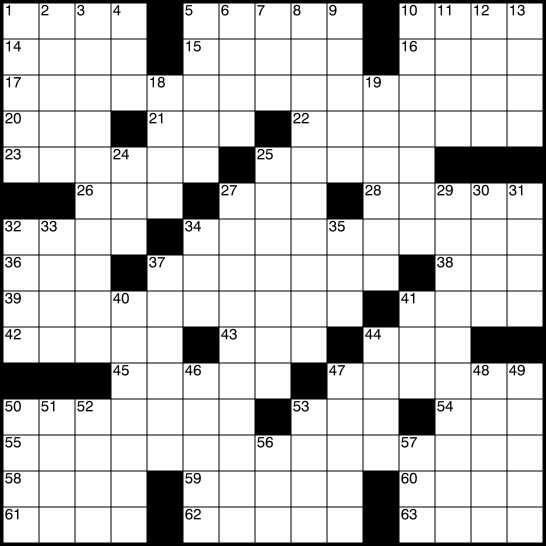
The world of woke crossword-puzzlers — because that’s a thing that exists — is one in which enthusiasts, via social media, grumble about white men, bemoan the insufficient prominence of “queer or POC colloquialisms,” share “off-colour jokes about hypothetical titles for a Melania Trump memoir,” and fret about the exact ratio of male and female names used as clues. Because a lack of “gender parity” in crossword puzzle clues constitutes one of “the systemic forces that threaten women.”

Crossword puzzles can do that, apparently.

The list of possible crossword-puzzle wrongdoings is, of course, extensive, ever-growing and not entirely straightforward.

Transgressions include clues for ILLEGAL (“One caught by border patrol”); MEN (“Exasperated comment from a feminist”); and HOOD (“Place with homies”).

I’ll give you a moment to steady yourselves, to recover from all that gasping.

A New York Times puzzle triggered agitation with the clue “Pitch to the head, informally,” the solution to which was “beaner.” Given sufficient effort, said word could also, it seems, be construed as a mild and antiquated racial slur, albeit one that had escaped me and which I had to look up. Inevitably, apologies and public prostration ensued, despite both the puzzler-writer and editor confessing their own ignorance and intending no harm. Needless to say, the apology immediately resulted in further hissing and rending of garments by people whose Twitter bios include preferred pronouns and the words liberal and feminist.

Unlike almost every other site on the web, I do encourage you to read the comments at David’s blog … he has a great group of regular commenters (commentators? commentistas? Whatevs…)

March 18, 2020

What is really driving the Wuhan Coronavirus panic

Filed under: China, Europe, Health, Media, Politics, USA — Tags: , , , , , — Nicholas @ 05:00

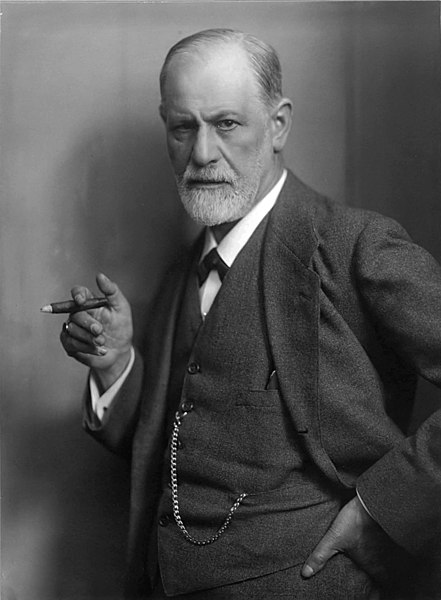
… besides the wall-to-wall hysteria in the mainstream media, I mean. Severian discusses the insights of “perverted old cokehead” Sigmund Freud on anxiety and its effects, then segues to our current, shared, plight:

Photographic portrait of Sigmund Freud, signed by the sitter (“Prof. Sigmund Freud”) by Max Halberstadt (c. 1921)
Wikimedia Commons

Everyone who has thought about it for five minutes knows that something’s not right. […] As y’all have noted, actual hard information on the coronavirus is hard to come by. Is it fully air-transmissible? What are the infection rates? Hell, what are the death totals? And speaking of the death totals, even if you trust China’s figures (which no reasonable person can possibly do), they seem … low. Like, really low. I actually trust Italy’s government to deliver some vague approximation of the truth, and even there, where they’re in full-blown freakout mode, it seems to kill off old folks with compromised immune systems and lung problems at a fractionally higher rate than your garden-variety flu.

So, you know … it’s the flu. Not great by any means, and more infectious (possibly) than some other flus in our recent past, but for all that just the flu. The ongoing sky-is-falling global freakout has next to nothing to do with the actual bug. We live in a deeply anxious age, and that anxiety has to discharge somehow. It’s global hysteria — classic hysteria, Freudian hysteria, an excess of stress that must be discharged by “converting” it into behavior.

The people who are freaking out about it aren’t worried about dying from it. No, really, they’re not. Nor should they be — no reasonably healthy person under age 70 has any reason to be worried about that. Instead, what they’re worried about is powerlessness. We’ve all long suspected that we’re ruled by idiots and grifters. We’ve all long sensed that our “leaders” hold us in deep contempt. And we’ve long known that none of our problems are worth anything to the global pirate capitalist class. The only reason those bastards care if we all drop dead from the plague is that they can’t sell enough iCrap to each other to keep the company stock price up.

We know this. But we can’t say it, and we can’t act on it, because doing so goes against our self-image. Our media, our education system, our “culture” (such as it is) has spent the last half-century telling us what special and unique snowflakes we all are, even as it’s forcing us into ever-greater conformity. We’ve broken all the taboos, transgressed all the boundaries, liberated all the oppressed. If there ever were to be such a thing as “social justice,” then truly we’ve achieved it, here in this best of all possible worlds where you can lose your job for not addressing your co-worker as a wingless golden-skinned dragonkin and 6’2″ dudes with beards down to their collarbones can go wee-wee in the little girls’ room …

… and yet. And yet. And yet feminists (just to stick with a theme), despite running everything for the last 30 years, still can’t get that lousy 25 cent raise. Seven out of every five college girls are sexually assaulted the minute they step on campus, despite boys being as rare as sasquatches on most campuses (and despite the ever-growing clamor for free college for everyone). You’re free to — hell, you’re practically required to — make up your own pronouns, but you’re not allowed to ask just how a degree in “gender studies” could be worth even one dollar in student loan debt, let alone one hundred thousand dollars. We keep agitating for change, keep voting for it, keep tweeting about it … and nothing happens.

That profound sense of powerlessness is exactly, and I do mean exactly, what screwed up Anna O. She hated her father for not allowing her any personal agency. In her heart of hearts she wanted him dead. And yet she knew herself to be a loving daughter, so that overwhelming sense of relief — indeed, of joy — she felt when he kicked the bucket sent her around the bend.

March 11, 2020

QotD: Orthorexia

Filed under: Business, Food, Health, Media, Quotations, Science, USA — Tags: , , , , — Nicholas @ 01:00

The American media and our popular culture both celebrate a fear of safe, nutritious food if it is not labeled “organic.” To be consistent then, why don’t we also celebrate anti-vaxxers’ fear of safe vaccines, which are also not “organic?” To be clear, I am not an anti-vaxxer. I am strongly pro-vaccine. Everyone in my house is vaccinated, and I am appalled at the outbreaks of contagious diseases due to anti-vaxxers. But let’s be clear, a Venn diagram of those who obsess about organic food and anti-vaxxers will reveal a major overlap. If you know an anti-vaxxer, he is most likely committed to an organic diet.

Our culture accepts as a scientific fact that organic food is healthier than non-organic food. You can watch TV, read popular magazines, or listen to healthy-living gurus, and overwhelmingly you will be told that organic food is healthier than non-organic food. Recipes tend to call for organic produce and ingredients. And it goes beyond organic foods. Genetically-modified foods are slandered as “frankenfoods” concocted by mad scientists in a laboratory. Further, we are admonished to avoid anything that is not “natural.”

OK then. Vaccines are genetically modified, lab-made, and certainly not natural. Being anti-vax seems a logical extension of the natural, organic lifestyle.

I know several people — including family members — who have so completely bought into the natural-organic hype that they genuinely believe GMO and non-organic foods are poisonous. They would rather starve themselves and their children to death than ingest a gram of non-organic food. They look at the shelves of a regular grocery store and see rows and rows of poison. There is a medical term for this fear of safe healthy food — it’s called “orthorexia.” I am not shocked that some of these individuals are anti-vaxxers. Instead, I am shocked (and relieved) that some of the orthorexics I know actually do vaccinate themselves and their children.

Buck Throckmorton, “Organic Food & Anti-Vaxxers – Does The Fear of Safe Food Lead to Fear of Safe Vaccines”, Ace of Spades H.Q., 2019-12-08.

March 6, 2020

Some of the early influences on Terry Pratchett’s writing

Filed under: Books, Britain, Media — Tags: , , , , — Nicholas @ 03:00

That is, the books that made him love reading and how he incorporated those early works into his own style. This is from a very late interview with Tom Chivers published after his death in 2015:

“I wasn’t particularly interested in books,” he says. “And my mum, God bless her, she rolled up her sleeves and gave me a penny per page, and it worked beautifully. I think she only gave me about thruppence, because the third book was The Wind in the Willows.” He was so enthused after this, she no longer needed to pay him. Indeed, Pratchett got a job in Beaconsfield library. “You’re talking to a man who thinks, mostly, that his school days assisted him not at all, but the library did, in spades.” He looks at me sharply. “You, when you were young, read lots of books, didn’t you? A –” he pauses, and chooses his next word carefully – “a —-load, I believe?” I did, I reassure him. “A library boy. I recognise the kind. I was the same.” He had an indifferent time at school – he grumbles about the “death or glory” nature of the 11-plus (he passed easily), and about old teachers who had a grudge against him at the High Wycombe Technical High School (“sort of half a grammar school. A big woodwork place”). But the fire kindled by Kenneth Grahame, and Ratty, Mole and Badger, grew, and blazed.

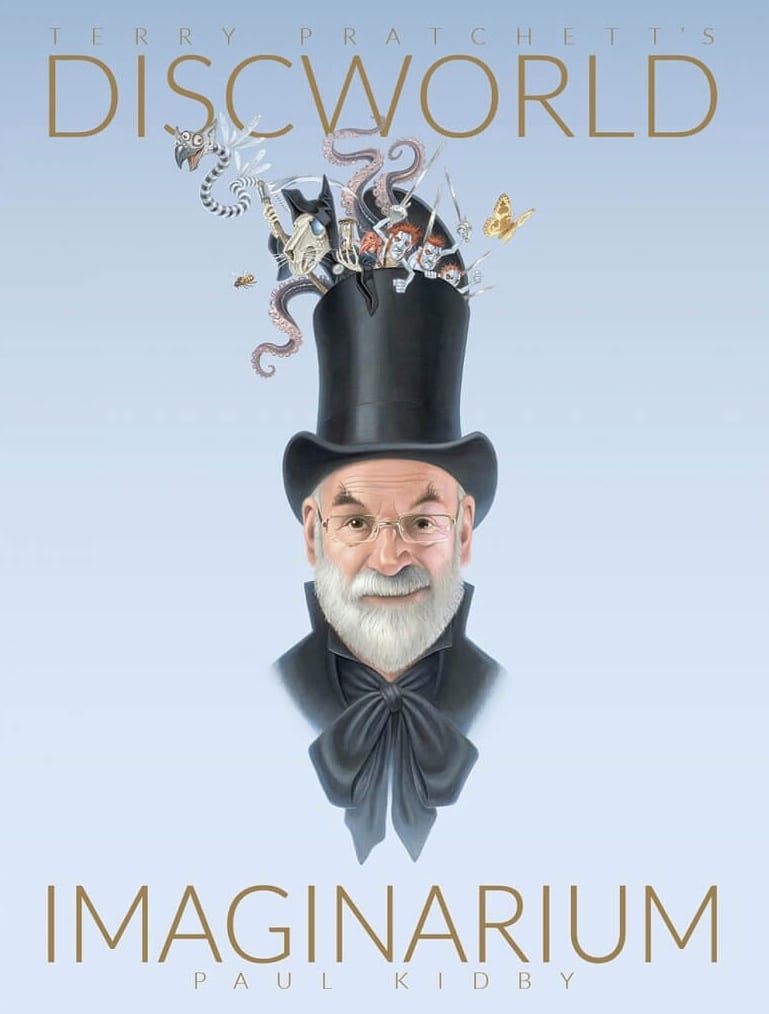
The cover of Discworld Imaginarium by Terry Pratchett’s “artist of choice”, Paul Kidby.

Pratchett’s own sense of humour, a sort of gentle, English, observational thing, stems from this period. “Wodehouse, obviously, but also I tore my way through the Just William books. Richmal Crompton was a very good writer. I think it was from her that I learnt irony. It took me a while to work it out.” Do you think you could define irony, I ask him. “Sort of like iron.” I deserved that, I acknowledge. “When you get hit on the head with it, you know it.”

He also fell in love with RJ Yeatman and WC Sellar, authors of 1066 and All That (“in the Thirties, when the middle classes were getting richer, the two of them really got as much fun out of that as you could. The Thirties were an awful lot of fun. Or at least until the end. Bad ending, the decade, admittedly”) and fell out with his headmaster for “bringing in a copy of Mad magazine. How horrible! And a copy of Private Eye. Seditious.” But it was the now defunct satirical magazine Punch which really formed the comic voice in which he now speaks. “I read my way through all the bound Punches. It was the best way to read history; you got it without granny looking over your shoulder, and it was just astonishing.

“And just about any writer of distinction, anywhere in the English language, worked for Punch. Mark Twain. Jerome K Jerome. And they spoke with the same voice, which opened the door for me – the same kind of slightly satirical, people-are-rather-silly-but-they’re-not-that-bad voice, friendly about humanity, fond of its foibles.” Apart from the books, the other influences of his youth are clear in his own writing – especially the later Ankh-set works, in which he frequently extols the virtues of the poor-but-respectable people living in tiny, tidy terraced houses, and of the self-made men and women. “There used to be a sort of dignity in labour,” he says. “I don’t think there is now.”

He has spoken, often, of how his time on local newspapers made him. He started at 16, in high dudgeon at his headmaster: “On my last day at the school, I left all my stuff behind and phoned up the editor of a local newspaper. He actually used some cliché like, ‘I like the cut of your jib, young man’, or something.” It is the stuff of legend that he saw his first dead body the next day, “work experience really meaning something in those days”, as he put it in his author’s bio in his books.

“Truthfully, without over-egging it, as I often do,” he says, “the library and journalism, those things made me who I am. Journalism makes you think fast. You have to speak to people in all walks of life. Especially local journalism. London journalism can p— in someone’s face and they can’t do anything about it. Try that in local journalism, and someone’s down to complain. Everyone should have one local journalism job in their lives, especially if they’re a nosy parker.” He talks of local journalists in the same way he does his parents, with a sense of quiet heroism. “I interviewed an elderly journalist who’d worked in a small town for a very, very long time. I asked: is it boring? And he said: over there, that’s where a couple pushed their daughter into the attic because she’d had a black baby. And over there, that’s where a man was caught in flagrante delicto with a barnyard fowl. And he’d said to the magistrates, ‘Well, it was my fowl’. Even those small moments, they make you realise the world is not as you thought.”

February 23, 2020

QotD: Go eat bugs, plebs!

Filed under: Environment, Food, Health, Media, Quotations — Tags: , , , , — Nicholas @ 01:00

What is this creepy obsession with the elite telling us to eat bugs? Every few weeks, some mainstream media outlet has one of its gooey writers go off on how delicious and nutritious insects supposedly are, and it’s downright bizarre. The latest piece of pro-pillbug propaganda is from the formerly prestigious Economist, “Why Eating Bugs Is So Popular In Congo,” where the author assures us that “The creepy superfood is rich in protein and magnesium.” Thanks, but I think I’ll get my protein and magnesium in a manner that does not involve gobbling grubs.

What is with these people?

This bug bingeing is a running theme in the mainstream media. The New York Times, taking a break from passively aggressively correcting its garbage takes, asks “Why Aren’t We Eating More Insects?” The answer is, of course, “Because they are insects, you weirdos.”

CNN goes on about “Bugs: The Food That Can Feed, And Maybe Save, The Planet,” as if Brian “Tater” Stelter is going to give up stuffing Cheetos in his talk-hole in exchange for caterpillars.

And National Geographic manages to do the impossible and make us hate the United Nations even more by informing us that the “U.N. Urges Eating Insects,” and offering us “8 Popular Bugs to Try.” Popular with whom?

The Economist is talking about people munching millipedes in Congo, and you have to wonder why we would take Congo’s lead in anything. It’s the Congo – you should carefully examine what the Congo does, then do the opposite. That goes for other strange countries too. Frankly, foreign countries are generally terrible and there is not a lot that other countries have to teach us – I lived on two other continents and this bizarre notion liberal Americans have about other countries being better than us is grossly misplaced. Other countries are mostly terrible.

Exhibit A: They eat bugs.

Do you think the people of Congo are saying, “Beef? Pass. Hand me that plate of maggots!” You don’t eat grasshoppers because you have other options. No one’s first choice is fruit flies.

Kurt Schlicter, “Tell The Nags To Go Pound Sand”, Townhall.com, 2019-11-19.

February 12, 2020

QotD: Experienced political operators after an unexpected paradigm shift

Filed under: Government, Media, Politics, Quotations, USA — Tags: , , , — Nicholas @ 01:00

I think this is causing some confusion, blindness and otherwise inexplicably stupid behavior in people who never seemed stupid before. This is what I call The Years the Masks Fell off.

Look, take a just-now thing: the DNC says that all precincts in Iowa WERE counted. The app recorded every vote, they say. They just need to tally them.

Turns out that’s probably not precisely true.

As a friend noticed, that’s not precisely a lie, that’s just “making sh*t up.”

We’re seeing that a lot from the other side of the aisle suddenly. Unbelievably stupid behavior like the sham wow impeachment.

They keep telling us “Who you gonna believe, me or your lying eyes?” and being shocked and appalled when we choose our lying eyes.

[…]

And then they’re shocked, nay astonished, when these tactics don’t work. While we who are standing outside this look at them and go “Who would think that would work? Some two year old?”

I mean half of the bizarre behavior of our government and its agencies falls under that heading too. “Who could think that would work/wouldn’t be found out/made any sense?”

But the thing you have to understand is that you’re not dealing with stupid people. Not by half. You’re dealing with people who were very competent and comfortable in — for lack of a better term — the previous paradigm of politics, or publishing or whatever.

The more comfortable they were; the easier it was for them, the harder it is to accept that it’s gone and it’s not coming back

For instance, the dems could trust the media would cover for them absolutely and completely, and that their pettiness, idiocy or outright corruption would never be revealed.

They got used to it, they got comfortable. They got to believing it was their natural right. It was just the way things were. They were the good people. Their hearts were pure. No one would ever look into their behavior outside the limelight.

If some psychological tests are correct, they grew to believe they were entitled to corruption and unethical behavior for all the “good” they did, such as Clinton thinking he was entitled to all the women he wanted for “fighting for women’s rights” (Which for men like him always mean abortion, but never mind.)

They can’t adapt. They can’t believe things have changed.

Sarah Hoyt, “How Things Have Always Been”, Libertarian Enterprise, 2020-02-09.

January 22, 2020

Australian tourism, RIP

Filed under: Australia, Environment, Media — Tags: , , , , , , — Nicholas @ 05:00

As we’ve all been inundated with the shocking images of almost the entire inhabited area of the Australian mainland burning, like this one, for example, claimed on social media to be a “satellite image”:

… it’s not surprising that anecdotal evidence of the decline in bookings from foreign tourists implies that there will be few visitors to the burned-out wasteland that used to be a thriving first-world nation. This, on top of the widely reported “death” of the Great Barrier Reef, means the few dozen dazed survivors will be reduced to cannibalism shortly. Or, as Arthur Chrenkoff suggests, we’ve been sold another bill of goods and things are not quite as desolate and post-apocalyptic as all that:

Just like many other people I know, I have been inundated by messages from family and friends overseas, inquiring about my safety, having been terrified by the media reports of what seemed like an environmental armageddon engulfing the entire country. I had to explain time after time that while the fires have been savage and extensive, they have largely burned through relatively sparsely populated areas (if it all, considering the vast extent of our national parks). No significant town has been threatened and destruction and loss of life, while tragic, have been pretty small in proportion to the area affected.

Yet, watching the hysterical and over-sensationalised coverage overseas has convinced many that the very existence of the nation is at stake. And the social media, if anything, has been even worse, with a number of completely misleading maps and photos exaggerating the extent of the affected areas by two-figure factors. As I pointed out, indeed the area the size of the state of Kentucky has been burned out, but unlike most other places on Earth, certainly in the developed world, Australia fits in nearly eighty Kentuckys, most of them pretty empty of human presence and activity.

Media sensationalises at the best of times in a never-ending quest for more eyeballs (“if it bleeds it leads”, or, in this case, “if it’s on fire, we’re on fire”) but the intersection of a large scale natural disaster with the “climate crisis” activism has generated a truly terrifying inferno of human passions where news becomes propaganda and the narrative trumps the objectivity. A significant proportion of the population — and the majority in the media — want to see the fires as Gaia’s wrath, with the disaster turning into green porn to terrify, titillate and agitate. Tourism has now become one of the casualties of this rhetorical excess, a collateral damage to the pursuit of a political agenda. This crisis is very much man-made and the economic pain unnecessarily inflicted on a whole industry because you wanted to make as terrible a point as possible will hang around your necks like a charred albatross, dear green activists on the streets and those masquerading as journalists.

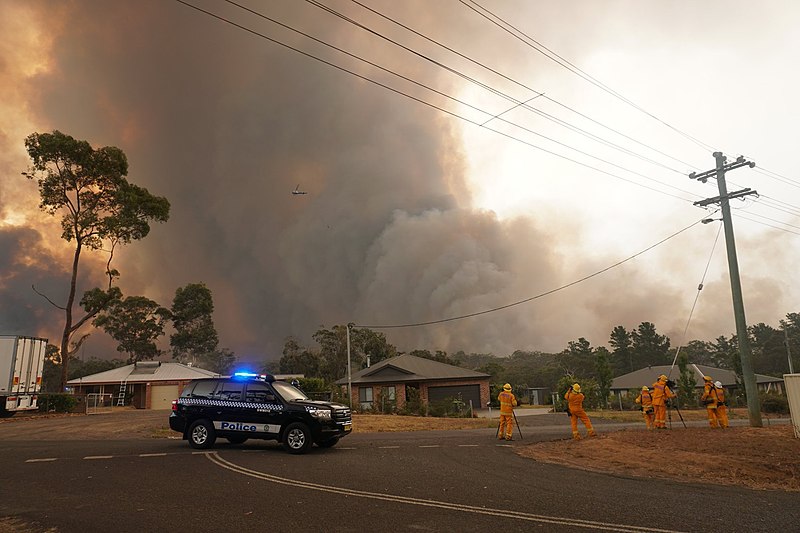
The Green Wattle Creek bushfire moves towards the Southern Highlands township of Yanderra as police evacuate residents from Yanderra Road, 21 December, 2019.
Photo by Helitak430 via Wikimedia Commons

January 10, 2020

QotD: Deciding what is “newsworthy”

Filed under: History, India, Media, Middle East, Quotations — Tags: , , , , — Nicholas @ 01:00

[…] the ripples of battle in their formal sense are guided by the presence of historians, and that means originally Westerners, and more recently in large part Europeans and Americans. And such distortions do not always play out in bias toward Westerners, especially in the present age. In April 2002 the Israeli Defence Forces entered the West Bank community of Jenin to hunt out suspected suicide-murderers, whose co-members had blown up hundreds of Israeli civilians over the prior year. Although fewer than sixty Palestinians were killed in Jenin — the great majority of them combatants — the world media seized upon the street fighting, dubbing it “Jeningrad” as if they were somehow the moral equivalent of one million Germans and Russians lost at Stalingrad. Yet just days after the Israeli withdrawal from Jenin, Pakistan squared off against India. The stakes were surely far higher: One-fifth of the world’s population was involved. Both sides were nuclear powers and issued threats to use their arsenals. In the prior year alone nearly four times more Indians and Pakistanis were killed than Palestinians and Israelis. By any calculation of numbers, the specter of the dead, the geopolitical consequences, or the long-term environmental health of the planet, the world should know all the major cities in Kashmir rather than a few street names in Jenin. And if the world sought to chronicle destruction and death in an Islamic city, then by any fair measure it should have turned its attention to Grozny, where an entire society of Muslim Chechnyans was quite literally obliterated by the Russian army.

The idiosyncracies of historical remembrance of battle do not hinge alone on the presence of a Socrates or Teddy Roosevelt in the ranks. Sometimes there are wild cards of culture and politics as well. In this case and at this time, the fact that Israelis fit the stereotype of affluent and proud Westerners abroad while the Palestinians were constructed as impoverished and oppressed colonial subjects brought to the equation the sympathies of influential Americans and Europeans in the media, universities, and government — the prominent and sometimes worrisome elites who determined to send their reporters, scholars, and diplomats to Jenin rather than to Islamabad or Grozny.

Victor Davis Hanson, Ripples of Battle, 2004.

December 31, 2019

QotD: Canadian journalism

Filed under: Cancon, Media, Politics — Tags: , , , , , , — Nicholas @ 01:00

… a Canadian Journalist’s main job is to smooth over any rough spots and shush away worries as the Liberal government plunders the public purse to pay for technocratic solutions to problems we didn’t know we had while adopting a laissez-faire attitude to the problems we do have. If the Opposition has a point, it falls to a Canadian Journalist to correct the record and say that, well, actually, no they don’t.

Josh Lieblein, “Hack or Flack: Aaron Wherry Edition”, Raving Canuck, 2017-11-29.

« Newer PostsOlder Posts »

Powered by WordPress