
… (related: Scott examined some of the same data about Holocaust survival rates as Eichmann In Jerusalem, but made them make a lot more sense: the greater the legibility of the state, the worse for the Jews. One reason Jewish survival in the Netherlands was so low was because the Netherlands had a very accurate census of how many Jews there were and where they lived; sometimes officials saved Jews by literally burning census records).
Centralized government projects promoting legibility have always been a two-steps-forward, one-step back sort of thing. The government very gradually expands its reach near the capital where its power is strongest, to peasants whom it knows will try to thwart it as soon as its back is turned, and then if its decrees survive it pushes outward toward the hinterlands.
Scott describes the spread of surnames. Peasants didn’t like permanent surnames. Their own system was quite reasonable for them: John the baker was John Baker, John the blacksmith was John Smith, John who lived under the hill was John Underhill, John who was really short was John Short. The same person might be John Smith and John Underhill in different contexts, where his status as a blacksmith or place of origin was more important.
But the government insisted on giving everyone a single permanent name, unique for the village, and tracking who was in the same family as whom. Resistance was intense:
What evidence we have suggests that second names of any kind became rare as distance from the state’s fiscal reach increased. Whereas one-third of the housholds in Florence declared a second name, the proportion dropped to one-fifth for secondary towns and to one-tenth in the countryside. It was not until the seventeenth century that family names crystallized in the most remote and poorest areas of Tuscany – the areas that would have had the least contact with officialdom. […]
State naming practices, like state mapping practices, were inevitably associated with taxes (labor, military service, grain, revenue) and hence aroused popular resistance. The great English peasant rising of 1381 (often called the Wat Tyler Rebellion) is attributed to an unprecedented decade of registration and assessments of poll taxes. For English as well as for Tuscan peasants, a census of all adult males could not but appear ominous, if not ruinous.
Scott Alexander, “Book Review: Seeing Like a State”, Slate Star Codex, 2017-03-16.
March 10, 2019
QotD: Surnames and taxes
November 29, 2018
England: South Sea Bubble – It Was Walpole – Extra History – #5
Extra Credits
Published on 25 Apr 2015Support us on Patreon! http://bit.ly/EHPatreon
____________Robert Walpole’s attempts to use the South Sea Company scandal to enhance his own ambitions are threatened by the appearance of Robert Knight, a former South Sea employee whose records of corporate bribery implicate Walpole and his friends in Parliament. But faced with threats of retribution if he ever shares these records, Knight flees the country rather than face a public inquiry. Although he gets caught and sent to prison in Antwerp, Walpole deftly engineers his release and escape. With Knight finally gone, Walpole teams up with John Blunt to pin the blame for the South Sea stock bubble on his political opponents, conveniently clearing the way for himself to become essentially the first Prime Minister of England. He also makes sure that all of his own supporters get off easy (if not scot free) for their involvement, and even Blunt walks away from the South Sea Bubble with more money than he started with.
October 27, 2018
HMS Queen Elizabeth to depend on Shock! Horror! Dutch escort!
At the Thin Pinstriped Line, Sir Humphrey explains to “Disgusted of Tunbridge Wells” and all the other would-be Admirals of the Fleet why having a non-RN escort for Britain’s newest aircraft carrier is hardly a bad thing:
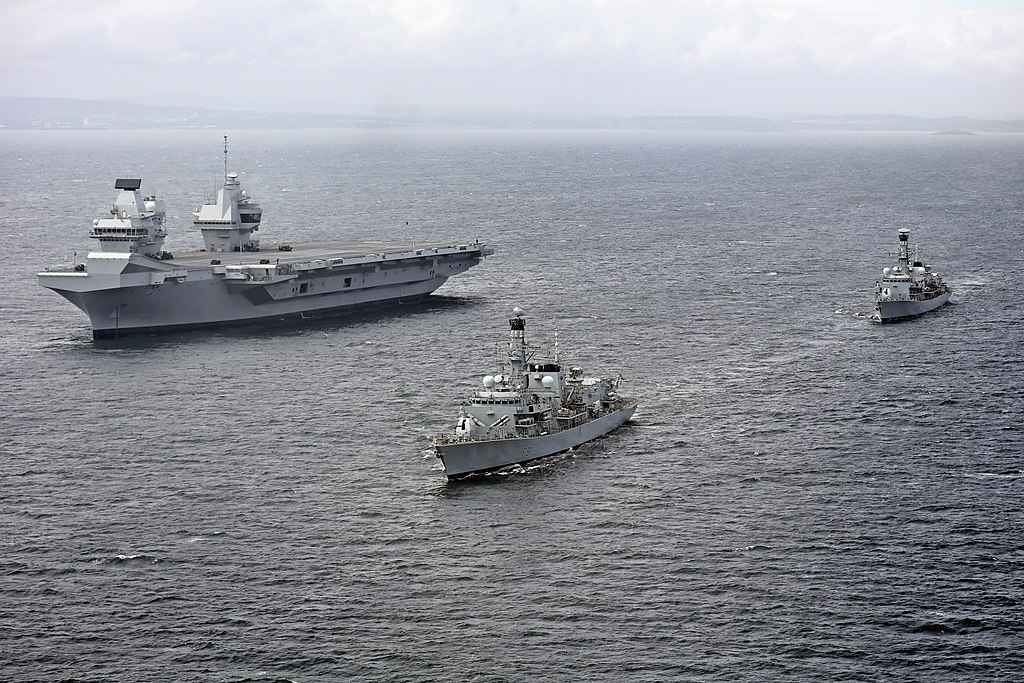
Aerial view of HMS Queen Elizabeth with Type 23 frigates HMS Iron Duke (centre) and HMS Sutherland (right) in June 2017 off the coast of Scotland.
Photo by MOD via Wikimedia Commons.
The United Kingdom has few allies closer than the Netherlands. Both nations are modern, outward looking and instinctively maritime in their view of the world. Long standing NATO partners and with significant experience of working together across the globe, the Netherlands Armed Forces are highly respected as being capable, well equipped and staffed with first rate personnel.
The relationship between the RN and the Royal Netherlands Navy is extremely close, particularly between the Marine Corps and the Submarine Services. It is therefore extremely pleasing to hear that the Netherlands will be deploying a warship to form part of the inaugural ‘Carrier Strike Group’ (CSG) deployments for HMS Queen Elizabeth in 2021 HERE. This is a significant announcement and it has several ramifications that are good news for the Royal Navy.
[…]
There seems to be an exceptionally British trait of moaning at good news. Some people felt that it wasn’t good enough for the RN to be ‘reliant’ on a foreign warship operating as part of the CSG, and that the UK should be going it alone. What utter rot.
It does not mean, despite what some naysayers were desperate to bleat about on social media without any evidence to the contrary, that defence cuts mean the UK is reliant on the Dutch to protect the carrier. The RN has spent a lot of time working out what escorts are needed and ensuring they will be available when necessary as part of the CSG to properly protect the carrier. Any foreign participation is a nice bonus capability to have, not a tacit hint that the RN is short of ships.
The reality of future operations is that the UK is going to operate as part of an international coalition with our friends and allies. Despite the fantasies of some, desperate to see a huge purely British task force sailing around the world looking for a fight and a free trade deal, the fact is that any future military operation is going to be international by design.
Working with allies is critically important but isn’t something you can just do at the drop of a hat. One of the reasons why NATO works so well is because it has spent 70 years investing in common processes, tactics and procedures and exercising them regularly to ensure everyone can work together coherently.
Integrating a Dutch vessel now is vital because it helps build and cement an understanding at operational level of how to work with each other, to learn the capabilities of each other’s ships and how to work them to best effect together. It can also spot unintended issues or problems and help work out how to fix them quickly. This takes time to do, so it is likely that any Dutch vessel assigned in 2021 will have spent a considerable period working up in advance before beginning the deployment proper.
For those who complain that the Royal Navy hasn’t got enough ships to escort the carrier, it is worth reflecting that the Netherlands have a total of 6 frigates. Assuming the normal serviceability rates for escorts apply, then two are likely to be in refit and another in maintenance or training. This leaves just three active vessels at any one time – so in reality, the Netherlands commitment to support the Carrier Strike Group represents them committing a third of their available escort force for a significant amount of time.
October 25, 2018
The History of Australia
History With Hilbert
Published on 23 Aug 2017The entire history of Australia from the earliest humans until somewhere after World War II where I lost interest.
July 5, 2018
Tales of Cromwell tanks
Lindybeige
Published on 6 Apr 2016War memoirs are filled with amazing anecdotes. Here I relate two, and ramble a bit about British WW2 tank units.
Support me on Patreon: https://www.patreon.com/LindybeigeI am likely to return to this topic – anecdotes from war memoirs. It is a rich vein of stories. These come from Troop Leader by Bill Bellamy, which describes the author’s time commanding a trio of fast Cromwell tanks in World War Two, when fighting the Germans in Holland.
Lindybeige: a channel of archaeology, ancient and medieval warfare, rants, swing dance, travelogues, evolution, and whatever else occurs to me to make.
May 23, 2018
Why The Netherlands Isn’t Under Water
Real Engineering
Published on 31 Oct 2017
April 24, 2018
“Brilliant” plans to win WWII: How France planned to win the war?
Eastory
Published on 12 May 2017In these series we will examine several “brilliant” plans to win World War II and see why they failed. This video shows how France planned to win the upcoming confrontation with Germany and how it all went wrong.
April 22, 2018
Hunting – Dreyfuss Affair – Equipment Modifications I OUT OF THE TRENCHES
The Great War
Published on 21 Apr 2018Chair of Wisdom Time!
March 16, 2018
Allied Unified Command On The Horizon I THE GREAT WAR Week 190
The Great War
Published on 15 Mar 2018While Germany is occupying a territory from the Baltics to the Black Sea and planning its huge spring offensive, the Allies are still trying to get behind the idea of a unified command.
February 28, 2018
Great Blunders of WWII: A Bridge Too Far 6
Anthony Coleman
Published on 4 Nov 2016From the History Channel DVD series “Great Blunders of WWII”
February 13, 2018
Tulip mania … wasn’t
Tim Harford on bubbles in general and the great seventeenth-century Tulip mania in the Netherlands in particular:
It seems all so much easier with hindsight: looking back, we can all enjoy a laugh at the Extraordinary Popular Delusions and the Madness of Crowds, to borrow the title of Charles Mackay’s famous 1841 book, which chuckles at the South Sea bubble and tulip mania. Yet even with hindsight things are not always clear. For example, I first became aware of the incipient dotcom bubble in the late 1990s, when a senior colleague told me that the upstart online bookseller Amazon.com was valued at more than every bookseller on the planet. A clearer instance of mania could scarcely be imagined.
But Amazon is worth much more today than at the height of the bubble, and comparing it with any number of booksellers now seems quaint. The dotcom bubble was mad and my colleague correctly diagnosed the lunacy, but he should still have bought and held Amazon stock.
Tales of the great tulip mania in 17th-century Holland seem clearer — most notoriously, the Semper Augustus bulb that sold for the price of an Amsterdam mansion. “The population, even to its lowest dregs, embarked in the tulip trade,” sneered Mackay more than 200 years later.
But the tale grows murkier still. The economist Peter Garber, author of “Famous First Bubbles”, points out that a rare tulip bulb could serve as the breeding stock for generations of valuable flowers; as its descendants became numerous, one would expect the price of individual bulbs to fall.
Some of the most spectacular prices seem to have been empty tavern wagers by almost-penniless braggarts, ignored by serious traders but much noticed by moralists. The idea that Holland was economically convulsed is hard to support: the historian Anne Goldgar, author of Tulipmania (US) (UK), has been unable to find anyone who actually went bankrupt as a result.
It is easy to laugh at the follies of the past, especially if they have been exaggerated for the purposes of sermonising or for comic effect. Charles Mackay copied and exaggerated the juiciest reports he could find in order to get his point across.

Update, 15 February: For more detail on the lack-of-bubble in Tulip Mania, you might want to read Anne Goldgar’s post at The Conversation.
Update the second, 30 March: At the Foundation for Economic Education, Douglas French takes issue with Goldgar’s interpretation of Tulip Mania.
Sure, rare bulbs were hard to reproduce and in the greatest demand. However, this does not explain the price history of the common Witte Croonen bulb, which rose in price twenty-six times in January 1637, only to fall to one-twentieth of its peak price a week later.
Peter Garber, tulip mania historian, who, like Goldgar, doesn’t believe tulip mania was a bubble, admitted the “increase and collapse of the relative price of common bulbs is the remarkable feature of this phase of the speculation.” Garber wrote that he “would be hard-pressed to find a market fundamental explanation for these relative price movements.”
Goldgar claims in her latest article that she found no bankruptcies or suicides associated with the bust and that the Dutch economy was not affected by the crash. However, the data I discovered while writing my thesis for Murray Rothbard that is the book Early Speculative Bubbles and Increases in the Supply of Money, was that there was a doubling of bankruptcies in Amsterdam from 1635 to 1637.
Also, Ms. Goldgar must have forgotten the numerous lawsuits she mentioned in her book that were spawned by busted tulip deals. Some of the litigation lasted for years after the bulb price crash in February 1637.
[…]
Ms. Goldgar’s research indicates that only a few hundred people traded tulip bulbs. However, she writes that a few bulbs did sell for 5,000 guilders (the price of a house) and “only 37 people who spent more than 300 guilders on bulbs, around the yearly wage of a master craftsman,” as if this makes her case that this wasn’t a financial bubble.
Readers should note Ms. Goldgar is not interested in prices or market fundamentals. Her research interests are “17th- and 18th-century European social and cultural history; The Netherlands and Francophone culture; Print culture and the culture of collecting; The interaction of society, art, and science.”
In my review of Goldgar’s book in 2007 for History of Economic Ideas, I wrote,
By chronicling the extensive and intertwined network of the real buyers and sellers in the tulip trade, Goldgar puts a human face on tulipmania like no other author has done.”
However, the economics profession will always define tulip mania as Guillermo Calvo does in The New Palgrave: A Dictionary of Economics: “situations in which some prices behave in a way that appears not to be fully explainable by economic ‘fundamentals.'”
Maybe no chimney sweeps were trading in bulbs, but the massive price movements of simple tulip bulbs don’t lie.
January 31, 2018
“Bitcoin is, of course, a mania – a delusion of the sort that human societies are prone to”
Tim Worstall looks at some historical manias and explains how even the maddest of them can yield long-term economic benefits (to society as a whole, if not to individual maniacs):
The UK’s railway mania, the tulip bubble, the dot com boom and other collective economic madness – such as bitcoin – might lose people a lot of money, but they often lay down important foundations
Bitcoin is, of course, a mania – a delusion of the sort that human societies are prone to. This is fighting talk from someone who declared in 2011 that bitcoin was all over. Being wrong is not interesting – it is rare things which are interesting, not common ones – but the psychology and economics here are important.
The classic text on this topic is Charles McKay’s Extraordinary popular delusions and the madness of crowds. Human societies are prone to manias which seem to defy any sense or reasonableness. Certainly markets can be so overcome, although the witch burnings show that it’s not purely an economic phenomenon.
The South Sea Bubble, Tulip mania, railway shares, the dotcom boom and now bitcoin are all part of that same psychological failing of not recognising that prices can and will fall as well as rise. That is the classical interpretation of the McKay book and observation, but modern studies take a more nuanced view.
South Sea and the Mississippi Company bubble were simply speculative frenzies, but the tulip story – while appearing very similar – can be read another way.
It is still true, for example, that a few sheds near Schipol, just outside Amsterdam, are the centre of the world’s trade in cut flowers – the result of that historical episode where a single tulip bulb became worth more than a year’s wages.
We can, and some do, take tourist trips to see the fields of those very tulips today. Modern researchers point out that the tulip was near unknown in Europe, the first examples only just having arrived from Turkey.
The art of cross-pollinating tulips to gain desirable characteristics was only just becoming generally known, and Europe was reaching a stage of wealth where the purely ornamental was becoming valuable.
Yes, the speculation in prices was ludicrous – although the weird stuff was in futures and options markets, not the physical trade, and the absurd prices never actually happened – but the end result of the frenzy was still that the tulip and flower market became and is centred in The Netherlands.
October 9, 2017
The Centuries-Old Debt That’s Still Paying Interest
Tom Scott
Published on 25 Sep 2017In the archives of Yale University, there’s a 367-year-old bond from the water authority of Lekdijk Bovendams, in the Netherlands. And it’s still paying interest.
Thanks to:
Prof. Geert Rouwenhorst for his time and explanation
All the team at the Beinecke Rare Book and Manuscript Library
Michelle Martin (@mrsmmartin) for editing the interview
and Leendert van Egmond for telling me about the bond!
September 25, 2017
QotD: IKEA’s shady history
IKEA itself serves as a fitting symbol of the middle-class masquerade. The company’s well-managed brand obscures the fact that its founder, Ingvar Kamprad, at the time that he founded the store in 1943, was a member of Sweden’s pro-Nazi fascist party, in which he continued to be active at least until 1948 and which he continued to praise for decades after; or that the company used forced prison labor in East Germany until the fall of the Berlin Wall. It is fitting that IKEA’s current worth is unknown, since it is technically owned by a phony-charity shell company incorporated in the Netherlands, enabling Kamprad to evade Swedish taxes. This is not to single out IKEA for particular scorn: one could write an equally lurid laundry list about almost any large corporation; a fascist undertone usually lurks beneath the surface of mass-production and mass-marketing. Consider the fact that Apple uses what is slave labor in all but name in China yet none of their customers seem to care.
Samuel Biagetti, “The IKEA Humans: The Social Base of Contemporary Liberalism”, Jacobite, 2017-09-13.
April 7, 2017
Some people build boats as a hobby … this guy built a Fokker Dreidecker I
At The Register, the story of Dr Peter Brueggemann’s quest to build a close replica of the kind of WW1 aircraft made famous by the Red Baron:
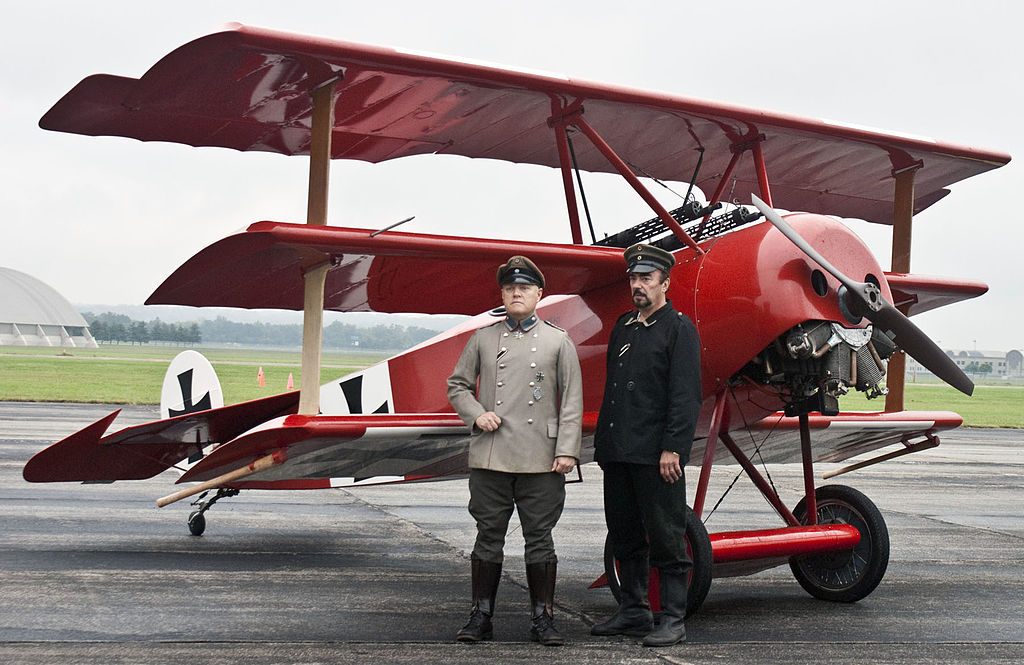
World War I Dawn Patrol Rendezvous DAYTON, Ohio — Reenactors stand in front of a Fokker Dr. I during the World War I Dawn Patrol Rendezvous at the National Museum of the U.S. Air Force, 8 August 2009. (U.S. Air Force photo, via Wikimedia)
A German orthopaedic surgeon in Norfolk has spent £70,000 building himself a flyable full-size replica of the Red Baron’s Fokker Triplane.
Dr Peter Brueggemann built the First World War-era aircraft by hand – even though when he started he couldn’t fly, as ITV News reported.
The bright red Fokker Dreidecker I (German for “three-decker”, or triplane) was built to a set of technical drawings prepared by an American aviation fanatic in the 1970s. No original Dr.Is exist, though a number of replicas have been put together during the 20th century.
Dr Brueggemann even acquired the title of baron from the Principality of Sealand, ready for when his Fokker makes its planned first flight this summer.
He told the telly station: “Being a surgeon has certainly helped and I have used surgical equipment like needles and forceps when stitching materials to the ribs of the plane.”
[…]
Fokker copied the original Dr.I design from British company Sopwith. During the early stages of air fighting in WWI, rate of climb was deemed vitally important. As aeronautical science was still in its infancy – aircraft were built from plywood and canvas, while the relatively primitive rotary engines of the day were only capable of around 110hp – the easiest way of increasing the amount of lift available was to add more wings.
First seeing action in early 1917, the Sopwith Triplane was an instant success. However, a captured example shown to Anthony Fokker, prompting German development of their own version. The first pre-production Dr.I was issued to a frontline unit in August 1917 and proved an instant hit. German fighter squadron commander Manfred von Richthofen recommended the Dr.1 be issued to as many frontline units as possible.


