
Quotulatiousness

December 7, 2012

Revisiting Pearl Harbour

Filed under: History, Japan, Military, Pacific, USA, WW2 — Tags: , , , , — Nicholas @ 10:38

In a History Today article from 2001, Dan van der Vat looks at the actual history rather than the film treatments of the Japanese attack on Pearl Harbour in 1941:

To recount what actually happened blow by blow, as in the exhaustive Tora, Tora, Tora!, is one thing; to use the event as the backdrop to an avowed fiction, as in From Here to Eternity, is equally legitimate. But to play fast and loose with history by presenting fiction as fact is at best confusing and at worse dangerous — especially when the event is still within living memory, affects current policy and needs to be understood by the young if the lessons of history are to be truly learned.

On Roosevelt’s ‘date that will live in infamy’, six Japanese carriers launched 350 aircraft to immobilise the US battlefleet at the very moment talks were due to resume in Washington. The Americans knew Japan’s propensity for surprise attack (Korea in 1895, the Russians’ Chinese enclave at Port Arthur in 1904, Manchuria in 1931, China in 1937). They were forewarned by their Tokyo embassy of the inclusion of Pearl Harbor in Japan’s war-plans, and they intercepted signals exposing its intentions. Yet the Japanese achieved strategic surprise. But their strategic blunder in not bombing repair facilities and fuel dumps spared the US Navy the crippling embarrassment of having to withdraw 2,200 miles eastward to the continental West Coast.

[. . .]

Initial American reaction to Pearl Harbor included not only rage at Japanese duplicity but also incredulity based on racism. Many witnesses insisted they had seen swastikas on the bombers; surely the Germans must have been behind such a sophisticated stroke. Inability to cope with the reality of America’s most spectacular lost battle led to a flourishing conspiracy industry which sprang up within hours of the bombing.

Even today, extreme revisionists claim that British frogmen came in on the midget Japanese submarines that almost gave the game away by trying to attack before the bombers. That at least one batch of intelligence intercepts from 1941 has not yet been released is taken as proof that they must conceal the ‘smoking gun’ the revisionists so stubbornly seek to this day.

Update: MHQ has the story of the most effective Japanese spy who reported on the comings and goings of US Navy ships at Pearl Harbour:

At 1:20 a.m. on December 7, 1941, on the darkened bridge of the Japanese aircraft carrier Akagi, Vice Admiral Chui­chi Nagumo was handed the following message: “Vessels moored in harbor: 9 battleships; 3 class B cruisers; 3 seaplane tenders, 17 destroyers. Entering harbor are 4 class B cruisers; 3 destroyers. All aircraft carriers and heavy cruisers have departed harbor….No indication of any changes in U.S. Fleet or anything unusual.”

[. . .]

Astonishingly, such critical intelligence was not the work of a brilliant Japanese superspy who had worked his way into the heart of the fleet’s installation. Rather, Takeo Yoshikawa, a naval officer attached to the consulate and known to the Americans, had simply watched the comings and goings of the fleet from afar, with no more access than a tourist. He made little effort to cloak his mission, and almost certainly would have been uncovered if American intelligence had been more on the ball, or if America’s lawmakers had recognized the mortal threat Japan presented. Instead, he raised little suspicion, and his observations helped the Japanese piece together an extraordinarily detailed attack plan, ensuring its success.
December 4, 2012

UAVs move closer to the front rank of US Navy assets

Filed under: Military, Technology, USA — Tags: , , — Nicholas @ 09:50

Strategy Page on the progress of the X-47B UAV:

The U.S. Navy X-47B UCAV (unmanned combat air vehicle) made its first catapult launch on November 29th, 22 months after its first flight. This launch was not from a carrier, but an airfield built to the same size as a carrier deck and equipped with a catapult. This first launch was to confirm that the X-47B could handle the stress of a catapult launch. Another X-47B has been loaded onto the deck of a carrier, to check out the ability of the UCAV to move around the deck. If all goes well, the first carrier launch of an X-47B will take place next year, along with carrier landings. Last year the navy tested its UCAV landing software, using a manned F-18 for the test, landing it on a carrier completely under software control.

It was four years ago that the navy rolled out the first X-47B, its first combat UAV. This compact aircraft has a wingspan of 20 meters (62 feet, and the outer 25 percent folds up to save space on the carrier). It carries a two ton payload and will be able to stay in the air for twelve hours. The U.S. is far ahead of other nations in UCAV development, and this is energizing activity in Russia, Europe and China to develop similar aircraft. It’s generally recognized that robotic combat aircraft are the future, even though many of the aviation commanders (all of them pilots) wish it were otherwise. Whoever gets there first (a UCAV that really works) will force everyone else to catch up, or end up the loser in their next war with someone equipped with UCAVs.

The U.S. Navy has done the math and realized that they need UCAVS on their carriers as soon as possible. The current plan is to get these aircraft into service six years from now. But there is an effort to get the unmanned carrier aircraft into service sooner than that. The math problem that triggered all this is the realization that American carriers had to get within 800 kilometers of their target before launching bomber aircraft. Potential enemies increasingly have aircraft and missiles with range greater than 800 kilometers. The navy already has a solution in development; the X-47B UCAS has a range of 2,500 kilometers

December 2, 2012

USS Enterprise, the first nuclear-powered aircraft carrier, decommissioned

Filed under: Military, USA — Tags: , , — Nicholas @ 12:02

The USS Enterprise was taken out of service yesterday after a long career:

The world’s first nuclear-powered aircraft carrier was retired from active service on Saturday, temporarily reducing the number of carriers in the U.S. fleet to 10 until 2015.

The USS Enterprise ended its notable 51-year career during a ceremony at its home port at Naval Station Norfolk, where thousands of former crew members, shipbuilders and their families lined a pier to bid farewell to one of the most decorated ships in the Navy.

“It’ll be a special memory. I’ve missed the Enterprise since every day I walked off of it,” said Kirk McDonnell, a former interior communications electrician aboard the ship from 1983 to 1987 who now lives in Highmore, S.D.

H/T to Doug Mataconis for the link. He also reported that the Secretary of the Navy announced that the third Ford class carrier will be called Enterprise.

November 29, 2012

The F-35 program in the cross-hairs

Filed under: Military, USA — Tags: , , , , , — Nicholas @ 09:10

I thought it had been a while since the last “bash the F-35” round of articles came past. Here’s Christopher Drew talking about the parlous state of the F-35 in light of the US government’s crushing budget woes:

The F-35 was conceived as the Pentagon’s silver bullet in the sky — a state-of-the art aircraft that could be adapted to three branches of the military, with advances that would easily overcome the defenses of most foes. The radar-evading jets would not only dodge sophisticated antiaircraft missiles, but they would also give pilots a better picture of enemy threats while enabling allies, who want the planes, too, to fight more closely with American forces.

But the ambitious aircraft instead illustrates how the Pentagon can let huge and complex programs veer out of control and then have a hard time reining them in. The program nearly doubled in cost as Lockheed and the military’s own bureaucracy failed to deliver on the most basic promise of a three-in-one jet that would save taxpayers money and be served up speedily.

[. . .]

“The plane is unaffordable,” said Winslow T. Wheeler, an analyst at the Project on Government Oversight, a nonprofit group in Washington.

Todd Harrison, an analyst at the Center for Strategic and Budgetary Assessments, a research group in Washington, said Pentagon officials had little choice but to push ahead, especially after already spending $65 billion on the fighter. “It is simultaneously too big to fail and too big to succeed,” he said. “The bottom line here is that they’ve crammed too much into the program. They were asking one fighter to do three different jobs, and they basically ended up with three different fighters.”

November 28, 2012

Chinese aviators start carrier landing practice

Filed under: China, Military, Technology — Tags: , , , — Nicholas @ 09:52

Strategy Page updates us on the development of China’s aircraft carrier capabilities:

A Chinese aviator, flying a Chinese made J-15 fighter, made the first landing and takeoff from a Chinese aircraft carrier just two months after the ship was commissioned (on September 25th). The first Chinese aircraft carrier, the Liaoning is a 65,000 ton, 305 meter (999 feet) long ship that had spent over a year on sea trials. During that time Liaoning was at sea for about four months. This was all in preparation for flight operations. Last year China confirmed that the Liaoning will primarily be a training carrier. The Chinese apparently plan to station up to 24 jet fighters and 26 helicopters on the Liaoning and use the ship to train pilots and other specialists for four or more additional carriers.

Five years ago the Chinese Navy Air Force began training carrier fighter pilots (or “aviators” as they are known in the navy). In the past Chinese navy fighter pilots went to Chinese Air Force fighter training schools, and then transferred to navy flight training schools to learn how to perform their specialized (over open water) missions. Now, operating from carriers, and performing landings and take-offs at sea, has been added to the navy fighter pilot curriculum. The first class of carrier aviators has finished a four year training course at the Dalian Naval Academy. This included learning how to operate off a carrier, using a carrier deck mock-up on land. Landing on a moving ship at sea is another matter. The Russians warned China that it may take them a decade or more to develop the knowledge and skills needed to efficiently run an aircraft carrier. The Chinese are game and are slogging forward. The first landing and takeoff was apparently carried out in calm seas. It is a lot more difficult in rough weather (when the carrier is moving up and down and sideways a lot) and at night. The latter, called “night traps” is considered the most difficult task any aviator can carry out, especially in rough weather.

They also point out that the US Navy’s experiments with naval UAVs continue and are putting technological pressure on both Russia and China to do the same:

Over the last few years, the U.S. Department of Defense decided that the air force and navy be allowed to develop combat UAVs to suit their particular needs. The X-45 was meant mainly for those really dangerous bombing and SEAD missions. But the Pentagon finally got hip to the fact that the UCAV developers were coming up with an aircraft that could replace all current fighter-bombers. This was partly because of the success of the X-45 in rapidly reaching its development goals, and the real-world success of the Predator (in finding, and attacking, targets) and Global Hawk (in finding stuff after flying half way around the world by itself.)

The U.S. Navy expects UAVs to replace most manned aircraft on carriers and the Chinese are aware of that. So the age of manned aircraft operating from Chinese carriers may be a short one. Chinese engineers are well aware of automatic pilot software and how it works. Now they will have feedback from Chinese carrier pilots and be able to do what the Americans have done.

The usual caveats about UAVs in combat should be noted.

The slow erosion of the US Navy’s carrier capability

Filed under: Military, USA — Tags: , , — Nicholas @ 09:07

At the Thin Pinstriped Line, Sir Humphrey looks at the US Navy’s carriers and the tasks they are being called on to accomplish:

On paper from next week the USN will operate 10 aircraft carriers, all NIMITZ class, after the USS ENTERPRISE is decommissioned. In reality those 10 vessels are going to be thinly stretched across the globe. Right now, of the 10 hulls, Nimitz is undergoing repairs, three are forward deployed (two are in the Gulf, one is in Japan) and another is available for tasking in the US. One (Abraham Lincoln) is available, but is about to enter deep refit for refuelling, while two more are in deep refit or being refuelled, with a further two in minor refit. As of today, the US Navy has just three operational deployed aircraft carriers at sea, with a fourth available in the US if required, and this is unlikely to change before summer 2013. (A good source of information can be found here — http://gonavy.jp/CVLocation.html)

The worry is that these sorts of availability problems will continue to grow as the class gets older. Make no mistake, these are some of the most complex and capable warships on the planet, but they are also getting old. Three of the hulls have now been commissioned for over thirty years, and another two for over twenty years. Although designed for an optimised 50 year lifespan, it is likely that as they age, maintenance is going to be increasingly difficult and availability will suffer.

Although a replacement class is now under construction, only one has been ordered so far, and the deep budget cuts likely to hit the DOD over the next few years means that it is by no means certain that further orders can be guaranteed in time to generate replacement hulls on time. This is a grim situation and it’s likely to get worse before it gets better.

[. . .]

Despite many years, and millions of dollars expenditure, the USN has not yet introduced a wholly new ship class since the DDG51s entered service back in the late 1980s. Although a couple of small ‘Littoral Combat Ships’ have entered service, the programme is delayed and it feels as if it is unlikely to ever yield large scale unit production. The USN surface fleet is getting a lot older though, with the Ticonderoga Cruisers, the older Arleigh Burkes and the residual Oliver Hazard Perry frigates all getting into their late teens through to late twenties. These ships have been worked hard for years, and yet no replacement is currently in site and likely to enter service within the next 5-6 years. The US escort fleet is increasingly reliant on the DDG51, which looks like it will remain in serial production for at least another twenty years. Of the replacement frigates and cruiser programmes, no signs of real progress seem to be occurring. While this situation drags on, funding is going to be needed soon for the next pair of CVNs to ensure serial production of the Ford class continues. So, the USN has a major problem in managing an ever more elderly fleet with ever fewer ships likely to be active. As spares budgets are cut, it will become harder to keep vessels at sea, while procurement of replacements seems ever more delayed.

Earlier this year, I linked to another of Sir Humphrey’s posts, talking about the US Navy’s “East of Suez” moment.

November 25, 2012

21st century navies to watch: China and India

Filed under: China, India, Military, Pacific — Tags: , , , , , — Nicholas @ 12:07

The Economist provides some background on a growing naval rivalry between the two biggest powers in Asia:

Samudra Manthan is the title of a new book on this topic by C. Raja Mohan, an Indian writer on strategic affairs, for whom the myth is a metaphor for the two countries’ competition at sea. This contest remains far more tentative and low-key than the 50-year stand-off over their disputed Himalayan border, where China humiliated India in a brief, bloody war in 1962. But the book raises alarming questions about the risks of future maritime confrontation.

[. . .]

China’s naval plans receive more attention. By 2020 its navy is expected to have 73 “principal combatants” (big warships) and 78 submarines, 12 of them nuclear-powered. Last year its first aircraft-carrier, bought from Ukraine, began sea trials; indigenous carriers are under construction. Proving it can now operate far from its own shores, China’s navy has joined anti-piracy operations in the Gulf of Aden. Of course this evolution is not aimed at India, so much as at building a force commensurate with China’s new economic might, securing its sea lines of communication and, eventually perhaps, challenging American dominance in the western Pacific, with a view to enforcing China’s view of its national sovereignty in Taiwan and elsewhere.

Indian strategists, however, tend towards paranoia where China is concerned. China’s close strategic relations with India’s neighbours, notably Pakistan, have given rise to the perception that China is intent on throttling India with a “string of pearls” — naval facilities around the Indian Ocean. These include ports China has built at Gwadar in Pakistan; at Hambantota in Sri Lanka; at Kyaukphyu in Myanmar; and at Chittagong in Bangladesh.

[. . .]

India’s naval advances are less dramatic. But it has operated two aircraft-carriers since the 1960s, and aims to have three carrier groups operational by 2020, as part of a fleet that by 2022 would have around 160 ships and 400 aircraft, making it one of the world’s five biggest navies. Like China, it also hopes to acquire a full “nuclear triad” — by adding sea-based missiles to its nuclear deterrent. While China has been testing the waters to its south and south-west, India’s navy has been looking east, partly to follow India’s trade links. India fears Chinese “strategic encirclement”. Similarly, China looks askance at India’s expanding defence ties with America, South-East Asia, Japan and South Korea.

November 18, 2012

Avoiding Somali pirates

Filed under: Africa, Military — Tags: , , , , — Nicholas @ 11:21

Strategy Page sums up the advice being provided to crews of merchant ships passing the Somali coast:

A decade of dealing with the Somali pirates has motivated merchant ships to adopt policies that make life very difficult for the pirates. To aid this process the NATO anti-piracy patrol emails advice to ships entering areas where pirates are active. The advice is based on experience with what works best to avoid getting captured by the pirates. If a vessel is captured, it costs the shipping companies (that own the vessel) millions of dollars, and it means the crew spends months (even a year or more) held captive on their own ship, often in squalid conditions. There is also the risk of injury, sickness or death, not to mention beatings and lack of medical care. So the crews have plenty of incentive to follow the advice.

The first item of advice is to keep a sharp lookout all the time. Radar will often reveal the larger mother ships, but the smaller speedboats carrying the pirate boarding party can only been seen by lookouts. If possible, supply these men with night-vision equipment. The pirates like to attack at night.

Stay away from unidentified ships, especially the small wooden cargo ships and ocean going fishing ships the pirates like to seize and use as mother ships. The pirates will not be able to deceive a determined identification attempt and the email advice gives plenty of tips on how to tell who is a pirate. If you identify a nearby ship as one seized by pirates, radio the anti-piracy patrol to check it out. Many mother ships are put out of action that way.

Avoid stopping at night, as this makes you a perfect target for pirate attack. When stopped at night use only the minimum number of navigation lights and otherwise keep the ship as dark as possible. If you must stop (usually outside a port) make sure the lookouts are alert and keep crew ready to quickly start the engines. Large ships can outrun and out maneuver pirates in their speed boats, but only if the larger ship is moving.

The anti-piracy patrol has also issued a list of things to look for when you see small wooden cargo ships and ocean going fishing ships and want to know if they have been taken over by pirates. The list describes the many telltale signs that these small ships have been turned into mother ships (and this reportable to the anti-piracy patrol).

November 11, 2012

Royal Navy patrol sees off Spanish corvette

Filed under: Britain, Europe, Military — Tags: , , , , — Nicholas @ 11:25

Gibraltar. Scenic and historic port at the mouth of the Mediterranean Sea. Oh, and ongoing point of friction between the UK and Spain:

A Royal Navy patrol boat has confronted a Spanish warship off the coast of Gibraltar in the latest and most serious clash over Britain’s territorial waters.

The Government has accused Spain of an ‘unlawful incursion’ after the Vencedora, a 288ft-long naval corvette, came within three miles of Gibraltar’s coast, apparently heading towards its port.

The Vencedora, which means ‘winner’, was equipped with Harpoon anti-ship missiles, multiple guns and torpedoes when it entered Gibraltar’s territorial waters on Wednesday afternoon.

The Spanish ship ignored radio warnings to leave the area, and HMS Scimitar, a seven-man patrol boat, was scrambled to intercept.

Gibraltar has been British territory since the early 1700’s, but the current Spanish government would like to change that. As the Wikipedia article points out, the inhabitants strongly prefer staying as British citizens to becoming Spanish:

In the 1950s, Franco renewed Spain’s claim to sovereignty over Gibraltar and restricted movement between Gibraltar and Spain. Gibraltarians voted overwhelmingly to remain under British sovereignty in the Gibraltar sovereignty referendum, 1967, which led to the passing of the Gibraltar Constitution Order in 1969. In response, Spain completely closed the border with Gibraltar and severed all communication links. The border with Spain was partially reopened in 1982, and fully reopened in 1985 prior to Spain’s accession to the European Community.

In a referendum held in 2002, Gibraltarians rejected by an overwhelming majority (99%) a proposal of shared sovereignty on which Spain and Britain were said to have reached “broad agreement”. The British government has committed itself to respecting the Gibraltarians’ wishes. A new Constitution Order was approved in referendum in 2006. A process of tripartite negotiations started in 2006 between Spain, Gibraltar and the UK, ending some restrictions and dealing with disputes in some specific areas such as air movements, customs procedures, telecommunications, pensions and cultural exchange.

Update, 13 November: And here they come again:

In memorium

Filed under: Britain, History, Military, WW1, WW2 — Tags: , , — Nicholas @ 11:00

A simple recognition of some of our family members who served in the First and Second World Wars:

The Great War

  • Private William Penman, Scots Guards, died 1915 at Le Touret, age 25
    (Elizabeth’s great uncle)
  • Private David Buller, Highland Light Infantry, died 1915 at Loos, age 35
    (Elizabeth’s great grandfather)
  • Private Walter Porteous, Northumberland Fusiliers, died 1917 at Passchendaele, age 18
    (my great uncle)
  • Corporal John Mulholland, Royal Tank Corps, died 1918 at Harbonnieres, age 24
    (Elizabeth’s great uncle)

The Second World War

  • Flying Officer Richard Porteous, RAF, survived the defeat in Malaya and lived through the war
    (my uncle)
  • Able Seaman John Penman, RN, served in the Defensively Equipped Merchant fleet on the Murmansk Run (and other convoy routes), lived through the war
    (Elizabeth’s father)
  • Private Archie Black (commissioned after the war and retired as a Major), Gordon Highlanders, captured at Singapore (aged 15) and survived a Japanese POW camp
    (Elizabeth’s uncle)
  • Elizabeth Buller, “Lumberjill” in the Women’s Land Army in Scotland through the war.
    (Elizabeth’s mother)

In Flanders fields the poppies blow
Between the crosses row on row,
That mark our place; and in the sky
The larks, still bravely singing, fly
Scarce heard amid the guns below.

We are the Dead. Short days ago
We lived, felt dawn, saw sunset glow,
Loved and were loved, and now we lie
In Flanders fields.

Take up our quarrel with the foe:
To you from failing hands we throw
The torch; be yours to hold it high.
If ye break faith with us who die
We shall not sleep, though poppies grow
In Flanders fields.

Lieutenant Colonel John McCrae, MD (1872-1918)

November 4, 2012

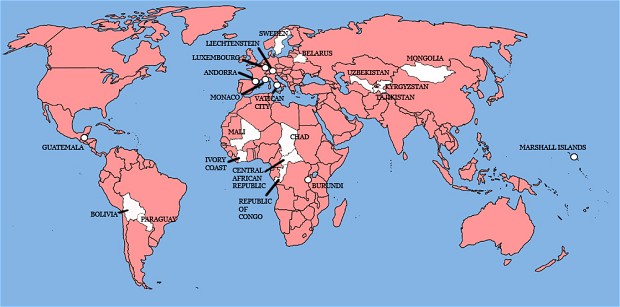
Invasive Albion disorder: only 10% of countries have never been invaded by Britain

Filed under: Africa, Americas, Asia, Books, Britain, Europe, History, Pacific — Tags: , — Nicholas @ 11:21

In the Telegraph, Jasper Copping explains why all those taunts about “perfidious Albion” are at least 90% deserved:

Every schoolboy used to know that at the height of the empire, almost a quarter of the atlas was coloured pink, showing the extent of British rule.

But that oft recited fact dramatically understates the remarkable global reach achieved by this country.

A new study has found that at various times the British have invaded almost 90 per cent of the countries around the globe.

The analysis of the histories of the almost 200 countries in the world found only 22 which have never experienced an invasion by the British.

Among this select group of nations are far-off destinations such as Guatemala, Tajikistan and the Marshall Islands, as well some slightly closer to home, such as Luxembourg.

The analysis is contained in a new book, All the Countries We’ve Ever Invaded: And the Few We Never Got Round To.

Stuart Laycock, the author, has worked his way around the globe, through each country alphabetically, researching its history to establish whether, at any point, they have experienced an incursion by Britain.

H/T to Colby Cosh for the link.

November 1, 2012

The American President

Filed under: Government, Military, Politics, USA — Tags: , , , — Nicholas @ 11:04

David Gewirtz has a thought about the awesome achievement of the American Presidency:

America has almost 3 million active and reserve military personnel. We spend almost $550 billion dollars each year on defense. According to the Federation of American Scientists, America has just about 5,000 nuclear warheads.

The United States Navy has about 300 ships, almost 4,000 aircraft, 71 submarines, and 11 aircraft carriers — each with more firepower than most nations. The United States has close to 9,000 battle-ready tanks. The United States Air Force has nearly 6,000 aircraft, 450 intercontinental ballistic missiles, and 32 satellites orbiting Earth under its direct control.

In other words, the United States has the most powerful military in the history of mankind.

And yet, every four to eight years, ultimate control of that incredible firepower changes hands — without a single shot being fired.

October 25, 2012

Follow-up – Argentine flagship’s crew to fly home after three week delay

Filed under: Africa, Americas, Government, Military — Tags: , , , , , — Nicholas @ 00:01

I originally found this story at the beginning of the month, and after all this time, the bulk of the Argentinian crew finally fly home. BBC News has the update:

Almost 300 sailors left on an Air France plane chartered by the Argentine government.

A skeleton crew is staying on board the three-masted Libertad to maintain it.

The tall ship was prevented from leaving Ghana after a local court ruled in favour of a US fund.

The fund, NML Capital, argued it was owed $370m (£231m) by Argentina’s government as a result of its debt default a decade ago.

[. . .]

An earlier plan for the sailors to fly back on an Argentine plane was scrapped because of fears that the aircraft might itself be impounded as part of the debt dispute.

On Tuesday, Argentine President Cristina Fernandez de Kirchner condemned the Libertad’s seizure and made it clear there would be no negotiations with creditors.


Photo by Martín Otero, 7 April, 2007

October 21, 2012

Animated map of the Battle of Trafalgar, 21 October, 1805

Filed under: Britain, France, History, Military — Tags: , — Nicholas @ 10:51

The BBC created an animated map you can view either with interpretations or non-stop, showing the tactics of Vice Admiral Nelson and Vice Admiral Villeneuve at the Battle of Trafalgar.

On 21 October 1805, the Royal Navy clashed with the Combined French and Spanish fleet at Cape Trafalgar, off the coast of Spain. The battle had massive repercussions for Napoleon’s France and the future of the British Empire.

October 14, 2012

Germany’s ambivalent relationship with their modern armed forces

Filed under: Europe, Germany, History, Military — Tags: , , — Nicholas @ 11:09

« Newer PostsOlder Posts »

Powered by WordPress


