Quotulatiousness

August 11, 2013

Debunking the “Cameron’s gunboat diplomacy” meme

Filed under: Britain, Europe, Media — Tags: , , , — Nicholas @ 09:22

Sir Humphrey points out that the British media’s collective gasp about Royal Navy ships being sent to Gibraltar merely highlights what a slow news month it is:

It’s an amusing irony that the recent row in Gibraltar has suddenly given the Royal Navy more publicity about its forthcoming COUGAR deployment in one evening, than it may have got in several months of deployment. The news that the Response Force Task Group (RFTG) is deploying to the Med has been seen as a clear example of gunboat diplomacy by Fleet Street’s finest, many of whom seem terribly keen on starting a war in order to fill column inches during a slow news month…

Its perhaps worth noting that this deployment is extremely long standing — the sort of planning which goes into deploying a major Task Force will usually commence at around 12 months prior to the event, when the rough outline of a plan is put together on the objectives of the deployment, likely ports, aims and intended outcomes and so on. While maritime power is about flexibility, it’s often forgotten that most RN deployments these days are the end product of months of well co-ordinated planning and staffing to ensure that the UK gets the best possible value from its naval assets.

[…]

What we can perhaps draw from this is that firstly the RN has enjoyed an unexpected boon of coverage, tapping into the nation’s subliminal psyche which holds that sending a grey hull is a key means of solving a crisis, no matter what or where the crisis is. There is perhaps work for some analysts to understand why, almost alone among all major powers, the cries of ‘send a gunboat’ seem to resonate most strongly in the UK (albeit to a lesser extent the same applies with the ‘send a carrier’ debate in the US). While deployments of warships can be seen as a useful indicator of interest in situations, it appears to be held most strongly in the UK — there is, at times, a fervent belief that deploying vessels is akin to the legend of waving the ancient banner three times in order for Arthur and his knights to appear — it makes little practical sense, but is somehow strangely comforting to the people.

August 6, 2013

Second Chinese aircraft carrier appears to be under construction

Filed under: China, Military — Tags: , — Nicholas @ 14:40

Strategy Page has the details:

Recent photos from a Chinese shipyard appear to show a section of a new Chinese aircraft carrier under construction. This appears to be a carrier similar to the American Nimitz class ships (100,000 ton vessels using a catapult rather than a ski jump flight deck for launching aircraft). Large ships, including warships, are often built in sections than the sections are welded and bolted together. The section of what appears to be a carrier does not indicate the exact size of the new carrier other than that it appears larger than the new carrier China commissioned at the end of 2012.

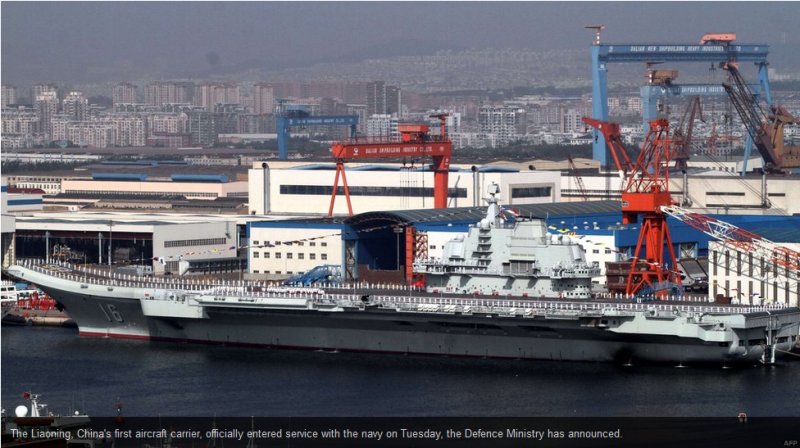
Last September China commissioned its first aircraft carrier, the Liaoning. At the time China was believed to be building the first of several locally designed aircraft carriers but the Chinese officially denied this. The only official announcements have alluded to the need for two or three aircraft carriers, in addition to the Liaoning. Construction of such large ships had not yet been seen in any shipyard. That has changed with the appearance of these new shipyard pictures.

[…]

The new Chinese “larger carrier” apparently means something like the recently decommissioned American USS Enterprise (CVN 65). This was the first nuclear powered carrier and it served as the prototype for the subsequent Nimitz class. It’s unclear if the new Chinese carrier will be nuclear powered. The Enterprise was an expensive design, and only one was built (instead of a class of six). While a bit longer than the later Nimitz class, it was lighter (92,000 tons displacement, versus 100,000 tons). The Enterprise was commissioned in 1961, almost 40 years after the first U.S. carrier (the Langley) entered service in 1923. In the two decades after the Langley there were tremendous changes in carrier aviation. While the innovation slowed after World War II, major changes continued into the 1950s (jet aircraft, nuclear propelled carriers, SAMs). But in the ensuing half century there has been no major innovation in basic carrier design. This has not been a problem because the carriers have proven useful, at least for the U.S. Navy (the only fleet to use such large carriers) and no one else has maintained a force of these large carriers. Only the U.S. has felt a constant need to get air power to any corner of the planet in a hurry. More importantly, no navy has been able to give battle to the U.S. carrier force since 1945. The Soviets built new anti-carrier weapons and made plans to use them but that war never occurred. China is building carriers but is not committed to having a lot of them to confront the U.S. but to intimidate its neighbors.

BBC News has a series of photos of the Liaoning from purchase to commissioning:


Click to see full-size images at the BBC website

Earlier reports on the progress of the Liaoning (under the name Shi Lang) can be found here.

Update: James R. Holmes on why China might be interested in becoming a 21st century naval power.

A couple of years back, when Beijing made its aircraft-carrier aspirations official, the fine folks at Foreign Policy asked me to explain why a historic land power like China cared about flattops. Being a bear of small brain, I reached into my mental bag of tricks and came up with Thucydides’ claim that fear, honor, and interest are three of the prime movers for human actions. Beijing feared U.S. containment, a relic of the Cold War; saw an opportunity to recoup honor lost during the century of humiliation at the hands of the imperial powers; and hoped to add to the naval power it was amassing to advance China’s interests in maritime Asia.

What’s changed since then? Fear and honor are emotional needs. It may be that sending the carrier Liaoning (formerly the Soviet Varyag) to sea helped satisfy China’s need to banish bad cultural memories. But who knows when fear will be at bay? The United States and its allies have ruled the sea in East Asia long enough that their navies may inspire fears disproportionate to their actual margin of supremacy. Or, the Chinese leadership may see value in protesting too loudly, and thus making Western powers fearful of creating a self-fulfilling prophecy, namely Sino-American antagonism.

Most importantly, it may be that having ameliorated anxieties arising from honor and fear grants Beijing the luxury of operating mostly from calculations of interest. Simply deploying a carrier, Liaoning, may forestall fears while satisfying Chinese society’s desire for a capability that every other great power enjoys.

July 29, 2013

Spanish border guards stage virtual blockade of Gibraltar

Filed under: Britain, Europe, Military — Tags: , , , — Nicholas @ 10:18

The Spanish claim to Gibraltar is being pursued by other means, it would seem:

Spanish police stopped every one of 10,000 vehicles leaving Gibraltar for the mainland yesterday, causing six-hour traffic jams in the latest escalation in the standoff over the Rock.

Officers from the Royal Gibraltar Police were forced to impose diversions and create beachside holding areas as Spanish authorities ‘choked’ the border, causing massive tailbacks in 30C heat.

It was the second day that border guards had blocked links to the mainland, in a move that seemed calculated to bring Gibraltar to a standstill.

[…]

Most recently Spanish fishermen sparked a stand-off with the Royal Navy as they attempted to disrupt the creation of an artificial reef in the Bay of Gibraltar last week.

The fishermen used fast boats to weave in between British vessels involved in the reef-laying operation in a bid to create large waves to disrupt the work, the Sunday Express reported.

Intervention by a Royal Navy patrol boat brought an end to the protests. A Gibraltar government spokesman has accused Spain of launching the ‘draconian’ border checks which continued yesterday in ‘retaliation’.

He said the decision to lay the reef, which consists of large concrete blocks sunk to the bottom of the bay, had been taken on environmental grounds.

However, he added, it had infuriated Spanish fishermen since it would also foil any attempts by their vessels to carry out illegal trawling of the bottom of the Bay of Gibraltar.

Criticising the Spanish government’s response, the spokesman added to the Sunday Express: ‘Not only are these measures affecting thousands of innocent Spanish workers who make their living on Gibraltar, but we are extremely concerned about pensioners and families with young children being forced to suffer in this way just because they want to visit the mainland.’

July 25, 2013

Hard times for Somalia’s pirates

Filed under: Africa, Military — Tags: , , , , — Nicholas @ 08:56

Strategy Page on the plight of a number of kidnapped ship crews in the hands of Somali pirates and the hard times those pirates are facing themselves:

Somalia is a sad place and one of the saddest tragedies ever is being played out where pirates in the north are holding 40 sailors and several ramshackle ships that no one will pay a ransom for. These are seagoing fishing boats and small freighters owned by small operators with no insurance to cover ransoms and not enough cash, or inclination, to pay what the pirates demand. The negotiators (who work for the pirates) have explained all this to the pirate chiefs, who are facing hard times themselves and stubbornly refuse to face the fact that they will never get anything for these 40 sailors and their ramshackle ships (one of which recently sank at anchor). Just killing the remaining prisoners (some held for three years) and sinking the ships risks retribution from the anti-piracy patrol off shore. Countries the prisoners are from have been pressured to pay ransom, but all of them adhere to the “no negotiating with terrorists” code. There is growing pressure on the pirates to simply release the unwanted prisoners on “humanitarian grounds” and at least get some good press out of this mess. That’s a bitter solution for the pirates, who have not captured a ship that could be ransomed in over a year. Several pirate gangs have disbanded and those still around have shrunk and cut the payroll considerably.

The big time piracy is largely out of business because warship patrols and better security aboard large ships passing Somalia has made it nearly impossible to seize these vessels. Holding ships for ransom only worked initially because Somalia, a state without a government since 1991, provided small ports on the coast of East Africa where pirates could bring the merchant ships they had captured, and keep them there, safe from rescue attempts, until a ransom could be negotiated.

[…]

Pirates usually function on the margins of society, trying to get a cut of the good life in situations where there aren’t many options. This is usually in areas where state control is weakest or absent, in failing and “flailed” states (a flailing state is something like Nigeria, Indonesia, or the Philippines, where the government is managing to just barely keep things together, unlike a failed state such as Somalia, where there isn’t any government at all).

The solution to piracy is essentially on land, where you go into uncontrolled areas and institute some law and order and remove the pirate safe havens. This has been the best approach since the Romans eliminated piracy in the Mediterranean over 2,000 years ago. Trying to tackle piracy just on the maritime end can reduce the incidence of piracy but can’t eliminate it. In the modern world the “land” solution often can’t be implemented. Who wants to put enough troops into Somalia to eliminate piracy? And flailing states are likely to be very sensitive about their sovereignty if you offer to help them control marginal areas.

A new industry has developed that attempts to “pirate proof” ships operating off Somalia. The most successful (and most expensive) technique is to put a small number of armed guards on each ship. That, and warship patrols, has greatly reduced piracy off East Africa (Somalia). But off West Africa (especially the Gulf of Guinea) the piracy threat is growing because pirates have found ways to get more valuables off ships before security forces (police, coast guard, or navy) can show up.

July 14, 2013

“The very definition of grand strategy is holding ends and means in balance to promote the security and interests of the state”

Filed under: Middle East, Military, USA — Tags: , , , — Nicholas @ 11:18

At the Anti-War blog, John Glaser looks at the ongoing costs of empire:

In Foreign Affairs, Michael O’Hanlon and Bruce Riedel suggest a cost-saving measure for America’s empire in the Middle East: opening more U.S. military bases in the region. Instead of relying as it has on expensive “aircraft carriers in and near the Persian Gulf,” the U.S. should move its military presence back onto land in at least three different Gulf states.

The primary purpose of having U.S. military bases peppered throughout the Middle East has traditionally been to exert control over geo-politically vital oil-rich countries and to allow for a rapid and coordinated use of military force at Washington’s command. As a Top Secret National Security Council briefing put it in 1954, “the Near East is of great strategic, political, and economic importance,” as it “contains the greatest petroleum resources in the world” as well as “essential locations for strategic military bases in any world conflict.”

O’Hanlon and Riedel don’t even consider the legitimacy of America’s military presence in the Middle East; for them, it is a natural law that can’t be questioned. So when faced with strained budgets that can’t support a sprawling, costly, and unwarranted empire, they try to figure minor cost cutting measures around the edges instead of reevaluating our military postures as a whole.

A CSIS report last year took a different tack, arguing that “disappearing finances; rising alternative power centers; declining US military predominance; lack of efficacy of key non-military instruments of power; and reduced domestic patience for global adventures,” all require a rethinking of U.S. grand strategy with an eye towards roll-back.

    The very definition of grand strategy is holding ends and means in balance to promote the security and interests of the state. Yet, the post-war US approach to strategy is rapidly becoming insolvent and unsustainable – not only because Washington can no longer afford it but also, crucially, because it presumes an American relationship with friends, allies, and rivals that is the hallmark of a bygone era. If Washington continues to cling to its existing role on the premise that the international order depends upon it, the result will be increasing resistance, economic ruin, and strategic failure.

That first sentence there is one of the most honest you’ll ever see from an elite DC foreign policy think tank. U.S. foreign policy is ultimately promoting “the security and interests of the state.” It isn’t for your sake. It benefits the government and the private interests aligned with it.

July 12, 2013

Mapping the latest British defence “disgrace”

Filed under: Britain, Germany, Military — Tags: , , — Nicholas @ 14:06

Sir Humphrey on the mapping uproar:

Several UK newspapers reported this week the findings of the UK Parliaments Intelligence & Security Committee report that during OP ELLAMY, the UK had relied on Germany to provide mapping for the RAF to conduct its missions. This was apparently a disgraceful sign of a nation in decline and that we should all be jolly ashamed of ourselves.

The reality (as ever!) is a little different and one worth thinking about. Maps are something that we all take for granted in our daily lives, and they are an utterly indispensable part of modern military operations (even in the hands of a newly appointed young officer). We perhaps take for granted the information on them, without considering how it is obtained. In the UK the Ordnance Survey has over many hundreds of years done a phenomenal job of providing accurate information almost down to the last manhole cover about what lies where. At sea the Hydrographic Service has similarly spent many hundreds of years charting the oceans and waters of the planet — it is not an exaggeration to say that in some of the more remote parts of the globe, the only charts in use date back to the surveys done by Captain Cook or other explorers. As a national asset the Hydrographic Office in particular is absolutely priceless — very few nations run credible hydrographic programmes beyond the UK, US, Russia and China. The Royal Navy, with its extremely effective and very hard worked survey fleet has been able to become a global leader in providing accurate chart information to the world — indeed many countries are enormously reliant on the UK for providing charts for their warships.

But, to put a map or chart together is an enormously complicated piece of work which takes a lot of time and effort. No country on earth currently has the resources to provide a truly global and accurate mapping capability of all the nations and areas that it may need military mapping for. Its not just a case of putting down some generic top level mapping and hoping that’s enough — modern military operations require a lot of detail, and to be able to work effectively, mapping is needed at a very high level of detail. When it comes to targeting, knowing whether a particular target is located at grid reference 123456, or 12345678 can make a huge difference — precision weapons nowadays mean that the chances of hitting the intended spot are much higher than ever before. This means you can destroy a critical node or facility without necessarily doing much in the way of wider damage, which makes rebuilding efforts easier, and also reduces the risk of civilian casualties.

[. . .]

The irony is that amidst the anguish over using German maps, the article skims over the wider point that Defence Intelligence appears to be losing several hundred posts. It is not commonly realised that the DI is responsible for the provision of geographic information to the military, currently via the Defence Geographic Centre in Feltham (for more information see LINK HERE). This sort of service is crucial to help the MOD maintain an edge on operations — it isn’t just about having a good set of weapons, but the ability to know where you are, where you are going and how you can have the best possible military effect that matters. Ironically the papers that got the most irate about the news the UK was relying on the Germans were also the same papers that call the most loudly for ever more civil servants to be fired. The problem is that the people working at the DGC are exactly the sort of civil servants who are not pen pushers, who make a massive, near immeasurable difference to UK security, and who face considerable uncertainty in the future. We perhaps forget at our peril that just because someone doesn’t wear uniform, it doesn’t mean that they don’t play a major role in helping the defence of the UK.

July 2, 2013

Russia’s French amphibious ships

Filed under: Europe, France, Military, Russia — Tags: , — Nicholas @ 08:42

As reported a few months back, the Russian navy will be getting a pair of amphibious ships from France. The deal isn’t going quite as smoothly as the Russians had hoped:

Russia recently bought two French Mistral class amphibious ships. Russia has not bought foreign warships for a long time, but this purchase was largely because of an eagerness to acquire Western shipbuilding technology and construction skills. This has already paid off, although not exactly how the Russians had planned. This became evident when a Russian official recently announced that the first Mistral would be built entirely in France. It had earlier been decided to have Russian shipyards build some sections of the first Mistral. It was quickly discovered that the Russian shipyard was not capable of building to the French specifications or do it according to the French timetable. The Russians expected to learn some valuable lessons from the French and, while embarrassing, this was one very valuable lesson. Russian shipyard officials have had their faces rubbed in the embarrassment of not being able to compete the way using their current practices. Russian experts on Western production methods and techniques have long complained of the antiquated and inefficient methods still favored by Russian shipbuilders. Navy leaders have been complaining for decades about the poor quality of work coming out of Russian shipyards. The Mistral purchase was to put this to the test.

BPC "Bâtiment de Projection et de Commandement" Tonnerre. Photograph by  Yannick Le Bris

The Mistral class BPC “Bâtiment de Projection et de Commandement” Tonnerre. Photograph by Yannick Le Bris

One thing American marines and sailors notice about the Mistral is the wider and higher corridors. This came about because the ship designers surveyed marines and asked what ship design improvements they could use. It was noted that in older amphibious ships, the standard size (narrow) corridors were a problem when fully equipped troops were moving out. That, plus the smaller crew size, makes the Mistrals appear kind of empty but very roomy. That, plus larger living accommodations (made possible by the smaller ship’s crew and marine complement), make the Mistrals a lot more comfortable. The French ships can be rigged to accommodate up to 700 people for short periods, as when being used to evacuate civilians from a war zone.

After the first two, additional Mistrals for the French Navy are being built using more commercial techniques and are expected to cost closer to $500 million each. France has three Mistrals with several more on order. Russia says it plans to base some of its Mistrals in the Far East, where there is an ongoing dispute with Japan over Japanese islands Russia occupied after World War II and never gave back. The Mistrals will probably show up elsewhere, because the Russian fleet is again patrolling the high seas and showing up wherever its government needs some muscle.

The Russians will name their two Mistrals the Vladivostok (initially planned to be based in its namesake city) and the Sevastopol (to be based at Novorossiysk).

June 14, 2013

Nostalgia for a far-distant imperial era

Filed under: Britain, History, Military — Tags: — Nicholas @ 00:01

At the Thin Pinstriped Line, Sir Humphrey pours cold water on the calls to re-establish the Royal Navy’s former fleet and base organizations overseas:

Humphrey has a certain pet hate on some internet sites, and this is the trend to ‘fantasy fleet’ creation. While the merits of discussing possible courses of action are interesting, in recent years these sort of threads have routinely become an excuse to wishlist large numbers of ships, aircraft and vessels in an almost fantasian order of battle which bears no resemblance to any current reality. Almost without exception these threads prove immensely dull to read, and rarely achieve more than listing different types of impressive ships in arbitrary ‘fleets’.

The concept of these so-called ‘fleets’ has often puzzled the author — it is something to which many posters cling to — the notion that the Royal Navy should somehow hark back to its imagined glory days and establish a ‘Far East Fleet’, a Med Fleet and south Atlantic squadrons, along with the supporting bases and dockyards. These impressive sounding titles are bandied around without really thinking what this means. Ironically, those who most loudly advocate the creation of these fleets are the ones who also demand that the MOD cuts the numbers of officials and Admirals to pay for it — as if adding an additional layer of command is going to somehow reduce officialdom.

For this post, Humphrey wants to consider why foreign dockyards and the concept of ‘Fleets’ is perhaps less relevant than ever to the Royal Navy of today, and considers that what may have worked in the past is not necessarily the model of the future fleet structure.

[. . .]

The other point which often crops up in Fantasy Fleet discussions is the keen desire for the RN to establish a network of overseas dockyards which will house whole squadrons of warships (presumably under the command of a newly re-established Fleet HQ). While it is wonderful to look back in history and see where the RN used to have permanent bases, it is hugely misleading to do so.

The author has a very personal view that the RN is in the business of sending warships to sea, and not the business of managing an unnecessarily large property portfolio. Every penny spent on building and sustaining shore infrastructure is a penny not being spent on a warship. While there is a very clear case for a well maintained and modern infrastructure, this does come at a cost. The RN already probably has a surplus of real estate relative to its fleet size, and much of this is buildings that are decades (and in some cases centuries) old, which require updating, refurbishment and refitting.

Historically overseas dockyards made perfect sense — in the early 20th century when communications were slow, it made immense sense to ensure that local dockyards could repair vessels on station, ensuring they were available in short order, rather than waiting weeks or months for spare parts to be sent out. The presence of coal or oil in the days before the RFA was a strategic necessity, while ammunition depots could easily store shells for use. Similarly, the reliance on troopships rather than trooping flights meant that long drafts for overseas personnel made sense — it wasn’t feasible to keep moving people around unless there was good reason to do so. Hence maintaining a strategic network of dockyards and accommodation facilities made enormous sense.

May 22, 2013

Spain needs to put new submarine design on a diet

Filed under: Europe, Military — Tags: , , , — Nicholas @ 16:33

If they launch the new class of submarines as designed, they might not be able to re-surface after diving:

Spanish engineers, who already spent some $680 million on designing the new generation S-80 class submarine, say it is a major “technical innovation.” There is just one problem the calculations show – if submerged into water, it may never come up again.

The Spanish media has been furiously discussing the errors made by the state-owned Navantia construction company, which has spent about a third of the huge $2.2 billion budget only to produce an ‘overweight’ submarine that is not able to float.

Spain’s Ministry of Defense has confirmed that Navantia detected “deviations” in the new submarine’s design, thus delaying its March 2015 scheduled launch for one or two years.

Navantia said an excess weight of up to 100 tons has been added to the sub during construction, and the company may have to redesign the whole craft.

May 21, 2013

Last of the Royal Navy’s Type 42 destroyers to leave service

Filed under: Britain, Military — Tags: , — Nicholas @ 08:22

HMS Edinburgh, the last of the Type 42 destroyers, will be hauling down her flag on June 6th:

In 1966 the Labour government cancelled the CVA-01 aircraft carrier project and the Type 82 destroyers that were designed as the carrier’s main escorts. The Type 82 programme was quite advanced and HMS Bristol was eventually completed. The Type 82 was really a light cruiser, large, heavily armed and expensive, with complex steam & gas turbine propulsion. In some ways it was a blessing that the costly Type 82′s were axed as the RN was able to get decent numbers of the alternative cheaper Type 42s.

The Type 42 was always an ‘austerity design’ and although by the batch 3 ships many of the problems had been cured, they were always considered only a partial success. Sometimes the quality and excellence of the RN crews could overcome these deficiencies, sometimes not. In the design stage it was decided not exceed a certain hull length in the erroneous belief that would save on cost, the first 8 ships were too short and this caused various problems throughout their lives. Poor sea-keeping was not only tiring for crews but affected the operation of the gun and delicate missile launcher on the foredeck. Rather cramped with a crew of around 250 (300 could be crammed in at a push), there was small margin for additional equipment but the RN just about managed to keep them effective with small incremental upgrades. The Type 42 was built around the Sea Dart missile system that was designed to provide area defence for the fleet from medium or high level Soviet bombers. The Sea Dart was pretty effective when the targets obliged by flying high but lacked the ability to engage close-in and low-level aircraft and anti-ship missiles. The RN developed the excellent Sea Wolf system for this role but it would be too costly to fit to the already cramped Type 42. Inexcusably for an air-defence destroyer, close-in weapons (CIWS) amounted to just 2 of manually–aimed WWII vintage Oerlikon 20mm cannons. This was quickly remedied after the Falkland’s war with fitting of 4 modern 20mm cannons and ultimately by the 1990s all ships were properly equipped with 2 Phalanx 20mm radar-controlled gatling guns. Unlike the Type 82, there was a hangar and flight deck which allowed the carrying of a Wasp and then the superb Lynx helicopter which gave the ship a major anti-submarine capability and light anti-shipping punch. Finally the Mk 8 4.5” gun provided limited air defence capability, last-ditch anti-shipping role, but was mainly used for bombarding land targets.

[. . .]

The Falklands war has dominated the story of the Type 42. On 4th May 1982 HMS Sheffield was hit by an Exocet missile, caught unawares while transmitting on satellite comms, she failed to detect the missile but without adequate CIWS would probably have been unable to save herself anyway. The missile failed to explode but the resulting fire eventually destroyed the ship, killing 22 of her crew. On 12th May HMS Glasgow was hit by a 1000lb bomb which fortunately passed right through the ship without exploding. She was patched up but had to limp home leaving HMS Coventry as the only remaining air defence ship in the task force. Coventry was sunk on 25th May 1982 by bombs while bravely operating in an exposed position to defend the landing ships with Sea Wolf-armed HMS Broadsword. The idea was that the combination of Sea Dart and Sea Wolf would provide long and short-range anti-aircraft coverage but although initially a success, Coventry’s luck ran out when she accidentally blocked Broadsword’s field of fire. This would not have been a problem for a single ship fitted with both weapons. HMS Exeter and Cardiff arrived as replacements and Exeter (with her better radars & electronics) achieved 3 aircraft kills. The Sea Dart system was a partial success in the Falklands war, exact figures are disputed but it achieved a roughly 50% hit rate. Its greater achievement was to force Argentine pilots to attack at low-level where their bombs sometimes didn’t fuse properly and failed to explode. What can be seen is that the presence of fighter aircraft (Sea Harriers) was a more effective weapon against attacking aircraft. Ship launched missiles are generally inferior to fighter aircraft, although missile systems in theory can be available 24/7 when it is difficult to maintain continuous combat patrol (CAP) cover. Although 2 were lost and 1 damaged the ‘expendable’ ‘fighting 42s” achieved their main strategic objective that was to defend the carriers and other ships that ultimately won the war.

May 18, 2013

US Navy’s UAV conducts touch-and-go landing on carrier deck

Filed under: Military, Technology, USA — Tags: , , — Nicholas @ 08:24

It’s still a work in progress: perfect conditions, no particular weather concerns, totally clear flight deck, but it shows that unmanned aircraft are becoming capable of much more than they’ve done so far:

An X-47B Unmanned Combat Air System (UCAS) demonstrator conducts a touch and go landing on the flight deck of the aircraft carrier USS George H.W. Bush (CVN 77), marking the first time any unmanned aircraft has completed a touch and go landing at sea. George H.W. Bush is conducting training operations in the Atlantic Ocean.

May 15, 2013

US Navy successfully launches UAV from aircraft carrier

Filed under: Military, Technology, USA — Tags: , , — Nicholas @ 00:02

Spencer Ackerman talks about yesterday’s step forward for unmanned aircraft in the US Navy:

ABOARD THE U.S.S. GEORGE H.W. BUSH — At 11:19 a.m. today, for the first time in history, a plane without a pilot in it executed one of the most complex missions in aviation: launching off an aircraft carrier at sea. Only the Navy can’t yet land that drone aboard the U.S.S. George H.W. Bush, an even harder but necessary maneuver if large drones are really going to operate off carriers.

On a crisp, bright and nearly cloudless day, about 100 miles off the Virginia coast, the crew of the Bush and the team behind the highly autonomous X-47B loaded up the deck’s second catapult with the drone and shot it off into the sky above the eastern Atlantic. The drone — which has its own callsign, “Salty Dog 502″ — turned downwind and passed over the ship twice, first from 1000 feet overhead and then from 60 feet overhead, before flying back to dry land in Maryland. The launch went exactly as the Navy hoped.

With that, the era of the drone took a major step toward patrolling the skies above the world’s waterways. It’s something the Navy hopes will have big implications for supplementing manned fighter jets in a carrier air wing, providing both persistent surveillance far out at sea and ultimately firing weapons in highly defended airspace that might mean death for human pilots.

Senior Navy officers openly likened the X-47B’s launch off the Bush to the first-ever launch of a plane off the U.S.S. Birmingham in 1910. “It’s one small step for man,” remarked Rear Adm. Matt Winter, the Navy’s chief program officer for unmanned systems, “and one significant technical step for unmanned-kind.”

April 30, 2013

QotD: Shades of Yamamoto

Filed under: Middle East, Military, Quotations, USA — Tags: , , , — Nicholas @ 00:01

While the results of the wargames are all well and good, El Reg hopes this won’t induce a sense of complacency. Wargames are just that — games — and reality is going to be much more unpleasant. As the 19th century Prussian military strategist Helmuth von Moltke the Elder noted, “No human acumen is able to see beyond the first battle.”

Barely a decade ago we saw this demonstrated with the Millennial Challenge in 2002 — a simulated land, sea, air and electronic online wargame against a fictional Middle Eastern country (somewhat like Iraq). It was intended to be the first test of the switched-on, network-centric warfare beloved by former US Secretary of Defense Donald Rumsfeld, and in practice it failed miserably.

The Red team, controlled by Marine Lieutenant General Paul Van Riper, refused to play ball — using motorcycle couriers and pre-arranged signals at evening prayers to trigger attacks on the Blue team forces rather than easily-tapped radio or wired signals. By the second day, Van Riper had sunk one aircraft carrier, ten cruisers, and five of six amphibious ships of the attacking force, and the $250m exercise was shut down and reset.

Iain Thomson, “NATO proclaimed winner of Locked Shield online wargame”, The Register, 2013-04-29

April 29, 2013

US Navy’s innovative Littoral Combat Ship designs still undergoing teething problems

Filed under: Military, USA — Tags: , , , — Nicholas @ 07:53

Strategy Page looks at the documented issues facing the two different ships in the Littoral Combat Ship (LCS) class:

The U.S. Navy is encountering a seemingly endless list of problems with their new “Littoral Combat Ship” (LCS). Last year it was decided to put the ship into mass production. But it was recently revealed that last year the navy discovered that the computerized combat systems of the LCS were vulnerable to hacking. The navy understandably won’t provide details about the vulnerability or the fixes that have since been implemented. This sort of vulnerability on U.S. warships has been hinted at for years, but navy officials have largely been silent on the subject.

Such vulnerabilities have become more common as warships became more networked (internally and externally) over the last two decades and installed constant Internet connections for work and improving morale. The LCS problems were encountered when one of the navy “red teams” (sometimes called “tiger teams”) played offence on the LCS electronics and found there was a way in that provided opportunities to do damage. The navy has no comment on the vulnerabilities with other ship classes.

The LCS has been unique in many ways and this has caused the navy all manner of grief in the media. The LCS is a new ship type and generating a larger number of problems than older, more traditional ship designs. The media loves this, because problems with weapons grab attention and ad revenue. In response to this media feeding frenzy the navy has tried some damage control.

[. . .]

This is all part of the expected years of uncertainty and experimentation as this radical new combat ship design seeks to find out what works, to what degree, and what doesn’t. There is some nervousness about all this. The U.S. Navy has not introduced a radical new design for nearly a century. The last such new design was the aircraft carrier, which required two decades of experimentation and a major war to nail down what worked. Even the nuclear submarines of the late 1950s and early 60s were evolutionary compared to what the LCS is trying to do.

In the last seven years two different LCS designs were built and put into service. Problems were encountered and that was expected. The much smaller crew required some changes in how a crew ran a ship and how many sailors and civilians were required back on land to support a LCS at sea. It was found that the interchangeable mission modules take far longer (2-3 days instead of 2-3 hours) to replace. The LCS has still not seen combat and the navy wants the first violent encounter to be successful or at least not disastrous. It is expected that there will be surprises, which is about all that can be guaranteed at this point.


USS Freedom at sea. Click for full-sized image at Wikipedia


USS Independence at pier side. Click for full-sized image at Wikipedia.

April 27, 2013

The Caspian Sea as a potential trouble zone

Filed under: Asia, Military, Russia — Tags: , , , , — Nicholas @ 08:46

Strategy Page provides some background on the possibility of conflict on the Caspian in the post-Soviet era:

The Caspian Sea, long a Russian lake, is now witnessing a naval arms race. Before the Soviet Union broke up in 1991, the only nations bordering the Caspian were Russia (with most of the coastline) and Iran. But now those two nations have been joined by parts of the Soviet Union that have become independent states (Kazakhstan, Azerbaijan and Turkmenistan). It goes downhill from there.

Iran shares a land border with Azerbaijan and has a historical claim on Azerbaijan. In the 19th century Azerbaijan (as in the area occupied the Azeris, a Turkic people) was divided by Russia and Iran. Currently about a quarter of the Iranian population is Azeri, but the Azeris of Azerbaijan believe all Azeris should be part of an independent Azerbaijan. This was how it was for centuries before Turkey, Russia and Iran began seeking to conquer Azerbaijan. Some Iranian Azeris like this idea and Iran is always looking for ways to make Azerbaijan back off. So Iran is building up its Caspian naval forces, which is annoying Russia more than Azerbaijan.

The Iranian buildup includes a new corvette, an Iranian built 1,400 ton ship. Azerbaijan responded by buying $1.6 billion worth of weapons from Israel (which angered Iran a great deal.) Among the items ordered were Gabriel anti-ship missiles. These are 522 kg (1,150 pound) weapons with a range of 36 kilometers. Azerbaijan will use these to protect its Caspian Sea coast from the growing number of Iranian warships being introduced in the area. Most of the Iranian Caspian “fleet” consists of small patrol boats. Some are armed with anti-ship missiles but they are basically coast guard type craft.

What really controls the Caspian is aircraft and Russia has the most of those. Russia also has the only water link to the ocean and thus the ability to bring in more warships on short notice. These, plus Russia’s larger air force gives Russia the edge.

« Newer PostsOlder Posts »

Powered by WordPress