Sabaton History
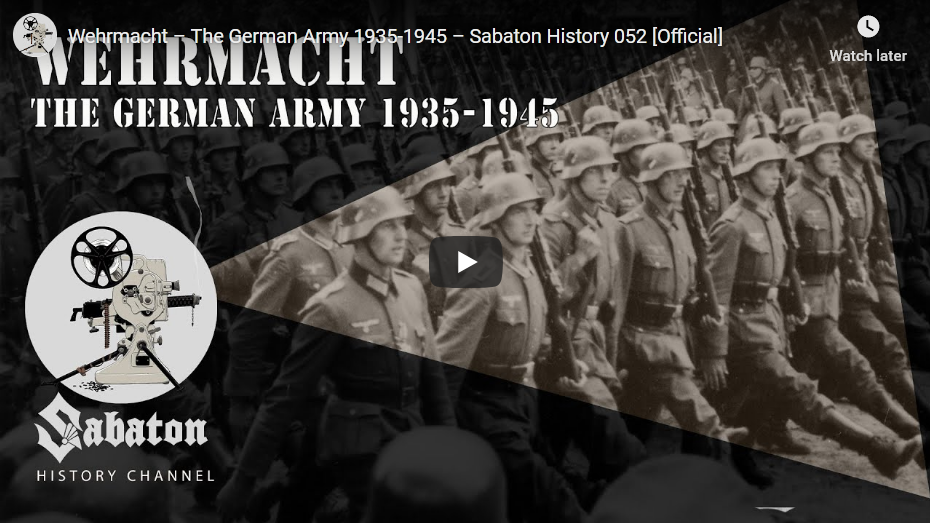
Published 30 Jan 2020From 1935 onwards, the German Wehrmacht was expanding rapidly. Millions of men joined the army, the Luftwaffe and the Kriegsmarine to fulfill Adolf Hitler’s visions for the 3rd Reich.
Highly motorized Panzergrenadiers, elite parachute- and resilient mountain-infantry troops were trained and and led with the utmost combat-efficiency in mind, supported by state of the art Panzers and aircraft. If it came to war, they would break the enemy and break them fast, achieving fast victories in a series of devastating hits. However, succumbing to the ideological influence of National-Socialism, the Wehrmacht found itself soon to be both culprit and accomplice to a self-reinforcing cycle of violence and atrocities.
Support Sabaton History on Patreon: https://www.patreon.com/sabatonhistory
Listen to “Wehrmacht” here:
CD: http://bit.ly/CoatOfArmsStore
Spotify: http://bit.ly/CoatOfArmsSpotify
Apple Music: http://bit.ly/CoatOfArmsAppleMusic
iTunes: http://bit.ly/CoatOfArmsiTunes
Amazon: http://bit.ly/CoatOfArmsAmzn
Google Play: http://bit.ly/CoatOfArmsGooglePlayCheck out the trailer for Sabaton’s new album The Great War right here: https://www.youtube.com/watch?v=HCZP1…
Listen to Sabaton on Spotify: http://smarturl.it/SabatonSpotify
Official Sabaton Merchandise Shop: http://bit.ly/SabatonOfficialShopHosted by: Indy Neidell
Written by: Markus Linke and Indy Neidell
Directed by: Astrid Deinhard and Wieke Kapteijns
Produced by: Pär Sundström, Astrid Deinhard and Spartacus Olsson
Creative Producer: Joram Appel
Executive Producers: Pär Sundström, Joakim Broden, Tomas Sunmo, Indy Neidell, Astrid Deinhard, and Spartacus Olsson
Post-Production Director: Wieke Kapteijns
Edited by: Iryna Dulka
Sound Editing by: Marek Kaminski
Maps by: Eastory – https://www.youtube.com/c/eastoryArchive by: Reuters/Screenocean https://www.screenocean.com
Music by Sabaton.Sources:
– Bundesarchiv
– IWM: H 21907- Bundesarchiv
– IWM: H 21907An OnLion Entertainment GmbH and Raging Beaver Publishing AB co-Production.
© Raging Beaver Publishing AB, 2019 – all rights reserved.
January 31, 2020
“Wehrmacht” – The German Army 1935-1945 – Sabaton History 052 [Official]
January 24, 2020
“The Attack of the Dead Men” – Gas Warfare on the Eastern Front – Sabaton History 051 [Official]
Sabaton History
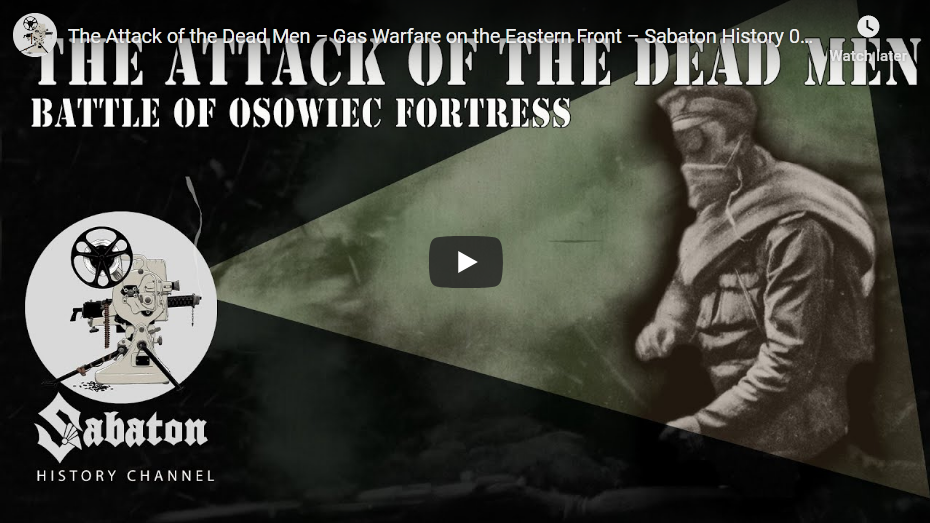
Published 23 Jan 2020This episode is about the “Attack of the Dead Men”. During the third battle for Osowiec Fortress in July 1915 during the Great War, German artillery was bombarding the defending Russian soldiers with a new deadly weapon: Poison Gas. The fatal mixture of chlorine and bromine descended like a green fog over the Russian trenches. Without adequate gas-masks to protect themselves, the defenders were believed to all have died in agony. However, as the German infantry advanced, they did not only march right into a Russian counterattack but also encountered the dead, seemingly rising from their graves.
Support Sabaton History on Patreon: https://www.patreon.com/sabatonhistory
Listen to The Great War (where “The Attack of the Dead Men” is featured):
CD: http://nblast.de/SabatonTheGreatWar
Spotify: https://sabat.one/TheGreatWarSpotify
Apple Music: https://sabat.one/TheGreatWarAppleMusic
iTunes: https://sabat.one/TheGreatWarItunes
Amazon: https://sabat.one/TheGreatWarAmazon
Google Play: https://sabat.one/TheGreatWarGooglePlayCheck out the trailer for Sabaton’s new album The Great War right here: https://www.youtube.com/watch?v=HCZP1…
Listen to Sabaton on Spotify: http://smarturl.it/SabatonSpotify
Official Sabaton Merchandise Shop: http://bit.ly/SabatonOfficialShopHosted by: Indy Neidell
Written by: Markus Linke and Indy Neidell
Directed by: Astrid Deinhard and Wieke Kapteijns
Produced by: Pär Sundström, Astrid Deinhard and Spartacus Olsson
Creative Producer: Joram Appel
Executive Producers: Pär Sundström, Joakim Broden, Tomas Sunmo, Indy Neidell, Astrid Deinhard, and Spartacus Olsson
Post-Production Director: Wieke Kapteijns
Edited by: Iryna Dulka
Sound Editing by: Marek Kaminski
Maps by: Eastory – https://www.youtube.com/c/eastoryArchive by: Reuters/Screenocean https://www.screenocean.com
Music by Sabaton.Sources:
– IWM: Q 78100, Q 86635
– The New York Public Library
– Narodowe Archiwum CyfroweAn OnLion Entertainment GmbH and Raging Beaver Publishing AB co-Production.
© Raging Beaver Publishing AB, 2019 – all rights reserved.
January 19, 2020
January 15, 2020
History Buffs: Amadeus
History Buffs
Published 3 Dec 2015In this episode we look at the original Rock n Roll bad boy, Wolfgang Amadeus Mozart! And who says this show isn’t classy and sophisticated 🙂
● Follow us on Twitter: https://twitter.com/HistoryBuffs_
_________________________________________________________________________
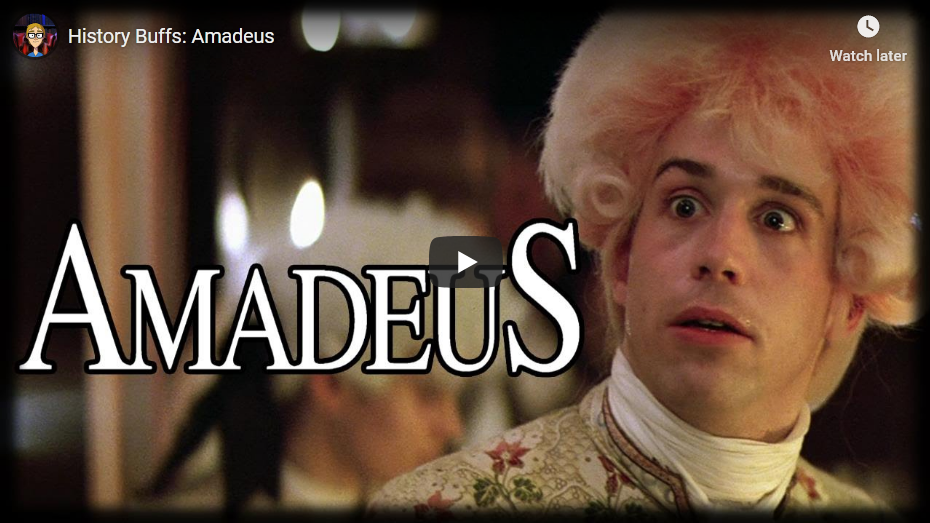
Amadeus is a 1984 American period drama film directed by Miloš Forman, written by Peter Shaffer, and adapted from Shaffer’s stage play Amadeus (1979). The story is set in Vienna, Austria, during the latter half of the 18th century.
The film was nominated for 53 awards and received 40, including eight Academy Awards (including Best Picture), four BAFTA Awards, four Golden Globes, and a Directors Guild of America (DGA) award. In 1998, the American Film Institute ranked Amadeus 53rd on its 100 Years… 100 Movies list.
The story begins in 1823 as the elderly Antonio Salieri (F. Murray Abraham) attempts suicide by slitting his throat while loudly begging forgiveness for having killed Wolfgang Amadeus Mozart (Tom Hulce) in 1791. Placed in a lunatic asylum for the act, Salieri is visited by Father Vogler (Richard Frank), a young priest who seeks to hear his confession. Salieri is sullen and uninterested but eventually warms to the priest and launches into a long “confession” about his relationship with Mozart.
“Subdivisions”
Colby Cosh on the way Rush responded to the “New Wave” on their 1982 album Signals:
Every Rush fan is presenting his own list of essential tracks this week: unexpectedly I found myself returning over and over again to “Subdivisions,” the opener from Signals (1982). No Rush song ever had a more portentous dividing effect: there are still fans who haven’t forgiven. Moving Pictures had come out in February of 1981, and its sales set up the band for life and beyond. But it was a consciously backward-looking record — the cover is a big clue — and a culmination of Rush’s original identity. Moving Pictures is an affectionate farewell to 11-minute track lengths and science-fiction song lyrics (mostly).
After just a few months came the first 51 seconds of “Subdivisions” — Rush’s own astonishing riposte to the New Wave. A lone synthesizer pulses (in 7/8) for a few seconds and then Neil comes in: no further description is possible or necessary. The passage would make a career calling card for any drummer, but what was novel was the upside-down structure of the song, with Alex Lifeson’s guitar showing up late and then carrying the rhythm (beautifully, if you take the trouble to pick him out) while the drums truly lead the way. This is rare, outside of a drum-solo setting, for any rock drummer not named Moon or Bonham.
It was as if Rush, until then a very loud group fuelled by metaphors of battle, had made a conscious decision to cool down and give the spotlight to its ultimate weapon. Very well, the start of Signals announced, this is the age of the synthesizer and we’re going along with it — but let’s see you S.O.B.s synthesize Neil Peart.
Not coincidentally, Peart’s lyrics for “Subdivisions” also took an artistic step: they shake free of the SF/fantasy tropes and the 1930s poetic conceits he had mostly hidden behind until then. Heard in 2020, the song drags the mind of the listener helplessly back to the moment when “Subdivisions” was on the radio, yet seems to have been written for us to hear now. “Some will sell their dreams for small desires,” Peart warned in a mood of cranky prophecy, “or lose the race to rats …”.
January 12, 2020
Neil Peart, RIP
I was very saddened to see the news, but it explains why the band retired:
Neil Peart, the virtuoso drummer and lyricist for Rush, died Tuesday, January 7th, in Santa Monica, California, at age 67, according to Elliot Mintz, a family spokesperson. The cause was brain cancer, which Peart had been quietly battling for three-and-a-half years. A representative for the band confirmed the news to Rolling Stone.
Peart was one of rock’s greatest drummers, with a flamboyant yet precise style that paid homage to his hero, the Who’s Keith Moon, while expanding the technical and imaginative possibilities of his instrument. He joined singer-bassist Geddy Lee and guitarist Alex Lifeson in Rush in 1974, and his musicianship and literate, philosophical lyrics — which initially drew on Ayn Rand and science fiction, and later became more personal and emotive — helped make the trio one of the classic-rock era’s essential bands. His drum fills on songs like “Tom Sawyer” were pop hooks in their own right, each one an indelible mini-composition; his lengthy drum solos, carefully constructed and packed with drama, were highlights of every Rush concert.
In a statement released Friday afternoon, Lee and Lifeson called Peart their “friend, soul brother and bandmate over 45 years,” and said he had been “incredibly brave” in his battle with glioblastoma, an aggressive form of brain cancer. “We ask that friends, fans, and media alike understandably respect the family’s need for privacy and peace at this extremely painful and difficult time,” Lee and Lifeson wrote. “Those wishing to express their condolences can choose a cancer research group or charity of their choice and make a donation in Neil Peart’s name. Rest in peace, brother.”
A rigorous autodidact, Peart was also the author of numerous books, beginning with 1996’s The Masked Rider: Cycling in West Africa, which chronicled a 1988 bicycle tour in Cameroon — in that memoir, he recalled an impromptu hand-drum performance that drew an entire village to watch.
Peart never stopped believing in the possibilities of rock (“a gift beyond price,” he called it in Rush’s 1980 track “The Spirit of Radio”) and despised what he saw as over-commercialization of the music industry and dumbed-down artists he saw as “panderers.” “It’s about being your own hero,” he told Rolling Stone in 2015. “I set out to never betray the values that 16-year-old had, to never sell out, to never bow to the man. A compromise is what I can never accept.”
Update: At AIER Peter C. Earle pays tribute to Peart’s life and work.
The announcement of the death of Rush drummer Neil Peart came as a tremendous shock. Having only retired about four years ago, so many fans of Rush (myself included) had convinced ourselves that this was a temporary hiatus, and that in a year or two – eventually, at any rate – there would be an announcement of a new album, a short tour, or some other project. Surely musicians of their virtuosity and passion couldn’t stay away from the studio or stage for long. But now we know we were wrong, and we know why.
It was revealed that Neil had been battling a brain tumor for over three years. Characteristically, he, his family, and friends (among the closest of whom, Rush vocalist/bass player Geddy Lee and guitarist Alex Lifeson) upheld his desire for privacy. I haven’t done the math as to whether Neil’s illness was likely a causative factor in the decision to retire, or whether it seems to have come along not long after the decision to retire.
[…]
In his role as the lyricist of Rush, Peart took on such topics as pernicious nationalism (“Territories”), mass hysteria (“Witch Hunt”), the division between constructive and destructive belief (“Faithless”), the fall of Communism (“Heresy”), conflict and power (“The Trees”), the horrors of totalitarian rule (“2112,” “Red Sector A”) and many allusions to individual liberty (“Tom Sawyer,” “Anthem,” “The Analog Kid,” “Finding My Way,” “Caravan”). He did so via lyrics which artfully and passionately evinced those sentiments; sentiments which early on suggested Objectivist perspectives, but over time developed into what he called “Bleeding Heart” libertarianism:
I call myself a bleeding heart libertarian. Because I do believe in the principles of Libertarianism as an ideal – because I’m an idealist. Paul Theroux’s definition of a cynic is a disappointed idealist. So as you go through past your twenties, your idealism is going to be disappointed many many times. And so, I’ve brought my view and also – I’ve just realized this – Libertarianism as I understood it was very good and pure and we’re all going to be successful and generous to the less fortunate and it was, to me, not dark or cynical. But then I soon saw, of course, the way that it gets twisted by the flaws of humanity. And that’s when I evolve now into … a bleeding heart Libertarian. That’ll do.
Neil, through his lyrics, managed to do what so many lyricists and writers – even, perhaps especially, so many libertarian intellectuals – fail to do: make liberty neither an alien fixture, a flat slogan, or a utopian slog. It is a way of thinking and living, and one which not only doesn’t ignore, but embraces the flaws and frailty of humanity, tempering realism with hope and optimism.
January 10, 2020
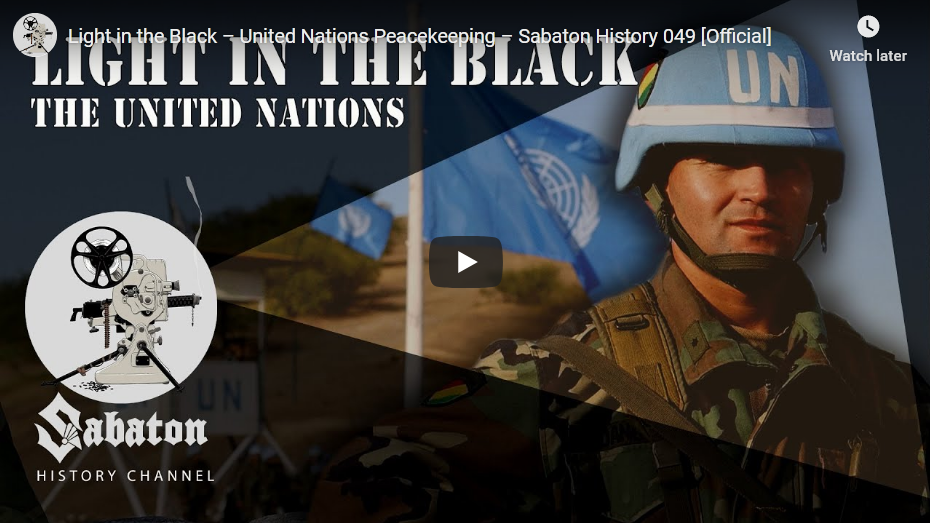
“Light in the Black” – United Nations Peacekeeping – Sabaton History 049 [Official]
Sabaton History
Published 9 Jan 2020The United Nations were created to avoid any future human suffering and all-out conflict. Numerous peacekeeping missions had the goal to deescalate and protect the innocent. However, the success and usefulness of the UN is still quite ambiguous. The Sabaton song “Light in the Black” is about the UN peacekeeping missions and we tell you about the history.
Support Sabaton History on Patreon: https://www.patreon.com/sabatonhistory
Listen to Attero Dominatus (where “Light in the Black” is featured):
CD: http://bit.ly/AtteroDominatusStore
Spotify: http://bit.ly/AtteroDominatusSpotify
Apple Music: http://bit.ly/AtteroDominatusAppleMusic
iTunes: http://bit.ly/AtteroDominatusiTunes
Amazon: http://bit.ly/AtteroDominatusAmzn
Google Play: http://bit.ly/AtteroDominatusGooglePlayListen to Sabaton on Spotify: http://smarturl.it/SabatonSpotify
Official Sabaton Merchandise Shop: http://bit.ly/SabatonOfficialShopHosted by: Indy Neidell
Written by: Markus Linke and Indy Neidell
Directed by: Astrid Deinhard and Wieke Kapteijns
Produced by: Pär Sundström, Astrid Deinhard and Spartacus Olsson
Creative Producer: Joram Appel
Executive Producers: Pär Sundström, Joakim Broden, Tomas Sunmo, Indy Neidell, Astrid Deinhard, and Spartacus Olsson
Production Intern: Rune Væver Hartvig
Post-Production Director: Wieke Kapteijns
Edited by: Iryna Dulka
Sound Editing by: Marek Kaminski and Karolina Dolega
Maps by: Eastory – https://www.youtube.com/c/eastoryArchive by: Reuters/Screenocean https://www.screenocean.com
Music by Sabaton.Sources:
RijksmuseumAn OnLion Entertainment GmbH and Raging Beaver Publishing AB co-Production.
© Raging Beaver Publishing AB, 2019 – all rights reserved.
January 9, 2020
QotD: National music
What does the soul of a people sound like? With the Germans, you have adequate proof; Wagner spoke for them, for better or worse — grandeur and myth that elevated the soul as easily as it rotted to the soundtrack for a meglomaniacal death cult. Italian music — well, no one ever marched off to war to Respighi’s ode to a peacock. Music for life, lived without lasting consequence. (They did their part in the Roman times; they’ve earned a nap.) French music is best expressed by the gauzy wash of Debussy and his comrades, music that doesn’t confront the ear but gently appeases it. America: cheerful tootling Souza marches or great broad optimistic Copeland yawps. Or jazz. Or rock and roll. Or country twangs. (It’s not that we have no sound — we have many, and each is as much a part of us as the other. Few cultures can pull that off.) Russian music has that delicious third-drink moodiness. Canadian music — no such thing, really, which is telling. Unless you define it as American style music recorded in a Canadian studio to satisfy a government requirement.
James Lileks, Screedblog, 2005-07-08.
January 3, 2020
“Union” – Battle of Monte Cassino – Sabaton History 048 [Official]
Sabaton History
Published 2 Jan 2020In early 1944, as the Allies are nearing Rome, Albert Kesselring orders a defensive line the likes of which rivals some of history’s greatest fortifications. Here, with the old hilltop abbey Monte Cassino looking down on the two front, the Axis and the Allies duel it out in a bloody and tiring fight for control of central Italy…
Support Sabaton History on Patreon: https://www.patreon.com/sabatonhistory
Listen to The Art Of War (where Union is featured):
CD: http://bit.ly/TheArtOfWarStore
Spotify: http://bit.ly/TheArtOfWarSpotify
Apple Music: http://bit.ly/TheArtOfWarAppleMusic
iTunes: http://bit.ly/TheArtOfWariTunes
Amazon: http://bit.ly/TheArtOfWarAmz
Google Play: http://bit.ly/TheArtOfWarGooglePlayListen to Sabaton on Spotify: http://smarturl.it/SabatonSpotify
Official Sabaton Merchandise Shop: http://bit.ly/SabatonOfficialShopHosted by: Indy Neidell
Written by: Markus Linke and Indy Neidell
Directed by: Astrid Deinhard and Wieke Kapteijns
Produced by: Pär Sundström, Astrid Deinhard and Spartacus Olsson
Creative Producer: Joram Appel
Executive Producers: Pär Sundström, Joakim Broden, Tomas Sunmo, Indy Neidell, Astrid Deinhard, and Spartacus Olsson
Production Intern: Rune Væver Hartvig
Post-Production Director: Wieke Kapteijns
Edited by: Iryna Dulka
Sound Editing by: Marek Kaminski
Maps by: Eastory – https://www.youtube.com/c/eastoryArchive by: Reuters/Screenocean https://www.screenocean.com
Music by Sabaton.Sources:
– Narodowe Archiwum Cyfrowe
– National Portrait Gallery
– Bundesarchiv
– National Army Museum
– IWM E446, E 3020E, MH 1557, NA 12895, NA 15139, MH 6352, MH 11250, NA15141, C4363, HU 16546, NA 9807, NA 13274
– Soldiers of 100th Infantry Battalion during the Battle of Monte Cassino courtessy of Bco100bn from Wikimedia Commons
– Gebirgsjäger in position in Saltdal in 1940, Courtessy of Rudi Margreiter through Arkiv i Nordland
– Fondo Antiguo de la Biblioteca de la Universidad de SevillaAn OnLion Entertainment GmbH and Raging Beaver Publishing AB co-Production.
© Raging Beaver Publishing AB, 2019 – all rights reserved.
December 27, 2019
“Panzer Battalion” – The Iraq War – Sabaton History 047 [Official]
Sabaton History
Published 26 Dec 2019An American-led coalition invaded Iraq in 2003. Sabaton’s song “Panzer Battalion” is about that attack and in this episode, Indy talks about the fight and its consequences.
Support Sabaton History on Patreon: https://www.patreon.com/sabatonhistory
Listen to Primo Victoria (where “Panzer Battalion” is featured):
CD: http://bit.ly/PrimoVictoriaStore
Spotify: http://bit.ly/PrimoVictoriaSpotify
Apple Music: http://bit.ly/PrimoVictoriaAppleMusic
iTunes: http://bit.ly/PrimoVictoriaiTunes
Amazon: http://bit.ly/PrimoVictoriaAmzn
Google Play: http://bit.ly/PrimoVictoriaGooglePlayListen to Sabaton on Spotify: http://smarturl.it/SabatonSpotify
Official Sabaton Merchandise Shop: http://bit.ly/SabatonOfficialShopHosted by: Indy Neidell
Written by: Markus Linke and Indy Neidell
Directed by: Astrid Deinhard and Wieke Kapteijns
Produced by: Pär Sundström, Astrid Deinhard and Spartacus Olsson
Creative Producer: Joram Appel
Executive Producers: Pär Sundström, Joakim Broden, Tomas Sunmo, Indy Neidell, Astrid Deinhard, and Spartacus Olsson
Post-Production Director: Wieke Kapteijns
Edited by: Iryna Dulka
Sound Editing by: Marek Kaminski
Maps by: Eastory – https://www.youtube.com/c/eastoryArchive by: Reuters/Screenocean https://www.screenocean.com
Music by Sabaton.An OnLion Entertainment GmbH and Raging Beaver Publishing AB co-Production.
© Raging Beaver Publishing AB, 2019 – all rights reserved.
Imagine John Lennon as a huge hypocrite
As Mark Steyn pointed out, it isn’t hard to do:
In his Christmas sermon five years ago, the Bishop of Shrewsbury described John Lennon’s ghastly dirge “Imagine” as “heart-chilling”. Here’s what I had to say about it, and about secularism and a common culture, in the Christmas issue of The Spectator a decade earlier:
At my daughter’s school this year, the holiday concert concluded with John Lennon’s “Imagine”. The school had thoughtfully printed the lyric on the program, and the teacher, inviting the parents to sing along, declared the number summed up what we were all “praying” for. Indeed. The droning vamp began, and John’s anthem for cotton-candy nihilists rent the air:
Imagine there’s no heaven
It’s easy if you try
No hell below us
Above us only sky
Imagine all the people
Living for today …Ah, that’s the message of the season, isn’t it? Back in the Sixties, John opined that the Beatles were bigger than Jesus Christ, which was a wee bit controversial in those unenlightened times but which appears to be no more than a prosaic statement of fact as far as the music department’s priorities are concerned. These days, “Imagine” has achieved the status of secular hymn, no doubt because of its inclusive message:
Imagine there’s no countries
It isn’t hard to do
Nothing to kill or die for
And no religion, too …Hey, happy holidays!
You may say he’s a dreamer, but he’s not. A couple of years ago, it emerged that Lennon was a very generous contributor not just to organizations that support and fund the IRA, but to the IRA itself. He could certainly imagine there’s no countries, nothing to kill or die for and no religion, too, but until that blessed day he was quite happy to support a religiously discriminatory organization that blows up grannies at shopping centres in order to get out of one country and join another. How heartening to know that, though he grew rich peddling illusory pap to the masses, he didn’t fall for it himself.
“Imagine” didn’t go over wild with the parents, who mumbled along unenthusiastically. To be honest, I’d prefer John and Yoko’s peacenik dirge, “(Happy Xmas) War Is Over”, though that might be a little premature and anyway that song suffers from the disadvantage of mentioning Xmas. On the radio you can hear “Frosty” and “Rudolph” and James Taylor’s new post-9/11 version of “Have Yourself A Merry Little Christmas”, but anyone with young children finds themselves exposed to a strange alternative repertoire of unseasonal favourites. My friend Tammy emerged from her daughter’s kindergarten concert in a rage: not just no Christmas carols, but no “Jingle Bells”. The only song she recognized was Lionel Bart’s spectacular melisma pile-up from Oliver!, “Whe-e-e-e-ere Is Love?”, which is not designed to be sung en masse. “They sounded like they were dying,” she fumed, before going off to beard the school board, who explained that “Jingle Bells” had been given the heave-ho on the grounds that it might be insensitive to those of a non-jingly persuasion.
December 25, 2019
Repost – “Fairytale of New York”
Time:
“Fairytale of New York,” The Pogues featuring Kirsty MacColl
This song came into being after Elvis Costello bet The Pogues’ lead singer Shane MacGowan that he couldn’t write a decent Christmas duet. The outcome: a call-and-response between a bickering couple that’s just as sweet as it is salty.
December 23, 2019
Repost – Kate Bush – Christmas Special 1979 (Private Remaster)
Published on 5 Oct 2013
I know there’s a good few copies of this out on YouTube, but here it is, again! The other copies were either split up into individual tracks, the best complete one (from BBC Four’s rebroadcast in 2009) had the wrong aspect ratio, which annoyed the hell out of me! So, here this is…
Video and audio have been tidied up very slightly, not much was needed!
Kate Bush – Christmas Special
Tracklist:
(Intro) 00:00
Violin 00:29
(Gymnopédie No.1 – composed by Erik Satie) 03:44
Symphony In Blue 04:44
Them Heavy People 08:20
(Intro for Peter Gabriel) 12:52
Here Comes The Flood (Peter Gabriel) 13:22
Ran Tan Waltz 17:02
December Will Be Magic Again 19:43
The Wedding List 23:35
Another Day (with Peter Gabriel) 28:05
Egypt 31:41
The Man With The Child In His Eyes 36:21
Don’t Push Your Foot On The Heartbreak 39:24“I was recently asked about this BBC TV special and I thought I’d share my comments here. Kate: Kate Bush Christmas Special is a stage performance by Kate Bush with her special guest Peter Gabriel. Though most of the songs are not holiday ones, they come from Bush’s first three albums (Never for Ever her third album would be released in 1980 after this 1979 TV special was taped). The performances include costumes, choreographed dances and a wind machine, creating an eclectic music TV special to say the least.
This is one of the programs that makes my research quite difficult — because it calls itself a Christmas Special yet it contains only one performance of a Christmas song “December Will Be Magic Again” (a song that wouldn’t be released as a single by Bush until the following year, in 1980). TV programming that calls itself a Christmas Special and yet contains little to no Christmas entertainment is actually quite common — especially on the BBC.
Between the end of November and the end of December each year, there is quite a bit of special programming on television. Remember Elvis’ 1968 Comeback Special — it aired in December that year and includes only one holiday song, a performance of “Blue Christmas.” Is it considered a Christmas special? No, not really. And so, despite its title, the lack of holiday programming in Kate Bush’s 1979 TV special means it shouldn’t be considered a Christmas special either. But the Kate Bush Christmas Special is certainly worth watching!”
H/T to Ghost of a Flea for the link.
December 21, 2019
Repost – The Monkees – “Riu Chiu”
Uploaded on 15 Dec 2015
The Monkees perform “Riu Chiu” from Episode 47, “The Monkees’ Christmas Show”.
H/T to Kathy Shaidle for the link.
December 20, 2019
“Seven Pillars of Wisdom” – T. E. Lawrence of Arabia – Sabaton History 046 [Official]
Sabaton History
Published 19 Dec 2019The British T.E. Lawrence played a major role in bringing together a coalition of Arab factions to rise up against the Ottoman Empire. Their efforts helped the British war effort in the Middle East, but the British-Arab coalition was not as stable as it might have seemed.
Support Sabaton History on Patreon: https://www.patreon.com/sabatonhistory
Listen to The Great War (Where “Seven Pillars of Wisdom” is featured):
CD: http://nblast.de/SabatonTheGreatWar
Spotify: https://sabat.one/TheGreatWarSpotify
Apple Music: https://sabat.one/TheGreatWarAppleMusic
iTunes: https://sabat.one/TheGreatWarItunes
Amazon: https://sabat.one/TheGreatWarAmazon
Google Play: https://sabat.one/TheGreatWarGooglePlayListen to Sabaton on Spotify: http://smarturl.it/SabatonSpotify
Official Sabaton Merchandise Shop: http://bit.ly/SabatonOfficialShopHosted by: Indy Neidell
Written by: Markus Linke and Indy Neidell
Directed by: Astrid Deinhard and Wieke Kapteijns
Produced by: Pär Sundström, Astrid Deinhard and Spartacus Olsson
Creative Producer: Joram Appel
Executive Producers: Pär Sundström, Joakim Broden, Tomas Sunmo, Indy Neidell, Astrid Deinhard, and Spartacus Olsson
Post-Production Director: Wieke Kapteijns
Production Intern: Rune Væver Hartvig
Edited by: Iryna Dulka
Sound Editing by: Marek Kaminski
Maps by: Eastory – https://www.youtube.com/c/eastoryArchive by: Reuters/Screenocean https://www.screenocean.com
Music by Sabaton.Sources:
– National Portrait Gallery
– Boston Public Library
– IWM: Q 59294, Q 73536, Q 115096, Q 73535, Q 60212, Q 103747, Q 67234, Q 59703A, Q 59576, Q 58858A, Q 58861, Q 58863, Q 59193, Q 58823, Q 58938, Q 59078, Q 59190, Q 58841, Q 58704, Q 59422, Q 58891, Q 60035, Q 59073, Q 60102, Q 60096, HU 123936, Q 12629, Q 58752, Q 59314, Q 59314A, Q 58830, Q 58845, Q 12364, ART 3198, ART 2510, Q 105583, Q 103750, Q 59324, Q 59312, Q 12363, Q 103770, Q 86295, Q 59061, Q 72565, Q 12332An OnLion Entertainment GmbH and Raging Beaver Publishing AB co-Production.
© Raging Beaver Publishing AB, 2019 – all rights reserved.
From the comments:
Sabaton History
2 days ago (edited)
Thats right, it’s Indy of Arabia! Even though “Seven Pillars of Wisdom” is a crew-favourite, we have waited with this episode until we could show off some exclusive material from the “Seven Pillars of Wisdom” music video. With none other than Indy Neidell in the role of Lawrence (or Peter O’Toole?). This episode sure is among our favourite episodes to this date — we hope you enjoy it as well. If you do (and you weren’t already convinced by Joakim’s awesome Call To Action (17:20), please consider supporting this project on Patreon. It is thanks to those who are already there that we’re able to keep making these episodes! -> https://www.patreon.com/sabatonhistoryCheers,
The Sabaton History Team