Both Vergil and Livy begin by putting down Homeric roots and anchoring their stories in the Trojan War. That makes a good deal of sense from a mythic perspective: the Iliad and the Odyssey were the most illustrious legends of the Hellenic world and so it made sense for the Romans, looking to claim a place in the Mediterranean, to make that claim through connection to this most illustrious of tales (and of course later, when Rome was a colossus astride the Mediterranean, which the Romans by then called mare nostrum, “our sea”, it made sense they would prefer a heroic origin with grandeur to match their power at the time). And so both Vergil and Livy begin their story with Aeneas and his plucky band of Trojan refugees, fleeing the fall of Troy (though interesting, while Vergil tells the tale as a harrowing escape, Livy politely suggests that perhaps Homer’s Achaeans let Aeneas go, Liv. 1.1).
Aeneas (son of Aphrodite/Venus and a mortal man, Anchises) does appear, by the by, in the Iliad, though he isn’t a particularly notable or impressive hero (naturally Vergil will embroider Aeneas until he is presented as the equal of an Achilles or Odysseus because … well, wouldn’t you?). The Aeneid follows (with the aid of a major flashback) Aeneas as he shepherds his surviving Trojans from Troy to their prophesied new homeland in Italy (with a minor stopover in Carthage) and then covers also the war that breaks out between Aeneas’ Trojans and the local inhabitants (the Latins) when he arrives. Vergil cuts off at the climactic moment of the war (which in turn presents Aeneas as rather morally grey, a feature that is also present, as we’ll see, in Livy’s retelling of Rome’s legends), but Livy provides the denouement. After a period of conflict (Livy presents two different versions of the exact sequence), Aeneas ends up married to Lavinia, the daughter of Latinus, king of the Latins (Livy calls them the Aborigines – lit, “the native inhabitants”, Vergil the Latins; in both cases Latinus is their king) and the Trojan exiles and Latinus’ people form a single community at Lavinium, which in turn founds a colony at Alba Longa, both in Latium (the region of Italy in which Rome is, although note we haven’t founded Rome yet).
We then fast forward a few generations. Rhea Silvia, a priestess of Vesta at Alba Longa gives birth to twins, Romulus and Remus by (Livy expresses some doubt) the god Mars. The twins are exposed (for complicated royal-family-drama reasons we needn’t get into) and rescued by either a she-wolf or a woman of ill-repute (Livy isn’t sure which on account of Latin lupa having both meanings and clearly both legends existed, Liv. 1.4) and raised among shepherds in the hills of northern Latium. More politics ensues, Romulus and Remus, having grown to adulthood, right some wrongs in their home city of Alba Longa and set out to found their own city.
At which point Romulus promptly gets into a fight with and murders Remus over who is going to be in charge (this sort of intense moral ambiguity where the venerated legendary founder figures are also quick to violence and deeply flawed is also a feature of the Aeneid and can be read either as a commentary on Augustus or as some lingering Roman discomfort with their own recent history of civil wars running from 88 to 31 BC; we are not the first people in history to have very mixed feelings about how well people in our country’s past lived up to our ideals). Crucially, Romulus forms his new settlement (prior to the fratricide) out of – as Livy has it – “the excess multitudes of the Albans and Latins, to which were added the shepherds” (Liv. 1.6.3). After this, desiring to increase the population of the city, Romulus sets a place of refuge in the city so that “a crowd of people from neighboring places, altogether without distinction, free and slave, fled there eager for new things” (Liv. 1.8.6) and were incorporated into Romulus’ growing city. Livy approves of this, by the by, declaring it the first step towards rising greatness.
Romulus quickly has another problem because all of these new settlers were men, so he concocts a plot to carry off all of the unmarried women of the neighboring people, the Sabines – an Umbrian people (we’ll come back to this, for now we’ll note they are ethnically and linguistically distinct from the Latins) – who lived in the hills north of Rome under the guise of a religious ceremony (Liv. 1.9-13). At a festival where the Sabines had been lured to under false pretenses, the Romans abduct and forcibly marry the Sabine women, while using hidden weapons to chase away their families (I should note Livy goes to some length to assure the reader that the captured maidens were subsequently persuaded to marry their Roman captors, rather than forced (Liv. 1.9.14-16), though what choice he imagines the unarmed, captive women to have had is left for the reader to wonder at in vain; in any event, we need not share Livy’s judgement or his effort at patriotic euphemism and may simply note that bride-capture is a form of rape). The Sabines naturally go to war over this but (according to Livy) a peace is mediated by the captured women (according to Livy, unwilling to see their new husbands and old fathers kill each other) and the two communities instead merge on equal terms. In the midst of all of this, Livy does have Romulus set down a set of common customs for his people, which he thinks to have been mostly Etruscan (Liv. 1.8.3), the Etruscans being the people inhabiting Etruria (modern Tuscany) the region directly north of Rome (Rome sits, in essence, on the dividing line between Latium to the South and Etruria to the North).
Now we want to note two things here from this high-speed trip through the first few chapters of Livy. First is the deep ambivalence towards Roman violence here. Livy presents Rome as a city founded on fratricide, conquest, rape and sacrilege. Livy occasionally attempts to soften the impact of these legends (particular with the Sabines), but only so far. This isn’t really the place to unpack of all of that but suffice to say that I think that Livy’s willingness to open his history of Rome – practically an official history of Rome – so darkly speaks to a literary project still attempting to come to grips with the stunning civil violence which had gripped Rome for Livy’s entire adult life and had, as he wrote, only recently ended. And one day we also ought to come back and do a deeper look at how women function in Livy’s legends and histories (Livy’s account becomes much more properly historical as he gets closer to his own time); women, mostly Roman women, suffering (often sexual) violence so that in their sacrifice the Roman state might be enhanced is a repeated motif in Livy (e.g. Lucretia, Verginia).
But more directly to our topic today, I want to note at this point exactly the sort of society Livy is imagining the earliest Rome, under its first king Romulus, in particular that it consists of a lot of different peoples and heritages. We’ll come back to exactly who all of these peoples are (historically speaking) in a moment. But Livy and Vergil first create a Trojan-Latin fusion community, which produces both Romulus and Remus and their initial core of settlers (mixed in with other, apparently purely Latin communities), who then gather up shepherds from all around, and then invite literally anyone from nearby communities to join them (which must include Etruscan communities to the north as well as Umbrians and Falisci of various sorts from the hills) and then finally fuses that community with the Sabines (an Umbrian people).
So we have our very first Romans, as the first Senate is being set up (1.8.7) and the very first spolia opima – the prize for when one commander defeats his opposite number in single combat – being won (1.10.7) and the very first temple being founded in the city (1.10.7). And those very first Romans, as Livy imagines them, are not autochthonous (that is, the original inhabitants of the place they live), nor ethnically homogeneous, but rather a Trojan-Aborigines-Latin-Faliscian-Umbrian-Etruscan-Sabine fusion community. For Livy, diversity – ethnic, linguistic, religious – defines Rome, from its very first days.
But of course this is all legends – important for understanding how the Romans viewed themselves, but necessarily less valuable for understanding the actual conditions in Rome at its earliest. Unfortunately, we lack reliable written sources for this part of the world so early (most of the “regal” period, when Rome was ruled by kings, notionally from 753 – the legendary founding date for the city – to 509, is beyond historical reconstruction).
Bret Devereaux, “Collections: The Queen’s Latin or Who Were the Romans? Part I: Beginnings and Legends”, A Collection of Unmitigated Pedantry, 2021-06-11.
October 3, 2022
QotD: The foundation of Rome, as recounted by Vergil and Livy
October 12, 2021
QotD: Titus Livius, better known as Livy
What little we know of the man himself suggests he was somehow financially well-off, independent, and reclusive. He was schooled in rhetoric, philosophy, and history. He never served in any public position, though apparently, he personally knew Augustus. Writing his massive history of Rome absorbed his adult life.
Though Romans at the time of his writing held his work in high regard, we know that some parts of Livy’s historical accounts were surely based on minimal records, old and dubious oral stories, and even legend. After all, he wrote 2,000 years ago about people and events of as much as eight centuries before his time. “I hope my passion for Rome’s past has not impaired my judgment,” he opined in his introduction to Ab Urbe Condita, “for I do honestly believe that no country has ever been greater or purer than ours or richer in good citizens and noble deeds.”
“The old Romans,” wrote Livy of his countrymen before the beginning of the Republic, “all wished to have a king over them because they had not yet tasted the sweetness of freedom.” But then in 508 BC, Romans mounted a truly historic revolution of both ideas and governance. They overthrew the monarchy and established a new order that ultimately included a Senate of nobles, popularly elected Assemblies, the dispersion of centralized power, term limits, a constitution, due process, habeas corpus, and the widest practice of individual liberty the world had yet seen. Before they lost it all less than five centuries later, they experienced a remarkable rise and fall. […]
From Livy, we learn about Rome’s pivotal wars against the Carthaginians, the Samnites, and other peoples of the Italian Peninsula. He also informs us of the rivalry between Sulla and Marius, the tumultuous last days of the Republic as strong men fought each other for power, the murder of Julius Caesar, and the self-serving machinations of Augustus. Livy celebrated the courage of his ancestors; in fact, he originated the phrase, “Fortune favors the brave,” which is still used commonly today as a maxim and a motto.
Lawrence W. Reed, “Lessons from Livy on How Great Civilizations Rise and Fall”, Foundation for Economic Education, 2021-06-28.
September 12, 2021
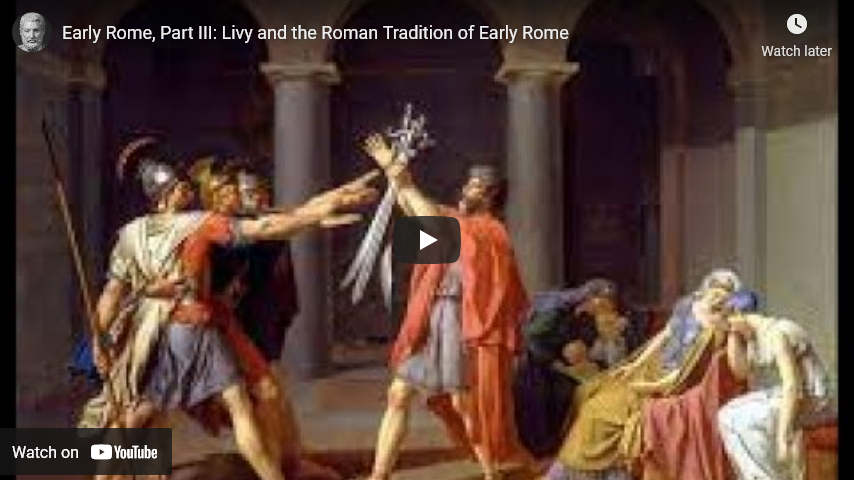
Early Rome, Part III: Livy and the Roman Tradition of Early Rome
Thersites the Historian
Published 5 Sep 2021Here, I examine Livy’s Book I with an emphasis on the tradition that he worked in and his agenda for undertaking such a massive and ambitious project.
Patreon link: https://www.patreon.com/thersites
PayPal link: paypal.me/thersites
Discord: https://discord.gg/QCaXXFr
Brave Browser: https://brave.com/noa557
Twitter link: https://twitter.com/ThersitesAthens
Minds.com link: https://www.minds.com/ThersitestheHis…
Steemit/dtube link: https://steemit.com/@thersites/feed
BitChute: https://www.bitchute.com/channel/jbyg…